Showing posts with label climate change. Show all posts

Wednesday, December 7, 2022

Nature-Triggered Emergency Operations in Canada

 This week, I went to Winnipeg in the coldest temps of the year thus far to observe one of the new CDSN research efforts: understanding the dynamics of Canadian domestic emergency operations in response to natural events.  Paraphrasing Emdad Haque, one of our co-directors,  nature will create extreme conditions, but whether they are disastrous is up to people and government.  Emdad, Nira Agrawal, and Kawser Ahmed brought together a sharp group of folks, including the army's liaison to Manitoba, the ADM for Emergency Management in Manitoba (a survivor of my big IR class at McG), researches from the universities in the area, and more (see here for details).  

What did I learn?

  • Emergencies are rare for any individual but they are increasingly common collectively.  Climate change is already fostering more and more floods, fires, and other extreme events.  So, this is not just a thing that happens from time to time but is an every day thing now.
  • The notion of the CAF as a last responder needs to die.  Yes, the military wants to be called on only in the most extreme emergencies when no one else can do what they can do.  But there are plenty of incentives for folks to ask for help and for the CAF to be unable to say no.
  • That most of this stuff ends being led by the most local folks--that the feds don't take over but are there to supplement.  Which means the military is following orders, not ordering people around.
  • As always, prevention is the least expensive route but often there are not political incentives.  It seems to me that the real opportunity to make changes to manage/mitigate is as the cycle goes from response to the emergency to recovery--that building back better is a thing.  Rebuild out of harm's way, away from the flood plains, for example.
  • As always, the Indigenous people are put into awful positions by the past and by the present.  Limited infrastructure means they need assistance, but then they are seen as objects, those to be rescued, rather than agents with their own expertise and preferences.  Evacuations need to be rethought--they are very disruptive physically, economically, culturally, mentally.
  • Federalism in Canada continues to suck mightily.  Some provinces understand that they need to build back better, so the Winnipeg floods didn't recur with the same level of damage.  Others understand that they can save money by doing less preparation and then call the feds in when help is needed.
  • There is a lot more work, coordination, planning, preparation going on in this area in between emergencies, that many bad storms and other events do get mitigated.  But again, it is going to get much harder as storms and other conditions get more intense.
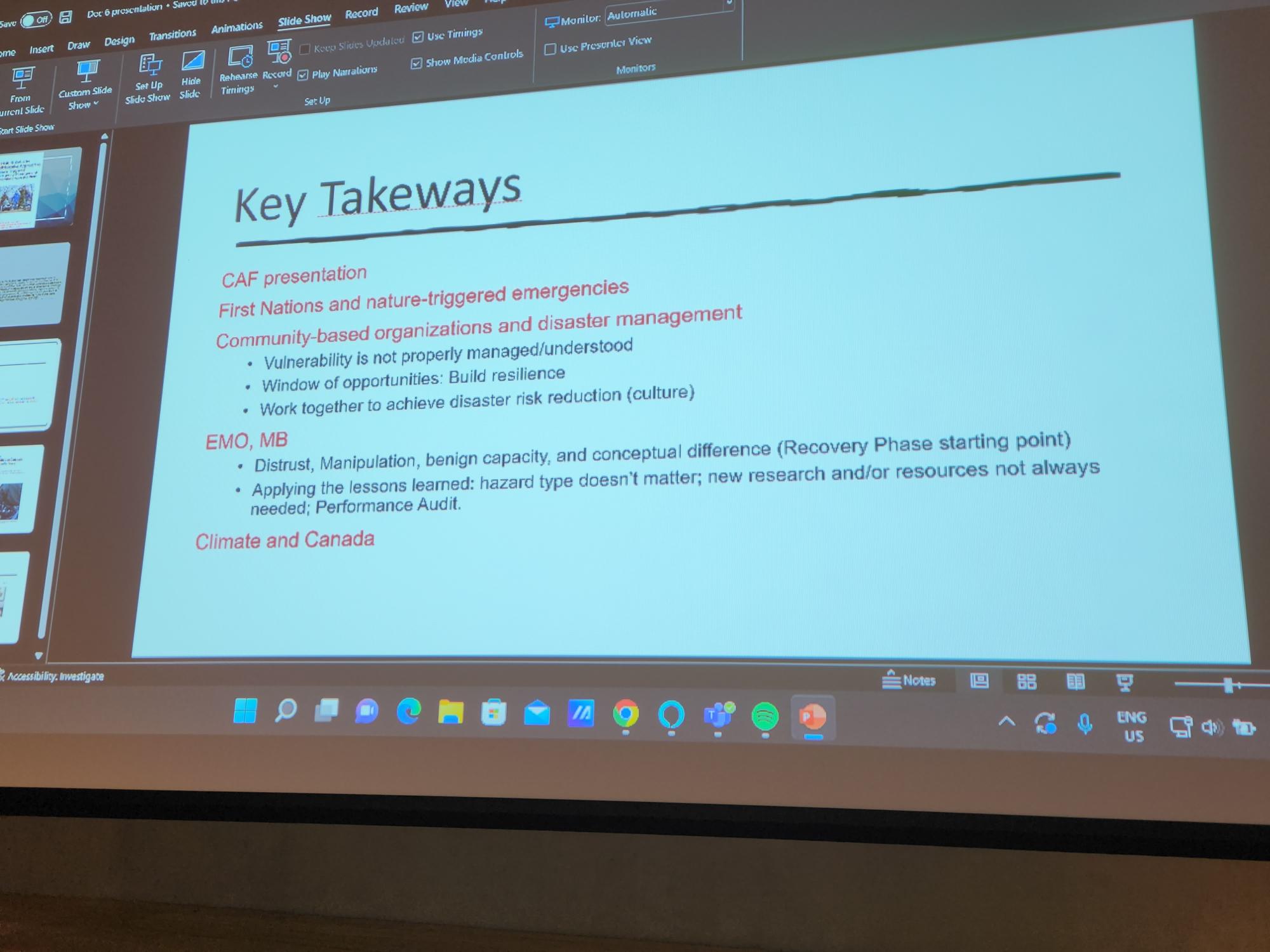
I was very pleased to see the CDSN idea work out here--that we had engaged people in different parts of government and society, there was a real exchange of information, the students were super engaged, and it is the start of a more comparative analytical conversation.  


I also learned that Winnipeg is cold, full of friendly folks, and one can lose one's mittens in a cab and then get them back when one happens to take the same cab back to the airport.


So glad I could hang with Andrea Charron,
who has done so much for the CDSN


Sunday, September 28, 2014

Climate Change and Sunday Silliness

Since I got a fun hate email due to a mention of climate change as the big threat, this week's NYT cartoon by Brian McFadden hits me just right:


Tuesday, March 20, 2012

Enjoying Spring?

This has been my first real spring in Canada in my ten years here: a March where the snow is mostly gone, where I can walk around in the afternoon with just a light jacket or none at all.  Terrific, except for this:


H/T to Sara M, who linked to this.

Oh, and this is the first year in my ten years in Canada where I skied not at all.  Mostly ice and rock for much of the season, and I was sick the one good weekend of the year.  Too bad, as moving to Ottawa will mean far longer distances to the Eastern Townships areas.  I didn't have a chance this year to say goodbye to Owl's Head, Orford or Mont Sutton.  Oh well, at least I don't have to scrape ice off my car that much this month (and rarely after we move--the new house has two car garage and Carleton has parking garages!).  Oh, yes, my driving is not going to slow down climate change at all in Ottawa, but I will be fuming less about bad Mtl mass transport, so there might be a tradeoff.

Wednesday, April 21, 2010

Two by Two Saves the World

Just a great video explaining the risks of doing nothing versus something on global warming.
The key props are a whiteboard, a devil's horns hat, and various combustibles. 


Trust the eggheads, huh?  Indeed.


HT to Kristy, my favorite Aussie for the link.

Friday, July 24, 2009

Arctic Sovereignty? Manly Issue?

I am an avowed Arctic Sovereignty [AS] skeptic. For the non-Canadian reader, AS refers to the political stand, adopted by the Conservative Party and others to assert and defend Canada's rights to the Arctic. These "rights" are faced by greater threats with the advent of global warming. Climate change means two things: that the Northwest Passage may actually become quite navigable and there may be huge amounts of resources to mine/harvest. The first change raises tensions with the US, as the US has always maintained the right to pass through straits around the world as part of being a Naval power. The second part has led to tensions with Russia, the US and Denmark (due to Greenland). There is even now a joint US/Canada mission to map the terrain under the water to determine which territory belongs to whom.

For me, the problem is that this stand is leading to new Defence spending patterns--focused on ships and planes to defend the Arctic. But as I have mentioned before, given how little Canada has to fund this stuff, it will never develop the capacity to deter or stop the encroachments of its potential adversaries (well, except for the Danes).

But now I know why Harper has been pushing this. He must read Maxim (Canada), since these are the results of their survey of Men:

Q34: Should Canada assert its sovereignty over the Arctic?
34 84% Yes
16% No


So there you have it. Of course, the same survey shows more than half the Men think Canada has the best health care system in the world, so take it with a grain of salt.


PS I am aware that if Arctic Sovereignty is AS, that makes me an ASS.