Showing posts with label intel. Show all posts

Wednesday, March 26, 2025

Security Clearances Fiasco 2: Another Bugaloo

 I wrote this piece a few years ago about how serious it is not to store classified documents seriously.  This week, the story is not documents but a group chat via an insecure system.  Lovely.  Now, the bullshit artists are trying to claim that the info was not classified.  Sure.  First, to be clear, the key official with authority to declassify stuff can't just say stuff was declassified after it is revealed that the info was mishandled.  There is a process by which stuff is declassified, and this ain't it.  

Ok, how does classification work?  Let's see what I remember (I learned this stuff my first week 20+ years ago and is very much burned in my head since, well, it was the only stuff that might have led to jail if I screwed up).

 Any document (and yes, a group chat counts) has a number of pieces of information.  Each bit of info, each clause or paragraph gets its own rating, so that a document may consist of unclassified stuff, some confidential info, some secret, and some top secret stuff:

(C)  Indicated confidental

(U) Unclassified

(S)  Secret

(TS) Top secret.

I guess there would also be either SCI--for need to know, compartmentalized info, but, guess what?  Since I wasn't cleared for SCI, I never saw any SCI stuff.  I inferred that mostly involved Special Ops or NSA stuff, but that is just a guess.

Anyhow, there are other classifications: NOFORN for not to be released to foreigners, NATO Only to be released to NATO countries, SFOR only to be released to countries participating in the NATO stabilization mission in Bosnia.. which included the Russians so not much secrety stuff there,  and so on.

 The key is that when a doc has a bunch of different info at varying levels of secrecy, the entire doc is rated at the level of the most secret piece.  So, a doc with lots of open source info having one bit of Top Secret in it would be classified as Top Secret.

Guess what a war plan consists of?  Heaps of Top Secret stuff.  For the Houthis group chat texts, the most secret thing there is probably the reference to the targeting of an individual.  We can't be certain of how they did that, but it probably involved a human source, given the context.  Guess who needs to know that?  Damned few people, and definitely not those on this chat.  So, probably TS/SCI--top secret, sensitive compartmentalized info.   You know what the opposite of compartmentalized is?  A 19 person chat on insecure channels.  

So, don't buy any excuse this assholes give--they were reckless because they were trying to show each other how tough they are, how cool they are.  So, they broke heaps of rules ... and laws.  But since their boss did so quite flagrantly, and since he pardons his loyalists, they can act with impunity. This is what impunity looks like.  A shit show.

Friday, August 12, 2022

Secrety Secrets And the Rules That Rule

 I tweeted out a bit of my distant experience to clarify some of the whole Trump madness and realized I remembered a heap from my brief time having TS but not SCI clearance.  Let me explain and maybe along the way, it will become even more obvious how egregious Trump's behavior has been regarding classified materials.

First, a caveat, yes, too much material is classified at too high a level.  This makes it hard for various actors to coordinate when they can't talk clearly/openly about stuff.  Tis why we now have fusion cells that include folks from multiple agencies.  But it does make it hard to communicate with the public about stuff that is not super secrety.  

Second, my experience is exactly 20 years old as I was finishing up my Council on Foreign Relations International Affairs Fellowship in the Pentagon as a desk officer on the Bosnia desk.  So, maybe stuff has changed, but, not really, as these processes are pretty static.

Ok, so I had a top secret clearance.  I needed one for my job as I literally could not access the computer systems in the Pentagon without it.  Sure, the unclassified network could be accessed, but we used that only for surfing the web and checking our email.  All of our work was on the classified network.  I also needed access to documents that were often classified as Secret or Top Secret in order to do my job--coordinating Joint Staff policy stuff with State, National Security Council, NATO, US military folks, etc.  

How did I get this TS clearance?  I was investigated, private contractors (I am guessing) looked into my criminal records, tax stuff, interviewed people who knew me, etc.  I have been on the other end of this, getting calls asking to give me evaluation on the reliability of applicants for governments (in the old days in the US, in Canada the past 20 years).  

I did not get an SCI clearance--Secure Compartmentalized Information.  I was not vetted so thoroughly that I could be trusted with such info.  Nor did I need it to do my job because I had a teammate on the Bosnia desk who did.  So, whenever Special Operations stuff or signals (National Security Agency work) came up, I got kicked out of the meeting.  

With my clearance, I was given a specific kind of badge.  It allowed me access to the hallways of the Pentagon unescorted and with the ability escort those without such a badge.  It did not allow me to be in the National Military Command Center, a building within the building, unescorted. I went in there a few times--for briefings/meetings, but none that stick out in my memory.  

Our entire office was a SCIF--sensitive compartmented information facility.  It meant we could leave secret stuff laying around (although I think we had to put away TS stuff, but I don't remember).  Our door had two locks--one for all the time and one for overnight or when folks evacuated (it was quite relevant for my 9/11 story). 

A key irony is that I only used the secure telephone system a couple of times (we did almost all of our work by email with word/excel/power point attachments) and meetings.  Once was calling the US general who was the Assistant Chief of Staff for Operations of the NATO Stabilization Force [SFOR] in Bosnia.  Why is this ironic?  That dude happened to be Brigadier General David Petraeus, who went on to violate rules about intel, as he brought home classified documents and shared them with his graduate student/girlfriend.  Ooops.  He was caught and got slapped on the wrist. 

The key is this: other than General Dave and President Donnie, people took this stuff super seriously.  We went back into a burning Pentagon on 9/11 because my team was carrying classified documents, and we did not want to do the paperwork that would be necessary to explain why we took the docs home.  And, no, I didn't hear what the folks said at the meetings I was ejected from--I didn't learn what the NSA had found or what the SOF dudes were doing in Bosnia.  I could make reasoned guesses, but I didn't have info.  Nor did I share any of the classified info I received in my year outside of the building.  

Sure, thanks to the glossy morning pamphlet of worldwide intel stuff, I got to learn bits and pieces about Iran's nuclear program and North Korea's (those are the bits and pieces I remember now). I found it fascinating, so I was at first astonished that Trump was bored by the daily intel briefs.  But then he is the most incurious person ever.  Which raises questions why he kept holding onto classified docs...  

All I know is that the rules are clear, they are obeyed damn near most of the time, that the folks in the US national security business take it seriously, and that it really is not that hard to follow the rules.  Plus there are all the docs I signed that said I could go to jail if I broke them.  So, yeah, I am hoping Trump goes to jail for this.  No one should be above the law, and no, Presidents can't waive a golf club to declassify stuff, and certainly, ex-Presidents cannot. 

Oh and this thread is mighty useful for the basics: https://twitter.com/MarkHertling/status/1557911395836071940


Wednesday, January 30, 2019

Intel Folks? Do Dems Trust Too Much?

One of the pushbacks I get from time to time when discussing FBI/CIA/NSA stuff, like yesterday's Trump performance of running directly against the intel community's findings on Russia (bad), North Korea (not disarming), Iran (not so bad) is that the intel folks got 2003 wrong.

Um, not quite and what they got wrong was partly on Hussein.  Huh?  First, there were a lot of reports before the war.  The intel community did not have a consensus that there was a nuclear weapons program in Iraq.  What mattered was that there were enough hints and rumors that a motivated person could extract those and make a case for a WMD program that needed to be attacked.  Oh, and that person was Dick Cheney.  He cherry-picked the intel to find the stuff he wanted to find.  In my interactions with military folks, they like to say that intel drives policy--that the info drives what the country/unit should do.  In the case of 2003, it was very clearly the case that policy--we need to attack Iraq--drove intel: "hey, lookie, this says that there might be a chance Hussein is pursuing WMD!"

Moreoever, Hussein did little to dissuade folks because his strategies to both stay in power and deter the neighbors.  That is, Hussein created heaps of ambiguity about the weapons programs inside the country, with many military officials wondering mid-war why these capabilities were not being deployed, so that potential opponents within Iraq would be frightened of him.  Likewise, after the failed war with Iran and other foreign misdventures, he wanted to deter the outsiders.  Of course, it was a dumb move since aspiring to develop WMD puts a target on one's country.  The point is that the confusion in 2003 about what Iraq was doing was partially intended by Hussein.

The intel community might have gotten wrong how fragile Iraq was, that it would be hard to govern after an invasion--I am not sure about that since it has gotten less coverage.  But the intel about WMD was gamed by the White House and Rummy's shop and not by the CIA or NSA.

Sure, folks were upset about what the NSA has been doing thanks to Snowden.  And, yes, the FBI has not been a force for social justice.  So, none of these agencies have been loved by Liberals and those further to the left.  However, those who want a sensible foreign policy tend to want to have functional intel agencies--knowing more about the world is usually conducive to better policy.  As it turns out, the intel agencies, despite much efforts by the Trump administration to politicize them, are still mostly reality based organizations who have clearer eyes about what Russia/China/North Korea/Iran are doing.  That their reports are dismissed by Trump is a tell--that he would rather do what he wants rather than what the US national interest happens to be.  Trump does not like folks to disagree with him, but disagreeing with the intel agencies is inevitable if one is deliberately and inherently ignorant.

This leads to a strange dynamic where the enemy of my enemy is my friend, so Liberals have reduced their criticism of the intel agencies despite the FBI leaking to the GOP about HRC and on and on and have embraced these organizations, even has they have done much that is not so nice in the past (and present).  For me, this is where I tend to be more centrist--that foreign policy requires secrets, requires trying to read the mail of the adversaries, and even sometimes requires subversion and violence.

Anyhow, this is a longer post than intended.  The key is this: 2003 is not a good way to de-legitimate the secret squirrels who are putting out reports in 2019.  It is a good way to to criticize the GOP, which has been the party of ignorance for more than just the Trump administration.  The difference is now it is not in service of a convoluted view of the national interest but is an effort to reduce Trump's vulnerability to prosecution.

Thursday, May 25, 2017

Intel Sharing Basics

I am not an intel person--I have excellent colleagues who are: Stephanie Carvin, Alex Wilner and Jeremy Littlewood.  But I do remember seeing heaps of classified materials and hearing lots of complaining about intel sharing 15 or so years ago during my year in the Pentagon.  So, here's what I remember.

Most countries complained about the US not sharing enough intelligence, not that the US was being too generous with it.  People are most familiar with the basic classification scheme:
  • Classified--broad category of secret stuff
  • Confidential--least restrictive form of classified material.
  • Secret--more restricted than confidential
  • Top Secret--a much narrower category--starting to get into the stuff that, if released, can significantly harm the national interest.  By letting our adversaries know what we know and how we collect it
  • Code-word, compartmentalized. This is need to know stuff--that the only people who are in on a specific operation or information source are those who need to know.  I was cleared for Top Secret but not code word.  I never needed to be read into any code word secret stuff.  From what I could figure out, this was really two main categories--special operations and stuff gathered via NSA signals intelligence.
Documents of all classifications (well, all those that I saw) could come with other markers:
  • NOFORN: that the information is not to be shared with any foreign actors, even the most trusted.  Stuff on terrorism might go here.
  • UKONLY (or something like that): info could be shared only with UK.  I assume there is a FIVEEYES label for sharing with only UK/Canada/Australia/NZ, but I didn't see any of that. Probably because I was on the Balkans desk, which meant that the next classification was
  • NATOONLY (or something like that): information that could go out to NATO allies.  Yes, this system means that there is stuff the US didn't share with anyone, some it shared with the UK but not the rest of NATO and some they shared with NATO members.
  • SFOR or KFOR ONLY: information that would go out to all countries participating in the NATO-led mission, including non-NATO countries like Sweden, Finland, and ..... Russia.  Not a whole lot of super-secret stuff under this label.
Trump has now taught American allies that the US can't be trusted.  It has always been the case that countries had to worry about sharing intel with countries who might be penetrated by spies.  Nobody has avoided that problem--not the US with Aldrich Ames and one of the Hansen brothers, not the UK with Kim Philby and the others, not Canada with its own spy problems, etc (actually, I have no idea about Australia and New Zealand).  Not to mention Snowden, Manning, etc.  But that is different from the leaks during into a raging river of secrets going directly from the President to the primary adversary and now the Manchester leaks.

So, countries are, predictably, reacting, by sharing less.  Which means that more puzzles will have missing pieces, which increases the likelihood that an attack is not prevented.  Trump's big mouth and the leaks pouring out of the intel community are going to do real damage.  Yet more unforced errors, something that this government does so very well.

Sunday, May 21, 2017

Oprah and Alliance Politics

I have been too busy transcribing notes from super helpful interviews in Brazil to blog much about the shenanigans in the US.  But Trump's giving away of Israeli intel to the Russians has me thinking about Oprah, Dr. Phil and other relationship advisers.

One of the things that most struck me way back when and continues to do so when I talk to military folks is how often they sound like Oprah.  Combat requires more than just training to shoot one's weapon--it requires trust that the people alongside of you as well as those dropping bombs or shelling the beach will do as expected.  That much of war comes down to relationships and especially alliance warfare. 

If you don't trust your allies, if you have a lousy relationship, people will get killed unnecessarily and it might even prevent allies from going into the field with you.  The best example of this from Afghanistan is from the first prison break in Kandahar (alas, we have to specify which one):
In 2008, there was a massive prison break, so the Afghan military ordered reinforcements.  The units mentored by the French moved towards Kandahar but without the mentors.  The French troops that were observing, mentoring, liaisoning (called OMLT's or omelets) the Afghans had to wait as they needed permission to leave their sector.  That phone call went all the way to the top, to President Sarkozy.  He did say yes, but while that process played out, the Afghan unit was needed.  So, the Canadian commander found some US Marines and plugged them into the Afghan unit.  That unit went into battle and broke, fleeing.  The next day, the same unit was reassembled and given their French mentors, and it succeeded.  Why the different outcomes?  Because the Afghans did not trust the mentors they did not know but did trust the mentors they did know.
When it comes to intel, trust is huge.  It really cannot be overstated--allies will only share intel if they think that their pals will not reveal the info.... especially if revealing it might give away how the intel was collected.  One can lose not just one spy but the entire network of spies (or an entire form of intel collection) if the info gets out.  Famously, the British did not prepare for the bombing of Conventry despite it being the home of many families of those breaking German codes... because doing so might have revealed that the British had broken the German codes (well, maybe).

That Trump would give away intel to the Russians was very predictable.  I am sure I tweeted about it, but I can't see to find any of my blogposts mentioning it.  One does not have to be a conspiracy theorist or even focus on Trump's love of the Russians.  No, one just has to understand that Trump is thoroughly unqualified and has no self-control.  He matkes me look discreet.  So, yeah, predictable.

I wondered in the fall whether allies would give Russia-related intel to the US with Trump as president. It turns out all that sharing any intel with Russia is problematic.  My guess is that the allies, including the other members of the Five Eyes (UK, Canada, Australia, New Zealand), will be far more cautious. 

Is this a problem?  Ironically, not really.  Having less intelligence to make decisions is only important if one uses intel to make decisions.  Since that is not the way of the Trump administration, the harm will be minimal in the short term.  However, in the long term, the damage is severe.  When future Presidents make intelligence-based decisions, will they have all that could be available?  I am not sure, as trust, once broken, takes a while to re-build.  Or so Oprah tells me. 


Tuesday, May 16, 2017

The Parade Goes On

The US and the world have been sucked into this parade of incompetence, grifting and shit for quite sometime.  The idea of Trump having intelligence was always scary---no, not that he might not be dim (he is dim and incurious)--that he might spill some secrets.  Did I imagine it would be directly to the Russians in the oval office?  Probably not. This stuff is very serious.

Last night, I tweeted my 9/11 story, focusing on how the officers I was with were determined to put the classified documents we were carrying to the State Department (there are rules for how they are carried--in a bag with a lock) back into a SCIF (Sensitive, compartmented info facility).   Which turned out to be a burning Pentagon.  Yes, we went back into the building.  Why?  Because taking care of classified docs is serious business and they didn't want to do the massive paperwork to explain why they took the docs home.

To be clear, these docs were all confidential or secret, certainly nothing at the code-world level.  I had a Top Secret clearance, which meant I got booted from the room whenever anything that was code-word classified--need to know--was being discussed.  As far as I could guess, this meant missing out on some signals stuff (NSA gathered intel was apparently classified at higher levels) or involving active Special Operations.  This all became more relevant a week and a day into my time at the Pentagon as counter-terrorism replaced peacekeeping as the US priority in the Balkans.

This is all to say FFS!!!  Telling the Russians anything like this is bad for anyone but for a president whose campaign/government is under investigation for its relationship with ... the Russians?  There was plenty of concern that Trump would be reckless and casual with the intel stuff.  I had kind of hoped that his lack of interest in the daily intel brief might serve to protect us all, but nope.  I had wondered whether American allies would share intel with us--one of the key ways the US gains from its alliances that Trump criticizes is getting intel from them--with Trump being so implicated.  Pretty sure that question is now being answered differently today than a couple of months ago.

Oh, and who is the ally who got screwed? No idea but the first call this morning is to Jordan, so:
Yes, a clue.

What we didn't need a clue about?  That Trump is profoundly unqualified to be President.  We knew that before November 8th, and pretty much everything that has happened since then proves it even more so.  Will the GOP do anything about it?  No.  Craven, they are.  So, buckle up as the ride is not going to get any less bumpy as we mix metaphors.

Wednesday, May 7, 2014

Snowden Accusations

I have been called out on twitter for my referring to Edward Snowden as "essentially a Russian spy."

Do I have evidence?  No.  But I am not a prosecutor or a cop.  So, when I say such stuff, I am offering my opinions.  Based on what?  On inference.  How so?

Well, a guy seeks to penetrate American intelligence agencies and their computer systems to download secret stuff.  Then he flees to countries that are adversaries of the United States.  He is welcomed and seems to be employed these days by Russia.  The decisions to allow Snowden into Russia and hang out must have been made at the very highest levels--by Putin.  Either Putin is a huge fan of complete transparency and the freedom to engage in dissent or he has other reasons for supporting Snowden.  Is Pultin altruistic?  Um, no.  Is he a fan of transparency?  Not in his country. 

In the good old days of the Cold War, there would be very few questions about what is going on.  Here, because Snowden blew the whistle on the National Security Agency's domestic spying, he is seen as a whistleblower.  And I would agree if that is all he did.  But he went further than that, releasing a bunch of information about American intelligence and cyber operations that really did not need to be released. 

It kind of parallels one of my rules of writing--just because you learn something does not mean you should include it in your article/chapter/dissertation.  If you want to point out that the NSA has been doing illegal stuff in the US, that does not mean you need to release information that might just be helpful to other countries and undermine the US position in the world.

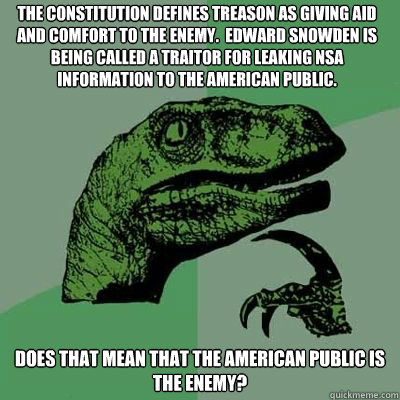
For some reason the phrase "aid and comfort" comes to mind.  Yes, treason is what comes to mind.

This, of course, leads to the following response:
But the enemy I have in mind is not the American people but Russia.  Russia is not at war with the US, so it probably does not quite count as aid and comfort to the enemy.  But Putin has made it abundantly clear that he is not a friend/partner. 

Again, I draw a very thick line between Snowden's two sets of activities--revealing that the NSA was doing questionable things in the US and revealing America's secret activities in the world.  Naive folks may think that gentlebeings do not read each other's mail, but in international relations, you don't have to be a Realist to understand that spying and counter-spying is endemic to the enterprise.

A caveat--I have not written much on this before because I am very ambivalent about much of this.  I have long been frustrated with Obama's policies on surveillance, secrecy and all that. Still, I cannot help but consider Snowden a defector.  Maybe it is that I grew up during the Cold War, but anytime an American flees to Moscow, I have to question their motives.  And when they do so while carrying heaps of American secrets on flash drives, I develop some assessments.


Wednesday, July 31, 2013

When Justice is Served

I don't have much to say on the Manning conviction because Joshua Foust said damn near all of it so well here.  For me, the key really is how indiscriminate the dump was.  Had Manning released a few key documents that revealed illegal or even just poorly conceived American programs, then a whistleblower he might be.  But that is not what he did.  Instead, he collected as much stuff on anything and everything and then handed it over to someone else to release, which was lazy and irresponsible. It is not whistleblowing but something else.  And in the process, he broke a variety of laws.  He should not have been treated the way he was once he was arrested, but that does not mean he did not commit some crimes.

I have similar feelings about Snowden, as he released some information that probably needed to be exposed and much information that did not need to be exposed.  More damning is the timing for Snowden--contacting the media and then getting the NSA contracting job--that it was deliberate ... espionage. 

Anyhow, I am not a legal analyst, and I have not followed either of these stories as closely as others.  Josh did a great, nuanced analysis on Manning--that his superiors screwed the pooch on multiple occasions, but that does not absolve Manning of responsibility.   So, go read Josh's piece. 

Thursday, October 11, 2012

Blame Canada, part 75

The naval officer (make that Royal Canadian Naval officer) who gave heaps of intelligence to the Russians, Jeffrey Delisle, pled guilty yesterday.  And it is times like this that I am not sure whether I have gone native or I am just reacting sensibly to hypocrisy.  Yes, the Americans are upset that a Canadian leaked heaps of stuff, since Canada is one of the five I's club: the five countries that share heaps (not all) intelligence.  These would be US, Canada, UK, Australia and New Zealand.  Yep, the Anglosphere actually exists (less important for Smart Defence, I asserted in London on Monday). 

Yes, it did damage US national security interests since the Russians learned more about not just what the 5 I's know about also how they know it.  But the US can hardly get too miffed given Wikileaks, which was a similarly huge data dump where a low ranking military person was able to search and grab whatever they wanted without much interference. 

Plus people tend to have short memories--the US has had plenty of spies in its own agencies including Aldrich Ames (CIA) and Robert Hanssen (FBI).  The Brits can hardly complain (Kim Philby, anyone?).  Spying happens.  Yes, these folks should be found sooner, but as the US learned, mole hunts can be just as destructive as intel leaks.  The search for spies can distract and can ruin careers, so again there are tradeoffs. 

The funny thing for me is, due to my rampant narcissism, how I react to it.  I get mighty miffed when the US is holier than thou.  Would I have reacted the same way before I moved to Canada ten years ago?  Probably, but not so sure.


Wednesday, January 18, 2012

I Have Got a Secret

The secret is that a country that never catches any spies probably has more of a problem than a country that catches a few.  The only countries that never catch spies are those that never look for them and those that are so meaningless that no one would bother.  On the latter score, Canada, as a member of NATO and as a member of the inner circle of very reliable allies (the four or five I's club--US, UK, CA, Australia--I forget the exact number), is likely seen as an important target for spying by Russia, China, and various other potential adversaries of NATO and the Anglo powers. 

Oh, and if Canadians are worried that this one suspected spy, Sub-Lt. Jeffrey Paul Delisle, will undermine how the allies see Canada, don't forget that the US has had far more spies caught in pretty high places over the years (Aldrich Ames, Robert Hanssen, etc.).*
*  Props to Spew friend, Phillipe Lagassé of U of Ottawa, for being a source for the NYT.

Indeed, this points out an interesting irony in US-Canadian relations.  There is a smug anti-Americanism that binds many Canadians, that being called "Americanized" is an insult, but Canadians also fear losing American respect and approval.  This case raises the salience of the latter strand within Canadian national identity as folks become concerned about whether Canada is seen as reliable enough.
MacKay told reporters on Tuesday that while the alleged breach is serious, he is confident that Canada retains the confidence of its allies who regularly exchange intelligence. But that bravado may obscure just how serious the American military and intelligence agencies view such matters, said one academic source, who did not want to be named.
“American agencies act unilaterally, so even if the (senior U.S. officials) said, ‘Don’t make a big deal on this,’ you’re going to have agencies saying that it’s a big deal,” the source said. “There’ll be some rough edges for quite some time in the way people share information.” (The Star)
Maybe a bit, but not really.  Again, this ain't wikileaks, and this is not having spies for Russia near the top of the CIA (Ames) or the FBI (Hanssen).  So, if any American intel person raises concerns about Canadian reliability, they should be reminded that the US has a history of being penetrated repeatedly and at the highest levels (and lowest with wikileaks). 

A fun note in this: one of the arguments that Phil and I have had over the years is whether the Canadian mission in Afghanistan bought it any influence.  Here, I think we may not see but probably feel some of that influence, as the Canadians were very reliable in a tough spot for years.  It is not like they spilled secrets to our adversaries during a NATO mission (unlike, say, France and the Serbs).  So, being in the esteem of the US over Afghanistan should mitigate some of the criticism from this case.

So, let's put some perspective sauce on this case, shall we?


Tuesday, December 20, 2011

Intel Failure? Some Perspective Sauce Please

The media seems thrilled that the various intelligence agencies did not know Kim Jong-il was dead until it was formally announced.  I am not so concerned.  Was there a major policy decision that was required between Saturday and Monday?  Ah, what is intel good for?  The mantra I remember from the Joint Staff: intel drives policy.  Knowing the situation as best as you can should shape what you do. 

Of course, shortly thereafter, you had the WMD mess of Iraq and the deployment of Chalabi (an Iranian agent) as our choice for leading Iraq.

But that is not the intel failure I want to discuss right now.  Those were obviously driven by politics with little regard for reality (what intel told us).  No, if the media wants to make a big stink about intel failure, go back to 2005-06: was there a failure of intel or was there just so much wishful thinking about the allies that the expansion of NATO to Southern Afghanistan was seen as relatively unproblematic?  In my research, I have heard various things about what the intel was on Kandahar, Helmand and Uruzgan as the Canadians, Brits, Danes, Dutch and Aussies were headed there.  This might be the subject of a serious intel failure story.

But being a bit slow on succession in North Korea, a place where we never had a great grasp?  Where we were not facing a major or even minor policy decision at the time?  Talking about distraction sauce, where is the damned fire?

Wednesday, November 3, 2010

Some Signs of Intelligence

In the aftermath of 9/11 (and before, actually), much has been made of the reality that the US Dept of Defence (the SecDef) controls most of the intelligence spending.  This may (just may, no certainty that this will happen) change with $$ being shifted to the Director of National Intelligence.  This may not lead to perfect outcomes, but if you want the Director of National Intelligence to have significant power (which was the idea behind the creation of the job), then you need to give that person some significant budgetary control.  I just wanted to highlight this potentially significant change.  It will then depend on who is appointed DNI and their priorities down the road, but his/her job is intelligence only, whereas the SecDef has many other areas calling for his/her attention.

Thursday, August 5, 2010

Where Is a Sicilian When You Need One?


Always useful to illustrate the challenge of trying to figure out how to think and out-think someone.  At what point do you stop?  A challenge for poker: is the other person weak?  Are they acting weak because they want me to bet?  Are they acting weak because they are weak but will think that I will think that they are acting weak?  And so on.  This problem is well known in the spy game, as Fred Kaplan's column discusses.
Deception must be taken for granted in the spy game. But how far do you go? At some point, even the most careful spies will just screw up and reveal their true colors. But at what point, and how can you tell the difference between a feint and a blunder?
It is an interesting piece, but does it really address the core question--why more now?  The answer seems to be that the "great game" has just been continuing all along, that the recent series of stories--the Iranian re-defector, the Russian middle class spies, etc--is just part of the ebb and flow.  Actually, that is probably the case--that spying has continued.  But perhaps years of criticism of over-reliance on technical means (satellites, etc) have led to renewed focus on the softer side of intel-gathering.

Either way, novelists will have plenty with which to work.

Tuesday, June 29, 2010

Way Too Late for Some Spy Games

To continue the theme of timing (too soon for HP?  too late for Lost), how about them Russian spies about two decades or more late and more than a few dollars short?  Drezner calls it the lamest espionage conspiracy ever.  He raises the point that the supposed info they sought is widely available on the net.  One of his commenters suggests that the effort was more about influence than about intel gathering.

The timing, always, is not random.  Right after a major US-Russian engagement, which is not going to make relations better, but before than the arrests happening just before or during (at least no spy planes have been shot down....).  The justice types in the US seem to claim that the timing was driven by the suspects getting close to fleeing.  But if they did no harm really, then who cares if they flee?  A bit perhaps, but again, unless they did get some significant intel or do some significant kind of damage, it is not clear why this is all that important, except that the FBI needs a win.

Ah, bureaucratic politics might be in play here.  That this major victory in counter-espionage is much less consequential than the on-going cyber-war with China (not that I blame Chinese hackers for my current computer problems--we have enough talented nihilists in the US, Canada and elsewhere).

But who knows?

Jessie Gugig, 15, said she could not believe the charges, especially against Mrs. Murphy.
“They couldn’t have been spies,” she said jokingly. “Look what she did with the hydrangeas.”
With a cover like that, these guys could be geniuses!