Showing posts with label professor. Show all posts

Monday, August 9, 2021

Prof-ing For the First Time: Some Semi-Solicited Suggestions

 Yesterday, I saw a new prof ask for any tips or resources about how to start teaching graduate classes, so, of course, I have a variety of ideas on that topic and also other getting started stuff.

To start with, the aim for the first year of teaching at any level is just to be clear and organized.  Set the expectations low for yourself--don't try to flip a classroom if you have never done it, don't build in elaborate simulations unless you have done it before or can borrow from those for whom you have TA'ed, don't aim to be wildly funny or entertaining.  The first year means lots of new course preparations, which involve a lot of work.  Get them right and you have the foundation for teaching for, um, much of the rest of your career.  Sure, you will teach new classes and teach the old ones in different ways, but the frameworks you set up will be useful far down the road.  

A fundamental rule, unless one has TA's and one does not usually have a teaching assistant for a grad class, is that whatever you assign, you have to do--read or grade or whatever.  

Borrow what you can--use the syllabi of classes you took as inspiration--either to do or to avoid depending on what you thought of the class.  I was lucky to TA for the same class three times in my second year in grad school--it was taught well, it was taught poorly, and it was taught ... experimentally (the Cold War was ending).  So, I borrowed heavily from the former, a bit from the latter, and avoided what the less good prof did.  

Figure out what the norms are of your department--what are normal office hours, how much reading is generally assigned, what is the normal kind of assignment load.  You want to be somewhere near the department norms as much for student expectations as for fitting in.  Over time, you can deviate, but best not to shake things up at the start.  

Why such a conservative start?  Because the first year is really hard as you will be doing not one new job but several--teaching new classes to new students, researching beyond the dissertation, doing much service to the department/university/profession, public engagement, mentoring, etc.  It is a lot, and it can be very stressful when combined to living in a new place, figuring out who you can trust in your new situation, and all the rest.  

Some other random bits of advice for the person starting out:

  • Be kind to staff--many faculty are not.  But they work harder and don't have the freedom that profs have to control what they do.  
  • Figure out your rhythm--when you write better, when you read better--and build your office hours and other obligations around your rhythm so that you can try to be productive.  It is really hard to work on one's research during one's first year of teaching, so don't expect too much, but build your schedule as best as you can to facilitate it.  That might mean carving out mornings or carving out one or two days a week.  Whatever works for you.
  • Get a sense of the culture--does everybody come in every day or do folks stay home on non-teaching days (this is mostly a post-pandemic question)?  Do people eat lunch together?
  • Ask your chair about service expectations and see if there is a culture for protecting junior faculty from doing too much service (there should be).  Beware that if you are not a straight white guy, you may be asked to do more service to represent those who have been historically excluded, and that is a real problem since the few get hit with a lot of work, making it hard to progress.  

Which leads to the big bit of advice.  It is ok to say no.  Not to everything, not all the time, but be strategic and say no to the things that are huge time sucks that don't advance your career.  Few folks get new jobs or tenure due to great service.  You should contribute to the greater good, but do so in ways that inform you about your new place and don't involve too much work.  This means identifying some people in the department who can be straight with you about what is and is not onerous.  

It has been a long, long time since I started prof-ing.  I have forgotten much, so any suggestions by others would be most welcome.  The good news is that my big day one mistake is one you are unlikely to make: I forgot to bring the copies of the syllabus to the first class on my first day .. and then to my second class on my first day ... and then to my third class on my first day.  These days, that stuff is all online.  So, enjoy whatever your first mistake is--you will remember it, but damn few others will unless you blog about it repeatedly.

Tuesday, November 13, 2012

The Last But Not the Least

Today was my last train to dissertation defence-land.  I went back to McGill for my last McG PhD student's defense.  Jessica Trisko was the final but not the least of my students.  Despite the fact that I had been pretty impressed all the way along, I was even more at the defense.  She not only explained what she did and did not do in her effort to understand how foreign aid can be diverted to facilitate repression, but she displayed a mastery of the data and of the cases. 

The work required a mighty slog through some ugly datasets and some creative work to put it all together.  She displayed diligence and determination along the way. The dissertation was quite interesting to read, and I learned much from her and her work.  Like most of her predecessors, Jessica asked interesting questions that took her far from my expertise.  As I said earlier this fall about another student, I don't need to promote Jessica as she has a tenure track position.  I am simply most proud of her, and I am looking forward to her doing great things.

To mark the occasion, I took a few pics of McGill.  I don't know when I will be going there again.  I knew I was going to have three return trips this fall, but that is over now.  The funny thing is that today was the first day they were holding job talks/interviews to replace me.  If only I had known, I would have crashed the job talk and asked pesky questions..... Alas. 

Thursday, September 27, 2012

Point of Professorial Pride

Yesterday, I took the train back to Montreal to participate in a dissertation defense of my pentultimate PhD student (actually, I have two more defenses to attend--my last supervisee and a student upon whose committee I serve).  I am very proud of Aisha Ahmad who aced the defense.  It went long not because she was under attack, but because we were all so engaged in her work and in her discussion of it.  Her dissertation, which compares the rise of the Taliban in Afghanistan and the Islamic Courts in Somalia, seeks to understand the relationships between Islamic politics and states un-failing.  How does order emerge out anarchy?  She did some tremendous fieldwork in Kenya, Somaliland and Pakistan plus some innovative survey work to convince the committee (and soon the world) that her economic explanation is quite persuasive.

I am not promoting her here to get her a job, as Aisha already has her dream job at U of Toronto.  She is from Toronto, and actually likes it there, so no need to help her find another job.  I am sure she will succeed there.  She won a teaching award at McGill as my TA, and she is the personification of diligence.  Moreover, Aisha is heavily involved in humanitarian work to help the people of the countries she studies.  Her work also speaks beyond the academy.  A couple of weeks ago, I was at a meeting with several members of the Department of Foreign Affairs and International Trade (Canada's State Dept), and they were talking about their new speaker series.  They would talking about a particular speaker who knocked their socks off--turns out to have been Aisha.

So, I am mighty proud.  Of all that I have done in my career and at McGill, that all but one of my PhD students went on to tenure track positions is a great point of pride.  Of course, the reality is that I am proud of the accomplishments earned by others.  These students did (and are doing) all of the work, learning new skills, exhaustively building datasets, and going to dangerous and less dangerous places to interview warlords, smugglers, members of militias, experts and so on.  All I did was repeatedly say: "Not everything you learn belongs in the dissertation."  Still, I will take credit for their work because that is how narcissists operate.

Seriously though, yesterday was a great day just for Aisha but also for me, for the rest of the folks on the committee, and for McGill.  I am most reluctant to use "Doctor" for folks with PhDs because Professor works so much better, but Aisha was a professor before yesterday.  Now she is Doctor Professor Aisha Ahmad, Ph.D.  Woo-hoo!

Tuesday, June 23, 2009

Service versus Summer Days

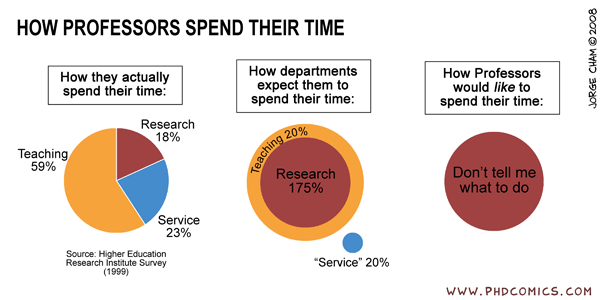
Summer days quickly fell victim to delayed service, so blogging will be light for the next week or two. The academic enterprise greatly relies on the third and least observed/rewarded part of the professor's job--providing service to one's department, to one's university, to one's community and to the profession.

  1. I have now much less service to my department as my term as Associate Director of Graduate Studies. Most of this kind of service ebbs in the summer time as people flee, especially the students. No job searches, which occupy heaps of time, either in the summer.
  2. Service to the university tends to decline as well--hard to have committee meetings when folks are out of town. Or at least can claim that they are. My role as Director of the Montreal Research Group on Ethnic Conflict bridges this and the next category, but since it mostly involves organizing speakers and workshops during the year, it does not occupy much time in the summer either.
  3. Service to the community can mean many things, depending on one's specialty. At TTU, the folks who did Public Policy were heavily involved in the municipal governments in the area. Here, my community service, such as it is, is mostly media stuff--some newspaper, radio and semi-regular appearances on TV. This is mostly event-driven, with my TV stuff at the local CTV station mostly focused on Canada's military effort in Afghanistan.
  4. Ahh. Here is the big one right now--service to the profession. Specifically, reviewing for journals, presses, grant agencies, etc. This always, always, always comes in bunches. This can be very time-consuming, especially one stupidly agrees to review large hunks of stuff. And I agreed to do a bunch of this before the trip to Europe, and, surprise, surprise, didn't get much done. I spent much of my downtime in Europe typing my handwritten notes into computer files, leaving little time or energy for reviewing other people's stuff. So now I am stuck.
I will probably end up blogging anyway, as I procrastinate or distract while I try to read the stuff.

Anyhow, this service stuff largely goes unseen, and is never really counted for tenure or promotion. So, the irony is that while I am critical in my written work of arguments that focus on the power of norms, I tend to say yes to service despite the rational calculus suggesting shirking would be the better option. Because it is the right thing to do. Collective action sucker, indeed.

Tuesday, May 12, 2009

Professors are Like Icebergs? A bit of edumication for the non-Academic

Things tend to go in waves, or, at least we perceive such patterns even if they do not exist. So, the media seems to really like it when professors go bad. For instance, the Georgia prof who killed his family and then himself. Perhaps I am reading too much into it, but there seems to be some delight taken when it is a professor, as opposed to a bricklayer (yes, a vague reference to a classic Trek-ism).

Whoa is us, the poorly understood profession. The classic pet peeve is, of course, "so, you have the summer off, right?" Nothing gets me going faster than that one. Explaining the academic job market to outsiders is always a challenge--how come you ended up in Montreal? Some un-named members of my family still don't get it, thinking that my occasional appearances on Montreal or Canadian TV or in the newspapers somehow makes me a more marketable political science professor. Umm, no.

And, of course, the other classic, usually said with shock and disdain, "How many hours do you spend in the classroom?" Well, our time in the classroom is the tip of the iceberg--it is part of what we do, but only a small part of the job. The rest is less obvious to the passing ships students, parents and media types.

  • Not only does teaching involve preparation, grading, and office hours to meet with students (of which students may or may not take advantage), but it also involves supervision of graduate students. This can take quite a lot of time if the students actually write. The advantage of my previous job is that I had few graduate students, so I didn't spend much time reading stuff. At McGill, I often put it that the grad students do my work (as research and teaching assistants) so that I can do their work--reading their proposals, theses, dissertations, article drafts, etc.
  • Then there is the research. Obviously, this varies--some schools value it more or less than others, but one of the effects of the bad academic job market of the early 90's was to increase the ability of schools to demand more productivity. So, now liberal arts colleges and lesser universities have greater expectations. What is this research? Well, the least humble way to think about it is that we profs create knowledge! So, that is a bit high falutin'. But we write articles and books, which, as my wife noted when I was in grad school, is mostly for others of our kind to read. So, I write mostly so that other political scientists (well, mostly those who are in my subfield) can be convinced of my arguments. In other posts past and future, I address the question of whether this actually matters or not for the greater good. But, research takes a great deal of time--reading the existing arguments, coding datasets, consulting archives, traveling to conduct interviews, writing, etc. This is what gets us merit increases, job offers, glory, donuts, and such. Again, I will defend the research enterprise on another day where I run out of ideas.
  • And, the most hidden and unpleasant part of the iceberg--service. Profs serve on a variety of department committees, including searching for hires, admissions for grad studetns and the like. The most intensive service within departments tends to be those that involve directing the graduate program or chairing the department. Neither are for the faint of heart. Profs help universities run by serving on all kinds of committees, which raises the question of why we need so many high level administrators, but that is a rant for another day. And then there is service to the profession--reviewing manuscripts, tenure files and grants; serving on committees of professional organizations, etc. This stuff is the least recognized by outsiders and least rewarded by departments, at least in my experience. Indeed, there are significant incentives to develop a reputation for being unreliable in the service category--you end up free riding on the efforts of others.
So, that is my rant du jour. Overall, it is a great job, and probably the only one for which I am suited. If I had to do it all over again, I would still choose this profession and this discipline despite the complete loss of control over where I can live. I just might have learned to say "no" more when asked to do stuff, but, then again, I am a collective action sucker.