Wednesday, April 11, 2012

Table of the Week


Yes, Canada has the best average salary for professors, before taxes.  Which is a significant caveat when comparing to the US but not to European countries.  I am not leaving McGill solely because Quebec universities pay significantly less than the rest of Canada, but, of course, it does not hurt. 

The funny thing is I took a pay cut to come here, as the US dollar was worth much more than the Canadian dollar back in 2002.  But the combination of furloughs and cuts in the US and changes in exchange rates (plus no housing bubble up here) meant that the move back then was well-timed indeed.  We tend to buy high and sell low due to circumstance, but we definitely had good timing for the big move to Canada.  And we are getting out of Quebec with the Parti Quebecois not yet back into power. 

Again, I didn't move to Canada because of the promise of higher wages, but I cannot possibly complain now.  Well, about that anyway.


Tuesday, April 10, 2012

When Policy Advocacy is Oxymoronic

I have not commented much on the Syria mess because, well, I have no solutions I can recommend.  But today's post at foreignpolicy.com about the fall of Srebenica reminds me of a basic reality: safe havens are neither safe nor havens. 

The idea of carving out space for Syrians fleeing from the repressive government is swell, except for the fact that it would require, ahem, war.  That is, NATO or someone would need to have the capability and the resolve to use said capability to defend the safe havens from Syrian attacks by air, by artillery, by infantry, by whatever.  It can be done, but would require pretty expansive rules of engagement.  NATO or mystery intervener x would have to be able to shoot down Syrian planes, fire back at Syrian artillery units, probably seize some key territories to make the safe havens defensible, and so on.  With Syria resisting, that would be war.  No more, no less.

Given that no one seems interested in this, especially since the US has already exceeded its war cap and as Syrian refugees are not flocking to the beaches of countries with politicians needing to make xenophobic appeals, safe havens or any other threat of force are not very likely.

So, what should we do?  Insert picture of shoulder shrug here.

The Uber Clinton

Ok, I may not have wanted to have Hillary Clinton be President, but I am starting to think she rocks as Secretary of State.  Why?  Because she gets the text meme!

I just met Secretary Clinton. She loves the site. Pictures to... on Twitpic

Productivity Hurts Blogging

Kind of like man bites dog.  My co-author, David Auerswald, is on a mission to finish our book NOW.  Well, this month before he starts to travel as a part of his job at the National War College.  So, don't expect as much blogging from me for the next few weeks as we put the big NATO and Afghanistan book to bed.  Or at least out of its misery as we ship it off to a publisher to review it.

Of course, as soon as something fun happens in the world, I will be back here spewing.  The challenge is that Ozzie Guillen has set the bar mighty high, as he praised Fidel Castro while managing a baseball team .... in Miami!  Way to antagonize a diaspora!

Monday, April 9, 2012

Interesting Map of the Week

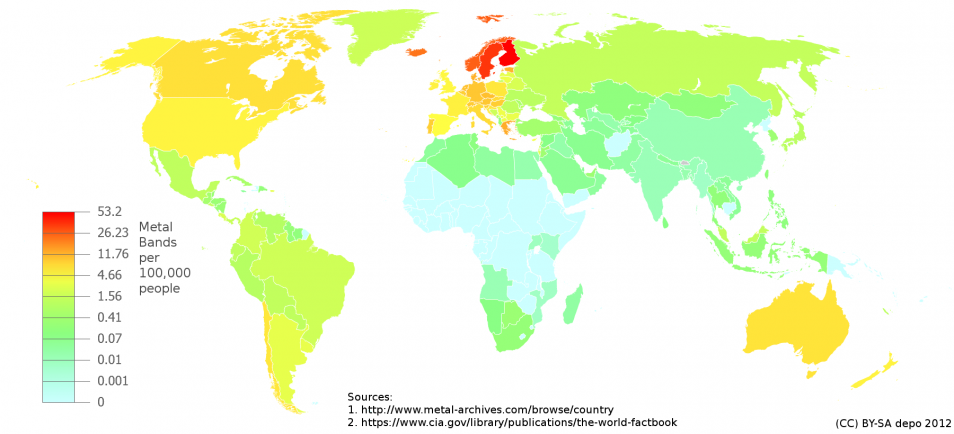
Metal bands per capita!

So, what does this tell us?  Besides that the vikings of the past are metal-heads?  I would have guessed that metal would be less popular in the Mideast than in Sub-Saharan Africa.  I also would have guessed more metal bands per capita in the former Soviet space. 

Thanks to http://flowingdata.com/2012/04/09/metal-bands-per-capita/

Do notice that similarities of metal band density do not appear correlated with peace, unlike the McD's peace. What other social science observations can we glean from this?


Treating Traitors with Trips?

Yes, it is alliteration day here at the Spew.  Well, every day is. 

Anyhow, Israel is once again asking the US to release Jonathan Pollard.  My answer, as always, is: screw you.  We only trade traitors when we have something to gain, like getting our own spies back.  So, unless Israel has some captured American spies or something else to give us (like some real relief on the issues the US cares about), Israel can suck some eggs--Passover eggs, Easter eggs or ordinary eggs.  I care not the kind of eggs, just that what we do with our own citizens who spy for other countries is up to the US government.  Foreign governments can whine all they want, but if you encourage folks to spy for you, then you have no place to make demands.

Yes, this is becoming an annual post, but Israeli entitlement has not gone away on this issue.  To be clear, I don't want Israel to go away, I just want Israel and its nattering nabob Netanyahu to consider the context and forget about Pollard.

Racist Racists and the Racism They Espouse

So, some moron rants some racism, and gets heaps of attention.  I really didn't know who John Derbyshire was until last week.  I am unimpressed.  I guess I am surprised this guy is getting so much attention, but I do think that it did produce at least one interesting post: What should you tell your children about John Derbyshire (and other racists). 

I am not posting all of it but here are some of the key lessons to be taught:
1) Among your fellow citizens are an unknown number who believe that certain human races are inherently inferior or superior than others. Most likely, these beliefs manifest in ideas that people of certain races are "just different," and that these differences just so happen to provide easy assumptions about the merit or quality of a person of one race or another.

(2) Americans are descended from people from every corner of the globe. The circumstances of their arrival vary widely, part of why their treatment and status once they arrived also varied.

(3) Your ancestry is cause for celebration no matter where your family's origins, but racists will take it to be a determinant of your personality, abilities, and worth as a human being.

(4) The default principle in everyday personal encounters is, that as a fellow citizen, with the same rights and obligations as yourself, any individual of one race is entitled to the same courtesies you would extend to any individual of another race. That is basic good manners and good citizenship. In some unusual circumstances, however -- e.g., racism -- some people will argue that equality must be "overridden" in the cause of, for example, "personal safety."

(5) Sometimes people will point out to you, "There are, for example, no black Fields Medal winners." Sometimes people say things like this because they want to discuss, say, the inherent inequalities in our education system that tilt the playing field against black students. Sometimes they say it because they want you to believe that black people are inherently worse at math. Both conversations are partially about race, but the latter is necessarily racist.

(6) As you go through life, you will experience an ever larger number of encounters with racists. Assuming your encounters are random -- for example, not restricted only to racist convicted murderers or to racist investment bankers -- the Law of Large Numbers will inevitably kick in. You will observe that the means -- the averages -- of many traits are not so different for racist and non-racist Americans. Some people argue that less-educated or poorer Americans are more likely to be racist. This appears to be false, and is sometimes informed by classism, which is not so different from racism.

(9) A small cohort of racists -- in my experience, around 0.5 percent -- is ferociously hostile to people of other races and will go to great lengths to inconvenience or harm them. A slightly larger cohort of racists may go along passively if the point-five percent take leadership in some event. They may do this out of a vague feeling that the minorities have it coming.

(10f) Do not settle in a district or municipality run by politicians who implement laws that promote racism.

(10g) Before voting for a racist politician, scrutinize his/her character much more carefully than you would a nonracist.

(13) In that pool of people who are racist, there are nonetheless many intelligent and well-socialized racists. (I'll use IWSR as an ad hoc abbreviation.) You should consciously seek opportunities to make friends with IWSRs. In addition to the ordinary pleasures of friendship, you will gain an opportunity to help your new friend expand his or her understanding of race and whether it really determines a person's innermost qualities.
(15) Fortunately, ISWRs are depleting in supply, as being openly racist in the U.S. becomes costlier and as Americans themselves become less racist. Moments such as the publication of and backlash against John Derbyshire's article are an opportunity to out one racist, and, more importantly, they are an opportunity to confront the racism that still exists in American society. Derbyshire, after all, has been writing this stuff unmolested for over a decade. Instead of focusing on why we reject his views now, maybe we should be considering why we tolerated them for so long.

Canadian Civ-Mil Ignorance

Hey, if you like an ill-informed set of civilians for managing the military, then what about reducing funding for civilian expertise?  See my new CIC post for a rant about budget cuts and the production of ignorance.

Saturday, April 7, 2012

Saturday Silliness, Taxes Edition

I am wiped from doing taxes, and I am only halfway through (optimstically).

So:

Friday, April 6, 2012

Procure This!

I have been busy today catching up on what I missed while I was discussant-ing, presenting, meeting, and even playing at the ISA.  The biggest news story up north: the F-35.  The Auditor-General discovered that the plane is freakin' expensive, that the government has been lying about it, and that the military has not been entirely honest either: see here and here for a start. Good times.  Will heads roll for such stuff?  Not sure, as Harper with a solid majority and no election in sight can do with what he wants.

The good news, anyway, is that the F-35 decision was not driven by corruption--Generals and pols are not getting rich from the contractor.  However, the bad news is that this is kind of typical--the Harper government tends to communicate poorly and the military tends to be opaque.  Indeed, the best analogy is my behavior as a kid or teenager: break something?  Hope no one notices.  Just deny.  I swear that the Forces and the government would be much better off if it admits there are challenges and that they are doing the best to address them, rather than insist that things are swell.  This would have worked better for detainees in Afghanistan, F-35s, and a host of other issues.  Instead, we develop a deep suspicion about the credibility of the government and its agents.

I have a longer diatribe about the challenges to civilian control of the military that should be out at http://www.opencanada.org/ in the next couple of days.  The point here is simply that the temptation to make things look great ultimately does no one any favors.  Or favours.  Or whatever.

Thursday, April 5, 2012

Saideman's Law


During the last dinner of the ISA, I learned that I have a law.  Well, my old chair at TTU (the very best chair I have ever had [that might seem like I am damning him with faint praise, but that is not my intention]), David Lanoue said that he frequently invokes Saideman’s law. 

Well, what is Saideman’s Law?  Apparently, during a department meeting at TTU, one of my colleagues was arguing that we had to do something because we had done it before.  I responded by saying that we should not do something that is quite stupid just because we did this stupid thing before.  The essence is that precedents should only bind if the precedent has legitimacy.   So, David, as chair at Alabama and now Dean at Columbus State College, has frequently invoked my argument when somebody says that “well, we did this before, so we need to do it again, even if it is a bad idea.”

Update: one of my commenters phrased the law thusly:
Saideman's Law: You are not bound (legally, morally, or otherwise) by the worst decision you ever made.

My take should not surprise readers of the Spew since I have railed against tradition for the sake of tradition, but it was gratifying to learn that my outburst has had a lasting impact.  I just need to find a snappy line to go with Saideman’s Law so I can make a bumper sticker akin to “Gravity: It is not just a good idea; it’s the law!”

Any suggestions?

ISA 2012 Day 4 and Beyond


While conference exhaustion sets in on the last day, the final day of this year’s ISA was actually one of the best. 
  • It started with a meeting of those folks foolish enough to agree to serve as section program organizers for next year.  I will be putting together the Foreign Policy Analysis section’s program for the conference in San Francisco.  This is foolish because I tis a lot of work, and most of it will be just as I am moving.  Lovely.   But for this enterprise to work, people have to volunteer to do this kind of stuff. 
    • It plays to two weaknesses—I am a sucker for collective action (ISA poker, ISA ultimate, ISA dodgeball, ISA hotdog eating contest, ISA Vampire Hunting Competition, ISA dance-off, etc.); and, well, I am an attention hound. 
  • I then went to a panel on Libya in retrospect (focused on the intervention last year more than the events of this year) that had two friends on it, including my co-author (the often mentioned Dave of the Dave and  Steve book).  The audience was so small that they turned the panel into a conversation instead of a series of paper presentations.  It was fun, interesting, and quite helpful.
    • Dave and I met during the conference, ramping up the pace of the last stages of the book.  We hope to finish by the end of the month unless Dave is playing a cruel April Fool’s joke on me.
    • We did have some good timing—our piece in ISQ is not gated.  Usually, ISQ is restricted, but this month it is available to everyone and we happen to be in it.  Check it out.
  • We then went to watch another panel on Libya starring Roland Paris and Kim Marten with John Mearsheimer as discussant.  Roland spoke about R2P’s inherent contradictions, including fostering unrealistic expectations.  Not fated to fail, he said, but fated to flounder.  When it is successful, it means that an non-event happened—lives were not lost.  When intervention does not take place, then R2P gets blamed even if it would be inappropriate.  I am going to have to improve my game if I am going to be speaking at events in Ottawa where Roland is in the mix.
  • The panel on Pop Culture narratives demonstrated that which looks easy is actually quite hard.  The panelists—Dan Nexon, Charli Carpenter, Dan Drezner, Pat James, and John Cristal—clearly put far more work and thought into their classes and the deployment of pop culture than I ever have.  We had a large crowd (for the last afternoon of the conference) and good questions.
  • I continued my one on one meetings with folks—one of the best parts of any conference.  I used to think that I had no network and was an isolated bit of driftwood floating in the profession.  That is clearly no longer the case.  I am most pleased with the collection of friends, acquaintances, colleagues, ex-colleagues, co-authors and other non-mutually exclusive categories of folks. 
    • Indeed, my dinner plans went from meeting with one prof who used to think that I was standing between him and every journal he submitted stuff into a meal with him and our mutual friends who just got in to town for the Southwest Poli Sci Assn meeting.
  • The night concluded with my roomie using his laptop to access HBO Go so that we could watch Game of Thrones.  It was a heap of fun.  A good start to an interesting season.
Overall, the ISA in SD was a  huge success—for the ISA and for me.  I got to play some ultimate with some friends and strangers, learned much from the few panels I did attend, got some feedback on my work, made plans with old and new co-authors, and re-connected with a heap of folks.  Definitely worth the trip, even if it meant missing the McGill Undergrad poli sci student assn. meeting.  I wanted to go to say goodbye.  Alas, I will have to do it on my blog as classes end.

Wednesday, April 4, 2012

Academic Business Models

I have blogged about the problem of universities and where they will get their money to fund their expenses enough.  Here I just want to link to a piece about the rising cost of administration.  It makes perfect sense--those who make the decisions spend more and more on themselves and those who enable them.  It might be that 21st century universities are harder to administrate and require more resources, but doing more with less might not just be for faculty and academic departments, eh?

Tuesday, April 3, 2012

ISA Day 2

Another busy day in San Diego at the ISA.  Since time is short, to the bullets we go:
  • I had an early meeting with an enthused co-author who has lots of plans.  Now, I know how annoyed my co-authors are by me, when I have more enthusiasm for a project.
  • I was reminded that the sun is quite strong when I got a nice burn while playing the first Annual ISA Ultimate game by the bay.  We had a good crowd so that we had a few subs.  And, yes, I did lay out twice to catch throws.  Heaps of fun.
  • Another meeting with co-authors (different ones), where I was the annoying "hey, let's get gooinnnnnnngggggg" one.  Ah, data collection and grant writing!  Who says our business is not glamorous?  Oh, you do.  Never mind.
  • I met with my adviser from grad school and then met one of my Phd students--what goes around comes around....
  • Speaking of grad school, I went out to eat with some friends from grad school, and the quality of the food at the restaurant was only exceeded by the quality of the company.  I was reminded of why I had such a great time in grad school.  It was not just the San Diego weather and food and stuff, but these folks.  So much fun.  My face started to hurt more from laughing than from the aforementioned sunburn.
  • I was reminded that if you have lousy cards and the game is so low stakes that you cannot bluff folks off of a pot, you tend to lose.  But the annual ISA poker game, which was wildly popular (two games played at once) was a heap of fun.  I just wish Pat James had better taste in beer.  
No panels today but heaps of meetings that have more content than they have beer.  Holy poor planning!

Monday, April 2, 2012

ISA Day 1

Again, not much blogging or tweeting for most of this week as I am at the International Studies Association meeting, doing important stuff like, hmmm, meeting people.

I had my busiest day first: presenting two papers, serving as a discussant on one panel and one business meeting.  I was late for the last one because it started at 6:30pm and that was mid-Duck meeting.  That is, the folks who blog at Duck of Minerva were flocking to the bar.  I had met some before, but not all.  Unfortunately, I had to see a group about a dataset--the Minorities at Risk project. 

Anyhow, what did I learn from the various panels:
  • Well, as the person charged with discussing six papers (usually panel shave three to four papers), I learned that brevity is not much of an aspiration.  Too bad, as conference papers are usually seen as draft versions of what one wants to submit to a journal, and no journal that I know of in Poli Sci/IR accepts articles that are longer than 12,000 words.  Some of these folks went way, way beyond that.  
    • Which reminds me of the iron law of academic reading--the more you assign the less the students will do.  
  • We could have had better time management since six people presenting could have left more time for me to discuss and for the audience to ask questions.  Instead, I ended up running over the session.  The papers were good, but we could have done a better job of delivering them briefly in writing and to the crowd.
  • I learned that it is hard to present a paper that is, well, mighty weak.  My paper on comparing the Canadian and Dutch departures/returns from/to Afghanistan was very thin on theory and implications.  I have a fun comparison, but not sure what I can learn from it.  Oh well.
  •  I learned what it feels like to be the free rider on a co-authored project.  My second paper was on institutions and ethnic conflict, and it was an effort to build on some of my previous work.  But nearly all of the work was done by my co-author, Johanna Birnir.  All of my other co-authored projects have either more even burden-sharing or with me doing more.  Alas, on this one, due to skillz differentials and time, Johanna did far more and my guilt is more than assuaged by the relief that we have a decent first cut.
  • I learned that my students do indeed rock.  I had dinner with four of my ex-students who have all gone on now to get good tenure track positions in North America.  A fun, smart bunch.  i was lucky to have them,  even when I whined about having to read their stuff.  I am mighty proud of these folks and the others who could not attend.  
I now have to meet said co-author upon whom I free-rode. Today, I just have meetings (business and not), the first ISA ultimate game, dinner with my pals from grad school and the annual poker game.  The weather is great, the company is excellent and my wife just might be a wee bit miffed that I am having such a good time while she is dealing with the last of our home repairs before we move in the summer.