Showing posts with label blogging. Show all posts

Sunday, April 30, 2023

Spew-Anniversary Time: Less Frequent, Still Generalizing But Now Generalized

Fourteen years flies by, eh?  I started blogging after peak blogging declined and while twitter was hip and fun and snarky.  Now, twitter is toxic, ok, it's owner is toxic, and blogging is hip again although folks tend to call it Substack.  I went from writing about anything sometimes four times a day to now writing far less frequently--sometimes four times a month.  I write less partly because I can just refer to an old post rather than rewrite the same thing over and over again. 

On the occasion of the 14th anniversary, I thought I would write something to keep up my monthly totals and to consider some of the ironies relating to my first post long ago and in a city not so far away (I am convinced that I write less because I am complaining about Quebec and its politics far less).

In my first post, I was reacting to two pieces I read and that were getting much play: one by Joseph Nye arguing that political scientists are not policy relevant and one by Francis Fukuyama about the need to get rid of tenure.  Let's take those in turn.  

I argued in the original post that the interest and willingness to engage the policy world varies among scholars, and that there are plenty of folks doing so.  Since then, the Bridging the Gap folks have not only produced many cohorts of folks interested in doing so, but this organization is now taking the next step with some others, pondering about the do's and don't's and the ethics of engagement.  DoD is populated by a bunch of political scientists these days, while DND (the maple version of DoD) killed their engagement program, the Security and Defence Forum, and then started a new one, Mobilizing Insights for Defence and Security or MINDS, that now funds nine networks on a range of topics.  We built the Canadian Defence and Security Network to foster greater engagement among the different parts of Canada's defence and security community, and after four years, I think we have been quite successful.

Of course, the question is whether policy-types listen to the academics or are they just checking boxes?  Hard to tell ultimately, but I do know that two of Arbour's recommendations came from one academic, and she consulted many during her review.  I also know that crises provide opportunities for outsiders to engage, and, yes, the Canadian military has been crisis mode for at least two years.  Anecdata is just that, but I have found that folks in government do listen to our BattleRhythm podcast, as I get calls when I say stuff that is out of date.   


Tenure is also in the news, as GOP-dominated state legislatures are attempting to wipe out tenure in Florida, Texas, North Carolina, and elsewhere.  People have always doubted whether the academic freedom that tenure was designed to protect was actually protected and deployed.  That is, people wondered whether academics might be trained to be uncontroversial through the probation period which then sticks, that profs do not really need academic freedom because they never really make use of it.

Dan Nexon commented on my first post, and it was most prescient:

those who say that the "free speech" issue isn't so important anymore only think that because tenure has protected it for so long. Abolish tenure, and things will get ugly very, very quickly.

Well, we may have a "natural experiment" where profs in GOP-dominated states will have different pressures/constraints to compare with those elsewhere.  Fukuyama was wondering if tenure caused stagnation as it reduced the incentives for profs to produce and to push.  He wasn't wondering about the punishment that may visited upon those who dare to dare.  Given how partisan, how ideological this current anti-tenure effort is, can we doubt at all that those in tenure-less places will have toe the line for fear of getting fired?  Just mentioning racism, which is an important topic in any number of history and social science classes, might be enough to get one fired, not to mention researching those in office right now who are white supremacists.  So, yeah, tenure is more relevant than ever, and the concern that it might cause some folks to become deadwood is far offset by the real threat of ideological conformity imposed by the far right that now dominates too many political systems (watch out, Albertan profs, you may be next).  

Finally, one of the themes of that first post was that I was originally miffed about folks generalizing about profs, but then I realized I am a professional generalizer.  I take ideas that I know well and apply them all over the place, to see what is common and what is not so common.  The funny thing is that I have recently taken umbrage at generalizations hurled at my kind--that some folks question the integrity of profs because they engage the policy community and even take money from the government, gasp!  As a good prof, I should be less concerned about folks thinking critically of my kind and more concerned with them doing the work as they criticize. That is, read our stuff and judge then if we are shills for whoever.  I do have 14 years of stuff right here.  Of course, some might think that this is a Steve Bannon-esque strategy of flooding the zone with shit.  Maybe?

There are many things people don't understand about professors, but two of them are:

a)  we don't pocket grant money--we use it to pay for research assistants (students), travel, access to data, equipment/software, and the like.

b) we spend our entire careers being criticized--the most valued publications are those that go through peer review, and peer review is often pretty brutal.  So, we tend to develop thick skins, as rejection is inherent in our enterprise, as I keep saying (I am 0 for 2 this spring in sabbatical fellowship applications, waiting to hear about a third).  

Of course, those are two generalizations that are mostly true but not always.  I hate when folks question my integrity, that kind of criticism does rankle.  So, my skin is not always as thick as I would like.  I am also easy trolled.  But that is a topic for another day.  Perhaps before the next anniversary.

One last thing: even though I have been doing this for fourteen years, I am always a bit surprised that people read my musings here.  The typos in many posts should remind folks that this outlet is for the half-baked.  The spew is only semi-finished.  Which may be for the best as my mistakes and my omissions have led to lots of interesting conversations.  Thanks for reading and engaging me.  While this thing may have started out as narcissism--my ideas are really important--this blog has really helped me engage my curiosity, learning much stuff along the way.


Saturday, December 31, 2022

The Year in Spew, 2022!

Do Spew and 2 rhyme?  I sure hope so as I begin my review of the year that was.  The last time I blogged less than I did in 2022 was ... in 2008, when I didn't blog at all.  What explains the decline?  Partly exhaustion, partly a decline in imagination, partly other social media sucking up my time (the podcasts, now tooting as well as tweeting), and partly the reality that I have written enough stuff before that when the topic comes up, it is just easier to repost.  Maybe a look at this year's posts will tell me a bit about what inspires me to write here and what does not, although survivor and recency biases may mesh nicely with my confirmation bias to prevent me from learning that much.  Hmmm.

January

I started by pondering whether JK Rowling has utterly destroyed her legacy--whether I can still consume Harry Potter stuff.  While I concluded that I could still enjoy the world she created, even as she betrays damn near all of it, my behavior, my choices, says otherwise as I had multiple opportunities to watch HP movies while hanging out at my mother-in-law's over the holidays and dodged all of them.  Something I had not done in the past.  Later in the month, I returned to the theme of what kinds of stuff can I read and enjoy given the complex realities of our time.  I wrote about how it has become harder to watch and read cop shows given what we know about cops these days.  I am finishing the latest John Sandford book which features multiple cops, Virgil Flowers and Lucas Davenport, solving a serial murder spree by bitcoin assholes, and have found it fairly compelling (unlike the most recent Jack Reacher book).  So, maybe I am less affected by the topics than by the behavior of the artist?

The month ended with the start of the occupation of Ottawa by extremists--far right white supremacists.  The year ended with an examination of whether the government should have invoked the Emergency Act.   Um, yeah, but because the emergency was that the provincial leaders were cowards who wanted the feds to own it.

February

The extremists in Ottawa became a focus for me, as it did for most of my city, for most of the month with posts on:

  • outbidding, explaining why the Conservatives were pandering to the extremists
  • anger, discussing how pissed off this made me, triggered indeed.
  • policing, as I learned that Canadians think that the cops should not be directed by the politicians as if policing is not inherently political,
  • my take on the Emergency Act.

And then the past came back to bite Ukraine and me.  My previous work on irredentism became relevant again with Russia's invasion of yet more Ukrainian territory. In this post, I explained the basics of irredentism--that it is always bad for the country doing the invading even as it may or may not be bad for its leader, that domestic dynamics are key, and so on.

March

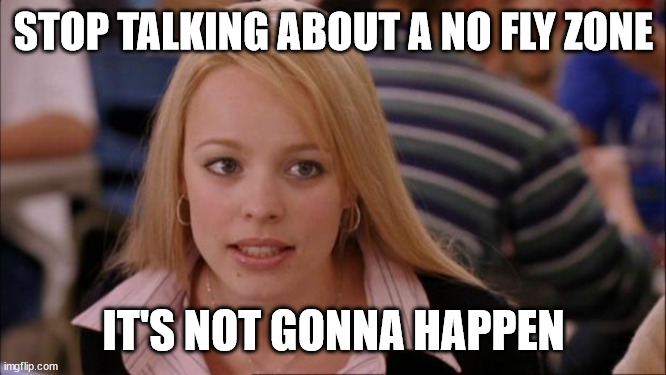
The focus of March was very much on the war in Ukraine.  I argued via a bit of screenwriting why a No Fly Zone was a bad idea. I elaborated about the disease of MOAR.  And, yes, I then invoked my work on irredentism to explain why Putin was willing to kill Russia's kin in order to "save" them.  I wrote about limited war, a topic that got new energy this week as some retired generals expressed much frustration at the unwillingness of the US to send deep strike weapons to Ukraine.

I also blogged about my appearance before the House of Commons Defence Committee.

April

This month had only a few posts, with nearly all focused on CDSN events.  The outlier was a post discussing the appearance of Minister of National Defence Anita Anand in my Civil-Military Relations class. That was super-cool--a great way to finish off that course.

May

I marked my 300,000th tweet before twitter's death spiral... maybe I caused it?

I discussed the two events organized by the CDSN Undergraduate Excellence Scholars--a conference and a hackathon.  I also went to Germany for another conference. Woot!

My last post took a first look at the Arbour report, where a retired Supreme Court Justice assessed the Canadian Armed Forces and why it has fallen short, yet again, on reforming itself when it comes to sexual misconduct.  I took a quick tour of the 48 recommendations.  

June

I didn't write much in June, but two of my posts continued my examination of the Arbour Report: here and here.  In the first one, I pushed on a point that will become a key question in my next project--what is the proper rule of a defence department or ministry or agency?  Arbour says DND is to support the CAF, and, no, nope, nuh uh.  This does help to explain a big problem with this and previous reports--having a very limited view of what DND's job is.  I also focus on the lack of a recommendation for an Inspector General, which is now a topic of research of this year's Visiting Defence Fellow.

I also marked my 10 years in Ottawa with this post. I am so glad that the tides of the academic job market washed me ashore here.  It was not my plan, but it has worked out wonderfully.

July

July was a month of ups and downs.  I started the month by pondering how long might the autocratic moment in the US last if Democracy were to give way.  The most pivotal building at my old summer camp burned down, but there was much resilience that day and beyond to give me hope for its future.

One of the ups was the new season of Battle Rhythm.  I am forever grateful to Stéfanie von Hlatky for helping us launch our podcast, and I was sad to see her move to admin stuff at her university.  But we got re-energized by a new crew of co-hosts.  Artur, Anessa, Erin, and Linna have provided a variety of perspectives since they joined us.  I am most grateful to Melissa Jennings for doing most of the heavy lifting in this effort and to Carelove Doreus and Racheal Wallace for their carrying the rest of the load. 

It has been a big year in Canadian civil-military relations, and one of the highlights was the decision to adjust the uniform standards to make the CAF more welcoming to more people.  I addressed these changes with some accidental foreshadowing of the awful Vimy speech by one of those responsible for the culture crisis that prevented the CAF from adapting sooner.

The month, which started with COVID finally hitting me and Mrs. Spew thanks to a conference trip to Berlin, ended in an upswing with both Beulahfest as my mom celebrated her 90th birthday and, yes, Stevefest, as I did a heap of stuff to celebrate another year of me.


August

Not many posts this month as I was very busy organizing and then

hosting the first in-person CDSN Summer Institute.  It was one of the original ideas animating the big grant application, and it was great to see it finally come to fruition with so many sharp people speaking and participating.  Plus it was an excuse to have a reception or three.  Just a great week worth all the effort by the CDSN team.

Much news about classified documents thanks to Trump hoarding documents he should have had anymore, so I shared what I had learned during the year I had a top secret clearance and worked every day in a SCIF--secure compartmented information facility.

Finally, I said goodbye to a key part of my life--ultimate frisbee.  I just kept getting injured and could not stay on the field.  I could still throw well, but that whole running thing proved to be too much.  I very much miss it, it gave me friends across North America, it gave me some level of fitness, it gave me heaps of silliness, and nothing can fill the hole it left behind, alas.  

September

Another light month for blogging.  I wrote a guide for those visiting Montreal for the American Political Science Association meeting.  

The focus of the month and of my career these days was/is civil-military relations.  I wrote about the retired generals and SecDefs providing advice on how to manage this relationship. And then I addressed a recurring challenge up here--should the Canadian military prioritize domestic emergency operations? Whether the CAF wants to or not (not), climate change is going to make this happen.  It already has.  I am getting more and more interested in studying domestic emergency ops in part because few defence scholars have done so.  Nothing like having a wide open field to pass the disk into.  Oh wait, that was last month's post about ultimate.

One reason I didn't post more in September is that I was headed west to Disneyland and to visit my daughter (not necessarily prioritized that way?).

October

I gave thanks for all kinds of stuff as Canada celebrates Thankgiving in October when Americans debate the role of Columbus.

I spent the rest of the month preparing both the CDSN Midterm Report for one of our funders and a conference to mark the midway point in our SSHRC grant.  It was great to hear from the co-directors of the various research efforts--Civ-Mil Relations, Personnel, Security, and Operations.  We were once told that the CDSN was just me and my friends dong stuff, but, to be clear, when it started, many of those who joined as co-directors were not friends and some were barely acquaintances.  Now, we are friends, but isn't that how networking works when it works well?  I am very proud of what we have put together even if it put a major dent in my blogging.

November

Was the theme of the month commenting on other people's mistakes?  Seems like it with a post on twitter's dramatic decline thanks to Musk and then the craptastic speech by a retired general.  That post generated more hits than any other this year and is in the top five of my 13 years of blogging.  The related tweet was also the most tweeted/impressioned tweet of the year and then some.  

It led to a post addressing "woke" and being "anti-woke," which helped me think about vice-signaling, the flipside of virtue-signaling. 

I got to put on my old NATO hat when some errant missiles from Ukraine's war with Russia landed in Poland.  I did much media as well to explain that NATO does not work the way may folks think--that there is nothing automatic about it, even if the attack had been deliberate.

One reason I blog less is that I simply have not been writing that much about pop culture here.  Why?  Mostly due to lack of time.  One exception to this was thinking about the International Politics of the second Black Panther movie.

December

The year ended with much CDSN and much cookies!

I went to Winnipeg for the first time for a CDSN workshop on Domestic Emergency Operations.  This is the focus of one of our four MINDS (DND) funded research projects.  I learned a great deal from sharp people both in and out of the government.  There is much work to do here, and I am glad we have made this one of our foci over the next three years.

Once again, we held an end of the year conference, the Year Ahead, which addresses some of the issues on the horizon.  This year, we also launched the new CDSN Podcast Network at the event!  The CDSN Podcast Network brings together four podcasts--Battle Rhythm, Conseils de Sécurité, SecurityScape and NATO Field Report.  We are open to adding others down the road.  Along the way, we fixed our Apple podcast feed.  I am most excited not just for having a new home for BattleRhythm but connecting and amplifying some student-run podcasts.

I finished the year with a heap of baking--cookies for friends around Ottawa.  The basic idea is this: I want to eat a lot of different kinds of cookies.  But then making so many different kinds means finding people who are willing to take most off my hands or else I will gain a heap of weight (winterfest did that anyway).  I enjoyed my first cookiefest in 2020, which was the first time I saw many people after months and months of quarantining.  So, I keep doing it, now armed with better equipment (kitchen aid stand mixer makes it much easier than the first cookie fest) and more recipes.  It is not just the baking and the eating.  I got to chat with a bunch of great people as I delivered the cookies.  If the cookies are joy (and, yes, they are), giving joy leads to receiving much joy.


One of the interesting dynamics of 2022 was the re-emergence of blogging.   That many folks started writing on substack, which, to me, seems like blogging but with the chance of income.  I have not moved over there as I am pretty happy with this perch. It does not make me money, but I doubt that people would pay that much for my half-baked (semi-spewed) writings.  One of my New Year's Resolutions is to blog more.  My guess is that I will be more successful at that than the ones focused on dietary restraint.

May you and yours have a terrific 2023!


Saturday, May 1, 2021

Holy Unround Number Anniversary: 12 Years of Spewing

FB was kind enough to remind me yesterday:


Happy spew-versary!  The question is how long will I continue as the trend is suggestive:

Whether one looks at yearly output or monthly (so that the first and last partial years are comparable), the decline is quite clear.  I still like to blog, but I am writing less.  Why?  I must result to the classic blog trick--the listicle.

  • Exhaustion of ideas.  I often find myself thinking about writing and then not and instead summoning an old post that covers the idea.  Why re-write an old idea when I can just re-post?
  • Exhaustion of Steve.  If I was able to chart the accumulation of grading, supervisees and administration responsibilities, I would guess that the line is inverse to these.
  • I am probably developing attention deficit syndrome, so that might be part of it.  I am so easily distracted (this post was written over two days because I stopped and then forgot about it).
  • Twitter takes over.  While I joined twitter in 2009, just a couple of months after starting the blog, I think I have increasingly found threads or even a quick tweet to suffice, when I used to write something here.  
  • Podcasts--others and mine.  I started the blog at a time where I wasn't teaching and wanted to unload my ideas.  Now, twice a month, I get to do that on three topics in conversation with Stéfanie von Hlatky on #BattleRhythm.  Plus I spend my spare time listening to other podcasts rather than noodling away in blogger.
  • Not as much common culture to discuss.  Some flurries of posts were due to the end of TV shows like Mad Men, Lost (yes, that long ago), Breaking Bad, and Game of Thrones.  Not sure if there is anything like that now.  Indeed, I post much less frequently about the tv I watch, the movies I see (a year sans movie theatres and counting), and the books I read.  I am still reading and watching, but not writing so much about it. 
  • Reversion to the mean?   Well, we don't know what the mean is yet, I guess. 

I still enjoy blogging when I do it.  It feels good to get a good rant off my chest like this take on the Ontario murder clowns.  Will I resolve to blog more in the future?  No, as I have found I enjoy it most when I feel like it, not like when I feel I should. I don't think this line will continue to decline so much that I stop blogging.  When the idea strikes me, I will blog.  I just have fewer ideas that I have not written about, I guess.

Sunday, July 28, 2019

FFS!

I learned it from Footloose:
"a time to weep and a time to laugh, a time to mourn and a time to dance,"

and, yeah, from the song, which I probably have to thank the Wonder Years for.

So, when I see this:

My response is to say: fuck that!

While I curse quite a bit at home (our daughter was cursing like a sailor long before she hit her late teen years), I almost never curse when I am teaching.  When I started blogging and then tweeting ten years ago, I also avoided cursing.  But something changed that produced not just the repeated FFS (where the profanity is only slightly hidden) but a more frequent appearance of Fuck!  That would probably be the election of 2016.  A quick check of my blog shows that most, not all, of the times I have used profanity (defined as fuck or shit but not FFS) have been since Trump began campaigning.  Not all uses are related to Trump, but most. 

Why?  Because I am and have been fucking outraged!  So much unnecessary bullshit that has harmed real people.  These are not imagined casualties but an actual body count caused by Trump's incitement of violent, deliberate incompetence at the border and in Puerto Rico, and on and on.  I find it outrageous for people not to be outraged at what has been going on in both US domestic and foreign policy.

And how to express outrage?  By using profanity.  These are not normal times, and we should not behave as if they are.  While Emmett used it in reference to the Chateau Laurier expansion shit-show, his point was a larger one--that we are focused on this rather than the awful stuff going on not just in the US but in Canada with Quebec legislating against religious minorities and the Conservative Party being (dare I say it) infested with white nationalists (see Rebel media folks). 

So, yeah, there is a time to dance and there is a time to fucking curse!


Monday, August 13, 2018

Granting, Not Blogging

Just a quick note to explain the blogging silence: this August is major grant application month.  The CDSN effort continues.  It involved a meeting last week that took much time and effort to organize, and the meeting went very well.  Which now means much time and effort to take the feedback we received and build that into the many different pieces of the application.  So, I will still blog, but don't expect as much for the next few weeks or so.  Likewise, I am spending less time on twitter--making occasional forays.  I probably should do this more often, but the imperatives of the grant writing schedule plus other obligations are forcing a concentration of effort that is unlikely to be sustained once the deadline is passed.


and if the past as any predictor of the future, when I say I won't blog much, I end up breaking that promise almost immediately.

Enjoy the last days of summer as academics panic about the declining days to get our non-teaching work done.

Sunday, December 31, 2017

2017: The Longest Year of Our Lives

Time for another year in review post--the Spew of 2017.  I blogged less this year, averaging 2/3s of a post a day, which is continues a decline.  Why?  Partly because I express much of my anger on twitter these days, partly because what I want to say I have said before, whether it is about #voterfraudfraud, the tyranny of low expectations, or the politics of academic departments, so I re-post, rather than re-write. 

Anyhow, even though I wrote less, the year felt incredibly long as living in Trump world means responding not to a crisis every few weeks but one every few hours, and that is exhausting.  Which is probably the best explantion for less blogging--it has been a very emotionally exhausting year.  Predictions ahead by folks seem to suggest it will get worse as we get the real Trump.... or nuclear war.

Anyhow, looking back, it was a great year for me despite what was going on elsewhere with record travel, meaning great food, really interesting stuff learned along the way, and, yes, selfies in new places.  I do these yearly summaries because they help to remind me what happened and they also serve as handy places to find key posts.  I hope you enjoy the bath in my nostalgia.

January

Japan a second time was just as lovely as the first. Ok, it was the third trip but the second research trip, which included travel to the other side of the island (took less time via bullet train than travel across Lost's island the first season but not the sixth) for a conference and more snow than I have ever seen.

2016 was a lousy year for predictions.  2017 was much better despite a vow not to make them (pie crust promises are a long tradition here at the Semi-Spew).  Perhaps the best one was when I referred to Trump's cabinet and other advisers as Arsonists.  That and my response to a question in Japan about the future of the Trump administration--nope, impeachment is not going to happen.

February

I was accused of being hysterical about Trump.  I guess if one considers the % of posts about the President, maybe.  But I think 2017 shows that I was right to be very, very concerned.  On the positive side, it was nice to see a man being accused of this largely gender-biased term.

Trump's continued and seemingly deliberate ignorance at NATO gave me much fodder for the year, correcting the dumb yet unkillable myths about the alliance and 2%.

I had a book workshop in Irvine that I turned into Anniversary Fest.  We were married 25 years ago in San Diego, so we returned to the scene of .... where it was supposed to happen.  We got rained out and forced inside.  And the amazing thing... I didn't blog about it.  Turns out Mrs. Spew can be super distracting ;)


My favorite idea of 2017--fighting #voterfraudfraud by getting Dems and others to get folks id's.  Voterfraudfraud needs to be fought in every way possible--in the courts, in the statehouses and in the streets. While we should fight efforts to require folks to get voter id's (always aimed at the real threat of folks voting for Democrats despite the claim that these are to fight the imaginary threat of voter fraud), getting people gun permits, drivers' licences, whatever is another way to fight.  Increasing the franchise and fighting voter suppression is a multidimensional effort.


Twas an early and very good International Studies Association meeting.  I got a Duckie for special achievement, I got to visit a really cool pop culture museum across the street from the hotel, I met up with my best friend from summer camp who I had not seen since College Spew was a toddler, and there were protests against the Muslim ban, which, alas, kept one of my students away despite her receiving an award.

March

I do much academic engagement from home--skyping to tv stations around Canada, so I felt Robert Kelly's pain. I know him as he was a Duckster for a while.  So, this resonated in multiple ways.

I got to go to India for a few talks and roundtables in Mumbai.  It was great to get perspectives from a very different part of the world and to see such an amazing city of contrasts.

One of the recurring themes on twitter in 2017 was how brutal the academic environment can be, so I jumped on the theme of academic kindness when it came up.  It helped me remember how many folks were so very good to me over the years that helped me get to where I am and to make the journey a mostly fun, engaging, and positive one.

April


A friend of mine started a great podcast on US National Security--Bombshell. I have been thinking of starting one, and now have much to learn from this one.

Will Moore shook the discipline, especially those who study repression and internal conflict, when he killed himself.  The irony of this act is that he felt alone in many ways despite creating an amazing community of scholars who loved him and each other.  They provided much solace for each other in the aftermath.  I am still angry and sad and frustrated, but I know I am in good company. 

I started referring to Trump as an uncertainty engine, but needed to plant my flag on it, so here's the definitive post where I explain how Trump generates uncertainty and why this is so bad.


May


While I have tenure at Carleton, my endowed chair is renewable. And, yes, I have been here long enough for it to be renewed.  Getting the notice allowed me to look back and be very thankful for everything the chair has done for me.

The Dave/Phil/Steve project took me to Brazil!  I spent two weeks in Brazil asking about their civ-mil relations and specifically the role of their legislature in overseeing their military.  I had so much help from a great team of Brazilian research assistants in Brasilia and Rio, and the Brazilians I met were very interesting and informative.  I did miss the political crisis in Brasilia by a few hours thankfully.  Rio was beautiful but wet.


I got plagiarized in a good way: a conversation with a producer in Hollywood led to some of my words making it into Brad Pitt's movie that tried to satire the US war in Afghanistan and Stan McCrystal's experience.

June

I finally got my hands on the long hidden Lessons Learned report by the Canadian government regarding the Afghanistan experience.  I was not impressed.  The good news is that Adapting in the Dust didn't get scooped.

Asia?  Again? Yep, after having spent only a week or so in Afghanistan in 2007, 2017 became the year of much Asia with another trip to Japan (instead of South Korea due to their impeachment getting in the way of interviews--which led me to ponder if I am the Impeachment Fairy)--a fourth time in the past year and half--and presenting in Hong Kong!

A regular theme here is griping about Canadian civil-military relations and the lame public debates we have here on the subject.  I had ample opportunity this year.

Five years in Ottawa! Wow!  I marked the anniversary via blogging about the many things I have enjoyed in the fast five. Oh and my sabbatical ended. Sob.

July

Canada turned 150 on the 1st.  Twas a big deal.   Did I list 150 reasons why I love Canada?  Um, close.

I had fun thinking about how the various players in the GOP would fit into the D&D world.  Yes, intelligence and wisdom are distinct attributes...

A key theme in 2017 and will be one in 2018: not any decent military options re North Korea.

August

I left PSR.

The Alaska trip went great--but getting to the port of origin (Seattle) was quite the learning experience.


US is not alone in having an ugly affair between white supremacist websites and right wing parties--Canada, too.


Another repeated theme this past year: let's not adore the military.  It is a bad look for a democracy and even worse for civilian control of the military.

September
APSA did doth rock with my cohort plus getting together.

Favorite documentary of the year?  Flatball.  Because it was about ultimate, duh.

The US won't protect Canada?  Please, let's not panic since Canada has never been protected by defenses against nuclear weapons, but rather US's commitment to respond to an attack on an ally.


Steve's world tour in 2017 continued with Latvia, as that is Canada's next NATO mission.  Tripwires can be fun!

October
Another recurring theme?  Mattis is overrated.

Shortest trip of the year was to see a former student, Aisha Ahmad, get the award she was supposed to have received at the ISA.  Super proud and impressed.

Sexual harassment was not just a Hollywood thing, but also a recurring theme at the Spew since universities tend to care about protecting themselves more than their students.


Secession is hip again, so my old work is relevant anew.  Actually, secession is not really more prevalent now than in the past, but let's not tell anyone that.

November

I thought about permission structures and cascades: that the Weinstein news changed who had permission to do what.  Now, at least temporarily, sexual harassers don't have permission to predate and survivors do have permission to come out and be believed.

The war on universities continues, so I ranted back at a journalist who was poo-pooing the grants we receive in the most annoying way possible.

December
A basic pet peeve for this dual citizen in Canada: when Canadians get US politics/history very wrong.


Trump as President has meant a lot of revisiting Intro to IR since the folks around him don't seem to understand the basics.  This lesson?  Pre-emption and preventive wars are two different things.


What magical creatures live in the academic universe?  A rare chance to be playful this year.


The year ended with my dad learning that he is dying, leading to the family seeing him and downloading his memories as much as possible.


In my scanning of the year, I see that I was focused on the same stuff over and over again.  I blame Trump since he had no learning curve.  But I will try to be more inspired next year by non-Trump stuff.  There will still be heaps of travel to new places although perhaps not as quite as much as in 2017.

May you and yours have a very happy and nuclear war-free 2018!


Wednesday, July 12, 2017

Ads? Never mind.

I asked yesterday on twitter and here if folks minded my having ads on the blog.

Most don't mind/don't care.  And then I checked what blogger would expect my income to be, and, well, it is what I originally expected.  Not worth the hassle (tax forms? annoying 9% of my readers, etc.)

So, never mind.

Tuesday, July 11, 2017

Ads?

I don't know how much money I would make, probably a pittance, but I am thinking of having blogspot post ads on ye olde Spew. Would this be annoying or not a big deal? 

Let me know.

Thanks,

Sunday, April 30, 2017

Happy Spew-nniversary!!!

Eight years and counting!  Sure, I have written fewer posts over the past year, but the Semi keeps in Spewing!  Approaching 1.5 million page views, with the trend steadily increasing upwards.


Everything I said last year at this time still applies.  Except now I need to get the blog either bronze stuff or appliances...

Anyhow, I am very thankful that I started doing this eight years ago.  It is not as much as a time suck as people thought, or as I thought before I started.  Twitter is the great enemy of productivity even as it has been mighty helpful over the years.  Blogging here has led to writing elsewhere--op-eds, posts at other websites (OpenCanada, Duck of Minerva, Political Violence at a Glance, E-IR, etc).  It has helped me get out some of my research ideas far earlier than otherwise would be the case as the academic publishing process is sloooooow.  Media folks have read my stuff here, which has led to not just more media appearances but better ones as they can ask me to explain my ideas rather than just asking what I thought.  The posts have led to interesting conversations on facebook and twitter, not to mention in person when I meet with people who have read my stuff.  I still blush and stammer when I met a Spew-fan, but am glad that what used to be just random thoughts that I wanted to express have become something more than that.

I wish I could dump all the posts into a word cloud thingy to figure out what I write the most about.  It is far easier to see which posts get the most hits: the ones that refer to Harry Potter due to searches finding my posts accidentally, the ones about social media and academia, the ones about sexism in the profession, the stuff on comparative xenophobia (thanks to Max Fisher when he was at the Washington Post) and some of the NATO stuff.

I am very thankful to the people I engage within on twitter and facebook that ultimately generates posts here as well as the people I interact with at conferences, in classrooms and in hallways that help to inspire many spews. As always, I welcome ideas and suggestions as I look forward to year nine of blogging here and there.

So tempted to shout excelsior in honor of Stan Lee, but I will go with one of my favorite superheroes instead:


Friday, March 3, 2017

Social Media in 2042 and the Present

Carleton is having an event that, among other things, ponders the future of public affairs stuff 25 years from now.  I was on a panel on:Academics in the Media Landscape: The Role of Scholar-Columnist-Bloggers with Stephanie Carvin, my colleague and frequent twitter banterer, Mira Sucharov,Hayden King,Dwayne Winseck and Frances Woolley (who is frequently wrong about bags of milk).

What did I say about the future of blogging?  I started with humility as I am not sure what 2042 will look like.  I put up pics of computing 25 years ago, now and the future (but blogger didn't like them so you can't see them here).


To suggest that 25 years ago, we had no idea what computers/the internet would look like in 2017 and thus we can't predict 2042 too well.

My second point is that we can't be too humble--we need to put ourselves out there even if we might be wrong, and so I displayed my post predicting a reasonably big Hillary Clinton victory.  Ooops.

I then suggested what will remain the same and what may change. In short, more academics will do some kind of social media to communicate their work, but not all as we are a varied group of folks, that how we do it will change quite a bit (who knows what the successor to twitter may be), that politicians will still be upset when academics say things about them, but that universities will eventually learn that trying to sit on bloggers is counter productive.  I also made a clear statement that tenure in the future, if it still exists, will still be focused on reserach and not engagement.  Oh, and that the media will rely on us even more since we provide heaps of content, including for those reporters who just want to cut and past a few tweets.

I concluded by saying our (academics) role is and will be:
  • Translate academic knowledge into digestible bits for broader audiences (the public cares not for lit reviews or methodology discussions).
  • Provide media with content/expertise
  • Engage--it can be a two way street, not just lecturing but interacting
  • Embrace academic freedom--who else can speak with few consequences?  

The other panelists said smart stuff, that I storify here.


Saturday, December 31, 2016

Semi Review Spew, 2016

Yes, 2016 was an awful year for actors, musicians, other celebrities, referenda, elections, democracy and refugees.  But, more importantly, was it a good year for me?  Ok, perhaps that is a bit much, but I have generally looked back at my year in blogging on or around New Year's Eve, and this has proven to be most useful for me when I need to track down notable old posts.  So, here we go again with the td/dr summary: the Spew had a better year than the stuff listed above.

January

The year started really with some experimentation--how to make good butter beer!  Glad I found this as it may inspire some more production before College Spew goes back to school.

One of the basic tendencies of 2016 was to trash millennials, so I am glad I started the year by pushing back against it.

My book was released and hit the top of a (specialized) bestseller list!  Woot!

I got to go to Japan!!!  I had never been before, never studied the place, but a trip organized by the Japanese Ministry of Foreign Affairs was not only educational but great prep for the research trip in October and again the one starting later this week.

Monday, September 12, 2016

Why Less Blogging?

I think because I am running out of words.  I mean, deplorable has been taken.  And it fits. 

Plus I have a heap of deadlines that do indeed exist despite the sabbatical. 

If you have any questions or suggestions for posts, let me know.  Of course, I might get cranky about something and go on a spew.

Monday, May 9, 2016

Pop Culture and IR: What I Do And Why

Today, twitter erupted (well, in my corner) about the use of pop culture to discuss international relations. Folks were pondering who could serve on a panel criticizing the use of pop culture and IR.  I came up as a potential defender of the faith tactic strategy form.

My answer: hell no.  Why?  Because when it comes to pop culture and IR, this tends to be my attitude:
Here's where I piss off the two very distinct sides: those that very seriously apply the meanings and uses of pop culture to understand the text of international relations and those that criticize them.  How so?  I am of the "geeking out" category (thanks to Dan Nexon for this category of pop culture and IRing).  I throw one at the other, sometimes pop culture at IR and sometimes IR at pop culture, to illustrate something interesting to me, to play with concepts and see how they are or can be applied.  I am never thinking about anything particularly deep, I am never doing this stuff with a great deal of nuance or methodological care. 

I do it because it is fun for me to do it, and I do it because I think it can make accessible concepts in IR that may not be so accessible otherwise.  I am not trying to prove anything or establish anything other than that I think I can be clever.  And I fail at that much of the time. 


As I discussed on twitter, my choice of name for this blog is not entirely accidently and not entirely driven by my thirst for alliteration.  The stuff here is Spew--me thinking out loud.  It is Semi in that it is not fully thought out.  For some relevant examples,

When I use pop culture in my teaching, it is aimed at providing examples or illustrations of dynamics quickly and engagingly
So, I don't want to participate in an anti-pop culture and IR panel because it simply would not be fun for me.

And, oh, by the way, if the various players in IR use pop culture to explain/justify what they are doing, maybe we do need to pay attention to it a bit.


Tuesday, May 3, 2016

May Mea Culpas

Yesterday, at the CGAI Symposium, I got to eat some crow as I was reminded that I had tweeted  about something and turned out to be wrong.  In this case, it was the Mistral story.  I had poo-poo-ed stories that indicated that the Canadians were interested in the French amphibious ships that were no longer being sold to the Russians.  As it turns out, the government was interested, the Canadian Navy wanted them, and the procurement bureaucrats were too slow and not so interested.

That news plus my speech last week after getting the Public Commentary award reminded me that this whole public engagement thing can be a bit, um, embarassing.  That I will say stuff that turns out to be wrong.  So, I decided to list a few of my more recent mistakes, so folks can read what I say here and on twitter with a huge grain of salt (as depicted long ago by one of my undergrads).
  • The most obvious failed assessment is that I didn't think Trump would get this far. I had underestimated: the appeal of xenophobia, racism, and misogyny; the weakness of the rest of the field; forgotten what a small percentage of the population turns out for primaries and caucuses.  I still am convinced he will lose in the general election because women are more than 50% of the electorate, that the electoral college already favors the Democrats, that the previous GOP candidates learned that they needed to reach out to minorities and Trump is very much doing the opposite of that.  Of course, I will admit that being a mistaken view in November if it comes to that.  
  • I predicted that General Vance would not be named to be the Chief of Defence Staff, but admitted that about this time last year.
  • I thought the Russians would stop at Crimea, but they have kept on keeping on in Ukraine thus far.  I don't expect anything more aggressive, but I definitely think NATO should prepare for the worst in order to discourage it.
What else have I gotten wrong lately?  Really, I want to know.


Of course, if one does not say anything, one can never be wrong.  But silence has never been a strength of mine.  More importantly, if one is going to talk about international politics and not just describe but analyze and even predict, then one is going to be wrong.  The obligation to engage the public and its rewards mean that I will keep risking being wrong.  I just hope that the advanced analytics folks will consider my VARF* to be positive. 
*Value Above Replacement Friedman

Saturday, April 30, 2016

Happy Spew-iversary

Today is the 7th Anniversary of Saideman's Semi-Spew.  Woot!  I guess I should get the blog either some wool or copper (tradition) or a desk set (modern). 

It has been an interesting adventure.  I started out mostly just talking to myself, trying to clarify some ideas and respond to the news of the day.  A few months into it, I joined twitter and started posting links to the blog, which meant that folks other than my family started reading my stuff.  For a few years, I was posting four items a day, some short and some incredibly short.  I find myself tweeting more and blogging less, although twitter still informs the blog, as it gives me stuff to react to--either conversations on twitter or links to pieces that draw my ire.  I used to think that a constant flow of much would help generate audience and keep it, but I learned that the content is what matters and that twitter/facebook can advertise the blog as well or better than heaps of pieces.

I have no regrets about the name, as Steve's Peeves would have been entirely too negative. And I love alliteration despite what various writing guides.  I am not sure the look of the blog is that great (I envy Pete Trumbore's)--I have been reluctant to change the look for fear of screwing things up too much.  I know my style of blog-writing borrows heavily from the stuff that I have read, with Dan Drezner's blogging over the years probably the most influential.

I find it wonderfully appropriate that my first post was about a couple of things that kept coming up: generalizing and policy relevance.  My second post was about ultimate!  My third made a promise that I didn't keep--that I would steal the question asked of the president as a running theme--how am I surprised, troubled, enchanted, and humbled by various things.  I will say that over the years, I have been:
  • surprised at where blogging has taken me.  It has led to more policy writing at various outlets (mostly Canadian and mostly military/alliance stuff). 
  • troubled by the impact it has had on my academic writing.  I love blogging because it does not require reviewing the literature or appeasing reviewers.  Well, academic writing still requires that stuff and so when I write academic articles, I sometimes get smacked around for not doing that stuff or, dare I say it, writing too informally.
  • enchanted by the interactions that blogging (and twitter) has produced with people around the world, in and out of academia.
  • humbled by the reality that people read this stuff that is poorly edited (lots of spelling mistakes and typos in old Spews) and sometimes poorly thought out.  When people say that they read my blog, I tend to blush and stammer, which is not how I react when someone tells me that they have read my books or articles.  Perhaps it is precisely because this stuff is not edited, not reviewed and often the first thing that pops out of my head in the morning (or evening).
Blogging has gotten me deeper into a variety of issues than otherwise would have been the case, such as voterfraudfraud, public engagement and policy relevance, concussions, academic freedom, and Harry Potter (ok, that last one was a pre-blogging thing, too).

I am most grateful not just for this week's recognition but also for the comments on the Spew, via twitter or on my facebook page.  And, yes, I'd like to thank the academy.

Thursday, March 24, 2016

Rabble Rouser? Moi?

I had an epiphany that would surprise few followers of the Spew: I am a rabble rouser.  I wasn't always this way.  Sure, I would whine and be outraged, but other than annoying those closest to me, it had little impact.  I was never much of an activist.

I went to all of one protest in my four years at Oberlin, where protests were aplenty.  And that protest was pretty spontaneous:  we were annoyed at the OC Republicans for arranging Ronald Reagan Appreciation Day somewhere around 1986.  It was trolling before trolling was cool.  Oh, and the guy leading it was Jacob Heilbrunn of the National Interest.

The difference between before and now is, of course, the internet.  My whining/complaining/outraging now gets read by between one to seven thousand and eight people (the ISA blogging mess) via the Spew or 7,120 twitter followers.  Another difference: folks have noticed and feed me stuff to get me outraged and then to spew..  The ISA blogging ban was the most obvious case.  My question this week about female full professors of color in IR is another. 

I am sure that my friends and colleagues in my various departments along the way are not surprised as I don't have much of a filter (although ISA is handy for running into people who make me feel restrained by comparison).  I generally don't mean to start up a ruckus, but when I learn stuff while online, I tend to blog and tweet about what I learn.  And then sometimes a ruckus ensues.  Sometimes one post leads to a reaction and then to another.  Perhaps it is also because there is so much silly stuff on the net that I have more reactions that turn into rabble rousing.

Anyhow, today I realized that there is a bit of a pattern here.  What to do about it?  Probably not much, as the world continues to provide stuff to trigger the Semi-Spew.  We shall see where this modicum of self-awareness goes.

Monday, January 11, 2016

How Far We Have Come

It was only two years ago that the ISA leadership was calling blogging "inherently unprofessional" and now we have a feature about the Monkey Cage and other blogs that demonstrate that poli sci blogging is not just accepted and appreciated but giving policy-makers and wider audiences better access to political scientists and giving political scientists wider audiences.

To be fair, the ISA mess was handled quickly as it became clear that the stated view was that of a minority of folks.  The battle to legitimate blogging was already won by that point, but some dead-enders were not aware of that.  We have many to thank for being the early adapted and early promoters--the Monkey Cage folks, Dan Drezner, Marc Lynch, Dan Nexon, Laura Sjoberg and many others.  I came to blogging relatively late--2009--when it was clearly becoming normal, so I don't really have a good grasp of what the first adopters went through.

All I do know is that there is a great thirst for better informed understandings of political stuff as the internet has become the normal way in which people seek to access not just news but insight about the world around them.  The various blogs, including those with which I am associated (Duck of Minerva, Political Violence at a Glance, OpenCanada), have become sources for Vox, Slate, Washington Post, and others who are looking for digestible bits of knowledge.  Journalists, policy-makers and politicians do not have the time or the expertise to plum the depths of academic journals.  They can read the shorter takes presented at the various blogs, as the Chronicle piece attests. 

And, as this quite suggests, the poli sci blogs can be a useful corrective to weak journalism:
If poli-sci blogs have helped inform reporters, says Jeffrey Smith, a former Missouri state senator who now teaches in the Public Engagement program of the New School, they’ve also forced them to up their game, providing "a check on some of the excesses of political journalists," including misinterpreting and relying too much on polls, and failing to provide context for the news.
The only quibbles I have with this piece are, of course, about the "advantages" econ has over poli sci. 
But over all, "political science still lags far behind economics" and has "fewer stars, less unified method," and is "less closely connected to business and money." All of that is "hard to overcome."
These are disadvantages?  Nay, they are strengths.  Econ may have greater legitimacy in policy circles, but I prefer to be in a field with multiple perspectives and methods, as no single method can get at every question.  And, no, being disconnected from business and money is a good thing, not bad.  Well, business.  More money would be nice, but blogging and other forms of online media are relatively cheap.  So, we are not that much at a disadvantage and we are less likely to pay attention to our paymasters.

It might be too much to say we are in a golden age of poli sci blogging, but perhaps not.  I am just glad I got on the train as it was speeding up.  The ride has been amazing, taking me to places that I would have never expected, both in terms of making me think harder about stuff and in terms of engaging with people I never would have. 

Wednesday, June 10, 2015

Blogging the Gap

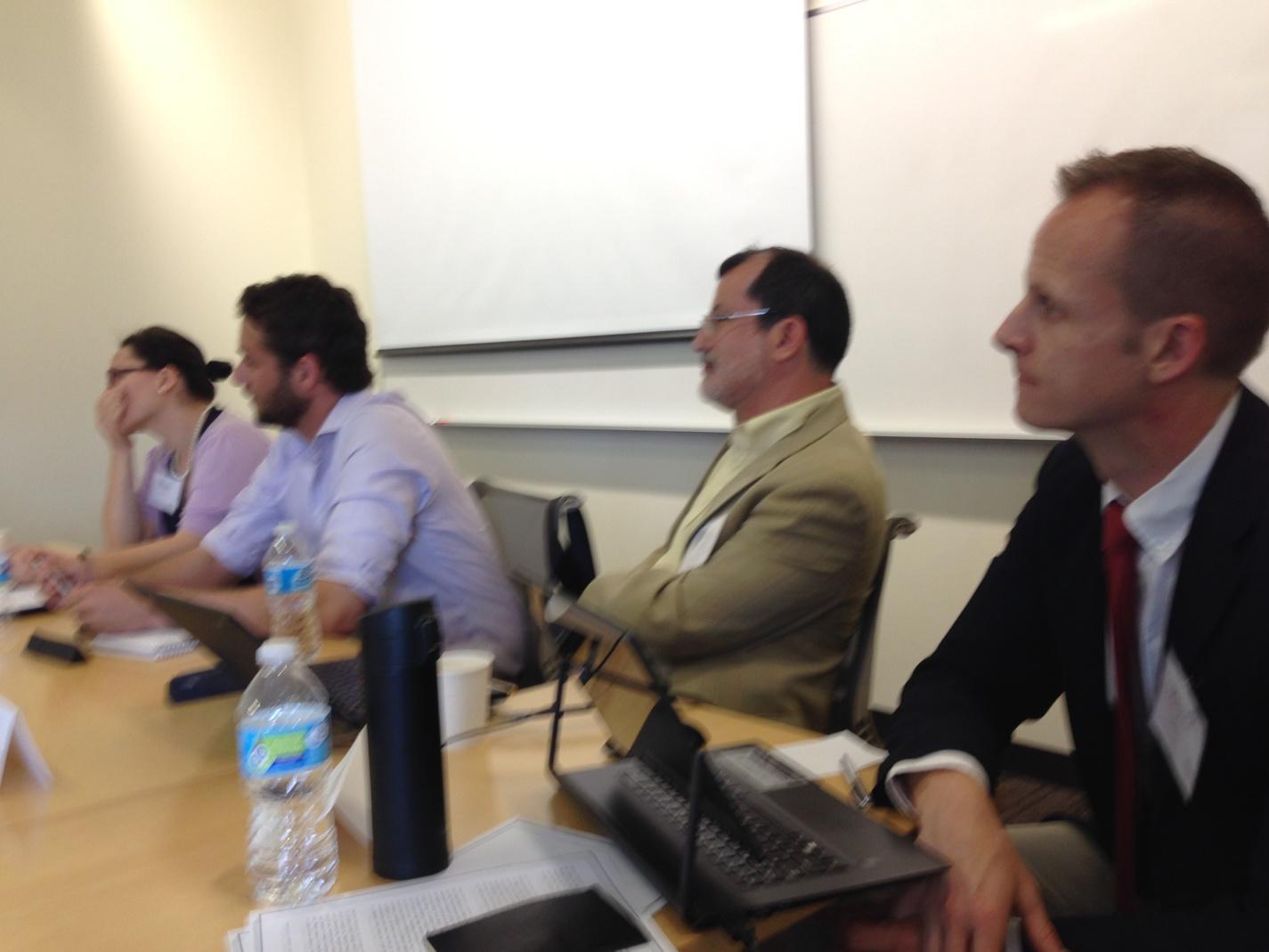
Yesterday, I had the chance to participate in the Bridging the Gap workshop led by Bruce Jentleson.  It is an effort every summer to help younger scholars figure out how to engage the policy world in a variety of ways, including figuring out how to write and publish op-eds, how to get into government for short periods of time (like the Council on Foreign Relations International Affairs Fellowship that changed my career/life), how to engage think tanks and more.

I arrived the day before and watched other folks (Michael Horowitz, Emily Goldman, Peter Feaver) talk about their government experiences, and then heard some editors talk about writing for magazines (Jacob Heilbrunn of the National Interest [we knew each other long ago at Oberlin], Ben Pauker of Foreignpolicy.com, Steve Clemons of The Atlantic).   I found both panels quite interesting and really enjoyed the deja vu from the first one as Mike and Peter, in particular, had experiences and reactions that were ones with which I heavily identified.

Anyhow, my job was, along with Ryan Evans of War on the Rocks and Kim Yi Dionne of the Monkey Cage, was to talk about blogging and other social media as well as the Online Media Caucus.  What did I say?

That blogging is now in its third generation--from random folks having small audiences and mostly talking to each other, to more prominent folks engaging wider audiences, to now a proliferation not just of blogs but of blogging collectives (Monkey Cage, Duck of Minerva, Political Violence at a Glance, etc) where the challenge is now getting one's blog noticed in the crowded space.

I discussed some of the pro's and con's of blogging (which mostly also apply to twitter):
 While there is some danger, I think even very modest restraint (I am not able to be more than just a bit restrained) is sufficient to allow one to partake of the benefits.

Should blogging/social media just be for tenured folks?  No, because we all should be disseminating our knowledge.  And blogging/twitter do lead to things like more citations, more engagement, more networking and this can actually help one get tenure as long as one does not see one's blog as a publication.  It does not count as a pub but as service.  Perhaps the easiest/least taxing/least risky way to blog as a junior faculty member or even student is to guest post.  This allows one to stake claims and gain visibility without appearing to be wasting time on non-pubs (old attitudes linger among the dinosaurs who have tenure).  For an engaging example of such a guest post, see this.

I also discussed twitter since I had heard they wanted more info on it.  I did admit that twitter can be a time suck if one gets engaged in long conversations or watches one's feed too much.  I insisted that not everyone should tweet but all scholars should be on twitter.  Huh?  That one can lurk and follow other researchers to learn about new research (I cited Jason Lyall as example) as well as follow key actors such as the NATO Secretary General (or my fave: @CanadaNATO and @USNATO) in one's research area, as well as the muse of the National Security twitter community (@morgfair).  One can find out lots of stuff without ever tweeting.

But if you want to make connections to journalists, experts, government folks and the like, then engage on twitter.  Ask them questions, retweet them if they say stuff that is interesting, offer one's views.  It is because of my engagement of the aforementioned NATO folks that when I was in Brussels, I ended up having real contact with real people and talked about the current dynamics within NATO regarding Ukraine and Russia.  I got in this business due to my curiosity--I want to know more about much--and twitter allows me to engage my curiosity in ways that foster my research and teaching and in ways that just entertain me.

How much can one say in 140 characters?  This central mystery deters many people from twitter: I can barely say something in 8000 words, so 140c?  My answer is that the 140 c constraint is a myth--as one can include links in tweets (to blog posts or whatever), that if pictures are a thousand words, then tweets can be a thousand words with the right pic attached, that one can have a series of tweets to make a point), and that conversations of 140c's back and forth add up to engagement. 

I concluded by plugging the Online Media Caucus, as both an advocate for those who use online media and as a focal point for talking about research, teaching, service and engagement via online media--how to do it better, how to understand it better.

Despite recent events, I think that we need to engage beyond academia more, not less, and the Bridging the Gap effort is an excellent way to help those who are interested in doing so.  I was glad I was able to attend and participate.  Not a bad way to spend a hot week in DC.