Sunday, April 30, 2023

Spew-Anniversary Time: Less Frequent, Still Generalizing But Now Generalized

Fourteen years flies by, eh?  I started blogging after peak blogging declined and while twitter was hip and fun and snarky.  Now, twitter is toxic, ok, it's owner is toxic, and blogging is hip again although folks tend to call it Substack.  I went from writing about anything sometimes four times a day to now writing far less frequently--sometimes four times a month.  I write less partly because I can just refer to an old post rather than rewrite the same thing over and over again. 

On the occasion of the 14th anniversary, I thought I would write something to keep up my monthly totals and to consider some of the ironies relating to my first post long ago and in a city not so far away (I am convinced that I write less because I am complaining about Quebec and its politics far less).

In my first post, I was reacting to two pieces I read and that were getting much play: one by Joseph Nye arguing that political scientists are not policy relevant and one by Francis Fukuyama about the need to get rid of tenure.  Let's take those in turn.  

I argued in the original post that the interest and willingness to engage the policy world varies among scholars, and that there are plenty of folks doing so.  Since then, the Bridging the Gap folks have not only produced many cohorts of folks interested in doing so, but this organization is now taking the next step with some others, pondering about the do's and don't's and the ethics of engagement.  DoD is populated by a bunch of political scientists these days, while DND (the maple version of DoD) killed their engagement program, the Security and Defence Forum, and then started a new one, Mobilizing Insights for Defence and Security or MINDS, that now funds nine networks on a range of topics.  We built the Canadian Defence and Security Network to foster greater engagement among the different parts of Canada's defence and security community, and after four years, I think we have been quite successful.

Of course, the question is whether policy-types listen to the academics or are they just checking boxes?  Hard to tell ultimately, but I do know that two of Arbour's recommendations came from one academic, and she consulted many during her review.  I also know that crises provide opportunities for outsiders to engage, and, yes, the Canadian military has been crisis mode for at least two years.  Anecdata is just that, but I have found that folks in government do listen to our BattleRhythm podcast, as I get calls when I say stuff that is out of date.   


Tenure is also in the news, as GOP-dominated state legislatures are attempting to wipe out tenure in Florida, Texas, North Carolina, and elsewhere.  People have always doubted whether the academic freedom that tenure was designed to protect was actually protected and deployed.  That is, people wondered whether academics might be trained to be uncontroversial through the probation period which then sticks, that profs do not really need academic freedom because they never really make use of it.

Dan Nexon commented on my first post, and it was most prescient:

those who say that the "free speech" issue isn't so important anymore only think that because tenure has protected it for so long. Abolish tenure, and things will get ugly very, very quickly.

Well, we may have a "natural experiment" where profs in GOP-dominated states will have different pressures/constraints to compare with those elsewhere.  Fukuyama was wondering if tenure caused stagnation as it reduced the incentives for profs to produce and to push.  He wasn't wondering about the punishment that may visited upon those who dare to dare.  Given how partisan, how ideological this current anti-tenure effort is, can we doubt at all that those in tenure-less places will have toe the line for fear of getting fired?  Just mentioning racism, which is an important topic in any number of history and social science classes, might be enough to get one fired, not to mention researching those in office right now who are white supremacists.  So, yeah, tenure is more relevant than ever, and the concern that it might cause some folks to become deadwood is far offset by the real threat of ideological conformity imposed by the far right that now dominates too many political systems (watch out, Albertan profs, you may be next).  

Finally, one of the themes of that first post was that I was originally miffed about folks generalizing about profs, but then I realized I am a professional generalizer.  I take ideas that I know well and apply them all over the place, to see what is common and what is not so common.  The funny thing is that I have recently taken umbrage at generalizations hurled at my kind--that some folks question the integrity of profs because they engage the policy community and even take money from the government, gasp!  As a good prof, I should be less concerned about folks thinking critically of my kind and more concerned with them doing the work as they criticize. That is, read our stuff and judge then if we are shills for whoever.  I do have 14 years of stuff right here.  Of course, some might think that this is a Steve Bannon-esque strategy of flooding the zone with shit.  Maybe?

There are many things people don't understand about professors, but two of them are:

a)  we don't pocket grant money--we use it to pay for research assistants (students), travel, access to data, equipment/software, and the like.

b) we spend our entire careers being criticized--the most valued publications are those that go through peer review, and peer review is often pretty brutal.  So, we tend to develop thick skins, as rejection is inherent in our enterprise, as I keep saying (I am 0 for 2 this spring in sabbatical fellowship applications, waiting to hear about a third).  

Of course, those are two generalizations that are mostly true but not always.  I hate when folks question my integrity, that kind of criticism does rankle.  So, my skin is not always as thick as I would like.  I am also easy trolled.  But that is a topic for another day.  Perhaps before the next anniversary.

One last thing: even though I have been doing this for fourteen years, I am always a bit surprised that people read my musings here.  The typos in many posts should remind folks that this outlet is for the half-baked.  The spew is only semi-finished.  Which may be for the best as my mistakes and my omissions have led to lots of interesting conversations.  Thanks for reading and engaging me.  While this thing may have started out as narcissism--my ideas are really important--this blog has really helped me engage my curiosity, learning much stuff along the way.


Tuesday, April 18, 2023

Open Letters, Closed Pockets?

 The Conference of Defence Associations Institute made a splash this week with an open letter "Call for Action: Canada's National Security and Defence in Peril."  It made a heap of news given who signed it: a heap of former ministers of defence, a bunch of ambassadors and high ranking civil servants, and several retired generals and admirals (tis funny to me that the title of the piece omits the squids and skimmers):

I respect the hell out of many of the signers as well as folks at CDAI, which as been a terrific partner of the CDSN.  However, I have quibbles, both minor and major, which I would have shared this morning on the radio had the host not gotten the wrong talking points--he asked me about Elon Musk and the CBC.  While it was fun to rant about bad faith actors engaged in vice-signalling, I did prep for the interview and didn't want to waste it, so here's some thoughts about this piece.  

First, I want to address a few specific gripes before getting to the larger context.

  • The letter talks about our military capabilities being woefully inadequate to protect our landmass.  That is not only true, that will ALWAYS be true.  How so?  The primary military threat to Canada are missiles launched by Russia/China/North Korea.  We can't stop those.  No matter how much we spend, we can't because we don't have ballistic missile defenses.  The Americans have been working on such defenses since Reagan's Star Wars speech, and they really haven't made much progress on it.  So, we should be clearer about what are the threats and what we need to defend ourselves from those threats.  The biggest threats to Canadian lives and property are stuff outside the military domain: climate change, pandemics, and cyber attacks (while the military has a cyber role, we should not be spending the scarce commodity of disciplined, trained people in uniform on jobs civilians can and should do).  People can cite Russian investments in the north, but we have to keep in mind that they have a whole lot of north to defend.  I do really worry about a war with China, but that is a China-Taiwan conflict that will spillover, and we will never have a navy big enough to make a dent in that conflict.  I say all this, even as I agree with the basic premise--we need to spend more.  But there are some difficulties with that, as I get to, below.
  • "We have also fallen short in meaningful contributions to burden sharing for the collective defence and security of our allies and partners."

 Oh really?  What burden has Canada shirked?  Canada paid the third highest price of any ally in Afghanistan and had far less restrictions until it became a training mission.  Canada is one of four framework nations organizing the defense/deterrence/reassurance missions in the Baltics and Poland.  While our contingent has been smaller than the others, the resulting need to organize many smaller and less respected (sorry) contingents has earned Canada a heap of kudos for stepping up when France refused to do so.  Canada has played a leading role in training Ukrainian forces before the Russian invasion of 2022 and since.  Canada has shipped a comparative level of arms and ammunition and other supplies to Ukraine.  

When people say Canada has not burden-shared enough, they really mean Canada hasn't spent enough on its military.  But that is not "burden-sharing" because spending on our own military really does not lift the burden that much from the others.  Here's a secret: the US would spend as much as it currently does even if Canada doubled its spending.  Indeed, given the domestic political dynamics driving American defense spending, I am pretty sure that if each and every US ally spent the equivalent of 2% of GDP on defense, the US would still spend about the same.  Which branch of the US military will say: hey, our allies have spent more, we don't need to spend as much?  Which defense contractors?  Which Senators and Representatives?  

And, yes, the easiest way to make progress to 2% is to tank the economy since it is all about spending relative to one's economy.  If one's economy grows pretty well, one might find one spending more money absolutely but not relative to that metric.  Canada is spending more on its military than it was a decade ago--more dollars, even if not a greater % of GDP.  More importantly input measures are dumb.  See Anessa Kimball's book for more on the craptastic nature of the 2% conversation.

  • Canadian civil-military relations conversations don't really address the challenges posed by having retired senior officers take political stances the same way these are raised in the US.  But perhaps they should.  If JC Boucher and I get funding, we will be studying whether the signals sent by retired officers cause Canadians to think that they are speaking for the active military.  If so, well, damn.  Because then the military is seen, rightly or wrongly, as taking a partisan stance.  And that ain't good. Folks can say this is a bipartisan letter since it has both former Conservative and Liberal politicians signing it, but nope, that doesn't do the trick since this letter is calling on this government, this party, to do better.  It does not call on Parliament to get its house in order even as the role of parliament in Canadian defence is so much weaker than damn near any other democracy.  So, this is critical of this PM and the Liberal party because they are the ones in power.  
  • Speaking of the former ministers, how many of them are responsible for the current mess?  How many of them cut spending, pushed back procurement processes, under-invested in procurement expertise, and so on?  Most of them?  All of them?  So much easier for them to criticize this stuff now that they are no longer beholden to parties and no longer running for office.
  • Which gets to the part that is most unrealistic: "the Government must radically accelerate timelines for procurement..."  Um, through magic?  A great application of Green Lantern theory.  DND doesn't have enough people to do the procurement stuff to buy the equipment and such.  So, that needs a heap of work to make happen before one can spend the money. If one were to magically allocate $15b more, the current staffing at DND couldn't spend it.

  Ok, the larger context.  The letter is right that the latest budget is disappointing from a defence/security perspective as it had no new money.  In my humble opinion, the gravest threat to the Canadian military is its recruitment and retention crisis.  That being short 16k people means not only that the CAF can't do as much, but that those in the CAF are stressed.  Stressed by having to do multiple jobs, stressed by not being well served by various offices that are understaff, and so on.  These pressures are likely to make it harder to retain people and harder to recruit, which will exacerbate the crisis--a downward spiral.  It would seem to me that while throwing money at the problem won't solve it, it probably could help.  Increase pay, increase benefits, spend more money on recruiting efforts, improve military bases, etc.  I do wonder what is happening to the money that is supposed to be going to the 16k soldiers, sailors, and aviators who aren't in the CAF.  Anyhow, that is one place where the money should be going.  

Another key part of the current context is that the Defence Policy Update is late and has generally been an opaque, underwhelming process.  Canada should have a quadrennial process--to review how well the last four years went and whether goals were attained, why DND/CAF fell short, and plans for improving as well as responding to new developments.  Instead, the DPU was going to be, from what folks have gleaned, a sales pitch for spending more money on NORAD modernization (which is necessary but won't actually lead to us being much safer due to that aforementioned missile defence problemo).  We will only be able to evaluate the DPU after it comes out.  

The previous review was much better than expected.  Maybe people liked it since it didn't make any hard choices as it didn't force any real tradeoffs.  But it did cost out the spending for the various programs and was pretty transparent.  Of course, when rolled out, much was made of putting personnel first in the document to suggestion putting personnel first in reality, but then Trudeau kept around a Defence Minister who kept around a Chief of Defence Staff that was abusing his power and engaged in sexual misconduct.  So, the proof is in the doing, not in the words on the page.

Finally, the political pressures run against most of this.  If we wanted good ships fast and less expensive, we'd buy them from countries that are good at that.  Instead, notice how the ship building is pitched by this government (and by the previous one, just not quite so starkly):


 That graphic is the cover for the 2015 Liberal Defence Platform.  Notice the purpose of naval investments--jobs.  Not ships.  Jobs.  Not defending maritime approaches.  This is one of the primary reasons why Canada doesn't have the equipment the CAF needs--that decisions are made about jobs and votes. Stephen Harper's plan was to capture Halifax and Vancouver via the shipbuilding program, but now all the parties are held hostage by Irving, Seaspan, and now Davie shipyards.  Folks can argue we need this capacity to maintain and upgrade the ships, but the choice to do it this way is incredibly expensive and ... no frigates (the AOPS ships the navy didn't really want are mostly broken).  

When we do import stuff, there is an urge to Canadianize it to make it fit Canadian standards.  So, now we have helicopters that are too heavy.  Oy.  The military always wants to put as much stuff as they can, so that the equipment can operate in all kinds of scenarios since they can only get one type of plane, one type of ship, and so forth.  But that goldplating makes the systems more expensive and less effective.  Again, choices need to be made, which might mean that a ship is good at one thing and not so good at another.  Because you know.... 👉

While this government is not great at delivering, most of this is hard-wired into Canadian politics.  Which party is going to get more votes by spending more money on defense?   "We believe this could be best accomplished on a non-partisan basis and would have broad public support."  Um, no.

Structural problems can't be fixed with just a call to arms and a smidge more political will (whatever that is).  Maybe this letter might impact those writing the Defence Policy Update, but that impact is likely to be on the packaging as the money is already set.  Trudeau has already made the decision for this year, and given the context--the war in Ukraine, the DPU, etc--I doubt that next year will be any different as we get closer to the next election.  

I get the frustration of those signing this letter. I share it.  I write blog posts out of frustration.  Other folks write open letters.  But move the policy needle?  I think not. 


Monday, April 10, 2023

Who Gets to Police The Defence and Security Community?

Driveby accusations of compromised integrity tend to create smoke that obscures.  It is easy, but it does not do much to advance the cause of transparency.  Pugliese is right that the government is not transparent enough in defence matters.  But spewing random accusations to taint those in the field does not provide greater transparency, but rather helps to foster more confusion.  It reminds me of what defence contractors do if they lose a bid--they raise questions about the process.  So, we never can tell if the process is decent since the losers always shit on it.  It may be populist to question the motives of all elites, but if one listens to these academics and the reporters they talk to at all, you will find that most just want Canada to do better.  We may disagree on what better means, but those in journalism and in academia are not motivated by profit.  

There is some irony in David Pugliese regularly calling out his media colleagues for not being sufficiently dogged or pure of heart or whatever.  What is it?  Well, he has set himself up with his Counterspin column in Esprit de Corps as THE defence media critic while being a defence journalist.  That seems to be a conflict of interest, which is his go-to criticism of many other people in this space.

Pugliese regularly criticizes his colleagues for not mentioning that some of their interview subjects may receive some funding from the Department of National Defence.  Of course, it is unrealistic that in any quick media hit that the journalist will mention all of the funding their subject receives.  But there is more to this, of course.

It is the questioning of everyone's integrity.  That is what is galling to those who find themselves the subject of these quick driveby's in Counterspin.  Yes, folks get $ from DND.  To be clear, each university has a research accounting office that ensures that the money is spent on legitimate expenses, and for DND or SSHRC money, that money is never income for the researcher.* This money never goes into the pocket of academics--it pays for the salaries of research assistants, it pays for travel for conferences and workshops, it pays for hosting events, and the like.  I am not paying for my kitchen renovation from the money I have received from DND.  So, are folks like me going to sell out our views for some research assistant salary?  If one suspects that they answer is yes, then read our stuff.  Critically evaluate our stances.  Just to mention the money is the laziest way to engage in criticism. 

Pugs criticizes anyone who is too close to the military.  I get that, but he is very close to the military too.  Not the institution but to those in it.  Where else does he get his leaks?  So, he is very dependent on those folks.  Does that make his reporting problematic?  It kind of depends on the story and the motives of the leakers, doesn't it?  Are they all pure of heart?  Damned if I know.  I wouldn't say that they are all tainted by being military personnel or being upset military personnel.  Likewise, I wouldn't say that anyone who meets with those who aren't leaking are either pure of heart or full of ill intent.  Again, to evaluate, read the stuff. I read Pugliese's stuff, and much of it is excellent, important, and necessary reporting.  Some of it is clearly folks using him to grind their various axes on minor issues that still seem to get on the front page. 

I am guessing Pugs would say that we say nice things about the powers that be so that we can get access.  Access for what?  Not to line our pockets because that is not how academia works.  Maybe we want access so that we can learn more, to understand things better, to share those improved understandings with our students, with those that read academic work, and with the public when the media reaches out to us.  Again, are we selling bits of our souls so that we can get this access?  The way, of course, to answer this is: read our stuff.  

One of the reasons this is all so very upsetting is that we live in a time of diminished trust in institutions and expertise.  There have been good reasons to distrust government, given how they have handled various crises and have made it hard to access information.  However, there are very few non-government voices in the defence and security community.  We do not have much of a tradition of relatively non-partisan think tanks.  We have various associations that get significant funding from defence contractors.  And we have very few journalists who have expertise on defence (Mercedes Stephenson has an MA from a Strategic Studies program!).  

This means that academics here get more attention than they do elsewhere.  It imposes upon us significant responsibility, so we do disclose on our websites where we get funding.  But we do not spend every media hit reporting who funds us.  We do not have the time, and, yes, we don't think our views are bought by whoever funds our research and dissemination efforts.  Indeed, academics would probably be voted most likely to bite the hand that feeds them.  For example, the same year I spent significant effort to get defence $ to fund the Canadian Defence and Security Network, I also spent calling for the Minister of National Defence to be fired.

The CDSN does not receive defence contractor funding.  We have had discussions about the perils of funding sources, how to remain independent, and we plan to have future events address the challenges of ethical engagement, building on the work done in the US funded by, gasp, a foundation--Carnegie Corporation of New York.  These are important conversations, and we should be having them.  But starting from the standpoint that only one man in Canadian defence journalism has integrity is not helpful or informative.  But maybe it makes sense if he wants to taint rival sources of information.  Of course, that would be speculating about his integrity, and that would be wrong.   


*  For those who are unfamiliar with academia, when it comes to grants, the way it works is:

  1. Apply to multiple grants
  2. Wait.  Tom Petty was right, the waiting is the hardest part.
  3. Grant application is approved by funder.  Does not always happen as I keep saying: rejection is inherent in the enterprise
  4. Get research ethics clearance from university committee.  The aim here is largely not to harm our research subjects--the people we interview.  These processes were developed after psychologists did bad things to the people they studied (Stanford Prison Experiment, the Milgram experiment)
  5. The university receives money
  6. Fund research assistants, organize events, arrange travel, etc.  
  7. Be reimbursed (one can sometimes get advances) for money spent on planes, trains, automobiles, hotels, per diems (usually something like $70/day for meals) with the aforementioned research accounting offices tracking what we spend and rejecting inappropriate expenditures..
  8. Report on activities and spending.
  9. Publish and engage the public/media.  Sharing our knowledge is one of the essential components of the job. 


Sunday, March 26, 2023

Professing about Punditry: Calculating Value Over Replacement Pundit, Canada Edition

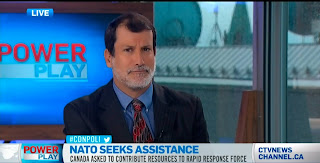
I look puzzled or annoyed as the anchor
got my title wrong, suggesting I run NPSIA
I have been thinking a lot lately about profs and punditry.  To start, I am just going to accept that profs who appear on TV are "pundits" as the definition of a pundit is: "an expert in a particular subject or field who is frequently called on to give opinions about it to the public."  Yep, that's us, among other folks.  Plenty of profs who aren't pundits, plenty of pundits who are not profs, but those who profess in the media are, indeed, pundits.  


This came up last week at the International Studies Association as there was a panel on "How Not To Bridge The Gap" which is about as deceptive as one can get in a panel title since it was really about how to bridge the gap--how to have the academics talk to the policy people and vice versa.  After a couple of decades of Bridging the Gap [BTG], a group dedicated to fostering the exchange, and a few years of a bit of that in a Canadian accent--the CDSN which has as BTG as a founding partner--folks are now asking about whether this is a good thing, whether it is dangerous, how to do responsible engagement, and such.

While all of this can be and should be quite complicated, I have a basic take on whether or not to do media stuff (and since I do a fair amount, you can guess where this is headed):

  1. We get public money to do our research, so we should give back.  Indeed, many grant applications require a dissemination plan.
  2. A fundamental part of professing is to disseminate knowledge.
  3. And if not us, then who?

This last thing is my focus today and was when I piped up from the audience last week.  That if we don't speak, the media will find someone else to fill that time slot, that page, that podcast, whatever.  So, one must ask themselves if one can bring more to something than whoever else they might get or whether one might not be as fit for that topic or issue than whoever else they might get.

This is where I borrow a concept from the analytics revolution in sports.  There have been all kinds of ways to measure the value of baseball players compared to each other, basketball players (one measure is called RAPTOR!), and so on.  My personal favorite happens to be from baseball.  I like it so much both because it has a good conception and has a fun acronym is VORP: Value Over Replacement Player.  This enables one not only to assess how a generic player in their position in the same season or time frame, but to compare players at different positions or in different time frames.  While technology, strategy, and medical care and the rest have changed over time, we can use this measure to figure out the relative value of players from different generations.  Babe Ruth is still #1 followed by Walter Johnson, Cy Young, and then Barry Bonds and then Bonds's godfather Willie Mays (this settles the Mantle/Mays thing).  I am happy to see Tom Seaver above Greg Maddox, that Seaver was much better than the replacement level starting pitcher of his era compared to Greg Maddox to the replacement level starting pitcher of his era.  In basketball, this puts Lebron over Jordan, which folks might disagree with just a bit. 

The point is not to stir up a debate about sports, but the idea of measuring someone compared the person a team could get that is easily available--off the street, from the waiver wire, from the minor leagues, whatever.  When it comes to media stuff, the producers of the various radio, television, podcast, and other programs need to fill content, so they will grab someone, anyone, to fill in a spot.  So, the point I raised at the conference and part of the reason why I do media stuff is: would we rather have a knowledgeable expert or some schlub off the street?  

Of course, they don't get just any schlub, they go to the experts who are already on their rolodex (to date myself even further).  We tend to see mostly the same folks again and again depending on the issue, so the question is, for every expert, are they more expert or less (dare I say it) hacky than the person who might be called instead?  

The VORP in sports is easy to calculate even if what goes in the calculations can be and is debated--how much does excellence at anyone time count compared to lifetime achievement, etc.  In punditry, how do we calculate VORP?  It will be less about what is quantified and more about what can be compared and ranked.  So, what may be in the minds of the producers and should be in our minds as we come up with a Value Over Replacement Pundit:

  1. How well they know the topic at hand?  Some folks are super sharp at one thing, others know a bit about a lot.  This measure here is about how much they know about the specific topic?
  2. What is their range?  How broadly can they speak?  Because you know the anchor is going to go off script and ask questions that are not necessarily in the strikezone.
  3. How articulate are they?  Can they speak/write clearly and dynamically?  I will mention my Lebron/Babe Ruth in Canadian circles on this measure below.
  4. How measured or responsible are they?  Folks saying that war between US and China is inevitable, for instance, have a lower VORP because they may very well be creating a self-fulfilling prophecy.  My speculating about terrorism in 1996 Lubbock should have set my VORP at a negative number.  On the other hand, I was far more responsible last March about calls for a No Fly Zone than a bunch of retired military officers in the US and Canada. 
  5. Availability: in sports, health is a gift/attribute in its own right, which means that some players rank higher because they can play most days.  Kevin Durant's VORP has been hurt by his various injuries.  In the pundit game, the question is whether one is willing to do it a bit, some, or a lot.  This can obviously tradeoff with expertise/responsibility pieces. 

There are probably other ingredients/variables, but let's stick with those for now, and folks can suggest additional ones.

The first item--how well they know the topic--allows us to bring in the positions from sports.  That one can have a high VORP if one is playing a position they are good at and a low one if they play one that is not their strength.  Babe Ruth has an incredible VORP because he was both a terrific hitter and an amazing pitcher.  So, some folks will have high Value Above Replacement Pundit because they know a lot about a lot, and they have the other key ingredients. In thinking about this and my experiences both in the media and watching other folks, I thought I should use a few key issues to highlight who has a high VORP.  And, yes, this was partially inspired by watching two NPSIA colleagues and one PhD student absolutely rock the Canadian intelligence beat.  

So, enough with the explanations and definitions, who has a high VORP in Canada?  Note, this is illustrative, not exhaustive.

I think number one on Canadian foreign policy, broadly defined, is Roland Paris.  He brings his years of academic experience on peacekeeping and international relations to bear along with his various times in government at different levels.  He is simply terrific at articulating complex stuff--his quotes today about Biden's visit to Ottawa were both accurate and delightful.  He is also very responsible--he's not going to say something that is wildly speculative.  If I were a producer, I would always go to him first on damn near anything.  When I appeared on TV with him once, I just basically said: "I agree with Roland." It did not make for good tv.  Bessma Momani has wide-ranging expertise, is compelling and clear, so she's a great go-to for Canadian relations with a variety of places.

On intelligence matters, Canada has quite a few folks who are super sharp on this: Stephanie Carvin, Leah West, Jess Davis, Artur Wilcyznkski, and Craig Forcese clearly have very high VORPs (I think Amar Amarasingam does too, but I haven't seen as much of his stuff).  Stephanie, Leah, Jess, and Craig have done extensive research, Artur has far more experience than the others in government in so many spots (he is a great podcast co-host for a couple of the podcasts on the CDSN Podcast Network).  Each are quite responsible, sticking within their lanes of expertise, not speculating wildly, and not having any ideological axes to grind (that's a hint for many of the folks who have low VORPs--who tend to dominate the editorial pages).

On defence stuff, Thomas Juneau has among the highest VORPs because he has academic and policy expertise, a willingness to do the media stuff, is excellent in both official languages. Stéfanie von Hlatky would have the highest defence VORP except she does not do that much media.  I wish she did more as she is super responsible, knows the Canadian defence scene, knows the US and NATO well, again strong in both languages.  I had fun watching her at a couple of NATO summits where the Canadian media grabbed us to "scrum" with them.  

Of the columnists, I think Shannon Proudfoot easily has the highest VORP.  Her columns always are well reported, provide valuable perspective, making one see things from a different angle.

Where do I fit in?  I think I have a decent, positive VORP score, but not as strong as those mentioned above.  I am not as articulate or as responsible.  I have a wider range than most, except perhaps Thomas and Roland (reminds me of the polls that show that men are far more confident about landing planes or battling bears), but with that greater willingness to talk about stuff at the edges of my expertise, I say stuff like Ukraine is going to lose the war.  I was wrong (many were wrong about that).  I should have been a bit more circumspect about potential predictions even while being clear as I could why a No Fly Zone was super dangerous. I did have fun saying "your guess is as good as mine" when an anchor went against the instructions asking about the pipeline sabotage.

One of the things I have been emphasizing in recent years is saying no to the media where my VORP trends negative or where I know folks who have much more value.  During the Vance/McDonald/Sajjan stuff of two years ago, I kept directing the media to people who studied gender and the military.  I was far more willing to talk when the story focused on civilian control of the military, something I study.  I have declined to speak much about balloons or about election interference as I really don't have that much to say.  I really don't know much about China, for instance. 

I will speak beyond my areas of expertise on the Battle Rhythm podcast because it is a smaller audience, I can edit myself afterwards, and my co-host and guests can and will correct me.  For a five minute hit on radio or TV, the anchor person is not going to push back if I say something wrong.  They may want me to do so since it might make for better tv.  

Who has negative VORPs, where a replacement pundit available off the street or waiver wire would be a significant improvement?  I could name a few obvious retired senior military officers, but that would be unnecessary.  I could also name some columnists for national papers in Canada including one who used to own a bunch of them before/after? he was convicted.

So some caveats here--I don't watch as much tv and I certainly don't listen to too much radio, so I am mostly influenced by the times I have appeared with other folks.  And, yes, most of the people listed above are very good friends.  I don't think I have to agree with someone to give them a high score.... but it probably doesn't hurt. Does that make me biased or do I simply hang with people with high VORPs?  ¯\_(ツ)_/¯

There is a tradeoff I forgot to mention in the first posting of this: if you say no a lot, they won't come back.  Which can be cool if one does not want to be bothered.  But saying yes a fair amount means that when I do say no, I can refer them to sharp, younger people who they don't know about, and this allows me to connect the media to diverse voices.  And they often listen.  The media wants good people, but they also have lots of time pressure, so they often go to the easiest get.  But if you give them help, they will add to their rolodex.

Feel free to nominate in the comments folks in the Canadian IR media space who are at either end of the VORP spectrum or in between.


Sunday, March 19, 2023

ISA 2023: So Much Gratitude

The ISA poster maker
was not wrong

 I am sticking around in Montreal after a wonderful ISA conference as I have a CDSN workshop on Climate Security.  So, I am hanging in my hotel room, marveling at how lucky I am.  I had a great time, meeting old friends, making new connections, giving feedback on a wonderful book, and being really grateful.  After two cancelled ISA's (Hawaii and Vegas, damn it!) and one strange, poorly attended one in Nashville last year, I was determined to hug longer and share my gratitude with all those who helped me along the way.  As it was a conference full of special events, this was not hard to do.


Lauren and me on
reconstructed McTavish       

Started by meeting up with a former undergrad who got hooked on IR in my Intro class at McGill . We walked around our old stomping grounds.  Lauren Konken and I had a great time, chatting about ye olde days and noticing what has changed at McGill.  The plywood instead of a real railing on my old office balcony?  Nope, that didn't change.

A ritual for Montreal conferences is for my former student Ora Szekely to take me to her favorite Chinese restaurant in Montreal's mini-Chinatown.  I am always thrilled to see my former students--they are mostly doing great, and they are mostly very funny people.  So, conferences are great for both silliness and pride.  I am quite thankful that I have had such great students over the years even if I whine about reading endless drafts.

I met with several editors to promote the Dave/Phil/Steve book manuscript, and they all indicated much interest. I feel good about our chances of getting our book out to a great press in the near future.

This was a year full of honorary panels honoring people I know.  Which means I am getting old.  I was asked to be on Victor Asal's panel, as the Ethnicity, Nationalism, and Migration section gave him an award for all of his work, and it was my honor to join Ora, Erin Jenne, Pat James, and some other folks (my memory sucks after a week of reduced sleep).  Victor has published an incredible amount of work in many areas with many, many co-authors.  And he is a mensch.  These panels are supposed involve some roasting, so I teased him gently while also noting his contributions and his mensch-ness.

For the first time, I attended the Presidential speech because the President for the past year has been Debbi Avant.  She was one of two senior IR grad students at UCSD when I arrived.  She was most welcoming, throwing a party for the prospective students, and then over my time there, most generous with her advice, and most supportive.  She was also a hell of a role model, starting with her doing security stuff at a time where no prof at UCSD did international security.  She was a pathbreaker in the field of civil-military relations, applying principal-agent theory to it before Peter Feaver made it cool to do so.  Since then, I have often asked her for advice, which she provided quickly and insightfully.  She threw yet another party when I visited Denver when I gave a talk on the Steve and Dave NATO book.  Most recently, she has served quite helpfully on the CDSN Advisory Board.  She gave a great, challenging talk, and was perhaps a little disappointed she didn't get as much pushback as she expected.

The other highlight was seeing my supervisor, Miles Kahler, be honored by various IPE luminaries.  The person assigned to talk about his work as an advisor could not make it, so I was happy to stand up towards the end and tell folks what a difference Miles has made in my career.  It was great to hear from these IPE leaders how Miles stood out, making me realize how I ended up emulating him--focusing on the domestic politics of IR, being at the intersection of comparative politics and IR, being a fox rather than a hedgehog (moving around, studying a bunch of stuff, rather than being focused on one big thing), and so on.  I was the first PhD student for whom he served as chair of the dissertation committee/primary supervisor (Debbi was the first one he worked with at UCSD).  So, maybe I made a dent on him too?  I am glad I got a chance to say a few words of thanks (and of snark) and share my appreciation of not just a great scholar but a terrific person.  I am far less intimidated of him now ;)


So, it was perfect that I ended my ISA by going out to dinner with Miles, his partner, and with another student of his.  It was a great dinner with a great beer, one that had a can that all admired.  "Any Time Is the Right Time."  Indeed. 


Friday, March 17, 2023

Talking to THE Civilian in Canadian Civil-Military Relations

 For the second straight year, Minister of National Defence Anita Anand joined my Civ-Mil class towards the end of the term.  That she is a former prof helps a great deal, I am guessing, in persuading her to spend roughly a half hour of her very busy time with us.  Last year, it was a bit of surprise.  This year, I knew ahead of time so I could prime my students to ask civil-military questions, not just Canada in the world questions.  And since the theme of yesterday's class was Culture Change, most of the questions focused on that. 

Once again, she spoke for a few minutes including discussing her background in corporate governance and how often she was in a boardroom that was far from diverse--that her previous work set herself up well for this moment.  She then talked about some of the achievements of the past 13-14 months: adopting the interim recommendation from Arbour about transferring sexual assault cases to the civilian courts, accepting the recommendations of both the Arbour panel and anti-discrimination panel, apologizing to those who were in the class action lawsuit, and more.  She noted that there is a lot of skepticism about culture change (I have heard much of that online and in person), so she noted how promotions of generals and admirals has changed (in my view, there is now much more civilian oversight than in the past, a very good thing), she mentioned a few programs that will be starting soon that I can't talk about at this moment, and more.  She said that she hoped to institutionalize these measures so they last for decades although this kind of contradicted some of her answers that focused on the right personalities and relationships at the top of DND/CAF. 

Anand then answered many questions.  So, what did they ask and how did Anand respond?

First, one student asked about whether the culture change effort was a short term effort or would require generational changes.  Anand indicated that there is no deadline, that it will require decades.

Second, how will the culture change fit into the defence policy update.  Here, she referred to a recent op-ed that suggested that she and DND were too woke and Marxist--she indicated that culture change is not something that gets in the way of operational effectiveness but is a necessary ingredient, something I have been yammering about as well on twitter and here.

Third, one student asked about the basic structure of Canadian civ-mil--that is a diarchy with the Deputy Minister and Chief of Defence Staff being equals.  Anand indicated that this structure works with the current team (which raised questions about what happens when the team is not good, and perhaps that structural change might protect against that some?).

Fourth, a student asked how do you keep this stuff prioritized?  The Defence Minister said that she needs to ensure every day that she, the CDS, the DM, her team, and everyone else is focused on this every day.

Fifth, one student asked about data sovereignty.  Anand responded by discussing how NORAD modernization is going to include a whole bunch of initiatives to improve the digital side of things.

Finally, our Visiting Defence Fellow, Colonel Cathy Blue, asked why Anand hasn't considered developing an Inspector General.  Anand noted that other agencies in Canada and beyond have IGs, but that her job as minister is to focus on implementing Arbour's 48 recommendations.  I found that a bit troubling as I understand that she is busy and the demands are high, but I didn't think the Arbour report was perfect and and should limit the imagination of what the Minister/DND/CAF need to be doing.   

I didn't get to ask any questions as I wanted the students to get their questions in during the short time we had with the Minister.  I will save mine for a future podcast interview or whenever we meet in person.  She did ask about my cookies, and my policy is always to deliver in person, so maybe some day we can actually meet in real life.  As always, I am super impressed with the current Minister of National Defence--I continue to think she is the right person in the right place at the right time.  She has faced greater challenges than she probably expected including a war in Europe.  We don't always see eye to eye on things, but she takes this whole civ-mil thing very seriously and very thoughtfully, and I really appreciate that.   I am very grateful that she is willing to hang with my students for a bit, as the students got a lot out of it.  I am also thankful to my students as they asked great questions.