Showing posts with label CSIDS. Show all posts

Monday, December 12, 2022

The Year Ahead 2023

 The Year Ahead conference, which started before the CDSN came into existence, has become a flagship event for both the Carleton research center, Centre for Security, Intelligence, and Defence Studies, and the CDSN.  It provides NPSIA-based scholars with a chance to interact with experts we bring to town and folks from in and around government who attend the event.  We consult our partners in government to see what is on their radar screen for the next year, and try to have panels that are relevant to them.  This year, we had panels on:

  • learning from Ukraine's successes and Russia's aggressive failures
  • the state of Canadian civil-military relations
  • xenophobia and national security, organized by our collaborator Women of Colour Advancing Peace and Security.

We also had a fourth session that was a little different.  We started with a Q&A between myself and Colonel Cathy Blue, our visiting Defence Fellow.  An Air Force officer, she is spending the year with us, auditing a few classes, working on a research project, advising us, providing us with a military point of view, engaging the students, and continuing her professional military education program that comes out of the Canadian Forces College.  She has been an incredible asset this year, a great sounding board.  

After that, we launched the CDSN Podcast Network!  We decided to build our own network so that we could provide opportunities to new podcasts across the country to be heard.  In addition to BattleRhythm, the CDSN's podcast for the past 3.5 years and Conseils de Sécurité, our partnered podcast with RAS/NAS en français, we will have SecurityScape and NATO Field Report.  SecurityScape is a podcast by graduate students at Calgary's Centre for Military, Security, and Strategic Studies, a partner of the CDSN.  They have had one season thus far, and they will drop six episodes of season two in 2023.  NATO Field Report will be a completely new podcast, run by the students and professions involved in the NATO Field School, which brings students to Vancouver for classwork and then onto Europe to various NATO facilities and headquarters.  They will be be dropping episodes episodically--as the field school approaches and then have interviews and reports during the field school's trips to Brussels, Latvia, and wherever else they go.  That we include a podcast that is a different model from the original ones helps to open our imagination for future additions to our network.

Along the way, we fixed a problem with had with our Apple feed. While we have consistently been producing episodes of BattleRhythm, those that relied on our Apple field were not getting automatic downloads of episodes.  Our stuff has always been available at the other outlets (Soundcloud, Spotify, Stitcher, etc.), but now we fixed this problem.  Folks just have to go to the Apple podcast app and search for CDSN and subscribe to get all of our podcasts.  

At the conference, we did a Q&A with the producers and hosts of the various podcasts.  We are very excited about all of this.  If you have an idea for a podcast on defense/security broadly defined, let us know, as we are looking to connect and amplify--the basic CDSN mission.

Nina Tannenwald
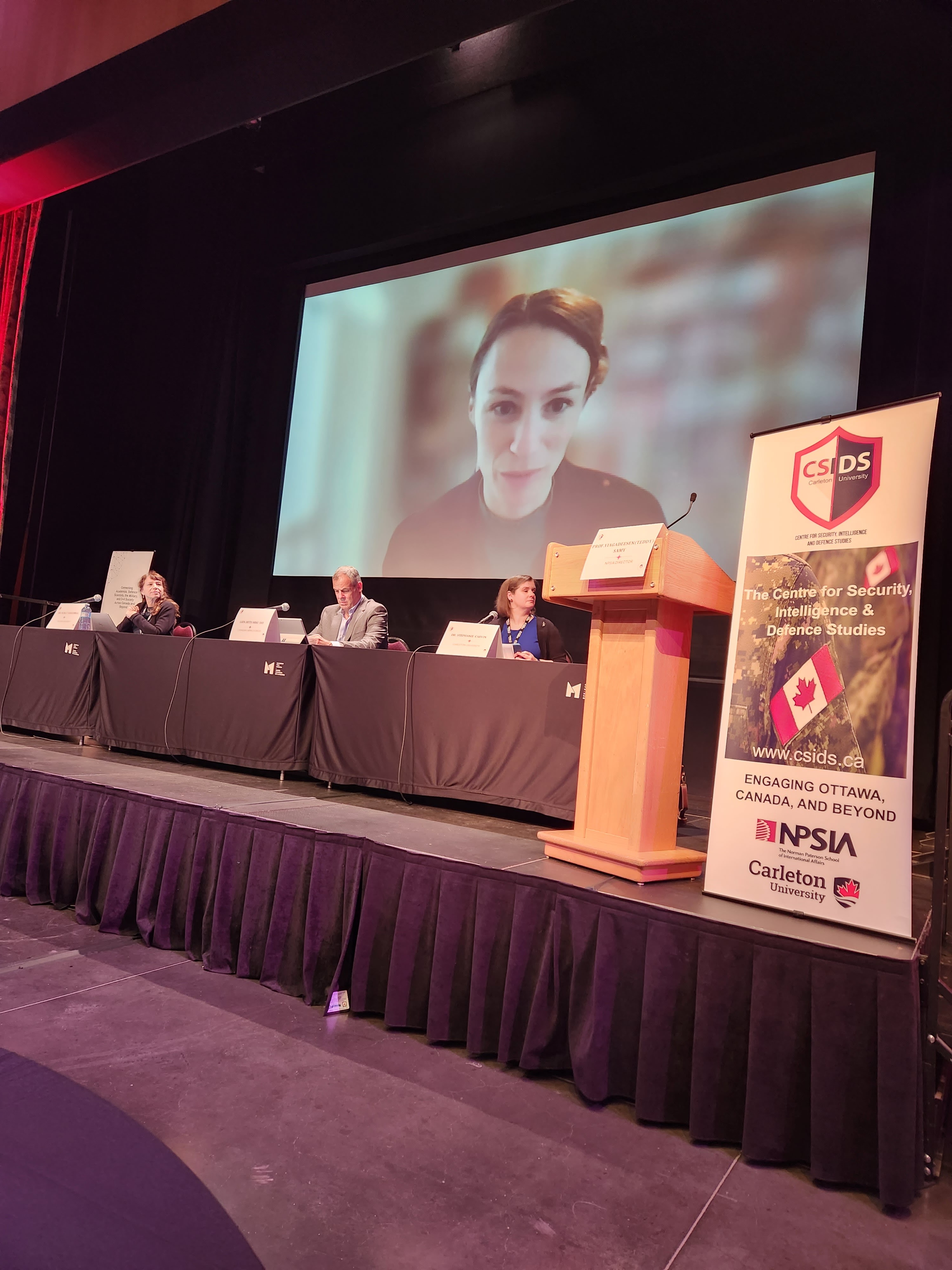
Back to the panels, we had Brown University Professor Nina Tannenwald, who discussed the nuclear weapon issues related to the war, retired LGen Mike Day who delineated the lessons from the war itself, and, via zoom, U of Texas Professor Sheena Greitens, who analyzed China's responses to the conflict.  It was a fascinating discussion.  

I moderated the Civil-Military Relations panel where Calgary Prof. Jean-Christophe Boucher and Charlotte Duval-Lantoine of Women in Defence and Security presented a survey they (and me and Lynne Gouliquer) are working on whether the various scandals are affecting Canadians' trust in the military, Andrea Lane of Defence Research and Development Canada presented the challenges posed to the Canadian Armed Forces by political polarization, and Alexandra Richards of Simon Fraser U. analyzed differences among the various generations and their attitudes.  

The final panel on Redefining National Security, organized by WCAPS-C, included Dr. Nadia Abu-Zahra of both Carleton and U of Ottawa, Azeezah Kanji of the Noor Cultural Centre, Jillian Sunderland and Aaron Francis of U of Toronto.  They presented critiques of the defence and security apparatus and community, especially the treatment of historically excluded communities.

We streamed the event, and it will appear on our youtube channels (CDSN and CSIDS) once we get things cleaned up. We will also be circulating a report and related policy notes in January.

I am very grateful for Team CDSN, especially Melissa Jennings, Sherry Laplante, Cathy Blue, Carelove Doreus, Racheal Wallace, Robyn Lalecheur, David Le, Duncan Herd, and Daniel Kholodar, and to the presenters and moderators.  It was great meeting both presenters and audience members, as the event is also a great networking opportunity.  We will do a "hot wash" to figure out what worked best and what could use improvement.  We are open to feedback so if you have suggestions, let us know.

And, yes, we do this stuff so we can eat food and hang out.  

Indeed it was.


I love Charlotte's expression as she realizes
that I am taking a mid-meal pic


Friday, November 4, 2022

The Rising Threats in the Indo-Pacific: Insights from Japan

Colonel Cathy Blue, our visiting defence
fellow, introduces the Vice-Admiral
 This week, the Centre for Security, Intelligence, and Defence Studies (NPSIA's research centre on such stuff) hosted Vice-Admiral (ret.) Toshiyuki Ito who was visiting Ottawa. 

Admiral Ito gave a comprehensive talk about the threats facing Japan and everyone else in the region from Russia to North Korea to China.  As a retired officer, he could be more direct about the threats perhaps than an active one, and he humorously invoked "academic freedom" anytime he said something that was a bit controversial.

Japan has to scramble aircraft twice a day to confront Chinese and Russian aircraft.  Ito spoke on a record-setting day as North Korea sent more missiles near and over Japan while it was also engaging in greater tensions with South Korea.  He did not address the difficulties with South Korea that would make a more coordinated response more complicated.  

Ito discussed Canada's exercises in the region including the monitoring of sanctions against North Korea and the freedom of navigation operations in the South China seas.

Perhaps most striking, Ito made it clear to the Canadian audience that a Taiwan scenario--the imminent attack by China (sometime between now and 2027)--is also a Japan scenario for a couple of reasons.  First, there are some Japanese islands mighty close to Taiwan, and it is hard to imagine these islands would not become part of China's invasion plans.  Second, the US has pivotal bases in Japan, which might be specifically targeted to prevent US intervention in a Sino-Taiwan war. 

Here, Vice-Admiral Ito illustrates the
evolution of Self-Defence and
how it fits into the constitution

Ito talked about the need for what he called counter-attack systems--which are essentially first strike systems designed to hit missiles aimed at Japan before they are launched.  This is part of a larger effort to squeeze today's realities into the constraints posed by Article 9 of the Japanese constitution.  That clause prohibits Japan from having a military, although Japan has one by another name: Self-Defense Force.  Its navy, Ito said, was the second largest or more powerful in the world after the US.  The dodge has always been that all sovereign countries are entitled to defend themselves, so the SDF is legitimate (not all Japanese parties agree).  But what counts as defense?  Knocking down incoming missiles is obvious.  Having the ability to pre-emptively strike those that have not yet launched?  Hmmm.  

Japan is doubling its defense spending, getting to 2% when the controversy used to be whether it would exceed 1% of GDP on defense.  What will it spend money on?  Perhaps F35s and missiles?  Unfortunately, we ran out of time so we could not get more specific answers to this and other questions.

It was very useful and interesting to see the Indo-Pacific from a different perspective.  I always this this map I saw all over Tokyo in government offices to illustrate:

This point of view best illustrates how China
is hemmed in by Korea/Japan/Taiwan/etc.


Saturday, December 4, 2021

The Year Ahead 2022: Hybrid Success

 Yesterday, the CDSN and CSIDS held the Year Ahead, which is an annual conference in Ottawa (and beyond).  The idea is to address some of the challenges likely to arise in the next year.  We consult our various partners in and out of government to get a sense of what those challenges are.*  We built a program focusing on:

  • Grey zone warfare--attacks from the usual suspects short of conventional war--cyber, disinformation, etc  Our two panels focused on the legal dynamics (do the various actors have authority or not) and what our allies are doing.  Leah West, my colleague at NPSIA, organized the first.  I corralled the second panel and had Rachel Babins of the new organization Emerging Leaders in Canadian Security moderate the second.  Key insights here:
    • international law is not as much of an obstacle to reacting to this stuff as some think.
    • that maybe the Russians and Chinese are worse off now as they have alienated much of the planet; 
  • Our fireside chat focused this year on Islamophobia and National Security, and was organized by a new group--Women of Color Advancing Peace and Security-Canada. 
    •  That Muslims are less likely to turn to the government if they fear that the government will destroy their sons.
    • That creating a crime focused on terrorism mostly put a target on the backs of Muslims even as far right white folks hurt more Canadians.  Indeed, Muslims have been victims of terrorism more so perhaps than any other group in Canada [except, I am guessing, women]
    • the government seems super fast when it imposes new policies and laws that are harmful to Muslims, but slow to introduce reforms, such as getting innocent kids off of no-fly lists.
  • Changing the culture of organizations.  Our directors of the CDSN Personnel Theme, Irina Goldenberg and Stéfanie von Hlatky, organized this panel, which consisted of experts in and out of government.
    • culture is a verb as well as a noun
  • Our final panel focused on nature-triggered emergency operations in Canada.
    • the trend in major emergencies is just astonishing--a very steady increase over time, including six this year.
    • greater clarity about why militaries seem to be the go-to: timeliness, competence, efficiency, and so on.

We will be issuing a report on the event in the new year--our research assistants took better notes than I did as I was focused on the event and the various complications.  We were not used to doing a hybrid event so we didn't have a way to tell the moderators that time was running out, for instance.   You can check it out for yourself:  here are the English and French videos of the entire event.

It was definitely worth it ** to hold the event as a hybrid.  We were able to get participants from other parts of the world via teleconference, and we had more people watching online than in person.  The in-person component was quite valuable as there were plenty of conversations in between the sessions, and we squeezed a lot into the day that we could not have if we were doing it online.  So, the best of both worlds, I think.

I am very, very grateful to our CDSN team for making this work so well.  Kaha, Melissa, Paxton, Racheal, Rose, and Gabriel were terrific.  And having others organize and moderate the panels worked out great.  


*  This post is being written on the road so I am not going to post pictures (they are on another device or the names of everyone) 

** Of course, if people end up catching COVID due to our event, then the costs/benefits calculation shifts....