Showing posts with label Year Ahead. Show all posts

Monday, January 5, 2026

Seven Years of Activities and Research: Presented and Celebrated

Last month, we celebrated seven years of CDSN-ing.  Our seven year grant ends in March,* so we held a Symposium on Monday focusing on our various activities and we filled our annual Year Ahead conference with our research teams presenting the culmination of their reserach projects.

Both days were terrific, and overall, it was a blast, as I learned a lot and I enjoyed how much everyone appreciated all the work we all did over the grant's timeframe.   

Our first day started with a roundtable about partnership, appropriately enough.  We had speakers from across the defence and security community: Caroline Leprince of DND, Cesar Jaramillo formerly of Project Ploughshares, Adam McCauley of CANSOFCOM, and our Visiting Defence Fellow Shawn Guilbault.  We talked about the challenges of bringing together actors with different perspectives, what each needs from and contributes to our partnership, and how we can better bridge the various gaps.

The second session focused on our post-docs--formerly (or still) emerging scholars who spent a year at one of our research centres, receiving mentoring on their research as well as much professional development and networking.  Linna Tam-Seto and Thomas Hughes now co-host our Battle Rhythm podcast, Manu Ramkumar may be doing similar stuff in the future, and Sanjida Amin is our current post-doc.  It was great to hear what they got out of the experience with us, and I am grateful for the insights and energy they brought the CDSN.  

The third session focused on our podcast network.  We started out with just one podcast on someone else's network, and now we have seven programs on the CDSN podcast network.  So, we talked about what each program was trying to achieve and what they learned along the way.  I chatted with Hannah Christensen of the NATO Fieldnotes podcast, Frieda Garcia Castellanos of Bylines and Frontlines from Women in International Security-Canada, and ....  They came to the podcast network in different ways, so it was really interesting to learn what they had picked up and what they wanted to do next.

The fourth session featured the victims of our book workshops--emerging scholars who had their books collaboratively scrubbed by local colleagues and experts the CDSN brought in. Stephanie Martel, Sara Greco, and Thomas Hughes spoke about their experiences with Srdjan Vucetic moderating the panel.   


Our fifth session had our past and present Undergraduate Excellence Scholars discuss their experiences.  Our aim was to include undergrads from historically excluded groups more involved in our network and in the Canadian defence and security community.  Chimdinma Chijioke, Armon Jeffries, Stella-Luna Ha, and Bianca Siem did different things, some were more involved in our stuff, some less so, some have moved on to graduate programs in defence and security, others are now employed in this sector, and some found work elsewhere.  This effort was not part of the original grant, but became a key CDSN activity as we realized we could do more to help foster a diverse, inclusive, and equitable network and community.  These folks proved that our modest investment was well worth it.

The last panel of the day focused on what the CDSN Co-Directors learned from seven years of partnership, research, and my nagging for reporting.  Anessa Kimball, JC Boucher, and Stefanie von Hlatky were instrumental in our success partly because none were shy about telling me and the rest of the team what we could do better/differently, and this roundtable illustrated that nicely.


That evening, we had a wonderful reception that helped to celebrate our accomplishments and continue the networking that has been both vital to our efforts and helpful to the individuals who found us along the way.

The second day of CDSN fest was a twist on our yearly Year Ahead conference.  Usually, we ask our partners in the defence and security community about the issues that most concern them in the near future--the year ahead--and then organize panels around those issues.  This year, we did something different--we had our SSHRC-funded research teams present on some of the stuff they learned over seven years of research.

The first panel was our Operations theme--what is the CAF doing in the world and what are we learned about it.  Alex Moens presented the state of the NATO Field School, which has been his passion project for at least a decade.  Andrea Charron discussed the challenges of US-Canadian relations as it affects continental defence, which spoke nicely with Stéphane Roussel's analysis of the efforts to develop greater autonomy from the US.

The next session was our Civil-Military Relations theme organized and moderated by JC Boucher.  Nik Nanos, a key partner, focused on the trends he found in the polling he has done with us.  Alexandra Richards discussed  her research on how the different generations of Canadians vary in how they see defence and security issues.  Caroline Elie from DND's Public Affairs spoke about the challenges of informing Canadians about defence even as it becomes a very high priority and very salient issue. 


The third session was a keynote speaker: LGen Stephen Kelsey, Vice Chief of the Defence Staff.  He did an excellent job of providing a short talk that gave us lots of time and material to spawn a really fascinating Q&A.  

The fourth session was our Security theme roundtable.  It was interesting to see how much of the focus was on NATO as our original intent with this theme was to ponder a variety of conceptions of security.  Srdjan Vucetic addressed what would endure from Trump's NATO skepticism.  Maxime Philaire presented on defence cooperation beyond treaties.  Anessa Kimball considered the credibility of NATO's new 5% standard on military spending.  

Our last session focused on our military personnel theme, which was really the most timely as their work got underway before the abuse of power crisis that dominated the CAF from 2021 onwards.  Irina Goldenberg addressed the reserves, which has gotten more attention as of late.  Stéfanie von Hlatky discussed the efforts to broaden the CAF to be more inclusive.  Linna Tam-Seto discussed the transition of military people to civilian life.  Joakim Berndtsson addressed the total defence idea that is so real in Sweden and, in my words, pretty imaginary in the Canadian case.  


We had one last CDSN 1.0 dinner to mark the occasion with most co-directors, staff, and myself celebrating seven years of researching, connecting, and amplifying.  We recognized each person's
contribution with a CDSN shirt with an affectionate nickname on the back.  Our post-docs, Manu and Thomas, came up with this one for me and it is perfect:


 I am so very grateful to everyone involved in the CDSN--the staff, the co-directors, the students, the partners, the participants, and everyone else.  The seven years flew by because everything was so very interesting and fun and engaging.  I learned a great deal about Canadian defence and security, about partnerships, about administering and leading, about reporting, and much, much more.  Thanks again!


As I mentioned last summer, we have applied for a new grant that would extend the CDSN's life another seven years. Given the relevance of the grant's focus, civil-military relations, and our proven ability to deliver (see above), we feel our chances are very good.  We do have a MINDS network grant that will continue our operations until the end of 2026 and maybe beyond that, but that program is under review. So, our best chance of keeping this thing going is with SSHRC.  

Friday, December 8, 2023

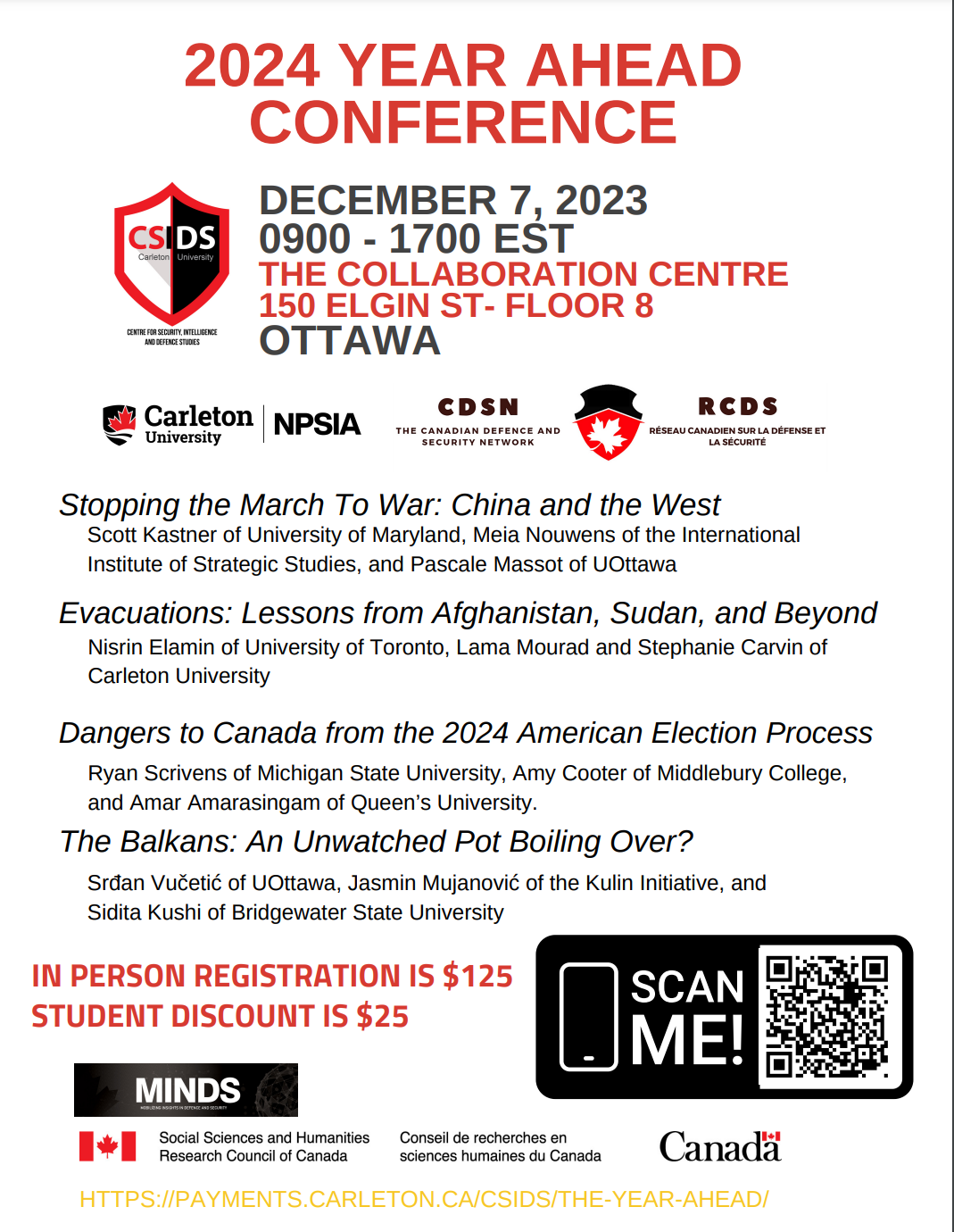
The Year Ahead: China, Elections Encouraging Extremism, Evacuations, and Back to the Balkans

 The past two days were heaps of CDSN goodness.  We supported the book launch of Phil Lagassé and Thomas Juneau's second Canadian Defence Policy volume, and we held our Year Ahead event.


The book launch had triple the number of people we planned for--150 or so.  We ran out of drink tickets before the speakers event started.  I got a chance to say a few words, mostly to tease Phil and Thomas, partly to promote the Year Ahead event.  It might have been the free booze or it might have been the appearance of the CDS that drew the crowd.  General Wayne Eyre stuck around after his talk for a good 1.5 hours to have pictures taken and to chat with the group.  In my intro, I mentioned that most folks think that no one in Canada cares about Defence, so I guess everyone who does was at the event. 

I really enjoyed the event--glad to see Thomas and Phil and their contributors get the spotlight, great to chat with former students, officers and officials who have interacted with me online but not in person, and various other folks.  I spent many of my conversations promoting our big event the next day.

The Year Ahead started before the CDSN, with Rob McRae as the director of our research center--CSIDS--building a conference aimed at considering the potential challenges facing us in the near future--the year ahead.  We took this over, and it has gone through various changes over the years due to pandemics and such.  This year, we moved to a different space, the former Shopify offices, which meant we could go down a slide and play with giant versions of Connect 4 and Jenga.  

We consulted our various partners in and out of government and came up with four topics.

In our first session (no pics since I was the moderator), we had Scott Kastner zoom in and Meia Nouwens and Pascale Massot in person discuss the challenge of addressing an aggressive China whilst avoiding war.  The good news is that China is not ready for a Taiwan invasion, so the much feared war is not as likely to happen very soon. On the other hand, various policies to deal with China are problematic--like "derisking" by trying to avoid China in various supply chains is simply not going to work well.  

In the second session, we had very different talks as Nisrin Elamin presented her experience as she was in Sudan when the coup attempt/civil war started, and had a hard time getting herself, her kid, and her parents out of the country.  Stephanie Carvin presented her comparative project (with the aforementioned Thomas Juneau) about how democracies take care of their people in conflict situations, Duty of Care, to help us understand the government side.  It was an excellent conversation to see the personal dynamics interact with the policy challenge.

We broke for lunch and made much use of this great space especially the students from Carleton and the NATO Field School:


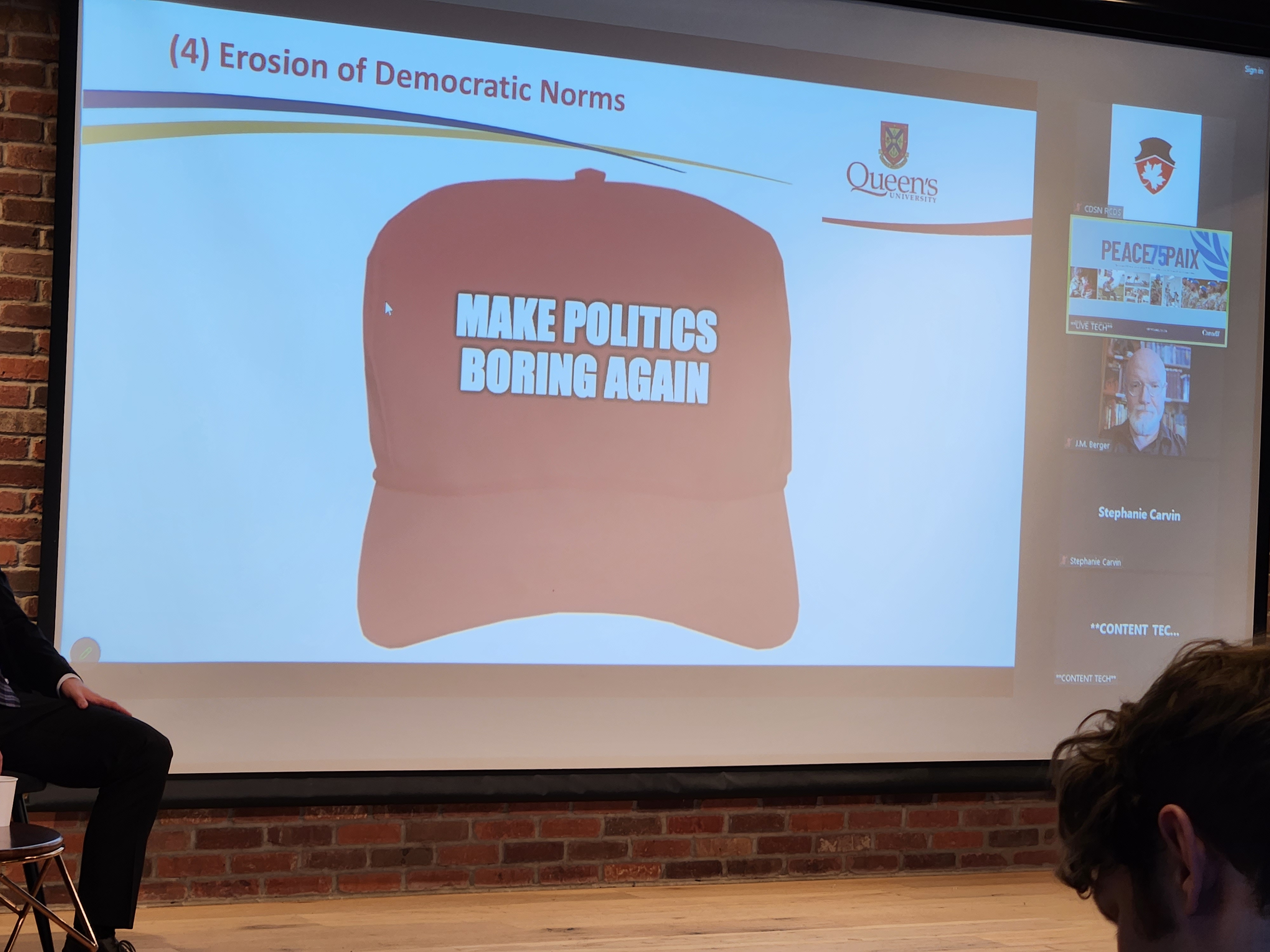
The third session considered whether and how the 2024 election would generate extremism and violence not just in the US but in Canada. They made it pretty clear that, yes, there will be more extremist violence generated by the next current election campaign, that Americans and increasingly Canadians are living in two different realities, and that things are going to get worse before they might get better.  Ryan Scrivens showed the trends over time, Amy Scooter talked about the rise of militancy in the US (buy her new book!), J.M. Berger talked about the social constructions that are driving these dynamics.  Amar Amarasingam presented more on the Canadian side of things.

As a political scientist, I ordinarily would not support this appeal that Amar made:


Our last panel was certainly not least as Srdjan
Vučetić, Jasmin Mujanović, and Sidita Kushi passionately and insightfully presented the latest dynamics in the Balkans.  I used to study the international relations of some of this so I was surprised to learn how badly the US is screwing this up by supporting directly or indirectly Serb nationalists who are preventing Kosovo from moving forward.  That five European
countries don't recognize Kosovo doesn't surprise me as these folks haven't read my earlier work--that secession is not as contagious as thought, that recognition in place does not really matter elsewhere, etc.  It was a great panel to end the day, since the speakers were very dynamic in their criticism of US and European policy in the region.  To put a Hungarian in charge of the NATO forces in the region is just dumb from so many dimensions--Hungary is a spoiler, its military was one of the worst performers in Afghanistan (the nearby New Zealanders would patrol in the Hungarian sector since the Hungarians didn't patrol)., and so on.

Oh and it turns out the metaphor I used to describe this panel was a bit ... dated and unoriginal and problematic:


 We concluded and moved on to a delightful dinner.  So glad I had a chance to meet these folks.  And I am very proud of the CDSN HQ folks--Melissa, Sherry, Racheal, and Mourad--for doing all of the heavy lifting (sometimes quite literally as our swag was in big boxes).  Much thanks to the MINDS and SSHRC folks who fund us and to the NATO Field School and the new Carleton Society on Conflict and Security (I am surely getting their name wrong)--a new student group on campus for those interested in defence and security stuff--for providing much of our audience.


Oh, and one last thing:

While others did go down the slide, I didn't manage to squeeze it in. 


Monday, December 12, 2022

The Year Ahead 2023

 The Year Ahead conference, which started before the CDSN came into existence, has become a flagship event for both the Carleton research center, Centre for Security, Intelligence, and Defence Studies, and the CDSN.  It provides NPSIA-based scholars with a chance to interact with experts we bring to town and folks from in and around government who attend the event.  We consult our partners in government to see what is on their radar screen for the next year, and try to have panels that are relevant to them.  This year, we had panels on:

  • learning from Ukraine's successes and Russia's aggressive failures
  • the state of Canadian civil-military relations
  • xenophobia and national security, organized by our collaborator Women of Colour Advancing Peace and Security.

We also had a fourth session that was a little different.  We started with a Q&A between myself and Colonel Cathy Blue, our visiting Defence Fellow.  An Air Force officer, she is spending the year with us, auditing a few classes, working on a research project, advising us, providing us with a military point of view, engaging the students, and continuing her professional military education program that comes out of the Canadian Forces College.  She has been an incredible asset this year, a great sounding board.  

After that, we launched the CDSN Podcast Network!  We decided to build our own network so that we could provide opportunities to new podcasts across the country to be heard.  In addition to BattleRhythm, the CDSN's podcast for the past 3.5 years and Conseils de Sécurité, our partnered podcast with RAS/NAS en français, we will have SecurityScape and NATO Field Report.  SecurityScape is a podcast by graduate students at Calgary's Centre for Military, Security, and Strategic Studies, a partner of the CDSN.  They have had one season thus far, and they will drop six episodes of season two in 2023.  NATO Field Report will be a completely new podcast, run by the students and professions involved in the NATO Field School, which brings students to Vancouver for classwork and then onto Europe to various NATO facilities and headquarters.  They will be be dropping episodes episodically--as the field school approaches and then have interviews and reports during the field school's trips to Brussels, Latvia, and wherever else they go.  That we include a podcast that is a different model from the original ones helps to open our imagination for future additions to our network.

Along the way, we fixed a problem with had with our Apple feed. While we have consistently been producing episodes of BattleRhythm, those that relied on our Apple field were not getting automatic downloads of episodes.  Our stuff has always been available at the other outlets (Soundcloud, Spotify, Stitcher, etc.), but now we fixed this problem.  Folks just have to go to the Apple podcast app and search for CDSN and subscribe to get all of our podcasts.  

At the conference, we did a Q&A with the producers and hosts of the various podcasts.  We are very excited about all of this.  If you have an idea for a podcast on defense/security broadly defined, let us know, as we are looking to connect and amplify--the basic CDSN mission.

Nina Tannenwald
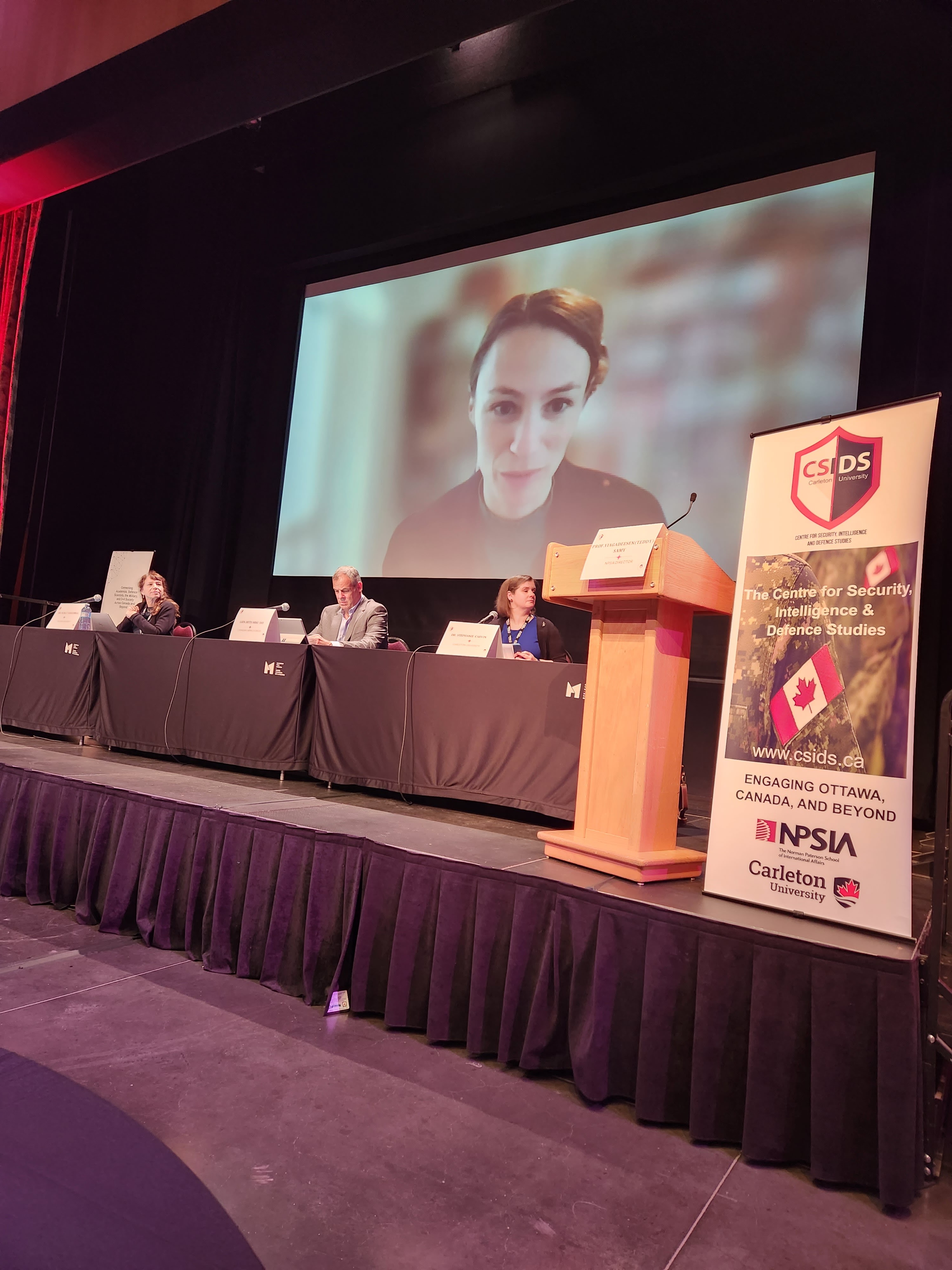
Back to the panels, we had Brown University Professor Nina Tannenwald, who discussed the nuclear weapon issues related to the war, retired LGen Mike Day who delineated the lessons from the war itself, and, via zoom, U of Texas Professor Sheena Greitens, who analyzed China's responses to the conflict.  It was a fascinating discussion.  

I moderated the Civil-Military Relations panel where Calgary Prof. Jean-Christophe Boucher and Charlotte Duval-Lantoine of Women in Defence and Security presented a survey they (and me and Lynne Gouliquer) are working on whether the various scandals are affecting Canadians' trust in the military, Andrea Lane of Defence Research and Development Canada presented the challenges posed to the Canadian Armed Forces by political polarization, and Alexandra Richards of Simon Fraser U. analyzed differences among the various generations and their attitudes.  

The final panel on Redefining National Security, organized by WCAPS-C, included Dr. Nadia Abu-Zahra of both Carleton and U of Ottawa, Azeezah Kanji of the Noor Cultural Centre, Jillian Sunderland and Aaron Francis of U of Toronto.  They presented critiques of the defence and security apparatus and community, especially the treatment of historically excluded communities.

We streamed the event, and it will appear on our youtube channels (CDSN and CSIDS) once we get things cleaned up. We will also be circulating a report and related policy notes in January.

I am very grateful for Team CDSN, especially Melissa Jennings, Sherry Laplante, Cathy Blue, Carelove Doreus, Racheal Wallace, Robyn Lalecheur, David Le, Duncan Herd, and Daniel Kholodar, and to the presenters and moderators.  It was great meeting both presenters and audience members, as the event is also a great networking opportunity.  We will do a "hot wash" to figure out what worked best and what could use improvement.  We are open to feedback so if you have suggestions, let us know.

And, yes, we do this stuff so we can eat food and hang out.  

Indeed it was.


I love Charlotte's expression as she realizes
that I am taking a mid-meal pic