Showing posts with label military history. Show all posts

Friday, November 8, 2024

Looking for Upside? CDSN's Domestic Ops Rock

Niru, Manu, and some of the other participants.
The post workshop dinner is not way we do this
but it is not not why we do this.
 This has been a crushing few days, and the hits will keep on coming.  But I can take some solace from the work we have been doing over the past few years.  Three years ago, the CDSN received funding from the Department of National Defence's MINDS program to address "Global Emergencies and Canadian Resilience."  That year, the MINDS program wanted research networks that addressed, among many other challenges/priorities, global health, supply chain vulnerability, the new NATO climate security centre of excellence, and domestic emergency operations.  We are coming to the end of this three year grant, and our next MINDS network grant application will focus on other stuff as DND's priorities have shifted.


Our CDSN Post-Doc,
Manu Ramkumar gave a
great talk on the
Singapore case
So, this was the last of the three workshops in Toronto run by Nirupama Agrawal, a professor of disaster management at York University, on what we can learn from Canada's domestic emergency operations.  She keeps bringing together military folks who are the key connections in Ontario with Ontario emergency management people, Indigenous folks who are involved in this stuff, academics, and municipal folks who do this stuff.  I finally attended one of her workshops as she kindly did not schedule it this time as the same time as US Thanksgiving.  

I am so grateful to Niru.  She got her students involved, they did a great job of running the day.  It was held in the Royal Canadian Military Institute, where I got to stay overnight.  It is a funky place, with lots of displays, libraries, bars, and history.  See the pics below.  I did guess during my talk that there are no displays of domestic emergency ops, and I was mostly right.  There was some stuff about the Canadian Rangers, who are northerners who play multiple roles as the eyes and ears of the military in the Arctic, but not anything else.

Why does that matter?  Well, I opened my intro talk with a discussion of what the CDSN is and does, and then talked about Canadian civil-military relations.  My usual shtick that the military wants to be autonomous and has more autonomy than most democratic militaries, and that the civilians are not doing much oversight.  When it comes to domestic ops, there is a basic disjuncture--the military doesn't want to do it and it successfully gets it listed at the bottom of the priorities of every defence policy document, and the population values this stuff quite a lot.  The civilians in government do not seem to be interested in getting this preference through to the military.  

After I spoke, we had a number of speakers who have real experience in this stuff, and I learned that there is far better coordination and lessons learned among the various actors.  I still am not sure how much Ontario is really picking up its share of responsibilities on this (there is a basic temptation for the provinces to shirk since they don't have to pay the bills when the CAF does the work even though the CAF could bill them--politically impossible to do so).  The military folks there were super sharp and had good stories to tell about how things play out in such efforts.  There is definitely room for improvement as the CAF is always asked to do more than their assigned tasks when they do engage in a domestic op (hey, can you take my appliances out of my flooded basement?).  


WWI flag with the scars of battle
Once again, the biggest challenges are how to deal with natural disasters that affect the Indigenous communities since the history of settler-ness means these places have poor infrastructure and are vulnerable to disasters.  Yanking them out in an emergency and evacuating them may be preferable to their being killed, but it is a crappy way to live.  So, there was some discussion of some efforts to improve their capacity to protect themselves.


I am very, very pleased and proud of what Niru and her students have accomplished.  This grant is ending, but we will certainly stay in the Niru business in one way or another, and our civ-mil stuff will ponder the domestic ops of it all.  I am just very grateful for the accidental networking that led to this partnership.

 And now a few random shots from our tour of RCMI:

An original copy of the letter
Ike sent the troops on the eve of D-Day


Display of women at war
featuring future CDS
Jennie Carignan
Display of Carignan's A-stan gear


Friday, June 28, 2019

The Most Well Known Battle Still Surprises: Some Stuff I Learned At Normandy

Yesterday, I went to Normandy, as I had some time before the EISS conference in Paris, and I hadn't seen much of the battlefields when I visited as an undergrad with a limited budget.  I had only seen one of the British beaches and its famous Mulberry artificial breakwater/port the last time.  This time, I joined a tour that started with a bus from Paris which went on to Caen, a pivotal target that took far longer to take, to Point Du Hoc, Omaha Beach, the US cemetery near Omaha, and then Juno Beach where the Canadians landed.

On the ride there (three hours), one of the tour guides (we had two) gave a long, basic download of the leadup to the war and then of the war itself up to D-Day.  It was most struck by her forthrightness about how divided France was between resisters and collaborators.

The Caen Memorial had two striking parts plus some other interesting aspects.  There was a great film that had a split screen with one side having the allies' perspective and the German perspective on the other.  It showed both sides preparing, alerting, fighting, and then one side winning and the other side losing.  The German side was actually a bit of a mix because it also showed the resistance setting up explosives and successfully derailing a train. 
The second striking aspect was a set of stones outside laid by a number of countries from the usual suspects of US, Canada, UK, Poland to those who had been liberated: Netherlands and Norway.  The Soviet Union laid one stone, characteristically taking most of the credit (and mostly deservedly so) for defeating Germany).  Strange to see?  Greece.  Um, sure.  And interesting to see: East and West Germany.  Each block had a different message which really reflected the very different cultures/approaches of the countries.  Some pics:

We had lunch there--an awkward one since we sat across from complete strangers with some families in between.  I watched some college student wolf down 5 cups of espresso.  Oh my.  The gift store had some nice stuff, but I could not help but notice the dominance of the 101st Airborne Division.  This was probably true before Band of Brothers and is certainly true now.  The 82nd does not get as much attention, the Big Red One (the 1st infantry gets much), and the 29th Infantry gets relatively little.  As a quick tour of the cemetery (see below) indicates, lots of other units paid a big price at or near Omaha.  The funny thing is the book I picked up to compensate for so much attention for the  Band of Brothers was ... about the next battalion in the same regiment of the 101st.  Oops.
Bunker at Point Du Hoc

We then went to Point Du Hoc, which has gotten much play over time, and deservedly so as nearly 300 US Rangers climbed up a sheer cliff in the face of machine gun fire and other weapons.  They took tremendous casualties getting to the top so that they could take out a major artillery piece that could reek havok on both Utah and Omaha beaches.  Except.... the guns weren't there.  I will be Peeving (my next Peeve segment on the BattleRhythm podcast will address this) about heroism combined with not completing the objective.   Indeed, I learned today at the conference that the leader of this mission was not promoted but sent home, never to lead another operation.  Which might be a hint.
 
Memorial at P du H
To be clear, I don't mean to diminish what the Rangers did.  It is just a big part of war that soldiers, marines, sailors, and aviators end up doing stuff that is amazing, but are frustrated by bad intel, poor leadership, luck, and, yes, the adversary being smart.

The Rangers who lost their lives at Point Du Hoc


We then went to Omaha Beach.  The bluffs above clearly provided the defenders with a huge advantage.  A lot went wrong on and near that beach that day.  Omaha gets more attention because it was the bloodiest beach, the toughest mission, the closest call.  It was moving to be at that place where so many got killed in the first wave, that the waves kept coming, that the soldiers eventually picked themselves up and broke out. 

The bluffs here tell the tale.  Not an easy place to land.
 And then, appropriately, we went to the US Military Cemetery where those who died in the first few months of the campaign (and some, pilots who got shot down, who died before D-Day).  These places are always beautiful, incredibly well laid out, well tended, and just wrenching with so many boys (most of the dead were privates or private first class--which means young, mostly) dying before they could really live their lives.  Not all were army as there were navy and army air force folks also buried here.  Most of the people here died after D-Day--the campaign to break out of Normandy was very difficult.  The hedges of the area proved to be very helpful for the German defenses.

US Cemetery at Omaha. The symmetry and all the rest are
so moving at every US military cemetery.


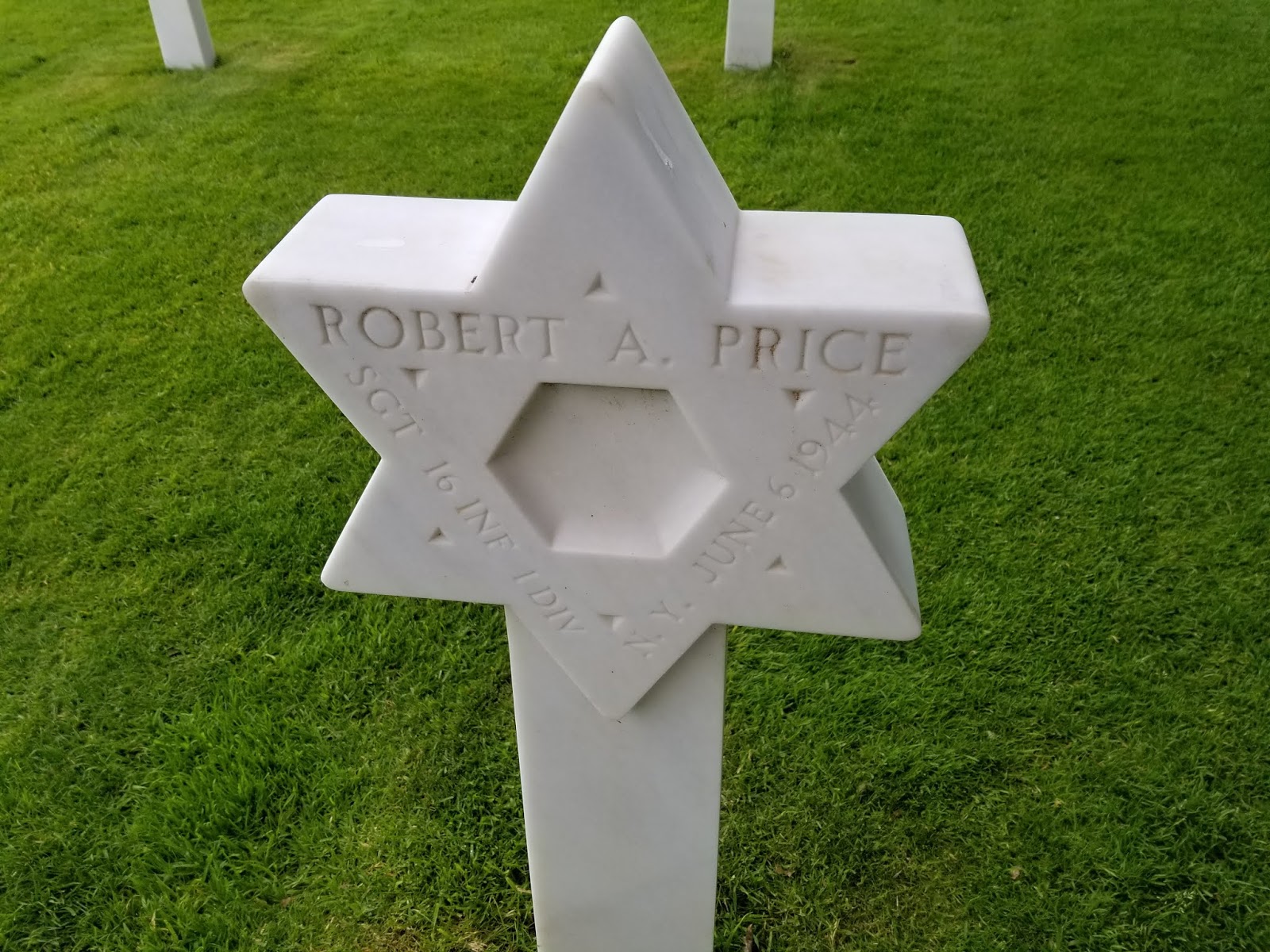
This man died on D-Day from the 1st ID, so he could easily
have died in the first wave.  The Big Red One is
appropriately named.
I also could not help but feel my identity.  I don't see myself as Jewish in terms of religion, but I could not help but pay more attention to the Jewish stars among all of the crosses.  More Jews may have died at Normandy, but most Jews end up getting buried in Jewish Cemetaries.  Still, there were enough to make it clear that Jewish Americans paid a price as well.  It also made me angry--that all these folks died to defeat Nazism and yet there are Americans now who buy into Nazi ideology.  Not sure how they can call themselves Americans.  They are, as they were, the enemy.


After the cemetery, we drove along Gold, the British beach, to get to Juno.  It was not so impressive--the museum and the various signage was not so extensive.  The Canadian beach was the second toughest, with lots of defenses built into the sand.  The sand itself seemed to be a weapon as it was driven into our faces by tough winds, the second time I nearly lost my hat and sunglasses (Point Du Hoc was the first).  I did feel my Canadian identity here--that Canada, yes, punched above its weight and played a key role.  Their museum's swag was not great, however.

Then we had three hours to get back to Paris.  Very much a worthwhile trip.

I learned a lot, was moved quite a bit, and checked off a key item on my list of places to visit.  I do love my job for many reasons, including giving me the opportunity to pursue my curiosity wherever it goes.  This applies both to my work and the stuff I can do that is work-adjacent.

And, yes, 


Thursday, June 6, 2019

D-Day and Today: Damn

A US military cemetery in Luxembourg,
mostly those who died at the Battle of the Bulge,
as I have not been to Normandy since 1987.  
I am rectifying that in a few weeks.
Today marks the 75th anniversary of D-Day--the invasion of Normandy.  It will be the last major anniversary of that battle where there are still  more than a handful those who participated.  The surviving veterans are all deep into their 90s.  I wonder how they are thinking about today's events as we see politicians in Europe and North America pander to the far right. I would guess that they don't think that the sacrifices of the past including the loss of family and friends were in vain, but I imagine they might be very, very frustrated and supremely disappointed.

While Donald Trump symbolizes much of this--"there were good people on both sides" of Charlottesville, he is not alone.   Not in the US, not in North America and not in Europe this week.  In the US, we have folks who are implementing Trump's policies with either a reckless or determined cruelty (hard to tell which on a given day) or both as kids are being kept in cages when they are not left alone in hot vans for nearly 40 hours, as orders of two million diapers remind us of the scale of babies in cages, as trans people are dying after being held by Customs, and so on.  This all began in the US with xenophobic statements about the threat of immigration despite the tide of immigrants falling. 

In Canada, the current leader of the Conservative Party seeks to have it both ways.  Showing up at an event where neo-nazis and other far right fringe elements and then saying his fear-mongering about irregular immigrants is not xenophobic.  Um, sure.  Andrew Scheer might be worried about Maxime Bernier's People's Party of Canada, but we should not forget that in the last days of the last campaign, Stephen Harper's team pandered to the far right, promising a tip line for folks report barbaric cultural practices, which was clearly aimed at Canada's Muslim community.  In Quebec, all of the major parties are pushing variants of laws that discriminate against Muslims and  Jews.  So, it is not just Bernier and not just the Conservatives being tempted.

In the UK, Nicholas Farage is influential as his party did the best in the recent European elections.  Seems like a hard plurality but not majority are ok with supporting lying fascists (that would be Farage) as long as they promise to leave the EU.  Damn the costs, full speed ahead?

In Europe and North America, we see far more swastikas and vandalism of Jewish cemeteries now than in previous years.  I don't think it is just confirmation bias or selection bias or anything like it.  What has changed over the past ten years or so and especially the last three or so has been the tolerance of the far right by right wing parties.  And folks on the far right engage in such activities because they are trying to send a variety of signals--to instill fear among Jews, of course.  But also to show that the Nazis, in whatever guise, are back and feeling bold.  Of course, attacking tombstones in the dark of night is not very brave, but it is what they do. 

The irony is that D-Day, despite being dismissed by the Russian foreign ministry on twitter this week, was a huge relief to the Soviet Union, something Stalin had demanded for years.  These days, the Russians, who had been hurt so much by Nazi Germany and who did indeed bear most of the burden of the war and of the victory, are now cheering on the far right in Europe and North America.  Their social media campaigns, their money, and all the rest are feeding the Neo-Nazis. 

So, it is strange to watch the D-Day ceremonies and feel far more common cause and sympathy with the German Chancellor than with the President of the United States or the Prime Minister of the UK. 

I am sure I will be feeling a variety of mixed emotions when I go to Normandy in a couple of weeks in between European conferences.  Just as I do today.  I am always in awe of those who flung themselves out of planes or jumped into the waters towards machine gun nests.  Ike said twenty years after D-Day: "these people gave us a chance, and they bought time for so, so that we could do better than we have before."  I just wish that we had used the time they bought more effectively.


Wednesday, June 4, 2014

Pondering the Pacific

Anniversaries relating to the Pacific War tends to get less attention in the American media than those of the European War.  Today is the anniversary of Midway, which turned the tide in the Pacific.  Before that battle, besides the Doolittle mission (whose success was almost entirely symbolic), there were no victories.

The US subs were fighting hard but the torpedoes were iffy at best.  The Battle of the Coral Sea was seen, as far as I can remember, a draw.  Midway's outcome was much, much clearer--four Japanese carriers lost to one American, and the end of any Japanese naval effort to extend its control.  Because the Americans could and did make many new carriers, and the Japanese could not, these losses were huge, along with Japan's loss of experienced pilots. 

Guadalcanal came later, as did the landings in Africa.  So, it is pretty clear Midway was the turning point, but it does not get much recognition because it happened in early June, and is, thus, in the shadows of the D-Day anniversaries.

Thanks to Steven Speilberg and Tom Hanks, when we think of D-Day these days, we think of Band of Brothers, which documented quite well how one company played a role in that Day of Days.   The show is eminently re-watchable, and I have done that more than a few times.

How about their "The Pacific"?  I am now watching it for the second time.  It really is terrific.  Alan Sepinwall, the TV critic, responded to my tweet thusly:

Why?  Because as violent and horrible as the European War was (D-Day and the Battle of the Bulge in particular demonstrate that), the Marines fought in an especially brutal campaign.  Fighting the jungle, fighting the rain, and fighting the Japanese made for a very tough watching... and I have not yet gotten to Pelelieu or Iwo Jima yet.  Watching The Pacific is like watching the BoB episode "The Breaking Point" about five or six or seven times.  Oh my.  Still, as we remember the soldiers, sailors and airmen who fought on D-Day, we need to remember the Marines, the sailors and airmen who fought in the Pacific.

Tuesday, May 20, 2014

Remembering or Politicizing

The NYT has a pretty moving piece that explains why Eisenhower did not go to Normandy in 1954.  He was not big on celebrating war's big events, as he was responsible for sending thousands of men to their deaths.  So, I understand this stance quite well.  However, I also understand why politicians, including President Obama, will go to Normandy next month to participate in the events relating to the 70th anniversary of that Day of Days. 

Is it just grandstanding that Ike was too good for?  Maybe.  But besides the blood on Ike's hands, a key difference is that no one really needed a big event in 1954 to remember the big day ten years earlier.  Now?  Most of those who fought that day and lived to see the end of the war are now gone.  As documented in previous posts, I am a big fan of Band of Brothers for many reasons.  One key reason is that it gave us a group of men who we could admire and tie the big story to a series of smaller stories.  Those men that we met via that TV series are mostly gone now too.  Dick Winters and Bill Guarnere were the two most memorable characters in the series, and, as it turns out, two of the most influential and visible members of Easy Company ever since the war.  And both are gone along with most of Easy Company. 

So, perhaps it might appear like politics to grandstand at an event like this, but with these politicians come their spotlights.  And a 70th anniversary is not a bad time to bring these spotlights to such a key moment in history paid for with the blood of Americans, Canadians, Brits, Poles, French, and others, not to mention the Russians who bore most of the heavy lifting of defeating Nazi Germany. 

Easy Company memorial near Bastogne/Foy (I have no Normandy pics)

Monday, November 11, 2013

What to Remember On This Remembrance Day


Below is the post that I wrote to go up on CIC sometime today.
 
This is the last Remembrance Day for the Canadians in Afghanistan.  This time, next year, the last of the trainers and logistics troops will be back in Canada.  Already, there are those who are asking what will Canadians remember about the Afghanistan mission on future Remembrance days.  Until Canada gets in another nasty fight, it is likely that Afghanistan will remain quite visible in the rearview mirror.  Given that one of the lessons of Afghanistan may be to avoid such battles, this means that Afghanistan will resonate for a while to come.

Of course, our first thoughts this time of year center on World War I.  Armistice Day has become Remembrance Day here in Canada, Veteran’s Day in the U.S., and elsewhere.  The poppies were “in bloom” in Edinburgh and Glasgow this weekend (I was at a conference speculating about the international security dynamics of Scotland’s referendum).  Our memories of World War I are entirely constructed—the number of surviving veterans from that conflict is now zero.  What we think of that conflict is what has been passed down via press reports, history books, and what our relatives have told us. 

When we wonder in the future (or perhaps even now) what we accomplished in Afghanistan, we should remember that World War I produced decidedly mixed results as well.  Yes, the conquest of France was prevented, Belgium became free again, and so on, but it was not the War to End all Wars after all.  The roots of the Second World War are very much in the First World War and how badly it ended.  Still, we mark World War I as a victory for the Allies and for Canada, given the impact Canada’s army made at Vimy and elsewhere. 

The Second World War seemed so much more decisive, another victory with Germany defeated.  Yet if we remember the war’s origins, the official start of the war was the invasion of Poland, which really did not become free until the end of the Cold War.  While much was accomplished and much was sacrificed, the war did not produce a decisive victory of freedom over tyranny with the Iron Curtain descending in Europe shortly after the war. 

The point of this quick review of history is that every war, even the big victories, produce mixed results.  Even unconditional surrender does not produce completely desired results.  We also tend to forget why the war began as goals evolve, justifications proliferate, and so on. 

When it comes to Afghanistan, and as we look backwards, we must remember what motivated Canada’s involvement.  It was not to teach the girls of Afghanistan, it was not to bring democracy, it was not to fight polio, and it was not about building a dam.  No, Canada went to war because its closest and most important ally was attacked.  For the first time in NATO’s history, Article V of the NATO treaty—an attack upon one is an attack upon all—was invoked in the aftermath of 9/11.  Canada met its alliance commitment, as did every other member of NATO, although countries varied in what they considered their fair contribution.  Canada was not the only country to “punch above its weight.” 

Yes, meeting the alliance obligations cost the Canadians much blood and treasure, as it was costly to many other allies.  Canada agreed to take one of the hardest parts of Afghanistan and hold it.  It didn’t clear, hold, and build as the mantra of counter-insurgency doctrine requires, but Canada did hold Kandahar (with help).  While Americans have short memories, the next generation or two of politicians, officials, and military officers will remember that Canada was there when America needed help.  And when Canada needs help, the U.S. will aid its ally.  The war was an investment not in Afghanistan but in the US-Canadian relationship.  Some may argue that Canada was “placating” the US, but a different way to look at is that Canada was being a good ally.  Just as it was a good ally in World War I and in World War II and in Korea. 

In international relations, distrust is widespread.  Allies often disappear when the going gets tough.  Being reliable, as Canada was in the aftermath of 9/11, is important, especially given the limited means that Canada can or will dedicate to its own defence.  The relationships built in war-time will benefit Canada in the future,sometimes in ways that are obvious and measurable and often less obviously.  We may not end up singing songs about this particular war, but the rhythms of this latest Afghan war will resonate among Canadians, Americans, Danes, Aussies, Dutch, French and other publics who gave some of their youth to fight a difficult war in a very challenging place.

Thursday, June 6, 2013

Marking D-Day with Context

Given that today is the 69th anniversary of D-Day, it is fitting that I finished reading Rick Atkinson's The Guns at Last Light yesterday.  It is the third book in his Liberation Trilogy about the American wars in North Africa (first book), Italy (second book), and Western Europe.  I had read a fair amount about WWII before, but these books did a great job of covering the alliance politics from top to bottom, and the warfare at the level of the generals, on the ground and in between.

So, on this D-Day anniversary, I want to highlight a few things I learned from this well-trod ground of WWII history (thanks @ncprime for pointing that out).  First, while we know a great deal about D-Day, Operation Market Garden, and the Battle of the Bulge thanks to movies (I need to re-watch the first part of Saving Private Ryan again), TV (Band of Brothers always deserves a re-watch), non-military historian types know far less about Hürtgen forest, for example, and how tough the fighting was not just to get over the Rhine but to get near it.  I do not mean to underplay D-Day, as it was an amazing collection of acts of bravery, but there was more to this war than that.  Including a lot of bad leadership.  Indeed, reading Atkinson's books makes one realize how much the fog of war really exists and how rare it is to have great leadership at the highest levels.  Having crappy 2-4 star generals is not just a 21st century problem.

Second, not planning for the day after is an old problem apparently.  Just as the US military, thanks to poor civilian leadership and Tommy Franks's limitations didn't plan for the aftermath on Iraq, the Americans and Brits did not plan very well for what happened after landing on the beaches.  That is, I knew that bocage/hedgerow country in France was tough from other stuff I read, but I didn't know that the allies never really prepared at all for it.  The good news is that improvisations by the guys on the ground to create blades that they put on the Sherman tanks and other improvisations made a difference. 

Third, a lot more friendly fire during the WWII than people tend to recall.  I knew of the bombs that fell short in the effort to break out of Normandy, but not the other many examples. 

Fourth, while I had read about Operation Market Garden before, and visited the sights when I was on my way to doing research in the Netherlands, the book does a great job of showing how poorly planned this effort was, and how much intel failure was involved (a recurring theme).  The Polish Commander's comments on the plan "But the Germans, how about the Germans, what about them?" are most instructive.  Worse, this was not the last time paratroopers were thrown into a battle with not so much thinking (see the effort to cross the Rhine).  

Fifth, I wished this book was out before we finished our book on NATO and Afghanistan, as De Gaulle provides us with some great examples of when double hats and national command complicate alliance operations.  Namely, when Ike wanted to pull allied troops back from Strasbourg to solidify the lines, DeGaulle ordered his commanders to disobey Ike "I order you to take matters into your own hands."  While the defeat of France was, of course, a very bad thing, it at least kept France from mucking up planning and operations until France was mostly liberated. 
Beetle Smith, Ike's chief of staff:  Juin said things to me last night, which, if he had been an American, I would have socked him on the jaw."
 The book documents very, very well the bickering between the Americans and the British (Monty, once again, comes off as a dick extraordinaire), but adding De Gaulle and the French just made things worse.  Indeed, I didn't know that the French had their own squabbles as one key general had stayed with Vichy and another had not.  They, of course, didn't get along. 
A great Ike quote: "Next to the weather ..., [The French] have caused me more trouble in this war than any other single factor.  They even rank above landing craft."
The book even goes into the talks at Yalta with more piling on the French, who were not there.  

Oh, and of course, one other non-surprise.  While the book focuses mostly on the American war, it does address the stuff at the leadership level, so we can get glimpses of a recurring pattern: that the British lead the Canadians poorly.  The Canadians did a lot of the tough fighting to free up Antwerp, which should have been Monty's priority as ports were mighty hard to come by (geez, the Germans were great at destroying ports!)  

In the epilogue, Atkinson cites a Churchill quote we use in our book: "There is only one thing worse than fighting with allies, and that is fighting without them." Indeed.  This is not the only big bonus of the books, to document this, but it is one that sticks out to me as I await the proofs for our book.

D-Day was an amazing day with such allied cooperation among the Americans, British, Canadians, Poles and others.  There was a lot of stress and tensions among these folks, but they managed to put enough troops on the beaches so that the Germans could be defeated 338 days later (with, of course, the Soviets doing much more of the killing and dying).  So, this day is very much worth marking.  Reading some really good history is good way to remember what the young men did on that day and the days after.

Sunday, May 19, 2013

Reviewing the Last Battle

I read a book review that inspired me to Kindle The Last Battle, by Stephen Harding, which documents one of the last WWII battles in Europe. The story apparently is well known in Europe, but never got that much play in the US. A bunch of French politicians were being held by the Germans in Austria at Schloss Itter, and in the waning days of the war, it looked like they might get executed.  A small group of daring US soldiers, combined with Austrian resistance and, more strikingly, German soldiers held off the SS troops long enough for relief to arrive.  So, you have Americans and Germans and old French soldiers and politicians fighting alongside each other after Hitler's death and when everyone thinks the war is over.

The book  was an interesting read, but definitely felt like it had a lot of padding.  It is only about 170 pages plus footnotes and bibliography and such, yet the beginning of the book was kind of slow at the start with more background than seemed necessary.  The problem for any author is that the battle itself was less than a day from when the firing started to when the relief arrived. So, there is not that much of a story to tell in a book. 

Still, the story was quite interesting and told well.  A couple of interesting pieces to the story:
  • Relief was complicated by the drawing of lines on the map--that one of the units attempting to relieve the castle was entering into the area of responsibility of another American unit, and the commander did not want to do that for fear of friendly fire.  Damn those arbitrary lines.
  • The book documents very well the conflicts among the French prisoners: Edouard Daladier vs. Paul Reynaud, General Maurice Gamelin vs General Maxime Weygand and others.  The stories of these and the other French prisoners (with one exception, Jean Borotra, who played a pivotal role in the battle) hating each other and acting childish were striking.  Indeed, they were stupidly disobeying instructions from the American commander.  As the battle was joined, they put themselves in harm's way, ultimately getting one of the key German officers killed.  With leaders like this, it becomes very clear why the French lost the war so quickly in 1940 and why they were so poorly prepared before that.
    • This gets to a basic gripe I have about Barry Posen's Sources of Military Doctrine.  It was a very influential book in Security Studies in the late 1980s, but the basic argument did not match the reality.  Trying to combine bureaucratic politics with structural realism, Posen argued that countries generally produced poor innovative military doctrine due to bureaucratic politics.  Only when countries face severe external threats do the politicians interfere to force militaries to adapt.  This sounds fine and good, but who faced the most severe threat in the mid to late 1930's?  France, of course.  But it adapted poorly, if outcomes are any measure.  What explains why France adapted poorly?  Not bureaucratic politics but domestic politics--unstable coalition politics led to short lived governments.  Of course, given the quality of the men leading France at the time, as revealed by this book, I am not sure a longer lasting government led by any of these guys would have been any good. 
  • One note for the Canadian folks: a few journalists jumped onto the various American relief convoys because they knew a good story when they saw one, including one young Canadian: Rene Levesque!  He, of course, went on to lead Quebec separatists in the 1970s and has a very windy street named for him in Montreal.  His efforts to get the story were mostly stymied by Daladier and Reynaud who wanted to save their stories for their memoirs, which were mostly aimed at blasting each other and whoever else for whom they had much resentment.  
In a WWII tale of much heroism, initiative, luck and guts about the efforts of the Americans, the "good" Germans, and the Austrians,* the French come off looking the worst.  Of course.
*  I have always been less than thrilled with the Austrian perspective on the war--as the first victims of the Nazis --as too many were way too enthused about Anchluss, Hilter, the SS and all of that.  But in this book, there was apparently a resistance movement that did help to make a difference at the very end of the war.

Thursday, August 23, 2012

Adventures in US Military History

On twitter, one question that came up today was this: was the Osama mission one of the most important in US military history?  I am no military historian, but I have a heap of opinions.  So, my answer was yes, but now I need to backtrack and figure out context and comparisons.

First, what is a mission?  It has to be a single attack/rescue/defensive effort, whatever.  It cannot be a repeated effort--that would be missions, not mission.  Thus, a campaign is not a mission.  A campaign is a combination of missions.  I am trying to think about D-Day--was that a mission or not?  Well, it was a focused effort at a single discrete objective--land tens of thousands of troops on Normandy's beaches.  But it took so much time--not just the one day really but weeks of bombing, and it took days/weeks to get sufficiently inland.  Usually, we would consider a piece of that big operation to be a mission, like the Brits seizing a bridge behind the lines. 

Second, this is comparative: there are many missions, of which the Osama mission is just one.  But how do we evaluate importance?  War-turning?  That would be a few, but killing Osama did not end the war on terrorism (since a war on a method of war is unlikely to end soon).  But a mission can have a big political impact and it can have a big military impact.  Remember the time that these guys blew up some big guns so that the British Navy could rescue heaps of troops in the Eastern Med?  In the book, it was more than just rescuing thousands of troops but about keeping Turkey neutral. Hmm.

Ok, so what comes to mind?  Just US military history for now.
  • Dropping the atomic bomb on Hiroshima.  That essentially ended the war and started the Cold War.  Huge political ramifications even if Japan might have surrendered shortly anyway.  Is it a mission?  Sure, one plane, one bomb dropped.
  • The Doolittle Raid.  A small set of planes taking off from a single carrier.  Direct military impact?  Not much especially given how much ordnance was dropped later.  Political impact much larger--both at home as it gave Americans a chance to cheer for something in the dark days after Pearl Harbor AND it provided some impetus for Japan's attack on Midway which did turn the tide.
  • Bastogne.  Sending the various units to prevent the fall of the crossroads was a huge deal, although Germany was going to lose anyway (thanks to the USSR!).  But the dividing lines in Europe might have been a bit further to the west if the Brits, Americans, Canadians, etc. had to re-take the ground lost here.
  • Operation Market Garden?  Had it succeeded, the war might have ended a bit sooner with the line drawn further to the east?  Of course, the mission really had no chance to succeed--what an incredibly optimistic plan.
  • World War I?  Nope.  Not a single mission comes to mind.  
  • 1898?  Damned if I know.
  • Civil War: was there a single mission?  Perhaps the defense at Gettysburg that preventing the Confederates from winning on day 1 or day 2.  Again, I am not a military historian, and harder to think of this as a mission.
  • War of 1812?  Please.
  • Revolutionary War: Hmmm, crossing the Delaware?  
  • Korea: the Inchon maneuver was more of an operation rather than a mission, eh?  Any particular missions in this war?  
  • Vietnam? Oh, one could suggest the mission that produced My Lai, but that kind of warps the notion of mission. Gulf of Tonkin, I guess.  The mission, whatever it involved, helped to justify escalation.  Would escalation have happened anyway?  Probably. 
  • Cuban Missile Crisis: the recon flight that spotted the missiles.  Damned important mission.
  • Which reminds me of the U-2 mission where the plane got shot down, scuttling some US-Soviet diplomacy.
  • The Iran hostage rescue mission was damned important.  Failure can very important.  In this case, it ultimately led to Delta, if I am not mistaken, and certainly helped lead to Goldwater-Nichols which reformed the US Joint Staff and how the US operates its military.
  • Greneda?  Ha.
  • The peacekeeping effort in Lebanon?  Well, the suicide attack on the US barracks probably shaped US and terrorist behavior in the region for a few decades (not to mention affecting Jack Reacher quite directly).
  • Any part of the first Gulf War?  No mission stands out.  Not even the Battle of 73 Easting since the US was going to destroy the Iraqi army wherever it was encountered.
  • Nothing in the Afghan war nor the second Iraq war stands out, but I could be missing something.
  • The Osama raid.  Too soon to really understand the impact on those who might and do support AQ.  Too secret to figure out what intel was gained.  
That is a long list.  I would have to guess the top five in importance are:  the Bomb, defense at Gettysburg, the recon kicking off the Cuban Missile Crisis, the Iran hostage rescue mission, Osama raid.

Feel free to disagree.

Friday, August 17, 2012

Revising History

Seventy years after the events, we finally learn a bit of truth about the Dieppe Raid.  It seemed like a typical tale: Canadian troops losing their lives needlessly due to poor British planning.  There is a documentary tonight in Canada that presents a new take.  See here for the newspaper tale.  The essence is that the entire raid was a cover for a commando raid seeking to get German code books and machines.  And it was led by Ian Fleming, the author of the James Bond books.

The frustrating thing about the newspaper story, and something I will have to track tonight, is whether the raid, actually worked.  Did they get the codes and machines or not?  If they did, then Dieppe can be re-coded a success, that the Canadians who died there helped to save lives elsewhere as the breaking of German codes was huge and entirely secret for decades.  I am kind of surprised that it took a few decades for this new version of the raid to come out since Enigma lost much of its secrecy in the 1970s if I remember correctly.  Then again, the Brits are generally far better at keeping their secrets. 

Even if the mission did not succeed in getting the codes, at least Dieppe now makes some sort of sense.  Still, it remains a testament to poor planning.  Further history work (or perhaps just watching the documentary) will be required to figure out whether the mistakes made were necessary for the mission or just poor planning--that the distraction could have been better planned.

Thursday, June 14, 2012

Falklands Retrospective

I have been engaging in a twitter conversation as a result of a tweet about the Falklands war, which ended thirty years ago.  The tweet was in response to a British retrospective that referred to the war as doing the impossible.  I reacted immediately to this because my memory of events in 1982 did not register expectations back then as impossible.

Well, apparently some folks did think the UK effort to re-take the Falkands/Malavinas was impossible.  That the islands were too close to Argentina for the British carriers to safely operate, that the British jump jets (Harriers) were unproven against fast jets (Harriers are slow), and so on. 

Why did I think then that this was not impossible?  Well, my mother worked for the US Navy at the time, ordering spare parts for planes, including the Harrier.  So, perhaps I had overly high expectations (which were met, they did fine).  I was also reading a lot of books at the time on the US submarine campaign in the Pacific, so I expected (if I am remembering correctly) that the British sub advantage would matter a a great deal.  Indeed, after a British sub sunk one of the biggest Argentine warships (the Belgrano), the Argentine navy became a non-factor.  Perhaps I was a bit stuck in the past/racist to think that the Brits easily handle any third world country because I was, well, 16. 

The real key is that Generals and Admirals are such lousy politicians that it messes up their day job expertise.  This case is the classic exemplar of a diversionary war--that the Argentine junta sought a fait accompli against the Brits to distract their population from their illegitimate government and its poor handling of the economy.  Otherwise, they would have waited a year or two because the British were planning on cutting back on its navy, including several of the ships that played a key role at the time.  And, as a democracy, the Brits made these plans quite public.  As my twitter conversation partner mentioned, winter would have been a better time given the difficulties of operating in bad weather.

Anyhow, I was surprised by the "impossible" word.  Hard, yes.  Impossible, obviously not in retrospect but not even at the time, at least to young me and to Maggie Thatcher.  I didn't agree with her on much, but on this, sure.

Wednesday, June 6, 2012

More Than a Band of Brothers

While the paratroopers tend to get heaps of attention when we think about D-Day, this Band of Brothers was more than just the 101st or the 82nd.  While Omaha was the toughest beach, the others were not so easy.  This video (h/t to Stephane Roussel on fb, a noted tank aficionado) provides a short illustration that this Band was quite big and quite multinational:


Update: The Army site on Normandy makes it clear that the selection bias towards paratroops is not entirely unwarranted.  That is, four US divisions (in addition to the Brits, Canadians and Poles)--two infantry (1st and 4th ID's) and two paratroop (82nd and 101st).  On the other hand, other tales of the war, such as the Battle of the Bulge focus almost entirely on the 101st, when the gravestones I saw nearby clearly show that many, many units had a role to play.

Monday, May 28, 2012

Hardly Academic? Hardly!

A very good piece in the NYT today about the debate within West Point about the future of counter-insurgency and the US military.  The article covers the views of both COIN-istas and COIN haters.  This is progress.  Why? Because ten years ago, there was little debate about COIN at all.  Now, you have two sides engaged in an argument, which is one of the best things that can happen to the folks going through West Point--to be exposed to this argument.  They don't have be a COIN fan or foe, but to see that sharp minds can disagree is a valuable thing.  When these cadets some day get placed into harm's way or are in the chain of command, they will perhaps be more open to different points of view.

One of the critical problems in the US military has been the desire to forget unfortunate pasts and avoid skill sets that might end up being used.  After Vietnam, COIN was put away and not really considered except by some mavericks like Petraeus.  My hope is that this history is not repeated.  The reality is that politicians will put troops into situations that require many of the skills and tactics that the Army learned at great cost the past ten years, whether the military wants to do such stuff or not.  Better to remember these lessons with a slightly higher risk of having to use them than to forget and then have to re-learn while under fire.

War, as Clausewitz said, is politics by other means.  COIN doctrine takes that to heart.  US grand strategy may be better served by avoiding fighting any insurgents, but as long as the US remains the predominant conventional power, the opponents of the US will mostly try to fight via insurgency.  Well, the smart ones, anyway.  Shouldn't we be prepared for that reality?

Friday, May 25, 2012

In a Valley A Long Time Ago

Great use of two movies to illustrate a bombing campaign during WWII:


And happy 35th anniversary to you and yours (and thanks to Starbuck).

Friday, November 11, 2011

Remembrance Day, 2011

Memorial on Arnhem Bridge
This year Remembrance Day, as they call it here in Canada and much of the world or Veteran's Day as it in the US, is a bit different for everyone and for myself.  It is the first one where there is not a single living combat veteran from the First World War.  Given that WWI spawned this special day, that is pretty significant.  This year, this day means a bit more to me as well, as last winter's research trip throughout the Benelux countries allowed me to do something that I had not done in my previous trips outside of North America--to drive. 

And drive I did, as I landed at the airport in Brussels and drive as directly as I could to Arnhem, the goal of Operation Market Garden in the fall of 1944.  That operation was to cross the Rhine and end the war earlier, perhaps saving many lives in the process.  The mission failed at a significant cost not just to the Allies but also the people of the Netherlands who had thought they had just been liberated. And now we have a phrase that lives in: A Bridge Too Far.

Anyhow, with a car, I was able to stop by a variety of historical sites, including battlefields and military cemeteries. Here are just a few of the many pictures I took along the way.  All I can say is that the travels certainly provided me with a large serving of perspective sauce.


Vimy Memorial

Vimy: Trenches


Canadian Military Cemetery, Netherlands


Easy Company Memorial,
next to where they fought in Bastogne
Bastogne
US Military Cemetery, Luxembourg
Memorial that used to exist at Camp Mirage for the Canadian losses in Afghanistan
The last two pictures are from different trips.  The first is a memorial that used to be at Camp Mirage, the support base for the Canadian effort in Afghanistan.  It has since been moved back to Canada since Dubai kicked the Canadians out of the base.


Australia War Museum

The second picture is from the Australian War Museum in Canberra.  It is an excellent museum that mostly focuses on the Aussie effort in the World Wars but also has parts on the subsequent wars.  Very moving and very informative.  And, given that poppies are the big theme these days for Remembrance Day in Canada, not a bad picture to conclude this post.