Friday, March 9, 2018

CIPS 10th, Grand Strategy, and Feminist Defence Strategy

The conference was in Alex Trebek Hall!
Yesterday, I participated in an event celebrating the 10th anniversary of the U of O's IR research center: CIPS (by law, all Canadian IR centres and think thanks have to have a C in their acronym).  It was an honor because of all the sharp people involved and despite U of Ottawa being Carleton's in-town rival.  One of the big boons to moving to Ottawa has been that there is another school in town, full of interesting folks doing great work and also full of friends. 

The theme of the conference was "Disorder, Disruptions, and Directions" and a fourth D was implicit in the title and not so implicit in many of the talks: Depressing.  Why?  Trump, Brexit, populism, the apparent decline of the Liberal International Order.  I was assigned the topic of Trump (I wonder why, I rarely think or write about him).  The other speakers were from Canada, the US, and Europe. Because we had a bunch of government types, we had to follow Chatham House Rule, which means we can talk about what was said but not attribute to anyone.  I am not a fan, but I mostly behaved.  I then asked a couple of the speakers if I could cite them, and since they are academics, they said hells yeah.... or something like that.

William Wohlforth of Dartmouth gave the keynote, and focused on US Grand Strategy After Trump.  It was actually US Grand Strategy before and after Trump.  As a reasonable Realist who has written on such stuff, Wohlforth raised a basic question--what is the reference point one has to "the good times."  I was reminded of my own piece, currently in process that asks a meta version of that question--when was peak Grand Theory.  Anyhow, his basic point is that the US had overextended before Trump--either under Clinton or under Bush, and so the US under Obama and now Trump has to deal with the realities of commitments and efforts being beyond the capabilities of the US.

He argued that the US had three tasks--to manage the global environment to keep threats away; to manage the economic order, and to foster an institutional order.  Doing more than that--democracy promotion, fighting terrorism everywhere, regime changing Iraq--is not sustainable.  With the end of the Soviet Union, the primacy of the US, Wohlforth argues, allowed the US to become a revisionist state--trying to change other states and the world as the US became less tolerant of risk.  One of the basic problems is that folks treated the international liberal order as a bicycle--if it is not always moving forward it falls over. 

So where are we now?  Wohlforth asked us to focus on what Trump has been doing, rather than what he tweets (alas, any effort to suggest Trump is not too bad is usually undone within hours by Trump behavior). The power balance shift is significant but exaggerated.  There is still only one superpower.  The interests of US engagement, when not overextended, are still greater than the costs. The institutional stuff is actually pretty robust.  So expect a less revisionist, more status quo President after Trump.

Overall, I found the talk super engaging, and it make me think about my priors.  Definitely shared points of agreement, as I have long argued that Obama was not retrenching, but just less willing to risk money and blood for dubious gains.  I am not so sure that Bosnia or Kosovo were really over-extension.  While the folks in the Pentagon thought they were expensive efforts that challenged readiness, they were nothing in comparison to dual wars in Afghanistan and Iraq plus all of the lesser conflicts.  I think the real over-extension was not Kosovo or modest democracy promotion but Iraq--that was incredibly expensive, demonstrated American ineptness, and created so many problems that continue to cause the US to expend much effort (Syria, Iraq).
The key for Realists and for pragmatic folks like myself (I am realistic about stuff, but I think that anarchy is not so determining and that interests come from domestic politics more than from the international system) is that grand strategy is about balancing capabilities and commitments.  The US, by getting stuck in Iraq, skewed commitments, and by the domestic political effort to condemn taxes as evil, have undermined American capabilities.  The gutting of governance, I think, besides racism, is the real cause of rising populism.  Yes, international trade and automation cause shocks and disruption (damn, I hate that word), but governments failed to react because key actors in domestic politics thought austerity was the way out.  Which meant people paid the price, not corporations. 
Anyhow, a great talk and now I feel that I read Wohlforth's book without actually reading it. Woot!

The other talk I'd like to highlight is Andrea Lane's.  Andrea is a graduate student at Dalhousie, but I think most people think she is a junior prof.  She definitely held her own in a crowd of graybeards like myself.   She was tasked to consider what a feminist defence policy would look like, and she started by invoking my favorite movie for any presentation:

Lane was right was that Liberals are doing very little:
  • eliminating sexual harassment and assault is "a bare minimum."
  • there is more to the problems of CAF recruitment and retention--systemic stuff.
  • training others to do better gender stuff while peacekeeping rings hollow if Canada isn't doing peacekeeping.
The ingredients of a feminist defence policy were very interesting:
  1. Less defence $ as they go mostly to men, helping men "all the way down", whereas "butter" or social programs tend to help women more. Fun pic of shipbuilding stuff featuring men, men and men. 
  2. Smaller defence industry as these largely male jobs are much better paid/pensioned & tax subsidized while women's jobs are none of things.
  3. Defence exports go to places where women and children are killed (Saudis make the LAV look mighty bad)
  4. Radically revise recruiting--stop recruiting men until we reach 50% women?  
    1. A subpoint on this slide was more realistic and one I would really like: stop the steady increase in use and valorization of SOF.  Male only SOF being used means women don't get combat experience which stunts their career development. And for me, this is bad because SOF have less oversight and are ways for politicians to use the military without being as accountable. 
  5. Reduce domestic abuse in military families.  This was in her radical proposals but should be in her "the least one can do" section.
  6. Her less radical proposal--focus on girls/women when building the cyber force.  Make that a woman's job--good pay, flexibility, etc.  The super important point: "without concerted effort to create woman-friendly cyber program, it will be male-dominated."
Lane did a great job of giving one of the last presentations--she work up and energized the crowd and, um, put the first female Canadian Brigadier General who came up through the combat ranks into a semi-awkward position.  To be fair, BG Carignan did a nice job of reacting to Lane's talk and was much more open and interesting in the Q&A than in her presentation.

Overall, a great day--they brought in very interesting people, kept things moving, and had us all drinking from the firehouse of insight. CIPS did a great job of celebrating their 10th anniversary.  I definitely will try to steal their recipe for successful conferences in case one of my network grant applications succeeds.


A Modest Revision to Chatham House Rule: Academic Exception

Later today, I will post some of what I learned at the 10th Anniversary of CIPS (the U of Ottawa research centre).  It was a great one day conference, full of sharp people that made me have a significant case of imposter syndrome.  And, yes, I talked about Trump---because that was my assignment.

Anyhow, what was kind of frustrating is that they applied Chatham House Rule to the event--which means we can talk about the stuff, but not attribute what was said to those who said it.  I get it--it makes it far easier for government types to speak freely or semi-freely, although it is often the case that the government types don't (it varied yesterday).  But academics?  Our job basically involves two fundamental things: to figure stuff out (I always find "create knowledge" to be a bit high falutin') and to share what we have figured out (disseminate knowledge).  It is completely contrary to the academic enterprise to limit one's audience.  This is not about citation (ok, mostly not) but about the reality that it is hard to talk about what people are saying if you can only share it in ways that mask their identities.  Because programs are generally online, live-tweeting, for instance, can easily give away who is saying what.

So here's my modest proposal for conference organizers: tell your audiences that CHRXA (Chatham House Rules Except Academics) applies: Chatham House Rules applies to the stuff that non-academics say, but feel free to tweet or blog about the academic mutterings.  I did ask after the conference if I could blog about a couple of the presentations, and the two academics said: duh, of course.  So, I will.  But I'd prefer for all those in the audience to share what they heard, so we need to be clear at the outset of these events. 

Let's make CHRXA more popular than fetch!

Wednesday, March 7, 2018

Aging Profs: When Will They Retire?

Image result for old muppets in balconyThis story got a lot of academic attention: that profs in Ontario (and elsewhere in North America) are not retiring.  With the end of mandatory retirement, professors seem to like their jobs and keep on keeping on.  One of my former colleagues at McGill is now significantly over 90 and still thinks he is the future of the department (my sniping since he is still involved in department politics and not in a productive way).  And, yes, I remember being told when I was in grad school, that there would be tons of jobs as folks retired... which never seems to happen.  So, I have mixed feelings and tweeted thusly:

Let me explain.  First, the retirement age of 65 does not makes sense anymore.  It was developed when half the folks would be dead at 65. Ok, maybe not quite, but the basic idea is that if you make it to the average lifespan, then you can stop working and live a few more years.  Now, folks who make it to 65 are very likely to make it another 10-20 years.  That is both a long time to live off of one's savings and to be unemployed.  So, if we start to change retirement ages to keep up with folks living longer and living better longer, then 65 is probably too soon.

On the other hand, more than a few folks who are over 70 and more so those over 75 often seem to be behind the times--not up on the literature, not up on the methods and trends, and so they make lousy advisers, not that great teachers, and so on.  And they are filling up lines that might be filled by younger, more energetic, more innovative folks who might also bear more of the burden of supervision, of service and all that.

On the third hand, one of the trends that has been going on since I graduated long ago is that retirements are often not filled.  That when the department loses a person, they lose that line and, instead, you might get a temporary person.  So, you get someone who teaches but can't provide much service to the department and is unlikely to produce much research (not because they are not up to it but because their load is so much heavier).  So, kicking out a somewhat productive older person might be a bad idea if the replacement is someone who produces less because they are teaching at multiple places to make up for their poor pay.

On the fourth hand, this stuff is gendered but not in the ways some folks expected (but Frances Woolley did expect because she is very smart).   Older profs are mostly male since the profession was very male for quite some time, so they are blocking spaces for younger women to move in and up.

And, yes, now that I am on the other half of my career, closer to retiring than to when I started, I am a bit more sympathetic to the old folks that people want to kick to the curb.  My goal has been 70, which I think is a fair compromise between getting out when I am still pretty young and hanging on forever.  Then I realized if I continue my sabbaticals at this rate, I would be eligible when I am 71.  Hmmmmm.   Of course, it all really depends on how the various retirement funds/plans are when I get older.  Moving to Carleton late in my career means working past 65 to get to twenty years, and the calculator for pensions (yes, a pension of some kind) builds in years of service, so there's an incentive to stick around.

What will I do when the time comes?  Damned if I know.  I do know I will feel less guilty if my department can't replace me with a tenure track line.  I know I will feel willing to leave if my various funds do well (that they can bounce back from the Trump damage of today) and if Carleton doesn't mess with my pension.  I can't blame people for sticking around for a few extra years, especially since most of us deferred making money for the 5-7 years of grad school and many of us lost control of where we could live long ago.  But I can see the challenge facing governments, and I can also see that if I become obsolete and out of touch, then I should get out of the way.  So, that is really it--will I be contributing when I am 67 or just draining?

Tuesday, March 6, 2018

Decoupling and the Alliance Dilemma: Get Out!?

As Glenn Snyder and then Patricia Weitsman so clearly identified (as well as Jack Snyder and Thomas Christensen), alliances always pose two threats to those who join: that they might be abandoned despite reassures to the contrary AND that they might get dragged into a war they do not want to fight.  So, abandonment vs. entrapment are the dual horns of the alliance dilemma.  So very relevant today as the story du jour is of "Decoupling" South Korea from the US.

It has long been a concern that North Korea would maneuver to separate the US from South Korea, and they have made a heap of progress lately.  This morning there are reports of talks leading to more negotiations between North and South Korea.  The concern is that South Korea might sign some kind of separate peace, giving into North Korea and leaving the US out. 

For much of the cold war and post-Cold War period, the South Korean concern would be that the US would abandon it.  Jimmy Carter proposed and then reversed himself on pulling the US troops out, as this undermined the credibility of the US commitment to South Korea, for instance.  Just like the Europeans, the South Koreans worried that the US might not show up, that it would be very costly for the US to defend South Korea.  The advent of the North Korean ICBM with the capability to hit the US gave the South Koreans the chance to re-visit all of the "would the US sacrifice Chicago for Bonn or Paris" debates.  So, yes, the South Koreans still fear abandonment and perhaps even more so with an uncertainty engine in the White House who confuses North and South.  You would think that this fear would lead them to focus on tightening the alliance, not decoupling.

Ah, but here's where the other horn of the alliance dilemma gets super-pointy: the US has been making noises about a new Korean war, that a punch in the nose or whatever effort to disarm North Korea, would be harmful to South Korea but not the US.  Indeed, Lindsay Graham has recently agreed with the White House rhetoric of, well, burning South Korea to save American lives.  The South Koreans know only too well that the opening shots of a new Korean war would lead to hundreds of thousands, if not millions, of dead South Koreans.  So, with all of the war talk in DC, they have good reason to fear being entrapped in a war they do not want.

So, I can't blame the South Koreans for seeking an alternative path, away from the races up the escalation ladders.  The problem, of course, is that if South Korea is decoupled from the US, that the alliance is broken, then North Korea can break its promises to South Korea and the US will find it hard to respond to a fait accompli in the aftermath of US forces being expelled from South Korea (the possible result of decoupling).  Where does Japan fit in all of this?  Completely screwed but that is an alliance that will be broken via other means (trade wars)....

In sum, Trump has made a difficult problem far more challenging.  The no good policy options problem is now far more likely to be all the worst policy problem.  Thanks, Trump.

Monday, March 5, 2018

The Trump Rosetta Time Machine

How do we make sense of Trump?  Yes, he is an uncertainty engine, but there are some basic tendencies that seem to be driving much of what he says and does.  He is a lifelong racist, so not hard to guess how he will act towards non-white folks, for instance.  When it comes to international economic stuff, it all starts with where his mindset stops: the early to mid 1980s (that and he never took Intro to International Relations).

When Trump talks about trade deficits and blasts Japan and Germany, he seem to be invoking a time where those two countries seemed to be the biggest threats to American producers.  Japan's economy has been stagnant for more than two decades.  Both countries have firms that have invested significantly in US-based production.  So, these views have mostly been overcome by events that Trump has not apparently noticed.

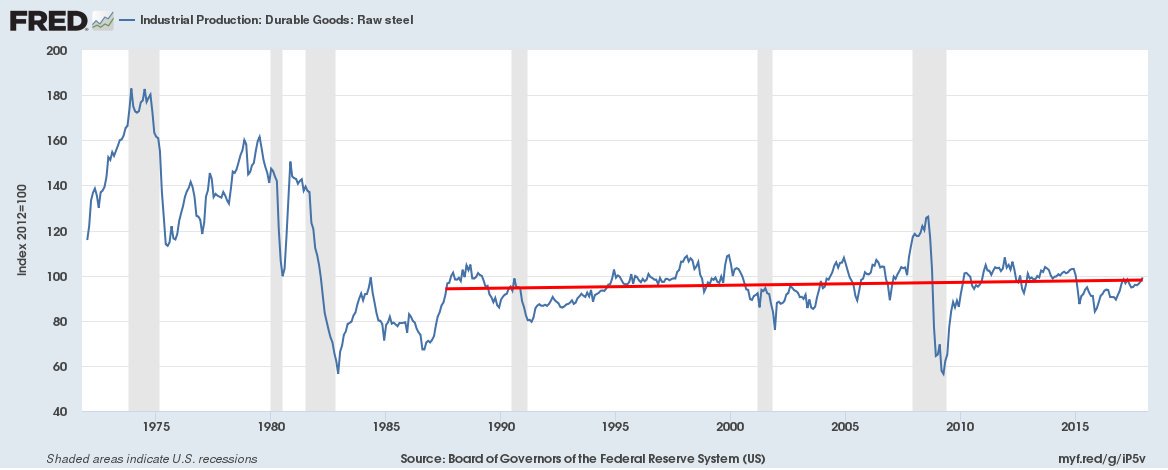
Trump's views on steel and aluminum, that these industries are on steep decline, makes sense if you compare the mid 1980s with the previous decades:
Media preview


 but these industries have been mostly pretty steady since then (big dip during the financial crisis, and mostly profitable as of late, and see here for more figures, h/t to Scott Lincicome).
 
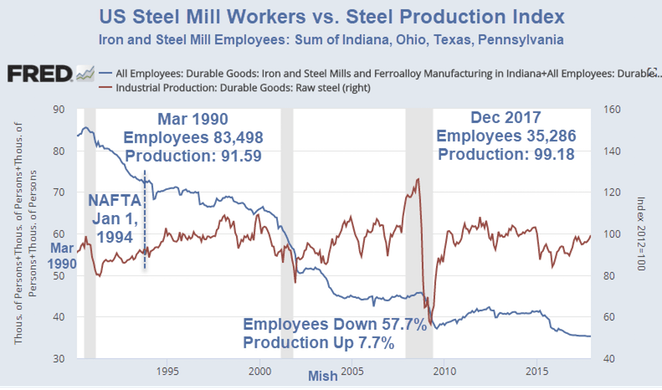
Media previewWell, steady in terms of output but not steady in terms of employment.  Another good tweet last night indicated that the productivity gain for making steel means that 2 people can make as much steel now as 10 could in 1980. So, the problem is not Canada, nor is it Germany or Japan or China, but increased productivity (yes, IPE is more complicated than that so I am simplifying).

Trump's views on NYC as a haven for crime is also outdated, as he seems to remember the NYC of the 1970s or 1980s. This is kind of strange since he spent so much time since then in the construction trade, where one would maybe get a clue about changes in "bad neighborhoods" and all that.

But Trump does not update his priors--he does not learn (he is a lousy Bayesian, overeducated social science types might say).  The only thing he learns or adapts to is when a line works in a speech and gets applause, and then he sticks to it.  So, when trying to figure out how Trump sees the world, imagine what he saw (via racist lenses and without the benefit of reading anything more complicated than a listicle) in 1984 or so.  That is how he views the world today.


Sunday, March 4, 2018

Trade War 101

I was quick to tweet but slow to blog about Trump's desire for a trade war because I don't research or teach International Political Economy.  However, the stuff here is so very basic that I can at least highlight some of the truly stupid stuff here.
  1. Countries will respond, raising barriers to American goods, so many American companies will be hurt.
  2. Any/all companies in the US that use steel/aluminum as inputs will have to raise the prices of their goods, making them less competitive on world markets and more expensive to those who buy them (tis bad for the car industry, for instance).  Others have pointed out that there are far more jobs and money in the businesses where people rely on steel/al products than in the production of steel and aluminum.  This is like fucking over the solar industry for the very small coal industry.
  3. As a result, this may cause inflation (going along with huge deficit spending in a relatively booming economy).  
  4. This will undercut the international institutions that the US built to, um, help the US.  While these agreements/norms/institutions were built so that others would buy in, they were very much aimed at creating an international environment conducive for US businesses.  Given that the World Trade Organization and other dispute panels have more often found in favor of American complaints than Chinese, for instance, this gutting of the trading order is not good.
  5. Steel is not coming back.  The rust belt will not unrust.  
  6. Protectionism like this always costs far more per job saved than what those jobs pay.  In other words, this is a very inefficient way to help these workers.  Better safety nets and training programs would be far better.
  7. Targeting allies is bad.  This will hurt Germany, Japan, and Canada probably more than it hurts China and certainly far more than Russia.  So, yeah, another example of Trump, stuck in the 1980s, hurting the US position in the world.  
  8. Pretty sure all of that supposed infrastructure program (not to mention a wall) require steel, so the prices of such stuff will escalate.
Of course, Trump doesn't care.  He is just angry at some slight, and we just have to be relieved he chose trade war rather than the other kind of war vs. North Korea or Iran.  Trump has never demonstrated much insight from the lessons of the 1930s, and he has always been a mercantilist.  The only good economic deal is an exploitative one.  The problem as I started off with is that other countries are not like contractors in the NY construction business--they can and will retaliate.  I have long wondered why the markets have liked Trump because this day was coming.... but they got their tax cuts.

Since tariffs are taxes, Congress does have a say.  Will they undelegate the authority they delegated to the President?  Will the GOP in Congress resist?  Is this like the tax cuts or like the Russian sanctions?  I have no idea since it requires Paul Ryan and Mitch McConnell to do the right thing.  How likely is that?


Thursday, March 1, 2018

Trump Years? Scaramuccis? Time is Relative!

One of the constant complaints about life in the Trump Era is how long every day/week/month seems to be.  Because every day is packed with controversies, each one seems longer, each week seems longer. For example:

I am highlighting the dog years part because it goes along with people saying yesterday (a Wednesday) how long this week has been and glad that it is Friday because by the third weekday, it has felt like we have lived through at least a full week.

Hope Hicks lasted six months as Communications Director (although never talking to the media?), which does not sound like that long, but she also lasted nearly twenty Scaramuccis (a Scaramucci is ten days).  If we measure things in terms of Scaramuccis, then perhaps it will make the various Trump crises seem as long as they feel. For instance, exactly a year ago, I was at a conference making a long qomment (a question that is really a comment at 1:16) about how Trump ain't normal.  One year is not that long ago, but that was thirty-six and a half Scaramuccis.

Alas, it does not do anything for the daily grind, where one hour feels like three or four. Any ideas for how to express the slowness of the average day in the Trump Era?  I don't really know the answer to this, but the good news is this: if it feels like 5pm at noon, then the drinking lamp is lit.


Wednesday, February 28, 2018

Appalling, Not Shocking, Academic Edition

The Chronicle of Higher Education has a really moving and horrifying story of Jorge Dominguez's career of success and sexual harassment. Dominquez harassed and even assaulted women for decades, for his entire career, and kept getting promoted even as women filed complaints and even as he got minor slaps on the wrist.   Yes, it happened at Harvard so it is more newsworthy, but this is not at all shocking.  Why?  Because universities care more about their reputations than their students until forced to do otherwise.

The harasser I know best started doing what he did before I got to McGill, did it while I was there, and apparently has done it since.  Why?  Because the consequences have been minor.  Why should women risk much stress and further abuse by coming out and filing charges when they see that the consequences for the harasser range from non-existent to not much? 

We have seen some progress in the US because the federal government via Title IX has levied pretty significant threats against universities if they do not deal with the harassment people (mostly women) face. The new budget the Canadian government released yesterday threatens to cut federal funding (which is mostly research money since the universities are run/owned by the provinces) for those universities who do not make progress on combatting sexual harassment.

Of course, universities will say that they do and then continue to do everything behind closed doors.  Yes, it is a tricky legal problem, but until serial harassers are essentially taken out to the university public space (quad, centre, student union, whatever) and drawn and quartered (metaphorically), why should anyone believe them?  To be less dramatic and more direct, until serial harassers face very visible consequences (fired), why should students and governments believe assertions about combating sexual harassment?

Sure, some men will worry about false accusations, but we are not calling for all accused men to be thrown out--just the Jorge Dimenguezs and Rex Brynens--just those who have engaged in harassment repeatedly and will not stop.  The students are simply more important.

On the bright side, stories like the Chronicle's help women realize that they are not alone, that they did experience what they thought they experienced, and it had little to do with whatever they did and everything to do with the harasser.  After posting about Rex two years ago, I have gotten a number of emails from women who were glad I did, that they now know that they were not alone.

Saturday, February 24, 2018

Canada Should Look East? Um, Maybe Not

Jeez, what a bad week for Justin Trudeau in India--he looks silly wearing traditional Indian garb, his wife posed with a convicted terrorist who also had a dinner invite, he gets snubbed for much of the time, and Canadian-Indian relations don't look good.  He also tried to use the Quebec example to analogize with Punjab, but since the only violence Quebec saw was nearly fifty years ago and was limited to one death and a bunch of mailboxes, perhaps not?

I am not going to overreact and say this happened because getting pics is more important than anything else.  I will say that Trudeau needs to leave the home game at home (pandering to the Sikh voters in Canada) and focus on the national interest when abroad. Oh, and he needs to shake up his team since this is the third flubbed Asia trip in a row--Japan, China and now India.  I would like to blame it on how much effort the government has put in the "manage and mitigate Trump" effort, but I do believe there are enough officials in the Canadian government to do two things at once.

It all makes me think that the pressure for Canada to be not just an Atlantic country but a Pacific one may be wrong--maybe Canada should do what it does best and not do what it is bad at as European and North American visits tend to be far less problematic.  I have no idea why.  Maybe the next government should go east, but this one should not venture beyond Hawaii?  Ok, that's a bit much too.  Still, there is a pattern here, and it is disturbing.

After spending an hour listening to the demographic trends the other day, where the biggest sources
of immigrants to Canada are the Philippines at #1, India and then China, Canada must pay attention to Asia.  Also, we can't ignore these markets.  I have been arguing that Canada should focus more on India than China if one wants more market access since the former requires far less compromising of Canada's values.  That may have to wait now, thanks, but the larger point remains.  Likewise, Asia matters since the most likely threat of a major war that disrupts the international economy and gets millions of people killed happens to be in Asia.  So, we can't ignore it.

So, how does Canada do Asia better?
  1. Find out who was responsible for organizing the past three trips and fire them or move them to the most irrelevant desk.
  2. Focus on sealing the deals that are there rather than risking them for marginal gains.  Don't travel to a summit where deals are supposed to be signed if you don't expect to sign a deal.
  3. Do not use these visits to play to specific audiences back home.  Pretend to be head of state and not just the head of the government (snarky, pedant Canadian institutions point).
  4. Build on Japan--that is the country that has the most common interests and also least implicated by Canadian politics.  It may not pay off for particular voting groups, but not everything does.
  5. Canada has a fair amount of academic expertise on Asia so maybe consult those folks and share your plans so that they can serve as a common sense filter.  Because eight days* mostly in Indian garb?  What is Hindi for oy vey?

*  I, for one, don't mind him bringing his family, but eight days in one country? Any country?  Nope, no.  way too much.

Friday, February 23, 2018

Is Trump Really That Bad?

Um, yes.  I asked a panel at the Ottawa Conference on Defence and Security about Trump because, well, I wanted to stir things up, and the panel was on the New World Disorder and Trump had barely been mentioned.  Jim Fergusson, a colleague I have known since our tour of Afghanistan in 2007, pushed back, saying ignore the tweets and US foreign policy is really not that different.  That the structures of US politics have contained Trump.  Hmmm.

So, what is my take?  You can probably guess.  We will defer the tweets for a second.  Let's first remember this list from the other day, focusing on the entries that are related to foreign policy:
  1. Appointing an agent of a foreign country (at least one, maybe two) to be National Security Adviser.
  2. Refusing to fight Russian meddling with American elections.
  3. Undermining civilian control of the military by appointing active and very recently retired generals to many significant posts and delegating responsibility for major decisions to those in uniform.
  4. Leaving the US understaffed in key areas at a time of significant crisis (who is the Ambassador to South Korea?).
  5. Lying every damned day about everything as well documented by Daniel Dale.
  6. Brinksmanship with North Korea.  Yes, North Korea is a hard problem, but it is far closer to a boil now than a year ago, and much of that is on Trump and his statements.
  7. Spilling secrets that allies have collected, creating great mistrust of the US.
 I have enumerated this list so we can refer to them more easily.  Numbers 1, 2, 5, 6, and 7 have certaintly undermined allies' trust in the US.  Will the US do what it has promised?  No idea.  So, some allies may hedge and look elsewhere.  Some potential allies may decide to gamble on China's good will instead.

Numbers 3, 4, and 6 have helped to cause the risk of new war and the reality of escalating the current ones.  So, I think that is significant.  North Korea would always be tricky, but we would not be this close to war if not for Trump.  Yes, it takes two to tango, but Trump is a really bad dancer.

Dropping out of TPP, which didn't make my list but was mentioned yesterday, has made a meaningful impact that we might call "Hegemonic Abdication."  It will be really hard to build back up American leadership that has been so quickly squandered.

Canada has spent all of its foreign policy effort, it seems, on managing the US relationship.  Does that explain the series of shitshows in Japan, China and now India?  Maybe, maybe not.

Lots of talk of trade wars, but that has not happened yet except for the solar panel stuff. We shall see how far this goes, but it is already causing allies to have much angina.

Re the tweets: are tweets policy? To the Chairman of the Joint Staff?  Apparently not (see transgender policy).  To foreign countries?  Absolutely.  They may not be POLICY, but they are presidential statements which affect how countries anticipate and react.  How long ago was it that Trump alienated all of Africa with his shithole comment?  Oh, a month.  It feels like a lifetime. And surveys of the rest of the world about America?  Cratering.  And that matters as public diplomacy is a thing.

I could go on, but, yeah, I think Trump has done plenty of harm already to American foreign policy, and we still have three more years to go.  This year will probably be the year where we determine whether this is just bad or historically awful (trade wars, wars with North Korea and/or Iran). May we live in interesting times?  No thanks.


Thursday, February 22, 2018

When Demographers Make Me Angry

Today was the first day of two days of the Ottawa Security and Defence Conference.  It is an annual event put on by the Conference of Defence Associations Institute, which is a think tank associated with a heap of veterans groups (the aforementioned defence associations).  They bring in a heap of interesting people including US generals and admirals (only one thus far this year and she canceled), experts from a variety of countries and a few random academics (not me).  It is great for networking, which is handy since I am building a network of Canadian Defence and Security folks (the CDSN!).  I also learn a lot, and, yes, sometimes, I get highly annoyed.

Today, I was highly annoyed by Darrell Bricker who was presenting a bunch of interesting information about both demographic statistics and surveys.  The funnest result: bloggers are far less respected than damn near everybody else, even lawyers and airport baggage handlers (sorry, messed up the photo, as bloggers were at the very bottom. Really!)


No, that didn't annoy me. What did was that the way he presented the core info: that women around the world are getting more education, which means delaying childbirth and having fewer children.  This then means two major punchlines for this audience: the ratio of workers to retired people is going to get quite bad, making it hard to pay for the retirement benefits of the old folks AND it will make recruiting hard because there will be fewer young people.  While I don't dispute the consequences, I had a real hard time with the whole "women getting more education is going to cause a lot of trouble" tone of the presentation for a few reasons.  First, keeping women down would be good?  No, no, no.  Second, there is a heap of social science that correlates women doing better with interstate peace, intrastate piece, and economic development (I can't seem to find any handy articles right now--a day of conferencing has undermined my google skills). Third, perhaps producing fewer people might be good when climate change bites real hard?  Fourth, the assertion that immigration is not a big deal since only 3% of the world's population lives somewhere else other than where they are born (yes, he said that) elides the reality that 3% of 7 billion or so is actually a pretty big number and the movement tends to in particular directions.

So, yeah, I should have asked a super-pesky question, like, should we stop educating women so they can birth some more babies.  But I didn't.  My bad.

On the bright side the rest of the panels were very informative and did not contain super-questionable assumptions about the place of women.  Indeed, one of the highlights was when a young woman, part of a student group, got up and asked a question that was more of a comment--that the presenters over the two days are hardly diverse--something like 21 out of 24 spots going to men.  She got a heap of applause after her statement. 

Overall, an interesting day, followed by a jaunt over to the War Museum for a reception for the Carleton Model NATO folks.  They are a bunch of undergrads from across Canada (seemed like many of them were from Western University--at least the ones I chatted with) simulating a NATO crisis this weekend.  Another smart group and much more diverse/representative--the future is mighty bright despite what one demographer suggested.

Monday, February 19, 2018

Trump as Worst President?

Tis Presidents' Day in the US (the name of the holiday in Canada varies by province--Family Day in Ontario, I think), so folks are trying to figure out if Trump is the worst President in US history.  Too soon?  Maybe.


Tis fair for Silver to think that Trump hasn't done enough damage yet.  Those at the bottom of the list tend to be those who broke the country: Buchanan as the last president before the civil war, Andrew Johnson who screwed up Reconstruction, Harding who helped give us the Great Depression.  Thus far, nothing as bad as the Civil War, Reconstruction and the Great Depression have happened.

But to be fair, those dead Presidents were only partially responsible--they had tons of help (I am not so sure about Johnson--I don't know Reconstruction politics that well).  Harding had heaps of help from Coolidge, Hoover and Congress.  Buchanan was one of many who helped bring the US to the brink of civil war.

One could ask about individual contributions of awful (I am omitting the tax cut since he had heaps of help with that), and this is where Trump really shines:
  • Undermining every norm about conflicts of interest and seeking to profit off of the presidency.  Has any President engaged in more corrupt behavior in their first year?
  • Appointing an agent of a foreign country (at least one, maybe two) to be National Security Adviser.
  • Refusing to fight Russian meddling with American elections.
  • Speaking of elections, Trump has tried to encourage more voter suppression but his own incompetence may have harmed that effort.
  • Obstructing justice early and often.
  • Appointing a retrograde racist to be Attorney General (yes, the Senate is guilty of letting that happen, so not just Trump).
  • Undermining civilian control of the military by appointing active and very recently retired generals to many significant posts and delegating responsibility for major decisions to those in uniform.
  • Attempting to make the Justice Department a biased participant in American politics.
  • Leaving the US understaffed in key areas at a time of significant crisis (who is the Ambassador to South Korea?).
  • Lying every damned day about everything as well documented by Daniel Dale.
  • Brinksmanship with North Korea.  Yes, North Korea is a hard problem, but it is far closer to a boil now than a year ago, and much of that is on Trump and his statements.
  • His condoning/encouraging of white supremacy (one reason why Woodrow Wilson is overrated).
  • Spilling secrets that allies have collected, creating great mistrust of the US.
Sure, none of this involves war (yet), economic hardship (yet), or civil strife (depends on how you count the number of minorities beaten and killed over the past two years).  So, maybe Trump has not presided over the worst times in American history, but he has almost certainty committed the most and potentially some of the gravest unforced effors.  But, yes, recency bias is a thing.

So, it may be too soon to put Trump at the very bottom of the list, but he is properly rated if he is near the bottom. Again, it depends on whether it is about the individual or about the Presidency and the era.  Which is why survey questions are hard to write, and the answers are often hard to interpret.

Sunday, February 18, 2018

Tenure Letters and Cohort Comparisons: This Way Lies Confusion

Tenure and promotion letters are one of the services academics do when once they get past tenure themselves.  I have blogged in the past about whether or not to write these letters, so today's post is about a frequent challenge when writing such letters: some (many?) provosts/deans/whoevers ask the letter writers to compare the candidate to the candidate's cohort--other people in the same area of research who have been at it for a similar time.*
*This post only addresses research since outside letters can only speak to research and because my only experience has been in research universities.

This request poses both practical and normative challenges.  The practical challenge is this: how does one know who the comparative cohort is?  As far as I know, there is no handy search engine that will pop out names of people in a subfield or research area sorted by year of PhD completion.  I don't have an encyclopedic memory for who finished in what year, nor, because I am far behind in my journal reading, really know who is doing what.  Reading all of the materials is extra work enough without systematically going through "peer institutions"** and identifying folks in the relevant subfield who are at the same stage of their career. I posted on facebook, essentially asking my IR friends for names of folks who would be in this person's cohort.  Instead of giving me names (ok, one or two people did), this led to a long and interesting discussion of the entire exercise of comparing.
**  One of the basic problems in all of this is that every Dean/Provost has an inflated sense of what their institution is, so the list of peer institutions is quite small--the Ivies, the top public schools and a few others.  It does help me, however, that I moved from a school seen as peer (McGill) to one that is not (Carleton), so I get fewer requests now than I did at the old place.  Woot.

The folks arguing for comparing to a cohort argued this was one of the most valuable pieces of information in the letter since everyone mostly writes super positive letters lest their few criticism arm those who are opposed to a candidate for whatever reason (not infrequently illegitimate ones like sexism, racism, animus, retaliation, etc).  More importantly, some folks argued that to evaluate a candidate, they should be compared to their peers.***  This is what many letter requesters want, and some even name specific scholars (usually the most well known/cited/productive).   Even if focused on a person's contributions sans comparison, competition ultimately enters as one evaluates the quality of the presses in which the candidate publishes, the selectivity of the journals in which their work appears, citation counts and h-indexes are essentially comparative and so on.

***One friend argued with me that competitiveness is productive, that folks who are competitive will be motivated to continue to publish after tenure, and that those who are not motivated by comparing themselves to others are likely to become deadwood.  I think curiosity and professionalism bred into us is sufficient, but I am sufficiently ego-driven that I see something to that argument.


But this raises a question of what is the point of being a scholar, of being promoted and tenured?  To be better than others?  Or to be productive, to make a significant contribution?  What difference does it make if candidate x is not as productive as the most productive people in the discipline?  Not everyone can be above average.  Perhaps the idea is only to tenure/promote people who are above the people who are at the average level of productivity?  How I write the letter depends on how I see the profession, and while there is a heap of competition in it--to get into grad school, to get grants/fellowships, to get into the more selective journals and presses, to get jobs--I think the larger enterprise is not competitive. It is about making contributions to knowledge, building on the work of others (past and present).  That co-authoring, for instance, and other forms of collaboration should not be penalized (I wrote the linked post in the aftermath of my co-authored work being dismissed by my senior colleagues because .... motivated bias, so that post might be a bit strident).  Moreoever, as one friend argued, relative comparisons may be unfair when there is a heap of bias--in who gets cited, who gets published in the top presses, etc. 

The tenure/promotion letter, in my view, is about addressing whether this person has made a contribution and is likely to continue to make a contribution. To me, these are absolute questions, not relative ones.  Which is why most of the letter is about what the person has researched and written and what their stuff contributes rather than the bean counts and comparisons with cohorts.  When asked to compare, I try to do so because, like saying no to the request, not following the instructions can be seen as criticism. But I don't like it, and I have a hard time because I do not have a good grasp of who is in the cohort.  So, what else do I do?  I whine here about it.

Saturday, February 17, 2018

Long Gestating Kushner Rant

I have not really blogged much about Jared Kushner because it seems so unnecessary---that it is patently obvious that Kushner is unqualifed and, yes, a security risk.  But he is still around, still being given too much responsibility, and still threatening American national security.  Oh, and demonstrating why there are laws and norms against nepotism.

What experience does Jared Kushner have to be a White House operative?  Crickets.  Badly managing a business is not a background for this job.  The only experience he has is being married to a Trump.

What experience does Kushner have to help facilitate Mideast piece?  Being Jewish is not experience.

What experience does Kushner have to be Trump's emissary?  Ok, he's related to Trump, but he has no foreign policy experience.   He has no background on Saudi Arabia or China besides perhaps liking despots?

What experience does Kushner have to help with the opoid crisis? Nada.

What experience does he have reforming government agencies?  Or with Veteran's Affairs?

The only experience that seems relevant is amassing foreign debt.  Which has led to him revising his security clearance paperwork several times.  As the folks at Pod Saves America reminded us this week, lying on the form is a felony.  Which, of course, then would make Jared ineligible to get a security clearance.  Yet he has kept having access to the most secret info, and according to one story I saw, he asks more often than anyone else for the classified info.

Combining Kushner's lack of knowledge with how easily blackmailed he might be, there is no way any semi-normal administration would put him anywhere near the centers of power.  Because Kushner is married to the daughter of a President who does not care about norms, standards, rules, etc, Kushner is where he is.  He should have been kicked out of the West Wing on day one.  It would have been better for all concerned had he and Ivanka (another thoroughly inexperienced amateur) stayed in New York.  But that would require judgment about capability and culpability and vulnerability rather than loyalty tests.

Here we are, John Kelly, the White House Chief of Staff, trying to marginalize the President's son-in-law.... At least, we will have a reminder for the next fifty years that nepotism is a bad idea.   Oh joy.

Friday, February 16, 2018

Black Panther: The Most Meaningful Marvel Movie

Mrs. Spew and I went to the first showing of Black Panther last night, and we were not disappointed.  Since most folks have not yet seen it, only go beyond the break if you don't mind being spoiled or were able to see the movie pretty quickly.

Sunday, February 11, 2018

Guidelines for NATO Spending: Inputs, not Outputs or Outcomes

I tend to complain a lot about the NATO 2% expectation--that members are supposed to spend 2% of their GDP on defense stuff, which probably makes more more Canadian than anything else I do (I don't skate or watch hockey much).  This is aspirational and countries are supposed to reach it by 2024.  I have written much about why this is problematic (it tends to make Greece look good, which is a clue; doing is more important than spending, etc), but today I want to focus on the heart of the matter: 2% is a measure of input and nothing else.

The basic idea is if we all spend a significant hunk of money, we will get more defense than if we spend somewhat less money.  But spending more money on defense may not improve NATO's ability to field effective armies, navies and air forces.  For many members, spending more could simply mean spending more on personnel, which might lead to a more capable force or it might not.  There are additional NATO goals which get far less coverage, which are aimed at persuading members to spend significant hunks of cash on capital--building ships, planes, tanks and other equipment.  Again, this is a focus on input.  Spending more on equipment does not necessarily mean getting better or more equipment.  It could simply mean more waste.

The funny thing is that the US is pushing Belgium to buy the F35, suggesting that this would help them get to 2%.  Buying a super-expensive plane may or may not improve Belgian military performance, but it might get Belgium off of the free-rider list?  I am trying to remember a similar example of being so focused on inputs that they become more important than outcomes, but can't at the moment.*


Sure, we tend to focus on inputs or even outputs because they are easier to measure, and in NATO dynamics, are things about which it is easier to come to a consensus.  It is hard to measure outcomes like readiness and effectiveness.  Also, big numbers are not secret whereas actual military capability--what can a country really do--might have to be covered in secret sauce.  But what really matters is whether NATO can fight better (against others, not against each other) or not.  Spending more might help, but it might not, depending on where the money goes.  When countries underperform, is it because they underspend or because they have restrictive rules or because they have lousy strategies (who could that be?) or because their procurement processes are busted (hello Canada!) or because the adversary gets a vote?

One last semi-related point: asking the Western democracies to spend more on defense after encouraging austerity post-2008 is a hard sell, and, yes, domestic politics is a thing.  After years of saying that spending must be cut on social programs because debt is the supreme evil, saying that the first priority now must be defense is just not going to fly, especially with all of the complex coalitions that are barely governing so many members of the alliance.

So, as we keep invoking 2%, let's keep in mind that many countries will never reach it, as it would require more than a few to increase defense spending by 50-100% AND it allows us to ignore the bigger challenges of how to foster greater effectiveness and readiness.

* The only thing I can come up with would be examples from the Soviet Union of meeting five year plan targets by building huge non-usable things that helped reach the goals measured by weight like one really ball-bearing or something like that.

Friday, February 9, 2018

Oscars 2018

I think I saw more of the nominees than in a normal year with fish sex Shape of Water being the last of the Oscar movies I will see in the theater.  Next week is Black Panther and then the rest of the summer movies of 2018 (summer is earlier than ever).  So, what would I vote for?

Best Movie:
Get Out.  It was the movie that did and will stick with me.  It had the most interesting and surprising premise.  It was multidimensional--funny, scary, moving, meaningful.  Number two is hard as Dunkirk was an amazing movie--very creative in its own way, very much the epic of the year.  But Shape of Water was also very multidimensional--Cold War spy thriller, sci-fi fish out of water (sorry), and romance.  Oh, and fish sex.  I saw Dunkirk a while ago so it is hard to compare with Shape of Water.  I did pay heaps of attention to the direction and editing of both, probably because of my daughter, Intern Spew, and her nascent film career.  Three Billboards was quite good and moving, but the racist redemption thing kind of took me out of the movie a bit.  Lady Bird?  Incredibly well acted but not all that special to me.  Sorry.

No vote for Best Actor as I saw only one of those--Daniel Kaluuya in Get Out.

Best Actress:
Frances McDormand was just a force.  Sally Hawkins comes close because she was so very good, so very expressive despite not being able to talk.  Saoirse Ronan was very good, but the role was not that special. 

Best Supporting Actor:
Despite the whole problematic redemptive racist thing, Rockwell pulled it off really well.  Jenkins was very good in Shape, but didn't help to make the movie.  Harrelson was fine in a small role--moving, but replaceable.

Best Supporting Actress:
Metcalf in a runaway.  Ok, I only saw two of the nominees, and Olivia Spencer was very good but again the movie didn't hang at all on her.  Metcalf helped to make Lady Bird be a notable flick.


Director:
Best movie should get best director, but I am inclined to give the writing award to Jordan Peele and the directing to either Nolan or del Toro since their movies were harder, more epic.  Hmmm.  Good thing I don't have a vote.

Best Original Screenplay:
Get Out.  It had better writing and a more interesting plot than the others--I saw all five of the nominees.

Best Adapted:
Logan.... only one I saw.


Thursday, February 8, 2018

What is Wrong With Mattis/Trump Dynamics? Let Me Count The Ways

The WashPo put out a great piece last night that is getting a lot of attention, asking whether Mattis can "check an impulsive president and still retain his trust?"  Lots of great details into the dynamics within American civil-military relations as the US barrels towards another war or two.  And the piece absolutely drives me nuts.  There is so much wrong both about how the US is operating and how the press is depicting the bizarro world we are now in, so I decided to enumerate my problems with both the facts that are reported and how they are reported:

Wednesday, February 7, 2018

Civil-Military Relations: Trump's Ego and All That

The big squirrel du jour last night was that Trump is actually getting the US military to plan a parade.  Sure, Trump admired the French military parade when he visited during Bastille Day, but we thought he might not remember.  Turns out that his memory of his own words is very bad, but his memory about things that makes him hard feel good about himself is a bit more robust.  So, planning is underway for the US military to have a parade down Pennsylvania Avenue.  Which will certainly do much ironic and not so ironic damage to the street.

Yeah, we've had military parades before but mostly after military victories.  Because Trump seems to be an autocrat-wannabe and also because he seeks to cut lots of useful stuff in the budget (like the Centers for Disease Control doing much work in the world to prevent epidemics from becoming pandemics--strange for a germophobe to do that), this expensive enterprise to make him feel good is being read as part of that larger destruction of democratic norms.

Which gets me to civil-military relations.  An essential but mostly overlooked ingredient for democracy is civilian control of the military.  This is always a difficult relationship since the two sides have very different perspectives and cultures and all the rest.  The concern in much of the literature on it is whether the military will "shirk"--do more or less than it is supposed to do.  For instance, a few months ago, it became known that the various branches of the armed forces were not informing the National Gun Registry folks about the domestic abuse and other crimes committed by soldiers, sailors, marines, airpeople.  Much of the literature is focused on how the civilians can create structures and activities to make sure that the military folks do what they are supposed to do.  Indeed, that is the heart of the Steve/Dave/Phil project that has taken me to Brazil, Japan and elsewhere.

What this literature only sometimes addresses is when the civilians are the ones deliberately screwing things up.  We have much less civilian control of the military right now because Trump has delegated most of the decision-making to the folks in uniform and to a guy who was in uniform until just a few years ago.  That was not good, but now we have the President seeking to have the military be more clearly part of the effort to prop up an unpopular government as he calls normal opposition to his regime "treason."  This is all awful, and it is all dangerous.

Building norms and institutions takes generations, but destroying them does not.  Trump is doing much damage to civil-military relations, making the crises under Obama or Bush or Clinton seem incredibly trivial.  The next President and next SecDef will have to do much work to salvage the relationship between the civilians in charge and the military.

There is one hope, but, well, not much of one: Congress can refuse to authorize the money for this.  But given how willing Paul Ryan, Mitch McConnell and majorities of Republicans in both houses are willing to sell out everything, I am not optimistic that Congress will play its role in American civil-military relations.  As it turns out, the original driving force of the big project was my idealization of Congressional oversight that might be just as dead as the rest of American political norms.

Finally, the only military parade I want to see is this one:


Tuesday, February 6, 2018

Canada Cyber Defence: Uninformed, Wild Speculation

I was chatting with a defense attache today, and he asked me a question about Canada: why hasn't Canada developed much of a cyber-defence capability yet?  Given that cyber threats are the most significant dangers to Canada (we are too far away from everyone for conventional military threats and most nukes will just pass over, oops), this is a puzzle.  I hate not answering questions, so here are my wild guesses, and you can let me know which you think makes the most sense:

1) Standard bureaucratic politics: neither the army, air force, nor navy wanted to spend money/personnel on cyber since it would mean taking away from the activities/equipment that they have long seen as priorities.  The only way to develop cyber capabilities is to have new money, which is ultimately what the Defence Policy Review (aka SSE for Strong, Secure, Engaged).
2) Canadian defence procurement doth suck muchly.  The SSE and the Liberal government budgeted money for new personnel and stuff to do cyber stuff.  So, yeah, we shall how long that takes to happen.  I feel like blaming Treasury Board because, well, I don't really understand it, but they seem to not like spending money.
3) Canada lacks a good imagination of the possible.  When we hear discussion of cyber and the CAF, the discussion ends up focusing on how can one have soldiers who compute?  Do we have to have the same physical standards for the cyber warriors as for the normal kind?  How about considering how the other advanced democracies do it?  The National Security Agency is owned by the Department of Defense, but is mostly a civvie agency if I am not mistaken.  Perhaps the DND cyber warriors could be civilians?  I have no idea really, but how about seeing how other countries have done it.
4) I do think that Canadians are worried about privacy and about the government having too much capability.  There was concern and questions about the cyber offensive stuff in the SSE.  So, maybe the politicians are slow because they think this stuff is unpopular?

As I said, I am wildly speculating.  Given where Canada is now on this at a time where Canadian institutions (including Carleton) are getting hit by cyber attacks, should we expect more out of the government?  If so, why is it (and previous governments) underperforming?  

Monday, February 5, 2018

Worst Advice for Grad Students?

After a brief glance at twitter this morning, I am tempted to run a contest: what is the worst advice to give a graduate student (other than to pursue a PhD, that is)?

What inspired this?

I don't think I ever told my students to work long hours.  Maybe I set goals for them that implied working longer hours, but I never told them to work 60 hours a week (my TA's might be nodding their heads but not my research assistants as my vague instructions never required long hours).  The whole "work smarter, not harder/longer" may seem trite and easy to say, but, in my humble experience, the biggest challenge to being productive was not the time put in but being productive in the time spent.  That focus is the problem, not hours. 

In my case, I definitely have a focus problem, not a time problem. I have never been one for putting in long hours.  Indeed, in my first teaching gig, I did work on Saturdays sometimes.... for those weeks where I skied on Thursdays (where was I this Friday?).  Ever since, my weekend work, a few hours here or there, not a matter of working entire weekend days, has mostly been grading and reviewing and some catching up in my reading, but that does not make me hit 60 hours because I have rarely worked nine to five on weekdays.  

Of course, it depends on what you count.  I do travel on weekends for interview research so that the weekdays are as efficient as possible, but I never have had an interview week that is pure interviews from morning to night.  While I do fill some of that time with transcription and planning, some of that time in foreign capitals ends up being empty .... which means tourism.  Conferences?  Those can be long days, but playing poker or drinking with friends after the panels? Is that work?  Not really. 

Getting back to graduate students, it really depends on their lives--what other competition is there for their time, how much progress they have made compared to the clock on their funding, etc.  Students fall short of making good progress in the program do so not because they are failing to overwork, but because they:
  • took on too many other responsibilities (working in student government, agreed to do service type stuff long before they should have, etc.  Saying no is really hard for academics but especially for grad students).  Of course, there are very demanding disciplines that require tons of time in labs so YMMV. 
  • could not figure out their research question.
  • had a hard time sticking to one question (juggling multiple projects is not something I recommend for anyone pre-tenure and especially not while in grad school).
  • had a hard time getting funding to do the research.
  • have a hard time working independently.
Yeah, I get it--that with a tougher job market, grad students need to publish while they are in school and that increases the workload.  So, I am not saying they never go over 40 hours.  But I would never tell a student to expect to average 60 hours a week.  Sometimes, one's load might go up that high, but at other times, one can't focus and one puts in under 40.  The academic life means that it is up to each individual how to figure out how much time to put into various things.  Early in one's career, course prep takes more time.  Later, course prep takes far less time, but one has to do more advising of advanced grad students or more administration or more service.  Which means that I tend to read far less than I would like.

And, no, I don't count time I put into blogging and twitter as work time because you may have noticed that my lack of focus definitely applies here--much of my online social media stuff has nothing to do with work.  When someone asks me to write for them, well, that is work.  Writing for myself?  Mostly fun, sometimes free therapy.

I have always been a big believer in work-life balance, that seeing a movie the night before a big exam or a defense is a good way to de-stress.  Sure, I wish I could be more productive, but that is not about putting more time in, but being more focused when I am trying to work. Speaking of which, time to get back to the big grant application.

Saturday, February 3, 2018

Ski Strategery

Longtime followers of the Semi-Spew will know that I like to give talks at universities near ski areas in wintertime.  This time, I gave a talk at the Centre for Military and Strategic Studies at the University of Calgary on what we can learn from Afghanistan.  And I learned much both from those who attended and from someone who couldn't make it to the talk but did attend the dinner (my first real convo with someone inside the Harper government!)

More importantly, I got to ski at Lake Louise.   My previous talk here about four years ago led to a different ski area--Sunshine.  I think I prefer Lake Louise, although I couldn't see much of it because it was snowing both days.  Indeed, both days, but especially the first, made for some challenging skiing since I could not see well at various times.

Given that I was talking about lessons learned when Canada was under much pressure in Afghanistan, what did I learn during two hard skiing days?
  • The Skier's dilemma (at least for me): Clear skies with great views OR poor views but fresh snow.
  • Learning to ski in the mountains (hills) of Pennsylvania trained me to ski on ice, not fresh snow.  I am not good on plentiful fresh snow, especially when the carving of predecessors turns a blue cruiser into a mogul field
  • I still skate like an American, as there were some flat parts and I tend to skate them poorly.
  • Some ski run names are very apt.  I finished Marmot (a rodent) run right before lunch.  While at lunch, a marmot came up to the lodge.  Glad I didn't ski Wolverine today.
  • That being single is a big advantage (although I miss my favorite skiing partner--Intern Spew), even though the lift lines were never very long--non-existent yesterday and fairly quick today.
  • More importantly, I learned being in a gondola with five bros can be fun, as they were amusing and one of them was carrying skiing juice.  That would be, in this case, jaegermeister, and yes, he was a German skiing with four North Americans.  
  • I can be too slow with a camera--one chair lift goes past a tree festooned with bras of all kinds.  It seemed photo-worthy, but each day I was on that lift once, so I didn't react fast enough either day. Rats.
  • I learned that the ski bums of Canada tend to be from Australia or New Zealand with a few Brits mixed in.  I remember this from my last trip, but I had forgotten.  
  • Banff is a pretty sweet place.  Sure, it has lots of touristy stuff, but lots of restaurants to choose from, amazing views, apparently bountiful public spaces/services, and nice folks.
  • I now get why folks who own Jeep Wranglers don't clear snow off of them as well as I can off of my car.  I had little choice at the airport, and this brand new Jeep is an interesting drive.  
I am very lucky that I can do this, that my teaching schedule this term (M/W) gives me the chance to take off just when the slopes are getting sweet.  It will probably be the only skiing I do this year, as the places closer to home have been cycling between rain/snow/melting/freezing and I am too old to mess with ice.

Oh, and one of the cool things about being on the slopes for two days is I am mostly out of the loop about whatever Trump is doing and how incredibly dumb the Nunes memo is.  Ok, I caught some of the tweets of along these lines:

Thursday, February 1, 2018

Rooting for Bad Civilian-Military Relations/

Reading this story about Korea war planning is giving me chills. 
 But the Pentagon, they say, is worried that the White House is moving too hastily toward military action on the Korean Peninsula that could escalate catastrophically. Giving the president too many options, the officials said, could increase the odds that he will act.
 Are we supposed to be happy that the Pentagon under Mattis and Dunford are trying not to give an options to Trump that he might choose to use force?  Yeah, the tyranny of low standards means I am now rooting for the Pentagon to defy the White House.  Still, even if there is no war, lasting damage to American civil-military relations may ensue.  I mean, I am glad that there really are some adults in the room:
The Pentagon has a different view. Mr. Mattis and the chairman of the Joint Chiefs of Staff, Gen. Joseph F. Dunford Jr., argue forcefully for using diplomacy. They have repeatedly warned, in meetings and on video conference calls, that there are few, if any, military options that would not provoke retaliation from North Korea, according to officials at the Defense Department.
 I want Mattis to push back against Trump's apparent desire for war.  So, woot, I guess.  But dumping Victor Cha still scares me.

I will be on the slopes tomorrow, so, um, good luck!