Showing posts with label cognition. Show all posts

Monday, March 5, 2018

The Trump Rosetta Time Machine

How do we make sense of Trump?  Yes, he is an uncertainty engine, but there are some basic tendencies that seem to be driving much of what he says and does.  He is a lifelong racist, so not hard to guess how he will act towards non-white folks, for instance.  When it comes to international economic stuff, it all starts with where his mindset stops: the early to mid 1980s (that and he never took Intro to International Relations).

When Trump talks about trade deficits and blasts Japan and Germany, he seem to be invoking a time where those two countries seemed to be the biggest threats to American producers.  Japan's economy has been stagnant for more than two decades.  Both countries have firms that have invested significantly in US-based production.  So, these views have mostly been overcome by events that Trump has not apparently noticed.

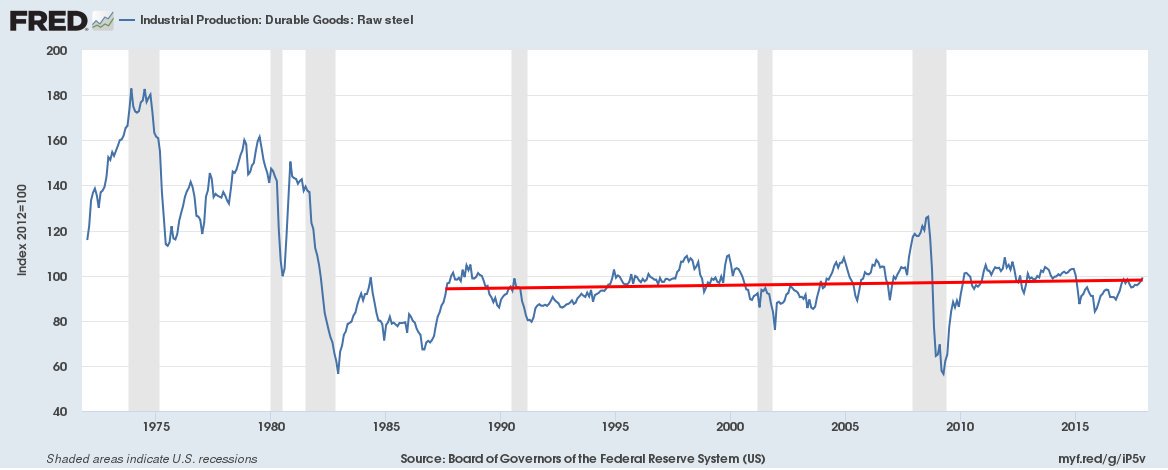
Trump's views on steel and aluminum, that these industries are on steep decline, makes sense if you compare the mid 1980s with the previous decades:
Media preview


 but these industries have been mostly pretty steady since then (big dip during the financial crisis, and mostly profitable as of late, and see here for more figures, h/t to Scott Lincicome).

 
Media previewWell, steady in terms of output but not steady in terms of employment.  Another good tweet last night indicated that the productivity gain for making steel means that 2 people can make as much steel now as 10 could in 1980. So, the problem is not Canada, nor is it Germany or Japan or China, but increased productivity (yes, IPE is more complicated than that so I am simplifying).

Trump's views on NYC as a haven for crime is also outdated, as he seems to remember the NYC of the 1970s or 1980s. This is kind of strange since he spent so much time since then in the construction trade, where one would maybe get a clue about changes in "bad neighborhoods" and all that.

But Trump does not update his priors--he does not learn (he is a lousy Bayesian, overeducated social science types might say).  The only thing he learns or adapts to is when a line works in a speech and gets applause, and then he sticks to it.  So, when trying to figure out how Trump sees the world, imagine what he saw (via racist lenses and without the benefit of reading anything more complicated than a listicle) in 1984 or so.  That is how he views the world today.


Wednesday, October 5, 2016

I Am Confused About Being Confused

One of my standard lines is "I am confused."  In twitter discussions, this is often treated as weakness--that I am a simpleton or somehow otherwise flawed because I don't see the situation as clearly as some advocate thinks I should.  But admitting confusion is, I think, an important step to learning and figuring something out.

That confusion is often created by others offering up contradictory statements--characterized by conflicting logics or by some form of hypocrisy or by some form of conflation of two different dynamics or by something else.  Recognition of contradiction can be met with all kinds of responses, but my "I am confused" is essentially suggesting that more thinking is required by me or by the advocate or by both.  Maybe that causes the advocate to be confused or to be upset.  Ooops.

Again, I think confusion is a healthy recognition that one needs to think more, pushing one out of one's comfortable cognitively closed boxes in one's head.  Indeed. when I taught Intro to IR, I vowed in my first class that the purposed of the course was to confuse the students.  That my job was not provide them with a single point of view, but with multiple ones with conflicting assertions about the nature of International Relations.  The idea was to provide the students with multiple tools to understand IR, so that down the road they could have multiple tools to understand events they observe. 

In short, I think too much confidence in the clarity of the world is a problem, as people refuse to recognize the complexities and as they refuse to acknowledge the tradeoffs.  Simple adherence to an ideology or point of view is far more comfortable than confusion--mostly by assuring the person that additional thinking is not required.

Am I being clear here or am I just making other folks confused?  If the latter, join the club.


PS  There is no deliberate subtweeting here.  Blogging today was inspired by a most friendly twitter conversation, but this is something I have been thinking about for sometime.  Or maybe it was inspired by my altered sleep cycle.

Sunday, August 10, 2014

Too Late to Day-dream?

I have not been blogging much during this family vacation at the beach.  Turns out I am doing something right.  This piece by a McGill prof identifies how we pay attention to stuff and how important it is to let our brains meander.

This has not been a particularly productive summer for me. Last summer, I wrote a new book (under review).  This summer, I started a new project and did not make much progress.  I did better un-stalling long moribund projects (conference deadlines are a beautiful thing, sort of).  One of my problems is that I have not followed the advice in this piece--to cordon off my time so that I don't do social media stuff when I am trying to do work.  Turns out that the world today is super-distracting!  Who would have thunk it?

Ok, so I was aware of that before.  But the importance of daydreaming/meandering highlighted here is suggestive.  I probably should listen to fewer podcasts when I am driving/exercising since podcasts mean focus and thus not much creative meandering.  Good thing I don't have a waterproof device for listening to podcasts in the shower.

The good news is that I have been pretty un-focused on this vacation--I have not done much in the way of academic work, I have not blogged, and I have not been on twitter/facebook much expect to post silly pics.

The better news is that this piece does justify something that I do regularly--naps FTW! 

The other key bit of news is that we should feel less guilty when we are not getting stuff done--because that is when we do get bolts of inspiration.  I surprised my relatives by discussing the relevance of guilt in the academic enterprise--they were horrified.  Like anything, perhaps not bad in moderation.   Distractions can be good:


On my last day of vacation, it is time for me to stop blogging and start doing the sunscreen thing.  See you on the other side (of the vacation).


Sunday, October 20, 2013

Recurring Themes Recur for a Reason

One of the recurring themes here at the Spew is that of confirmation bias--that people pay attention to that which they want/expect to hear/see and ignore that which does not fit their pre-existing bias.  I am self-aware enough of this to understand that confirmation bias is probably a key reason why I like this NYT op-ed on .... confirmation bias.

Of course, this is a far more nuanced and specific take on the issue than my rambling, so don't listen to me.  I am not an expert on any dimension of psychology especially the fields that I tend to cite but not read--cognitive and social.  But then again, according to this piece, it is best not to listen to the most confident doctors but those who have doubts--they tend to be more reliable.

If that is the case, then perhaps you should listen to me about the things with which I feel the least confident.  This would include:
  • International political economy
  • Hockey
  • Women/girls and the pursuit thereof
  • Advanced quantitative methods
  • Discretion.  That is being discreet.  On the other hand, the forthcoming book focuses on why folks give their underlines more or less discretion, so I can fake confidence there.
  • Defense on the ultimate field.  I am very confident about throwing, but defending?  Not so much.  
  • Jumping.  I have never been confident in my vertical ability and wildly overconfident in my horizontal efforts (diving).
  • Duration of civil war.  I think I have a decent to good grasp on the causes of internal conflict but not so much on what causes them to endure or not.
  • Running discussions in small classes.  I am far more confident, however unjustly so, about my ability to lecture.
  • Cakes.  I am probably too confident about making pies and cookies, but not so much cakes.  Good thing is that I do know someone who is a cupcake magician.
  • Judicial politics.  I don't study Congress (well, not until the next project) or Parliament, but I probably think too much of my ability to understand such stuff, but I am entirely unsure of how/why various Supreme Courts decide/operate.
  • Dancing.  I can neither dance nor judge it.  Nor sing.  Nor do anything in the creative arts with the possible exception of acting.  
  • Serious fiction.  I don't read the stuff that wins Nobel Prizes in Literature. 
Anyhow, the key lesson of the NYT piece is that one must think for themselves--do not turn off one's brain when listening to experts especially those telling you want you want to hear.  Of course, this means that you should probably ignore this post.

Thursday, May 9, 2013

Time for a New Religion


A friend of mine (h/t to JJ) posted on her facebook page the divergent reactions to the National Household Survey of Canada, which is like a census but is no longer mandatory (Harper hates social science along with all other sciences, apparently).

JJ noted that the anglophone press noted that immigrants are speaking more French than before.  The French press notes that 20% of the immigrants do not speak French.  Oh joy, the cup is either 80% full or 20% empty?

For me, what this means is this: I want Confirmation Bias to be a religion because I so strongly believe in it.  Of course, those who want to see the "census" reporting French is under attack note that not all immigrants are picking up French, and, of course, those who think that the language thing is over-wrought in Quebec (which it is, I can confirm with bias).  People see what they want to see much of the time.  How can 80% of immigrants learning French be insufficient?  Oy.

Anyhow, now that we are trying to start up Confirmation Bias as a religion, what does that require?  Hmmmm.  From here, I cropped this:


The idea is that information is filtered as it comes in, so that only that which confirms one's beliefs makes it through.

Ok, next step is dogma, which we borrow from the Ironborn of Game of Thrones: That Which We Believe is Never Dead Disconfirmed.

The only rite of passage required to join is to believe what one has always believed no matter how much disconfirming information is provided. 

Holidays? We can steal the holidays of pre-existing religions by focusing on those aspects of each holiday that celebrate the selective filtering of information.

I am not an expert on religion, so let me know what we need to add, and if it fits with latent existing beliefs, I will support your suggestions.  If not, then not.

Sunday, February 10, 2013

Is Mali Afghanistan?

Last night, I was asked once again is Mali Africa's Afghanistan?  Hell if I know.  Well, I didn't say that, but it really depends on what you mean by "Afghanistan."  Mali experts will say no, because all experts hate when their place is considered to be very comparable to another, especially one of the objectively worst places on earth (not just violence, but corruption, economic situation, etc., Afghanistan always ranks at the top or bottom of those lists).  I am an expert on neither country, but have followed Afghanistan for much longer since the books in progress focus on outsiders mucking around in Afghanistan.  Plus ten days there in 2007 make me an expert, right?

So, when I think is Mali like Afghanistan, I tend to say no because:
  • Who is the Pakistan in this analogy?  Maybe Libya played the role of outsider feeding/fostering unrest, but not anymore.
  • Indeed, the neighbors seem to be constructive.  Imagine a world in which India and Pakistan and Iran were working together to support the government of Afghanistan and the NATO effort?  Yeah, unrealistic, but Mali, as far as I can tell, is getting help from multiple countries in the region to regain control of the north.
  • Does Mali have poppies or the equivalent?  Afghanistan has been greatly complicated by the reality that poppies are one of the very few profitable exports with efforts to substitute/eradicate/minimize raising all kinds of problems.  
  • While the various groups that seized the north share some identities with the people who reside there (Tuareg, Muslim), they apparently wore out their stay quite quickly and don't have the reservoir of support that the Taliban has had among certain tribes within the Pashtuns. 
What makes Afghanistan and Mali similar?
  • Limited trust/capacity at the center.  Afghanistan has Karzai, and Mali has a new military regime promising to have elections soon.
  • A crappy "security sector."  Afghanistan's police systematically abuse the populace.  Mali's military seems to be killing folks who have little to do with the various separatist groups.
So, yes, there are a few similarities, but violence, state collapse, and intervention do make Mali Afghanistan.  Mali's road will be tough and bumpy, and it may not head where people hope it is heading.  But it ain't Afghanistan.  When we apply analogies, we really need to think not just about the apparent similarities but the core properties and see how many of them apply.  In this case, a few but not that much.

Wednesday, January 23, 2013

Yank My Chain If You Will

I guess there is probably one thing that will get me to react faster and more vociferously than anything else: giving credence to a conspiracy theory.  Today, Salon ran an utterly idiotic piece on giving conspiracy theories a chance.   It is such crap that I refuse to link to it (even though it is easy to find).

It was trying to distinguish unworthy conspiracy theory (Sandy Hook) from more worthy (JFK, 9/11).  While the article is fully flawed, the two big logic bombs are these:
  • "“Conspiracy” theories develop, first and foremost, because the official version is obviously bogus."
  • That they develop and are relatively credible when there are people out there who can gain from the event--the defense contractors after 9/11 for example.
First things first: conspiracy theories develop not because the conventional wisdom is bogus but because some people do not want to believe the conventional wisdom.  They are motivated by their prior beliefs to disbelieve events/policies/whatever that challenge their views.*  In retrospect, I am not surprised about Sandy Hook conspiracy stuff because this was a family that fit the general model of the NRA--Mom was a fan of guns, taught the kids, worried about losing the guns, etc and then the kid killed the  Mom and shot up a school, pretty much verifying the idea that guns in "good homes" are dangerous, too.  So, rather than believe that view of events, which would be ... the reality, the truth, the folks who do not want this to be true, make something up.

Same goes for 9/11.  This is about people not wanting it to be true that government failed to protect us, that Arabs/Muslims could be so clever to pull this off, and all the rest.

The second hunk of illogic is arguing that if someone benefited by something, they wanted it to happen.  Americans wanted World War II to happen since it made the US a world power with no equals?  Yes, Haliburton and the rest of the Bush Administration gained heaps of influence and such in the aftermath of 9/11, but that does not mean that they caused it.

I know I am wasting my time with this, as most of my readers are reasonable folks who see conspiracy theories for what they are: distraction sauce.  The folks who buy into them tend to be reality-averse so logic, facts, etc. will not persuade.

*  I am sure there is a heap of psychology and sociology on this but I only have time to rant, not read.

Tuesday, April 5, 2011

Social Science and Bush Policy Towards Iraq

I have already posted at the Duck and also at my blog on the spat between Tom Ricks and Peter Feaver.  Today, Feaver responded to Ricks.  I don't want to get into the he said/he said debate.  I just want to raise one point and then develop it a bit:

Feaver is not really doing social science here.  He is seeking to explain why a particular decision happened, but he is missing a huge opportunity to develop a general understanding of Presidential behavior about the deployment of troops.  He is only focused on the surge, and his narrative suggests that Bush was making some good, tough decisions to push the surge even when some (not all) of the senior military leadership opposed it.  The problem here is that Feaver could have asked a slightly different question, which would have been more interesting and more relevant beyond who gets credit for the surge: what explains the variations in Bush behavior from genial, go along, let Rummy mismanage the war to the tough decider?  In the Feaver story, Bush is pretty sharp especially with the implicit comparison to the doofus who got the US into a land war in Asia (at least Obama is getting us into an air war in Africa--no wise aphorisms about that).  So what explains that?

Let me suggest a comparison across cases: Clinton in 1995, Bush in 2006/7, Obama in 2009: all three Presidents faced roughly the same decision: to expend significant political capital to pull out troops (European for Clinton, US for Bush, US and essentially NATO+ for Obama) in a questionable, somewhat failing war effort OR reinvest with additional Americans and effort.  Once Bill Clinton committed to his European pals that he would use US forces to extract them from Bosnia if necessary, the choice of using US troops to enforce a peace became much more palatable.  With Bush facing a huge defeat in Iraq, the choice to invest just a bit further with some new generals (Petraeus and Odierno) and a new SecDef Gates and more troops, the decision was easier.  Obama did not want to send more troops into Afghanistan, but ultimately chose to do so as a last chance to find some success.

What does this scream?  Prospect theory, baby.  Gambling to avoid losses is a basic tendency according to the cognitive psychologists.  We are more risk acceptant when it comes to avoiding losses and more risk averse when it comes to gambling for gains (Jack Levy has several good pieces on this stuff including this one).  I am no expert on psychological approaches to foreign policy and international relations (that's Brian's gig), but it seems to me that we have a fairly simple (dare I say parsimonious?) explanation of Presidents making decisions about the deployment of force that is consistent across continents, economic times (good or bad), uni- or multi-lateral efforts, and so on.

The key is to think about the variation within the Bush Administration (a most similar comparison) or perhaps the similarities across Administrations (most different, more or less).  The spat between Ricks and Feaver is on the details of one case, but we can learn far more by comparing.

Saturday, January 15, 2011

I am a Card Carrying Member of the Military-Industrial-Academic Complex

Yep, I get $$ from the Canadian Department of National Defence and from NATO.  So, forget everything I have ever said or will say since I am completely compromised by my role in the military-industrial-academic complex.

Ok.  Of course, the problem is that this concept, like globalization or "neo-liberalism" among many others has been abused so much that it loses much of its meaning.  This piece reviews a book about Eisenhower's speech that introduced the term.  Of course people have used it to justify their own beliefs, but Ike was not arguing that militaries are evil, that war is never necessary or that the complex causes war.  Nope, he just warned that too much power in the hands of the military-industrial complex might lead to too much spending (he liked programs that were cheap--bigger bang for the buck) and perhaps a garrison state where international threats justify an intrusive government.  Well, that latter dynamic can happen with or without a military-industrial complex as we had Red Scares after World War I, Adams and the Sedition act and so forth.  So, international threats can breed over-reactions without being cheer-led by General Dynamics and the generals in the five-sided building. 

To blame the military-industrial complex for anything is easy.  Because of their power, we sometimes buy armored fighting vehicles that do not work, planes that crash too often, ships that are entirely too expensive.  But did the military cause the US to invade Iraq?  Did the big defense industries?  No.  The causes of the Iraq war are both simple and complex.  Simple in that we had a group of individuals running the country who desired this war at a time where the usual checks and balances were not in play due to 9/11 (not that they caused 9/11 to have this effect--they were just, pardon the term, lucky).  Complex in that each of these actors had different reasons for wanting a war, and a lot of it had to do with dysfunctional cognitive processes like confirmation bias, wishful thinking, groupthink, analogical reasoning and so on.

To argue that somebody caused something because they benefited from it is a common fallacy.  I benefited from the Canada Research Chair program.  How did I cause it?  My research has benefited from the complexities of Afghanistan.  How did I cause that?  Obviously, it is easier to draw the connections when the people in power have ties to those who benefit, such as Cheney and Haliburton, but it is far easier to argue and demonstrate that Haliburton got good contracts because of its political connections than it got the war it wanted....

Monday, June 28, 2010

Confirming my Bias

I have repeatedly referred to confirmation bias in my blog.  Well, another blog has an extensive post.  Which makes me feel good since it confirms my biases. 
Your opinions are the result of years of paying attention to information which confirmed what you believed while ignoring information which challenged your preconceived notions.
Half-a-century of research has placed confirmation bias among the most dependable of mental stumbling blocks.
Journalists looking to tell a certain story must avoid the tendency to ignore evidence to the contrary; scientists looking to prove a hypothesis must avoid designing experiments with little wiggle room for alternate outcomes.
Without confirmation bias, conspiracy theories would fall apart. Did we really put a man on the moon? If you are looking for proof we didn’t, you can find it.
Another study at Ohio State in 2009 showed subjects clips of the parody show “The Colbert Report,” and people who considered themselves politically conservative consistently reported “Colbert only pretends to be joking and genuinely meant what he said.”
Of course, I am only showing the parts of the article that confirm my own biases.
In science, you move closer to the truth by seeking evidence to the contrary. Perhaps the same method should inform your opinions as well.
I don't watch Fox News, but then again, I don't watch any other news either (the Daily Show does not count as news).  In my normal life, I don't seek out differing opinions, although I would like to think I am open to new ideas if they are presented to me.  In my blogging life, I probably spend way too much time at the same set of sites to get my info (slate, NYT, fivethirtyeight).  In my professorial life, I do seek out the stuff that disagrees with me.  OK, if it is well executed (I don't read Robert Kaplan or Sam Huntington unless I am compelled to do so, usually by guys in uniform).  The reviewers will hammer me if I ignore the opposing arguments, so my confirmation tendencies are overwhelmed by the system that ensures a broader reading. 

Perhaps we all need anonynomous reviewers to push us to think outside of our boxes?

Friday, June 25, 2010

Friends Confirm My Biases

FB friend Brandon posted two pieces yesterday that I found interesting because they confirm my predispositions.  Ooops, another conformation bias sighting!

First, Brandon linked to a paper that argues and seeks to prove that distance learning provides inferior results to non-distance learning (that would be live learning--for undead learning, see Drezner's forthcoming textbook):
Counter to the conclusions drawn by a recent U.S. Department of Education meta-analysis of non-experimental analyses of internet instruction in higher education, we find modest evidence that live-only instruction dominates internet instruction. These results are particularly strong for Hispanic students, male students, and lower-achieving students. We also provide suggestions for future experimentation in other settings.
So, modest in general but strong for groups that are already facing significant educational challenges.  Yes, males are facing challenges, including being out-numbered in higher education.  Well, among the students, we males still dominate in the professorial ranks, but you get the idea.  This study may not be definitive, and will certainly not end the debate.  But, anything that justifies my current occupation has got to be right.

Second, Brandon linked to a piece agreeing with my stance that Republican immigration posturing is going to bite the party and not just on its ass (where would that be?).  This should not be too surprising as politicians often pursue the short term rather than the long term.  But it could be the case that the effects of pandering to the anti-immigration folks may be much more immediate than the long term--like losing the Texas governor race this fall. 

Of course, this just confirms that friends are those that share my biases.  But then again, Brandon and I argued a lot about The Pacific until he saw the error of his ways.

Thursday, June 3, 2010

To Err is Human

To make an error in baseball is inevitable--built into the statistics.  Last night, a pitcher was robbed of a perfect game because an umpire got a call wrong.  Not just any call wrong, but the one that would have been the last out.  Pretty unfortunate.  The good news is that most of the folks involved are handling it pretty well.

The really strange thing is that this would have been the third perfect game in a relatively young season when baseball has never had two in a season before.

What can we learn from the reactions to this event?  That people read into an event what they want. Cognitive consistency has been a recurring theme in my blog (here and here, for instance).  So, I guess I should be self-aware enough and realize that I am seeing cognitive consistency because that is what I tend to see everywhere due to my own bias to see cognitive consistency.