The past few years challenge much of the conventional understanding of international relations. One of the big lessons from the IR scholarship of the 1970s is that the nature of international relations is that threats and bullying don't work. As Robert Jervis discussed it, the world can be either a constant chicken game or a repeated prisoner's dilemma--aka deterrence vs. spiral model. In short, is international relations an environment (a system!) where countries cave into threats or do they balance against them, that those who believe that pushing countries around are usually confronting with coalitions created by such bullying. Kaiser Wilhelm, as IR scholars use as a example, threatened everyone, hoping that they would back down. Instead, these countries solidified their alliances and showed up in Europe in August 1914. Oops.
Over the past several years, we have seen a series of countries engage in bullying behavior--Russia, Saudi Arabia, Trump's US and China. Russia has wielded nuclear threats to encourage Europeans to not deploy troops to the Baltics and to dissuade them from supporting Ukraine. How has that worked so far? Saudi Arabia has seemingly become unhinged as of late, overreacting to Canadian discussions of Saudi human rights and all but warring upon Qatar. Trump, well, is a bully, so we ought not be surprised by his threats nor by his ignorance of IR scholarship. Threatening the allies has led them to ponder hedging and alternatives. He might think the North Koreans have submitted after last year's threats, but I am pretty sure the North Koreans think they have the upper hand.
The big surprise, to me anyway, is China. China has managed its rise so very well in large part because it has mostly wielded a velvet fist. Yes, it has buzzed American planes and ships, had friction with Indonesia, and other stuff. But generally, the China of the 2000s and early 2010s has been replaced by a more aggressive and obnoxious China. The tiff with Canada is important since Canada was the western democracy least likely to object to the Huawei company getting inside Canada's 5G. Well, not any more. The current standoff is causing Canadian parties to rally against China--who is arguing now that Canada should submit? Moreover, a conversation with a European diplomat today reminded me that Canada has more influence than folks think. Not necessarily to push China back into the straight and narrow but to serve as bellwether. If a country has a problem with the US or EU, well, those are powerful entities that can antagonize. But a country has a problem with Canada? That suggests that the particular country is problematic... and, jeez, is China problematic these days.
I am not a China expert so I don't really know what is driving China to behave this way. I would guess domestic politics and nationalism (populism? Not quite). But everything I have learned in my career tells me that China's choices now are self-destructive--that being aggressive does not pay in the long run. That bullying is counter-productive. Perhaps China is encouraged because the US led by Trump is so incompetent and unreliable, which means balancing will be late, inept and weak. But it is still a dumb move--the Chinese have been gaining strength with little opposition because they were not overly aggressive.
The thing about IR theory stuff--it didn't say that bullying didn't happen. It just said it was not productive. So, the question for future IR scholars, if we live so long, is whether China, Russia, Saudi Arabia and Trump's US are punished or not. We shall see.
Monday, January 21, 2019


Friday, January 18, 2019
Not Gonna Happen, Explained
Every couple of weeks, one of my colleagues at NPSIA, an economist, asks me, "Come on, Steve, are you still so sure Trump will not be impeached?" (Caveat: I got 2016 wrong, so what do I know?) We had that conversation again yesterday. I wish I could just flash this thing I created at him
 To be clear, there are a few stages to the impeachment process: the House of Representatives considers one or more articles (charges) of impeachment (you can bet on multiple articles); then the House votes and a majority of yea's sends it to the Senate. So, when folks say a President has been impeached, they might mean just this part of the process, and, if so, my meme above doesn't apply. However, there is the next stage, where the Senate holds a trial and then the entire Senate acts as jury, with a 2/3s vote needed to convict. My meme above refers to that--don't count on Trump losing his office due to impeachment precisely because I don't think that 67 Senators will vote to impeach.
Let me explain. I have changed my mind about the first stage. The latest revelations--that Trump directed his lawyer (and probably others) to lie to Congress--are definitely impeachable. As someone on twitter reminded me, the first article against Nixon was exactly this. I am sure that the Mueller report will contain enough stuff that it will be hard, if not impossible, for the Democrats in the House to avoid voting on impeachment. Nancy Pelosi can count votes, and I am pretty sure she will get a heap of pressure by much of the party to put impeachment articles on the agenda.
It comes down to this--Trump is only leaving the White House in six ways (in increasing order of likelihood):

Let me explain. I have changed my mind about the first stage. The latest revelations--that Trump directed his lawyer (and probably others) to lie to Congress--are definitely impeachable. As someone on twitter reminded me, the first article against Nixon was exactly this. I am sure that the Mueller report will contain enough stuff that it will be hard, if not impossible, for the Democrats in the House to avoid voting on impeachment. Nancy Pelosi can count votes, and I am pretty sure she will get a heap of pressure by much of the party to put impeachment articles on the agenda.
Quick tangent: why wouldn't Pelosi want to have Trump impeached? Because she and other Dems think they would be in the same position as the 1998 Republicans who got smacked pretty hard for trying to impeach Clinton. I think this is different--that Trump has proven to be unfit to a majority of Americans. Yes, his base will be pissed and turn out more in 2020. However, this will also energize the Democratic base, and, since turnout is a Democratic problem and there are more Democrats than Republicans, and since Trump is not appealing to independents either, I don't think this is 1998. I am guessing Pelosi will agree eventually.So, I think impeachment in terms of the first stage will happen. But here's the thing--if they can't even get 60 Senators to keep sanctions on Russian companies linked to Putin, how will an impeachment vote get 67 votes? Keeping sanctions on the Russians is EASY--no one's base is demanding the reduction of sanctions on the Russians yet the GOP, including the supposed voice of moderation Mitt Romney, held the line. FFS. So, no, the President will not be impeached. Nor will he be 25th Amendment-ed, as that would require his cabinet to turn against him and then getting a super-majority vote through the Senate (and House).
It comes down to this--Trump is only leaving the White House in six ways (in increasing order of likelihood):
- Trump loses the primaries to another Republican. Fun to imagine, not going to happen. The GOP is his party now, and a large chunk, the most likely to show up at a primary election are a bunch of cultists.
- Trump quits. One could imagine him making a deal where he and his family get to keep their ill-gotten gains and go free but leave office. I doubt it, since he has been trained to think being President gives him immunity and allows him to pardon anyone he wants. And why should he not believe these things.
- Trump is impeached as the GOP in the Senate realize that their states actually contain a good number of folks who have been hurt by Trump's policies (these policies tend to hurt GOP voters but not GOP donors).
- Trump leaves at the end of his second term.
- Trump has a heart attack, stroke, or other medical problem that either kills him or permits 25th amendment to be applied.
- Trump is defeated by a Democratic candidate in 2020. This is the only path that Democrats can really count on. Trump can still win, of course, but this the one where Democratic activism, effort, donations, organization, etc can make a difference. The Dems can't make the Republican Senators value country over party, but they can do their damnedest to turn out and win.
Wednesday, January 16, 2019
Civil Oversight? Lessons from Belgium and New Zealand
Yesterday, a piece co-authored by Phil Lagassé and myself hit the streets. Ok, it was moved from "early view" to actually published. Woot! Phil wrote a blog post to celebrate to explain what he did (his fieldwork, my title)*:
When Civilian Oversight is 'Civil': Parliamentary
Oversight of the Military in Belgium and New Zealand
In October of 2016, Russia accused the Belgian air
force of killing civilians in Syria. In many political systems, this might
cause the opposition to attack the government either because they feel betrayed
by the government’s secrecy or because it is an opportunity to score
points. Instead, Belgium’s secret-cleared
parliamentary committee overseeing military operations met, sufficient
information was provided to prove that the Russian accusation was baseless, and
the opposition was then satisfied. What
could have been a conflict within Belgian politics and perhaps a civil-military
confrontation was quickly defused. This
was possible because Belgium has a cooperative form of civilian oversight of
its armed forces. We find a similar type
of cooperative oversight in New Zealand. Drawing on principal-agent theory,
which identifies two types of oversight --police patrols and fire alarms-- our
study argues that Belgium and New Zealand use a third type of oversight to
scrutinize their military affairs: community policing (Steve says: because we need more metaphors!)
Existing principal-agent studies note that principals,
such as legislatures, use 'active police patrols' or 'reactive fire alarms' to hold
agents, such as executives, to account. Police patrols and fire alarms tend to
rest on suspicion and confrontation toward the agent by the principal.
Community policing, on the other hand, refers to oversight that emphasizes a
comparatively higher degree of trust and collaboration between the principal
and the agent. The aim of community policing is not to detect the agent's misbehaviour
through intrusive measures or alerts, but to satisfy the principal’s concerns
that the agent is being transparent and to assure the agent that the principal
respects their autonomy in return. Rather than stressing confrontation,
community policing relies more on confidence-building between the principal and
agent.
Our paper argues
that oversight operates along a spectrum of trust (Table 1):
Table
1. Trust and Oversight Strategies
|
Trust
|
High
|
Moderate
|
Low
|
|
Form
of Oversight
|
Community Policing
|
Fire Alarms
|
Police Patrols
|
The higher the trust between the principal and the
agent, the more likely that a community policing approach will be adopted. As
trust diminishes, principals will rely on increasingly more intrusive oversight
efforts, from fire alarms to police patrols.
Community policing is an inherently fragile form of
oversight, insofar as it depends on collaboration between the principal and the
agent, and on rewards instead of sanctions to ensure that the agent acts as the
principal demands. But community policing also has important advantages over
police patrols and fire alarms. Notably, under community policing, principals
can get a high degree of information from the agent for relatively little
effort. Under police patrols, information usually comes at the cost of more effort,
while fire alarms trade-off minimal information for less effort. As long as it
holds together, therefore, community policing can be an attractive form of
oversight as compared with police patrols and fire alarms (Table 2).
Table 2. Forms of Oversight
|
Oversight
|
Police Patrol
|
Fire Alarm
|
Community Policing
|
|
Approach
|
Confrontational
|
Confrontational
|
Collaborative
|
|
Effort
|
High
|
Low
|
Low
|
|
Information
access
|
High
|
Low
|
High
|
|
Tools
|
Sanctions and rewards
|
Sanctions
|
Rewards
|
To illustrate how community policing works, we examine
how the Belgian and New Zealand Parliaments oversee their military and defence
officials.
In Belgium, community policing involves satisfying all
political factions that they know what the defence minister and military are
doing and why, while leaving the executive to set policy and make military
decisions. In keeping with the nature of Belgian federalism and the country's
factional political culture, the aim is to build confidence amongst Belgium's political
parties. As a result, the Belgian Parliament emphasizes sharing information in
secret committees that include representatives from these parties. The system
focuses on making all parties and factions feel that they have been properly
consulted and informed.
In New Zealand, by contrast, community policing
involves ensuring that the defence ministry and armed forces operate and make
decisions with a high degree of transparency and openness. The New Zealand
Parliament's Foreign Affairs, Defence, and Trade committee reviews and
scrutinizes estimates and military acquisitions in a public setting, using
unclassified information provided by the Ministry of Defence and New Zealand
Defence Force. This process is enabled by the New Zealand government's efforts
to increase transparency and establish a bipartisan defence consensus between
New Zealand's major parties. Underlying New Zealand's approach to community
policing is the government's belief that confidence in its ability to control
the armed forces is best achieved by showing Parliament, and by extension the
public, that the defence ministry and armed forces have nothing to hide.
Our research
suggests that community policing may be a response to past failures of
oversight. Indeed, one avenue for future
research would involve examining whether failures tend to encourage the
adoption of a community policing approach. Belgium developed new parliamentary
procedures to oversee defence procurement and military operations because of
scandals that revealed the limitations of its Parliament's oversight powers. These new procedures and the lessons of the
scandals fostered a greater effort by all sides to improve transparency. Likewise, a severe crisis in New Zealand’s
civil-military relations led to a new consensus among the major parties, the
Ministry of Defence and New Zealand’s military that produced greater
transparency and, with it, greater trust.
Our article
concludes that more work is required to see if community policing oversight
happens in larger countries and within other kinds of political structures,
such as presidential systems. Our
purpose was to establish that there is a third form of oversight that relies on
trust and collaboration, instead of suspicion and confrontation. The next step is to see if the concept has
limited or wider application.
Tuesday, January 15, 2019
Why Does Trump Hate NATO?
Trump's desire to pull out of NATO is in the news again. Trump has very few real beliefs, but trashing NATO is perhaps just behind his racism/xenophobia and his mercantilism/corruption for most consistent beliefs/stances. Why?
First, we can consult the Trump Rules and focus on projection, numbers, and, yes, entropy.
Third, well, we could consider the Putin factor. Not so much that Putin is causing Trump to behave this way, but that Trump was an attractive candidate to the Russians both because he was a force for disorder and he was hostile to NATO. One of the basics of Russian foreign policy under Putin has been the desire to break NATO. No need to invade the Baltics to test NATO if the arsonist in the White House is trying to burn it down.
Could the US survive without NATO? Sure, its nuclear weapons mean that only terrorists will directly attack the US. But will the US thrive without it? No. Tensions, crises, and friction in Europe will come home to roost. Consider how often the US has been involved in the Mideast, which is actually at best the third most important region in the world for the US in terms of trade, investment, and all the rest. Europe remains important even as China replaces it as the second heavyweight in International Relations. NATO has been a good idea for more than 70 years because prevention is, indeed, cheaper than the cure. We have avoided a third World War, and the stability that NATO has brought to Europe is a significant part of that. IR scholars disagree a lot, but they definitely agree on NATO
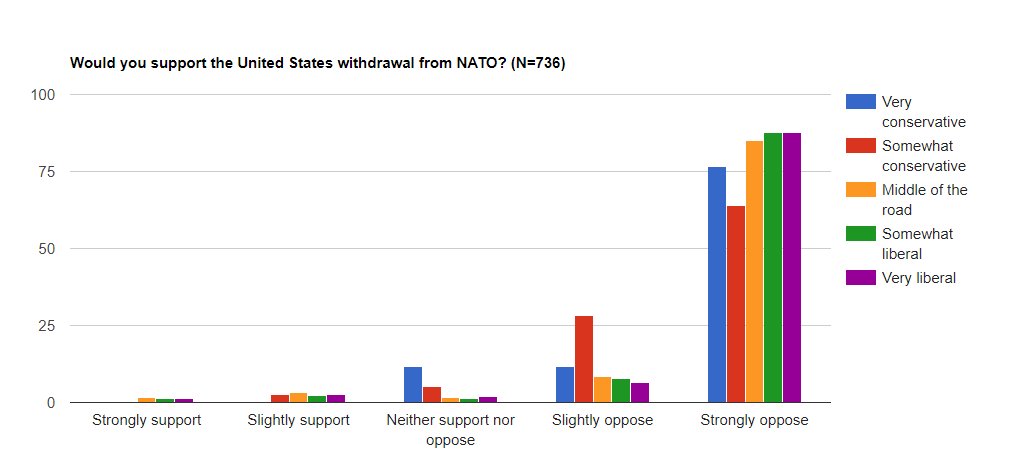
As we enter an age of multipolarity where things become less certain and there is more room for misperception that can lead to war, it makes even less sense now to give up on a key source of certainty and stability. But then again, everything Trump touches turns to shit. Will the Republican Party let Trump sell off one of the most important assets of US national security? Probably.
First, we can consult the Trump Rules and focus on projection, numbers, and, yes, entropy.
- Trump has a hard time valuing reciprocity, NATO' essence via the promise of an attack upon one is an attack upon all, because he projects onto everyone else how we views things. That other countries must be ripping the US off and trying to get by via doing less precisely because that is his life-long modus operandi. He just does not get the security guarantee because he can't see anyone else keeping it since he never keeps his word. So, NATO can't mean as much to Trump as it means to damn near every major politician in the US and Europe for 7- years (De Gaulle pulled out of the operational command, but he did not pull out of NATO).
- Trump can't get any numbers right, so, of course, he does not understand that the 2% guideline--that members of NATO should contribute at least 2% of their GDP to defense--is not some kind of payment to the US for the costs of defending Europe. Nor can he understand that not everything the US spends is on European defense. Nor that 2% is a dubious measure.
- Trump does not value order. He likes chaos in his own team, fostering rivalry among his advisers. He does not value European order either, seeing the allies as competitors. It may not always be deliberate, but it is part of a basic tendency--to dismiss institutions and norms and processses. Maybe sometimes we overvalue such stuff, but avoiding major war in Europe and fostering prosperity has seemed like a pretty good deal for 70 plus years.
Third, well, we could consider the Putin factor. Not so much that Putin is causing Trump to behave this way, but that Trump was an attractive candidate to the Russians both because he was a force for disorder and he was hostile to NATO. One of the basics of Russian foreign policy under Putin has been the desire to break NATO. No need to invade the Baltics to test NATO if the arsonist in the White House is trying to burn it down.
Could the US survive without NATO? Sure, its nuclear weapons mean that only terrorists will directly attack the US. But will the US thrive without it? No. Tensions, crises, and friction in Europe will come home to roost. Consider how often the US has been involved in the Mideast, which is actually at best the third most important region in the world for the US in terms of trade, investment, and all the rest. Europe remains important even as China replaces it as the second heavyweight in International Relations. NATO has been a good idea for more than 70 years because prevention is, indeed, cheaper than the cure. We have avoided a third World War, and the stability that NATO has brought to Europe is a significant part of that. IR scholars disagree a lot, but they definitely agree on NATO
As we enter an age of multipolarity where things become less certain and there is more room for misperception that can lead to war, it makes even less sense now to give up on a key source of certainty and stability. But then again, everything Trump touches turns to shit. Will the Republican Party let Trump sell off one of the most important assets of US national security? Probably.
Friday, January 11, 2019
Move to Canada? Still More Complicated But A Bit More Realistic
The Washington Post had a piece on folks moving to Canada due to the Trump Administration, and, at first, I was like, no, not again. As someone who moved to Canada, I have long pushed back at the whole "I hate who won this election, I am moving to Canada" thing as immigration is hard. This piece had four distinct differences from ye olde silly stories:
The article mentions the cold. That can be an issue, but mostly not. As it suggests, if you get the right clothes and get your commute sorted, you will be ok. The problem is really the length of winter, not how cold it gets. Well, in Ottawa and Montreal. I have no idea how cold it gets in Edmonton, but I imagine most of these folks are moving to Calgary, Vancouver, Toronto or maybe Montreal. Of course, if they are moving to Vancouver or Toronto, they will be saving some money as they are probably a bit cheaper than Silicon Valley but not much.
The taxes are higher, but that is probably a wash when you consider the cost of health care insurance in the US. And with higher taxes come not just health care that will not bankrupt you, but maternity leave (and paternity leave in many cases) and other stuff.
Lastly, as my dissertation advisor reminds me, there is xenophobia in Canada. Quebecois politicians have competed with each other to alienate Muslims and Jews with laws about wearing religious apparel. A former Minister of Foreign Affairs is starting up a xenophobic (and transphobic) party, and the more mainstream Conservative Party is dancing with xenophobes as well. Given the diversity of Canada combined with the existing parties and electoral system, I think that xenophobia will not win. Then again, I was wrong about Trump. So, this place is not perfect by any stretch of the imagination.
Canada is a great place to live, but it is not a colder version of the US--it is a different place. And the provinces are different from each other, and there are other complexities. I am happy that Canada is smart to try to lure smart people who face potential problems due to the awful xenophobia coming out of the White House, but I am also sad that the US is losing the next generation of talent because it elected Trump. That incredibly bad decision will continue to have ramifications not just for the next couple of years but for a generation or more. The movement of smart people to Canada to avoid Trump makes clear the costs will be enduring.
- twas focused not on just dissatisfied liberals (or conservatives in 2008/12 if you can imagine that) but on immigrants to the US, so folks who didn't have deep ties and face significant risks
- due to a xenophobic regime. Trump's presidency is not ordinary, so the idea of leaving it makes more sense--escape the fascist hellscape while you can.
- that these people are valued--the programs discussed are for those with tech skills. Canada is not seeking to get any and all immigrants in the US--just those in science/tech areas. I remember back when I moved to Canada, I could have gotten five years of no Quebec taxes (a significant hunk of money) had I been a hard scientist. Social science? Nope, doesn't count.'
- there are private actors setting up firms to facilitate the transitions.
The article mentions the cold. That can be an issue, but mostly not. As it suggests, if you get the right clothes and get your commute sorted, you will be ok. The problem is really the length of winter, not how cold it gets. Well, in Ottawa and Montreal. I have no idea how cold it gets in Edmonton, but I imagine most of these folks are moving to Calgary, Vancouver, Toronto or maybe Montreal. Of course, if they are moving to Vancouver or Toronto, they will be saving some money as they are probably a bit cheaper than Silicon Valley but not much.
The taxes are higher, but that is probably a wash when you consider the cost of health care insurance in the US. And with higher taxes come not just health care that will not bankrupt you, but maternity leave (and paternity leave in many cases) and other stuff.
Lastly, as my dissertation advisor reminds me, there is xenophobia in Canada. Quebecois politicians have competed with each other to alienate Muslims and Jews with laws about wearing religious apparel. A former Minister of Foreign Affairs is starting up a xenophobic (and transphobic) party, and the more mainstream Conservative Party is dancing with xenophobes as well. Given the diversity of Canada combined with the existing parties and electoral system, I think that xenophobia will not win. Then again, I was wrong about Trump. So, this place is not perfect by any stretch of the imagination.
Canada is a great place to live, but it is not a colder version of the US--it is a different place. And the provinces are different from each other, and there are other complexities. I am happy that Canada is smart to try to lure smart people who face potential problems due to the awful xenophobia coming out of the White House, but I am also sad that the US is losing the next generation of talent because it elected Trump. That incredibly bad decision will continue to have ramifications not just for the next couple of years but for a generation or more. The movement of smart people to Canada to avoid Trump makes clear the costs will be enduring.
Wednesday, January 9, 2019
A Puzzling Rant
One of our PhD students defended his dissertation proposal yesterday, and he got challenged on whether his puzzle was really puzzling or not. Yesterday evening, my PhD dissertation proposal workshop met and pondered this--what makes a puzzle a puzzle? This led to my ranting about such stuff, so I thought I would share what I thought about all of this.
Long ago, before the internet and barely after the invention of electricity (or so my daughter always thought as a kid), we did not focus so much on puzzles but on "so what?" Or, as they put at UCSD in my time there, how would someone who does sewage maintenance (either study it or do it?) care about your project. Since that ancient time, it has become a ritual in poli sci (and maybe other fields) job talks that one introduces the project by saying: here's this puzzle that I seek to understand. This puzzle is supposed to be the hook to get folks engaged in the project. That in most job talks, the audience consists of some people in your subfield and most people outside of it, so how do you get those folks engaged? This is important.
However, sometimes I think this is the tail wagging the dog. The point of doing a dissertation is to....
complete an original research project. The question can be but need not be original. The answer can be but no need not be original. The method can be but not need not be original. But the parts as they fit together must be original. So, you can take an existing theory and apply it to an original question, you can take a new theory and apply it to an old question, you can take an existing theory and question and test it in a novel way. But the point is that the research project is really about the research, not the hook. So, I tend to find PhD students starting their dissertation proposal hung up on the puzzle, which is somehow apart from the question, rather than on the question itself and then the proposed answer.
Indeed, the puzzle thing is really about marketing. I actually used the sizzle of the steak thing last night when talking about it. In much of our introductions, we make a big stink about how our work is counter-intuitive. That our work is provocative because it runs against how people think about things. Again, this is about marketing--that our work is important because it is making people re-think things. And, indeed, the work I remember the best is the stuff that made me see the world differently, such as Kelly Greenhill's Weapons of Mass Migration. But most work is actually not that counter-intuitive.
For instance, a certain random academic decided to argue that countries took sides in other people's ethnic conflicts, and the choices they made were driven by whether the key constituents had ethnic ties with one side or the other. Oh, that was me. I thought it was counter-intuitive because the existing wisdom (that I never did quite defeat in the minds of observers) is that countries do not support secessionists elsewhere if they face secessionists at home. That vulnerability and international norms prohibited such stuff. My dissertation aimed to disprove it (and I did, but not everybody has read it yet...) and provide a "counter-intuitive" alternative. My alternative was actually pretty damned intuitive. Indeed, I intuited it from existing work on the comparative politics of ethnic conflict (I borrowed Donald Horowitz's work).
Anyhow, the point is that graduate students have to come up with a hook to get others engaged. But we advisers may want to keep in mind the aspirations of the students. If they want an academic job, then, yes, they will need to conform to the intersubjective reality that we have created--that to make the project appeal to search committees and then to hiring departments, it needs to identify a puzzle. If, on the other hand, the student is seeking a job in the policy community, maybe being counter-intuitive and having a flashy puzzle is not the key. Maybe instead, the way to sell the project and the student is to position the project as addressing a key policy issue in that community. Rather than saying I have a puzzle, the student can say I have research that can help us develop policy better. Damned if I know, as I have not had long discussions with those in the policy community who hire PhDs.
Still, it comes back to this: we can probably retrofit a puzzle onto any project, isn't it the project itself--the question, the answer, the methods, the execution--that should matter most?
Long ago, before the internet and barely after the invention of electricity (or so my daughter always thought as a kid), we did not focus so much on puzzles but on "so what?" Or, as they put at UCSD in my time there, how would someone who does sewage maintenance (either study it or do it?) care about your project. Since that ancient time, it has become a ritual in poli sci (and maybe other fields) job talks that one introduces the project by saying: here's this puzzle that I seek to understand. This puzzle is supposed to be the hook to get folks engaged in the project. That in most job talks, the audience consists of some people in your subfield and most people outside of it, so how do you get those folks engaged? This is important.
However, sometimes I think this is the tail wagging the dog. The point of doing a dissertation is to....
complete an original research project. The question can be but need not be original. The answer can be but no need not be original. The method can be but not need not be original. But the parts as they fit together must be original. So, you can take an existing theory and apply it to an original question, you can take a new theory and apply it to an old question, you can take an existing theory and question and test it in a novel way. But the point is that the research project is really about the research, not the hook. So, I tend to find PhD students starting their dissertation proposal hung up on the puzzle, which is somehow apart from the question, rather than on the question itself and then the proposed answer.
Indeed, the puzzle thing is really about marketing. I actually used the sizzle of the steak thing last night when talking about it. In much of our introductions, we make a big stink about how our work is counter-intuitive. That our work is provocative because it runs against how people think about things. Again, this is about marketing--that our work is important because it is making people re-think things. And, indeed, the work I remember the best is the stuff that made me see the world differently, such as Kelly Greenhill's Weapons of Mass Migration. But most work is actually not that counter-intuitive.
For instance, a certain random academic decided to argue that countries took sides in other people's ethnic conflicts, and the choices they made were driven by whether the key constituents had ethnic ties with one side or the other. Oh, that was me. I thought it was counter-intuitive because the existing wisdom (that I never did quite defeat in the minds of observers) is that countries do not support secessionists elsewhere if they face secessionists at home. That vulnerability and international norms prohibited such stuff. My dissertation aimed to disprove it (and I did, but not everybody has read it yet...) and provide a "counter-intuitive" alternative. My alternative was actually pretty damned intuitive. Indeed, I intuited it from existing work on the comparative politics of ethnic conflict (I borrowed Donald Horowitz's work).
Anyhow, the point is that graduate students have to come up with a hook to get others engaged. But we advisers may want to keep in mind the aspirations of the students. If they want an academic job, then, yes, they will need to conform to the intersubjective reality that we have created--that to make the project appeal to search committees and then to hiring departments, it needs to identify a puzzle. If, on the other hand, the student is seeking a job in the policy community, maybe being counter-intuitive and having a flashy puzzle is not the key. Maybe instead, the way to sell the project and the student is to position the project as addressing a key policy issue in that community. Rather than saying I have a puzzle, the student can say I have research that can help us develop policy better. Damned if I know, as I have not had long discussions with those in the policy community who hire PhDs.
Still, it comes back to this: we can probably retrofit a puzzle onto any project, isn't it the project itself--the question, the answer, the methods, the execution--that should matter most?
Monday, January 7, 2019
Where is Intro to IR When You Need It?
One of the basic claims I make as a poli sci professor is that my goal is to help the next generation become more informed citizens, so that they understand their interests, and can vote accordingly. So, when I see a a guy getting upset that his business is hurt by tariffs, I want to scream.
I didn't spend a lot of time on International Political Economy in my Intro class (I don't teach it anymore as my Carleton course load is purely grad student stuff, but I miss it--twas a fun class to teach). IPE is not my strength, but I did get the basics across:
Thus, I wish that more Americans had a basic knowledge of International Relations. They don't get that in high school civics classes (one reason I avoided that class and happened to discover by accident in college that Poli Sci includes IR). At the college level, American Politics may be required, but IR? Probably not. Too bad.
* That book is also a great demonstration of how to turn a dissertation into a good book.
I wish more voters had intro to International Relations. Trump kept his promise on trade and it has had predictable results. Guy was brpetrayed by his own ignorance https://t.co/tROnwa4GoX— Steve Saideman (@smsaideman) January 7, 2019
I didn't spend a lot of time on International Political Economy in my Intro class (I don't teach it anymore as my Carleton course load is purely grad student stuff, but I miss it--twas a fun class to teach). IPE is not my strength, but I did get the basics across:
- free trade is the story of concentrated pain and diffuse benefits: that consumers benefit but not obviously so by lower trade barriers but less competitive sectors get hit hard. And politics often means that smaller groups actually have louder voices because they can organize. Hard to organize all consumers to care a lot about paying too much for their sugar.
- reciprocity is a thing. It can lead to cooperation or conflict, as the strategy of responding to what the other country did can lead to gains over the long term or unending rivalry. The key: don't expect your nasty moves to go unpunished.
- finally, I basically sold them Helen Milner*: that because many firms rely on exports or rely on importing components, they will not want tariffs as they hurt their sales abroad (due to retaliation) and they hurt their sales at home because their stuff gets more expensive since they have to build the cost of higher inputs, as the tariffs are indeed a tax they must pay stuff they import, into the price of their goods.
Thus, I wish that more Americans had a basic knowledge of International Relations. They don't get that in high school civics classes (one reason I avoided that class and happened to discover by accident in college that Poli Sci includes IR). At the college level, American Politics may be required, but IR? Probably not. Too bad.
* That book is also a great demonstration of how to turn a dissertation into a good book.
Sunday, January 6, 2019
Pentagon Explainer: A Building With Many Pieces
Yesterday, twitter got fussed that the "Pentagon Chief of Staff" resigned his position. This was very confusing--there is no such position. Did this story refer to the Chairman of the Joint Chiefs of Staff General Dunford? No, it referred to retired Rear Admiral Kevin Sweeney who served as the chief of staff to the Secretary of Defense. People seemed to think this post is a big deal, that it might mean a hole in the chain of command. Nope. It is just the guy who runs the SecDef's office, who was chosen by Mattis because he was a friend and respected colleague of Mattis.
 So, let me clear some brush here, as others are doing so. The first thing to understand about the Pentagon is that it is not nearly as united or coherent as people think. The building itself consists of five rings that are connected to each other and five wedges. When they renovated the building--both before and after 9/11, they did that one wedge at a time. The only truly Pentagon stuff are the souvenirs:
This architecture is nicely symbolic as there are no Pentagon posts except perhaps for Pentagon journalists. Otherwise, if one works in the Pentagon, one belongs (and I do mean belongs) to either:
Anyhow, the point here is that there is no Pentagon job. Sometimes, there might be a Pentagon position--when the Joint Staff and the OSD agree on something. That may have been common in the past, but was certainly an exception in my year as Rummy's people and the Joint Staff rarely agreed on stuff. Maybe the past two years we have seen building positions, as Marines (ex or otherwise) have led both sides.
All this points to a larger dynamic--we tend to freak out too easily these days. It is hard to tell which changes, which moves are normal and which are abnormal since Trump is destroying most norms and is causing chaos on daily (sometimes hourly) basis.
When it comes to the Pentagon, just keep in mind that it is a strange place with a variety of processes and procedures and acronyms that most people are unfamiliar with. The saner experts (the Bombshell women are a good group of such folks) will let us know whether something is normal or offsides. Or in other words, rather than hitting the panic button, ask yourself this:

Even in the age of Trump, the answer is often no, not yet.
 So, let me clear some brush here, as others are doing so. The first thing to understand about the Pentagon is that it is not nearly as united or coherent as people think. The building itself consists of five rings that are connected to each other and five wedges. When they renovated the building--both before and after 9/11, they did that one wedge at a time. The only truly Pentagon stuff are the souvenirs:
 This architecture is nicely symbolic as there are no Pentagon posts except perhaps for Pentagon journalists. Otherwise, if one works in the Pentagon, one belongs (and I do mean belongs) to either:
- the Office of the Secretary of Defense--those individuals, mostly civilian with some military folks sprinkled in, who serve under the SecDef to advise him (no women SecDefs yet), to execute the non-military decisions, etc.
- the Joint Staff--those individuals, mostly military with some civilians sprinkled in, who serve under the Chairman of the Joint Chiefs of Staff, who advise the Chairman and do heaps of coordination between the various pieces of the armed forces and the rest of the world. This is where I served on a fellowship way back in 2001-2. I was placed there because I "wanted to see the sausage get made" and the Joint Staff is a nexus between military and civilian words.
- the Army Staff--those individuals, mostly military, some civilian, who serve under the Army Chief of Staff, to do the advising, implementing, yada, yada
- the Navy Staff--those serving under the Chief of Naval Operations, yada, yada, including Marines.
- the Air Force Staff--those serving under the Air Force Chief of Staff.
Anyhow, the point here is that there is no Pentagon job. Sometimes, there might be a Pentagon position--when the Joint Staff and the OSD agree on something. That may have been common in the past, but was certainly an exception in my year as Rummy's people and the Joint Staff rarely agreed on stuff. Maybe the past two years we have seen building positions, as Marines (ex or otherwise) have led both sides.
All this points to a larger dynamic--we tend to freak out too easily these days. It is hard to tell which changes, which moves are normal and which are abnormal since Trump is destroying most norms and is causing chaos on daily (sometimes hourly) basis.
When it comes to the Pentagon, just keep in mind that it is a strange place with a variety of processes and procedures and acronyms that most people are unfamiliar with. The saner experts (the Bombshell women are a good group of such folks) will let us know whether something is normal or offsides. Or in other words, rather than hitting the panic button, ask yourself this:
Even in the age of Trump, the answer is often no, not yet.
Friday, January 4, 2019
AOC and All That
Mrs. Spew gets annoyed that AOC is getting so much attention--that she is but one new representative. I am similarly annoyed. Not because she has done anything wrong, but that Congress (old and new) and American politics are more complicated (or so I hear) than one new, very left-wing politician. Sure, the Republicans are going to focus on her because she is further to the left than the rest of the party and will be made to be seen as the average Dem. I don't think she is their focus because they fear her as much some might wish that.
Anyhow, on the bright side, she can take it:
This is the thing--she has great social media game. She can respond quickly and sharply and with great snark to the stuff they hit her with. Indeed, they don't really know how to hit at her. The dude who posed the video of her Breakfast Club dancing has now deleted his account, having been supremely ratioed (far more comments at than being retweeted). All that video did was make her more human and, dare I say it, more attractive.
And give folks much fodder:
I have not read enough about PAYGO and other differences AOC has with Pelosi, but note that she was not part of the rebellion that sought another speaker--that was the douchebros who want to drag the party to the right. While I would prefer the Dems not to be a geritocracy, Pelosi, unlike Schumer, has won my respect again and again by keeping the rabble of Dems together to push for real stuff. I am more comfy having her in the room making deals with Trump than I am with Schumer who seems far more intent on easing the way for more awful judges to be appointed.
Anyhow, I will not knee-jerk support AOC or even care that much about her, except enjoy her snark and to push back about her symbolizing anything about the mainstream of the Democratic Party EXCEPT that one party is diverse and dynamic and engaging and sometimes fun.
Oh, and Ally Sheedy approves:
Update: there is now a twitter account called "AOC Dances to Every Song" in case you want to see more adaptations: @aoc_dances
Anyhow, on the bright side, she can take it:
Over 200 members voted for Nancy Pelosi today, yet the GOP only booed one: me.— Alexandria Ocasio-Cortez (@AOC) January 4, 2019
Don’t hate me cause you ain’t me, fellas 💁🏽♀️ https://t.co/kLor9A0TWa
This is the thing--she has great social media game. She can respond quickly and sharply and with great snark to the stuff they hit her with. Indeed, they don't really know how to hit at her. The dude who posed the video of her Breakfast Club dancing has now deleted his account, having been supremely ratioed (far more comments at than being retweeted). All that video did was make her more human and, dare I say it, more attractive.
And give folks much fodder:
I took that video of AOC dancing and turned it into an ad for Medicare For All with a catchy theme song. pic.twitter.com/PLO1WkgEID— Jonathan Mann (@songadaymann) January 3, 2019
I have not read enough about PAYGO and other differences AOC has with Pelosi, but note that she was not part of the rebellion that sought another speaker--that was the douchebros who want to drag the party to the right. While I would prefer the Dems not to be a geritocracy, Pelosi, unlike Schumer, has won my respect again and again by keeping the rabble of Dems together to push for real stuff. I am more comfy having her in the room making deals with Trump than I am with Schumer who seems far more intent on easing the way for more awful judges to be appointed.
Anyhow, I will not knee-jerk support AOC or even care that much about her, except enjoy her snark and to push back about her symbolizing anything about the mainstream of the Democratic Party EXCEPT that one party is diverse and dynamic and engaging and sometimes fun.
Oh, and Ally Sheedy approves:
I LOVE THIS #TeamAOC— ally sheedy (@allysheedy1) January 3, 2019
Update: there is now a twitter account called "AOC Dances to Every Song" in case you want to see more adaptations: @aoc_dances
Tuesday, January 1, 2019
What to Expect in 2019?
I have seen a lot of folks expecting 2019 to be worse than 2018, as Trump might be more unhinged. Which then led to: could he be any more unhinged? His New Year's tweet suggests, yep, he can go lower/higher.
As I get ready to teach US Foreign Policy, I can say for certain that I will not enjoy this ride.
I haven't thought Mattis was that much of a break, so while Trump is likely to pick someone worse, I don't think there will be a huge difference. The US will escalate most wars that lack decent plans, Trump will refuse to be accountable, and the Pentagon will be relatively opaque. The big difference is that rather than the Joint Staff and the rest of the US military dominating policy-making (Marines uber alles), the civ-mil problem will be much strife between a Trumpier Office of Secretary of Defense and the military. Not better civ-mil, just different.
We often see anniversaries as focal points, so the reality that 2019 will see the 90th anniversary of the Great Depression and the 80th anniversary of the start of World War II is not great. Markets are already nervous enough, and Nazis are already mobilized enough. On the bright side, it is the 75th anniversary of D-Day, so defeating Nazis will also be celebrated. The founding of NATO in 1949 will get attention, but I worry that Trump may use that event to do more damage to the alliance.
The 50th anniversary of landing on the moon should be a positive thing, but the state of advanced tech these days--hacking, cyber attacks, limited progress in addressing climate change--may make us more depressed about the state of humankind. That it will also be the 20th anniversary of the Y2K panic may give us some solace--we managed to avoid disaster that time.
Thirtieth anniversary of the fall of the Berlin Wall and the end of Communism would be swell if it were not for the West surrendering many of the gains from winning the cold war. Damn, I am depressing on the first day of this New Year. Sorry.
Personally, I hope to spend less of 2019 writing grants than 2018 (to mixed success) and more time spending grant money. The various fates of such efforts will be known by the end of spring, which might mean an awesome but busy summer and fall. Thanks to my daughter successfully establishing herself on the west coast, I expect to be spending more time out there. I still have a bunch of research travel ahead to familiar places (Berlin, Riga, maybe Tokyo) and less travel to new places as the Dave/Phil/Steve project wraps up the research and starts to focus on figuring out what we have learned. I will also be traveling to Washington, DC to continue a much belated project with a former student, Ora Szekely, to figure out if we can provide a new way to understand bureaucratic politics. I will have other side projects and other trips, but nothing like the back to back to back trips of South Korea/Chile/NATO summit.
The upside of 2018 was a conscious effort by many academics on twitter to be kinder in their interactions. We will be needing more kindness in our own communities, in our own circles, as it will be, as the President suggests, a bumpy ride. But we will need to be more than kind--we will need to be assertive, to defend those who are attacked, to fight back against #voterfraudfraud and other attempts to undermine democracy and the rule of law. And we will need much patience and much beer, as the 2020 election is already underway. It was easy to predict that the Dems would take back the House but not the Senate. Who will emerge in 2019 and 2020 to contest Trump? Damned if I know.
Given that I ended 2018 with much Harry Potter via movie marathons and Binge-Mode, let me invoke Dumbledore: when one is faced between the right choice and the easy choice, let's make the right one.
And this might be my 2019 anthem.
HAPPY NEW YEAR TO EVERYONE, INCLUDING THE HATERS AND THE FAKE NEWS MEDIA! 2019 WILL BE A FANTASTIC YEAR FOR THOSE NOT SUFFERING FROM TRUMP DERANGEMENT SYNDROME. JUST CALM DOWN AND ENJOY THE RIDE, GREAT THINGS ARE HAPPENING FOR OUR COUNTRY!— Donald J. Trump (@realDonaldTrump) January 1, 2019
As I get ready to teach US Foreign Policy, I can say for certain that I will not enjoy this ride.
I haven't thought Mattis was that much of a break, so while Trump is likely to pick someone worse, I don't think there will be a huge difference. The US will escalate most wars that lack decent plans, Trump will refuse to be accountable, and the Pentagon will be relatively opaque. The big difference is that rather than the Joint Staff and the rest of the US military dominating policy-making (Marines uber alles), the civ-mil problem will be much strife between a Trumpier Office of Secretary of Defense and the military. Not better civ-mil, just different.
We often see anniversaries as focal points, so the reality that 2019 will see the 90th anniversary of the Great Depression and the 80th anniversary of the start of World War II is not great. Markets are already nervous enough, and Nazis are already mobilized enough. On the bright side, it is the 75th anniversary of D-Day, so defeating Nazis will also be celebrated. The founding of NATO in 1949 will get attention, but I worry that Trump may use that event to do more damage to the alliance.
The 50th anniversary of landing on the moon should be a positive thing, but the state of advanced tech these days--hacking, cyber attacks, limited progress in addressing climate change--may make us more depressed about the state of humankind. That it will also be the 20th anniversary of the Y2K panic may give us some solace--we managed to avoid disaster that time.
Thirtieth anniversary of the fall of the Berlin Wall and the end of Communism would be swell if it were not for the West surrendering many of the gains from winning the cold war. Damn, I am depressing on the first day of this New Year. Sorry.
Personally, I hope to spend less of 2019 writing grants than 2018 (to mixed success) and more time spending grant money. The various fates of such efforts will be known by the end of spring, which might mean an awesome but busy summer and fall. Thanks to my daughter successfully establishing herself on the west coast, I expect to be spending more time out there. I still have a bunch of research travel ahead to familiar places (Berlin, Riga, maybe Tokyo) and less travel to new places as the Dave/Phil/Steve project wraps up the research and starts to focus on figuring out what we have learned. I will also be traveling to Washington, DC to continue a much belated project with a former student, Ora Szekely, to figure out if we can provide a new way to understand bureaucratic politics. I will have other side projects and other trips, but nothing like the back to back to back trips of South Korea/Chile/NATO summit.
The upside of 2018 was a conscious effort by many academics on twitter to be kinder in their interactions. We will be needing more kindness in our own communities, in our own circles, as it will be, as the President suggests, a bumpy ride. But we will need to be more than kind--we will need to be assertive, to defend those who are attacked, to fight back against #voterfraudfraud and other attempts to undermine democracy and the rule of law. And we will need much patience and much beer, as the 2020 election is already underway. It was easy to predict that the Dems would take back the House but not the Senate. Who will emerge in 2019 and 2020 to contest Trump? Damned if I know.
Given that I ended 2018 with much Harry Potter via movie marathons and Binge-Mode, let me invoke Dumbledore: when one is faced between the right choice and the easy choice, let's make the right one.
And this might be my 2019 anthem.
Subscribe to:
Posts (Atom)