Showing posts with label immigration. Show all posts

Wednesday, October 23, 2024

Mass Deportation: What Does It Mean?

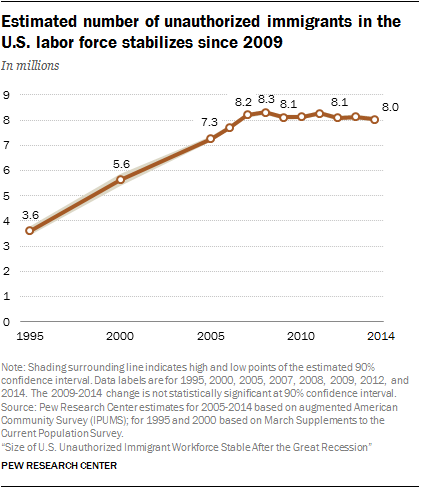
 It is awful that mass deportation is supported by lots of Americans.  Perhaps because they have no idea what it means.  Let me listicle my way through why it would be the single most destructive public policy since Reagan's supply side economics?  Nope.  Smoot-Hawley?  Maybe?  Damn, I can't think of a single policy worse than this in the past 125 years, as Jim Crow was a bunch of stuff, not one single policy.

  1. Lots of places to start, but let's go with concentration camps.  That any effort to take 10-20 million people out of society and then try to deport will mean putting them someplace first.  The US does not have the prison space for this, so the second Trump admin will have to hastily set up places to jam people.  Will these places be overcrowded?  Yes.  Will they have proper health/sanitation?  No (see the DHS chapter of Project 2025 for a call to lower standards below what states might set).  Will disease, such as tuberculosis become rampant?  Yes.  I have been to concentration camps in Germany, I have seen how residential schools in Canada were implemented.  The cruelty is, indeed, the point. Overstaying one's visa or trying to get asylum or seeking a better life for your kids is not justification for a high risk of death. 
  2. It will be very destructive to the economy--it will rip out of key sectors much labor that citizens aren't lining up to do.  Construction? Don't we have a housing crisis?  Agriculture?  Day care and elder care? 
  3. They are not a drain on the government coffers, as undocumented workers tend to pay into social security and medicare but aren't eligible for these benefits.  Indeed, the best way to keep social security and medicare solvent is to have more immigrants, who tend to be younger than citizens, not fewer.
  4. It would not reduce the, yes, rather low crime rate because undocumented immigrants and immigrants of all kinds actually commit less crime than citizens.  The anecdata of this or that bad immigrant committing crime is atypical--the numbers consistently tell the tale.  
  5. Who will be swept up in the mass deportation?  Undocumented people?  Sure.  How about legal immigrants?  Yes, given the rhetoric about the Haitian immigrants who are in the US legally.  How about the children of immigrants who were born in the US?  Yes, as the Republicans want to get rid of birthright citizenship.  How about Brown and Black citizens who aren't carrying documents the day they meet up with the various deportation squads (I would call them brute squads, but the giant in Princess Bride is much kinder than ICE/Customs/militias/sheriffs/etc)?  
  6. The fundamental authoritarianism of it all--that we would all have to carry passports or birth certificates every day as the forces of the state demand "papers, please," whenever they want.  This is American democracy?  No, it is not.
  7. The huge amount of money that will have to be spent on it to expand law enforcement at all levels.
  8. The likelihood of violence between states that don't want this to happen and the Trump administration--civil war?  Something like that.
  9. And, yes, use of the military against protestors who want to stop such an abhorrent policy.
  10. The racism of it all.  Pretty sure ICE and the rest will be chasing people of color and not white Canadians or Norwegians who have overstayed their visas.
  11. It is completely unnecessary.  There is no real immigration crisis.  The system is overburdened, but that does not mean that there are challenges to law and order, that the economy is being harmed, that people (other than the migrants themselves) are facing much harm or threat.
  12. It is also immoral--ethnically cleansing the US to appease Great Replacement theory types who worry that people of color will govern them as harshly as the white supremacists governed the people of color.   Also, the US agreed to the international laws on asylum--we are obligated to help people who can't go back home without facing significant risks.  The US has always applied that inconsistently, letting in Cubans but not Haitians.  But one of the lessons of World War II was to provide asylum to those facing great dangers in their homelands.  That was the right lesson to learn and it should not be unlearned now to appease white supremacists.
  13. update: I forgot to mention that this will distort US foreign policy as Trump's team will have to expend a great deal of effort and leverage to find homes for 10-20 million people outside the US.

This is not the way to address the housing crisis. The way to deal with a housing crisis  ... to build more housing.  Unemployment is very low, so this is not a matter of immigrants, legal or otherwise, stealing jobs from American citizens.  Again, undocumented workers tend to do jobs citizens don't want to do.  I am sure I could go on, that I didn't include everything that one can.  

Friday, January 11, 2019

Move to Canada? Still More Complicated But A Bit More Realistic

The Washington Post had a piece on folks moving to Canada due to the Trump Administration, and, at first, I was like, no, not again.  As someone who moved to Canada, I have long pushed back at the whole "I hate who won this election, I am moving to Canada" thing as immigration is hard.  This piece had four distinct differences from ye olde silly stories:
  1. twas focused not on just dissatisfied liberals (or conservatives in 2008/12 if you can imagine that) but on immigrants to the US, so folks who didn't have deep ties and face significant risks
  2. due to a xenophobic regime.  Trump's presidency is not ordinary, so the idea of leaving it makes more sense--escape the fascist hellscape while you can.
  3. that these people are valued--the programs discussed are for those with tech skills.  Canada is not seeking to get any and all immigrants in the US--just those in science/tech areas.  I remember back when I moved to Canada, I could have gotten five years of no Quebec taxes (a significant hunk of money) had I been a hard scientist.  Social science?  Nope, doesn't count.'
  4. there are private actors setting up firms to facilitate the transitions.
This last thing is key, as it is not easy to move.  Mrs. Spew remembers the first few years in Canada as being rather difficult--that Canada is not simply a colder version of the US.  My favorite story is of having difficulties driving across the border since I owed money to Honda-America on my car.  It took me eight weeks or so to get it imported--it was stuck on my driveway (Customs thought of that as a generous exception--they preferred that I had parked the car on the US side of the border).  Oh, I couldn't simply transfer the loan to Honda-Canada because the two Honda entities do not work with each other.  I couldn't get a car loan since I was seen as a flight risk and had worse credit as a temporary resident than a high school kid.  So, it is not easy.

The article mentions the cold.  That can be an issue, but mostly not.  As it suggests, if you get the right clothes and get your commute sorted, you will be ok.  The problem is really the length of winter, not how cold it gets.  Well, in Ottawa and Montreal.  I have no idea how cold it gets in Edmonton, but I imagine most of these folks are moving to Calgary, Vancouver, Toronto or maybe Montreal.  Of course, if they are moving to Vancouver or Toronto, they will be saving some money as they are probably a bit cheaper than Silicon Valley but not much.

The taxes are higher, but that is probably a wash when you consider the cost of health care insurance in the US.  And with higher taxes come not just health care that will not bankrupt you, but maternity leave (and paternity leave in many cases) and other stuff.

Lastly, as my dissertation advisor reminds me, there is xenophobia in Canada.  Quebecois politicians have competed with each other to alienate Muslims and Jews with laws about wearing religious apparel.  A former Minister of Foreign Affairs is starting up a xenophobic (and transphobic) party, and the more mainstream Conservative Party is dancing with xenophobes as well.  Given the diversity of Canada combined with the existing parties and electoral system, I think that xenophobia will not win.  Then again, I was wrong about Trump.  So, this place is not perfect by any stretch of the imagination. 

Canada is a great place to live, but it is not a colder version of the US--it is a different place.  And the provinces are different from each other, and there are other complexities.  I am happy that Canada is smart to try to lure smart people who face potential problems due to the awful xenophobia coming out of the White House, but I am also sad that the US is losing the next generation of talent because it elected Trump.  That incredibly bad decision will continue to have ramifications not just for the next couple of years but for a generation or more.  The movement of smart people to Canada to avoid Trump makes clear the costs will be enduring.  

Wednesday, June 6, 2018

The Immigration Problem

Recent polls in the US suggest that large majorities of not just Republicans but independents consider immigration to be a big problem.  It is not.  It is so not a problem, but, just like #voterfraudfraud has convinced significant numbers of Republicans that voter fraud is a threat, the GOP and its allies have convinced much of the American people that immigration, legal or not, is a threat.

How is immigration a threat?
  • Is it because larger and larger numbers of people are seeking to come to the US? Legal? Yes, although I would love to see these tables controlling for size of US population as there are more now but a smaller share of US population  Illegal?  Nope, the trends, especially from places like Mexico, are in the opposite direction.
  • Is it because immigrants are more likely to be criminals?  Nope.  That all MS 13 is mostly threat inflation by the way.  They are bad hombres, but mostly because the US sent criminals to Latin America where they helped to radicalize others.  Well done.
  • Is it because immigrants are resource black holes?  Actually, nope as they pay taxes but are not allowed to receive most benefits. Flows can hurt local governments, but that is a problem that could be easily fixed.
  • Are they a threat because they are mostly people of color?  Ding, ding, ding. 
Yes, the current wave of anti-immigration feelings in the US is based on myths and on racism and xenophobia.  This, of course, is not new.  It used to be that Irish and Italians and Jews were not considered white (ask the alt-right folks these days about whether Jews are white), but John Kelly seems to have forgotten that.

Anyhow, immigrants are not significant threats to employment.  Indeed, for social security, medicare and other programs to be funded down the road, the best solution is to bring in more immigrants to offset the fertility decline and aging of the American population.  This is not an option for more xenophobic places (yeah, Japan, talking about you ... and Russia).

So, I just want to push back against this whole idea of immigration being a problem.  But what do we call the myth-ing of this.  We have #voterfraudfraud for voter suppression.  What is a handy term for this?  #Immigrationfraud?  Nope.  #NoImmigrationProblemo?  #XenophobicFraud?  Please post in the comments if you have a better name for this.


Sunday, May 27, 2018

Disbanding ICE?

Sounds pretty radical to push to disband a government agency, right?  When I first started hearing "Disband ICE," I kind of recoiled because I thought it was too far of a reaction.  I do worry about the left moving too far to the left, that pushing for the end of an agency seemed too radical.  Both that it was an unrealistic demand and also something that would get in the way of real reform. 

Immigration and Customs Enforcement would seem to be a necessary agency--that if one has immigration and custom laws, one would need a body to enforce them.  Yet the United States managed without ICE until 2003.  It is a relatively new government body, and it was one of the many hasty reforms, along with the creation of its Frankenstein monster of a parent agency--the Department of Homeland Secuirity--that was built in the aftermath of 9/11.  When is it a particularly bad time to build new institutions?  When people are panicking and when a national emergency has caused Congress and the media to give the executive branch carte blanche (note that most of the major institutional reforms of the US national security state happened after World War II and mostly before the development of McCarthyism).

To be clear, ICE and the laws it was enforcing existed before Trump and were subjecting people to real harm under Obama.  That actually means that there is a greater need to do something serious rather than just say that the next administration can just appoint the right people at the top. 

The abuses over the past year and half or so are making the case for ICE's disbanding.  Rather than seeking out violent people who violated immigration and customs laws, the agency has been showing up at schools, hospitals, courts, and elsewhere to grab people who have committed no crimes in the US, including Dreamers whose status should shield them from deportation.  They defy judges who get in the way

When a government agency becomes the go-to threat, it may be time to go.  I don't recall in my lifetime people threatening those who are different that they would call the FBI on them, but now we have both random racists and the Secretary of Education threatening to call ICE.  I can't help but think of the Gestapo and other coercive agencies that could be wielded as threats to their citizens.

How do ICE agents implement their mandate? With brutality and, thus far, impunity.  The stories of ICE now seeking to destroy records of their assaults, their rapes, and their other abuses show that the agency is beyond redemption.  Anyone seeking to destroy records of their misdeeds (um, Gina Haspel) cannot be trusted.  Accountability starts with the record of behavior, and if you cannot tolerate having that record exist, then you are opposed to being held accountable. 

ICE is not the only agency that engages in awful behavior.  I think the difference is that this is the majority of what ICE does.  The FBI, the ATF, local law enforcement, and other agencies have all had their problems, but for those actors, the problems are bugs, not a feature.  For ICE, their awful methods are not exceptions but seem to be the rule. 

So, yeah, in 2020, I want to see the Democratic candidates for President outbid each other in promising to disband ICE.  I am not usually a fan of candidates being pushed further and further to an extreme by the far end of a party, but, as I said above, there is no redemption for ICE, even before we heard of what they were doing to the children.  And, no, I am not going to vote for Democratic candidates who suggest that ICE just needs some modest tweaks. 

Tuesday, April 26, 2016

My Quadrennial Complaint

Every four years, folks threaten to move to Canada if their candidate loses.  Or the person they hate wins.  Yes, it makes a smidge more sense in the age of Trump, but please:

Lena Dunham is the latest, and, given her political acumen, um, we should not care too much about what she says.  But this is typical, and, of course, the media have to report it. 

But the reality is that few move.  As I learned when I move to Canada, it really is a different country.  I have been tempted to write a book (the title would be A Yankee on Ice) that documents what surprised me and what I learned about this place beyond the obvious (it is frickin cold for many, many months unless one is in Vancouver).  It is a wonderful place, and we have been most happy here.

BUT I had a job waiting for me, which made the immigration process possible.  Canada does not let in just everyone who wants to move--it has border controls, an immigration service, and everything.  Really.  Just like most other countries. 

It is only slightly less annoying when far right wing folks make that threat because even under Harper, Canada's laws and taxes are not what American right wing folks would like.  Same sex marriage, etc.

Anyhow, could the media just show some discretion and not play up this shit every four years?  Please?  Pretty please?


Monday, June 8, 2015

The Starting Points Visited and Re-visited

Manhattan looked great from the other side
Mrs. Spew and I were footless and fancy-free yesterday as we were in northern New Jersey for a family event the day before (the last Bar Mitzvah of my sibling's kids), so what did we do?  Ellis Island and Liberty Island.  This seemed like a good way to spend a day, especially after the past few years have taken me to the beginnings of the U.S.A.: Jamestown, Plymouth Rock, Yorktown, Leiden (where the Pilgrims left Europe for Massachusetts).


Twas a very modular main room--reconfigured
again and again over the years.
There was so much that was so striking but what impressed me most about Ellis Island was the composition of the tourists.  It was one of the most diverse collections of humanity I have ever been among (the ELF score was pretty much at its max).   I have been to many tourist sites around the world, and I cannot remember one that had so many people from so many backgrounds.  Which makes sense, partly because NYC brings tourists from all over the world and partly because much of the world went through Ellis Island during its three decades as primary destination for immigrants headed to the US.

Of course, the history of the US and its immigration is not all peaches and creme.  I was glad to see several displays featuring the backlashes against immigration.  No, I am not a fan of xenophobia even if it played a key role in the Bill and Steve book (being re-printed as a paperback this August thanks to our pal Putin).


The timing was particularly apt as I recently got into an argument with a Canadian journalist who insisted that the US needed to make Spanish an official language of the US.  Given that English is not an official language, this seemed strange to me.  Indeed, after ten years in Quebec, I am more firmly convinced that the American strategy is the better one: rather than forcing folks to learn English, the US government lets the market and the society induce people to learn English.  The great consistency over the centuries has been this: the first generation may not learn English but the second one will pick up enough and the third will be fluent.  Which is why the picture to the right struck me: the many languages people spoke and wrote when they came over.  Again, American history is chock full of conflict and the union still needs to be perfected, but there are some good reasons why people still want to move to the United States.  I don't think Russia or China have the same pressures caused by people wanting to immigrate.  People do indeed vote with their feet.

 Maybe I am being overly patriotic because I found this while walking around Ellis Island:


 We learned that these panels were not of all immigrants who went through, but those immigrants who entered somewhere and had family members recognize them (pay $, I suppose).  Still, the idea that I was standing near where my ancestor came across more than a century ago gave me some chills.

And, of course, maybe it has to do with how beautiful the Lady was yesterday:


Monday, July 7, 2014

American Exceptionalism--the Good Kind

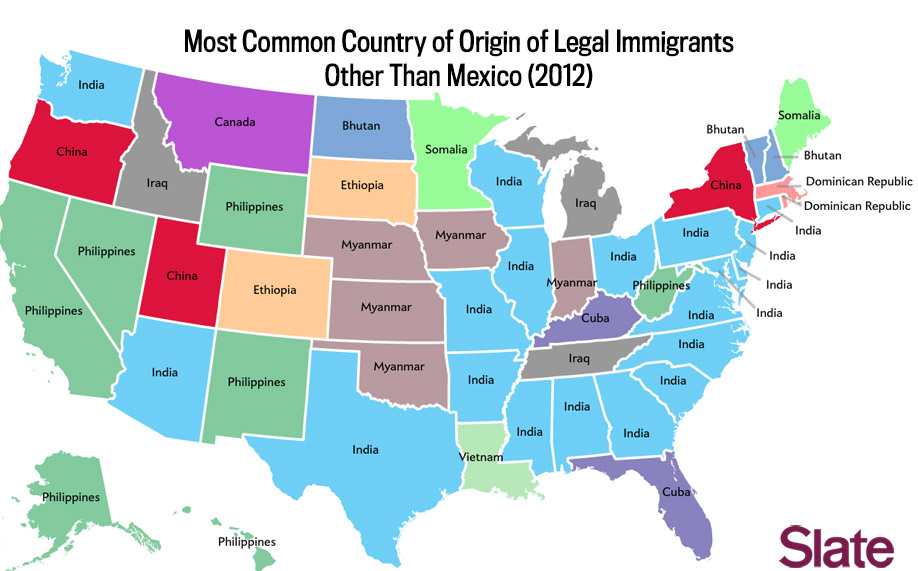
One of the big differences between the US and Europe seems to be that the flows of people into the US (and Canada) are far more diverse.  This is best illustrated by the recent Slate map:
http://www.slate.com/articles/arts/culturebox/2014/05/immigration_map_what_are_the_biggest_immigrant_groups_in_your_state.html

While the largest group immigrating into the US are Mexicans, we can see here that people from other parts of the world are immigrating.  The non-India, non-China, non-Cuba immigrants may be somewhat surprising.  The key here is that no one group really dominates the immigration picture.  Sure, Sam Huntington's dead body would still point out that Mexicans are number one, but the new Americans are a diverse lot. 

This is good for a number of reasons, but my point here is that it means that there is less of a sense by those already here that they are being swamped by one group with one set of values (as if any one group entirely shares the same set of values).  Sure, I got a strange Mexican-ization question earlier this year about the forthcoming US Civil War II, but the reality is there is probably less antagonism and less strife when the newcomers are a mix.  Which values will alter the existing American ones?  Those based on Hinduism?  Catholicism? Buddhism?  The answer is none of the above. 

Instead, my guess (as a non-expert on migration) is that the American stew will just have a few more spices, but will remain largely the same.  Sure, there will be more non-whites compared to the whites, but more brown Americans is only a probably if you are ... racist.  Sure, parties that pander to racists might suffer, but there is an answer to that--don't pander to racists.  For all of Stephen Harper's problems, his brand of conservatives long ago figured out that playing to immigrant communities was good for their political chances.  Democracy is kind of cool that way--if you want more votes, then appeal to those beyond your narrow group (if the lines and institutions are drawn the right way). 

Anyhow, the real contrast is between the US and its European friends who are facing heaps of stress with their immigrant populations in part because of the relative size of the flows, in part because they are relatively new to the immigration game, and in part because the immigrants all seem to be part of one community. 

One joy of the Furth of July is that the ideas behind the declaration, once one corrects for gender, apply so broadly--that all people are created equal, with rights to life, liberty and happiness (property sounds so crass).  The American struggle is not with the ideals but how to implement them well.  Because if we don't have cool rules ourselves, we will be bogus too, as the great political philosopher Jeff Spicoli instructed one score and twelve years ago.


Sunday, February 3, 2013

Brutal Take on Immigration Reform

Brian McFadden brings the heat, burning many sides of the immigration reform debate:

I think the last two panels are perhaps the most cutting. What say you?

Friday, September 14, 2012

Election Rituals: Repeating the Move North Myth

Every four years, Canadians and others ponder: will herds of Americans move north if a certain Presidential candidate wins?  I was asked about this in 2004 and maybe 2008.  This year, someone again is asking folks at my old school about it.

Here is my standard answer: No.  As my school's office manager (an American) put it, people move across the border for love or money.  Either they want to move to be with someone or because there is a job for them.  I moved north of the Wall border because I had a great job.  I stayed north and moved slightly west for a better job.  I did not move north to escape Bush.

Moving across an international boundary is actually pretty darned complicated and costly.  The paperwork to become a permanent resident in Canada can be more than $2k for a family of three, and it can take years.  When you enter the new country, you lose your old credit rating and are seen as a flight risk, so getting credit cards is hardly trivial, getting a car loan is more costly (oh, and moving a car across that border that is still being paid off is mucho complicated), and even buying a house can be a bit problematic. 

But I guess the media outlets like to return to the old well and perpetuating old myths since it requires less work.  Speaking of which, time to get back to my day job.

Sunday, February 12, 2012

Graphic Weekend, Part II

We are going be seeing a heap of stats, tables and figures over the next several months as STATSCAN rolls out the results from the latest census.  The first set of big news was two-fold and related--that the western part of the country was growing faster than the rest and that immigrants were settling more in the western parts of Canada.


This figure illustrates who is coming from where and going where.  I wish they had used another color than black to indicate the provinces--makes immigration appear to be a black hole when the stats are very clear that Canada's future rides on immigration.  That is, Canadians are not birthing babies at a rate that would sustain the welfare state--not as severe as in Europe but still problematic.  The inflow of immigrants largely resolves this as the inflow of new folks to work pay the taxes necessary to cover the retirements of the older generations.

Anyhow, this will be an interesting set of stats to study for the next ten years or so.

Thursday, January 27, 2011

Another Hysteria Defanged

Eurarabia?  Not so much.  Muslims are not going to be increasing their share of populations as significantly as the hysterical folks feared.  The problem for the Denmarks and Netherlands of the world is that they are not used to immigrants at all, that the fears of being swamped by Muslims is not about losing their majorities or political dominance but dealing with folks that are different.  Perhaps these facts might reduce the appeal and legitimacy of those who try to inflame the fears.  Or not.  Facts never get in the way of a good mongering of fear.

Still, the important stuff is at the bottom of the piece---once again, the key is not so much religion but wealth/poverty.

Wednesday, September 15, 2010

Figuring Out the Right Reaction

This story of a teen who was booted out of the US despite having good documents on him makes me wonder how I should react?
  • Appalled that this kid was badgered into essentially confessing to a lie?
  • Appalled that the immigration folks spent more than eight hours on this case when they might just have better things to do?  How much of a threat was this kid compared to other border issues?
  • Appalled that these guys gave a pass on his brother and then didn't stop to think that since his brother was kosher, maybe he is, too?