Wednesday, July 11, 2018

EU Tour and then Some

I got to Brussels a day ahead of the summit, and I got a chance to see Brussels and tour the EU.  I have been to Brussels a number of times, so it is not new to me, but I always see something different.  Alas,  I saw much sadness after Belgium lost to France in the World Cup.  It was kind of exciting to be walking the street with gasps and ooos emanating from all of the bars.  Of course, there is one element of Belgium I appreciate the most....

This time I went to a small beer museum that is right on the Grand Market.

Map of breweries in Belgium--yep, a lot.
EU Commission was across
the street from where we toured
A former student of mine now works for the President of the EU Council--tis the body consisting of the leaders of each member, so it is more political than techocratic.  If I remembered my lessons well. 


The Ikea conference room
Yeah, like someone would put me in a position of power.


Happy to hang with former student Helena H. 
She reminded me of all the super-sharp undergrads and how
fun it is to see them become super responsible adults.
 Then some random shots on the way back--the standard coffee pic


The standard wacky building pic


Sunday, July 8, 2018

NATO Summit Approaching!

Two years ago, I got to go to the NATO Summit side party in Warsaw.  The blue of the expert forum's tent is still in my eyes.  That summit, among other things, presented the new commitment to send a "persistent [can't use Permanent due to respect for a dead treaty] presence" to the Baltics.  Which leads to the question du jour: what is the next NATO summit going to produce?  Again, I am going to the expert forum side party--this one will be at NATO headquarters instead of tents at a soccer football stadium.

Last time, much of the focus was on anticipating what would be in the communique that would represent what was agreed on.  I remember that it was enumerated, and it had something like 140 or more pieces to it (ok, 139).  This time? Um....  I think people will mostly be wondering if there is a communique, given what happened at the G-7 Summit or even if there is a NATO.

It seems like Trump only cares about one thing, and it is not what NATO is doing to foster peace and stability in and near Europe.  Nope, he only "cares" about whether enough countries are paying for NATO... which, of course, he is entirely confused or deliberately ignorant about how the whole 2% expectation works.  To remind folks, here is the burden-sharing bit in a nutshell:
  • NATO agreed in 2014 (the Wales Summit) that countries should aspire to reach spending 2% of their GDP on .... their own defense in 2024.  The idea is that if they have better (more, higher tech) armed forces, then NATO will be more capable.
  • Most countries have not reached 2% (again, the goal was to reach it by 2024), although nearly all members have increased defense spending.  Not to please Trump as most of this was in the works prior to his win, but in reaction to Putin/Russia/Crimea/Ukraine and a realization that the military cuts had been too deep.
  • The 2% metric is simple but deceptive since Greece scores really well (if the denominator is GDP, well, there you go) but Greece's armed forces have not played a meaningful role in a NATO operation since...., um, .....   Yeah.  Maybe the Cold War?
  • Trump rails about this as if the core value at stake--peace and stability in Europe--is not something the US would want even if it had to pay for it on its own.  
  • Even if the other members hit 2%, Trump would be upset at the US spending more, forgetting that the US is spending more on defense because (a) it has other priorities around the world; (b) it chooses to do so.  
Anyhow, there is no doubt that the burden-sharing debate will have center-stage, so much so that it is likely to drive all other agenda items to the margins or beyond.  Indeed, there is not really much of an agenda for this summit.  Why?   Because the US usually helped to push the agenda forward, and it no longer has either the interest to do so or the ability since the upper levels of State are still barren.  Neither Tillerson nor Pompeo made much of a dent at previous ministerials to advance any particular goals beyond folks spending more.

There will be major initiative akin to the 2016 summit's Enhanced Forward Presence.  There will be discussion of Russia, but probably nothing major to initiate--certainly not reviving the NATO-Russia Council.  There will be discussion of making it easier to move troops across national borders within NATO--there is no Schengen borderlessness for military units.  The need for this is obvious as exercises have shown how hard it is to get stuff from West to East, but I am doubtful that much will actually happen on this issue. There will be more talk of NATO-EU cooperation, but action?  I tend to doubt it.  Promises of NATO doing more training of Iraqi military and the like?  Probably.

But the show will be Trump and how much of NATO can he burn down.  Because his priority is to burn down any multilateral institution--anything that treats other countries semi-equally is something Trump opposes.  Plus anything that ties the US to other countries is a bad thing in his eyes.  The 2% thing is an excuse.  Yes, other countries should spend more on defense (and mostly spend better, yes, Germany, we are talking to you), but the consistency in Trump's stances towards international organization is hostility, not burden-sharing concerns.

So, I am headed to Brussels this week to watch a trainwreck up close.  The good news is that there is no NATO disco party scheduled this time.  Phew. I am sure that SVH is relieved she doesn't have to see me dance this time (she and I both went to Warsaw and are going to Brussels).


Old TV?

So, this came along on twitter:
My first thought was, yeah, I have heard that Netflix has renewed interest in Friends.
My second thought was: hey, Friends is much further away from day's kids (first run was from 1994-2004) than damn near everything I watched when I was growing up in the early to mid 70s?:
  • The Monkeys was on from 1966-68
  • Star Trek was from 1966-69
  • Hogan's Heroes, a personal fave, was from 1965-1971
  • McHale's Navy was from 1962-66
  • Gilligan's Island was 1964066
  • Voyage to the Bottom of the Sea is from 1964-1968 (I just found its first season on DVDs, so looking forward to that bit of nostalgia.
  • Dick Van Dyke was from 1961-1966.
Hmmm, I guess I didn't watch many 1950s TV shows deep into the 1970s (Mrs. Spew mentioned I love Lucy), but definitely early 1960s. To put it in some perspective, when Happy Days came out, it was closer to the 1950s than we are to when Friends came out in the mid 1990s.  Indeed, we are further away from Happy Days than the mid-70s was from the Great Depression. 

In short, we are getting old.  That whole stat of the Berlin Wall being down longer than it was up should give us a reality check, but we are much better at grasping the passage of other people's time (the history books we read and lessons we got in school) than time flying by in our lifetimes.

Why blog about this?  Because I watched way too much TV in my entire life the 1970s? That and because it helps put the passage of time in perspective.  As I am on the "wrong" side of 50, I could use that and also this bit of distraction sauce given the awful mess and regression that is 2018


Wednesday, July 4, 2018

The Darkest Independence Day Since?

I am not old enough to remember 1968, which was probably the other candidate for worst American summer in my lifetime.  Assassinations, riots, a very unpopular war whose end was being undermined by the opposition party, and more.  Now?  As the classic horror movie line goes, the killer is inside the house.  Trump and his band of arsonists, varying in levels of incompetence and intelligence, are surprisingly efficient at burning down most, if not all, the norms of American politics and thus the institutions that regulate the political system.  The Republican Party has been working on this for decades, so this is not just a Trump thing, but now they are abetting the worst instincts of the most extreme parts of their party.

I have been blogging less lately because I just don't know how to express the appropriate level of frustration, regret, anger, and sadness.  I get it that when people say this is unAmerican, they are forgetting that the words of the Declaration of Independence and then the guarantees in the Constitution applied to white men, and property owners at that.  But I also get it that the uneven course of American history was largely, although not entirely, to "perfect the union."  To realize the words and values of the founding documents and amend them to make sure that they apply to women, to African-Americans, to immigrants, and, lately, to LGBTQ folks and beyond.

The American Dream was (not is) that one's kids would be better off than oneself.  While the conventional notion of this focused on economic matters, and this is where the Dream crashed first, it also meant a better society, a fairer one, a more just one.  That America is the land of opportunity.  It was always imperfect, and, as my daughter would always remind me, the changes were not happening fast enough.

Well, the destruction of the positive norms and institutions are happening more than fast enough.  Just this last week illustrates the accelerating pace of destruction: people at the border denied due process and having families ripped apart, maybe irrevocably; very partisan decisions at the Supreme Court that not only reverse much progress but suggest that the next court might choose to protect Trump rather than make sure the rule of law applies to all (the whole examination of double jeopardy which might mean that Trump can pardon people in ways that make it impossible for state level prosecutions to hang over people's heads); the end of affirmative action in university admissions; the trade war that hurts our allies; the upcoming NATO meeting and Russia summits that may lead to the US being aligned with the worst against the best; and on and on.

Yes, it has been worse, but we tend to think of the American Civil War as a one time thing that was the worst moment in American history--a war of brother against brother, with democratic rights sacrificed so that the Union could win.  What makes all of this so much more galling is that it is so unnecessary:
  • there is no immigration crisis in the US--just perceptions of one.
  • the trade relations with most countries are fine, as deficits are not especially harmful--the economy was doing fine, although not providing  enough wage growth.  The big question is not globalization but automation.
  • the facts of Russian intervention in the election are pretty clear, so it should not be hard to acknowledge them and figure out ways to confront Russia and reduce the vulnerability of American politics to it
  • affirmative action in higher ed is not a problem for white kids--the crisis in higher ed is one of debt and cost.
  • the previous administration was the least corrupt in our recollections, and now we have an entitled group of grifters .... who we knew were corrupt before they were elected and before they were confirmed by the Senate. 
I used to be optimistic about the resilience of the US to come back from big mistakes.   The US came back from the grueling era of Vietnam and Watergate.  The worldview of the US came back from the incompetence and arrogance of the Bush Administration's invasions and occupation of Iraq.  Why am I more pessimistic now?  Because one party controls not just all levels of national government, but is entirely focused on governing on behalf of the extreme end of the party--the white supremacists.  Congress, with the exception of the Senate Intel Committee, is failing to do its job to check the Presidency, and the Courts are now being filled with awful people who will perpetuate the worst for decades to come.  I am pretty confident that the Dems will do well in November, but I am increasingly doubtful that the 2020 election will be at all fair.  And, yes, the Dems have a lot to prove about winning a national race.

I hope that Dan Drezner is right about betting on the American phoenix, but I just don't have that confidence anymore.  It has been shaken by the willingness of too many to watch a compromised President to do whatever he wants, including putting kids in cages.  The protests do provide some glimmer of hope.  But I don't now if they will carry through to 2020.  And eight years of Trump and a complacent Congress may be too damned much for this country to handle.

I write this post from Santiago, Chile.  I went to their Museum of Memory and Human Rights last week, which documents the carnage of the Pinochet regime.  The country is still paying a price for the damage caused by that period.  Families are still ripped apart, and, as I am finding out, the Congress faces pretty strict limits on its ability to oversee.  I guess this country gives me hope that the US could bounce back as Chile is a pretty neat place to visit, but I am probably not seeing some of the more enduring and more painful legacies of the past.

So, on this Independence Day, I grieve for what we have lost, I worry about the immigrant kids, and I wonder how this will all end.  Hopefully, it will not end with bloodshed but with the rule of law being reinforced with the Trumps and the administration marched off to jail. 

Sunday, July 1, 2018

Steve's Skiing Beliefs: Andes edition

Today, I survived the more than 50 hairpin turns up to Valle Nevado and then down... because I was not driving.  Definitely the most challenging drive to any ski area I have experienced.  I was told that it might be crowded on a Sunday, but I can't imagine that many cars braving that drive.  And nope, it was not very crowded.  The only crowds I faced were in the restaurants as folks spent more time in them watching the World Cup games.  No lift lines of any length, the slopes were rarely crowded at all.

I observed much along the way, and I was also reminded of my Ski Beliefs or Skideology.

The tourist company picked me up and dropped me off at a staging area where many of the others were getting ski clothes--coats, pants, boots.  I brought enough gear that I didn't need any--I had hoped to rent a helmet but that didn't work out.  Then we got into a set of buses and went to the slopes.  Valle Nevado is very close to the city of Santiago--as the crow flies.  But as the car drives, it requires a lot of careful driving, so a 15 mile drive took an hour.  Which was fun, because the linelessness meant getting plenty of skiing in.  On the drive, we did pass some protest banners since some folks are not fans of  the mining going on nearby.  It also reminded me of the movie about the 33 Chilean miners who had to be rescued after a mine collapse.  On our DVR, and now I need to watch it.

While I have skied at places that had some terrain above the treeline (Whistler, Copper, Lake Louise), I think this is the first time I have been at a place entirely above the trees.  Runs are marked by colored poles---green for beginner, blue for intermediate, red for advanced and black for expert.  Red was new to me--I had not seen that category before.  I ended up on a number of red runs, as they were really what I think of as blue runs.  Sometimes a bit steep or a bit narrow but rarely both and never bumpy (old knees and bumps are not friends).  The greens were fun as were the blues.  The reds were mostly fun, but the morning conditions of ice and hard pack made them a bit less enjoyable.  The afternoon snow meant for softer conditions, but sometimes not so visible ones.  I ended up falling as I approached a chair lift as I missed where the path was and sailed down a more direct and less groomed way.  No harm done.  I laughed. 

I managed to Samba but not Tango---some runs were named after various dances--as the signage was inconsistent.  Another surprise were a few chairlifts that had conveyor belts that one would stand on as the chair came at you. Which reminds me of my Code or Ideology:
Have I mentioned that I love my job lately?
  • A chairlift selfie is required
  • Avoid any kind of dragging lift--t-bar, j-bar, whatever--as much as one can.  I would ski to a more distant and inconvenient chair than take a dragger.  Bad memories from my first days of skiing.  This place had a mix--one gondola, some chairs and a bunch of dragging things.  
  • Stop before one is tired, not stop because one is tired.  Because of my aforementioned fall, I was on the edge of being tired when I stopped.  I think stopping early has been a key cause of my skiing health (the one time I got hurt, I was trying to do something silly).
  • Bumps are evil.  To be avoided.  In that, today was a huge success.
  • Chocolate can be cold or hot, but must be liquid.


Saturday, June 30, 2018

Amy's Rule, Fog, and An Awesome Mall

My first week in Chile endeth with a lot of walking, some climbing, some riding, lots of obscured views and a really big mall.  When I interviewed a retired officer this morning (yes, a Saturday!), it was beautiful.  So nice that Deadpool and Spider-Man swung by.  Then I went back to my hotel room and changed for a day of adventure.  As I left my hotel room, I realized my sunglasses were not necessary--the fog had rolled in. 

Do I continue my plan to go to the top of Metropolitan Park, complete with a big Virgin Mary statue OR do I skip that and find some museums?  Amy's rule kicked in--when you can climb while touring, do so (Amy is a close friend of my wife and they explored Europe together long ago when there was still a wall and there was not yet a Euro and Donald Trump just a frickin joke). 

So, off I went to test at maxim--you can't have a funicular without fun!  And it was a delightful ride up despite having a lousy view.  I then went on the paths and steps to get to the top, passing by a group of hip young folks swing dancing. 


Most brutal
pendulum
After seeing Virgin Mary covered in fog, I took the gondola to the other side of the park.  I got off at the wrong stop, but had a pleasant walk down the hill.  I checked out the Open Air Museum--a statue park with more dancers (belly), and then hit a mall.  No adapters for the strange Chile plugs (a row of three prongs), alas, but lots of choices of everything.  It was vast, and it tended to keep like stores together--sports clothes in one spot, electronics in another, etc.  One of the outdoor sporting clothes store was called Canadienne!  The food court and restaurants at the top were massive.  I got to watch the last 5 minutes of the Portugal-Uruguay game and then highlights of today's games as I feasted. 

What did I learn along the way or forgot to mention in earlier posts?
  • There is a much higher likelihood of a busker (begger with talent) on a subway car here than anywhere else I have traveled.  They are friendly and vary in the aforementioned talent.
  • The dogs tend to have coats, whether they are stray dogs or not.  Santiago is not that cold--30s-50s right now (yeah, I can do metric but I still think in F).
  • Johnny Rockets was either amazingly popular or very slow or both.
  • A recurring theme this week--lots of public displays of affection.  Unlike Budapest where it is concentrated on an island, I saw couples necking pretty much everywhere.  And the age range was broader than one might expect.  
  • Twas easier to navigate Asian subways despite the foreign alphabets.  Yes, it is easier to read the signs here, but they tend to put in less than visible spots. Tonight's adventure was walking into a station that had signs for where line 6 was but was also a line 1 stop.  I had to ask for help.  Never had to ask for help in Tokyo or Seoul.
Anyhow, it has been a productive, enjoyable week with much awesome food.  Tomorrow, I try to ski in July to celebrate Canada Day.  Ok, to see the Andes up close and have some fun.  Ciao ciao.


Thursday, June 28, 2018

Confronting the Costs of Autocracy, Chilean Edition

Perhaps it was most suitable that I went to the Museum of Memory and Human Rights in Santiago the week the US made significant strides of its own towards authoritarian rule (the Supreme Court sanctioning the Muslim Ban, Justice Kennedy giving Trump the ability to re-make the court, etc).

I don't have many pictures since one is not allowed to photograph within the building.  Too bad as it was a most moving and educational display.  It presented the events of the junta taking power, the executions, the torture and disappearances, the reactions of the world, and the rise of protests and eventually the end of the regime.  I knew about this in the abstract, but the museum did an excellent job of putting faces and voices on it.  We could see the metal beds that were hooked up to batteries to shock people, we could see the pictures of those who were killed.  We could see the testimony of the survivors.  The most striking thing to me was something that was absent--I could see no mention of the role played in the coup by the US and the CIA.  One of my research assistants explained later that Nixon/Kissinger did not have as much of an impact as often viewed, as documents have revealed.  They tried, but it was mostly domestically driven.  Perhaps, but I would still have expected some blame.  Indeed, when asked by students who were surveying people at the museum, I identified myself as a Canadian largely because I didn' want to be associated with those who were partially responsible for the horrors displayed.  Oh, and maybe because it is embarrassing to be an American abroad in the age of Trump. 


One of the challenges of being an arrogant researcher traveling to places far and wide is that I don't know as much as I should--I learned in an interview later that day that the constitution here is the one written by the authoritarian regime.  I would have expected a new constitution, but nope.  According to the interiewee, the constitution was written to protect against tyranny of the majority, but not quite like how the US has long considered that--the minority here is the right wing and the military.  I could be wrong, and I will do more research to figure this out.


I have more interviews ahead.  The only certainties I have learned thus far is that countries can recover from autocracy, that the costs are staggering, and, yes, the food in Chile is amazing.

Monday, June 25, 2018

Chile, Day Two

Just a few quick observations as I get ready for a busy day tomorrow--heading to the site of the Chilean Congress, which is not in the capital.  I'll explain that tomorrow.
  • Santiago is a kiss on one cheek kind of place, as opposed to Quebec's two cheek, and with semi-complete strangers?  Hmmm.  
  • First place I can recall where there are many stands selling fresh cups of juice.
  • While metro is pretty easy to navigate, there is less signage at each stop than in my last few stops (Tokyo, Seoul) so getting off at the right stop will be a concern.
  • The Andes are beautiful even if hazy.  They are calling to me!
  • If the first interview is any indicator, Chile may not be so different from Brazil... hmmm.
  • I found a favorite secessionist movement: the Independent Republic of Pisco (a drink)-->
  • I can read enough Spanish to make fun mistakes when ordering dinner -->
  • Yes, I found myself watching World Cup highlights as my interpreter translated the interviewee's comments.
  • Pretty sure just saying si would simplify most restaurant transactions.
  • Oh my, the food is good.  This will be a recurring theme.
  • Being in the artsy part of town is not going to get old--the opera singer in the metro station was amazing.
Tomorrow's observations will involve driving (or being the passenger driven by undergrad interpreters) in Chile, Valparisio, and stuff in between.  Ciao, ciao.

No, I Don't Feel Ashamed About Shaming

Lots of opinions on whether Red Hens and other restaurants should not serve Sarah Huckabee Sanders and other Trump folks.  I have not blogged about it because I have been traveling, but I did tweet and get some pushback.  I do see some divisions among those who are against Trump, so here's my take.

I borrowed a friend's quote that illustrates this all very nicely:
"I’m so encouraged that the restaurant didn’t judge Sarah Sanders on the color of her skin, but instead by the content of her character."
This gets to the heart of the difference between this and the gay wedding cake thing: that those who seek to sell to the public cannot discriminate against groups but can discriminate against individuals for who they are and what they have done.  Would I serve a pre-trial Jeffrey Dahmer?  As a private actor, I don't need to do any kind of due process to kick out any individuals who find to be problematic for their past behavior. 

Ok, Sanders is not a cannibal, but I did compare her to Goebels.  Yes, I am much more free with the Nazi comparisons now that the President has said he doesn't think there should be any due process for those who infest the US and where his agents separate families by lying about sending the kids to the showers.  [Who radicalized me?  Trump apparently] 

Is it wrong to peacefully protest outside the home of DHS head Kirstjen Nielsen?  I am not sure.  Given that her department contains agencies failing to protect those they handle, I have to think that her homelife should not be immune.  I am sure someone will say that an eye for an eye will make us all blind, but it ain't an eye for an eye---that is the false equivalence machine at work.  Peacefully protesting is not as painful as separating or imprisoning families.  

Speaking of false equivalence, making people uncomfortable about being white supremacists is not uncivil, certainly not as uncivil as being white supremacists and inflicting one's views on legislation, executive orders and the instructions given to the agents of the state.  Citizens don't need to do due process to express their opinions, especially when governments are not doing the due process that is required of agents of the state before they do grievous harm. 

We can argue whether it is good politics to focus on this, but we can do two things at once--confront this administration as it does serious harm AND have politicians run on pre-existing conditions, the gutting of medicare and social security, tax cuts for the rich and benefit cuts for everyone else.  This is a time to stand up for what is right and stand against that which is so very wrong.  If it makes the evil-doers (and, yes, they are doing evil at home and abroad) a little uncomfortable, I am more than fine with that.

Indeed, here's a fun proposal: after the Civil War, Robert E Lee's property was taken away and turned into Arlington National Cemetery.  They are running out of space, so after Trump leaves office and has his assets seized for the various criminal enterprises which took place within such places, how about we turn Trump's golf courses into National Cemeteries and his hotels into prisons for Trump admin officials who engaged in corruption or otherwise abused their power?  Of course, after all due process has been, um, processed.


Sunday, June 24, 2018

Chile Roadtrip, So It Begins

I arrived in Santiago, Chile this morning (5am) for the start of the next case study in the Steve/Dave/Phil project.  Why Chile?  Because we wanted variation in Presidential systems (US, France, South Korea, Brazil and Chile) regionally, threat-wise, and age-wise.  While we could have picked any South American democracy to compare with Brazil and the others, we chose Chile because it has a reputation for taking oversight seriously (and a conference trip to Argentina suggested Chile might be a more interesting case).  We shall see. 

What have I learned so far?
  • That Zoey Deutch and Glen Powell remind me of Lea Thompson and Alan Ruck in Set It Up, a romcom.  The story is about two executive assistants who are so overworked that they scheme to set up their bosses (Lucy Liu and Taye Diggs).  Digression: I wonder about Executive Assistant Spew (my daughter is now an EA for three folks at a Management company in Hollywood).  Anyhow, Deutch is Thompson's kid, so it is not surprising that I see a lot of LT in her.  Powell is not related to Ruck, but I can't help but see Ruck in this role.  Fun Netflix movie good for ipad-ing during a flight given the increasingly lousy options.
  • I am not a fan of DirectTV on flights since I don't like the limited choice of movies nor losing the ability to control the timing.  It was handy for watching some of the World Cup, but our takeoff coincided with extra time in the Germany-Sweden match, so we all missed it.
  • Panama City is as super-easy place to change planes.

  • Empanadas are a super lunch, but you probably knew that.
  • Caramel is a thing here: 
  • Lots of romance on the streets on a Sunday morning.
  • I didn't expect cacti although I guess palm trees were not that surprising.
  • People are perhaps too helpful.  I got rushed out of the airport and into my taxi before I could manage to rent a phone or get some Chilean currency.  I have not arrived without currency on a Sunday morning since ... 1987.
  • It pays to stay in the arty area--I bumped into street muscians and folks selling their art on the way to and from dinner.  Including two one-man band guys being a two man-band, if that makes any sense.
  • Lots of dogs, but the stray ones seem to be in very good shape and are pretty well treated--a guy hosing down the plaza slowed down to give a persistent dog some water to drink.
  • Some great sights thanks to Cerro Santa Lucia:

The Andes are amid the haze


Friday, June 22, 2018

Time to Dance, Time to Mourn, Time to Dodge NYC Traffic

After my father's death, my siblings and I went to Philly to see my Mother and start the great excavation (my dad was a big-time hoarder) and then went to NYC for the funeral and the shiva.  I learned much along the way.

First, much thanks to those who commented on my blog, tweeted at me, posted condolences on facebook or reached out in other ways.  We all complain much about social media, but there are lots of great people out there who help extend one's sense of community--I definitely did not feel alone at all this week.  I felt the friendship, the love, and the concern, and I am very grateful for this extended community.  Thank you.

Second, I learned that my brother-in-law is sneaky funny.  At the funeral service, when I stepped up to say a few words, most of the folks were on alert, worried that I might spend much time on the difficult parts of my relationship with my dad.  I did not.  My brother-in-law?  Oh my, he focused on Reuben's Rules (my Dad's name was misspelled in the paper of record, the one he obviously collected no matter where he was!) which was a semi-roast in a very loving, humorous way.  I wish I could have written them all down--having violated many of them many times except the first one--don't be late.  I got my impatience from my father.

Third, I learned about driving in Brooklyn.  Lots of double parking, lots of left turn lines, so driving was much like skiing down a slalom--left, right, left, right.  Fun for me, not so much fun for Mrs. Spew.

Fourth, I was much more attentive to the surroundings at this burial than at my uncle's.  My dad and uncle are buried next to each other in a larger family plot, and I know better now some of the ancestors and their history better.

Fifth, I am lousy at remembering rules, and shiva is full of them.  Shiva is the Jewish mourning period that goes for seven days after the burial (I think).  We stuck around for only a few since I have a big trip tomorrow.  One is supposed to sit uncomfortably for hours as folks come by to wish their condolences.  We aren't supposed to listen to music (some of the next generation played my aunt's big piano before we were told--as a primary mourner, I am not supposed to listen to music for a year).  The real key is lots of food. Booze is ok but not as central as it is to a wake, I guess.  Because my father outlived most of his friends and relatives and had lived outside of New York since, um, 1971 or so, we didn't get too many folks.  Which meant it was mostly an intra-Saideman affair.  My daughter flew back from the west coast as did one niece, and we had much of the next generation--my siblings' kids and some of my cousins' kids.  Stories were told, we did what Saidemans do--talk a lot. My mother was her usual stoic self.  What awaits her now?  Digging through my dad's hoarding.  We did some of that in our short time in Philly, and two of my siblings did some of that in my dad's last few days as he finally relented.

As I said in my comments at the funeral, my father went out on his terms--he still had all of his mental ability and memory, he waited to die until after he could attend two more grandchild graduations and after another family event.  He got to say goodbye to almost everyone.  Given his love of travel (he retired early so he could hit all seven continents), I am sure he would be glad I am venturing off to Chile for the next stage of my current project.  So, I post this with a smattering of pics I could find on my computer, which is also appropriate as he was an obsessive photographer of family events.

An old picture that was posted by boy in the middle of an old
vacation with the family of my father's closest friends.
Gotta love early 1970s clothing.  Aside from my father,
my family is in the middle and on the right

During our Hawaii trip, my folks were called up at the luau
as the longest married folks.  They made it past 60 years
My father with my nephew--the last of our name on our side.

High school graduation with my daughter and my parents--
not getting a similar pic after her college graduation was an epic fail.
Tea time at the summer vacation in Quebec a couple of years ago
with my father, mother, aforementioned brother-in-law
and the most responsible sister who is the family's
collective action sucker for whom I am most grateful
(sucks to to be the oldest, great to be the youngest)

Cape Cod vacation: the nuclear family.

Sunday, June 17, 2018

The Last Father's Day

This Father's Day started off pretty complicated--lots of feels.  First, the story of the week, so quickly crowding out the supposed peace in our time summit in Singapore, is the destruction of families and the incarceration of kids from infants to teens. Count me more than sufficiently appalled. I see many fathers and others tweeting about this story and its meaning today on Father's Day.

Second, this is the first Father's Day where my only child is, well, no longer a child.  She graduated college last month, found an apartment on her own, and is two weeks into her first full time (with benefits!) job in Hollywood.  Thus far, the biggest challenge have been ants (Trader Joe's parking lots were the biggest challenge during her internship this winter).  That and finding time to do errands given the long hours she is working.  But she just got her first adult paycheck.  She did all of this with little help from her parents.  All I did was help her drive her to LA in January.  Anyhow, I take much pride in her gutsiness and her accomplishments, so this is a very proud Father's Day.

Third, it is also a pretty sad Father's Day, as I learned while I was writing this post (I was in the middle of the next paragraph) that my father passed away last night.  He was diagnosed with a terminal disease last December and was supposed to live a few weeks.  He outlived that prognosis and maybe a couple of others, but not the last one. He lived long enough to go to my daughter's graduation and that of one of my nieces. 

The way this played out enabled him to have a last conversation with each of his kids several times.  At 90+, he didn't lose his mental capacity (he was still doing his own taxes and fighting over pennies with the NY tax folks), just his hearing.  So, these conversations were mostly lectures.  Lectures of regret and fear.  We had a lousy relationship for nearly my entire life, one that worsened when I married someone outside of his religion.  He regretted what he did and apologized several times over the past couple of years.  I have forgiven each time, but he did not process that and did not move on.  Stubbornness and holding grudges were key traits he has handed down to me.

They are all laughing at my father who was peaking through
a porthole as we were taking pics the last night of the cruise
if I remember correctly.  He was superproud of his herd
of grandkids. 
Where does the aforementioned fear come in?  He worried that my siblings and I will not stick together after his death, and I get that, since my father facilitated family vacations the past 20 years or so which brought together my parents, my siblings and the next generation.  His strategy worked, as the granddaughters and grandson get along very well, and I did see much of my siblings every summer and every Thanksgiving.  Last summer, the cruise to Alaska was seen as a big deal partly because it was his 90th birthday and mostly because it seemed to be the last one where everyone would be together--that the post-college grandkids might not be able to attend the next one.  So, we went all out and created some great memories. It was doing a couple of things my father loved most--traveling, observing (but not really participating) in nature, taking lots of pictures.

While we didn't get along very well, I do appreciate many things....
That he was proud of me regarding my career and my work as he always had a strong interest in international relations;
That he was proud of who my daughter was turning into, that he lived long enough to see her graduated and employed;
That, ironically, my wife became his favorite in-law;
That we shared a love of travel and of good food (although he was very much a wine person and found my love of brew pubs entertaining);
That he cared so much about the family;
That I probably get my curiosity from him as he read voraciously and saved stuff to read even more so (he was quite the hoarder--he printed out years of the Semi-Spew to read or re-read).
And other stuff, too, that I will probably figure out at the funeral as he is eulogized.
From the last family vacation, he so loved nature so this shot seems appropriate. 

So, yes, a very complicated and sad Father's Day.  I hope my readers can celebrate this day with silly presents and fun stories and see the Incredibles 2. 


Saturday, June 16, 2018

Professor Tweed Drank Sherry in the Lounge?

I have long criticized how popular culture portrays professors: mostly as lechs seeking sex with their students.  But it is not just the media's fault.  There are heaps of silly stereotypes that are spread and reinforced by the pundits as well.  This week, someone slammed profs in their faculty lounges, and I had to wonder: had they been in a department sometime in the last 25 years?  Faculty loungers?  Sherry swilling?  Yes, we occasionally wear tweed, but most of the stereotypes were either never true or haven't been accurate in a long, long time.  So, I asked my twitter followers for their fave stereotypes:

Thursday, June 14, 2018

Trump Doth Project Too Much

I have been saying for quite some time that Trump and his allies "doth project too much."  As in doth protest too much. Why?  Because they constantly accuse other folks of what they themselves are doing.

Why?  Because Trump and his kind know that they themselves are awful people who have no ethical compass, no respect for the law or decency, who have much sense of entitlement, and ... expect everyone else to be just as awful.

So, when they criticize others, they focus on what they would do in a similar circumstance and say that is what these folks are doing.  Clinton Foundation must be corrupt because the Trump one certainly is.  And on and on and on.

I think this is the Rosetta Stone for understanding much of what Trump says--that when he says something bad about someone else, he is usually revealing something that he does himself.  The swamp? He has been living in and creating swamps his entire life. 

Anyhow, I will not keep track of Trump projections because I don't have Dan Drezner's diligence when he keeps track of Trump fans and aides who refer to him as a toddler.  But I will point it out when I see it--and that will be often.


Being Properly Appalled

There has been a lot of bad stuff over the past year and a half--failing to prepare and then help Puerto Rico recover from a hurricane, corruption here, there and everyPruitt, the racism, xenophobia and misogyny, but I guess I have reached my limit.  Until now, I was angry and ruthlessly pessimistic, but now I can't even describe how I feel, and my attempt to come up with a way to describe the worst set of policies possible will have to be tossed aside.

That policy and that description was: kiddieconcentrationcamp.  I thought it might do a decent job of reflecting the horror that is the mass separation of parents from kids, including infants, and putting them into dead walmarts and eventually tent cities, but my twitter followers found it problematic.

This entire story starting with this is just appalling:

The pictures are more than a thousand words--they reflect an effort to destroy families.  Is this going to be a deterrent? Who the hell cares?  It is simply inhumane.  Taking infants in the middle of breast-feeding?  This is what happens when you call all immigrants animals (or at least the non-white ones).  This is the outcome of electing a white supremacist president with a majority party that has been beholden to white supremacists.  The virulent xenophobia has had consequences--people are being hurt and the kids will be scarred.  Those who survived American concentration camps during WWII are still affected by that experience 70 years later.

No, this is not the first time that we have people of color being separated from their parents.  Watching the reboot of Roots reminded me that perhaps the most painful scenes were when slaves were separated from their families, often capriciously.

Sure, it could get worse--right now, the policies are not aimed at deliberately killing these people.  So far, only immigrants that the US has sent back to the desperate situations from which they have fled have been killed.  But when you start telling parents that their kids are going to the showers so that you can separate them without violence or resistance, we are already far, far down the road to doing even more abhorrent things.

I haven't blogged for the past several days partly because I was at a conference and partly because I had no words for this.  My attempt of #kiddieconcentrationcamp showed me that any shorthand for this is awful, just like the set of policies that are producing mass child incarceration.  Call it whatever you want, but be clear that it is perhaps not unprecedented (slavery, Japanese internment) but it is inhumane, it is the product of white supremacy, it is the deliberate policy of this government, and it should be unacceptable.  Maybe attacks on pre-existing conditions coverage will help more next fall, but I do hope the Democrats take a stand on this because they need to be on the right side of this, whether it is politically convenient or not.

As for the pro-family party, well, we know that they have no values except tax cuts and supreme court seats.

Sunday, June 10, 2018

Blame Canada? No, Blame the Projecter in Chief

I thought it felt strange to be an American in Canada during the Bush Administration, but the past 24 hours?  Oh my.  Trump and then his team of enablers have said that it is Justin Trudeau's fault that the G7 summit ended in tears and anger.  As I said on twitter, this is the worst retconning I have seen since that scene in Phantom Menace where Qui-Jon discusses the role of midichlorians in the Force.

Here is the order of relevant events during this summit:
Trump arrives late, the women are not thrilled.
  • Before the summit, Trump imposes tariffs on allies for the alleged national security posed by steel and aluminum imports.
  • The allies, including Canada, develop a variety of retaliatory tariffs, to be imposed if the US continues its course of action.
  • Trump decides to skip most of the second day of the summit
  • Trump arrives late for the first session of the second day.  That it was the session on gender equality was kind of perfect, as Trump spent 75% of the allotted time or so, kind of like how women are paid 77% or so of what men make.
  • Trump leaves summit.
  • Trudeau, at the ending press conference (a standard part of these events), says that if the US tariffs are in place, Canada will respond in kind.
  • Trump throws snit, says US won't sign the communique.
  • Trump's team accuses Trudeau of stabbing US in the back and arguing that if summit with NK fails, it is Trudeau's fault.
WTF?

There is, I think, a simple explanation.  Trudeau has spent the past year and a half trying massage Trump's ego and make nice, hoping that would smooth out the relationship.  While it was a good idea and the best Canada could do, I think Trump interpreted it as Trudeau being weak and that Canada would not respond if Trump pushed Trudeau around.  So, when Trump does finally give the Canadians a hard shove with the tariffs, he is surprised and offended that Canada pushes back.  Trump was angry because he expected Trudeau to fold, and he was angry because most of the other six members of the G7, including Macron, pushed back.

Again, if you watch Trudeau's statement, it really is not offensive in the least.  But it shocked Trump because he thought he had cowed Trudeau.  This is no betrayal, this is no stab in the back.  It is a leader of a democracy standing up for its interests.  And, yes, it pains me when the discussion is focused on dairy since I would like the Canadian Dairy Cartel to cease to exist, but, remember, this started with aluminum, steel and the opportunistic use of a national security opt out clause that allows Trump to impose tariffs.

Trump should get used to this: publics in the democracies are not fans, so politicians will outbid each other to stand against him.  So, he probably should hang out with dictators as hanging out with leaders of democracy will only disappoint him.

Finally, in all of this, once again, he doth project too much.  It is Trump doing the betraying, it is Trump stabbing the allies in the back.  It is Trump negotiating in bad faith.  Any noise created by his advisers should be ignored as they seek to displace blame.  The fault is clearly not in the stars but lies with Trump.


Friday, June 8, 2018

Previewing and Retrospecting: NATO, Values and Security

People have been asking me lately--what is the big deal with this international liberal order?  What has it ever done right? What has it ever given me? There are lots of pieces to it, but I am focused on NATO for obvious reasons, including my assignment at next week's Kingston International Conference on Security.

So, here's Mattis's quote from the NAC (North Atlantic Council) Defense Ministerial:
and my reaction.


I used to scoff at the usual NATO existential crisis stuff--that NATO needed a reason to exist in the aftermath of the Soviet collapse, that there was some conflict within that might lead to the alliance breaking up, etc.  But now I am in the club of those who fear for NATO's future.  Why?  Trump.  It is that simple.  Putin actually did more for NATO unity in 2014 than anything else by making folks remember NATO's day job--keeping Europe peaceful and, as a result, prosperous.  But his gambles on Trump, on Brexit, on supporting right wing aspiring autocrats (Orban of Hungary, Erdogan of Turkey, etc) have worked out.

The alliance has worked and changed our conception of alliance not just because it is far more institutionalized than any other alliance past or present, but because all of it relied on largely shared values.  Not just democracy but democracy with embedded liberalism--that governments played a role in adjusting to international shocks, made easier by international cooperation.

And now is a splintered G-7 meeting due to Trump using "national security threat" to play a particularly problematic card--to impose tariffs on allies without the consent of Congress.  To be clear, this is the opt out card built into the agreements.  He does not really believe that these countries or their exports to the US are any kind of threat, but he does not believe in norms, rules or the future. So, Trump has used this exception, antagonizing everyone except maybe the Italians (their own populist election results are handy for self-destruction). 

So endeth the shared values.  Orban has already promoted illiberal democracy, and Trump would too if he could articulate anything (note that Gorka is back, and Gorka is a living embodiment of Orban's illiberal democracy).  True, Trump is not the US, but he is, alas, 40% of it, and the GOP seems ok with selling out American values for tax cuts and court seats.  So, even if/when the Democrats come into power, they will not be able to reassure the Europeans and the Canadians.  After all, this big split is the most significant ... since the last Republican president and the misconceived Iraq war of 2003. 

So, how can NATO provide security by reassuring nervous members and deterring adversaries?  The lack of common values undermines NATO credibility--will the US show up if Russia does something?  Perhaps not since Trump is now trying to get Russia back into the G8 despite everything Russia has done since seizing Crimea.

NATO isn't dead, and I hope to see signs of life when I go to the expert side party at the summit next month. But NATO is far from healthy, and I worry that we soon look back at those 70 years Mattis speaks of and wistfully remember the good old days.  Maybe the good old days weren't as good as they seem, as Billy Joel reminds us, but they were better than the days before that--WWI, WWII and all that. 


Canadian Defence Review: A Year Later

I spent yesterday at a Canadian Global Affairs Institute event on the Defence Policy Review (aka Strong Secure Engaged or SSE).  I am a CGAI Fellow, so I am kind of obligated to go, but I would have gone anyway as it is a great occasion to learn a lot in a short period of time, to meet new people in the defence sphere, and to bump into folks I have met before (like the Chief of the Defence Staff, more on that below).

I did live tweet some of it so you can find my running comments via searching me and @Caglobalaffairs a la:
 The running theme of the conference was that most folks thought the SSE was really good (sure, because it really did not make hard choices, but did set up several reasonable priorities such as making clear the personnel issues and giving money to academics to do engagement [alas, not my group]), but that the implementation is really hard and only just started.

Striking moments of the day:
  • when one of the most senior and conservative defence  scholars seemed pretty woke by suggesting that the challenge of recruitment and retention of women in the CAF is mostly misogyny.
  • followed up by a defence attache from a senior Westminster country said that a Canadian military exercise was too focused on gender by including a realistic peacekeeping scenario where the abuse of women might trigger mission failure.  Some people are not quite so woke, I guess.  Given events in Bosnia (where a major contractor was a participant in the trafficking of women) and more than one UN effort where the peacekeepers were raping women AND in Baltics where the Russian propaganda machine is making myths about NATO troops raping women, maybe this guy is clueless about the realities of 21st century war.
  • Much talk of lapse management--that the CAF/DND often don't spend the entire budget because the processes are slower than expected so that a project can't be funded--because the contracts are not settled or whatever.  I remember my mother, working at the Naval Aviation Supply Office in Philly, spending out the budget she had every October (the end of the fiscal year if I remember correctly) on spare parts for Harriers and P-3s and the like.
  • CGAI collected anonymous questions since either military folks are defence contractors might be worried about offending someone.  Yet none of the questions were all that controversial... well, except mine.
  • Lots of discussion about transparency--I wish I had remembered to ask about non-disclosure agreements being imposed on those working on the fighter replacement program (aka To F-35 or Not To F-35)
  • My pal and grant teammate, Stefanie Von Hlatky of Queens, had the punchiest presentation of her panel on personnel, noting that Canada talks a good game but is 7th on gender measures at NATO, putting it behind Hungary (growing autocracy FTW?).
  • The room seemed to have a better balance although not close to 50-50 in gender representation than previous versions.
  • I was chatting to two reporters over the lunch break and the Chief of Defence Staff Jon Vance came up to us, and we had a nice chat, including about the Steve/Dave/Phil project.  He is genuinely interested in civ-mil stuff, so I hope to continue this conversation at a later date.
  • Vance then gave a very interesting keynote speech, and I, of course, asked an obnoxious question: given that you are talking about this stuff still being in the beginning stages (like developing more flexible rules for personnel stuff) yet you are nearing the end of your term (average CDS term is three years and Vance is at the end of three years), how can you ensure that your efforts will be sustained beyond your time in office?  How do you institutionalize the effort?  He then poked fun at me, that I was suggested that he leave sooner than later (not at all), and that my term was short too (far from it): UPDATE (SVH provided the quote): “not sure you’ll be around much longer either... I spoke to the Dean"  Having spent a year on the Joint Staff, I know how to receive humorous fire from senior officers.
  • I live-tweeted the afternoon panels less because I was getting wiped out as was my phone's battery.  Also, I had to tweet back at people who were engaging me about my conversation with Vance.
  • The last panel had the top three civil servants at DND: the Deputy Minister Jody Thomas, the Senior Associate DM and the Associate DM.  I asked Thomas about this "taking more risks" thing she and Vance kept talking about.  Her answer, after joking about whether she would be leaving soon too and my tenure (a nice callback to Vance's jokes--tis a good thing to have a fairly sympatico CDS/DM team).
  • I then chatted over drinks with a bunch of defence contractors, but did nothing to get them riled up like previous conferences where I said stuff about planes and ships to get Lockheed and General Dynamics reps in my face.
  • On my way out, I picked up CGAI's new publication (spring issue will eventually be posted here).  I have a piece in it on academic engagement with defence, which, well, has been overcome by events as the military might say.  As I always say, rejection is inherent in the academic enterprise.
Anyhow, we are coming up on the sixth anniversary of our move to Ottawa, and this event reminds me of why I am so happy here.  Getting razzed by the most senior military officer in this land above the wall is a feature, not a bug, of being involved in the life of a national capital.  I have far greater awareness, engagement, and enthusiasm because I have heaps more opportunities to bump into all kinds of sharp folks.  Yesterday, this included reporters I have come to know, military officers, officials at DND, random defence contractors, other CGAI fellows, academics and others.  I do love my job, and I very much love it here in Ottawa.... even if my province voted for the worst guy.


Wednesday, June 6, 2018

The Immigration Problem

Recent polls in the US suggest that large majorities of not just Republicans but independents consider immigration to be a big problem.  It is not.  It is so not a problem, but, just like #voterfraudfraud has convinced significant numbers of Republicans that voter fraud is a threat, the GOP and its allies have convinced much of the American people that immigration, legal or not, is a threat.

How is immigration a threat?
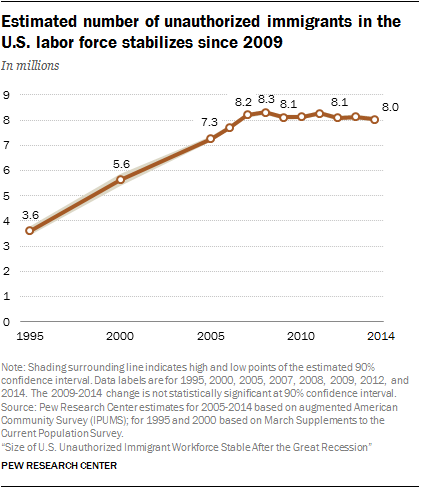
  • Is it because larger and larger numbers of people are seeking to come to the US? Legal? Yes, although I would love to see these tables controlling for size of US population as there are more now but a smaller share of US population  Illegal?  Nope, the trends, especially from places like Mexico, are in the opposite direction.
  • Is it because immigrants are more likely to be criminals?  Nope.  That all MS 13 is mostly threat inflation by the way.  They are bad hombres, but mostly because the US sent criminals to Latin America where they helped to radicalize others.  Well done.
  • Is it because immigrants are resource black holes?  Actually, nope as they pay taxes but are not allowed to receive most benefits. Flows can hurt local governments, but that is a problem that could be easily fixed.
  • Are they a threat because they are mostly people of color?  Ding, ding, ding. 
Yes, the current wave of anti-immigration feelings in the US is based on myths and on racism and xenophobia.  This, of course, is not new.  It used to be that Irish and Italians and Jews were not considered white (ask the alt-right folks these days about whether Jews are white), but John Kelly seems to have forgotten that.

Anyhow, immigrants are not significant threats to employment.  Indeed, for social security, medicare and other programs to be funded down the road, the best solution is to bring in more immigrants to offset the fertility decline and aging of the American population.  This is not an option for more xenophobic places (yeah, Japan, talking about you ... and Russia).

So, I just want to push back against this whole idea of immigration being a problem.  But what do we call the myth-ing of this.  We have #voterfraudfraud for voter suppression.  What is a handy term for this?  #Immigrationfraud?  Nope.  #NoImmigrationProblemo?  #XenophobicFraud?  Please post in the comments if you have a better name for this.