Showing posts with label Afghanistan. Show all posts

Saturday, January 24, 2026

The Real Burden-Sharing: The Allies and Afghanistan

 I have always hated the 2% metric--that NATO allies are good ones if they spend the equivalent of 2% of their gross domestic product on their own armed forces.  Input measures always problematic, it was a measure that made bad allies (Greece) look good, and, most importantly, it says nothing of what allies are willing to do with each other.

 What is an alternative metric?  Blood.  And it is very relevant this week as Donald Trump insulted the allies by saying that the US did all of the fighting in Afghanistan while the allies stayed away from the front lines (um, insurgency/counter-insurgency doesn't have front lines like conventional wars, Donnie).  Au contraire, as the allies did much of the fighting in Afghanistan from 2003 to 2009, when the US was distracted by its war of choice in Iraq.  When Obama sent more troops in 2009, then the burden shifted but did not really end until 2014 when NATO essentially pulled out of combat.

Yes, it is true that allies varied in what they were willing to do.  Dave and I literally wrote the book (ebook is on sale) on this as this was our sole focus, unlike other books on NATO and Afghanistan.  I say this not to boast, but just to say that I know whereof I speak on this (ok, a little boastful).  Of course, the facts tell the tale themselves.  This is page four of the Dave and Steve book: 

As you can see, the top five countries, by per capital killed in action from start to 2009, are Estonia (tiny country means tiny denominator means bigger %), Denmark (you know, the folks who own Greenland), Canada (ye olde 51st state), UK, and then .... the US. No accident as Denmark and the UK fought mostly in Helmand, the one of the most dangerous spots in the country (ask the Marines), and Canada fought in Kandahar, one of the other most dangerous places.

Someone else can dig up the post 2009 numbers (see http://www.icasualties.org/App/AfghanFatalities), but the basic pattern will hold--many allies did sacrifice much for America's war.  None of these countries had deep interests in Afghanistan--this was their contribution to the alliance (aside from most staffing AWACS planes over the US in 2001-2) in the aftermath of 9/11 and after the alliance invoked Article V.

But Trump sucks at math and at history (and also has no sense of honor or obligation), so, of course, he gets this wrong.  But we shouldn't.  Oh, and Trump was quite toxic in most of these countries before this week.  Veterans in these, who tend to be right of the center, will absolutely flip on Trump over this.  Which means that it will be very difficult or impossible for politicians in these places to bargain with Trump and to give in to him.

So, the recent past matters, and it is going to bite Donnie on his big behind.
 

Saturday, September 11, 2021

Twenty Years Later: Let's Kill Green Lantern

For the 20th anniversary of 9/11, our team at CDSN/CSIDS organized an event and created a video.  The event brought together those with perspectives on the international dynamics after 9/11 with those having expertise on the ramifications in Canada: the Asia Foundation's Tabasum Akseerformer Ambassadors Sabine Nolke and Kerry Buck, and Imam Navaid Aziz who is a leader of Canada's Muslim community.  We taped it:

We also put together a video asking those who served in decision-making posts that day as well the perspectives of today's experts:

We still have much to learn from the past 20 years, but if there is one thing I want folks to learn is this: Green Lantern is not a thing.  Huh?  Green Lantern is the DC superhero whose ring allows him to create a green version of whatever he wants--he can wish anything into being.  What we should have learned from the experience in Afghanistan and the other interventions of the past 20 years is some damned humility about what can be done in the world.  

Yet we haven't.  Yesterday, a person with whom I appeared on TV a few years ago reposted the link, arguing that we should have confronted Pakistan more assertively as it supported the Taliban.  

Sure, I agree that Pakistan was/is supporting the Taliban, but in that video, I noted that there was little the US and its allies could do about it.  Why? Nearly all of the supplies for the troops in Afghanistan--ammunition, water, fuel, food, etc--flowed through Pakistan.  Plus much of the air support flew over Pakistan.  The alternatives were Russia and Iran ultimately... not great.  So, the US had minimal leverage over Pakistan.  The irony here is that the Taliban's victory and the American withdrawal from Afghanistan dramatically reduces Pakistan's leverage.

A tangent about leverage: I was on a TV program this week, and there were five panelists, so I didn't get much of a chance to speak.  But I wish I had made a simple and obvious point--that the US and its allies had a lot of leverage in 2002 and damned little in 2021 vis-a-vis the Taliban.  So, that affected the kinds of deals one could make.  

Anyhow, onto a more local bout of Green Lanterning.  I watched a CGAI event that presented Canadian decision-makers of the time--Richard Fadden and Eugene Lang--and the CDSN's Andrea Charron talking about the legacy of 9/11 as well.  One recurring theme, especially by Lang, was that Canada has chosen to be dependent for its security on the US.  Sure, the US is not as reliable as it used to be (thanks to Trump and the GOP), but WHAT ALTERNATIVE IS THERE?  Lang kept saying, we could chose to be less so, and my basic question is how?  Spending double on the military wouldn't do it.  Triple?  It may suck sometimes, but there is no getting away from basic facts--that the US is the only country bordering Canada, that it is way more powerful on every measure, and that collaborating with it is the only choice.  Canada could choose to do less operations abroad, but it can't choose not to rely on the US for its own defence against China and Russia. 

So, how about some humility?  That is the one of the most important lessons of the past 20 years.  We have less influence over events than we think, that force is not as effective as we would like (good for breaking, bad for building), that cooperation is hard but necessary, and that we can't wish things into being.  It is not so much that there is no "political will" but that there are real constraints that can't be wished away--domestic ones and international ones.  

In the comic books, if I recall correctly (I was never a reader of Green Lantern), the adversary of GL is anything yellow, and, yes, this is a reference to cowardice.  But it is not cowardice to recognize that one does not have Green Lantern's powers.  Indeed, it may be far more courageous to recognize the limits of one's own abilities.  

So, I will conclude with an Ultimate analogy.  I think, when I played best, it was because I was pretty good at recognizing the limits of myself and my teammates--that I would not throw high throws to my teammates who could not catch the disk over their heads, that I would not throw very far in front of my teammates who were not so fast, that I wouldn't throw hammers to teammates that had problems catching that hard to read throw (and for other reasons), that I no longer try to throw it as long as I used to as I cannot (aging sucks).  It is no accident I have been using the following image for years:

A man has got to know his limitations (and women, too)


Thursday, August 19, 2021

Why Talk About Afghanistan

 Someone asked me today why I am talking to the media about Afghanistan: aren't there better people to talk about this stuff, especially Afghan women?  The answer is: essentially, yes, there are other voices that need to be heard.  So, I have started asking the media to ask those folks, and a TV thing I am doing tomorrow already has someone else on the panel who is covering that perspective.  For all of these other hits?  Why do I say yes?

I have been feeling uncomfortable for a few reasons:

  1. I wrote a lot about Afghanistan, but not recently.  I have not been studying the country closely as my work shifted to other topics.
  2. What I did write was on the outsiders--on NATO and on Canada--not domestic dynamics.  
  3. Many of the questions focus on what is going on right now at the airport in Kabul, and, well, damned if anyone in Canada can speak to that except the intel and ops folks in the CAF, and they aren't going to be doing any media anytime soon.

So, why do I talk anyway?  Primarily because many of the questions are about the big context--why are we there, what did we try to do, why did it fail, what does it mean for now and the future?  Those are questions I can try to answer.   This podcast for one of my better outings.  

Baseball advanced analytics came up with a measure to value players--VORP--value over replacement player.  The idea is how much more valuable is a player than the average one that could fill that spot.  The question when it comes to speaking to the media is whether I have a positive or negative VORP--value over replacement pundit. 

When the sexual misconduct/abuse of power crisis became a media story this winter, I sent the media to the women I know who study this stuff--Megan McKenzie, Maya Eichler, Charlotte Duval-Lantoine, Stéfanie von Hlatky, CDSN Post-doc Linna Tam-Seto, and others.  When the story shifted to focusing more on the civil-military relations aspects--what is parliament doing, why isn't the Minister of Defence doing his job (what is his job), I agreed to do the media hits because that is what I have been studying lately.  My VORP when it comes to sexual misconduct is negative--there are plenty of folks who can talk about that stuff far better than I.  My VORP when it comes to civ-mil is positive, in my not so humble opinion.  I can provide a comparative perspective, informed by research around the world including in Canada, for Canadian civilian-military dynamics.  

For Afghanistan, it really depends on the questions that are asked and how well I can dance towards once I can answer.  The challenge is that the questions I am told they will ask (if they tell me) are often not ones that the anchor/host actually ask.  I have gotten better as the week has gone along to asking them what they want to talk about and declining if it is out of my range.  Should they be talking about the situation facing the women of Afghanistan?  Yes.  Should I be the one answering that?  No.  Should they be talking about the other stuff?  Yes, and I can speak to some of it.  

I also feel obligated--that the grants I have applied for usually include "knowledge dissemination plans" of some kind.  So, if I get public money to study stuff, I should engage the public on that stuff.  The media's attention to these issues is episodic at best, so when the media finds an issue I have spent much public money studying, I tend to agree to talk.  Because the media will focus somewhere else soon enough.  So, in one sense, I am trying to make the governments' (and other grant agencies) money worthwhile beyond the academic enterprise.

But yeah, none of this feels good, mostly because we are talking about defeat and the consequences of losing. 


Monday, August 16, 2021

The Fall of the Afghan Government: The Big Questions

 There already has been and already will be much discussion of what all of this means.  Since I rode my bike yesterday and the podcast ran out, I have thoughts.  It is, of course, premature, but this is the place for half-baked ideas--the semi in the spew.  

The first question is: did social science waste its time and money?  Stathis Kalyvas asked this question today

I responded to him by noting several things

  • Failure was overdetermined so even if there was good social science that caused someone (the US govt?) to do stuff better, it might not have made a difference
  • that what we learn here could work better elsewhere
  • that folks may have learned stuff, developed policy implications, but that those implications did not produce policies that politicians wanted to follow.  When some economists said austerity was good for economic growth, that hit a group of pols in the sweet spot--hey, let's spend less on the poors.  But academics often recommend policies that are costly in the short run and the benefits only accrue in the long run (climate change!), and politicians live in the short term.

There is an irony here--that Kalyvas led a movement in the comparative politics of civil war, arguing that the local dynamics and the national dynamics were different, that the master narrative was often deceptive.  Well, the social science stuff done on the war may have been good at grasping elements of the local dynamics, but it turned out the master narrative mattered, too.  That the Taliban was able to take the local stuff--fights over property, groups being left out of the spoils, etc--and use that to undermine a weakly institutionalized and very divided Afghan govt and society.  A recurring theme--easier to break than to build

The next question is: was it worth it?  Depends on the it one is referring to.  The goal was a self-sustaining Afghan government, and, that effort clearly failed.  If the it was more about meeting alliance obligations, which is why most of the non-American countries showed up and which is how I define the "it" in my book on Canada's experience, then it is a matter of what were the benefits of meeting an alliance obligation versus the costs of opting out.  Opting out of Afghanistan would have been costlier than opting out of Iraq, but were those costs worth over 160 Canadian lives lost and many more wounded?  

A different way to think about "worth it" is did the effort make either a significant difference in the 20 years that it was worth it or if there is stuff that will endure beyond the Taliban's victory today?  There is no doubt that life got better for Afghans after the Taliban was ejected--the measures in terms of infant mortality and women surviving childbirth are clear.  The folks who were immunized due to a polio vaccination campaign will not get polio, so that is perhaps the most enduring contribution by the outsiders.  So, there is a generation of Afghans who live now thanks to the intervention.  But is that worth the 3500 lives lost by the allies and the tens of thousands of lives lost by Afghans who got caught in the middle?  How many would the Taliban have capriciously killed in the past 20 years if they still governed?

Is Afghanistan better off today than Libya or Syria?  Those are places where the US intervention was more modest.  I am not sure--part of this depends on what happens next.  But, ultimately, given that Afghanistan in 2022 is probably going to look a lot like Afghanistan 2000, it is really hard to say it was worth it. Maybe Rumsfeld was right in his original intention--that breaking the Taliban and then running would have been better, although, again, Libya suggests maybe not.  

So I don't really have a good answer.

What can we learn? 

  •  Much humility about the use of force.  We could not kill our way to victory.  Despite 20 years and a lot of resources, the effort failed.  It is simply much harder to build governance than it is to break a regime.  Obama learned that lesson and thus was reluctant to intervene in Libya, but was pushed into it by France and UK.  He tried to stay out of Syria, and well, that showed doing little or nothing is problematic, too.
  • I read a pretty persuasive thread about the US military maybe not preparing for the end because they wanted to force Biden's hand.  Obama was very concerned about the military boxing him in, and, I think Biden learned that lesson.  The end here was very, very fast, but there seems to have been no plan.  Isn't the military supposed to be planning contingencies all the time?  The two wars revealed that civilian control of the US military is not what it should be.  Part of this is that militaries are trained to be can-do outfits, and they are often relentlessly optimistic, which then creates credibility gaps. 
  • To stop using the graveyard of empires.  Afghanistan will not sink the American empire.  The greatest threats to American power are domestic.  Some will argue that the forever wars led to Trump and that may be true to a degree, but the polarization of American politics and the rise of the bad faith crowd in the GOP preceded 9/11.  But that is an argument for a different day. 
  • Our allies will learn ... what they want to learn.  No, our allies will not think the US is unreliable for leaving after 20 years.  After all, most of them were there and left before the US (hey, Canada!).  Just like our allies didn't give up on NATO and other allies after Vietnam, they won't after this.  Partly because there is no other game in town and partly because they all know that they are not Afghanistan.  Indeed, the lesson from Vietnam was: hey, if the US is willing fight for more than a decade, lose thousands of soldiers, and spend billions of dollars for a place it does not really care about, then we are ok. And that same less applies here since the US stuck around in a place that it really didn't care about for 20 years, trillion dollars, a couple thousand lives, and so on.

Who is responsible?  Everyone.  The US made big mistakes at the outset---relying on warlords, having too small of a footprint, sponsoring a constitution that was a very bad fit, distracted by Iraq--and other mistakes along the way--cycling generals and strategies, for example.  Obama made mistakes, Trump didn't help.  Biden's team has handled this endgame poorly. The allies could have done better (see our book for some reasons why they didn't).  Pakistan did so much to undermine the effort, and Iran and eventually Russia did some damage. The Afghans were served poorly by their own politicians.  

It is a land of bad policy alternatives, so I have a hard time articulating what should have been done in 2001-2002.  It is easy to note what should not have been done.  I think the key thing to remember is that the enemy has a vote, as they say, that the Taliban had agency.  So, one cannot read into the current dynamics too much about US mistakes without considering how the Taliban would have changed its behavior.  Again, it is easier to destroy than to create--we demonstrated that in 2001, the Taliban has demonstrated that ever since.  I don't know if the Taliban will manage to control the entire country, but they did succeed in denying control by the Afghan government and its allies.  What's next?  More heartbreak.

I am very sad for the Afghan people, who were poorly governed by their own, and let down by the international community.  I also feel bad for those in the various militaries and governments who sacrificed much and who continue to pay a price for what they tried to do, as they watch twenty years of effort reversed in a few weeks.  


Saturday, August 14, 2021

Thinking and Talking About Afghanistan

 It feels strange for me to be doing so much media this week on Afghanistan, as I haven't been following the conflict or the country closely since I finished the two books on NATO's experience and Canada's.  The caveat I usually offer is that I studied the outsiders and their politics, not the politics of Afghanistan itself.  Yet, I have spent this week far more focused, in part because of the media's questions and in part because of the dynamics of this year, on Afghanistan's politics.  

The big questions involve why the Afghan National Army [ANA] has broken and what would have happened if Biden had broken the deal that Trump had signed and kept a magical 2,500 troops in country.

  • I think the breaking of the ANA says less about the training and more about politics.  Yes, the US and its allies built the ANA so that it was perhaps not best suited for situations where logistics would be difficult and transport would be hard.  The departure of outside enablers made a difference.  BUT the ANA fought hard for years, paying a huge price over time.  What made it not sustainable was ... politics and governance.  That any army can't fight forever if it is not getting the political support it requires.  The stories this week of units running out of food, water, ammo are telling.  Plus we must remember, wars like these are not just about who can kill but who can either govern or undermine governance.  The enduring lesson of the past 20 years is that it is easy to break shit but not so easy to build stuff.  I wonder how well the Taliban, good at breaking stuff, will be at building a functional government.
  • Did Biden cause this to happen by pulling out the last remaining troops?  Yes and no.  Yes, in that it confirmed what people had long knew and expected--that the US was leaving--and there was not so much clarity about the US providing air support.  But the idea Biden reneging on Trump's deal to get out in 2021 would have stopped this suggests that the Taliban would have just gone along with it.  The Taliban had been working on this for quite some time, they have managed to upset efforts to build governance, and they may have made side deals with key actors (I am wondering about Karzai's clan....).  So, I don't think keeping 2,500 trainers in Kabul would have stopped the semi- or un-governed provincial districts from falling or Herat and Kandahar from falling.  I do think it is in part about expectations and anticipation--why keep fighting if you know you are going to lose?  The US moves may have altered expectations somewhat, but people have been raising questions for years about how sustainable the pace of operations was for the ANA.

Since no one in the US and its allies has the desire to send another 100,000 troops to re-fight the war, the focus must be on helping as many people get out and find a home as possible.  

Will a Taliban-ruled (not so much governed) Afghanistan be a threat?  I am not so sure.  ISIS proved you can inspire terrorism with or without a territorial base.  The Taliban may have also learned that hosting international terrorist organizations may be more trouble than its worth.  Sure, they may be coming back into power, but spending 20 years on the run may not have been so much fun for them.  Of course, folks often don't learn, which means the US may end up using air strikes and special ops to disrupt terrorist organizations if they start making Afghanistan a home.  We have learned a lot about what can be done from a distance, and I think there will be more willingness now than in 1998 to use force against potential terrorist groups.  

None of this is good, but much of it was inevitable.  I am reading a book about Afghanistan right now called Unwinnable by Theo Farrell, and it is pretty convincing.  At the end of the day, the key thing is this: counter-insurgency is really hard and third party counter-insurgency is harder still.  It tends to be easier to disrupt governance efforts than to govern (as the anti-maskers in the US are proving).  If a government needs help to fight an insurgency, well, it is going to be very, very hard.  And when those governing have competing interests, like grabbing every dollar they can find for themselves, the effort may just be doomed to fail.

So, the keys now are to do whatever we can to help those who helped us, to help the rest of the refugees, and to learn as much as we can, including developing greater skepticism about the utility of force and about the ability of outsiders to defeat insurgencies.  


Tuesday, July 13, 2021

Fighting and Losing: Thinking About Afghanistan

 20 years after the US and then its allies got into Afghanistan, they are getting out, and it may be that the Taliban will return to power.  Maybe the government of Afghanistan will hold on, but much of the terrain over which NATO and its partners fought is falling into Taliban hands.  This week, some of the places where Canadians died have fallen.  What to make of it?  

Lt. General Eyre, the Acting Chief of Defence Staff had a very good statement:

My perspective, of course, is very different as I only spent a week in Afghanistan, and I didn't lose friends in battle.  The starting point, I guess, is thinking about what the troops and civilians were doing there.  In my book, I argue that the primary objective was to support an ally that had been attacked, that Canadians had no intrinsic interests in Afghanistan, but joined the effort to support the US and to support NATO.  And in that effort, Canadians, in and out of uniform, were mostly successful for the time they were there.  Canada left Kandahar before its allies left other combat zones, but while it was there, the CAF was more flexible and more helpful to the allied cause than almost any other ally.  And Canadians paid a higher price as a result.  

While the Canadians were in Kandahar, conditions improved, but there was a limit to what kind of sustainable impact they could make.  As Eyre says in his note, the job of the foreign militaries was to create the space for the political stuff.  No matter the Kandahar Action Plan or the Helmand Plan or the Uruzguan Plan and on and on, the outsiders simply could not change the politics of the place.  Ok, they could affect it, and did so often quite badly as the constitution was a poor fit for the place and as the outside forces often got played by the Afghans, with our "allies" providing tips that often were aimed at hurting their rivals for land, drugs, and power.  As I keep saying, third party counter-insurgencies are third-party for a reason--that the government of the place is not up to the task and that becomes pretty hard to fix.  

Was defeat inevitable?  I am still not sure as there were so many big mistakes early--the US going too light, becoming too quickly distracted by Iraq, putting into place a crappy constitution, and on and on.  But wars get lost--as far as I can tell, no country is undefeated.  How one grapples with that reveals as much or more character than the winning or losing.   The old saying is that victory has many parents but defeat is an orphan.  Everyone will try to disown this war, but we can look at the conflict and figure out what are the limits of power, what are the mistakes that we ought to avoid in the future, and what we do really well.  Trying to forget about this war and moving on, back to Great Power Competition, will only ensure that we are poorly prepared the next time.  The lessons of Vietnam came late to the battlefields of the Mideast, the lessons of Afghanistan may come too late down the road.

The focus now should be on helping those who helped us--the interpreters, the drivers, and the others who are at greatest risk of retaliation.  Of course, this will be one last bit of damage we do as we will be taking from Afghanistan some of the folks who might best contribute.  But our responsibility is to those individuals who we made promises to, more so than the long-term prospects of the place.  With all things in Afghanistan and in counter-insurgency, the choices are between bad and worse.   

It is natural to be angry and sad. The days ahead are going to be full of bad news.  In terms of the big Biden decision, I am not sure how this would be much different if it happened next year or the year after.  Sticking around would have made much more sense if there was evidence that there was progress being made, that the outcome would be different with a bit more time and investment.  I don't think Trump was wrong about wanting to get out of all of these wars--just about how to do it.  Nobody wants to lose a war on their watch, but deferring so that someone else can lose it on theirs is quite problematic.

There is much more to stay about all of this, so I will probably come back to it eventually.  Right now, I am just sad for the Afghans who were let down by their own leadership and by the outsiders. 


Wednesday, December 11, 2019

Afghanistan Papers Quick Reaction

I don't have time to read many of the documents that the Washington Post attained, but I have read the covering story and reactions by others.  My basic take is that this is not the Pentagon Papers, at least not yet, as the stories are mostly about a lack of a coherent strategy, success or progress was hard to measure, about the difficulties of cooperation within and between countries, that clients are unreliable and inevitably so, and so on.  And these things ... were not the product of malfeasance/malice but unfortunately dynamics that are damned near inevitable and, yes, we (those paying attention) knew about most of this stuff.  Indeed, Stephen Harper, reacting to the messed up Presidential election in Afghanistan in 2009, basically admitted defeat.

I tweeted online about a series of original sins which others added on to.  Here, I just want to discuss a key civ-mil dynamic since many of the other things are getting play elsewhere: relentless optimism by the officers leading these efforts.  I wrote in the conclusion of Adapting in the Dust that this would create a credibility gap between civilians and military folks, and I am pretty sure this WashPo report will have the same effect.

Why are the military folks seemingly so optimistic?  Both American and Canadian officers seem to think that they cannot and should not say no when asked to do something.  Sure, the civilians have the right to be wrong, so the military can't say no, but perhaps they can say "x is going to be really, really hard, and it isn't advisable to do x."  But alas, they seem to think they are Can Do! organizations. 

The funny thing is that this is a big contrast to what we knew about the US military in the 1990s--that it was hard to get the military to support intervening in the Balkans and elsewhere.  Deborah Avant wrote a piece called Are Reluctant Warriors Out of Control, not something you might see these days.  What is different? 
  1. I fundamentally believe that the US armed forces still prefers not to fight new wars, but is also pretty interested in escalating the wars they are in and in not leaving a war once they are there.  I remember stories on the Joint Staff about Hugh Shelton, the previous Chairman, resisting Clinton's various missions in the Balkans.  This is the kind of thing that led to Madelaine Albright famously saying "'What's the point of having this superb military you're always talking about if we can't use it?"  On the other hand, once Mattis became SecDef and Trump delegated to him, we saw an escalation in the use of force and expansion of missions...  So, I am not sure that the US military opposes all missions, but it does seem determined not to leave.
  2. Humanitarian missions of the 1990s?  Not something the military wanted to do.  taking the fight to the terrorists, however defined, not so much opposition.  So, it might be the kind of mission matters.
  3. It could be that 9/11 changed attitudes as the threats to the US and Canada and Europe became more direct. 
Anyhow, we need to improve the civ-mil conversation so that the military can be more pessimistic when it needs to be pessimistic and more optimistic when it is more optimistic.  And the civilians need to listen.  Getting there is really hard, and, yes, the civ-mil relationship needs a heap of trust on both sides.  Is that likely?  Depends on the country. 

Sunday, September 8, 2019

Afghanistan Shenanigans

There is always temptation to mock Donald Trump, so let's try to put into perspective this whole "hey, let's bring the Taliban to Camp David* a few days before 9/11 anniversary to make the Deal of the Century; oops, let's not!" thing.

First, some basics:
  • No, the Taliban didn't organize the attacks on the World Trade Center and Pentagon and target #3 which became a hole in Pennsylvania farmland.  Nope, that was Al Qaeda, which the Taliban government of the time permitted to run around their country, organizing terrorist campaigns against the West.  
  • It is ok to negotiate with the opponents in a civil war (Afghanistan has long had a civil war, so folks who say that one will start anytime soon are missing the cold, hard reality) as civil wars end either by one side defeating the other or by negotiation.  Victory by the Afghan government and the NATO folks was never very likely, and we all gave up on that with the withdrawals in and around 2014.  A bargain would potentially stave off the defeat of the Afghan government, as its troops and its civilians are facing a very high price every day to continue the war.
  • But the war continues in part because of international support and in part because folks remember how the Taliban ruled before.
  • Which makes any deal pretty difficult to arrange, since there is no trust for the Taliban.  Again, this is mostly normal--that it is hard to negotiate these days and they usually need some kind of third party guarantor to punish those who cheat.  Who would that be in this case?
  • Didn't Jimmy Carter bring the Israelis and the Egyptians to Camp David to negotiate an agreement which stands to this day, despite assassinations, coups, and other political unrest in Egypt?  Yeah.  But Trump ain't Jimmy, and it is not clear there would be a Sadat in the room.
  • Sometimes, violence continues while the bargaining goes on.  I can't recall situations where the violence escalates in the final stages, but it might make sense from a Taliban perspective to get Trump to sign any deal.  Given that Trump often indicates he will take any deal, just to get a deal (see negotiations with North Korea, ultimately the revision of NAFTA fits in this category as well), the Taliban may have pushed a bit too hard.  But that is what happens when one develops a reputation for being a paper tiger.

Ok, with that out of the way, how do we make sense of the tweet about cancelling the meeting of Taliban officials, the President of Afghanistan, and Trump at Camp David?  The stories in the past few weeks focused mostly on the phased withdrawal of American (and maybe NATO?) troops from Afghanistan in exchange for ..... um .... Not clear.  There was definitely a sense of a "decent interval" which refers to the way the US got out of Vietnam--by Kissinger making a deal that doomed South Vietnam, but would have a bit of time--a decent interval--between departure of the US and collapse of South Vietnam.  The pics from the fall of Saigon make that interval look not so decent AND the Nobel Peace Prize that Kissinger earned (and that Trump may covet) quite tainted since it was less a treaty and more a surrender.

So, excuse the Afghans who are thrilled this thing didn't happen.
 “A lot of Afghans are happy about Trump’s tweets because they may stop a bad deal with the Taliban, but they ignore the fact that there is a fundamental lack of strategy in Afghanistan that could prolong and exacerbate the bloody conflict,” tweeted Haroun Rahaimi, a law instructor at the American University of Afghanistan in Kabul. “I fear for what may come next!”

They know what Kissinger did for South Vietnam, and they have long been suspicious of being sold out.  And, yes, Trump is not the most credible of negotiators or third party guarantors.  President Ashraf Ghani was not involved in the talks, so he and his supporters worried about what the deal would mean.

Again, the discussions did not seem to focus on power-sharing, on how to include the Taliban's armed forces in the Afghan military or how to demobilize them, or any of the usual topics of an effort to end a civil war.

The big problem here is not bargaining with the Taliban, but doing the work to make this happen.  That is, it requires a significant amount of expertise, discipline, and planning to figure out how to use whatever declining leverage the US has left (signaling one is leaving ASAP is not great for leverage, as Obama found out) to get a deal that at least has some pretense to guaranteeing that the side the US/NATO have been supporting is not betrayed.  All the stories about these negotiations indicate that the US "process" is a shitshow as the National Security Adviser has been left out of it (the schadenfreude about John Bolton being sidelined is offset by empathy for the Afghans), that it is run by an agent (Zalmay Khalizad) who may not be coordinating with anyone, and with Trump thinking he can go with his gut once he gets in the room with the Taliban officials.

Mostly, this tweet was about Trump's ego--that he tried to make a big deal because he thinks he can make big deals even though he didn't do any of the work to make a big deal likely and then he got upset when the Taliban continued to keep up the pressure.

I guess people have been thinking all along that things could be worse because he hasn't screwed up everything.  Maybe not, but I'd say he is working on it except that Trump doesn't work.  He is too damned lazy.


*  Camp David is on the same mountain/hill in Maryland as the summer camp I went to for all of my teens, and there is a reunion going on there this weekend that I could not attend.  I wonder how the folks who are attending are feeling about the turmoil over on the other side.


Monday, April 1, 2019

Anniversary of the end of Canada's War in Afghanistan

Markers for those Canadians who lost their lives in Afghanistna
NATO is still in Afghanistan sans Canada.  Five years ago, Canada ended its military role, although the big change was four years earlier when Canadian troops moved out of Kandahar and started the training mission elsewhere.  Still, it is an important anniversary. 

To my surprise, Afghanistan has not yet fallen to either coup or the Taliban.  It, however, is suffering mightily from civil war, and the US is keeping the Afghan government mostly out of the negotiations with the Taliban.  So, the war goes on. 

As we look back, there is a lot of regret.  I have seen many folks saying that the war should never have happened--if we had given the Taliban more time, then they might have turned over Bin Laden.  I don't really think so.  Others say we could have just chased AQ out and then left Afghanistan to its own devices.  I think the examples of Libya and Syria suggest that is not a great counterfactual either.  I do think that the US starting another war and becoming distracted by that, combined with designing a dumb constitution, were the big fatal errors. 

That will do the trick
I tried to answer some of the big questions about how Canada did in my book--Adapting in the Dust (now less than C$10 in either paperback or e-book).  Why did Canada join the effort?  Simply put: an ally was attacked.  Why did Canada keep going back?  Because Canada wants to be a good ally even when it is hard.  Did the military have too much influence over the big decision?  No, it was Paul Martin's to make, and I am pretty sure most other PM's would have done the same thing.  The bureaucracy mostly recommended the Kandahar deployment, not just Rick Hillier.  Did the parties handle the conflict well?  Nope.  Should we be surprised?  Not really.  Did Canada manage its mission well--did whole of government work?  Better than most countries but not that great. 


I do think Canada needs to put stuff in comparative perspective--all of the countries involved faced the same challenge regarding detainees, for instance.  A key myth--that Canada was alone in Kandahar--did no one any favors. 

I still wonder whether Canadians began opposing the mission because of the costs paid by the Canadian troops, because of what the Canadian troops were doing (combat), or because of the end of elite consensus (my personal fave based on the academic literature on casualty aversion). 

We can learn a lot from this experience.  Alas, the government did not, with a pathetic ten page document that wasted a lot of effort to come up with pablum which they then hid not just from the public but from the rest of government.  The good news is that, dare I say it, this is a job for academics.   Not just me but also folks like Boucher and Nossal

Canadians will always be unsatisifed with this mission, and rightly so.  The troops, the diplomats, the aid workers and others made a contribution, a difference, while they were there.  But they faced tremendously difficult decisions, had to compromise their values, and only had limited ability to change things.  I wish they had had better political leadership.  And I hope the next time, the political system handles things better .... although I doubt it.


Thursday, October 18, 2018

Killings in Kandahar: Instant Reaction

The news out of Kandahar is pretty awful: the top leadership of the province was killed in an apparent attempt to kill General Austin Miller, the commander of US and NATO forces in the country.  There is not many details, but the WashPost account is suggestive of some key dynamics and challenges.

First, it sounds like the killer was apparently part of the provincial governor's security team.  Not great.  It does seem like the primary threat in Kandahar to elites are their security teams, as I seem to remember it was also a member of Ahmed Wali Karzai's security team that killed him. 

Second, and, more importantly, the focus is on Abdul Razik the police chief of Kandahar.  Why?  Because (a) the inability to build institutions meant that the US, Canada and the rest of NATO bet on individuals.  That if we had the right individuals in place, we can manage things and even perhaps improve them.  The story focuses on Razik's own networks and his own capabilities, not that of his office.  That he is hard to replace--because we have relied on individuals.  And, yes, individuals come and go.

Third, the focus is on the police chief, not the governor.
Among those reported killed in the attack inside the governor’s compound in southern Kandahar province were the country’s top police general, Abdul Raziq, who was seen as the most powerful man in southern Afghanistan.
That says something about how little progress has been made--that it is still very much about who controls force, not who governs.  If progress had been made, the focus would be more on the political side--the assassination of a governor.  If we think about this happening in most other places, wouldn't we note the political leader first and foremost?

Fourth, um, about Razik, the discussion of his "strengths" reflects some desperation on the part of the outsiders:
Amrulleh Saleh, a former Afghan national intelligence chief, tweeted that Abdul Razik had been “an architect of stability” in Kandahar who had established “deep political networks” in support of the government. “This is a pan-Afghan loss,” he wrote.
Abdul Razik, a lieutenant general in the Afghan National Police, was a controversial official who had been repeatedly accused of torturing detainees and other abuses during his rise to power in Kandahar. At the same time, he earned a reputation as a ferocious opponent of the Taliban and gained the respect of successive American and NATO military officials in Afghanistan.
Controversial figure?  Indeed.  This points to the biggest challenge facing any outsider hoping to run a successful counter-insurgency effort--local allies.  Do they have similar interests?  Do they behave in ways that alienate local constituencies?  Does one need brutality to win a counter-insurgency?  I am not sure, since this guy was brutal and yet.... is Kandahar a success or a failure? It hasn't fallen (unlike Kunduz), but it is not a haven of security either.

This one story, again based on initial reports, is just very suggestive about how complex counter-insurgency efforts can be, how difficult they are, and how many tricky tradeoffs are involved.  I am sure the US/NATO forces are mourning the loss of Razik, but maybe they should be wondering why they are so dependent on one guy?


Sunday, October 7, 2018

Afghanistan Anniversary

Today is apparently the 17th anniversary of the start of the US (and then allied) war in Afghanistan.   Not quite old enough to drink but old enough to disapparate.  Anyhow, when I was working on ethnic conflict stuff, including my time in the Pentagon on Bosnia, the frequent refrain was that it takes generations for a society to start to recover from a war.  Indeed, when I first heard that the US was calling its post-invasion role in Iraq "Occupation," I was relieved.  Why? 

Because I thought we might have realized that it takes quite a while to make progress after conflict.  That many of the previous conflicts were still problematic because each peace-keeping/nation-building effort was focused on the very short term, as in one year at a time or so.  Indeed, I remember an American officer comparing Bosnia to the American civil war since his unit was one that combined VA and MA personnel--blue and gray.  My response (in my head): yeah, because the North and the South only took 100 or more years to get along.

If the US had invaded Afghanistan with the intent of being there twenty years, as opposed to looking to get out at the first moment possible, much might be different.  Not only would the Taliban perhaps have been less willing to just out-wait the outsiders, but the plans, operations, campaigns and investments might have been different.  Rather than focusing on just getting to the next election or other key milestone (definitely not benchmarks), the US and its allies could have been more focused on building institutions.  Institutions take time to become legitimate and respected and taken for granted. 

Of course, it would be unrealistic for any democracy to tell its public that it would be going to war in a place for two decades.  Far more realistic to say we will be there just for a few years and then keep kicking the can down the road.  This works for winning (or not losing) support back home, but it does no favors to those in the field. 

So, on this anniversary of the Afghanistan campaign, I am embracing humility.  Since we can't expect politicians to defend long term investments, we probably should avoid making decisions that lead to long term wars.  Maybe an American intervention in Syria in 2012 might have improved things compared to what happened, but how many forever wars can the US be sucked into at any one point in time?  As long as we keep thinking that these wars are all going to be short, we are going to do just enough to make sure that they are prolonged.


And, yeah, I am in a pretty pessimistic mood given the destruction of American institutions the past week or two.


Thursday, August 16, 2018

Afghanistan Retrospective Book and Review

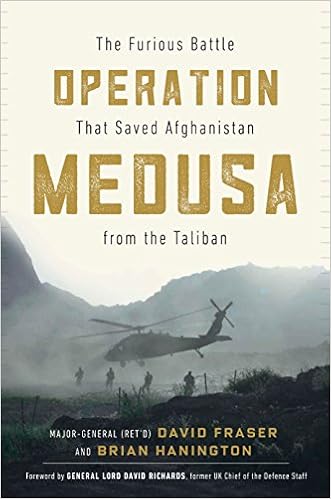
I got a copy of General (ret.) David Fraser's book on Operation Medusa several weeks ago, and have been reading it in my spare time.  I have some thoughts, of course, as I have written much about Canada and Afghanistan.  I also have some caveats--I am not an expert on battles nor did I spend much time in Afghanistan (8 days).  But I have interviewed people, including Fraser, who were involved in the battle or were there afterwards.  So, take what I have to say with a grain of salt. 

First, the book is engaging and interesting.  It covers the battle and not much else--not a whole lot of context for the whys and the aftermath, but that is fine. The book presents itself in a very uncritical, patriotic manner--that the general led brave men and women in a difficult fight, and the book is more or less a tribute to those folks. 

Second, the book is not very self-reflective--again, it is not that kind of book.  While Fraser admits that not everything went well, he does not really elaborate on what he could have done better.  He is critical of others, and when there are mentions of arguments with subordinates about tactics, he argues this is natural, rather than maybe not listening to those who understand the local conditions better?  I have heard enough over the past ten years or so in Ottawa and elsewhere that I am pretty sure this book is rubbing some key folks the wrong way. 

Third, one could read into it what you want.  Any discussions of surprises or intelligence problems could be seen as criticism of the current Defence Minister, Harjit Sajjan who was the key intel officer for Fraser's team.  Or it could be that Fraser didn't listen well or that the situation was too fluid, so it was not really anybody's mistake.

Fourth, the story reminds me of the most important military problem in Afghanistan in 2006--size. Yeah, caveats and all that, but the big problem was simply not enough troops on the ground.  One company had responsibility for Zhari, Panjwayi and Maywand?  A company is about a hundred soldiers.  That is not Fraser's fault, but is something that, along with all kinds of other basic stuff (giving the President too much power, Karzais being a bad group of "allies", Pakistan, etc), made victory very difficult.

Fifth, Fraser's attitude about NATO is both strange and informative.  It is strange in that he keeps appreciating the Americans, the Brits, UK, and such while blasting NATO but those folks are there as part of a NATO mission.  What is informative is his depticiton of the Danes being unwilling on page 138.  I got the Danish side of the story when I was working on the Dave and Steve book. The Danes were quite willing to go into the fight--spent most of the war in the one of the most dangerous parts of Afghanistan--where the poppies grow in Helmand--but they pushed back against Fraser. Why?  Because he was trying to treat their recon vehicle like a tank or armored vehicle--he wanted it on the front lines, whereas the Danes viewed this system as good for being on the edge of the battle to provide info.  So, perhaps Fraser didn't know how to handle some allies or didn't listen well?   I get being frustrated that the Germans and French didn't show up, and that NATO ROE were less friendly, less flexible than the American ones (speaking of which, he claims credit for making sure the wounded would get treated within one "golden" hour--but that was a NATO-wide policy, not his innovation or initiative).  This stuff mattered, but Fraser's job in 2006 was to be the NATO commander and not just the Canadian one.  He wore two hats, and one he mismanaged. 

Sixth, a key challenge in reading this book is that one of the central complains about Fraser is hard to evaluate from Ottawa in 2018.  There was a plan to engage in bombardment of the Taliban compounds for three days, but Fraser called that off.  He says that it was not doing much damage since the Taliban were dug in and underground.  Folks who served there suggest otherwise.  I am in no position to adjudicate this, but I didn't find Fraser's explanation very convincing.  This is a sore spot that he could have addressed better. Similarly, I heard that the basic plans were unimaginative and were repeated, which Fraser's narrative contradicts.  I'd like to have someone who served in the battle speak up and clarify this. 

The funny thing is that when I interviewed Fraser in 2007, I was focused on figuring out the NATO side of things and he wanted to lecture me on "effects-based operations."  The notion that any military plan should figure out what the likely effects are in the short, medium and long term.  That Kandahar didn't fall then and hasn't fallen does speak to the importance of both Medusa and the Canadian effort in Kandahar.  I am tempted to go on a tangent about a recent Macleans piece that seems to want to make the Canadians the good guys and the Americans the bad guys, but that is a Spew for another day. 

Back to grant-writing.


Wednesday, January 31, 2018

Afghanistan is Hip Again?

I was on Canadian TV last night to talk about Afghanistan, as they anticipated that Trump would talk about it and about sending more troops there.

This is what we got:
Our warriors in Afghanistan also have new rules of engagement. Along with their heroic Afghan partners, our military is no longer undermined by artificial timelines, and we no longer tell our enemies our plans.
 Wow, that clarifies everything! What are the new rules of engagement?  There is so much wrong packed into this one sentence that I am tempted to post a certain pic:

Ok, not everything is wrong--the Afghan security forces (when some of them are not raping kids) are pretty damned heroic.  They have been paying a huge price and have not yet broken.  But if the rules of engagement are looser, rather than tighter, what this really means is almost certainly more civilian casualties, and that will probably undermine the effort.  Sure, Afghanistan is a damned if you, damned if you don't place as the work of Jason Lyall indicates.  Also, the folks who pushed for tighter rules and less collateral damage included the generals.  Stan McChrystal had many faults, but his push for courageous restraint was probably one of the most significant contributions he made--that sometimes it is better not to shoot at a high value target if it means lots of civilian casualties and waiting for another day and less problematic opportunity makes sense.

Trump's line about artificial timelines is not wrong either but not entirely right.  Because having no deadlines, and even more importantly, no strategy and no clear desired outcomes means that this is, indeed, a forever war. When will the US be ready to leave Afghanistan?  What conditions will permit it?  Is the US effort really doing anything that, dare I say it, hastens the day that they can leave? 

The whole "We don't tell our enemies our plans" thing has always grated at me.  It is one of those incredibly dumb Trumpisms that he gets addicted to.  No, we have never told our enemies our plans (although Trump does tend to tell our adversaries about our intelligence programs and those of our allies), but having a plan is a good thing even if they are not always realized.  Again, what is the strategy here?  While specific tactics should be secret, to get everyone moving in the same direction towards a desired goal (the military would say endstate), the major players all need to know what the strategy is--the Afghan government, the allies, the State Department, USAID, um, the military, etc.

Anyhow, no explanation or even description of the escalation of numbers of troops, just a hint that the use of force is escalating.  Is this a bad thing?  The old rule that one should never want to be mentioned in the State of the Union probably does not apply here, since Afghanistan should be a priority but is being treated as a throwaway line.  And, yes, it suggests that we are throwing away the lives of those wounded or killed there without much thought.


Wednesday, August 23, 2017

Trump's Secret War Plans

Trump's argument that he is keeping the numbers and plans secret so that the enemy does not learn of our plans is bullshit.  Let me count the ways:
  1. The Taliban could count C17s just as the Viet Cong counted helicopters.  The Taliban is not a dumb organization.
  2. The Taliban can observe our bases and count that way.
  3. The Taliban can get a copy of the next supplemental appropriation bill and do the math (divided by roughly $1million to get the number of soldiers).
  4. While the specific operational plan of the day may benefit from secrecy to surprise the adversary, the larger strategy does not benefit from surprise in the same way. Think about D-Day: we didn't tell the Germans which day or where, but they sure as hell knew there would be a second front (ok, third or fourth front, depending on how you count) somewhere.  
  5. It allows this government to avoid having a clear strategy or plan.  
  6. It denies Congress the chance to oversee and ask tough questions of the generals. At least in public.  The generals would have to respond to Congress's questions since, Trump may not know this, Congress co-owns the US military.  Ooops. Better to have the debate in public than in secret so that voters can then hold the administration accountable.  Oh, wait, maybe that is the point.
  7. It allows Trump to delegate all responsibility to the military when civilian control of the military is crucial for democracy to operate.
I am sure I am forgetting stuff so suggest away and I will update.

Tuesday, August 22, 2017

TV Panels Mean Much is Left Unsaid: Afghanistan Edition

Dale Smith teased me a bit after my appearance on Power and Politics today that I had much more to say.   Maybe, maybe not.  I said much at the Globe and Mail, on various radio programs and here at the Spew.  The challenge is that we have little time to chat, and when the other guy says stuff, I often don't have the chance to respond.  Shuvaloy Majumdar is smart and sharp on this stuff with real policy experience (first time I met him), so I didn't disagree with what he said, but perhaps with his optimism.  I guess the key things I wanted to say or respond to are:
  • Afghanistan is not as remarkably progressed as Shuvaloy suggests--the last election was a shitshow (we don't know who got how many votes), the resulting ad hoc coalition is not working out so well, and the messed up institutions we implanted way back in 2002 still screw stuff up. So, I took exception to the idea that it is all about Pakistan.  Corruption and warlordism are also just a wee bit problematic
  • The Taliban is not simply = Pakistan.  The Taliban may be agents of Pakistan's intel agency, but heaps of principal-agent problems here.
  • Pakistan's observer status at NATO is just a trifle--something that they don't care much about.
  • That Shuvaloy's things that Canada and NATO could do are all things that fall far below any threshold of counting as much in the eyes of Trump.  It is about troops on the ground and maybe money.
  • That assertions about other partners--the Emiratis, the Russians, the Chinese--are about wishes and not realities.  Nobody is going to rescue the US from this war.  Some might put pressure on Pakistan, but Pakistan is used to pressure and will continue to be America's worst or second worst ally.
My best move was to trash Tillerson before the cameras went on, so that Rosemary Barton put some skepticism in her voice when mentioning him. 

Anyhow, TV is fun, traffic is not, getting soaked in a downpour not fun in a suit.  But an interesting media day today: four radio programs, one op-ed, and one TV hit.


Monday, August 21, 2017

Key Rules of US Civ-Mil and Trump's New 'Strategy'

I wrote something for a newspaper for tomorrow, but have much more to say about Trump's speech.

This post will not focus on how icky the first part on loyalty was.  Instead, I focus on the rules of US Civil-Military Relations:
  1. the US military does not like to start new wars (see Deborah Avant)
  2. once involved in a war, the US military likes to escalate.  They want more troops, as if more means better.  More can be better, but that really depends on the strategy and the adversary and the conditions.  
  3. Washington, DC establishment prefers MORE ... something.  It prefers action.  
  4. Everybody hates micro-management.  But no one wants to be held accountable.  Ooops.  The US military likes to talk about how they are accountable, but the costs for bad decisions are borne by the local commanders (captains of ships, battalion commanders), not those making the bigger decisions in Kabul (Bagram) or the Pentagon.  
  5. People complain about the rules of engagement, but these conversations tend to forget basic Clausewitz: war is politics by other means. Despite all of their sins and arrogance, Petraeus and McChrystal got that right.  If you want the public to support our adversary, then use more force and more recklessly.  How did being more brutal work for the Soviets in Afghanistan?
  6. Kicking the can down the road is the American way.  This additional four or five thousand works will not lead to victory but it might help stave off defeat for a while.  Woot?

I really don't know if some more troops is good policy or not.  I do know our troops need decent rules of engagement.  Barbarism may sound like fun, but is not a good look.  It offends the allies, it antagonizes the locals, and I do think we learned it is better to be more targeted, more careful than not.  The US has not lost wars because the troops' hands have been tied.  The US lost wars (Vietnam) and are not winning recent wars (Afghanistan) because we simply have less resolve, less interest, less commitment than our adversaries.  Oh, and counter-insurgency is really, really hard and takes heaps of patience, which is not something that Americans tend to have.

Thursday, August 3, 2017

Trump's Frustration With Afghanistan

I absolutely get why Trump is frustrated with the war in Afghanistan.  The Taliban, even if they are more fragmented than we tend to appreciate, are doing quite well, and the Afghanistan government is not performing well despite the departure of Karzai.  When Obama spent much of 2009 considering whether to surge or not, I was most ambivalent for many reasons.  Was Afghanistan similar enough to Iraq (where the surge seemed to work)? Wasn't the primary challenge political and not military?

So, I see where Trump is coming from.  Of course, his reasoning and his analogies are flawed (Afghanistan ain't a restaurant).  And that gets to the big problem now: he is uniquely unsuited to come up with an alternative policy.  He has a short attention span and hates to listen to bad news.  Afghanistan requires focus and a willingness to see both progress and falling backwards.  Trump has allowed/encouraged Tillerson to gut State, when, again, the primary challenge in Afghanistan is political: not just about improving governance by Ghani and his administration but also figuring how to negotiate with the Taliban AND how to get the various outside actors (Pakistan primarily but also Russia, China, Iran and India) to coordinate enough to provide a conducive environment. 

I have no idea if General Nicholson should be fired.  I do know that replacing generals every year or so has not been good for the war effort as each one has a different strategy.  This means that no strategy is really ever implemented fully, that the folks in the ground get whipsawed by the changes in rules and priorities. 

On the other hand, Mattis arguing that we are losing because we do not have the right strategy may seem to miss the point.  As a former general, he sees the key to winning and losing to be about getting the right strategy--the right set of plans that have various lines of effort coordinated to reach a desired endstate (yep, that is how they speak).  Endstate means goal or final desired outcome.  But is it about picking the right set of plans?  Or is it that we outsiders have, dare I say it, limited influence?  That the actors on the ground have more at stake, longer time horizons, and more influence? 

Whatever strategy the US and its allies choose, the folks on the ground will be deciding whether to bet their lives on the Afghan government, on the Taliban or on staying on the fence.  It is not clear that we can affect those decisions that much.  We didn't influence them that much when there were more than a hundred thousand troops on the ground, so why expect more influence now.  Indeed, Jason Lyall's work seems to suggest that we are damned no matter what we do. The outsiders get blamed for what the Taliban does.  Oh crap.

Until we have some humility about what the outsiders can do, no strategy is going to be "the right strategy."  So, yeah, Trump should be frustrated.  But he lacks the capacity to think long and hard and reality-based.  Thus, I don't expect a significant improvement.  Perhaps he will call for the end to the US effort there, but addressing that is a blog post for another day. 


Thursday, June 1, 2017

Learning Lessons? Not Much

Several years ago, I had heard in various bars in the Byward Market that the Canadian government under Stephen Harper had engaged in a serious Lessons Learned exercise about Afghanistan.  I heard that the document was buried (I used the last scene of Raiders of the Lost Ark to illustrate).  I tried an Access to Information Request in January of 2013, but got rejected because the document was viewed as "advice to cabinet" and containing sensitive information about Canada's allies.  I thought this was hogwash, so I appealed.  I got the document just before my recent trip to Brazil (here it is),* so I didn't have time to process it.
* I was so enthused that I wrote all over my one copy of the document, sorry.  Had I realized that I would be posting it, I would have copied it and then written on the copy.  My bad.

Although I have other stuff I need to do, I got inspired by the new discussion about Canada returning to Afghanistan (unlikely), so I will review the document here.  You will probably be as underwhelmed as I was.  The good news is that my book remains alone as a real effort to learn lessons about the Canadian mission.

The document is only ten pages, which means that it is only a shallow cut at best, and the first two or three pages are intro and context, not lessons.  Thus, there really is little text for such a complicated mission.  So, I will go through the document below... it shouldn't take too long.

The intro is fine--500 interviews from participants across government and across all levels is swell.  If this is the only document out of that work, then lots and lots of stuff was left behind, alas.  The Manley Report gets a heap of notice on the second page and rightfully so.  It produced a "Transformational Agenda" which, I would suggest, is a bit much.  Yes, stuff got better but it did not transform the bureaucratic politics that determined how the mission was conducted before 2008 and how much of it was conducted after 2008.  This reads too much like cheerleading and not enough like lesson learning.

The first lesson--the need for strategic assessment and direction.  Absolutely and one reason why any advocacy of Canada returning to Afghanistan should hesitate unless they have a clear strategy based on the real challenges. This leads into more back-patting--arguing that the establishment of the six priorities became everyone's priorities.  Well, everyone but the military's (who were focused on counterinsurgency, which was not one of the six priorities) and CIDA's (reluctant all the way along).  The document does acknowledge "inconsistencies between Canadian objectives and those at the international level." The Six Priorities were good as a checklist for telling Canada what was being accomplished so that Canada could leave (they were an exit strategy), but how did they fit into winning the war?  The language here does recognize that the CF were more focused on the combat mission, suggesting how the civ and mil were not on the same page.
This section has a key lesson:
"A single, overarching strategy that integrates respective national involvement with that of the international mission would be ideal for ultimate coordination."  Yeah, multilateral warfare is hard and multilateral COIN is really hard.  The recommendation that follows from this is pretty vague and leads to this conclusion:
"To the extent possible. such assessment and direction should also preface the
operationalization of any engagement and be aligned with a framework of principles and
objectives agreed upon by the international community and the host country."

This is striking--that implicitly, this still puts the aim of the larger effort--the host and the international community second.  To the extent possible?  Hmmm.  This should be the starting point--how Canada helps the effort reach its goals.  But I get the political dynamics--that it is about Canadian interests first, but it is hard to see how Canadian interests are served well when the mission is not tied very firmly to the larger endeavor. In the case of Kandahar, the civilian effort--the six priorities--focused Canada but were mostly detached from winning the war, especially as things evolved.

The second section focuses on cross-organization integration--the whole of government stuff.  The key lessons here were the creation of a cabinet committee and task force in PCO and the RoCK.  The former is heralded as providing much coordination, which it did as long as the Prime Minister cared about the mission and lended his heft to the person running the task force (David Mulroney at first).  Ok, that last part was my addition.  The RoCK or Representative of Canada in Kandahar is lauded as improving interagency command and control (my caveat: depending on how the Rock and the CAF commander got along--not all got along great--personalities/relationships matter).  Seniority of the appointments is mentioned, but I don't think the RoCKs were all very senior DFAIT (GAC) officials.   I do think the RoCK idea is important and is something that should be applied in future efforts.

The Interagency planning section has a big problem: DFAIT/the Task Force made its plan in 2008--which schools would be built, etc, and then was done planning. The military kept on planning as it kept on adapting to changing circumstances.  The report admits that  "there were conflicting understandings of how the civilian-military actors in the field ought to interoperate in order to achieve the goals, including who had what roles and responsibilities".  The report goes in to argue that there was success in reaching common understandings at the Provincial Reconstruction Team level in Kandahar.  From all that I heard and learned, I'd agree that the PRT did amazing work to get everyone on the same page.  But that was usually despite the conflicting priorities and decision-processes of the key actors back in Ottawa.

The report goes on to address cultural differences among the key Canadian organizations that were managed via co-location (those living together in Kandahar learned how the other folks thought) and pre-deployment training.  Absolutely, but the civilians tended to be late to the pre-deployment training since the civilian organizations don't have spare capacity to have people be gone for extended training periods. So, the document calls for a civilian deployment capability, which makes much sense but is unlikely given recent budgets.

The report then addresses a big challenge: risk management. How to deploy civilians in a dangerous spot?  Protection for the civilians meant less soldiers doing the work that the military valued. The report notes that this meant that the RoCK was not the face of the mission--the commander was. The key lesson here: some force needs to be deployed that is dedicated to protecting the civilians, so that the civilians are not stuck behind the wire when the military is focused on other priorities.

A paragraph on the international side is redacted.

The next section focuses on delegation--that CIDA sucked at giving their folks in the field authority to make decisions, which might have led to more adaptation as things changed.  Ok, that's how I put it, but that is what this part is talking about.

Performance management: how to assess effectiveness.  The report then says how wonderful the six priorities were in providing a common approach.  I am not a fan, as it tied the entire mission to goalposts set in 2008 and thus could not address changes in the battlefield, in the war, and perhaps made adaptation difficult, if not impossible.  Oh, and the reports based on the six priorities were perhaps a smidge overly sunny.  Read the stuff on the prisons, for instance and then remember there were two prison breaks, including one right after an especially sunny report.  Sure, folks can say that the priority of that effort was to make sure there was not abuse in the prisons, but given that the first job of a prison is to keep people inside the prison, some reflection here might have been appropriate.  That we didn't notice that the folks we were training to not beat the detainees might have been suborned by the Taliban.

And also, of course, not much COIN in the reports.  The lessons here, instead of addressing the need for flexibility and adaptation, focuses on the need to come up with measures (quant and qual).  Perhaps less frequent reporting (hallejuah most folks down range would say, I am sure), the report advocates.  Again, entirely absent from this paragraph on performance management is anything about winning the war.  Oops.  No real cautions here about the problem of measuring inputs or counting outputs and missing outcomes (which is the thing that really needs to be measured).

The last section addresses "engagement strategy": explaining the mission to Canadians and to the rest of the world.  The report notes that CF casualties and the detainee story dominated the coverage.  The report can't blame Harper for hiding from the mission after 2008, nor that the Conservatives may not have minded the focus on detainees--it allowed them to call Jack Layton Taliban Jack for caring about their human rights.  The media was, of course, focused on the exciting stuff of battles and bloodshed, but with the civvies in the field having their talking points written in Ottawa, of course, the press would spend more effort talking to the soldiers.  They had more interesting stories to tell not just because they involved combat but because they were unfiltered.  Oh, and some of this is alliance-based.  NATO was slow at taking video and getting approval from the members and putting it online.  The Taliban's approval process took much less time.

The report concludes with a few key sets of lessons based on what I summarized above.  My immediate reaction: meh.  Yes, we need to reduce cultural barriers between agencies, but waiting for a crisis is too late.  I would suggest that the Canadian government learns from the reforms in the US military in the mid-1980s--to get promoted in the US military now beyond Colonel, one needs time at a joint job, working with those in other branches of the military.  It would make sense that the future Director Generals of the various agencies have spent some time working in other agencies--senior DND officials should do time in GAC or Public Safety and vice versa.

Two last notes (you can see what I scribbled on the document):
  • Don't lowball.  Each democracy entered Afghanistan trying to commit as little as possible and all ended up increasing significantly.  Had they started out with what they finished with, the mission might have been more successful.
  • Think about winning.  This was and is a war.  What does it take to win?  The words "win" or "war" are never used in this document.  What does that say?
I, of course, have other lessons, but you will have to read Adapting in the Dust for those.


Monday, May 29, 2017

Caveats Go Hollywood

A few years ago, I got contacted out of the blue by the people who produce Brad Pitt movies.  They were working on a movie about the US effort in Afghanistan, had found an article David Auerswald and I had written. They were looking for interesting material to supplement the stuff they were using from Michael Hasting's work on General McChrystal, and so I ended up having a phone conversation with a producer while he was driving around Los Angeles.


So, I had been eager to see War Machine, the Netflix movie that just dropped this weekend.  Lo and behold, within five minutes, there's a junior officer talking about alliance politics, using a line I had said in many talked (see the slide) about countries not being willing to fight at night or in the snow.


The way the officer sound it sounded exactly the way I talked about it in numerous presentations.  So, I think I conveyed it that way while on the phone.  They could have gotten the line from the book (see to the right), but not the article that they originally mentioned.

Anyhow, I was mighty pleased to see our work appear in a movie.  Not sure it counts as either a citation or policy relevance, but I will take it.

Regarding the movie itself, it tries to have it both ways: tell the McChrystal story and be a fictional take.  So, there is some confusion about what really happened.  For instance, in the movie, Obama blows off McMahon (Brad Pitt as McChyrstal) in Copenhagen.  From what I remember, they did meet and chat there.  For my interests, I was more annoyed by a line later in the movie as McMahon was trying to get more contributions from Europeans (force generation is begging!)--that the Germans would contribute but that their contribution would be restricted to base.  Alas, as Dave and I found and wrote about, this ain't true--the Germans actually made their troops more flexible--able to engage in offensive operations--in 2009 (around the time McChyrstal was doing this stuff) because their parliamentarians had realized that the restrictions had made the German troops targets.

So, I am pleased to see our stuff in a film and that force generation be depicted pretty well, but, of course, the movie took liberties, which is to be expected.  Anyhow, that is my brush with Hollywood until my daughter graduates and starts making movies there.


Sunday, September 11, 2016

Fifteen Years Later: Thinking About the Lessons of 9/11

Before last fall, I had not visited the site since the spring of 2002
I did a bit of media stuff the past few days that prompted me to think a bit about 9/11 and what we have learned.  Also, as I was thinking about the annual 9/11 post, I was trying to figure out what to say that would be different or just repeat the usual story.  This year, a key part of my 9/11 story resonates more than ever before--that the officers I was with were desperate to get back into the building so that we could deposit our classified documents rather than take them home.   Thanks to this election, we are all now far more aware of classified materials and the need to be responsible.


Anyhow, over dinner a couple of days ago, I happened to talk to Mrs. Spew about an exercise I did on the first day of class when I was teaching smaller classes.  I would ask the students what their first international political memory.  You can tell how long I have been in the business by tracking the evolution of the answers:
So many first responders died, devastating NYFD and PD.
  • Started with either Grenada or Falklands
  • Moved on to students first memory being Iran-Contra
  • The fall of the Berlin Wall lasted for a few years with the Gulf War of 1991 starting to resonate more
  • Then Bosnia and Rwanda dominated the answers up until
  • 9/11
And then I realized that if I taught such classes now (only grad classes these days), 9/11 would no longer be in the lived memory of the new generation of undergrads.  International events rarely impact three year olds.  Wow.


Anyhow, I have realized that as time moves us further away, the stories of that day move me more and more.  See here, here, here, here, and here.  Indeed, it gets mighty dusty in the Spew cave when I read such stuff now.  I didn't cry on 9/11.  Probably too shocked, stunned and angry.  Now, I am mostly sad when this stuff comes up.  Why?  First, the stories are very sad, about the heroes who lost their lives.

Second, they gain greater resonance as we seem to be unlearning the lessons of that day.  One of George W. Bush's greatest contributions (he had a few) was making it clear that Islamophobia was not the right response to 9/11.  Alas, politicians, not just Trump, have decided to scapegoat Muslims for the crimes of their less moderate "kin".
Part of the memorial

Third, 9/11 and the fear mongering since have created perceptions that we are more in danger now than before 9/11.  Well, it depends on your point of comparison, but Americans are not really that much more at risk--the number of Americans killed by Islamist terrorism every year is quite low and lower than the number killed by white supremacists.  For Europeans, things seem much more dangerous, but the danger is comparable to the 1970s, yet they didn't panic and seek to exclude large groups back then.  It is far more dangerous in Afghanistan, Iraq, Syria and Libya.  But not in the West, so perhaps we should try not to overreact.

Fourth, speaking of the Mideast and beyond, I am sad that the US got distracted by the Iraq fixation.  I am not sure we could have been successful in Afghanistan, but I am pretty sure we would have had a better chance had we done more earlier.  Obama's surge came many years too late.  Lots of lost opportunities.

Fifth, I am sad because 9/11 facilitated Iraq (no, 9/11 was not caused by Bush, but his team took advantage of it), and Iraq was not just so very costly to Iraqis and to Americans and to our allies, but also this mistake is what caused ISIS to exist.

Sixth, we will never know what the US could have done with the political capital, the support, accumulated in the immediate aftermath of the attack.  It was wasted as the Bush Administration focused on Iraq and precious little else.  And that makes me sad.

So, I have many reasons to be sad on this day every year, as do we all.  15 years have gone by, and the impact of that day continues to reverberate.