There is often much concern about Arctic security these days. Russia is investing in bases and equipment, and Canada lacks both. So, the concern is that Canada would not be able to defend its arctic possessions. Despite lacking in arctic knowledge, I feel pretty confident in my comeback: who is going to take what and how? Russia, of course, Russia. Oy.
The Arctic is a hard place to operate because it is cold and it is very, very far away. This is not just true for Canada but for everyone else and especially Russia. That is, to poach Canadian territory means operating on a regular basis in the high, high north. It is very, very expensive and for what? Resources? Seems like the reality is that the resources to get there and stay there will continue to challenge those who want to dig up the stuff.
So, as I have been fond lately of quoting Napoleon: do not interrupt your adversary when he is making a mistake. Russia is, indeed, an adversary, and spending heaps of money on arctic capabilities is a mistake.
The other countries--US, Norway, Denmark--aren't adversaries. So, chillax.
Friday, April 10, 2015


Wednesday, April 8, 2015
True Confessions: Not Born to be an Academic
I shocked my wife at dinner tonight. Somehow, I got started talking about my attitudes long ago. I guess it is because my daughter does not think she is a good writer when we have seen her do some great stuff.
Anyhow, I told Mrs. Spew two things: that when I was in college, I didn't like to do research; and I also didn't like public speaking. Sure, I liked acting, but talking about stuff that was not scripted by someone else and memorized? Oh my. She really had a hard time buying it, but I was nervous in front of audiences, and didn't like that feeling when I was talking about my own stuff.
When did that change? Probably at the University of Vermont, when I first started teaching. I enjoyed the material (Intro to IR) so much that I forgot the nerves. I still got nervous speaking to groups of professors at conferences, but having information supremacy over the students (I had done the reading and then some) helped remove the fear. Over time, repetition helped me shake off the nervousness in front of prof audiences (except for job talks where the stakes were high--that never went away). Of course, this tale is shocking to anyone who has tried to shut me up, which is pretty much everybody.
About that research thing, sometimes it is still a chore, but when I realized it meant that I could pursue whatever I want, it became less of drudgery to be avoided and more of an opportunity to engage in my curiosity. I think that shifted in my junior year in college when I had the chance to write my first long piece of research. Still, research really became fun when I started getting out of libraries and talking to people about it--both interviewing subjects and presenting the findings.
I think the key for both of these things is that when I was in high school, I sucked at anything that didn't interest me (French, music, art).* Once I found stuff that engaged me more than anything else--International Relations--the research of and the talking about it got much easier and more fun.
* This does not bode well for me when it comes to administrative work.
Snowflake Memories
I have written before about my Rummy experiences, but wanted tor revisit after seeing this post yesterday at vox. I was able to dig through Rummy's website and found the document that spawned a heap of paperwork at my desk on the Joint Staff.
 In the aftermath of 9/11, many allies, partners and others offered to help the US, and since Rumsfeld didn't want allies on the battlefield (with a few exceptions), he wanted to use these offers to get the US out of a variety of commitments around the world. Backfill refers to finding other forces to fill the gaps after one removes one's troops.
I didn't see this snowflake directly, but it produced a memo with a "wishlist" of a number of missions around the world that Feith thought might be good places to withdraw American troops and have someone else replace them: the Multinational Observation Force in the Sinai, SFOR in Bosnia, KFOR in Kosovo, a handful of folks helping out in East Timor, Korea, and on and on. It listed pretty much every American contingent in a peacekeeping operation around the world as well as many overseas contingents.
I got to be the "stickee"--that I was stuck with it. Why me? Partially because Bosnia was on the list and I was one of two guys on the Bosnia desk. Mostly, I think it was because I was still learning the job and they didn't want to waste the time of a more productive member of the Joint Staff. Let''s use Saideman on this--he has not much on his plate, and the other folks are doing stuff that will amount to something. Just a guess.
I did my job, which was to coordinate with the Joint Staff desk officers responsible for these various missions. Each one came back with basically the same message: nope, not now. Our troops in place x were part of a commitment that had politico-military equities that still exist--we did mission x for a reason and that reason has not evaporated--so we should not pull these folks out. For example, I wrote the Bosnia response to the memo directly (the rest I essentially summarized/cut and pasted/plagiarized from the other JS folks), and I probably wrote something about how we made a commitment to our allies, citing the George W. Bush statement: In Together, Out Together. That we would not leave our allies behind, handling this thing that we helped get many of them into (France, UK, Canada were already stuck in Bosnia in 1994 before SFOR, of course). Plus 9/11 made Bosnia a bit more relevant for the US since it was a possible vector through which terrorism may flow--some veterans of the Afghanistan campaign who then fought for Bosnia's Muslims settled there.
The memo went up and then was sent back down by the two star Air Force officer above me because of Iceland was not on my list... because it was not on the original memo. The USAF had a desire to get out of the Iceland mission. What I learned yesterday is that he was not alone as Rummy had asked Feith shortly after the first request about how to get out of Iceland. Indeed, getting out of Iceland was one of Rummy's first instincts in the first month after 9/11. It just wasn't on Feith's list that I received initially.
The problem is that the Iceland mission had linkages--to Iceland's support of US Navy operations there. So, we kicked that can down the road. Indeed, we, the Joint Staff, said no to all of the items on the list. As a result, I got to respond to that memo two more times, as Rummy didn't like to hear no, and would push and push until he got the answer he wanted. I kept giving Rummy through the chain the best "politico-military" advice I could, based on the feedback received from the other JS desk officers. Our answers did not change during my time. I have no idea how others responded to it after my year was up.
The only real changes that ultimately occurred were:
Sure, the memo was not as silly as "Fix Pakistan", but my experience in this process was most educational and not just about Rummy's refusal to take no for an answer. I also learned a bit about these other missions and about the multilateral inclinations of the US military. They would rather operate with others, helping them out, knowing that they could use some help some day. One could argue that the Joint Staff was just status quo oriented, but my sense from the experience was that the JS staffers had a clear vision of the long term interests of the US, one that saw cooperation with allies and partners as a key, dare I say it, enabler/force multiplier. Ah, you can take the academic out of the Pentagon, but not the Pentagon out of the academic.
I didn't see this snowflake directly, but it produced a memo with a "wishlist" of a number of missions around the world that Feith thought might be good places to withdraw American troops and have someone else replace them: the Multinational Observation Force in the Sinai, SFOR in Bosnia, KFOR in Kosovo, a handful of folks helping out in East Timor, Korea, and on and on. It listed pretty much every American contingent in a peacekeeping operation around the world as well as many overseas contingents.
I got to be the "stickee"--that I was stuck with it. Why me? Partially because Bosnia was on the list and I was one of two guys on the Bosnia desk. Mostly, I think it was because I was still learning the job and they didn't want to waste the time of a more productive member of the Joint Staff. Let''s use Saideman on this--he has not much on his plate, and the other folks are doing stuff that will amount to something. Just a guess.
I did my job, which was to coordinate with the Joint Staff desk officers responsible for these various missions. Each one came back with basically the same message: nope, not now. Our troops in place x were part of a commitment that had politico-military equities that still exist--we did mission x for a reason and that reason has not evaporated--so we should not pull these folks out. For example, I wrote the Bosnia response to the memo directly (the rest I essentially summarized/cut and pasted/plagiarized from the other JS folks), and I probably wrote something about how we made a commitment to our allies, citing the George W. Bush statement: In Together, Out Together. That we would not leave our allies behind, handling this thing that we helped get many of them into (France, UK, Canada were already stuck in Bosnia in 1994 before SFOR, of course). Plus 9/11 made Bosnia a bit more relevant for the US since it was a possible vector through which terrorism may flow--some veterans of the Afghanistan campaign who then fought for Bosnia's Muslims settled there.
The memo went up and then was sent back down by the two star Air Force officer above me because of Iceland was not on my list... because it was not on the original memo. The USAF had a desire to get out of the Iceland mission. What I learned yesterday is that he was not alone as Rummy had asked Feith shortly after the first request about how to get out of Iceland. Indeed, getting out of Iceland was one of Rummy's first instincts in the first month after 9/11. It just wasn't on Feith's list that I received initially.
The problem is that the Iceland mission had linkages--to Iceland's support of US Navy operations there. So, we kicked that can down the road. Indeed, we, the Joint Staff, said no to all of the items on the list. As a result, I got to respond to that memo two more times, as Rummy didn't like to hear no, and would push and push until he got the answer he wanted. I kept giving Rummy through the chain the best "politico-military" advice I could, based on the feedback received from the other JS desk officers. Our answers did not change during my time. I have no idea how others responded to it after my year was up.
The only real changes that ultimately occurred were:
- The US got out of Iceland as NATO made a commitment to rotate planes through to provide Iceland with some reassurance. The Iceland Air Patrol became a model for the Baltic Air Patrol, which preceded Putin's moves but is now bigger and with much more visibility.
- The US got out of Bosnia in 2004 when it was changed from a NATO mission to a EU mission. This betrayed "in together, out together" but it happened anyway.
Sure, the memo was not as silly as "Fix Pakistan", but my experience in this process was most educational and not just about Rummy's refusal to take no for an answer. I also learned a bit about these other missions and about the multilateral inclinations of the US military. They would rather operate with others, helping them out, knowing that they could use some help some day. One could argue that the Joint Staff was just status quo oriented, but my sense from the experience was that the JS staffers had a clear vision of the long term interests of the US, one that saw cooperation with allies and partners as a key, dare I say it, enabler/force multiplier. Ah, you can take the academic out of the Pentagon, but not the Pentagon out of the academic.
Monday, April 6, 2015
The Accidental Researcher
I was asked recently about my research--how did I get my ideas and whether I chose my research projects strategically. That is, did I start research anticipating what is in demand--what is likely to be published? And the answer is basically no. I always want to do stuff that is publishable, but I have never tried to do what is hot (a couple of close calls--see below). Instead, I have followed my curiosity.
My dissertation and subsequent research from it was the product of a happy accident. Well, not so much of an accident but a series of projects that evolved to someplace very indirectly from the starting point. I started out thinking about sovereignty--that the "units" in IR are defined as territorial hunks with their own governments. I was curious if the international relations of the territories was distinct from the international relations of the distinct governments--do other countries mess around with one aspect of a country's sovereignty more than another? This basically meant I was interested in comparing the international relations of revolution (changing governments) with the IR of secession (changing boundaries). The conventional wisdom was that not many folks messed around with supporting secession, so I had an interesting contrast until ... I realized that the conventional wisdom was wrong.
That there seemed to be a whole lot of supporting secession in South Asia (India supporting groups in Pakistan and vice versa, plus stuff elsewhere) but not in Africa. So, the dissertation then became a comparison of those two regions until I realized that the conventional wisdom in Africa was wrong--countries did support secessionists. So, I was flummoxed--more support of secession than usually argued. I don't know when or where I had the modest brainwave, but I wrote it down immediately on the inside page of my address book (it was handy, and I was not going to lose it): think about ethnicity. So, I didn't start my dissertation thinking I was going to write about the international relations of ethnic conflict... it just happened.
My work on the IR of secession led to tangents that focused on the domestic politics of separatism and on the contagiousness of conflict (an interest that has popped up for me every once in a while) and then onto the next project. A case study in the dissertation didn't really fit into the first book but raised questions about inconsistent irredentism--when do countries engage in efforts to take "back" "lost" territories. This project took place in between the hip periods of irredentism--the early 90s of Yugoslavia and Armenia and the mid-teens where Putin is bringing it back into fashion. I was curious as to why there was both more and less irredentism in the 1990s than I had expected.
I used the irredentism project as part of my application to the Council on Foreign Relations to be an International Affairs Fellow. I wanted to get some government experience, and I wanted my family to be in DC for a year since my wife's family is there. During the interview process, I said I would like to be placed at the National Security Council or the National Intelligence Council because I wanted to see sausage get made. My interviewers said: you should go to the J5. I was like, J what? It turns out that the NSC was not an option since the National Security Adviser of the time was hostile to having CFR fellows on the NSC--despite the fact that she, Condoleeza Rice, had previously had this very fellowship.... and served in the Pentagon. Anyhow, I ended up getting placed, with very little of my own agency involved, in the Balkans Branch of the East European Division of the Directorate of Strategic Planning and Policy of the Joint Staff. On the Bosnia desk. For my year, much of the time spent on Bosnia (and Kosovo when I was helping the folks near me) was actually time spent on ... NATO.
[Interlude I: around this time, I did ponder changing course and studying corruption. My year on the Joint Staff taught me how important corruption is to civil wars and peace/stability operations. But then I realized that I just didn't have the skill set (advanced economics) and the data would be difficult, so I didn't pursue it]
And as the irredentism project finished up with the help of Bill Ayres, I started a new project, seeking to understand double hatting: how officers serving two roles balanced each role. In my year on the Joint Staff, I regularly interacted with both the American and NATO staffs of the individual commanding both American forces in Europe as CINC/combatant commander and NATO forces as SACEUR, and these staffs would say different things. So, how do officers manage the pulls of very different bosses? The more we (David Auerswald and I) looked into it, the more we realized that the national chain was far more important than the international chain (see the intro chapter here). Instead of comparing Bosnia to Kosovo to Iraq to Afghanistan, Afghanistan ate the book. There was enough variation among countries and the focus turned mostly to the cross national comparisons that looking across operations did not make sense... until Libya happened as we were wrapping up the book. So, we put in a quick case study of the Libyan operation.
[Interlude II: I nearly chased the money. As we were working on the NATO book, I kept hearing that we didn't really have any good measures (metrics) for figuring out if NATO was being successful in Afghanistan. There was a grad student at McGill who really wanted to apply for a Minerva grant, and I realized that I could chase the big bucks (millions of dollars) to study something really important and really timely and really desired by multiple governments. But it would distract me from everything else I was doing. So, I didn't do it.]
My next book, completed, reviewed and under consideration by an editorial board, spun off of the NATO book. I had learned much about Canada and its behavior in Afghanistan that did not fit into half of one chapter of the NATO book. I never intended to study Canada when I moved here, but I ended up with great access and developed a number of strong if not always well supported opinions about what happened and why it had happened.
The new project, which just received funding, was inspired by a conversation with a Canadian member of parliament--that the defence committee here is essentially blind--no security clearances. So, we (Dave, Phil Lagassé and I) are going to be traveling to figure out how do legislatures vary in overseeing militaries. This project naturally emerged from the NATO project--continuing our interest in comparative civ-mil dynamics but looking more at legislatures than at executives, more at oversight and less at discretion.
I have skipped over some other stuff along the way--the institutions and ethnic conflict project that produced my most cited piece and also years of frustration (working on a dataset that became widely criticized), the diaspora project that has been very challenging, the TRIP dataset that will emerge soon, other pieces)--as this post is long enough.
The key is this: I have followed my curiosity, the poking of co-authors, and pretty much nothing else. It would have been more rational to stay within my initial lane: no new lit reviews! I probably could have gotten more done. But I got into this business because I am a deeply curious person, and this job allows me to pursue my curiosity wherever it goes. I have an idea of what the book after the next book will be, but I could easily be wrong. Just as my job path has been nothing like I would have expected (Vermont -> Texas Tech -> McGill-> Carleton), my research path has been just as indirect. Maybe my research imagination has always been drunk....
Men Mad Dead Pool: It Begins
So, those who laughed, and said there will not be that much death in the last seven episodes, where are you now? Oh, laughing at our contestants who completely whiffed as Rachel Menken/Katz was not on any one's draft board. Yes, that blast from the past was missed by all of the contestants.
Lots of death imagery, including Don's obsession with a waitress named Di, so expect more to fall before we are done. Will anyone die by moustache? Seems likely given Roger's and Ted's.
Some potential problems for our contestants as many drafted candidates were not seen at all:
Six episodes to go.
Lots of death imagery, including Don's obsession with a waitress named Di, so expect more to fall before we are done. Will anyone die by moustache? Seems likely given Roger's and Ted's.
Some potential problems for our contestants as many drafted candidates were not seen at all:
- Wendy: no Duck, Fred, Greg, or Gail. However, Greg's death would take place off-screen.
- Noah: None of his characters were seen at all with Jim and Lou likely exiled forever and Bob Benson? Noah went old, but he also put his money on the irrelevant.
- Rob: Pete is, of course, around, but the others not so much. Henry and Harry are certain to show up, but Ginsberg and Sterling's daughter?
- Chip: Only Sal is unlikely to be seen at some point. Hmmm.
Six episodes to go.
Sunday, April 5, 2015
Mad Men Dead Pool Draft
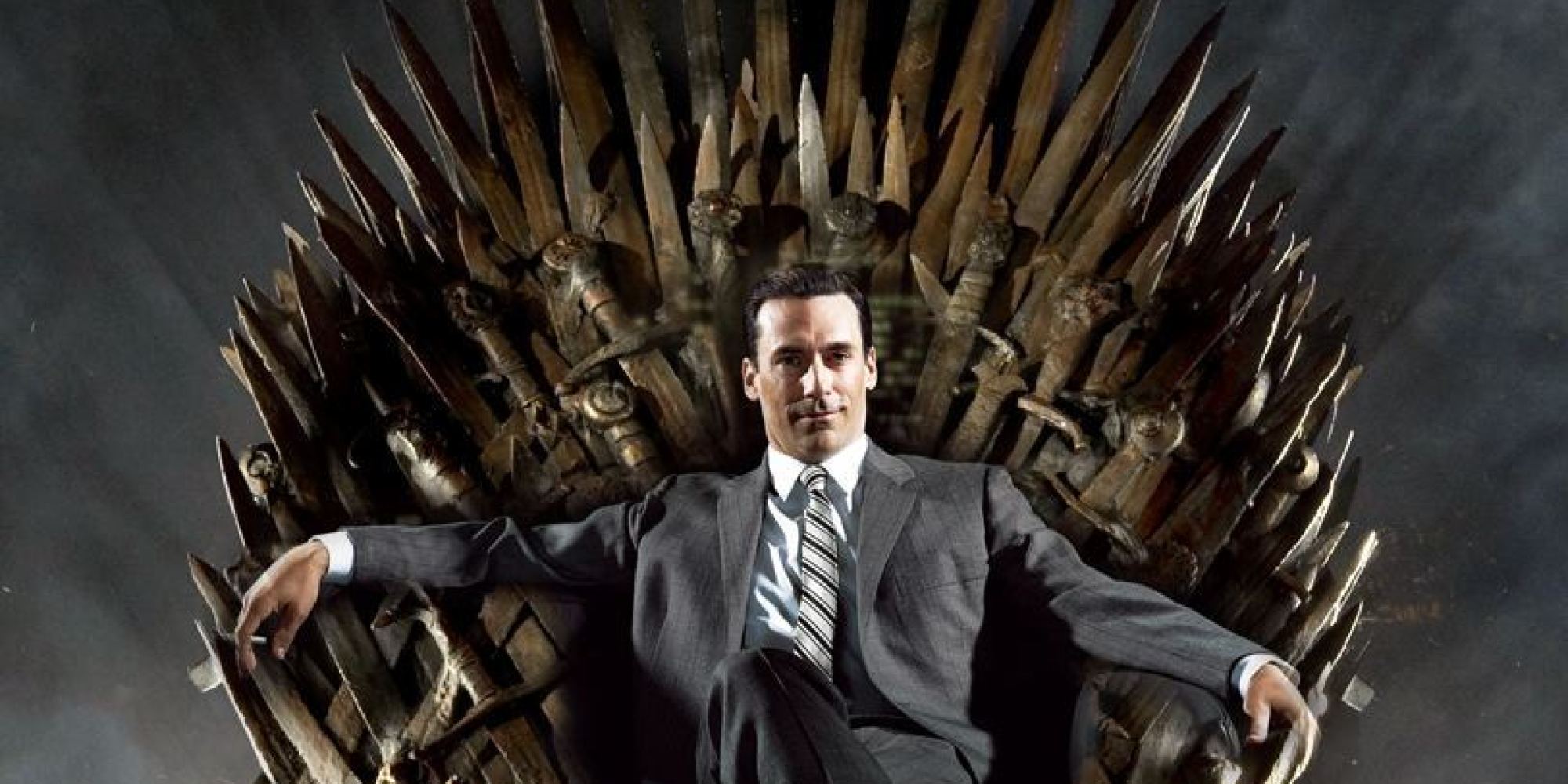
Will dropped out, so I decided to five deep in the draft for the Mad Men Game with the following results:
| Players | Round 1 | Round 2 | Round 3 | Round 4 | Round 5 |
| Wendy | Roger Sterling | Duck Phillips | Fred Rumsen | Greg Harris | Gail Holloway |
| Noah | Jim Cutler | Lou Avery | Jim Hobart | Mona Sterling | Bob Benson |
| Rob | Henry Francis | Michael Ginsberg | Pete Campbell | Harry Crane | Margaret Sterling* |
| Chip | Don Draper | Ted Chaough | Bobby Draper | Megan Draper | Sal Romano |
* Rob picked Sterling's daughter, not his wife, but got the name wrong so I have corrected above and below.
Wendy's first choice is a good one--as all but Rob had Roger in their top three. Her love of dogs might explain Duck as her choice in the second round. The pick who slipped further than expected was her fourth round pick--anytime you can bet on a rapist who is currently in an unpopular war to die, you have to do it. He would have been my second pick, but I have often been wrong on these things. Matt Weiner is not aiming to service the fan demands or else Greggie would have bit it by now.
Everyone but Noah got their first pick, but Noah can take some solace in getting this next four choices and lucking out (in my view) with a terrific fifth pick. Bob Benson is the sleeper in this game, and I already have money in Vegas on him biting it as the odds were 23-1. Except for that last pick, Noah's strategy seemed to be betting on the old guys to bite it. Jim Hobart was a sneaky pick, as a side character who runs McCann Erickson, he could die at any time....
Rob made an excellent choice with his first pick, as what can happen in Betty's storyline besides becoming a widow? Hmmm. Rob did seem to focus his choices then on the dysfunctional folks--Ginsberg is already certifiable, Pete is also a rapist, and Harry shows has poor judgment except in his rare Cassandra moments. Margaret Sterling is a sneaky good choice since she is prone to joining cults. Vegas has set the odds on her appearing at all in the next seven episodes at 7 to 1. His next pick would have been Glen Bishop, and I think that would have been a better choice given Matthew Weiner's willingness to engage in nepotism.
Finally, Chip really does not like the Draper family: Don, Bobby and Megan? Don is a sound bet. The time frame is too late for Megan to fall victim a la Sharon Tate to the Manson folks, but LA is a dangerous place. Ted? He might crash his plane. Sal? Unlikely to be seen again.
I still am in need of a tiebreaker. Hmmm. Ok, in what year will the show's last moments take place?
How does Vegas view the odds here? Wendy is the favorite at 3-1 due to the combo of Roger, the dogkiller and Joan's ex. Noah is almost a co-favorite at 7-2 as his line up of old plus Benson seems most promising. Rob's odds are 12-1 since he may get lucky with one character, but more than that? Unlikely. And Chip actually is not that far behind--one good car crash and he can take the entire game.
I will try to post updates along the way, but I will be out of the country on April 19th. Good luck to all!
Close But Not Quite
This cartoon by Brian McFadden is mostly on target:

But the problem with agriculture is not so much the demands of the east to eat but of the power of the ag industry in California. California politicians are not going to be shy about annoying the rest of the country (might get them more votes), but they are shy about confronting big Ag in the state. Otherwise, the reaction to the water problem would definitely involve restrictions on the farmers.
Anyhow, fun cartoon that is 95% of the way there instead of the usual 110%.
Writer's Bloc or Exhaustion of Ideas
I was going to write this morning about the selective use of the bible to justify intolerance of gays, but then I realized I had written that already.
So, then I decided to post this pic:

And perhaps post a good pic that reveals the ignorance and irony of selection bias:

Yep, one pic shows the selective reading of the bible. And this guy is not unique at all, unless the folks behind the spate of anti-same sex marriages are also seeking to bring back other bible stuff....
Anyhow, this has all made me realize why I may be blogging less these days--hard to say new stuff about dynamics that have been in abundance the past six years (and yes, this month marks Six Years of Spew).
So, then I decided to post this pic:
And perhaps post a good pic that reveals the ignorance and irony of selection bias:
Yep, one pic shows the selective reading of the bible. And this guy is not unique at all, unless the folks behind the spate of anti-same sex marriages are also seeking to bring back other bible stuff....
Anyhow, this has all made me realize why I may be blogging less these days--hard to say new stuff about dynamics that have been in abundance the past six years (and yes, this month marks Six Years of Spew).
Friday, April 3, 2015
Two Can Cut the Salami
Russia has been making a lot of threats lately, including nuclear ones. That if NATO moves troops into the Baltics, then the Russians will, um, do something with their nuclear weapons. What? Is Russia willing to start a nuclear war if the US puts five or ten or twenty tanks into the Baltics?
If so, this basically means that Russia will use its nuclear threats anytime it wants to exert a veto on US/NATO policy. That, of course, is unacceptable. If placing US/NATO troops in the Baltics is something that Russia really does not want, then we should it unless Russia gives us something that we want, such as really respecting the deal with Ukraine....
However, that is unlikely and probably not enough. Russia has been playing salami tactics with us--taking small pieces, none big enough by itself to warrant much retaliation. The Baltics fear that they will be next. To deter that, the US/NATO should try some salami tactics of their own: send some small units to hang out in the Baltics, then reinforce a smidge and then declare that these units will be there for a while, and then later announce that the basing is permanent. At which point does Russia start nuclear over this?
If the threat is of fomenting dissent and trouble within the Russian speaking populations of the Baltics, there are political ways to handle this--lean on the governments of those countries to treat these people better, and engage in an information campaign (proproganda) to educate the Russian-speakers in the Baltics about how much fun it is to live in Crimea, eastern Ukraine or even Russia today.
I tend to make cautious recommendations, but my frustration here is the idea that only one side can take advantage of the stability-instability paradox. And I also don't want US foreign policy and NATO decisions to be subject to Russian nuclear blackmail. Nuclear weapons in this relationship should only be used for one's own security, and, indeed, they do, making the claims about Ukraine's importance for Russian security to be ... incredible.
A Slightly Less Quick Reaction On Iran Nuclear Deal
Last night, I quickly dashed off a post on the deal, so I left much out. Critics will focus on what this does not change: that Iran is expanding its influence in the region (um, thanks GWB), that Iran supports terrorist groups, that Iran is hostile to Israel. Yep. There are two responses to this:
a) US arms control negotiations with the Soviet Union did not fix the US relationship with the USSR. They mostly just slowed down and managed the arms race, while giving the US and the Soviet Union a bit of progress on the bilateral relationship. The deals did not stop the Soviet Union's support of insurgencies the US did not like, it did not stop the USSR from controlling Eastern Europe, and it did not lead to the Soviet Union rejecting its own ideology which called for worldwide revolution (a pretty hostile ideology if you are old enough to remember.
b) The deal does not fix Iran's problems either. The US is still seen as being mostly bent on Iranian regime change. The US is still arming its friends in the region. Israel gets to keep its nuclear weapons without any negotiated restrictions on its nuclear weapons program. Pakistan (not a friend of Iran) gets to keep its nuclear weapons.
Anyone expecting this deal to do anything other than limit Iran's ability to develop nuclear weapons is just not that serious. This deal does mean that the US stays under the war cap--that we are not adding yet another country to the US military's agenda today.
One last thought: wasn't it Reagan who said Trust but Verify? The deal has that hardwired in, yes?
Thursday, April 2, 2015
Iranian Nuclear Deal
I am trying to figure out whether deferring Iran's nuclear ambitions is the better part of the deal or the reality that Netanyahu's best efforts to derail it failed. It may not be a perfect deal (this suggests it is mighty good), but perfection is the enemy of the good enough. And in that, diplomacy is like academic writing. If you want something perfect, it ain't ever going to happen. But is it good enough? Probably. The arms control agreements with the USSR didn't solve the relationship, but they managed the relationship. And that is not bad. For similar views see this piece by Fred Kaplan.
Drezner and Farley had a good few tweets on this:
Drezner and Farley had a good few tweets on this:
What this deal won't stop Iran from doing: 1) Threaten Israel 2) Arm proxies 3) Repress Iranians. What no #IranDeal was gonna do: see above.
— Daniel Drezner (@dandrezner) April 3, 2015
@dandrezner I would amend and add "What no #seriesofheavyairstrikesonIran was going to do: see above"I cannot help but think that Netanyahu's opposition made it easier for the Iranians to accept. "If Bibi hates this deal that much, it cannot be that bad for us." And to be clear, it is not just the American right wing that is opposed to this agreement--the Iranians have their own hardliners. Netanyahu's tantrums in the US demonstrate that Obama was independent from Israel, which removes something that might taint the deal too much for the Iranians. So, thanks, Bibi, for being the bad cop.
— Robert Farley (@drfarls) April 3, 2015
Rejection Last Year, Success This Year
In this academic business, one is always, always getting rejected. Last year, at this time, I learned that my grant application was rejected. Yesterday, the second try succeeded. Woot!

How do I celebrate? By happy coincidence I was scheduled to interview a member of the Canadian parliament about the role of the defence committee in civil-military relations. Hence this picture.
The project, with Phil Lagassé and Dave Auerswald, aims to consider a key set of questions raised by the Dave and Steve book but not answered: if war is too important to be left to the generals, then overseeing the military is too important to be left to the executive branch. How do the world's democracies vary in the roles played by their legislatures? Why? To what effect?
Lucky I have been. Not only were we one of the few grants funded (the acceptance rate for this grant is not quite NSF levels but getting there), but I have two great teammates who are going, alas, get some of the better trips that this research will fund. I am lucky too in that I have received a couple of invites for this spring, to Belgium and the Netherlands, to do some stuff, which will provide me the opportunity to do some of the research for this project.
The next five years are going to be chock full of funded research to ask parliamentarians, military officers, journalists, observers and experts many questions. Today's conversation turned the focus away from one of our core interests--information--and towards a key dynamic of agenda-setting.
Some of my friends also received positive grant news yesterday, and several received negative news. That is the nature of this business. I know that the success of ours now is built on the rejection last year and on the many other rejections we received on drafts of our other work. I hope my friends will have better luck next year, and I will definitely give them any assistance that they ask of me. Time to pay it forward.
Tuesday, March 31, 2015
Belated Mad Men Game
I have been busy with other stuff, so the Mad Men Dead Pool will be holding a moderated draft. I will take lists of twenty characters (IMDB is your friend) from each contestant of who they think are likely candidates to die, and then use them to draft for each player.
We have five players, and I have used cards to choose the draft order:
The order will be Wendy, Will, Noah, Rob, Chip; Chip, Rob, Noah, Will, Wendy; and then repeated. So, each player will have four players in their dead pool. The one with the most dead Mad Men characters wins. Deaths must be confirmed. If off screen, then we will need on screen discussion to be definitive. I will, of course, make all decisions and am the final arbiter. It is my game ;)
I forget what folks suggested as tie breakers which were excellent, so each player will submit not just a list of ten names with the characters they think will die (most likely at the top, less likely at the bottom), but also their favorite tie breaker. I will then quickly decide which tie breaker is the one I will use and then get their answers for the tie breaker.
Ok? Clear? Maybe not. Well, let's see how it goes. The deadline for the draft lists is Saturday at 5pm EDT via email. If the contestants cannot figure out my email, they deserve to lose. That way, I can "run" the draft Sunday morning and have it posted before the first episode of this last set of seven episodes.
Okey dokey!
We have five players, and I have used cards to choose the draft order:
- Wendy goes first since she "drew" the 9 of clubs;
- Will goes second since he "drew" the 7 of spades;
- Noah goes third since he "drew" the 5 of diamonds;
- Rob goes fourth since he "drew" the 2 of spades and then the seven of hearts and then the Queen of diamonds to break the ties with
- Chip who goes fifth since he "drew" the 2 of diamonds, then the seven of clubs before the eight of spades.
The order will be Wendy, Will, Noah, Rob, Chip; Chip, Rob, Noah, Will, Wendy; and then repeated. So, each player will have four players in their dead pool. The one with the most dead Mad Men characters wins. Deaths must be confirmed. If off screen, then we will need on screen discussion to be definitive. I will, of course, make all decisions and am the final arbiter. It is my game ;)
I forget what folks suggested as tie breakers which were excellent, so each player will submit not just a list of ten names with the characters they think will die (most likely at the top, less likely at the bottom), but also their favorite tie breaker. I will then quickly decide which tie breaker is the one I will use and then get their answers for the tie breaker.
Ok? Clear? Maybe not. Well, let's see how it goes. The deadline for the draft lists is Saturday at 5pm EDT via email. If the contestants cannot figure out my email, they deserve to lose. That way, I can "run" the draft Sunday morning and have it posted before the first episode of this last set of seven episodes.
Okey dokey!
Circling Trolls or the Forces of Reason
A Canadian member of parliament, James Lunney, is leaving the Conservative Party because he really wants his freedom of religion to be unrestricted. What does that mean? Apparently, he wants to talk about evolution or something.
It seems to be the case that he fears that his Christianity is being repressed by a party that represents the right part of the Canadian political spectrum. Boo freaking hoo!
I tweeted thusly:
It seems to be the case that he fears that his Christianity is being repressed by a party that represents the right part of the Canadian political spectrum. Boo freaking hoo!
I tweeted thusly:
I guess the MP is upset that there is not enough tyranny of the majority? Maybe he should move to Indiana #LunneyWTFIf the poor MP thinks he will get flak for criticizing that which science has proven quite well--evolution is a fact and there are theories that vary in how well they explain that fact--then he is right. Given that we live in a time where the forces of anti-science are creating public bads--measles outbreaks--we need to be clear that the facts are the facts, and you can have your opinions about them. But if you are a politician, be prepared to suffer the slings and arrows of outraged reason.
— Steve Saideman (@smsaideman) March 31, 2015
Spewing About Canada After the Vote
Check out my latest TV appearance, this time with Dave Perry on CPAC, taped before and broadcast after the Canadian Parliament voted to "support" the mission. The fun part is when Martin Stringer cites ye olde Spew!
Weird but Better
What a strange piece?! Steve Coast (never heard of him before) writes an interesting piece that argues the world is getting weirder. Why? Because we have figured out how to manage many of the normal problems so that the weird stuff is the danger now. He cites air travel--that air frames are far better, so now the problem is the occasional crazy pilot who can lock out the other pilot. Of course, one of the sources of prior air travel was apparently urine corrosion for airplane bathrooms, so let's not call the old form of crashes entirely un-weird.
And I can see how this applies elsewhere--that war is far less frequent than it once was, but now we have terrorists who have outsized influence. And terrorists are mostly ... weird.
The article then turns to solutions: more freedom. If we have less rules, we can do stuff faster. Because, you know, speed is really the important thing we value. As an incredibly impatient person, I might sympathize with that, but not really since I like the safety part. That rules do get in the way of transactions, as Coast argues, but that just means we need to figure out the best balance. Instead, the piece SPEEDILY takes a jump in a libertarian direction. The move is:
Oops, citing slavery might be a Godwin's law-like move, but I am sure enterpreneurs like Coast would prefer to have a situation where there are few laws limiting how labor is used--that would make things speedy, right?
And I can see how this applies elsewhere--that war is far less frequent than it once was, but now we have terrorists who have outsized influence. And terrorists are mostly ... weird.
The article then turns to solutions: more freedom. If we have less rules, we can do stuff faster. Because, you know, speed is really the important thing we value. As an incredibly impatient person, I might sympathize with that, but not really since I like the safety part. That rules do get in the way of transactions, as Coast argues, but that just means we need to figure out the best balance. Instead, the piece SPEEDILY takes a jump in a libertarian direction. The move is:
If we can measure economic value as a function of transactional volume (the velocity of money for example), which appears reasonable, then fewer rules will mean more volume, which means better economics for everyone. So it used to be very hard to create an airline, now it’s easy, we have more choice and more flights and so on.I may not an economist, but this seems to be one way to define or measure economic value. Oh, and more volume means better economics for everyone? No, not really, as we have found that equity/fairness/etc tend not to be produced in rule-free or rule-scarce places. Instead, early movers/those with early advantages can use their market (and otherwise) power to dominate. I think we used to call that colonialism/imperialism which produced stuff like slavery.
Oops, citing slavery might be a Godwin's law-like move, but I am sure enterpreneurs like Coast would prefer to have a situation where there are few laws limiting how labor is used--that would make things speedy, right?
Monday, March 30, 2015
Figuring Out My Syria Stance
I was on the radio this morning talking about the Canadian parties and where they stand on Syria/Iraq and the expansion of the mission. I indicated that the Liberals are in a difficult spot, stuck between a Conservative party that is pushing for force to be used and a New Democrat Party focused on non-violent means. The Liberals want voters next fall from the right and the left, and any move here will antagonize one side or another. Sucks to be in middle.
But to be fair, this is a really hard policy problem: should Canada be dropping bombs on Daesh in Iraq and Syria? To what end? I have been ambivalent so I am using this post to figure out my stance. The focus here is on expanding to Syria, as it is the real question du jour, but many of the arguments apply to bombing Iraq as well.
Pro's
Con's
But to be fair, this is a really hard policy problem: should Canada be dropping bombs on Daesh in Iraq and Syria? To what end? I have been ambivalent so I am using this post to figure out my stance. The focus here is on expanding to Syria, as it is the real question du jour, but many of the arguments apply to bombing Iraq as well.
Pro's
- Striking Daesh (ISIS/ISIL/IS) in Syria will make it harder for them to expand their territory in both Syria and Iraq.
- Causing Daesh to lose some territory is a major defeat for them as their rhetoric and strategy have focused on momentum and inevitability.
- Helps US with "low density, high demand" assets. Not the CF-18s but the Auroras and refueling aircraft. Helping an ally in difficult times is a good thing.
- But it is not going to get Canada anything in its relations with the US if there are offsetting domestic dynamics--Keystone pipeline, for example.
Con's
- Hurting Daesh in Syria helps Assad. So, hurting one set of genocidaires assists another.
- The risk that a plane might get shot down or fail, leading to the capture of a pilot by ... barbarians.
- Syria has air defenses that have not been knocked out.
- So far, Syria has implicitly cooperated with the US and its Arab allies. No reason to see this change. If it does, Canada can leave Syrian air space.
- Being so very visible in this fight (only non-US Western country striking Syria) probably makes Canada a more likely target for terrorism by Islamist extremists.
- To be clear, I don't believe that Canada's foreign policy should be held hostage due to fears of retaliation. It is a con, but not one that is large in my calculus.
- Money spent on this effort means less money for the Canadian Forces to do something else.
- What else? Training and maintenance. Harper is not sending the CF to do peacekeeping someplace else, so no false choices between this and DRC or whatever.
- Responsibility to Protect [R2P] is kind of moot here. Why? Because it would imply helping the Syrian people with their biggest threat--Assad! Um, yeah. Even Lloyd Axelworthy, father or patron saint of R2P, is not saying that R2P applies in Syria.
- Talk of victory via bombing (by Canadian Minister of National Defence Kenney) is silly. We cannot bomb Daesh into defeat. That is the job of people on the ground.
- International law? I am not an expert on such stuff, but I have never found compelled by the argument that one needs a UN Security Council resolution for doing something serious in the world. Why? Because it means that one's foreign policy is subject to vetoes by Russia and China.
- Exit strategy is missing? Yes, in the case of Syria, there is no clear strategy to win. Bombingwill not do it. In Iraq, one can hope that the Shia government finally figures out that lasting stability requires a credible arrangement with the Sunnis. If the Sunnis switch sides, then Daesh will have a very difficult time. In Syria? Not so much. But it is very easy for Canada to leave. Canada can say it has done what it can and put the 69 SOF back on a plane home. The logistics people are in Kuwait and can come and go at the government's whim. The planes can obviously fly home. This is not Kandahar.

- Mission creep? Yes, expanding to Syria is some creep, but it is not a radical expansion of effort. So far, no more SOF, no more planes. So, this is a re-allocation of effort and not an increase in the personnel or expenses. The risk is somewhat larger but not radically so. This is not an enduring ground campaign.
Sunday, March 29, 2015
University Mismanagement
The Economist has a piece on American higher education. There is an earlye early mis-step of suggesting that higher ed has two customers--students and government--when much of American higher ed is private. Oops. Still, it does present some challenges about the current state of higher ed-more expensive, more debt, mixed outcomes, etc.
At least this piece, unlike others, does keep in mind that universities have multiple purposes,* and on a key dimension, things are not so bad in the US:
I am not saying that there is not a problem, but that the equity problem is very much one of government policy. Yes, universities and colleges need to figure out how not to have their tuition outpace inflation (especially for the next three years), but the equity story is as much or more about public policy as it is about management (completely contradicting my first point, right?).
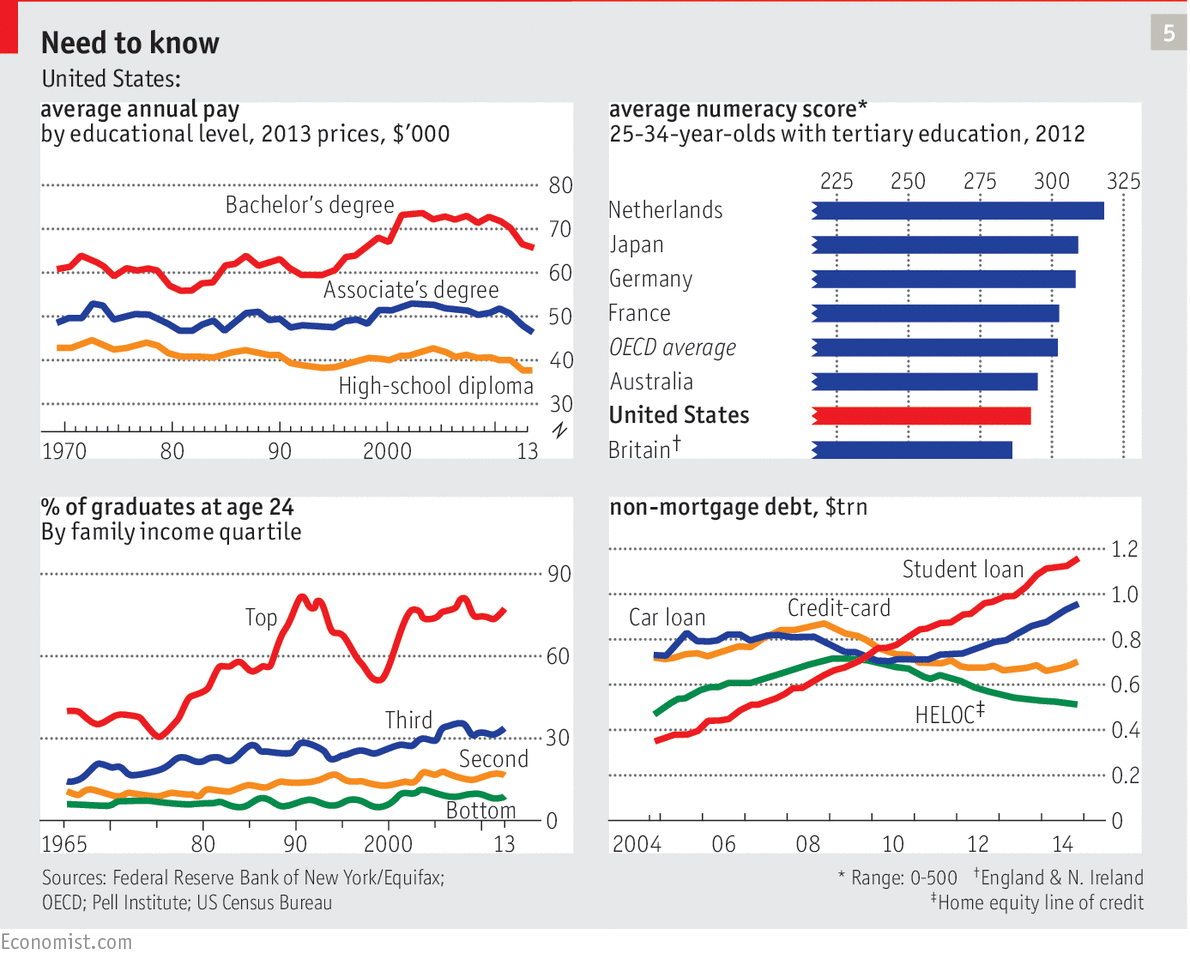 Are students just buying degrees as the article insists? Yes and no. Yes, employers seek folks who have degrees in the fields they need. But with degrees come ... skills, knowledge, an improved ability to think and write and all that. And the best way to make sure one is paid well in the long term is ... to take a look at the difference in the income of those with those degrees and those without. Oh, and much of the dip in BA income over the past several years has more to do with macroeconomic dynamics (the recession, the faux austerity measures, problems with firms valuing bonuses to the top folks and not good pay for the average worker) than anything universities have been doing wrong lately.
The article places the blame for the current state of affairs on "shared governance."
 Really? Profs have that much power? Yes, tenure restricts the ability for resources to be shifted around, yet we have seen a massive shift over the past twenty plus years in terms of the percentage of classes taught by tenure track professors vs that taught by adjuncts. The latter are cheap--the pay is low, the benefits are few and they can be hired/fired easily. So, the managers have actually plenty of flexibility despite the inflexible tenured profs. The US has little in the way of professor unions (unlike Canada) which means managers have even more flexibility.
Yes, professors and departments resist reallocations from one area to another, just as any entity/group does. All you have to do is read Machiavelli to get that:
But that something is not for-profit schools, which this piece considers to be threatened by over-regulation. The experience thus far of such places has been rather exploitative, so one "woots!" when one hears of U of Phoenix hemorrhaging enrollments. Ok, that one would be me.
The strange thing is that the article concludes that universities are less healthy because tuition is not growing as fast. Um, isn't that a good thing? I am confused. Indeed, I know there is a problem, especially since I am paying American tuition to a private school. I worry about the future of my profession, but the diagnoses and remedies posed here are really quite lousy. Ah, the all powerful profs dictating to administration! If only.
At least this piece, unlike others, does keep in mind that universities have multiple purposes,* and on a key dimension, things are not so bad in the US:
On the research side, America’s government has little to complain of. Although several European countries have more Shanghai top 100 universities in relation to their population than the United States does, America still dominates the summit of research: 19 of the world’s top 20 universities in Leiden University’s ranking of most-cited scientific papers in 2014 were American.The article suggests three: research, human capital and equity. The first two? Sure. But I am not sure that equity is the goal of the US government or of its constituent units. Nor, to be fair, for Canada either. Indeed, the insistence on relatively low tuition in Canada is actually not a force for equity since it means that the poor subsidize the middle class and the rich. If the various governments of the US really cared about equity, they would not have cut support for higher ed over the past twenty or thirty years. The big force driving up tuition at public schools probably not faculty salaries but more likely to be filling the gap produced by the decline in state government support.
I am not saying that there is not a problem, but that the equity problem is very much one of government policy. Yes, universities and colleges need to figure out how not to have their tuition outpace inflation (especially for the next three years), but the equity story is as much or more about public policy as it is about management (completely contradicting my first point, right?).
The article places the blame for the current state of affairs on "shared governance."
Yes, professors and departments resist reallocations from one area to another, just as any entity/group does. All you have to do is read Machiavelli to get that:
``And let it be noted that there is no more delicate matter to take in hand, nor more dangerous to conduct, nor more doubtful in its success, than to set up as the leader in the introduction of changes. For he who innovates will have for his enemies all those who are well off under the existing order of things, and only lukewarm supporters in those who might be better off under the new.''Profs have little input on the big infrastructure programs that can bankrupt schools (UQAM in Montreal, Sweet Briar College in the US come to mind). The growth in administrative costs are undeniable. How much of this is needed versus how much of this is not? Not so clear. But, sure, we need to do something.
But that something is not for-profit schools, which this piece considers to be threatened by over-regulation. The experience thus far of such places has been rather exploitative, so one "woots!" when one hears of U of Phoenix hemorrhaging enrollments. Ok, that one would be me.
The strange thing is that the article concludes that universities are less healthy because tuition is not growing as fast. Um, isn't that a good thing? I am confused. Indeed, I know there is a problem, especially since I am paying American tuition to a private school. I worry about the future of my profession, but the diagnoses and remedies posed here are really quite lousy. Ah, the all powerful profs dictating to administration! If only.
Tales Finally Told: Canada and D-Day
 When I was at a conference in New Brunswick, Marc Milner, one of the hosts and a military historian, chatted briefly about his new book: Stopping the Panzers: the Untold Story of D-Day. It turns out that historians have slighted the Canadian contribution in June in France 1944. We should not be surprised by this since most of this history was written by Brits and Americans who focused on their own forces. This book fills a big gap, explaining that the Canadian army did exactly what they were supposed to do, even though it was very, very hard.
The traditional history has the Canadians stumbling around Caen, failing to take that city early. As it turns out, the planners of the invasion identified the key threat to the invasion--a German counter-attack through the most tank-friendly country. They built a largely Canadian unit to occupy that space, giving it more much anti-tank capability than any other unit that landed on June 6th. This unit was trained and equipped to stop the likely Panzer assault.
As it turned out, the planners knew what they were doing--they predicted quite well what the Germans were going to try to do--run the tanks up through the allied beachhead to the sea. But they failed due to the actions of the Canadians. So rather than being stuck in place, the actual story is really more of the Canadians doing exactly what they were supposed to do and do it quite well. And the cost was higher than it should be as they faced SS and Hitler Youth units that executed a larger number of POWs.
In this case, not losing was very much winning. The Canadians protected the beachhead so that the allies could land the units and materiel that would eventually be used to break out of Normandy. The book may overplay sometimes the Canadian contribution--when it focuses on the Canadian units in the fake army that was used by the allies to persuade the Germans that Normandy was a feint and that the real attack was coming at Pas de Calais. Yes, that disception was important, but I am not so sure that the Germans were convinced by the apparent presence of the Canadian units in that effort. It might have mattered but not that much.
I am not a military historian and for good reason. This research was far more thorough in the getting all the details lined up to tell a very interesting story about this overlooked part of the most studied military campaign. it was a good read that also taught me the importance of artillery in tank warfare.
Becoming Canadian
It only took me thirteen years to go to a professional hockey game. Well, it is very hard getting tickets to Canadiens games, so when a colleague invited me to an Ottawa 67's game, I jumped on it. The OHL (I have no idea what that stands for) is minor league hockey, and does not get quite the same love as the NHL. So, there were plenty of empty seats at the playoff game between the Ottawa team and the Niagara team.
The crowd that was there saw an interesting game. No scoring and few shots on goal in the first half with the away team controlling much of the action. They scored the first goal in the second period, which was immediately met by a flurry of Ottawa goals, six of them! The final score was 8-2.
 Watching a 67s game at home is an interesting experience. The arena is under the stands of the TD Stadium, so once side of the arena is truncated. The players at this level are young, so the cheerleaders (all three or four of them) are high school age, and had the embarassing task of helping to run the intermission games. The first one was a Price is Right game where two fans had to guess the price of various products--toothpaste, for instance. Oy.
The tickets are apparently not expensive, so there were lots of kids who ate up the experience. The boys under or around ten seemed to really enjoy dancing badly, hoping that they get on camera.
 Is there fighting at this level? Um, yeah.
It was not hard to immediately adopt the home team--smaller, feistier, and laying out on defence early and often. I will still not watch a heap of hockey on TV, but this is probably not the last game I will attend. I do hope this meets the hockey requirement on the citizenship application.

The crowd that was there saw an interesting game. No scoring and few shots on goal in the first half with the away team controlling much of the action. They scored the first goal in the second period, which was immediately met by a flurry of Ottawa goals, six of them! The final score was 8-2.
Watching a 67s game at home is an interesting experience. The arena is under the stands of the TD Stadium, so once side of the arena is truncated. The players at this level are young, so the cheerleaders (all three or four of them) are high school age, and had the embarassing task of helping to run the intermission games. The first one was a Price is Right game where two fans had to guess the price of various products--toothpaste, for instance. Oy. The tickets are apparently not expensive, so there were lots of kids who ate up the experience. The boys under or around ten seemed to really enjoy dancing badly, hoping that they get on camera.
It was not hard to immediately adopt the home team--smaller, feistier, and laying out on defence early and often. I will still not watch a heap of hockey on TV, but this is probably not the last game I will attend. I do hope this meets the hockey requirement on the citizenship application.
Friday, March 27, 2015
Today's News in University Awful
We already knew that the University of Oregon is, um, mighty messed up, as it used students' records from campus counseling to defend itself from a lawsuit (one where the victim of sexual assault accused the university of protecting the perpetrators from untimely discipline). Now, it seems Oregon may be firing the people who worked at the counseling center who resisted this effort.
This is doubling down on the betrayal of trust. Students should not trust any campus employee at Oregon, as they will be subjected with dismissal if the staffer takes the students interests and rights seriously. I feel sorry for all those working at this institution, as it is now a place where the students have no assurances that their rights and well being matter. Indeed, when it comes to it, the students who are victims are victimized again to protect the University and its athletes.
Apparently, the school must believe that old line that there is no such thing as bad PR. Um, there is, and this is textbook. The effort to coverup and then punish is going to do far more damage to the university's reputation than a couple of rapists.
If only the University of Oregon were a public school where legislators and state officials might be able to do something about it.
Tuesday, March 24, 2015
Canada Expands Its War: Qomments
The Nerdist broadcast has a thing called Qomments--questions and comments. Which pretty much captures what this post on the news du jour.
- Does it matter that Canada has no legal cover for this? This is the first time I know of (and I am no Canadian military historian) where Canada is engaged in combat (by planes, if not by SOF-ish adventures) without either an international resolution (UN or NATO or both) or an invitation by the country to be protected.
- Is the kind of bombing in Syria different than that which is going to happen now in Iraq? That is, not that there are no targets left in Iraq but if the fighting shifts into the cities, such as Mosul, there may be different risks--more risks of hitting civilians. Is the Syrian air campaign seen as cleaner? I have no idea.
- The plan in Iraq is clear but hard--try to get the existing government to make deals with the Sunnis that bind them better than the last time. Not easy at all but an exit path. Bombing helps keep ISIS down, but lasting stability requires a deal of some kind. Syria? I have no idea. Bomb ISIS helps Assad, but not bombing ISIS in Syria helps ISIS in Iraq. Damn.
- I hate talk of exit strategies because it means you are far more focused on the getting out rather than the doing. But there is some need for some idea of what the strategy is here besides whacking moles. Attrition is probably not going to work too well.
- I do prefer renewing this thing a year at a time rather than every six months. Not just because the media time suck is then less frequent, but because none of the actors involved benefit from the spin cycle being that frequent.
- What will happen to public opinion now that the mission is expanded to Syria? The recent poll does not ask this. Given that ISIS is mighty unpopular here, especially after the events of October in Quebec and Ottawa, the best guess is that the public is not going to mind so much as long as it does not mean much more risk. Which gets back to whether the air strikes in Syria are qualitatively different than those in Iraq?
- I am not thrilled that there is not much of a learning curve when it comes to the language about ground forces: "Canada will not be participating in ground combat operations." I prefer the American language about enduring offensive operations. CANSOF are going to be doing combat, as they have already done so. They have fought when fired upon and put themselves into places where such stuff happens. They have participated in the air campaign by lasing ISIS targets, which means they are abetting combat from the ground. So, "ground combat ops" is a lousy description of what they are not doing. What they are not doing is engaging in an enduring offensive effort. If they want to foreswear raids (something that the American language clearly permits), then they can say that. Oy.
Monday, March 23, 2015
More Hours in the Classroom
It is time for that ritual post--responding to those who think that being a professor means we work 10 hours a week. One of my earliest posts compared a prof to an iceberg in that much of what we do is unseen (and that we destroy ships). An op-ed in a Canadian newspaper (which was so awful it does not deserve linking) made the claim that our teaching is only ten hours a week and that we should not do the research stuff that much. More significantly, the governor of Wisconsin, a state known for its excellent institutions of higher education, has been saying that profs need to teach more classes and do more work.
Before I start: a caveat--I teach a 2/1 load--two courses one semester and one course the other as I buy out one class a year with the funds that come with my endowed chair. So, I am a particularly poor situation to make any arguments since I am in the classrooms less than my colleagues. But I am self-aware, not humble, so I will argue anyway about these claims.
Let's consider this a challenge: if folks want us to teach more, what do they want us to do less? Because, yes,Virginia, Scott Walker, most profs work 40 or more hours a week as it is. So, if you want us to do more time in the classroom, we are going to do less of something else. Just tell us what you want us to do less of:
Could I teach more and still be productive? Sure, but I would have to do less stuff--I would have to say no to more students who need me to be a second or third reader on their theses and dissertations. I would have to say no to public engagement. The fundamental fallacy of the past decade or two of management has been that we can do more with less. The reality, as Dave Perry put it for his analysis of the Canadian Forces budget, is that we would have to do less with less. Indeed, with more teaching slots going to adjuncts, the research/supervision/service load is increasingly concentrated on the smaller number of tenure track folks.
To argue that professors are wasting heaps of time is to engage in the same kind of fantasy that we can cut government budgets by reducing the number of civil servants without losing any service. Most of the people in government jobs are doing something real. Most, although certainly not all, professors are working pretty hard. The idea of waste allows one to dodge the real tradeoff--if you want more of x, expect less of y. But that tradeoff is quite real. So, just be honest, and tell us what we should do less of in exchange for more classroom hours.
Before I start: a caveat--I teach a 2/1 load--two courses one semester and one course the other as I buy out one class a year with the funds that come with my endowed chair. So, I am a particularly poor situation to make any arguments since I am in the classrooms less than my colleagues. But I am self-aware, not humble, so I will argue anyway about these claims.
Let's consider this a challenge: if folks want us to teach more, what do they want us to do less? Because, yes,
- Teaching: Yep, we could spend more time in the classroom and less time teaching. How does that make sense?
- One of the biggest time commitments is to the supervision of undergraduates and grad students. At liberal arts colleges, they spend far more time supervising each individual undergrad. At most universities, one can spend a fair amount of time supervising various kinds of undergrad theses. In my previous job, I did some of that, and it takes time. I did supervise a bunch of PhD students and still do some of that, and I now supervise MA students in greater volume.
- Maybe we should have fewer graduate students, which would reduce how much time we spend on supervision. But that is a decision that should be made directly and not through the back door of higher teaching loads.
- One could spend less time preparing lectures and seminar discussions. Yes, this actually does take time. The more classes you teach, the more prep work that is required. Sure, over the course of time, each class is mostly prepped. But in most disciplines, there is new stuff to learn to teach, so we need to read books, journals, newspapers, and other media through we learn stuff. Yes, we keep learning.... if we have the time.
- One could reduce the time spent on teaching by having more multiple choice exams. There is room in the academic enterprise for these things, but they do not really test thinking as much as they test memorization (at least as far as I have been able to design such tests). To really educate the next generation to think better, we need to see it on paper--via papers and essay exams. Which means grading, which takes time. More classes mean less time for grading.
- Research: This is usually the target of the teach more crowd. Why? Because research is useless?
- No. It is not. I have argued elsewhere that teaching and research inform each other.
- One example of the relevance of social science research that is often targeted. There has been much scholarship on what kinds of political institutions make ethnic conflict more or less problematic. While there is much about the relative success story of South Africa, one key ingredient is that they brought in the experts--the academics--who studied such stuff and asked how they should design their constitution. Afghanistan? No, not at all.
- If you take a look at the map around UCSD (the place I know best, but true elsewhere too), you will see that it is damn near surrounded by bio-tech and information technology companies. Tis no accident.
- I am currently reading a book on a key moment in Canadian history: the Normandy campaign. Why is this relevant? Because it shapes how Canada sees its military and others see it, which might just shape the role it plays in future multilateral military operations.
- The reality is that universities are the epitome of economic multipliers--money goes in, and it spurs the local economy... more so than prisons or military bases. And much of that is related to the spinoffs from research.
- It is certainly true that not all basic research turns into tangible economic outcomes, and that private actors can do research, too. But much of what private actors do is subsidized by government one way or another. Plus the accidental discoveries of random academics often have huge value-added. And are often, of course, inconvenient for the powerful. Which is why the freedom to engage in whatever research one wants (within limits--no longer experimenting on students that much anymore) is so very key. That government labs and private labs are unlikely to produce that inconvenient stuff that is often so important in the long run.
- Via grant-writing, we are expected to raise money for our research--much of that money does not end up in our pockets. Actually, none of it does. Much of it funds graduate programs, some of it funds travel/equipment, and much of it funds universities via "indirect costs" that never go through the professor's account.
- Service: Much of that research stuff and that teaching stuff requires service to function.
- We need people to spend time reviewing manuscripts (articles, books, chapters) so that we can be sure they are worthy of dissemination via reviewed outlets. I often say that I don't work that much on weekends, but then I realize I do most of my article reviewing on weekends. I am probably not the only one.
- We spend much time evaluating ourselves so that we only hire, promote and tenure those who are deserving. This takes a tremendous amount of time--reading files, writing recommendations, listening to talks, etc.
- Speaking of recommendations, not sure if it goes here or under teaching, but if you ask folks to teach more, they might have less time to write letters of recommendation for their students. Which might hurt their employability. Oops.
- We are expected do outreach more and more--give talks to folks in the community, actually do community service, speak to the media not just to provide expertise but raise the visibility of our university, engage in social media to promote ourselves and thus our university, etc. If we are in the classroom for more hours, we would have to cut back on this.
- Self-govern. Sure, we could have more administrators hired to do much of our self-government for us, but that would require more money. So, if we teach more, are you going to hire more administrators to do the self-governance that we would not have time for? Maybe.
Could I teach more and still be productive? Sure, but I would have to do less stuff--I would have to say no to more students who need me to be a second or third reader on their theses and dissertations. I would have to say no to public engagement. The fundamental fallacy of the past decade or two of management has been that we can do more with less. The reality, as Dave Perry put it for his analysis of the Canadian Forces budget, is that we would have to do less with less. Indeed, with more teaching slots going to adjuncts, the research/supervision/service load is increasingly concentrated on the smaller number of tenure track folks.
To argue that professors are wasting heaps of time is to engage in the same kind of fantasy that we can cut government budgets by reducing the number of civil servants without losing any service. Most of the people in government jobs are doing something real. Most, although certainly not all, professors are working pretty hard. The idea of waste allows one to dodge the real tradeoff--if you want more of x, expect less of y. But that tradeoff is quite real. So, just be honest, and tell us what we should do less of in exchange for more classroom hours.
Sunday, March 22, 2015
Gallows Humor
Literally--humor about executions that point at the hypocrisy of the US and its politicians, again H/T to Brian MacFadden and the NYT:

If you cannot laugh about it, you can only cry about it... The satire here is excellent for emphasizing the damn near universal hypocrisy on this.
If you cannot laugh about it, you can only cry about it... The satire here is excellent for emphasizing the damn near universal hypocrisy on this.
Twitter Fighting
Many of the players in this year's tourney, including many on #TeamSpew, are new to the game. The basic instructions are at http://www.twitterfightclub.com/. But what does it mean to twitter fight in TFC15? Each round of the tourney, each player will face another player and they must out-tweet them to both the public at large and a panel of judges.
Yes, it is in part a popularity contest, which is why I tended to draft twitter-ers who have more followers. But the people with huge followings often do not engage in the game seriously, so they often don't win the votes of the judges.
So, again, what does out-tweet mean?

Yes, it is in part a popularity contest, which is why I tended to draft twitter-ers who have more followers. But the people with huge followings often do not engage in the game seriously, so they often don't win the votes of the judges.
So, again, what does out-tweet mean?
- Well, it can be volume. That was certainly one of the strategies I used, as I could be online tweeting while doing my regular academic stuff more than some of the folks I played against who had jobs that took them away from twitter/computer and certainly those who were flying (pre-wifi in the skies those days of yesterday [two years ago]).
- It can be insight/utility. That is, one tweets stuff in one's area of expertise to produce high quality tweets--helping people to learn about that area.
- It should involve engagement--that the twitter fighter engages the adversary, the judges and those following the players. Twitter is far more interactive than blogs (indeed, some judges discount links to blogs), and so to be a good twitter fighter, one should be engaging those who follow you. Some judges will test the twitter fighters by asking questions or offering challenges. One would be wise to follow the judges of your round for at least the day of that round. [Yes, some ego stroking might be involved]
- Funny but not brutal snark is a key ingredient. The idea of this tourney is to have banter among those doing national security stuff. So, funny tweets or strategies (someone came up with a fake twitter account of @exumAM's beard). In my last couple of rounds in my finalist campaign, I came up with some meme-ish graphics that were fun (at least to me):
I have already seen a number of players make amusing boasts and offering challenges. The key is to keep things in the spirit of the game. I have made more than a few friends and some valuable connections with the people who defeated me, those who I beat, and those who were in other parts of the brackets. Twitter fight club may seem like a time suck, but it has been very, very good to me.
Engage!
Saturday, March 21, 2015
Star Wars: Space Only
Someone has edited the end of Return of the Jedi to be just the space stuff
And it is just fantastic. It ramps up the tension far more than the three sided battle--on Endor; between Luke, Daddy, and the Emperor; and the space stuff. But, well, the rest of the stuff was kind of necessary.
Still, the interplay among the various elements in space is far more compelling than the space battle that opens Revenge of the Sith. There, it is just Anakin and Obi-wan. Here, so much more with stakes one cares about.
Once again, the internet is a magical place and this is why I am on twitter.
H/T to @cblatts
Friday, March 20, 2015
Twitter Fight Club 2015: The Draft!
As one of the recent finalists of Twitter Fight Club (I was second in 2013), I have the honor having one of the sections of the bracket named after me AND I get to play a role in the seeding.
Today, at 5pm, the past four finalists will take turns "drafting" the 64 people in the game. The first four people picked will be #1 seeds, the second four people picked will be #2 seeds, and so on. This takes a bit of work out of the hands of organizer of TFC: Caitlin Fitzgerald. Given how much work she does for this month-ish of silliness, snark, and networking, it is very least we could do.
How will I choose? I have financed a team of data analysts from a variety of places (you know, 538, Silicon Valley, Michigan's ICPSR, Wall Street, etc) to develop an algorithm that takes into account the competitor's klout, tweet volume, number of followers and experience in previous twitter fight clubs. I then take the subsequent ranking and move people up and down based on the quality and quantity of snark I have witnessed, their actual day jobs (working for media outlets > first year grad students), and a variety of idiosyncratic factors. For instance, there is one player who blocks me and whom I block. I will not be drafting that player.
I will be picking third in a snake-style draft--1 2 3 4 4 3 2 1 1 2 3 4, etc. At the end of the tourney, the drafter who picks best (there are points for each picked player that survives each round) will be declared the winner. I have come close to winning not just the tourney but the bracket part of the competition. But I don't really expect to win here. If I do, well, woot for me!
And, yes, I am releasing my strategy ahead of the draft because the other drafters are not privvy to the particular algorithm or how I have modified even that secret formula based on fairly random factors.
Oh, and how do I know that my algorithm has face validity? Because it results in @Hayesbrown being ranked first. And he is the favorite heading in. I start with chalk but will not stick to it.
Do follow the fun today at 5pm EDT at #TFC15.
When Iraq is Easier
I wrote last week that the "Russian front" was far easier than the Mideast for the US and its allies because it did not involve state/nation-building/counter-insurgency. All the US and NATO has to do is credibly commit to those inside the alliance and hold the line against Russia. Not easy but easier than building stable political systems in the Mideast.
Well, next week, Prime Minister Stephen Harper is going to announce Canada's next steps in the region and the "Syria" word has been mentioned. So, I thought I would take a moment to ponder the differences between Iraq and Syria. And the first thought is .... Iraq is easier. How so?
When people talk of endgames, strategies, and exits, there actually is a real set of answers for Iraq and damn near none for Syria. There is a recognized, semi-viable government in Iraq. Unfortunately, it has been led by Shiites who have been using their positions to make up for the years of repression and oppression by Saddam Hussein's Sunni-dominated government. Oh, and their religious identity makes Iran their most appealing ally. Good times. Still, this basic reality that there is something there in Baghdad means that there are ways out for the US and its allies. Not easy at all but the potential way out of the quagmire: strengthening the military and police of Iraq so that they can provide security AND the hard part--somehow the government becomes more interested in not harming the Sunnis who are not part of ISIS or any other insurgency.
Sure, that is not easy but compare it to Syria. What is the way out of Syria? Um..... Yeah. There is no viable opposition that is not ISIS, AND the government is just impossibly illegitimate. What does victory look like in Syria? Damned if I know. I have no clue about how to get from here to there. The key point here is that Syria is just very, very complex. Hitting ISIS helps Assad, which is something most folks do not want to do. Hitting Assad helps ISIS. Oy. Helping the other opponents of Assad has helped ISIS since these folks tend to lose and then give up their stuff to ISIS.
The other difference for Canada's big decision next week is that Iraq is legal--government welcomed all of us in, and intervening in Syria is not so much. No UN resolution, no NATO consensus, no government asking for help. Not sure this matters that much to Harper, but it matters to the Canadian public to a degree. Would Syria be a bridge too far? Probably not as long as the casualties stayed where they are now (one killed, three wounded).
I cannot guess what Harper will announce in a few days, although I have little doubt that Canadian Forces, in a non-convetional form, will be sticking around for a while longer in the Mideast--bombing in Iraq, SOF training plus in Iraq at the very least. Doing more? Maybe, but I would still bet against conventional forces doing counterinsurgency stuff. No Kandahar II for this government.
Thursday, March 19, 2015
Progress Means Procrastination
That wonderful academic moment where you figure out the paper/chapter
that is due soon is, alas, quickly followed by the urgency to
procrastinate, such as with this fun game I learned via @midnight: http://www.googlefeud.com/
and what have I learned? That I suck at this game.
Hope you procrastinate well!
and what have I learned? That I suck at this game.
Hope you procrastinate well!
Wednesday, March 18, 2015
It is All About the Small Pleasures
It is important to smell the roses and all that. And it is important to enjoy some good snark:
Either you laugh or you cry, and I choose to laugh.
@Worse_Reviewer hey, when we talk about de tenure, we mean de book or 6-8 of dese here articlesOf course, the U of Tennessee undermining tenure is pretty ugly, but gallows humor has a purpose--to take a bit of the pain out these kinds of things.
— Steve Saideman (@smsaideman) March 19, 2015
Either you laugh or you cry, and I choose to laugh.
Thinking/talking about Social Media and Research
I was asked to participate at a Carleton workshop on social media and research. I live-tweeted it, so that means I can storify it. I missed the opportunity to vine it, snapchat it, pinterest it, and otherwise social media it.
It was useful to get me thinking about how others think about this stuff and things I tend not to think about: ethics for one....
I am thinking of coming up with a twitter 101/FAQ. Let me know if you have any suggested entries.
I could either do that or scout my draft picks for twitter fight club 2015.
Subscribe to:
Posts (Atom)