Showing posts with label religion. Show all posts

Tuesday, July 23, 2019

Thinking About Frisbee Theology

I saw this pic (thanks Jade):


and it got me thinking about how quickly one might find sects developing around different beliefs. So here are some questions that might lead to splitters and all that:
  • What kind of dog?  I would assume that the mainstream Frisbee-ite would image the Dog to be a border collie, but I could see groups taking different stances on what kind of dog will eventually receive the earth-frisbee--Muttites, Goldens, Labbers, etc.
  • What kind of throw?  Sure, the mainstream frisbee-ites will probably this that God make a casual backhand throw, but Flickers are those who believe God threw a forehand strike... which means, of course, we have less time as backhands are tend to be more float-y than a forehand.  Of course, this raises all kinds of theological questions as God could have thrown the earth inside out or outside in, producing different kinds of curves, which might make it harder for the Dog to catch the disk.  
  • Do some religions think much about whether the frisbee ends up on a roof or on the other side of a fence?
  • Is there, dare I ask, a defense seeking to block the throw?  This presents a completely different view of the God-Disk-Dog, um, dogma because one might worry about there being opposing forces that seek to prevent the successful completion of earth-frisbee's journey.  Those who root for the defenders might be akin to Satanists, rooting for the opposing team.
  • What kind of player is God after all?  Is he an old school pot-smoking hippie who never drilled, doesn't bother to stretch, and mostly hucks the disk long?  Or is she more like the 21st century handler, who is comfortable making short and long throws in all directions?
I do believe the disk has a spirit that unites those who value it.  Beyond that, the theology needs much work. 


Saturday, June 6, 2015

The Ties That Divide Still Bind

In my work and in my life, I have always been quite critical and even cynical about religion.  I have argued in my work that religion, like other ethnic ties, are used by politicians to distract and divide.  Yet today as I was in the audience during a relative's religious rite of passage (Bar Mitzvah), I was struck by how much of the prayers, songs, chants and other rituals are burned into my brain.

I hated going to services growing up, and spent most of my time in the synagogue figuring out how to climb to the top (twas a Frank Lloyd Wright design as you can see to the right).  I stopped going to services after my Bar Mitzvah (which was a painful experience given how little I wanted to prepare for it) except for the high holiday services (Rosh Hashanah and Yom Kippur) when I was a teen and except for the occasional Bar Mitzvah of the next generation.  Yet I found today's service (quite long) magnetic?  That the songs and all the rest helped to generate a sense of commonality/community.  Which is, of course, the point.

I still found myself outside more than inside.  That even though I was born and raised in this community, I am an outsider as I do not believe.  People can say that it is an ethnic community and one can belong even if one does not believe, but the core of the community is a shared belonging to a religious identity.  While I remember how the songs are sung and how to say/chant the prayers, I do not do so because I am not willing to celebrate or promise my allegiance to this or any other god.

And this reminds me that any identification creates a sense of us and them.  I was very much a them today despite the appearances of us-ness--the garb, the physical similarities to those around me.  I was reminded of the title to my first book and its snazzy cover that neatly demonstrated the concept--that ties that bring (some) people together are also divisive.

I participated because family is more important to me than religious identity or differences.  But I was uncomfortable and always will be at occasions like this.... until we get to the eating and drinking part.  Oh, and the occasional dancing is ok, too.

One of my cousin's asked me to Semi-Spew today, but I am not sure this is what he was looking for.  Oh well, you get what you pay for.


Sunday, April 5, 2015

Writer's Bloc or Exhaustion of Ideas

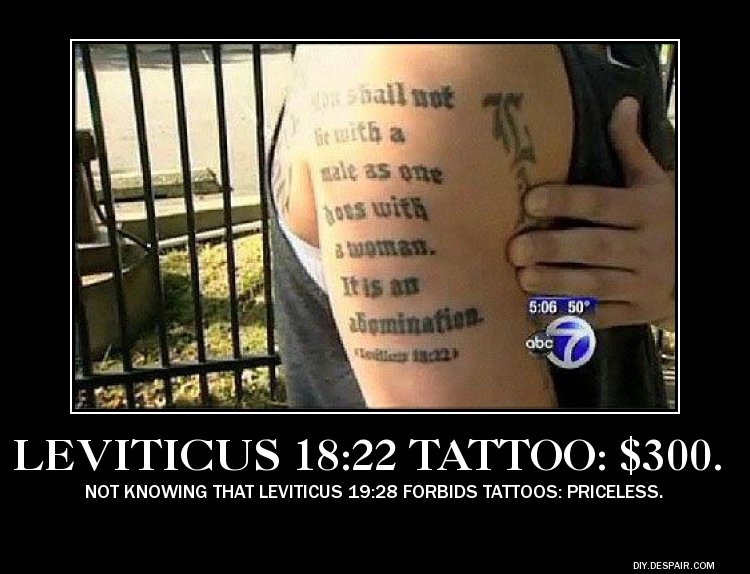
I was going to write this morning about the selective use of the bible to justify intolerance of gays, but then I realized I had written that already.

So, then I decided to post this pic:

And perhaps post a good pic that reveals the ignorance and irony of selection bias:

 Yep, one pic shows the selective reading of the bible.  And this guy is not unique at all, unless the folks behind the spate of anti-same sex marriages are also seeking to bring back other bible stuff....

Anyhow, this has all made me realize why I may be blogging less these days--hard to say new stuff about dynamics that have been in abundance the past six years (and yes, this month marks Six Years of Spew).


Tuesday, December 16, 2014

Embracing the Pyromania of The Festival of Lights

I tend not to write about Judaism here, as I have a pretty ambivalent relationship with the religion in which I was born and the ethnic identity that I cannot escape.  But it has come up a lot the past few days and with Hanukkah starting tonight, it felt time to have a few thoughts on Jewish stuff for a change.

First, the big news, of course is this:
JK Rowling had been asked if there were any Jews in the world of Harry Potter.  That she could only come up with one seems a bit low, but then again, one kid out of the named characters is not that bad, since Jews are about .5% of the British population. Given stereotypes about Jews being smart and clever and all that, of course, the one Jew is on the house dedicated to the brainy kids at Hogwarts.  So, is JK playing with stereotypes?  Maybe so, but the odds are really one in four anyway.

Second, my favorite tweet of the day was this:

Yep, taking the dreidel song and using it to make fun of Putin's problems is just fantastic.

Ok, the real discussion over the past day has been this Vox post about whether one should expect Muslims to always disavow and condemn acts by Muslims.  I posted on my fb page, and it led to a really interesting discussion about what we expect of ourselves and of others.  A Jewish contributor suggested that it is the job of Jews to condemn fellow Jews for doing stuff that besmirches the religion, but perhaps it is not fair to expect that of others.  My stance is a pretty belligerent one: acts by individuals are acts by individuals and should not be read as saying anything about the identity they claim to represent, and that we should not expect anyone to have to condemn the acts of members of their group.  Of course, this wildly contradicts much of my work on ethnic conflict that assumes that groups act as groups.  Oops.   I will have to square that circle someday.

Anyhow, on this first night of the most socially constructed holiday (Hanukkah was never really that much of a holiday until Jews had to develop an event to compete with Christmas--at least that is far as I know), if you are celebrating the festivities, enjoy your pyromania.  I certainly did as I grew up.  And enjoy the family, the fun, the latkes and the gifts--which, contrary to stereotypes and jokes, are not just socks and underwear.


Sunday, November 2, 2014

This Week in Airline Safety Videos

This is from Haaretz, an Israeli newspaper, and is delightful:


Not quite as fun as the new or old Air New Zealand videos, but quite good nonetheless.

H/T to Mathew Shugart.

Friday, September 12, 2014

Playing the Middle in a Religious War

One way to look at things in the Mideast* is as a religious war between Sunnis and Shia with the Saudis and Qatar on one side and Iran on another.**  That most of the other actors can be seen as proxies/allies in this fight.  Assad is not Shia, but relies heavily on Iran and Hezbollah.  ISIS is based on a perverted form of Sunni Islam, and has apparently received much support in the recent past from Qatar just as Al Qaeda received much support from Saudis.
*  Take all of this with a grain of salt since I am not an expert on the Mideast.
** Yes, there is more to it with all kinds of ethnicities and tribes and such.  This is not a Clash of Civilizations--too much intra-Sunni and intra-Shia violence to say that big blocs are the only dynamic here.

Which puts the US in the middle.  In Syria, the US wants to defeat ISIS (the Sunnis) without helping Assad (ally of Shia) in Syria.  In Iraq, the US wants a government that has been pro-Shia to become  inclusive government (good luck with that) to defeat ISIS without giving too much help to Iran.  Our allies in this war, who are tepid, are mostly Sunnis who are hardly moderates--Saudi Arabia, Qatar, etc..  When I saw this tweet from the US Dept of State, I had to consider that the effort might be doomed:

As much as I would like for treatment of women to be central to the fight, it is as Dan Murphy put it--for domestic consumption and perhaps for the Europeans--but not really central to the strategy.  It does help to illustrate how screwed up all of this is.

To be in the middle of a religious war is a bad thing.  Some (I forget who) have offered up the idea of a new Westphalia--that Iran and Saudi Arabia should/can agree that the religion of a state should be what that state's leadership decides and not be subject to this rivalry.  Good luck with that.  The bright side is that it only took thirty years of war to produce the Treaty of Westphalia, which means we might be halfway there?

The American solution, of course, is to take the state out of it, and let religion be up to individuals.  That, too, is a non-starter.  So, the US is left in the awkward spot of trying to get religious extremists of various sides to be a smidge less extreme, I suppose.  Because the forces of secularism are not going to be coming to the rescue in any of these places.

Our best hope is that the ISIS folks alienate everyone through their beyond the pale barbarism, so that the locals, no matter how objectionable they are to us or us to them, switch sides and support this tepid coalition.  Kind of sounds like Afghanistan, right?  In that case, this should just take thirteen years or so.

Perhaps the theme song for this conflict is:

Tuesday, July 15, 2014

Keeping Religion in Ethnicity

When I posted a few days ago about the Israel-Palestinian conflict, a friend asked about my including of religion in the definition of ethnic conflict.  So, here is my explanation. 

The definition of ethnicity that people in political science tend to use focuses on perceived common ancestry centering around a few markers of identity.  The definition in my dissertation and first book:


"Ethnic groups are 'collective groups whose membership is largely determined by real or putative ancestral inherited ties, and who perceive these ties as systematically affecting their place and fate in the political and socioeconomic structures of their state and society (Rothschild 1981).'  These ties usually are related to race, kinship (tribe or clan), religion and language."
In the intervening years, not much has changed.  In a forthcoming piece of which I am one of many co-authors, the focus is very much on defining what counts and what does not count for the dataset:

Consequently, the AMAR criteria that aim to outline socially relevant groups at a given point in time are that:
(1) Membership in the group is determined primarily by descent by both members and non-members.
(2) Membership in the group is recognized and viewed as important by members and/or nonmembers. The importance may be psychological, normative, and/or strategic.
(3) Members share some distinguishing cultural features, such as common language, religion, occupational niche, and customs.
(4) One or more of these cultural features are either practiced by a majority of the group or preserved and studied by a set of members who are broadly respected by the wider membership for so doing.
(5) The group has at least 100,000 members or constitutes 1% of a country’s population.
Why is religion part of ethnic identity when we see so often people refer to "ethnic and religious" or "ethnoreligious"?   Because it is about identity and one that is seen as inherited.  Sure, people can convert to a different religion, but other "markers" of identity are also more malleable than advertised.  Languages can be learned and adopted.  One can move to a different region and then identify with that region (I am reminded of the "Californian since 1970 or 1980 bumper stickers").  One could argue that race is fixed, but yet not so much as people of mixed race can try to identify in a variety of ways.  Kinship often means multiple identities as well. 

Folks who study ethnicity are very aware that it is a socially constructed thing, so the boundaries are fuzzy and one's identity is not entirely up to oneself but how other see it.  Note number 2 of the AMAR criteria--that the membership is defined by members and nonmembers--not by oneself.

For me, in my research, religion does much of the same causal work as language or race or kinship--creating a sense of affinity or enmity which then affects policy preferences--do we want to help group x or group y?  Let's help the group with whom we share some ties--racial, religious, regional, kinship, or linguistic.  When identities cross-cut, then politics is about defining which ties are the most salient.  When identities converge--group x shares the same religion, language and race as group y--the politics became easier.  It becomes less about defining which identity matters and more about defining oneself as the best defender of the group.

Which leads us to ethnic outbidding.  When politicians compete to be the best defender of group x, each one may try to top the other, as in an auction for support from the group. The claims become more and more radical.  Religious outbidding and linguistic outbidding are not that different--just the promises will vary. 

For my work, the key difference between religion and other ethnic identities is really about the reach.  That religious identities cross not just land borders but across oceans so that Libya supported the Moros of the Philippines, for instance.  Race can have the same distance, but clan/tribe and language much less.

Each kind of ethnic tie will have different implications for politics, as I discussed early in my blogging career.  Religious differences have implications for much of what governments do, whereas linguistic divides matter for employment and education more so than elsewhere.  Race?  The irony here is that race does not really have much in the way of logical implications for politics until/unless racial divisions have historical content.  And yes, then it matters quite a bit. 

Anyhow, a long answer to a simple question.  When we speak of ethnic groups, ethnic ties, ethnicity in poli sci, the concept includes religion as a potentially relevant component.  Why? Because it is how people identify us and them in social groups that sometimes become politically relevant. 


Monday, December 2, 2013

Karl Marx and the US Air Force Academy

"History repeats itself, first as tragedy, second as farce."  This is a famous Marx quote but could apply quite well to the US Air Force Academy.  I have posted far more often about the USAFA than the other military academies.  

A sample from google

Why is that?  Is the USAFA more flawed, more worthy of scorn and criticism than the others?  Probably, but to be honest, it is probably because I visited USAFA more recently than Annapolis and have never been to West Point.  

When I visited the USAFA in the early Aughts, it was part of an academic outreach program all three military academies had (have?) where they brought in undergrads from around the country to have discussions about some key topic and also brought in some random academics to moderate some of the discussions.   What struck me most strongly was that I felt like I was at a religious university, as the environment seemed to be quite ... Evangelical.  I had flashbacks to my time in Lubbock, where I felt like an outsider since I did not follow a particular brand of Christianity.  The symbols (especially the extravagant chapel) and the discourse all made it apparent that this one public, academic institution had been pretty much taken over by those with a sectarian view of the institution's role in the U.S.  Which disturbed me utterly.  

Of all the Amendments to the Constitution, the first is the most important, I think, as it creates boundaries that restrict how much the government can be captured by some groups to be used against others.  Freedom of speech, freedom of the press are basic fundamental requirements for democracy.  But so is keeping religion out of the government.  As a scholar of ethnic politics, I understand only too well how dangerous it is for religious groups to impose their views on the rest of their society.  When we have a military educational institution doing pretty much that to its students, then we have trouble, big trouble.

I guess I have a heap of schadenfreude about USAFA troubles.  An institution that tends to use "Jesus as crazy glue"? The Academy is largely captured by those who seem to be holier than thou yet is this corrupt?  That tends to demonstrate the wisdom of our founders--that religion is not a guarantee for higher morality.  Indeed, those who try to extend domination of one religion are far more corrupt and problematic.

So, what is the latest news out of the academy that has gotten my ire and fire?  To combat its sexual assault problems and other challenges, the USAFA academy apparently persuaded (coerced?) students to become informants and thus violate the code of conduct that I once mocked.  Read the story--it is appalling.  What is perhaps the worst part about it?  How the leadership of the institution and of the US Air Force run away from responsibility?  Well, perhaps it makes sense since Sergeant Schultz was in the Luftwaffe, right?  So, "I know nothing, I hear nothing" is probably a universal Air Force mantra?  The institution is not even responding to a Senator's inquiries, but I guess we should be used to the institution ignoring its overseers (see point three).


Perhaps we should follow Robert Farley's advice and just get rid of the entire service?  Sure, that seems extreme, but given how broken the USAFA is and that the USAFA is the building block for the entire officer corps of the US Air Force, it suggests (as the Chief of Staff's denial indicates) that the service is rotten to the core.  If we cannot disband the Air Force, we might want to consider getting rid of the USAF Academy and selling off its assets to the local religious organizations.  I cannot think of a worse place in the US to train the next generation of leaders of the US Air Force than the US Air Force Academy.

Thursday, May 9, 2013

Time for a New Religion


A friend of mine (h/t to JJ) posted on her facebook page the divergent reactions to the National Household Survey of Canada, which is like a census but is no longer mandatory (Harper hates social science along with all other sciences, apparently).

JJ noted that the anglophone press noted that immigrants are speaking more French than before.  The French press notes that 20% of the immigrants do not speak French.  Oh joy, the cup is either 80% full or 20% empty?

For me, what this means is this: I want Confirmation Bias to be a religion because I so strongly believe in it.  Of course, those who want to see the "census" reporting French is under attack note that not all immigrants are picking up French, and, of course, those who think that the language thing is over-wrought in Quebec (which it is, I can confirm with bias).  People see what they want to see much of the time.  How can 80% of immigrants learning French be insufficient?  Oy.

Anyhow, now that we are trying to start up Confirmation Bias as a religion, what does that require?  Hmmmm.  From here, I cropped this:


The idea is that information is filtered as it comes in, so that only that which confirms one's beliefs makes it through.

Ok, next step is dogma, which we borrow from the Ironborn of Game of Thrones: That Which We Believe is Never Dead Disconfirmed.

The only rite of passage required to join is to believe what one has always believed no matter how much disconfirming information is provided. 

Holidays? We can steal the holidays of pre-existing religions by focusing on those aspects of each holiday that celebrate the selective filtering of information.

I am not an expert on religion, so let me know what we need to add, and if it fits with latent existing beliefs, I will support your suggestions.  If not, then not.