Friday, December 8, 2023

The Year Ahead: China, Elections Encouraging Extremism, Evacuations, and Back to the Balkans

 The past two days were heaps of CDSN goodness.  We supported the book launch of Phil Lagassé and Thomas Juneau's second Canadian Defence Policy volume, and we held our Year Ahead event.


The book launch had triple the number of people we planned for--150 or so.  We ran out of drink tickets before the speakers event started.  I got a chance to say a few words, mostly to tease Phil and Thomas, partly to promote the Year Ahead event.  It might have been the free booze or it might have been the appearance of the CDS that drew the crowd.  General Wayne Eyre stuck around after his talk for a good 1.5 hours to have pictures taken and to chat with the group.  In my intro, I mentioned that most folks think that no one in Canada cares about Defence, so I guess everyone who does was at the event. 
I really enjoyed the event--glad to see Thomas and Phil and their contributors get the spotlight, great to chat with former students, officers and officials who have interacted with me online but not in person, and various other folks.  I spent many of my conversations promoting our big event the next day.

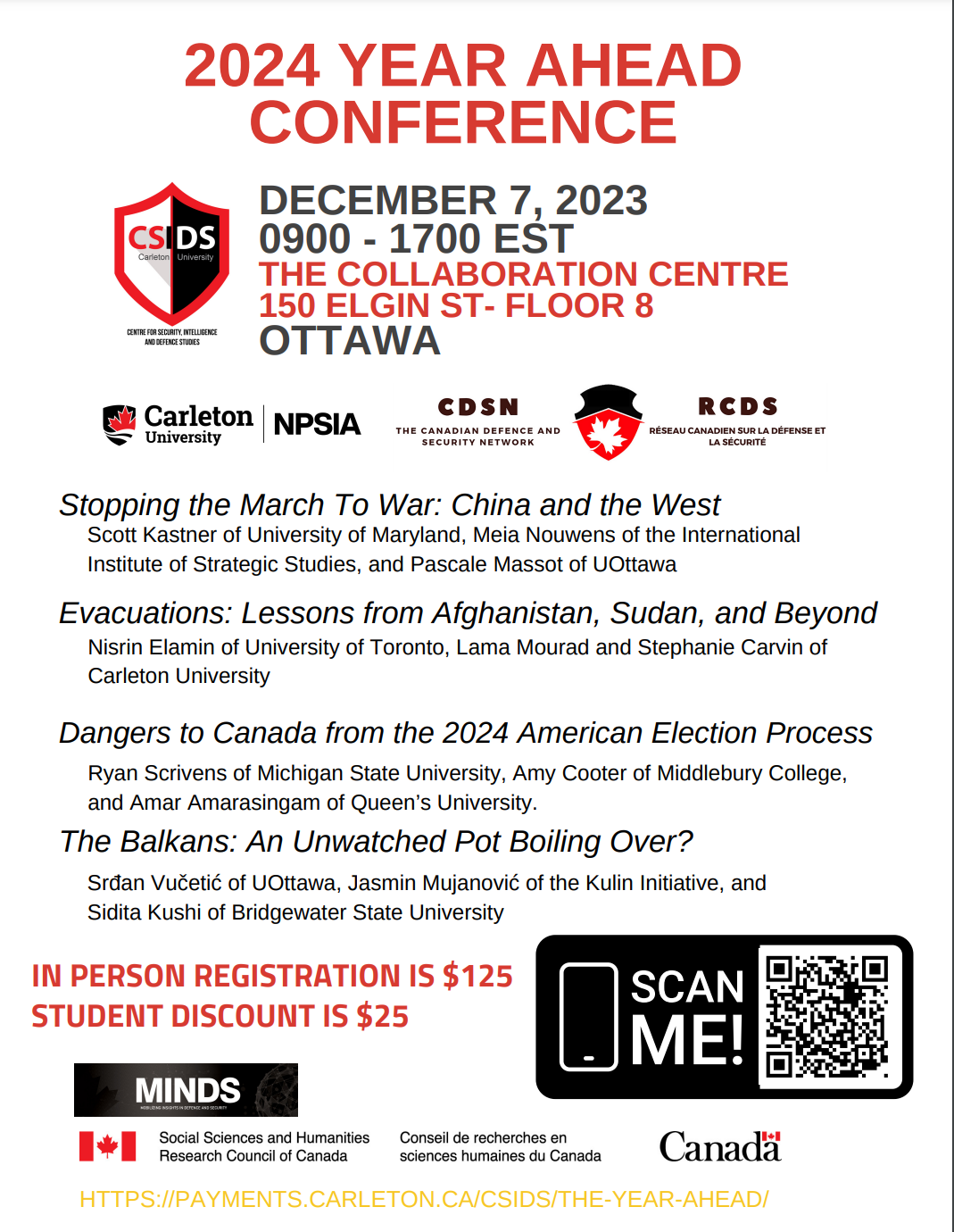
The Year Ahead started before the CDSN, with Rob McRae as the director of our research center--CSIDS--building a conference aimed at considering the potential challenges facing us in the near future--the year ahead.  We took this over, and it has gone through various changes over the years due to pandemics and such.  This year, we moved to a different space, the former Shopify offices, which meant we could go down a slide and play with giant versions of Connect 4 and Jenga.  

We consulted our various partners in and out of government and came up with four topics.

In our first session (no pics since I was the moderator), we had Scott Kastner zoom in and Meia Nouwens and Pascale Massot in person discuss the challenge of addressing an aggressive China whilst avoiding war.  The good news is that China is not ready for a Taiwan invasion, so the much feared war is not as likely to happen very soon. On the other hand, various policies to deal with China are problematic--like "derisking" by trying to avoid China in various supply chains is simply not going to work well.  

In the second session, we had very different talks as Nisrin Elamin presented her experience as she was in Sudan when the coup attempt/civil war started, and had a hard time getting herself, her kid, and her parents out of the country.  Stephanie Carvin presented her comparative project (with the aforementioned Thomas Juneau) about how democracies take care of their people in conflict situations, Duty of Care, to help us understand the government side.  It was an excellent conversation to see the personal dynamics interact with the policy challenge.

We broke for lunch and made much use of this great space especially the students from Carleton and the NATO Field School:


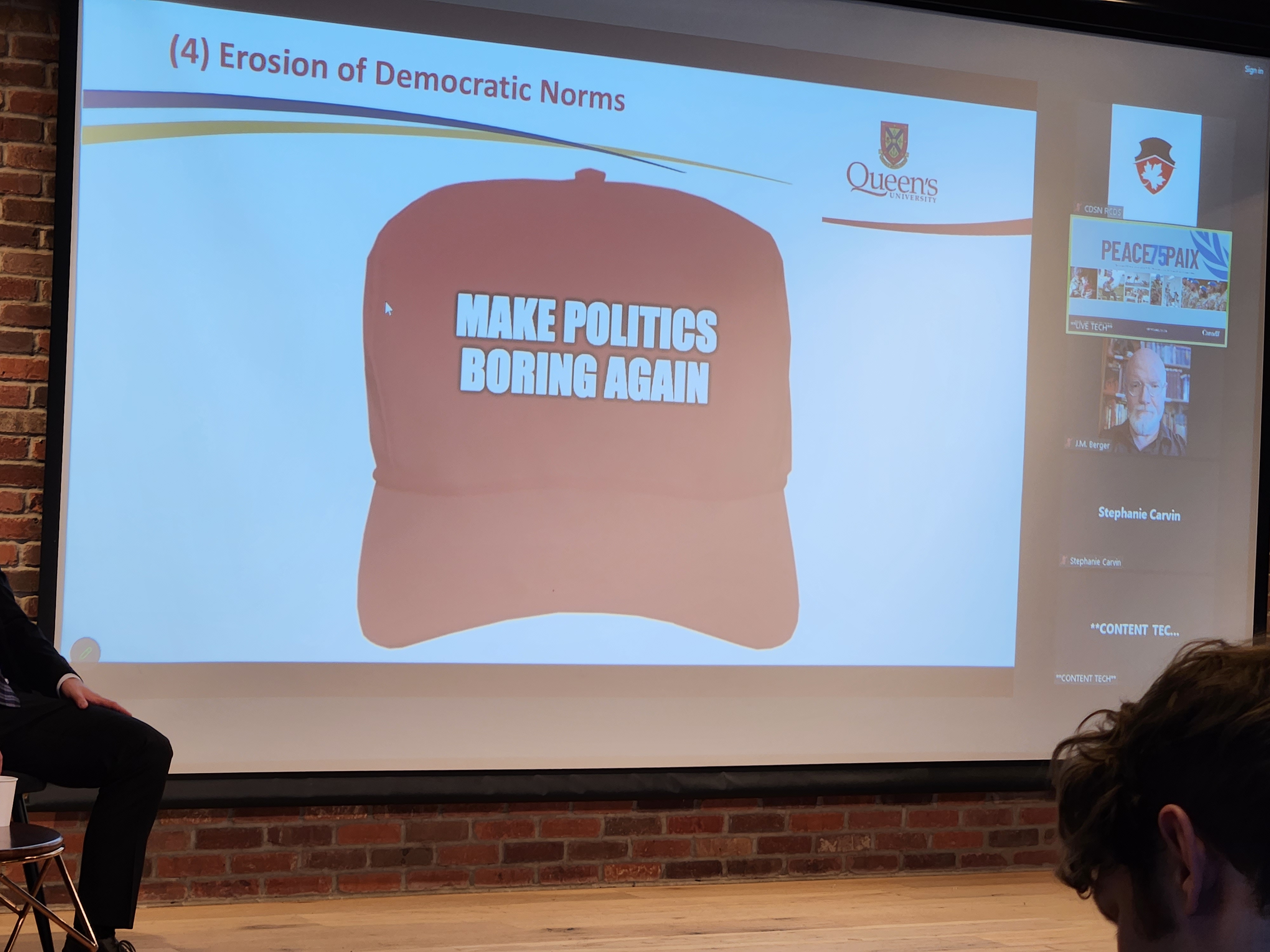
The third session considered whether and how the 2024 election would generate extremism and violence not just in the US but in Canada. They made it pretty clear that, yes, there will be more extremist violence generated by the next current election campaign, that Americans and increasingly Canadians are living in two different realities, and that things are going to get worse before they might get better.  Ryan Scrivens showed the trends over time, Amy Scooter talked about the rise of militancy in the US (buy her new book!), J.M. Berger talked about the social constructions that are driving these dynamics.  Amar Amarasingam presented more on the Canadian side of things.

As a political scientist, I ordinarily would not support this appeal that Amar made:

Our last panel was certainly not least as Srdjan
Vučetić, Jasmin Mujanović, and Sidita Kushi passionately and insightfully presented the latest dynamics in the Balkans.  I used to study the international relations of some of this so I was surprised to learn how badly the US is screwing this up by supporting directly or indirectly Serb nationalists who are preventing Kosovo from moving forward.  That five European
countries don't recognize Kosovo doesn't surprise me as these folks haven't read my earlier work--that secession is not as contagious as thought, that recognition in place does not really matter elsewhere, etc.  It was a great panel to end the day, since the speakers were very dynamic in their criticism of US and European policy in the region.  To put a Hungarian in charge of the NATO forces in the region is just dumb from so many dimensions--Hungary is a spoiler, its military was one of the worst performers in Afghanistan (the nearby New Zealanders would patrol in the Hungarian sector since the Hungarians didn't patrol)., and so on.

Oh and it turns out the metaphor I used to describe this panel was a bit ... dated and unoriginal and problematic:


 We concluded and moved on to a delightful dinner.  So glad I had a chance to meet these folks.  And I am very proud of the CDSN HQ folks--Melissa, Sherry, Racheal, and Mourad--for doing all of the heavy lifting (sometimes quite literally as our swag was in big boxes).  Much thanks to the MINDS and SSHRC folks who fund us and to the NATO Field School and the new Carleton Society on Conflict and Security (I am surely getting their name wrong)--a new student group on campus for those interested in defence and security stuff--for providing much of our audience.


Oh, and one last thing:

While others did go down the slide, I didn't manage to squeeze it in. 


Wednesday, November 29, 2023

Burden of Proof? Nope.

I am not a lawyer, but, then again, the topic I am discussing today is not about legal stuff but political stuff.  That is, folks may say that there is a judicial process  or that the burden of proof has not been proven yet so we can't do x.  But when it comes to political decisions, one does not need proof beyond a reasonable doubt.  One does not even, dare I say it, need due process in many cases.

Let me throw out a few less than hypothetical examples.

Example 1: Someone comes to the Minister of National Defence and says that the Chief of Defence Staff, the top person in the armed forces, is hitting on subordinates.  The MND does not need a full investigation to decide that maybe having a guy who is violating the various policies on sexual misconduct should continue to lead the military during a time where addressing sexual misconduct was one of the highest priorities. The job of oversight is not about only making decisions after investigations have been completed.

Example 2: India is suspected of assassinating a Canadian on Canadian soil.  It is then indicted for trying to do the same just a bit to the south--trying to kill someone in the US.  One does not need to wait for the legal process to play out to re-think an Indo-Pacific strategic that is partially predicated on India being a reliable partner in the effort to contain China* or what not.

The commonality in these two cases is the use of legal proceedings as a dodge from talking about or actually changing policies in light of new information.  Sure, there is no certainty about the new info--there are reports, accusations, but not confirmed stuff, but, of course, there rarely is certainty.**  So, new information should change the calculations even if the new information is not 100% certain.  

To be as blunt as possible, one does not make defence or foreign policy based on the decisions of courts most of the time.  While legal stuff matters--whether a particular option is legal or not, etc--it does not determine entirely what a country should be doing.  If, say, India's populist government appears to be acting in ways that are contrary to international law and violating Canadian/American sovereignty, then one needs to start adapting the old strategy (no matter how new/old it is) to account for that.   

The larger point, I guess, is this: we make decisions all the time based on available info and on a variety of calculations.  We do not apply a burden of proof equivalent to what is required for a prosecution for many reasons.  Promotions are not as life-changing as imprisonment, so we don't have the same burden of proof--we don't need to know for certain that certain nominees to the Supreme Court have engaged in sexual harassment or assault to decide to find someone in whom we can have greater trust.  We can take into account accusations that are yet to be proven when thinking about extending someone who is charge of the entire military because no one is entitled to that job.  We need to stop treating high office like folks are entitled to it and that we need absolute certainty before booting people.  Same goes for, say, security clearances--suspicion can be enough to deny a security clearance and thus jobs that require such clearances.  Which is why it should be easier to boot people from the armed forces if they are suspected of being white supremacist.

We need to take seriously the burden of proof when the state is taking away someone's freedom.  We can have a lower burden of proof for many other endeavors, including revising foreign policy strategies.


* Folks can claim that Indo-Pacific strategies are not aimed at containing China, and I have to loudly scoff.  If that is not what the strategy is for, then why the urgency?  And if it is not for that, then we need a China containment strategy as well.

** Not to mention that many trials do not really resolve things because the defendant had crappy lawyers or terrific ones, that the prosecution did terrific or made a hash of the case.  So, again, big policy decisions can't ride on juries and judges, etc.

Wednesday, November 22, 2023

Danke-Giving?

 It was already a year for which I have much to be thankful for, and then I received word that one of my applications for my sabbatical plans came through: spending time in Berlin in 2024 and 2025!  So, as is my ritual here, I'd like to express my thanks (dankes?) for the past year.

So far, no one
fell during the horas
I have seen the past
few years but....
First, I am most thankful that my family has made it through intact in a supposedly post-pandemic year.  Some had bouts with covid, some sprained various body parts (that would be Mrs. Spew), my mother-in-law had a health crisis that ultimately led her to moving from her four floor townhouse to a senior retirement place, and many of the next generation moved.  The last few years have taught us not to take anything for granted, so as I prepare to see the west coast kid and the rest of the family as we eat too much food, I am very grateful. We had a great time at the Florida Saideman-fest with Samantha's Bat Mitzvah, just as loud as the NY version but with twice the alligators.


Jon out-dappered me.
He and I ran the place
as the rare eight-weekers.

Second, I am very thankful for the support, humor, and friendly abuse my friends are so generous giving to me.  I have accumulated a far spread silly bunch of sweet people who put me in my place when I need it, encourage me when I am frustrated, and ski with me.  A key highlight was a trip back to the past--the 100th anniversary of the summer camps that were so important to me from age 10 to age 20: Camp Airy and Camp Louise (I didn't go to the latter as a camper, as it is a girls camp, but it was a place I spent much time acting and ... other stuff).


Third, 2023 has been a great skiing year (2024 may be better, it will be different-er).  I had a nice trip with JC Boucher and his family, as we airbnb'ed in Canmore and skied the various places near Banff.  This was an excellent scouting opportunity for my anniversary trip to Banff with my daughter, sister, and wife (who couldn't make it to due to her mother's illness and big move).  I have one last trip this year to ski with my sister in Utah at a place I haven't been since 2001--Alta!

I haven't skied with my daughter since probably 2014 as we didn't ski when she came back from college each winter break or spring break, as far as I can recall.  So, it was a blast to hang out with her for a short time as she didn't have a lot of paid time off.


Fourth, I am very grateful that my travel schedule went into overdrive, much like the pre-pandemic: Carlisle PA for a civ-mil conference, Fort Lauderdale for Samantha's Bat Mitzvah, Latvia for a Department of National Defence tour, SPAIN with Mrs. Spew for our first Eurotrip together (really!), LA for the APSA and to see our daughter in our new digs (she and her roomie and their cats keep moving around LA), Reston for another conference and to see my wife's family, Seoul and Copenhagen, Toronto, and now Philly.  Still two! trips left this year: Alta and Virginia for a new kind of winterfest--air bnb rather than crashing at my mother-in-law's.  I got to see a lot of great people, eat fantastic food, and do a heap of tourism.  


Fifth, I am so very thankful for the CDSN Team.  This past year, I have been able to delegate more, worry less, and watch the team rock a series of activities and efforts.  Last year, we hired Sherry to handle our money and our event planning.  She has been incredible--today's emails were her answering various queries and me just loving that I didn't have to enter the fray at all.  Of course, Melissa is the key to all of this--as our chief operating officer, she runs the shop, generates a heap of ideas for future efforts, and engages our partners and participants.  Racheal has been our PhD research assistant for several years now and is handling more and more stuff so well that I don't have to do much revising.  Mourad is our new PhD RA and he is super enthusiastic.  The CDSN continues to grow and excel, going from 2 podcasts to 6 programs in our podcast network.  Our Summer Institute was the best yet with 1/3 of the participants from the military, 1/3 from the policy world, and 1/3 from academia.  Our various research teams are producing important results and great publications, and we are very much making progress on our various objectives.  I am so grateful to all those who contribute to our stuff--it would not be possible without so many generous, creative, fun, sweet, sharp folks lending their expertise and time.

I am so thankful for our new kitchen.  I spent a lot of time working on the design and plans and then figuring out ways to eat when the oven and sink were out of commission.  It came together so very well, and now this season's cookie baking extravaganza is easier and more fun.  It was a year full of baking, eating, and then treadmilling so that I could eat some more.  2024 will have less of that in the first half as whatever kitchen I have in Berlin will not compete with the great setup I have in Ottawa.

Oh, and I am most thankful for this sabbatical.  Getting a break from teaching after the worst of the pandemic has been a great relief.  We did manage to finally finish the Legislatures and Armed Forces book and send it off to presses--I am pre-emptively thanking kind reviewers (pretty please!).  I got started on the next big thing, and I have gotten a bunch of smaller projects started or finished.  I haven't read as many books as I had planned...yet.  Oh well. 

I passed the midway point in my time at Carleton as this is my 12th year at Carleton, and I am pretty sure that I will retire before I hit 24.  I am very, very grateful for this place and these people.  I have had more support than at any previous spot, I have enjoyed the students (two of whom who defended their dissertations this year!), it has given me a great perch to do all kinds of stuff including public engagement, government exchanges, defence ministers in my classes (via zoom), and more.  It has been a fantastic place to work, and getting better as we keep hiring sharp, sweet young folks who make me see things in different ways. 

I am pretty sure 2024 is going to be even better, as I have some pretty fantastic plans, so I am thankful for what is about to be as well. 

I hope you and yours have much to be thankful for.  Enjoy your huge meals and many pies.


More Germany, More Better

My quest for a sabbatical hangout has succeeded (have I mentioned rejection is inherent in this enterprise?).  The Humboldt Foundation is going to fund six months of my hanging out at the Hertie School in Berlin--three months in 2024 and three months in 2025.  The Hertie School is an international affairs graduate program and very strong in international security.  What will I be doing there?  

First, I will be pursuing the next big project: understanding the varying roles defense agencies play in democracies.  I have already been to South Korea, quite recently.  The next step will now be Germany. Obviously, being in Berlin will facilitate the German case as I will have much time to interview folks in their Minister of Defense, in their armed forces, journalists, and experts.

Second, the project involves case studies in other European countries.  So, I will be able to travel to some other parts of Europe to do some of the work for this project.  Which ones?  Not sure yet.

Third, I will get engaged in the life of Hertie, so that I can learn what the students and profs in Europe are thinking about a variety of international security issues.  Marina Henke, one of the very sharpest scholars on alliance politics and international security, is my host, so I hope to learn much from her about how folks are thinking about NATO, Ukraine-Russia, and other topics. 

Fourth, I hope to have some chances to visit various research centers and talk about my work and, again, get different perspectives.  I will be a cheap date for two winters--that it won't be hard to bring me to any place from the UK to Eastern Europe, compared to the costs of flying me across the Atlantic.  That's, um, a hint. 

Fifth, deep into my career, I need a breath of fresh air, a change of pace, a bit of a shake up.  Sabbaticals are good for that, but sabbaticals away from home are better at it. 

Oh, and maybe there will be some time for tourism and skiing.  

So, there will be the complications of getting a visa and finding an apartment, but overall, it is time for this senior scholar to do a happy dance:


Sunday, November 19, 2023

Thinking About Israel and Palestine: Headaches and Insomnia

 I am not sure that the past month's headaches and insomnia are due to the challenges of thinking about the Israel-Palestine conflict, but I am going to use that as my intro to this effort to think through this stuff.

Usual caveats apply: I am not a political theorist or moral philosopher, I am not an expert on the conflict itself.  Oh, and I was raised Jewish and the education I got at Hebrew school did not adequately present the realities of the past.  I did take one Mideast politics course in college, and I did spend one week on an amazing and amazingly depressing tour of Israel and Palestine with a bunch of other academics four years ago.

Wednesday, November 15, 2023

Dueling Irredentisms: Always Bad, Never Inevitable

 I am not an international law specialist nor have I extensively studied the Israel-Palestine conflict, but I have written extensively about irredentism--the effort to enlarge one's country to include territories that are considered to be one's own by history and by blood.  So, when I see pictures like this, I get engaged:


The river to the sea, used by either side, is an inherently irredentist phrase: that the lands between the Mediterranean and the Jordan River belong to just one side of this means seeking to get all of the territory of the other.  Palestianians and their supporters have been saying this, and so have Israelis and their allies.  Irredentism does not have to be this maximalist--Russia has claimed just a chunk of Ukraine.  But these claims and efforts are inherently violent--that any effort to change one's boundaries to include territories governed by others will produce war because no country (or quasi-state) surrenders inhabited territory without a fight.  Not Ukraine, not Taiwan, not Israel, and not Palestine.

The thing is: all territory has been occupied by multiple groups, so there will always be competing claims pretty much everywhere on the planet except perhaps Antarctica.  Stuart Kaufman illustrated this nicely at the start of his book on Modern Hatreds:

So, if irredentist claims are possible everywhere, then why isn't there violence everywhere?  Despite the news suggesting otherwise, ethnic violence, including irredentism, is rare.  Ethnic conflicts do end, people do find a way forward without fighting. Remember that the key grievance between Germany and France for ... at least three wars ... was Alsace-Lorraine.  Yet that is not an issue these days.  

It is rare because irredentism is usually very self-destructive.  It didn't work out so well for Nazi Germany and not so well for 1990s Armenia, Croatia, or Serbia.  It has worked out well for China (Tibet), but Taiwan would be another story entirely.  Bill Ayres and I compared the irredentisms that occurred in the 1990s (the aforementioned Armenia, Croatia, and Serbia) and those that did not--Hungary, Romania, and Russia.  We confirmed that irredentism is very costly and self-destructive, but some countries do it anyway--when it benefits the politicians in power.  What is good for the politicians may not be good for the public, which produced our title: For Kin or Country.  Helping the kin abroad is often very bad for the country as war is bad.  Russia is paying a pretty high price for its irredentist campaign against Ukraine, but, thus far, Putin hasn't paid a price himself.  

So, when I see what is going on in Israel and Palestine, my bias is to watch the strategies politicians use to stay in power and see how that intersects with the nationalism of the country. Politics is in part about shaping the nationalism, defining the us, the them, and whether the them can be tolerated.  A central irony we found is that the nationalisms that were more willing to include the thems, the others, in the state, the more able they are to engage in irredentism since any successful expansion will generally lead to more thems as well as us's in the larger state.  Indeed, why do folks often oppose irredentism--a successful campaign would produce the equivalent of a massive wave of immigration, upsetting the balance of domestic politics.  For example, a Greater Albania including Kosovo would likely weaken those who currently hold power in Albania since there are a lot of Kosovars.  

And, yes, this gets to a key dynamic that the Hungarian case revealed--shades of identity, of us-ness.  That for Hungarians in Hungary, they identify with the Hungarians outside of Hungary (due to the Treaty of Trianon in 1920) but only up to a point.  Those Hungarians didn't experience post-1956 Hungary, so they don't have the same experiences and thus are not seen as quite the same.  So, Hungarians in Hungary want the Hungarians outside of Hungary to do well but to stay put--they don't want to share power or their welfare state with them.  

Anyhow, irredentism varies over time and over targets based on who matters to the politicians in power.  Somalia's irredentism from 1960 to 1990 varied depending on who was in power and whose clans they needed for support.  So, Somalia sometimes targeted all three neighbors, despite that being profoundly unwise, because the clans with ties to those in Djibouti, Kenya, and Ethiopia all mattered in the domestic political game. At other times, only those in Ethiopia matters (1976-1977).  

Back to Israel and Palestine: the irredentist efforts of Hamas (it aims to eliminate Israel and govern the entire space) and of Netanyahu (his coalition includes many parties that seek to incorporate the occupied territories, hence the support for the crazed settlers)* reinforce each other, giving each set of politicians more support from those who fear the other.  Not unlike Milosevic and Tudjman being each other's best allies as Tudjman could get Croats to support him because of the threat posed by Milosevic, and Milosevic could do the same to get Serbs to support him.  

Have Hamas and Netanyahu delivered on other public policy issues?  No, they are utter failures, but they are hard to replace when the enemy is at the gates.  The coverage of this war has been quite clear that Netanyahu empowered Hamas to weaken the Palestinian Authority and perhaps also to keep the Israeli public focused on this than his own corruption.

So, what is good for the politicians--war--is bad for the public, but the publics go along with it because they don't see any alternatives.  That people on both sides are talking about claiming territory from the river to the sea is understandable and horrifying, given what it requires--lots more bloodshed. It empowers the worst leaders. It requires incredible leadership by alternative politicians to push in another direction. But until that happens, there won't be peace. BUT if that were to happen, you could have peace. Alas, extremists have killed or marginalized the peacekmakers. So, things are going to be grim. 

We did cover this a bit in the book when we survey the world's irredentist hotspots including Ireland, Kashmir, Taiwan, etc.

Anyhow, the focus should be on the politicians and their incentives. Irredentism is not inevitable, it can be sidelined.  But it can be really hard to stop once it gets started because of the media it generates, the fear it generates, and how the two sides can reinforce each other's worst instincts.


*Yes, killing the two state solution is a key part of an irredentist strategy.  Never really thought about that before, but two state solution inherently recognizes limits on expansion, so one must do away with that if one wants to add the desired territories.


Saturday, November 11, 2023

On the Road in Multiple Places

 It has been a very long time since I have been away from home this long--October 2016--when I spent a month of my last sabbatical in Tokyo [I just received word that I will be spending 3 months abroad x 2 over the next 1.5 years, but more on that later].  This time, two weeks in South Korea and nearly a week in Denmark.  The packing was not that challenging since it is fall in both places although Seoul and Busan were decided
y warmer than Copenhagen and mostly much drier.

I was in South Korea to do the next project's first case study (well, mine, as Phil has already been traveling for some of his).  And then I went to Copenhagen to present the findings to a group I have never met before--the International Society of Military Scientists.  There are some civ-mil folks, but also strategy people, military culture analysts, and all kinds of stuff.  The trick is that the South Korean case was/is not easy to code or figure out.  I did have good access and had much help from a great team of fixer/interpreters, but I need to spend more time thinking about the case, talking to experts, and reading more.  So, the presentation was a bit tricky.  But it went ok. Folks keep finding the project to be interesting.

So, let me instead compare the two trips:

  • Costs (food, taxi): Cost:  South Korea.  Copenhagen is simply a very expensive place, and Seoul/Busan are not.  I kept doing the exchange rate math here in Copenhagen and kept freaking out just a bit.
  • Bike Danger: Denmark.  So quiet, so many.
  • Availability of Bomb Shelters, Emergency Gear: South Korea
  • Easy for the linguistically lame: Denmark.  I have no inhibitio
    ns there about speaking English, as everyone responds in kind thus far.  Also, the alphabet is the same with some strange looking o's, so I can figure much out.  Not so much in Korea.
  • Weather: South Korea.  Much drier and warmer.
  • Walking tourism: Busan > Copenhagen > Seoul.  All three places are great, but I have been to Copenhagen a few times before and to Seoul once before so novelty here wins out.
  • Food: I kept finding Indonesian food in Korea, so that's a win right there.
  • Sleep: oy.  Not great in either place.  Jet lag plus hard to control room temps and those duvets that mean either hot or cold and nothing in between.  
  • Oy, and flying my preferred airline is indeed better than not.  The Lufthansa flight from Seoul to Munich was about as long as the flight from Newark to Japan, but it was econ, no plus, which mean no room before the inconsiderate person in front of me decided to repeatedly slam her seat as far as it could go, hitting my knees and bouncing my ipad off my little table.  Shitty seats are shitty seats, no matter the airline, but when I have a bit of status, I can get at least those precious two or three inches that make all the difference.  When I fly, I always am thankful that I am not tall.
 I am bummed I missed the Vimy Gala as Jacqui O'Neill rocks mightily, and while her talk was not aimed at undoing the damage done by last year's craptastic speaker, it was still an excellent tonic.  Funny what happens when you take the decision-making out of the old boys network's hands.


Wednesday, November 8, 2023

Election Predictions? Hells No! Ok, Maybe

 Last night, at the big conference dinner, a Finnish attendee asked me about the big question of 2024 in the US (yes, US are super worried and they should be).  I first said that I don't do predictions anymore, given my blogging/tweeting/facebooking debacle of 2016.  Then she pushed, so I discussed how I am slightly optimistic but that was diminishing with the potential impact of Gaza on Democratic turnout.  And then I woke up this morning after another Democratic run of success--that the GOP has pretty much lost every election since 2016.  So, I am feeling a bit more positive than I was last night.  

So, what am I thinking now these days?  

First, I am concerned about Gaza/Israel as it may turn off Arab Americans particularly in Michigan.  I don't think that these folks will vote for Islamophobic, xenophobic Trump and his party that is now tyring to get Palestinians living in the US kicked out.  But they may not turn out as much--that Dem turn out has been the key since 2016. So, not great. The Jewish vote?  Oh, where it is strong, it is not going to swing anything---not in California, New York, or, ha, Florida.

Second, the vote yesterday matters far more than various polls.  In each election since 2016, the GOP has underperformed.  Why? It turns out switching from being vaguely racist, more obliquely misogynist, only somewhat theocratic to being rabidly racist, wildly Christian nationalist, and actually depriving women control over their bodies (arresting moms for transporting their daughters for abortions? jailing them?) has made a dent.  In 2016, people could argue that Trump wasn't a real conservative and wouldn't appoint theocrats and their pals to the courts. Now?  Yeah, people are mighty upset that radical courts matter, that state legislatures and various governors are very enthusiastic about making many Americans miserable in so many ways.  So, abortion is a vote winner for the Dems, and that's not going to change anytime soon.  

The part that stunned me the most was the wipeout of the Christian nationalists on school boards.  Local politics is hard, people don't turn out, but the batshit crazy folks with their book banning and trans and homophobia hate, indeed, triggered the Libs.  Trump and the GOP will be wearing this shit next year as the primary campaign is going to define the party as, well, freaking crazy and way outside the mainstream.  

Third, on the big "issues" that the GOP want to use against Biden--his age, his son's crimes--Trump is far, far worse.  Biden may be old, but there is not the record of him losing his train of thought and saying truly bizarre stuff compared to Trump.  Of course, the media will false equivalence this stuff away, but that still means that Trump can't get much of an edge on this.

Fourth, I was asked what happens if Trump is in jail in November.  I said unless it is for the documents case, I believe he will still be the GOP candidate.  There is simply way too much fear in the party regarding Trump's supporters--both because they are violent and because candidates want their support if Trump were to somehow be eliminated.  Trump's criminal behavior is already priced in, however, so it won't hurt him as much as it should.  His voters both want power and are super resentful, so they don't care. Do enough non Trumpist Republicans exist that might stay at home?  Um, I made a gamble about that last time, and it didn't work out--power matters more.  HOWEVER, the big promise for non-Trumpist GOP folks last time was getting the courts, and that is not going to change with another four years of Biden.  So, maybe they won't be so motivated to vote?

Fifth, the GOP is not going to learn any lessons right now about what is causing their electoral defeats.  Why?  Because their primary processes are still going to reward extremism, so they will still send proto-Nazis and theocrats to compete for otherwise winnable Senate seats and then lose those races.  In red states, they can win those races, but in purple ones, they can't--playing to the extremist base may aid in some turnout but hurts more than it helps... at least that is how I read 2018, 2020, 2022, and now 2023.

Sixth, the Dems?  Damned if I know whether they will learn the key lessons and apply them well.  Biden's presidency has been a mixed bag with the media emphasizing the mistakes and the losses.  If the recession still doesn't happen, if jobs remain plentiful and wages going up, the inflation narrative may fade a bit. Will they make progress on making housing more affordable?  Probably not.  Oh, and that foreign policy stuff?  It won't matter except to various diasporas, but some of those are in key locations.  So... 🤷

Oh, and a Canadian note: the Conservative Party has been plagiarizing a bunch of GOP bullshit--trans phobia, using woke as a slur, etc.  I am thinking now that if the Canadian electorate is at all like the American one, these stances are going to hurt the Tories, not help.  So, will Polievre snatch defeat from the jaws of victory?  Probably.

But that would be a prediction, and I suck at those.


Friday, November 3, 2023

Second Time is the Charm


 As I wait for my flight across Asia to Germany and then Denmark (civ-mil conference in Copenhagen), I thought I would look back at what I observed and learned from my second trip to


South Korea.  The big lesson is that I enjoyed it more the second time.  Sure, the first time I got to check out the DMZ, and I think I had more, clearer interviews, but I wandered a bit further this time, got to see more neighborhoods, and then, went to the other end of the peninsula to very pretty Busan.  

Tuesday, October 31, 2023

No Zombies on This Train to Busan

One of the joys of my style of fieldwork--two weeks or so at a time--is that I have to figure out what to do with the weekends in between.  I can't expect interview subjects to meet with me on the weekend, soooooo I have to find something to do.  During my first trip to South Korea five years ago, I spent one of the weekend days during a DMZ tour--a tour bus took us to various sites along the DMZ including going into one tunnel that the North Koreans had dug.  Very cool!  This time?  I decided to go to Busan.

Wednesday, October 25, 2023

The New Project Begins: Seoul Fieldreport #1

 I am in South Korea for about two weeks to start my part of the next big project: understanding the relationships between defence agencies and the militaries they are supposed to, um, uh, something.  A few years ago, I would have said oversee, but this project essentially started with an interview with a ministry of defense official who said his agency's role was to protect the military from the civilians, which is very much the opposite of oversight.  So, Phil Lagassé, Ora Szekley, and myself are traveling to a bunch of countries to catalog the various roles that these agencies think they have and then to explain the variation.  Tis another cool project that engages in heaps of comparative civil-military relations.

I started on this road by accident.  The experience I had in the Pentagon raised questions about NATO, but once I realized officers wearing two hats, their NATO role and their national command responsibilities, would always care more about the national hat, the research would have to take place in a variety of national capitals, rather than in Brussels or Mons (the military hq of NATO).  And that was cool for me as it meant lots of interesting travel, many fascinating interviews, and eventually my favorite book: NATO in Afghanistan: Fighting Together, Fighting Alone.  It essentially asked why countries had different rules for their contingents in the field--who had to call whom for permission for what kinds of activities.

Which, of course, then lead to the next question: is anyone watching to see if those contingents are staying within the rules?  Since many countries had legislatures writing those rules, we wondered if they watched to see if those rules actually constrained behavior.  Early conversations with Canadian parliamentarians suggested not so much, and we found that Canada was not alone in that.  That book is now awaiting review at a couple of publishers, hopefully to see the light of day at your neighborhood book shop (or online one, anyhow) in ... 2025?  

The next question, as mentioned above, is whether defense agencies are overseeing their armed forces.  Our case selection this time is mostly repeating the previous cases--because we have some understanding, if not expertise, in these cases, we have contacts in these places, so the research should be fairly straightforward.

So, that is why I am in South Korea.  It was a fascinating case for the legislatures book, and is pretty interesting thus far after two interviews.  What have I learned thus far?

  • there are places where you can get a private room and a set menu to have a lunch meeting/interview, but wow, the food keeps on coming.  I lost track of how many dishes we had for lunch.  It was terrific, and the room was quiet so I could tape the interview.
  • I don't remember being turned away from BBQ places last time, but they apparently don't want solo eaters, at least in this neighborhood.
  • I need to be more careful as I deleted today's pics.  
  • I learned that Google and South Korea are having a spat, so I can't use google maps to give me good walking directions.  I have had to download alternative apps that work ok, but not quite as good.
  • I need to pay more attention to the signs on tables.  For dinner tonight, I went to a place that serves a variety of basic dishes, and it had a clear sign taped to the place where one can use a screen to order food: foreigners order at the counter. I got handed a multilingual menu, pointed what I wanted, paid, and sat down.  When my number came up, I got my food and sat down.  But no silverware, no chopsticks.  There was a self-serve hutch that had forces, glasses, and some side dish stuff. No chopsticks no napkins, no spoons.  Turns out the spoon/chopstick markings on the table indicated a sneaky side drawer containing those and napkins.  I only realized that 3/4s of the way through the meal when I noticed someone accessing their stuff.
  • I learned garlic fried chicken is really good for dinner and also good cold for breakfast.
  • I am off my game a bit, not just with deleted pics, but my taxi from the airport train took me to the wrong hotel--there are two hotels of the same name here, and I knew that, so I should have been clearer.  Not a huge deal, but at the end of a very long travel day, it was not welcome.
 I ran into a display of 70 years of US-ROK alliance at the Museum of Contemporary History.


More reports from the field and perhaps fewer deleted pics in the days ahead.


Sunday, October 22, 2023

Meeting of the MINDS!

I was almost as thrilled about being allowed out on the patio
on a beautiful fall day* as I was that the CDSN team
rocked the event.  Sherry, Melissa, Racheal, Ryan, and
Mourad (Jae should have been in the picture) not only
did all of the hard work to make the event happen, but
shared the lessons they learned in our years of
partnership/networking.  This event competes with
our Summer Institute for one of my favorite events.

This week, we, the Canadian Defence and Security Network, held a conference at NPSIA: the Meeting of the MINDS.  We brought together representatives (project directors, project coordinators, graduate students) from the nine networks that DND funds and folks from DND's Policy directorate.  The idea was to foster more connections in both directions.  The networks need to learn from each other not just what each one is doing but what lessons they have accrued so that all of us can do better.  Given what we do--assess policy and make policy recommendations, we felt all of us meeting the policy shop at DND might foster an improved exchange of research ideas and priorities and findings. .

The entire event was covered by Chatham House Rule, so I can only attribute what I said.  What I can say about the other folks is that we got a great crowd from DND and not just from the policy shop as the folks from the Chief of Professional Conduct and Culture and from the Public Affairs branch also turned out in significant numbers.  The morning sessions involved parallel roundtables, each one having the directors (or their representatives) discussing briefly their biggest finding to date, their greatest challenge thus far, and their next major step.  The idea was to start the conversation, and it worked quite well.

These sessions were moderated by individuals in DND with related expertise/interest.  So, we combined the three tech networks--Canadian Network on Information and Security [CANIS], Triple Helix and Space Security Network--and DND found someone from the relevant Defence Policy office; the Transforming Military Cultures network was joined by the one focused on Military Sexual Trauma; Women, Peace, and Security was paired with the Network for Strategic Analysis; and the CDSN was on the same roundtable with the North American and Arctic Defence and Security Network as we both focus on domestic stuff (among the CDSN's themes is one on Domestic operations).  

For lunch, each of the networks got a table or two, and the DND people were assigned to the networks that were of greatest interest to them.  This prevented the middle school dance thing of boys on one side, girls on the other dynamic that might have happened with DND folks just hanging together and the academics on the other side of the room.  Forced network is, well, more networking.

DM Bill Matthews
After lunch, Deputy Minister of Defence Bill Matthews spoke for a few minutes, and then we had a Q&A for the rest of the hour.   I can't say what he said or what folks asked, but I can say that JC Boucher and I had a fun argument in front of everyone about strategic communications.  Once again, I voyaged beyond my area of expertise, which surprised no one at all.  The next session had a similar talk and Q&A kind of engagement with a senior defence official about what the Policy Directorate does, what its priorities are, and how it is thinking about engaging us shaggy academics.   We then split into smaller groups to have more folks involved in the discussions.  I will say that all of these conversations were in the shadow of anticipated budget cuts, with the academics most concerned about the future of the low hanging fruit that is the MINDS program.  

After a networking reception Friday night, the academics reconvened on Saturday with a few MINDS folks stopping by.  The second day alternated roundtables of project coordinators and panels of graduate students. The former discussed the lessons they have learned network budgeting, accounting, reporting, and event planning, and the latter presented sharp research projects that ranged from Planetary Security (I learned 2029 will be a fun year for re-watching Armageddon and Deep Impact) to the legacy of moral injury experienced by the children of military folks to climate change impacting the Women, Peace, and Security effort to artisanal mining to the benefits of nuclear weapons (?!) to NATO cyber security.  While the students were most impressive, it was most fun to see the behind the scenes folks have the mic for a change.

The last panel was a conversation among the Project Directors about lessons learned, challenges we faced, strategies for getting things through various bureaucracies, and whether/how to do this kind of thing again.  Running these networks is a lot of work, but it is much easier when one can invoke this song:


Sunday, October 15, 2023

100 Summers of Fun and Community

 Last night, thanks to a nearby conference, I was able to go to the 100th Anniversary Gala of Camp Airy and Camp Louise in Baltimore.  Camp was a huge part of my child/teen-hood, as I lived 44 weeks each year for the eight weeks in the hills of rural Maryland.  With a crowd of 700 or so people, I had guessed I might bump into something like 20 people (3%) given that I was there for 11% of its history.  Well, I fell a bit short than that, but it didn't matter as some of the most important people in my time at camp were at the Gala.
The place has a heap of history


They had a video that addressed the fire
and how they are coming back from that
Two events cast a shadow.  First, during the summer of 2022, the camp's main building, its dining hall and offices, burnt down at the start of the summer session.  No one was hurt, and the community rallied to provide food and tents and other stuff so that the summer could and would go on.  So, this gala was partly a fundraiser for replacing the dining hall.  The insurance may have been good enough to cover the replacement of a 100 year old building but not to create a 21st century dining hall--ADA compliance, fire suppression systems (made me think of The Bear), and all the rest.  


I made the montage!  Didn't hurt that I am pals
with the ace archivist--Eric T
The second event was Gaza.  These are Jewish camps--lightly so as it only meant kosher meals, basic Friday night/Saturday morning services, Israeli counselors to join the other foreign counselors (British mostly), and such.  So, it came up during the speeches with an appropriate tone of sorrow rather than revenge or hate as well as concern for of the Israelis who had cycled through Airy and Louise, including campers last summer.  I do have fond memories of the Israeli counselors who crossed my path in my 11 years with those on the outdoor staff (hiking, climbing, etc) driving us to various sites to climb/hike/raft/camp/etc as Israelis didn't seem to understand what brakes were. 


Jon cleaned up better than I did. 
We were in the same bunks from when we were
13 to when we were 17 as CIT's. 
And as he noted last night, as the rare kids
staying all summer, we knew the place better
than damn near anyone else,
and with knowledge comes power.

There were some folks who mentioned concerns with safety as this time as 700 Jews might make a good target for revenge.  There were some cops at the front of the event.  I hadn't thought of violence aimed at this gala, and I thought this was a bit much, but I can't blame some folks for worrying.

In the past, I have discussed my ambivalence about my Jewish identity.  One reason why I never really got religion or understood its power for others is that the various temples/synagogues my family joined in the various we lived when I was growing up didn't provide a real sense of community.  On the other hand, these camps did that for me in a big way, and I may not have realized that before last night.  I felt a connection to everyone there, I loved camp because I felt like I belonged, it was a place where I excelled in most things and in those things where I didn't excel, I still had lots of fun and firsts (that would be romance).

Fun to see Tracy (c) and Jim (r) during the
Wacky Olympics, and, yes, I still have
that shirt.

Speaking of such stuff, I wanted to share this story and this book.  Nope, none of the ladies I pursued long ago attended the Gala, but I am not surprised.  More by happenstance than anything else, those girls that interested me way back were not those who were lifers at Louise.  

Anyhow, I only realized this weekend that this summer was the, gasp, 40th anniversary of my last summer as a camper--as a counselor in training.  I stuck around for three more years as a counselor.  And I think the last time I visited the place was in 2001 while moving myself and my dogs to Virginia for the year in the Pentagon.  It has been too long.  Time to start scheming to visit the place again...


It was great to see both the old friends and the rest of the lifers who fell in love with those special places up in the hills.  The gala had a theme -- camp is ....--and while they let folks fill it out themselves, they also did suggest something... making camp have something common with soylent green:

Reminds me of one of the songs burned into my heads.  During my era, they regularly sang a song that had the music from Charlie Brown.... Happiness is a summer at Airy ....   and indeed, it was and is.

Wednesday, October 11, 2023

Words Fail, Theories We Have Many

Gaza in the distance
 I have spent most of my career engaged in the five d's of dodgeball when it comes to the Mideast and especially the Israel-Palestine conflict.  Despite starting my career with the international relations of ethnic conflict, I managed a total of one piece of research on the Mideast, and that was more by accident than by design.  I got asked to join an edited volume project by a terrific Mideast scholar, Shibley Telhami, after one of my very best job talks (which did not produce a job).   

Bomb shelter next to a kindergarten if
I remember correctly

When I turned to doing civil-military relations, I was asked if I was including Israel in my multi-democracy study, and I said nope.  I have a better explanation for that--that as a very militarized society, its' civil-military relations are far less comparable.  

Bus stop, shelter in a town that
was probably overrun last weekend

But on the ethnic conflict side?  Maybe I refrained because the one time I raised it as an illustration in a job talk, it did not go well.  That lesson was certainly reinforced by the experience of teaching US Foreign Policy the semester the US invaded Iraq. That class quickly divided into pro and anti factions based on how the students identified with one side or the other of the Israel-Palestine conflict.  

Perhaps it is because of a conflict between my background/identity and my scholarly work.  I often joked that the three things I learned in Hebrew school were: enough Hebrew (barely) to get through my Bar Mitzvah, much about the Holocaust and the history of oppression of the Jews, and that Israel was empty before the Jews got there and everything Israel does is right.  The last is the most relevant although the second obviously hits hard when more Jews died in one day due to violence this weekend than any other time since the Holocaust apparently.  I definitely was miseducated about the history of Israel.  I was also conflicted about my upbringing since I hated Hebrew school (I never fit in or came close), never believed in the religion, and came to realize my identity as Jew is defined by the reality that Nazis would have included me in their roundups no matter what I believe.  That is, identity is not defined by oneself but by the interaction of oneself with others, and as long as folks saw me as Jewish, it was less relevant what I believed.

Open air prison ....

So, that ambivalence then hits the stuff I have picked up from the work on ethnic conflict.  I can see via those lenses that ancient hatred is not really what is going here, but political dynamics in Israel and in the Palestinian community.  There is outbidding and pandering to extremists in both, which then feed the outbidding and pandering in the other.  Netanyahu feeds Hamas, and Hamas feeds Netanyahu.  When I visited in 2019, my first visit, as part of a group tour of IR scholars, I got to see how much has been locked in, that bad decisions beget bad decisions.  That Israeli generals told me that the only response to violence is to hit harder than they hit you, as if this were Chicago with the Untouchables fighting Capone.  I could see their point of view, but again, it was a path to more violence.  I left Israel, like many of those on the trip, sad and frustrated--that the future of Israel and of the Palestinians was bleak--that there was no way out and no one in or near power was interested in finding one.  And this happens.

So, I see people saying that an unprovoked Israel deserves all of our support.  And I have to recoil a bit, as Israel has done a shit ton of provoking via its empowering of rabid settlers who have encroached on the Mosque and engaged in lots of violence against Palestinians in the West Bank.  But I also recoil when I hear folks talk about Hamas being part of anti-colonial struggle, as, yes, the Palestinians do have legitimate grievances, but Hamas is an awful, theocratic, maybe nihilist entity that did truly barbaric things.  Yet, I also know that Israel is going to kill a lot of Palestinian kids in Gaza since, yes, the population of Gaza is about 50% under 18.  War crimes do not justify war crimes.  And more violence is not going cause this conflict to go away. 

Pretty sure those towers are now destroyed

Both sides need far better governance, actors who don't benefit from the other side being radicalized.  But the institutions and dynamics of each are perverse and reinforcing.  I hope that Netanyahu pays a high price for letting this happen on his watch, but I seriously doubt that Israeli politics is going to move to the center as a result.  The flavors of the more successful parties in Israel are all variants of far right.  The left/center was broken by the second Intifada, and I doubt that these events will resurrect them.  I know less and understand less the Palestinian side, but I am pretty sure that air strikes are not going to lead to moderates taking power.


 So, I have rambled without reaching a clear idea of who should do what. Which is probably fitting.  And also explains why I have been reluctant to discuss this stuff--not just a bad job talk in 1993, but because the reality is so difficult, twisted, and painful.

Update:

I got into a conversation with my sister during the weekly family zoom, and she pressed me on when have ethnic conflicts ended peacefully rather than through conquest.  I gave the easy answer: South Africa.  But that conversation reminded me of the basic rules of ethnic conflict:

  1. Most ethnic groups, no matter their history, are at peace: violence is rare.
  2. When there is violence, it ends. No place is constantly at war forever.
  3. The past constrains choices but does not determine the present.  It is up to today's politicians to decide what to do, and the incentives the structures/systems provide influence but do not determine.  Agency remains.

Which means it didn't have to be this way, it didn't have to happen this weekend, while there are dynamics locking the parties in, those dynamics can be resisted, and, yes, outsiders could play some role in either exacerbating or ameliorating the nasty dynamics.


Monday, October 2, 2023

Maybe There Was No Crisis? Another Prosecution Without a Conviction

 The latest news, that the second chief of personnel to lose their job due to accusations of sexual misconduct, LTG Stephen Whelan, has his case withdrawn, may cause some folks to argue that there was never really a crisis, that this was all hysteria (yes, that word), and the culture change efforts are unnecessary.

I don't know Whelan, and I am not a legal expert.  I do know that there have been multiple reports that indicate that military justice is somewhat broken, and handing stuff over to civilian courts is no panacea.

What I do know is that there was and is a crisis, not just of sexual misconduct, but abuse of power and, yes, civilian control of the military.  How do I know that?

  1. The former Chief of the Defence Staff, Jon Vance, pled guilty to obstruction of justice. What justice was he obstructing?  An investigation into his multi-decade affair with a subordinate than ran completely counter to the campaign he was "leading" to deal with such stuff in the military.
  2. The same person appointed as Chief of Personnel (the one before Whelan) someone who had a nickname as Mulligan man for evading prosecution for rape ... until now.  I have had folks claim that Vance didn't know about this.  Um, sure.  So, either Vance did know and didn't care, or he didn't know because he didn't do a sufficient job of vetting those he chose for the key slot of .... implementing policies concerning such stuff as sexual misconduct.
  3. Vance's successor, Art McDonald, was accused of sexual assault and was not prosecuted because the suspect military investigators argued that everyone was too drunk to testify against him AND then McDonald violated the norms of civil-military relations by insisting he was coming back via a letter he sent to all of the generals and admirals.  Talk about entitlement.
  4. There was a settled class action suit involving over 20,000 former or current military folks, including a significant percentage of men.  
  5. There has been the exodus of women officers with bright careers who were disgusted by their senior officers.
  6. There are multiple reports on this: DesChamps, Arbour, Fish, ....

I have had plenty of conversations with folks in the military who think that there was a problem, that there is a lot of work being done to address the problem, that the problem is hard, that there is progress, but it is far from solved.

So, yes, Fortin got off, Whelan got off. Others may also not be prosecuted or the prosecutions may not work out.  If this were a murder case, we wouldn't say that the victim is not dead.  Again, sexual misconduct and abuse of power are existing problems, they do deter recruitment and they hurt retention.  The culture of the Canadian military must continue to change to reflect a more diverse military unless we want only straight, white, Christian men.  

To deny that is to be bad at math, history, and social science.  And finally, no one is entitled to a three star/leaf position.  Whelan may want his job back, but to have such an elite office, one has to be beyond reproach.  That the government failed to make its case does not mean that Whelan should serve as Chief of Personnel.