Ah, the ISA never gets in the news in a good way. Last time, it was my blowing up an ISA proposal on blogging. This time, it is their reaction to a complaint about sexual harassment at a conference. I have been reluctant to comment because: a) I am in Korea doing fieldwork and spent most of my typing in poor ergonomic conditions on transcribing notes; b) this is very much a tempest in a teapot kind of thing, getting far more attention than other, more severe problems in the discipline; and c) as a white guy, I am probably not the best to judge whether this joke/complaint/reaction/counter-reaction is problematic or not.
Having said that, of course, I have thoughts, and as someone who has commented much on sexual harassment in the discipline, folks have asked what I think about this episode. So, here I semi-spew about this incident.
First, tone matters a great deal, so we don't know how snide or not Lebow's tone was. But making a joke to the guys at the expense of the women, which is how the story sounds, is not good and not appropriate.
Second, Lebow has a reputation in the discipline which makes it hard to judge things--he is seen as a difficult person, so I am not surprised that he is, in my view, overreacting. He should have taken his lumps: "I am sorry. I made a bad joke, and I offended you" and moved on. Instead, he pushed back and wanted to publicize it all. Congrats to him on blowing this up.
Third, hierarchy matters--Lebow is a big name in the field so with great power comes great responsibility. Contra to Roseanne Barr, punching up with jokes is more acceptable than
punching down. Indeed, that is one way to challenge the powerful. I remember quite clearly that I made a joke about a junior woman's appearance (her height) at a conference, the person called me on it, I felt abashed and ashamed, I apologized, and I don't think I repeated that behavior since. Would I have behaved differently had it gone directly to an ISA procedure? I don't know, but I probably would not have been looking for media outlets to air my side.
Fourth, I feel for the ISA folks, as they faced no good choices in this, and now they look like humor scolds.
Fifth, contra to this piece, yes, one can make jokes that involve sex at conferences but you do it with your friends and not complete strangers. Context matters and audiences matter. So, saying you can't joke at conferences and can't joke about sex is simply wrong. But the content and context of the joke matters. Sure, "ladies lingerie" does not have much content to it, but in a small box full of strangers, it is a bad context.
Sixth, I can't really judge Simona Sharoni as I don't know her and have not been in her shoes. But I have seen enough sexism in academia to understand that senior women are fed up with a lifetime of accumulated grievances and react when they see more of it. Would this be a hill I would die on? No, but again, white guy who has faced not much sexism or other identity-based difficulties over my career.
Most importantly, I worry that this incident will be used to trivialize complaints about sexism and sexual harassment. I saw this every year when I was at Texas Tech, as the yearly sexual harassment training session turned into a competition among the senior men in the department to undermine the presenter. As that department was thoroughly toxic at the time due to the sexual harassment by one of my colleagues, this trivialization of the issue was incredibly problematic. Sexual harassment is real, and sexism matters a great deal (see all of the work on citations, on leaky pipelines, and all the rest), so focusing on whether "women's lingerie" as a joke distracts us from the more serious issues facing women in political science and international relations. For some, this is an opportunity to do exactly that--distract us from the serious issues. For others, they see this as part of a larger pattern. And I stand with the latter, as I have seen the former do too much damage.
Showing posts with label sexism. Show all posts
Showing posts with label sexism. Show all posts
Wednesday, May 9, 2018


Thursday, December 7, 2017
Good Politics and the Right Thing To Do, Franken Edition
I have long been a fan of Franken. I have most, if not all of his books. I really enjoyed him actually doing quite well as a Senator, as he did try to hold government officials/appointees accountable. He accidentally trapped Sessions in a lie that will keep on dogging the highest law enforcement official in the land. And, yes, he has to go. It is both the right thing to do and good politics.
Franken is a serial sexual harasser and perhaps even serial sexual assaulter (groping counts, doesn't it?). This is not the case of him saying something once or acting inappropriately once--it is a pattern of behavior that he is not denying although he has underplayed what is clearly something quite systemic in his own character. He does not belong in the Senate, he should not be representing people nor should he be paid by taxpayers with public funds. Everything he does now is tainted. The Democratic Party needs to have some core values and treating women decently should be one of them. Franken may have done good things for women in general, but he has bad for the individual women he has encountered. Franken leaving or getting kicked out is the right thing to do.
It is also, conveniently, good politics. Not just that the Governor of Minnesota will appoint a Democrat so it does not affect the balance of political control of the Senate in the short term (that someone has to run in 2018 to replace Franken could be dicey). It is good politics because the Democrats are increasingly becoming the party of consistent values and the GOP is the party of opportunism. This ain't bad optics going forward. More importantly, it is good politics because women are more than half of the electorate, and the gender gap already favors the Dems and will favor them more so. Sure, more than a few women have other interests/identities that cause them to vote against their interests as women---they may be rich, they may love their guns, they may be racist, or whatever.* Still, alienating some women by being the party of sexual assault is not going to help the GOP, and by drawing a clear line between the Democrats and the Republicans on this, the Democrats will benefit. The GOP can suppress the vote of minorities and the young via #voterfraudfraud voter id laws, but how can they suppress the female vote? I am sure they will find a way, but it is much harder.
Franken is a serial sexual harasser and perhaps even serial sexual assaulter (groping counts, doesn't it?). This is not the case of him saying something once or acting inappropriately once--it is a pattern of behavior that he is not denying although he has underplayed what is clearly something quite systemic in his own character. He does not belong in the Senate, he should not be representing people nor should he be paid by taxpayers with public funds. Everything he does now is tainted. The Democratic Party needs to have some core values and treating women decently should be one of them. Franken may have done good things for women in general, but he has bad for the individual women he has encountered. Franken leaving or getting kicked out is the right thing to do.
It is also, conveniently, good politics. Not just that the Governor of Minnesota will appoint a Democrat so it does not affect the balance of political control of the Senate in the short term (that someone has to run in 2018 to replace Franken could be dicey). It is good politics because the Democrats are increasingly becoming the party of consistent values and the GOP is the party of opportunism. This ain't bad optics going forward. More importantly, it is good politics because women are more than half of the electorate, and the gender gap already favors the Dems and will favor them more so. Sure, more than a few women have other interests/identities that cause them to vote against their interests as women---they may be rich, they may love their guns, they may be racist, or whatever.* Still, alienating some women by being the party of sexual assault is not going to help the GOP, and by drawing a clear line between the Democrats and the Republicans on this, the Democrats will benefit. The GOP can suppress the vote of minorities and the young via #voterfraudfraud voter id laws, but how can they suppress the female vote? I am sure they will find a way, but it is much harder.
* Yeah, I am still bitter about white women voting for Trump, which upset my prediction last fall and gave us this darkest timeline.Anyhow, I will get over the heartbreak of having a guy I have long favored turn out to be sleazy and hurtful to those who was supposed to be helping. Will the GOP get over being the party that preferred a child molester in the Senate and an admitted sexual assaulter in the White House? I am not so sure.
Monday, July 17, 2017
Senior Women in Academia: Few or Feared?
This piece is deservedly getting much attention. In my prior jobs, I have seen men disparage some senior women as being crazy bitches (Berdahl's phrase but one that, alas, has been used widely). On the other hand, damn near all of the friction/tension/conflict I have witnessed in my academic travels (four universities, two in the US, two in Canada) have been caused by men. This is mostly but not entirely a numbers problem combined with confirmation bias.
The numbers problem is this: there have always been very few women in senior spots in the places I have worked. There were one full and one associate at UVM, one associate at TTU, one full and associate at McGill, and one or two associates at NPSIA when I started at each institution. So, there were few women to be viewed as mentors by junior women, and few women to be seen as crazy bitches. But since there are few of them, whatever they do is noticed more than what the masses of men do.
Which leads to the confirmation bias problem: that when one has a bad experience with a female senior faculty member, it gets remembered and reinforces the stereotype more than when one has a bad experience with a male senior faculty member. Are there senior women out there that are nasty/arrogant/difficult/whatever and do not support those who came after them? Absolutely. Friends have told me tales. However, I have heard far more tales and certainly have experienced far more hostility from men in the business.
All of this is, of course, anecdata. So, I will focus on the anecdata I know best--the women at each stop along the way as well as those I have met at conferences who are institution-builders, who are excellent mentors to male and female graduate students and junior faculty, who support their peers bigly. The ones that come to mind immediately are: Lisa Martin at UCSD (now at Wisconsin), Cherie Maestas at TTU (now at UNC Charlotte); Juliet Johnson at McGill, Sara Mitchell via ISA conferences (she's at Iowa), Stefanie Von Hlatky in the Canadian and NATO world (she's at Queens) and Stephanie Carvin at NPSIA. Many other women have played important roles in at these places and elsewhere, and I am most grateful to all to all of them. The good news is that these and other women are doing a great job of mentoring the next generation. The key is to find the holes in the leaky pipeline and plug them (which, funnily enough, several of these folks are doing).
The numbers problem is this: there have always been very few women in senior spots in the places I have worked. There were one full and one associate at UVM, one associate at TTU, one full and associate at McGill, and one or two associates at NPSIA when I started at each institution. So, there were few women to be viewed as mentors by junior women, and few women to be seen as crazy bitches. But since there are few of them, whatever they do is noticed more than what the masses of men do.
Which leads to the confirmation bias problem: that when one has a bad experience with a female senior faculty member, it gets remembered and reinforces the stereotype more than when one has a bad experience with a male senior faculty member. Are there senior women out there that are nasty/arrogant/difficult/whatever and do not support those who came after them? Absolutely. Friends have told me tales. However, I have heard far more tales and certainly have experienced far more hostility from men in the business.
All of this is, of course, anecdata. So, I will focus on the anecdata I know best--the women at each stop along the way as well as those I have met at conferences who are institution-builders, who are excellent mentors to male and female graduate students and junior faculty, who support their peers bigly. The ones that come to mind immediately are: Lisa Martin at UCSD (now at Wisconsin), Cherie Maestas at TTU (now at UNC Charlotte); Juliet Johnson at McGill, Sara Mitchell via ISA conferences (she's at Iowa), Stefanie Von Hlatky in the Canadian and NATO world (she's at Queens) and Stephanie Carvin at NPSIA. Many other women have played important roles in at these places and elsewhere, and I am most grateful to all to all of them. The good news is that these and other women are doing a great job of mentoring the next generation. The key is to find the holes in the leaky pipeline and plug them (which, funnily enough, several of these folks are doing).
Tuesday, August 9, 2016
The Point of No Return?
Today was a bad day for the Trump campaign and a bad day for democracy as Donnie joked/or not about the NRA fans (Second Amendment people) dealing with Hillary Clinton and/or her judges after she wins (because Donnie knows he is going to lose?). Yep, Presidential candidate incited violence again. So, is this the point of no return?
What does that mean? That Trump cannot pivot back? No, he has no discipline and not much of a learning curve, so that was never in the cards. I think people are saying essentially that this is too far, that this is beyond the pale, that this is unacceptable. Once you cross this line, there is no returning to decency, to a candidacy that decent people can support. Indeed, folks are wondering if this is the point at which Paul Ryan can walk away. No answer yet as he has mastered the five D's of dodgeball to avoid the many questions today.
But I think people are missing something--Trump crossed the point of no return last year when he announced his candidacy, when he said that Mexicans were rapists. Ok, sure, one could say even before that since his birther fixation made Trump a racist and a conspiracy theorist and a panderer to white supremacists. But, if we want to date the time at which his Presidential campaign became so tainted by his utterances, by his policy stances, by his awful Trump-ness, then, well, his announcement will do since it attacked Mexicans and the rest of the Hispanic community by extension. Oh, and for the GOP, that first move also may help to kill your party for a generation since you embraced it.
That Trump kept then saying stuff and taking stances that seemed to be "new points of no return" kind of misses the point--it is not that these were now the new standards of alienating folks, but that he just went past the point of no return and then just kept going deeper into the land of awful stances, including:
 The whole idea of the point of no return is that once you pass that point, you don't return, right? Well, Trump passed the point of being minimally acceptable last summer and kept on going further and further down the road of hate/fear/indecency/inciting violence. He ain't coming back. Once one appeals to white supremacists, that should be it. Everyone should have run away from him and never looked back. Yet folks keep needing a new line to be drawn, a new pivot back that .... never happened. I wonder tomorrow how the craven folks will justify sticking with Trump now that he has passed the latest point of no return.
What does that mean? That Trump cannot pivot back? No, he has no discipline and not much of a learning curve, so that was never in the cards. I think people are saying essentially that this is too far, that this is beyond the pale, that this is unacceptable. Once you cross this line, there is no returning to decency, to a candidacy that decent people can support. Indeed, folks are wondering if this is the point at which Paul Ryan can walk away. No answer yet as he has mastered the five D's of dodgeball to avoid the many questions today.
But I think people are missing something--Trump crossed the point of no return last year when he announced his candidacy, when he said that Mexicans were rapists. Ok, sure, one could say even before that since his birther fixation made Trump a racist and a conspiracy theorist and a panderer to white supremacists. But, if we want to date the time at which his Presidential campaign became so tainted by his utterances, by his policy stances, by his awful Trump-ness, then, well, his announcement will do since it attacked Mexicans and the rest of the Hispanic community by extension. Oh, and for the GOP, that first move also may help to kill your party for a generation since you embraced it.
That Trump kept then saying stuff and taking stances that seemed to be "new points of no return" kind of misses the point--it is not that these were now the new standards of alienating folks, but that he just went past the point of no return and then just kept going deeper into the land of awful stances, including:
- POWs are not worthy of much respect since they get caught (Hey, McCain, how could you possibly endorse this guy?)
- Megyn Kelly and the first early but inevitable misogynist outburst.
- Telling his supporters to beat up the protestors.
- Suggesting that Cruz's dad killed Kennedy (so much for democratic discourse).
- Yada, yada, yada
- Questioning whether a Hispanic judge could fairly adjudicate the case involving the fraudulent Trump University.
- Attacking NATO, making it seem like US should run its foreign policy like a protection racket
- Calling Elizabeth Warren Pocohantas
- Inviting Russia to release more hacked materials.
- The convention speech
- Insulting a Gold Star family--the Khans.
- Inciting violence against the opponent and/or the judges she chooses
ifwhen she wins.

Tuesday, March 29, 2016
IR Full Female Profs of Color: Few and Far Between
Last week, I asked a question online that was asked of me
and then I asked at the ISA two weeks ago:
Can you name women of color working in the US or Canada who
do IR and are full professors?
At the ISA, folks
could only name one or two. On twitter
and facebook and my blog since then, the total has increased to eleven:
- Neta Crawford of Boston University.
- Condoleeza Rice, who was a full prof at Stanford before becoming provost and then worst National Security Adviser.
- Jacqueline Braveboy Wagner, City College of New York.
- Reeta Tremblay of U of Victoria.
- L.H.M Ling of the New School.
- Katherine Moon of Wellesley.
- Zehra Arat of U of Connecticut
- Christine Chin of American U
- Saadia Pekkanen of U of Washington
- Nazli Choucri of MIT
- Sheila Nair of Northern Arizona U.
Not great. Sure, we
could be missing a few, but this short list demonstrates the point that my
friend was making: there are damn few role models/mentors in US/Canada IR for
women who are not white.
One can quibble with the various modifiers/restrictions in
the question:
- what is IR? I tended to exclude a few names of those who are experts on one country or an area and do not do foreign policy/international relations type questions. I am sure we could get the list to be significantly longer if we included women who do one area of the world. Indeed, some of the women above can be considered area studies people but have done some IR-ish stuff. While the ISA is broadly inclusive so that it includes area studies people, the point of this exercise was about whether women who do IR might have mentors, not whether there are women who do IR or comparative. Also, in the conversation I had with my friend, her concern was in part about the implicit and sometimes explicit expectations to be an expert in the area of the world her family comes from rather than being an expert on general IR stuff. There is a tendency to push people of color to study stuff like an area of the world or race and ethnicity, whereas white people can be expected to study anything.
- why US/Canada? Well, the friend is in US/Canada North America and was pondering the availability of mentors. There was no intent to diminish the contributions of women of color at schools in other parts of the world. While the internet makes it possible to confer with people around the world, one is likely to meet up with people in the same region
- why women of color? That was the way it was put to me. We could use other ways to talk about race, such as visible minority (the Canadian way to refer to these kinds of identities), but I stuck with the term that was most inclusive. And identity is always tricky: are Arab Americans people of color? Traditionally, not so much. Since 9/11? Maybe. I asked a full prof I know whether she was a person of color and she said she was not, but understood how some might see her fit that category. Anyhow, I was not aiming at perfect coding, but at getting a general idea, and the paucity of names is suggestive.
A quick look at this reveals a few patterns: no Latinas,
three African-Americans and then Asian-Americans making the majority of the
list. So, yeah, there are few role
models for African-American women and none for Latinas who want to do IR. There are few women of color that
undergraduates, grad students and junior profs can look to and think
"well, they made it so maybe I can, too.""
Most of the women listed are post-positivist, which could
mean either that women who do such work are more likely to make it through the
leaky pipeline, or there might be an affinity for a particular kind of IR by
women of color, or maybe sampling bias as one of my key sources of names knew
these people because their work speaks to each other.
One Canadian, several in the Northeast/New England area, a
few from the West Coast, and nothing in between or down south. So, if you want to meet your mentor, it means
traveling for most folks.
How do we "fix" this? How do we have more women full professors of
color in IR? Obviously, whatever
barriers exist to promoting women and people of color need to be broken down. I used to work at a university where there
was an apparent barrier between associate and full, and that helped to
perpetuate the gender imbalance. Indeed,
in Canada anyway, it seems like the process to become tenured is far easier
than becoming Full even though the former means lifetime employment and the latter
might mean a raise. In the US? I don't know. But there has been stuff written on the leaky
pipeline, so we need to find the leaks and plug them, including discrimination
in citation patterns and in listings on syllabi and differential service obligations
(women end up doing more service, which may not help them get promoted).
A different friend of mine told me at the ISA that none of
the female associates have received outside offers, and all of the male
associate profs in her department have received such offers even though the
women have better research scores. How
does that happen? Such a perfect (and
awful) correlation of gender and opportunities?
Getting outside offers is one way for people to get promoted faster, and
it seems at least in that one case (more survey work required) one key tool to
fast promotion has been denied. So,
perhaps one way to deal with this problem is to make sure that senior searches
take seriously the full range of candidates and not just the first names that
come to mind?
Monday, March 14, 2016
Because It Is the Right Thing
In the aftermath of some posts of the past week and related discussion at the place where political scientists engage in anonymous discussions, folks have questioned my motives. Of course. I do not need to defend myself, but I do like to myth-bust when I can, so here are some alleged motivations and then my real motivation.
- "Saideman hates people who are pro-Palestinian." No. I am not a fan of the BDS effort, but I am neither pro or anti Palestinian or pro or anti-Israel. This conflict, like many others, is intractable for a variety of reasons, with people on both sides doing good and bad things. I have already written elsewhere about the choice Israel is facing is to be Jewish or democratic but not both....
- "Saideman is bitter about McGill." No, not really. I actually really enjoyed my first seven years there, and then the last three or so were problematic. But my problems were focused on the Chair and the Full professors, and that old chair is no longer in a leadership position, and the barriers to Full-ness have been overcome by the forces of reason (the Associate professors). Oh, and the tricky thing: RB was one of the few Fulls who took my side in the Promotion fiascoes, so this argument does not fly. Also, as distance grows between my time at McGill and the present, I have grown to focus more on all of the good stuff and not so much on the negative stuff with this one key exception.
- Saideman is white-knighting. This is the classic misogynist accusation whenever a man stands up for women--that he is doing it to impress women and/or to get laid.
- Saideman is seeking attention since no one reads/cites his stuff. While I am an admitted narcissist and attention seeker, this is not my intent. If I wanted to get heaps of hits on my blog, I would simply attack the same two political scientists over and over again (I try to restrict those posts to once or twice a year). While the anonymous folks might not believe it, I am pretty happy where I am--there are always bigger fish a not-so-wise Jedi once said. So, I could be cited more or less.
- Mostly because it is simply right.
- Partly because my mother instilled that belief in me and then my wife and daughter remind me.
- Partly because I went to Oberlin which made me confront my sexism and my homophobia.
- Partly because I am a scholar of ethnic conflict and, as a result, know the destruction that comes with discrimination.
- Partly because I have supervised many students and worry about how the world will treat them.
- Partly because I have seen plenty of sexism over the course of my career.
- And, like dodging in dodgeball, it is worth mentioning twice: equality is simply right. We are deserving of equal treatment. That discrimination exists is, well, basic to social psychology (thanks Donald Horowitz), but we don't have to tolerate it nor should we.
Sunday, March 6, 2016
McGill's Shame Continues
Really? Back at it again? I have repeated referred to a particular serial sexual harasser in McGill's Political Science department, but obliquely so. Why obliquely so? Because I am not sure what the consequences are for me of violating the confidentiality agreements of a place I used to work and because I didn't want people to speculate about who received this guy's unwanted attention.
Well, I just learned as a result of this post this morning that the same guy is back at it. When he was caught during my time there, only a few faculty knew. They may have wondered why he got moved out of his office in a remote location and put next to my office. I apparently was supposed to babysit/monitor him (which was strange since I only learned of his behavior informally, not through the administration). But that was temporary, apparently, as I left and the next guy in that office probably didn't know that oversight of this guy came with the office (and I think the harasser moved back to his remote location where he can predate without oversight). His ban of supervising grad students apparently has lapsed as well. When I was on grad admissions, I tried to keep students who wanted to do Mideast or peacebuilding from coming to McGill because I had little confidence that they would stay away from him.
Yes, most of the students knew because word gets around, but there was no guarantee that the word would keep being shared over time and all it takes is for a new student to have a few interactions with a serial harasser to have their trust in the institution and in academia irrevocably broken ... especially when the institution knows but does little.
The confidentiality that is thrown over the situation means that the prof in question appears to get away with it--those who know he commits these acts again and again do not see any consequences and those who don't know think nothing of it, perhaps even referring students to him if they develop an interest in Mideast politics and/or peacebuilding.
There, alas, is no internet trail to follow (there was once a post on Rate my prof about him but it disappeared) ....
Anyhow, as I have said before, if you have students or are a student thinking of going to McGill's political science program, I'd be willing to be more specific. It is a great school and a great program with mostly great people, but there is poison within and it continues to remain and it remains under-identified and under-sanctioned.
Well, I just learned as a result of this post this morning that the same guy is back at it. When he was caught during my time there, only a few faculty knew. They may have wondered why he got moved out of his office in a remote location and put next to my office. I apparently was supposed to babysit/monitor him (which was strange since I only learned of his behavior informally, not through the administration). But that was temporary, apparently, as I left and the next guy in that office probably didn't know that oversight of this guy came with the office (and I think the harasser moved back to his remote location where he can predate without oversight). His ban of supervising grad students apparently has lapsed as well. When I was on grad admissions, I tried to keep students who wanted to do Mideast or peacebuilding from coming to McGill because I had little confidence that they would stay away from him.
Yes, most of the students knew because word gets around, but there was no guarantee that the word would keep being shared over time and all it takes is for a new student to have a few interactions with a serial harasser to have their trust in the institution and in academia irrevocably broken ... especially when the institution knows but does little.
The confidentiality that is thrown over the situation means that the prof in question appears to get away with it--those who know he commits these acts again and again do not see any consequences and those who don't know think nothing of it, perhaps even referring students to him if they develop an interest in Mideast politics and/or peacebuilding.
There, alas, is no internet trail to follow (there was once a post on Rate my prof about him but it disappeared) ....
Anyhow, as I have said before, if you have students or are a student thinking of going to McGill's political science program, I'd be willing to be more specific. It is a great school and a great program with mostly great people, but there is poison within and it continues to remain and it remains under-identified and under-sanctioned.
Institutional Sexism
The NYT has a very sharp op-ed on sexism in science, but, of course, it ain't science alone. I have addressed this before, including here. The author of the op-ed makes clear her frustration with universities that fail to act.
My basic complaint for the past x years has been that universities insist on confidentiality to protect the victim, but it really protects the perpetrator and, of course, the university. Most students will learn who was the target, but the faculty may be left out of the loop since the university prohibits the various folks in the know to share the info. So, the serial harasser gets a slap on the wrist and then what? Eventually, the penalty and perhaps restrictions (such as not being allowed to supervise students) eventually fade, and new students get to be harassed.
Institutions protect themselves rather than their students again and again. I do think the various federal lawsuits may ultimately cause universities to be more responsible--so that they don't face a federal lawsuit, but it should not be this slow and reactive.
My basic complaint for the past x years has been that universities insist on confidentiality to protect the victim, but it really protects the perpetrator and, of course, the university. Most students will learn who was the target, but the faculty may be left out of the loop since the university prohibits the various folks in the know to share the info. So, the serial harasser gets a slap on the wrist and then what? Eventually, the penalty and perhaps restrictions (such as not being allowed to supervise students) eventually fade, and new students get to be harassed.
Institutions protect themselves rather than their students again and again. I do think the various federal lawsuits may ultimately cause universities to be more responsible--so that they don't face a federal lawsuit, but it should not be this slow and reactive.
Monday, February 29, 2016
Epiphany Du Jour: No Female Bosses For Me?
I saw a tweet:
And it made me realize something: I have never been in a department that had a female chairperson or department head. There have been female deans, but a single woman has been my direct supervisor. That is, the departments (UVM, TTU, McG, and Carleton) are 0 for 7. To be fair, when TTU's poli sci department was in receivership, the outside chair was, um, influenced by a junior female faculty member, and she did a great job trying to get him to avoid the dumb mistakes he was inclined to make.
What to make of this record? A friend on twitter jokingly blamed me, but, for those who don't know, chairs are picked by the deans with or without the support of the department. Who are usually the candidates? The full professors who have not yet done it. When there are none of those or those that have not done it were overlooked for a reason, then the dean will look to associate professors, which can be dicey since the fulls have a big vote on whether associate professors can be full professors. And, yes, in small departments, junior faculty are sometimes asked. I met one of those while I was in Quebec two weeks ago. As long as the department has little say on that person's tenure, then ok, I guess.
Anyhow, one reason why I have had no female chairs is that the leaky pipeline and path dependence has meant few women have been sufficiently senior while I was at the various places. Both UVM and McG had some kind of problem with promoting people to full (I don't know the deets on the former but experienced it in the latter), so that limited the pool. At TTU, the most senior female was not yet full, if I remember correctly. At McGill, the one female full prof had done it a long time ago. The person who would have been the best chair was hired as an associate while I was there and was not promoted to full until after I left, and she was smart enough not to be chair while associate. At my current spot, there are no women who are full professors.
Yow. Yes, even as we do a better job of producing more female Phds and hiring women at the junior level, there are still not enough women who have gotten tenure and then promoted to full to provide a pool of potential chair candidates. At least not when I was at these various places. The leaky pipeline refers to the problem of women dropping out or behind, through a variety of reasons including insufficient support while bearing children, not getting cited enough (there is bias in citations), not getting good teaching evals if those affect promotion (evals are biased), women get buried in greater service obligations, and so on. Not great at all.
Is there anything else going on? Did the various deans avoid selecting women to be chairs in poli sci departments in which I have worked? Not as far as I can tell. [Update: a friend has told me that she has been in several departments where the faculty vote and women get repeatedly overlooked--which shows the limits of my experience]. In one, there had been women who served on that capacity before my time (McG). I think there might have been a female Director of NPSIA in its past. I do think it is about the relative lack of women at the higher ranks. The other possibility, of course, is that departments run by women have not hired me. So, it could be about me, I suppose, but I doubt it.
The tweet above suggests that male feminists may not be sincere about wanting a female boss. All I can say is that I definitely would have preferred some female chairs in my career. I have only had two very good to excellent chairs in my career, so the average male chair is meh at best. Most of the women I have known, especially two "most likely to be chair" candidates would have been superior. And yes, they would be far better than I would be. Note that I have yet to be chair, so make of that what you will.
Anyhow, there has been much progress, and I do have some female friends who chair departments, but there is much more progress to be made.
when guys who call themselves "male feminists" see a woman get hired as their new boss https://t.co/BZdMhUdsb0— maura quint (@behindyourback) February 29, 2016
And it made me realize something: I have never been in a department that had a female chairperson or department head. There have been female deans, but a single woman has been my direct supervisor. That is, the departments (UVM, TTU, McG, and Carleton) are 0 for 7. To be fair, when TTU's poli sci department was in receivership, the outside chair was, um, influenced by a junior female faculty member, and she did a great job trying to get him to avoid the dumb mistakes he was inclined to make.
What to make of this record? A friend on twitter jokingly blamed me, but, for those who don't know, chairs are picked by the deans with or without the support of the department. Who are usually the candidates? The full professors who have not yet done it. When there are none of those or those that have not done it were overlooked for a reason, then the dean will look to associate professors, which can be dicey since the fulls have a big vote on whether associate professors can be full professors. And, yes, in small departments, junior faculty are sometimes asked. I met one of those while I was in Quebec two weeks ago. As long as the department has little say on that person's tenure, then ok, I guess.
Anyhow, one reason why I have had no female chairs is that the leaky pipeline and path dependence has meant few women have been sufficiently senior while I was at the various places. Both UVM and McG had some kind of problem with promoting people to full (I don't know the deets on the former but experienced it in the latter), so that limited the pool. At TTU, the most senior female was not yet full, if I remember correctly. At McGill, the one female full prof had done it a long time ago. The person who would have been the best chair was hired as an associate while I was there and was not promoted to full until after I left, and she was smart enough not to be chair while associate. At my current spot, there are no women who are full professors.
Yow. Yes, even as we do a better job of producing more female Phds and hiring women at the junior level, there are still not enough women who have gotten tenure and then promoted to full to provide a pool of potential chair candidates. At least not when I was at these various places. The leaky pipeline refers to the problem of women dropping out or behind, through a variety of reasons including insufficient support while bearing children, not getting cited enough (there is bias in citations), not getting good teaching evals if those affect promotion (evals are biased), women get buried in greater service obligations, and so on. Not great at all.
Is there anything else going on? Did the various deans avoid selecting women to be chairs in poli sci departments in which I have worked? Not as far as I can tell. [Update: a friend has told me that she has been in several departments where the faculty vote and women get repeatedly overlooked--which shows the limits of my experience]. In one, there had been women who served on that capacity before my time (McG). I think there might have been a female Director of NPSIA in its past. I do think it is about the relative lack of women at the higher ranks. The other possibility, of course, is that departments run by women have not hired me. So, it could be about me, I suppose, but I doubt it.
The tweet above suggests that male feminists may not be sincere about wanting a female boss. All I can say is that I definitely would have preferred some female chairs in my career. I have only had two very good to excellent chairs in my career, so the average male chair is meh at best. Most of the women I have known, especially two "most likely to be chair" candidates would have been superior. And yes, they would be far better than I would be. Note that I have yet to be chair, so make of that what you will.
Anyhow, there has been much progress, and I do have some female friends who chair departments, but there is much more progress to be made.
Friday, January 8, 2016
Sexism in Economics:WTF?
I have written previously about sexism in political science, mostly focused on anecdata--the plural of anecdote. Today, Heather Sarsons has a piece in the NYT based on much more advanced analysis than anecdata, an argument that was terrific in both senses of the term:
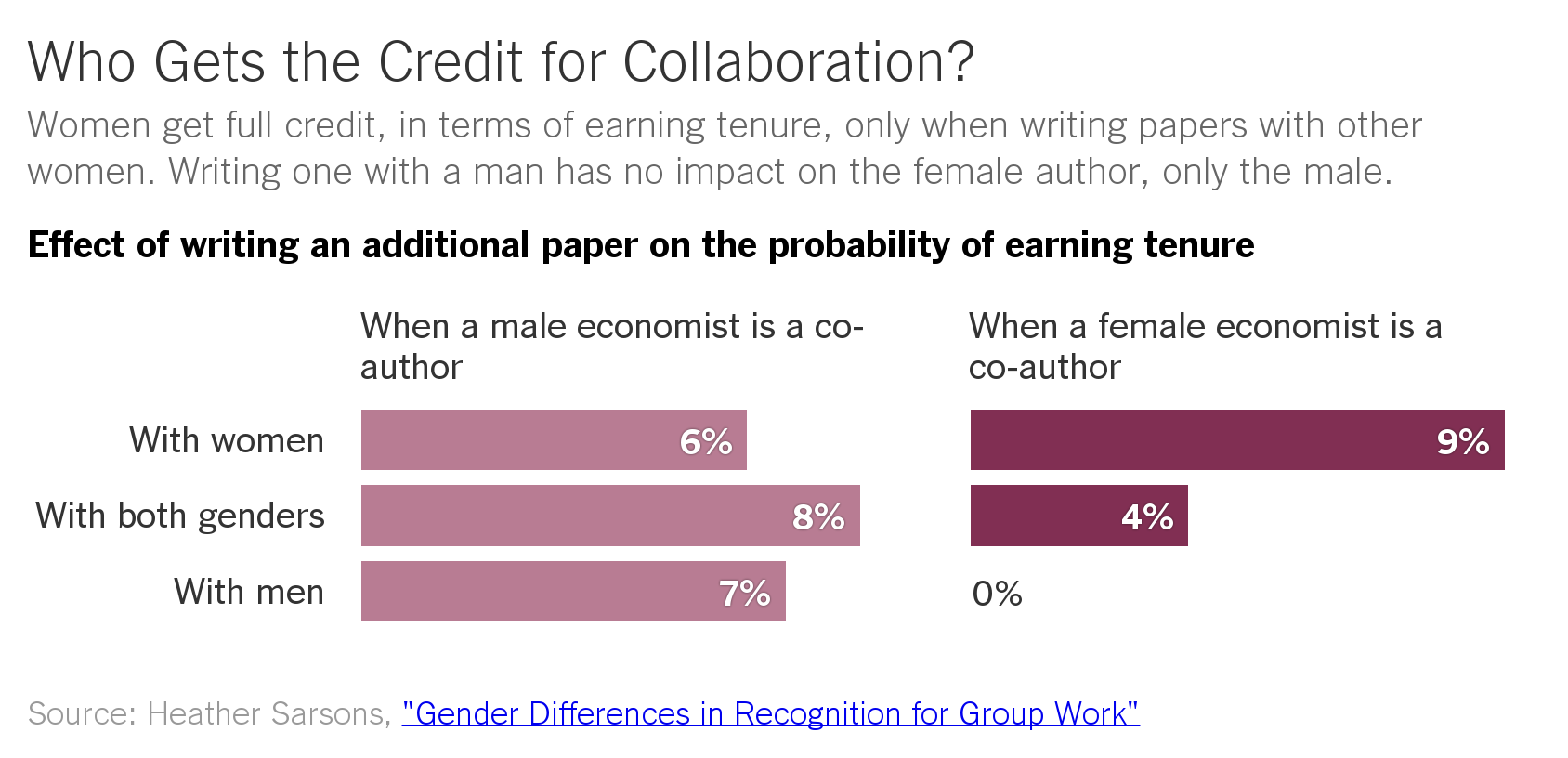
Co-authorship does present challenges when assessing someone's record, no doubt. Indeed, I was denied promotion to full professor at my previous job since my second book essentially counted as zero because it was co-authored. The signalling of my name going first despite not being in alphabetical order was ignored. Why? Not sexism and not because co-authorship is wrong as one of my leading opponents had co-authored stuff. No, the problem was that a handful of individuals didn't want me to get promoted and then read the file the way they wanted to, even if it was hypocritical or logically inconsistent or both.
It may be that economists on tenure committees just tend to devalue the contribution of female co-authors in general or it may be that they use the co-authored work to diminish records so that women are denied tenure. It ain't pretty either way you look at it.
This sends such an awful message, particularly given the other inequalities that already exist. Since the econ profession is still male dominated, co-authoring with senior faculty means co-authoring with men mostly. So, this article's findings suggest that women should avoid doing that. Indeed, the way to proceed is to solo author. While it is fine to solo author, doing so to avoid the slings and arrows of sexist senior males puts women at a competitive disadvantage as they lose publishing opportunities. The catch-22 is this: publishing with other folks can help get more/different stuff out and cited but then it gets discounted?
I don't know if this bias is as bad in poli sci. The paper indicates that it is not as big a problem in sociology. Maybe partly a function of how male dominated each discipline is. I do know that political science is far more co-authored now than in the past, that folks struggle with how to evaluate co-authored work, and, yes, there is still sexism in poli sci.
The real Iron Law that matters here is this: people will read a person's tenure package positively if they want to, and negatively if they want to. They can find things to nitpick if they want to deny tenure and they can come up with justifications if they want tenure someone with a shaky record. The best way to shield against that particular dynamic is to have the best record possible, making it hard but not impossible for those motivated to vote now to do so AND to give folks up the chain of decision-making reasons to overturn bad decisions AND to have a record that makes one competitive elsewhere if things go awry. What that means for co-authoring in political science for women? Not sure, although the safest bet has always been to do some solo work to demonstrate one can work on their own.
- the popular sense of wow, amazing, cool
- and the original sense of this is so awful that I feel scared.
Co-authorship does present challenges when assessing someone's record, no doubt. Indeed, I was denied promotion to full professor at my previous job since my second book essentially counted as zero because it was co-authored. The signalling of my name going first despite not being in alphabetical order was ignored. Why? Not sexism and not because co-authorship is wrong as one of my leading opponents had co-authored stuff. No, the problem was that a handful of individuals didn't want me to get promoted and then read the file the way they wanted to, even if it was hypocritical or logically inconsistent or both.
It may be that economists on tenure committees just tend to devalue the contribution of female co-authors in general or it may be that they use the co-authored work to diminish records so that women are denied tenure. It ain't pretty either way you look at it.
This sends such an awful message, particularly given the other inequalities that already exist. Since the econ profession is still male dominated, co-authoring with senior faculty means co-authoring with men mostly. So, this article's findings suggest that women should avoid doing that. Indeed, the way to proceed is to solo author. While it is fine to solo author, doing so to avoid the slings and arrows of sexist senior males puts women at a competitive disadvantage as they lose publishing opportunities. The catch-22 is this: publishing with other folks can help get more/different stuff out and cited but then it gets discounted?
I don't know if this bias is as bad in poli sci. The paper indicates that it is not as big a problem in sociology. Maybe partly a function of how male dominated each discipline is. I do know that political science is far more co-authored now than in the past, that folks struggle with how to evaluate co-authored work, and, yes, there is still sexism in poli sci.
The real Iron Law that matters here is this: people will read a person's tenure package positively if they want to, and negatively if they want to. They can find things to nitpick if they want to deny tenure and they can come up with justifications if they want tenure someone with a shaky record. The best way to shield against that particular dynamic is to have the best record possible, making it hard but not impossible for those motivated to vote now to do so AND to give folks up the chain of decision-making reasons to overturn bad decisions AND to have a record that makes one competitive elsewhere if things go awry. What that means for co-authoring in political science for women? Not sure, although the safest bet has always been to do some solo work to demonstrate one can work on their own.
Wednesday, September 2, 2015
Pondering Sexism in Syllabi
After a duck of minerva piece (and associated published article) that documents some sexist patterns in what appears on IR syllabi, there has been some pushback, suggesting that choosing women's work over men's might be sexist as well. Damn. What to do?
Well, I had several reactions:
Well, I had several reactions:
- um, guilty? I tend to promote women's stuff here, as their stuff tends to get omitted from favorite book lists (which might just shape and be shaped by syllabi), and given the quality of this stuff, their work is not being omitted due to being inferior. I tend to assume sexism is in play in ways that work against women because I have seen a heap of sexism in the field. It is not like men are not being cited and not being listed on syllabi, so I don't fear that they (we) face discrimination.
- Any view that women's work might be cited less/used less on syllabi because it is inferior needs to have a theory of inferiority. What would make women, on average, do worse work than men? I have no idea.
- I do have a theory of male inferiority: that some men have been able to succeed due to privilege and even have reinforced existing patterns of discrimination that they can publish inferior work in top outlets and appear on heaps of syllabi. I call such folks IR trolls. That I might discriminate against using the work of big name males because I am not sure their work is as good whereas women's work had to be better to get published/cited/become canonical.
- Seriously, women and men, on average, do equally good work, so if I find a syllabus having many more work by males than by women, I swap out some of the male work and replace with work written by women. It does no harm since the work is basically equivalent, yet helps to remind students that there are sharp women doing work in this area.
Sunday, July 19, 2015
Vance and Sexual Harassment
There has been a fair amount written about the new Chief of Defence Staff General Jon Vance, including this, but people are overlooking a key episode: his career was upended slightly by sexual harassment. After Vance completed his tour in Afghanistan, he came home and started a new job within the Canadian Forces. After several months, he was compelled to return to Afghanistan because his successor, Daniel Menard, got fired for sleeping with his subordinates. Because of the need to find someone who was already prepped to run that important job quickly, Vance was asked to go back. He got to witness what happens to a command climate when a poor example is set.
So, as Vance addresses this key issue in the Canadian Forces, he is even likelier to take it more seriously than his predecessor.
So, as Vance addresses this key issue in the Canadian Forces, he is even likelier to take it more seriously than his predecessor.
Thursday, July 9, 2015
Taking on Sexual Harassment in Canadian Armed Forces
This story suggests that there are divides within CAF over CDS Lawson's stance on harassment: "lack of leadership!" That there are conflicting imperatives to fight sexual harassment but to be quiet. The Chief of the Navy apparently has been much clearer to his sailors. Given Lawson's initial reaction, his then bungled statement, and this apparent leadership division, I am not surprised that the top brass are "literally counting the days until he leaves."
I can speak to a bit of this as I have some junior officer friends who faced a real challenge: that the roll out of the report was met with no new instructions for how to communicate to the troops. My friends chose to talk directly to their subordinates about the report, and then found themselves hanging out to dry as their superiors were like "hey, wait, we don't have guidance."
Given that this military, so proud of mission command in Afghanistan--delegating to the commanders on the ground, does not know how to operate when it comes to these issues, it is definitely time for some new leadership. While much can be structural/institutional/cultural, the reality of modern militaries is that the chain of command matters a great deal. So, although real, quality leadership is not a magic elixir, it can produce far more change and reform than a change in bosses in other realms (such as academia).
General Jon Vance's job was always going to be tough. It is up for debate whether it is now easier (easier to do better than his predecessor) or harder (more messes to clean up). I vote for harder.
I can speak to a bit of this as I have some junior officer friends who faced a real challenge: that the roll out of the report was met with no new instructions for how to communicate to the troops. My friends chose to talk directly to their subordinates about the report, and then found themselves hanging out to dry as their superiors were like "hey, wait, we don't have guidance."
Given that this military, so proud of mission command in Afghanistan--delegating to the commanders on the ground, does not know how to operate when it comes to these issues, it is definitely time for some new leadership. While much can be structural/institutional/cultural, the reality of modern militaries is that the chain of command matters a great deal. So, although real, quality leadership is not a magic elixir, it can produce far more change and reform than a change in bosses in other realms (such as academia).
General Jon Vance's job was always going to be tough. It is up for debate whether it is now easier (easier to do better than his predecessor) or harder (more messes to clean up). I vote for harder.
Wednesday, July 8, 2015
Sexism in Political Science: Fact or Fact?
There is a discussion on PSR about sexism in political science, with most folks concurring that it is still an issue with some deniers pointing out that support groups for women are exclusive, too. Um, yeah. How to address such discussions? I go to my standard operating procedure: what have I seen over the years? The answer: a heap of sexism which has not gone away.
First, there is the repeated myth that jobs are gamed for women and minorities, which explains why white men don't get jobs. Of course, this defines all women and minorities who do get jobs as less qualified. The problem with this myth is that it is not true. I cannot speak for the other subfields, but my work with the TRIP data indicates that IR scholars are mostly white (80*%) and mostly male (70%), and that these numbers have only changed modestly since they started doing TRIP surveys ten years ago. You would think that if most of the jobs were going to women and minorities, the numbers would have swung. I also would not have much in the way of male friends in the business that are my age or younger if women were always or mostly beating the men.
In my career, I have lost many job competitions and I cannot think of one where an inferior woman beat me out. I have mostly lost to males, including some I consider superior to me, some that are my equals and a few that I would consider to have inferior records at the time. Indeed, most of the job searches I remember, I was competing against other men, including my first and second tenure-track/tenured jobs.
The repetition of this myth helps to foster sexism by allowing the men who share it to consider the women (and minorities) as inferiors who did not earn their jobs. Indeed, I originally came out on PSR as myself to de-myth a job search my department was running--that we were only looking for females for a particular job search.
Second, while sitting in various departments, I have seen plenty of sexism. At my first tenure track job:
Third, almost always when I see a list of a person's favorite books recommended on some blog, it has somewhere between zero and one females. Which is why I wrote this post a while back which took little time to write since most of my favorite books are by women. Similarly, we see plenty of panels and workshops that have few, if any, women, such as the most recent Aspen Forum.
Fourth, we actually have some IR scholars lamenting the end of the Old Boy's Network. Note Boy's and not Girls or Kids or whatever. These folks sit in powerful positions.
Fifth, I also see my female friends be far more burdened by service (there was a recent graph flying around the internet demonstrating that women and minorities do far more service than white men). Since there are relatively fewer women and minorities who are tenured or Full, they tend to get hit with lots of requests as people want a balance or representation on committees, among letter-writers, whatever. Good intentions that lead to bad outcomes since service goes unrewarded.
Sixth, I have seen far more attacks at PSR on women for their looks, for their relationships, for daring to beat a man out in a job competition and more. I don't think that PSR is representative of the discipline, but it does shape attitudes and perceptions. I don't think the profession is as hostile to women as it used to be, but PSR often makes the case that not much has changed (the evidence would be more obvious if the moderators didn't delete many of the offending posts and threads).
Seventh, women get paid less, promoted less despite/because of doing more service, and get less research money. Thanks to Page Fortna for reminding me of this (in the comments).
I am sure there is plenty of sexism that I didn't observe as it did not affect me directly, and I tend to be oblivious. The reality is that path dependence is a bastard--making it harder to compensate for the sins of the past. Of course, there are still plenty of sinners still around as I have discovered in my academic travels. There has been progress, as there are more women who are successful and have gotten tenure, but there are still plenty of impediments and enough men with lousy attitudes/beliefs. Which is why we need some vigilance when people put forth the old BS.
First, there is the repeated myth that jobs are gamed for women and minorities, which explains why white men don't get jobs. Of course, this defines all women and minorities who do get jobs as less qualified. The problem with this myth is that it is not true. I cannot speak for the other subfields, but my work with the TRIP data indicates that IR scholars are mostly white (80*%) and mostly male (70%), and that these numbers have only changed modestly since they started doing TRIP surveys ten years ago. You would think that if most of the jobs were going to women and minorities, the numbers would have swung. I also would not have much in the way of male friends in the business that are my age or younger if women were always or mostly beating the men.
In my career, I have lost many job competitions and I cannot think of one where an inferior woman beat me out. I have mostly lost to males, including some I consider superior to me, some that are my equals and a few that I would consider to have inferior records at the time. Indeed, most of the job searches I remember, I was competing against other men, including my first and second tenure-track/tenured jobs.
The repetition of this myth helps to foster sexism by allowing the men who share it to consider the women (and minorities) as inferiors who did not earn their jobs. Indeed, I originally came out on PSR as myself to de-myth a job search my department was running--that we were only looking for females for a particular job search.
Second, while sitting in various departments, I have seen plenty of sexism. At my first tenure track job:
- one faculty member was sleeping with multiple female grad students, creating a very hostile work environment for all; I was told that one of the perks of the job was "they let you screw the students here."
- one faculty member said at a job search meeting that a female candidate did not need the job because her husband had a job;
- every sexual harassment workshop for the department was trivialized by some of the older males.
Third, almost always when I see a list of a person's favorite books recommended on some blog, it has somewhere between zero and one females. Which is why I wrote this post a while back which took little time to write since most of my favorite books are by women. Similarly, we see plenty of panels and workshops that have few, if any, women, such as the most recent Aspen Forum.
Fourth, we actually have some IR scholars lamenting the end of the Old Boy's Network. Note Boy's and not Girls or Kids or whatever. These folks sit in powerful positions.
Fifth, I also see my female friends be far more burdened by service (there was a recent graph flying around the internet demonstrating that women and minorities do far more service than white men). Since there are relatively fewer women and minorities who are tenured or Full, they tend to get hit with lots of requests as people want a balance or representation on committees, among letter-writers, whatever. Good intentions that lead to bad outcomes since service goes unrewarded.
Sixth, I have seen far more attacks at PSR on women for their looks, for their relationships, for daring to beat a man out in a job competition and more. I don't think that PSR is representative of the discipline, but it does shape attitudes and perceptions. I don't think the profession is as hostile to women as it used to be, but PSR often makes the case that not much has changed (the evidence would be more obvious if the moderators didn't delete many of the offending posts and threads).
Seventh, women get paid less, promoted less despite/because of doing more service, and get less research money. Thanks to Page Fortna for reminding me of this (in the comments).
I am sure there is plenty of sexism that I didn't observe as it did not affect me directly, and I tend to be oblivious. The reality is that path dependence is a bastard--making it harder to compensate for the sins of the past. Of course, there are still plenty of sinners still around as I have discovered in my academic travels. There has been progress, as there are more women who are successful and have gotten tenure, but there are still plenty of impediments and enough men with lousy attitudes/beliefs. Which is why we need some vigilance when people put forth the old BS.
Tuesday, June 30, 2015
Diversity vs Merit? Storifying a Strong Criticism of a Weak Critique
Andrew Coyne wrote a fairly lame piece about the Liberal promise to have a diverse cabinet--that 50% of the ministers would be women. Well, I am glad I didn't take it on, as Lauren Dobson-Hughes took it apart nicely so we don't have to do so:
Wednesday, June 17, 2015
A Mediocre Day for Women and Their Allies
Three events occurred yesterday that do not advance the cause of women at least in the short run:
- Donald Trump announced his presidential campaign
- Chief of Defence Staff Tom Lawson said that the sex assault problem in the Canadian Forces was due in part to biology
- I saw Jurassic World.
Subscribe to:
Posts (Atom)