Saturday, July 13, 2013

The Military Industrial Congressional Academic Complex

Yesterday, a twitter friend started posting about defense dollars being spent at universities.  He was making a point about how people seem not to realize how much $$ go to universities from DoD:


I first took him seriously and defended the academic-military relationship, although he didn't need the lecture.  But since I had a bunch of tweets on this, I thought I would explain my take, as some folks do worry about academics getting money from the military or from government.

The first point is simply this: if one is going to do research that requires coding (and thus graduate students and/or undergrads) or travel for interviews, fieldwork, whatever, then one is going to need money.  Where does that money come from?  In Canada, there is not much in the way of private sources of cash, so one relies on one of the national grant agencies (universities tend to provide little $$ for research expecting that their profs get the national money).  If one does international relations, one can apply for money from the Department of National Defence and from the Department of Foreign Affairs, Trade and Development.  One could seek out money from the corporate sector (not so much in my area), but if people worry about the taint of government, the taint of corporations might bother them more.

My attitude towards govt $, military or otherwise, is simply this: if they do not tell me what to say or how to say it, then I am not worried about strings.  I understand that people might fear potential retribution which might cause self-editing, but I have yet to feel any pressure to say what I think the government wants me to say.  Indeed, my blogging and my pubs are not very filtered, with heaps of criticism towards the governments of the countries I study and also often of the oppositions of those governments. 

I can see how getting too buddy-buddy with the folks we study could cause problems, but extreme distance is also harmful because then we have no clue about that which we are studying.  Life, as always, is full of tradeoffs.  My preference ordering generally would be: university $ > national grant agency $ > government $ > private for profit $.  If I worked in the US, I would probably put non-profit (Carnegie, Ford, Pew, etc) in between university $ and national grant agency $.  Of course, once one adds in status and expectations, the ordering changes a bit with national agencies being seen as more prestigious and generally more valuable to one's universities since they get a cut.

I have long sucked at the teat of government in doing my work.  When I was a grad student, I received funding from the Institute on Global Conflict and Cooperation, which is a U of Cal system wide institution that essentially represents the conscience money given to the UC schools to compensate for running the nuke labs.  IGCC was originally run by physicists who discovered sin--that they wanted to study how the stuff they built would not be used.  IGCC was mighty good to me, as has Canada's Dept of National Defence has been, with a couple of small grants to help with workshops and research travel (my trip to the Netherlands a couple of years back). 

So, when I hear folks complain about defense dollars going to the academic world, I think about how little my work has been shaped by those who gave me money, and how grateful I am to their generosity and their distance.  It is not a perfect world, which is why it is so much fun to study, and as I try to make folks aware of the tradeoffs policy-makers need to face, I try to make sure I am aware of the ones I make.  Consider this post a reminder to myself.

Friday, July 12, 2013

A Day Late, a Shark Short?

Space, the scifi channel in Canada, showed Sharknado tonight.  I missed the first 30 minutes since I had not realized it was on, so I might have missed some key bits of plot that would have made the movie make sense.... or not.  Anyhow, it was just delightfully awful as twitter reported last night.

My big complaint: they had a weapons-making scene but failed to turn it into a montage!  We needed a montage:


Alas, it was not to be.  My other regret was the 24 hour delay meant I could not participate in the twitter conversation last night.  Oh well, I am just glad I could see The Narrative work its way through most of L.A.

Environmental Xenophobia

I have not been following the writings/speeches of David Suzuki as I do not study environmental politics. However, he seems to have crossed over to my territory: xenophobia.  He criticized Canadian immigration policy as "we plunder southern countries by depriving them of future leaders," which might sound somewhat reasonable (more in a second).  However, he also said "Canada is full, too!  Although it's the second largest country in the world, our useful area has been reduced."  That second part is so chock full of stupid that it makes the rest of his statement quite tainted.

Yes, if the advanced countries of the world set up immigration policies intended to lure the best and brightest to Canada, then Canada is doing less developed countries a disservice.  One can criticize immigration policies for having negative impacts on other countries.  I think the issue is more complex than that, as the possibility that the best (smartest, most trained, most talented, whatever) might leave can serve as a brake on governments from pursuing bad policies.  If they cannot exit, a key restraint on bad (or worse) policy policy is gone.  The article that discusses this also mentions remittances--that the immigrants tend to send income back to the homeland.  Indeed, remittances have become a major source of income in less developed countries. Anyhow, still, one can debate the pro's and con's of immigration policies that might entice the skilled to leave the countries that need those skills.

One cannot really debate that there is heaps of room in Canada.  It is one of the most underpopulated countries on the planet: 2nd largest country with 33 million people.  Even if one were to exclude from the math the various territories that are not so inhabited or inhabitable, Canada is a big country with lots of space.  Sure, Toronto and Vancouver are facing significant pressures because of the flow of immigrants, but there are plenty of smaller urban areas in Canada that have room for immigrants.  The country has heaps of fresh water and energy and food.  The immigrants are mostly coming from places that lack fresh water and energy and food.  Which is better for the global environment?  Keeping people where there is scarcity?  Or letting some to move to where there is abundance?

I am not an expert on the environment, but claims like what Suzuki has made suggests that he is not either.  Out of space?  Canada?  Looks like intolerance of foreigners to me... and that would be xenophobia.  Perhaps Suzuki is not a xenophobe, perhaps he just sucks at math. 

Helping a New Dean Out

Recently retired Admiral and former SACEUR (military head of NATO) James Stavridis is now a Dean at Tufts, and is "drinking from the firehose."  That is, getting heaps of info in a short period of time to learn the new job.


This is not new to him, as the US armed forces tend to move officers from job to job and they have to learn quickly the new stuff, like a submarine commander being put on the Joint Staff's Balkans desk.  I witnessed the ability of this sub captain and many others to learn completely new tasks quickly.  Still, as someone who has studied NATO for several years and has dwelled within academia for two decades, I thought I could point out for the Admiral a few key differences/similarties between his old job as SACEUR and his new job as Dean of the Fletcher School.
  • Remember how you could not remove easily those officers countries put under NATO command?  Well, tenured professors are even more difficult to remove.  The good news is that you can alter what the profs get paid or what their portfolio of responsibilities might be (direct a center? maybe, maybe not), whereas the capabilities of your subordinates in NATO were largely determined by what their home countries gave them.
  • When countries transferred their contingents to your command, they let you know most, if not all, of the restrictions that limited their usefulness (caveats).  Most professors and sub-units will NOT be so clear about what they will and will not do.  Oh, professors, unlike countries, can change their minds quite frequently.
  • Just like in NATO, not all of the professors will show up when something important is going on.  
  • No worries about trying to get consensus--imagine if there are many Greeces and Turkeys playing out their various dysfunctional interactions in ways ways that block committees and thus block progress.
  • The good news is that the stakes are far lower at Tufts than in Brussels.  The bad news is that the lack of urgency means that folks will not be motivated as much.  In the case of NATO, countries would relent and join the common good if the future of NATO was at risk.  Hard to get all hands on deck when the future of Tufts and of Fletcher is not at risk (unless Drezner gets one of those Sharknado movies filmed on campus). 
Seriously though, I am sure that you will be a terrific Dean, especially as it will allow you to continue to engage in public debates and lend your expertise to the issues of the day.  Tufts is lucky to have you.  

Thursday, July 11, 2013

Supercalifragalicistic

Apparently the author of Mary Poppins was not all that thrilled to be in business with Disney.  There is a movie coming out with Tom Hanks as Walt Disney and Emma Thompson as P.L. Travers, depicting the tensions behind getting the rights and making the movie.

We lived on Mary Poppins during a pivotal time in Toddler Spew's life--at 2 years old, she needed corrective surgery (not life-threatening but not life-fun either).  The time in the hospital was largely spent watching the same movie over and over again--Mary Poppins.  Given its length and its quality, this was ok--as it repeated less often than a shorter movie and had heaps of goodness in it. And as a result, I not only named an article after a key Mary Poppins utterance, but would use the movie to illustrate runs on banks for my Intro to IR class.

So, thank you, Walt Disney.  You might not be perfect, but you gave me and my family a movie that served as many spoonfuls of sugar that, indeed, helped the medicine go down.

Feeling Guilty About Guilt: Guilt II Electric Boogaloo

I have gotten a fair amount of pushback on twitter and facebook for my post earlier today about guilt, and I deserve it.  Indeed, I feel guilty for what I wrote.  Ok, for guilty for how I said it.  Clearly, academics research for many reasons, including the thirst for knowledge, the enjoyment of interviewing/reading/writing/coding (coding? enjoyable? um, hmmm), competition with friends and not-friends, ambition (defined in many ways: to move up, to be influential, to get raises, whatever), and more.  Guilt is not the only motivator or the most important motivator of research, but as most of deadlines are self-inflicted (we go to conferences to set artificial deadlines to get us to get work done), making progress in our thirst for knowledge, in our grant-writing (oy), in our competition, in our ambition often is accompanied by a feeling that we are falling short.  I call this guilt.

For most folks in this business, there are three things we must do--teaching, research, and service.  Most people are probably not equally passionate/thirsty/whatever in all three.  For some, research is the price of doing what one truly loves--teaching.  When I was in grad school, the Designing Political Research class started with the prof asking us what we wanted to do.  Pretty much all of us said: teach at a liberal arts college.  Research would be necessary to get and keep such a job but the focus would be engaging young minds.  Well, most of us did not end up at Oberlin or Dartmouth (ok, one of us ended up at Dartmouth).  Most of us (including the one at Dartmouth) did get turned on to doing research*, and then the job market market sorted us now, mostly sending us to places where research was expected.  Anyhow, this tangent permits the next one: that not only is research something some do so that they can teach, but teaching is something that some people do so that they can do research. 
* The irony is the Dartmouth guy outclassed everyone else in terms of pubs, cites, influence and profile, and is so damned nice and decent that it is hard to hate him.  But his wife and kids are so terrific that, well, it becomes easy to hate him (kidding).
So, for some researchers, teaching is not the passion, but one  works at teaching well because of obligation and guilt (more on obligation vs. guilt below).

Service?  Sure, a few folks grab service obligations with both hands and revel in meetings, reviews, and all the rest, but for most of us, service is an obligation.  But it is an obligation that many folks avoid/evade.  Why do it, as it often gets in the way of teaching/research?  I posited an answer--guilt.  Is guilt the same as obligation?  I owe it to my colleagues to do this stuff, so that I am not a shirker?  That collective action must be provided or else we will all suffer?

Well, I have had plenty of colleagues who reveled in shirking and some who seemed super-human in how much service they would do (JJ, JL, what is it with the J-folk?) compensating for the shirkers.  In most of my career (with an exception for a couple of years at the end of my last job), I have rarely said no.  I tend to say yes to tenure review requests, to journal review requests (unless I am already over-committed or the stuff is out of my area) and so on.  I agreed to supervise a dissertation at Carleton only a couple days after I accepted the job and many months before I moved there.  I was thinking about guilt today in part because I was feeling guilty for saying no--to Carleton undergrads who need supervision for their honor's theses.  Because I am in a school (the Norman Paterson School of International Affairs) that has no undergraduate program, I feel less obligated to serve on such committees ... but I still feel guilty. 

So, I guess my first post should have focused on, in part, when are obligations sufficient to obligate and when does guilt (and/or shame as one FB friend suggested) play a role in getting people to do what they are supposed to do?  If I knew the answer to that, I might be good at doing more service ;)

To be clear, I still think we profs feel guilty much of the time--that we are not doing enough, not being productive enough.  I was trying to think about how productive this guilt can be, although some have said on twitter that guilt makes it harder to write.  Hmmm.  Now I feel guilty for wasting lots of my time and others for not really resolving anything.  

Guilt Is The Key

People wonder why tenured professors with job security in hand might keep on keeping on.  Why do they say yes to projects, to reviewing articles for journals, to serve as external referees for tenure/promotion cases, and so on?  I was feeling bad about the time I was wasting this morning standing in line at the grocery story because I did not blog at all yesterday.  Whuck?

Jeez, my blog is purely a voluntary activity, that I write mostly for myself, that I never expected to get much traffic, and only goes viral when I attack certain academics.  Yet I feel guilty if I don't keep it going.  I used to try to have several entries a day (kept that up for a few years), and now I just try to keep it going.  Most days, it is not that hard, but sometimes I lack inspiration.

But this speaks to a larger issue: that which divides academics is not really about ambition but about guilt.  In any department, there is a mix of people who are reliable and those who are not.  The unreliable people are unreliable either because they are somehow broken--that they screw up when asked to do stuff--or are rational.  That is, if you develop a reputation for being unreliable, then people ask you less often to do stuff.  The unreliable seem not to feel the guilt or perhaps are not motivated by guilt.  I felt guilty even as I embraced being partially unreliable in my last years at my previous job.

If you are reliable, well, you get asked to do more stuff.  So, why do more stuff?  Why do folks publish after tenure?  Partly there are pay increases and potential desires to remain mobile, but for most folks, they are not moving.  Why agree to do service for which there is little reward?

My answer: I think that the professing profession socializes us into feeling guilty if we do not keep at it, that we need to be constantly thinking about our research, that we need to keep writing even after we make full professor, that we need to keep on keeping on.

Our profession requires a great deal of self-motivation because we have many tasks to perform and no one telling us what to do at any given moment or how to do it.  The immense freedom we have to use our time as we see fit is the big advantage of being a professor.  But this freedom can be problematic if we do not have something pushing us to do what we are supposed to do.  Chairs/deans have limited abilities to get people to contribute.  Ambition can play a role to a certain degree, but I do believe that this profession mostly operates via guilt--a sense that one is letting others and oneself down if not doing what one is supposed to do.

Sometimes I see somebody doing a 9-5 job and I get a short pang of jealousy as I know that they can leave the job when they leave the job at the end of the day--that they are not thinking about work afterhours besides bitching about bosses and such.  Of course, I quickly realize I would be miserable under those conditions.  I spent a year being in a tight hierarchy, was told what to do, had my work re-written multiple times, and had to send up papers and slides with arguments that I didn't buy but were the ones the organization was pushing.  I tolerated that part of the job because the rest of the experience was so very cool, but there is no way I would want to do that forever.

The guilt goes with the territory, and it is a small price to pay for having a cool job.  But it does not go away.  Not even in summer when we are "off", not even when there are no more promotions to be had.  So, I accept the guilt that writing my blog means not writing stuff that "counts" and that writing the stuff that counts means I am not doing other stuff.  And yes, when I am on vacation, that is time I am not spending on my work.

I probably have not articulated this well, and it may sound whiny or entitled that guilt is my motivator, so I guess I should feel guilty for this post, right?

[Update: check out this supplemental post as I am feeling guilty about what I wrote here]

New Spew Contest: Best Airport Code

YOW is the designation for the Ottawa airport.  Having that for an airport in a national capital is too perfect.

So, the challenge, dear readers, is this: are there any contenders among the world's airport codes for suitable match?  Or at least amusing?  Winner gets my undying admiration.

Update: so far, the suggestions have been ironies (Singapore and SIN, Helsinki and HEL) and amusing (BAD, SUK), but appropriate?  

Tuesday, July 9, 2013

Texas Women Fight Back

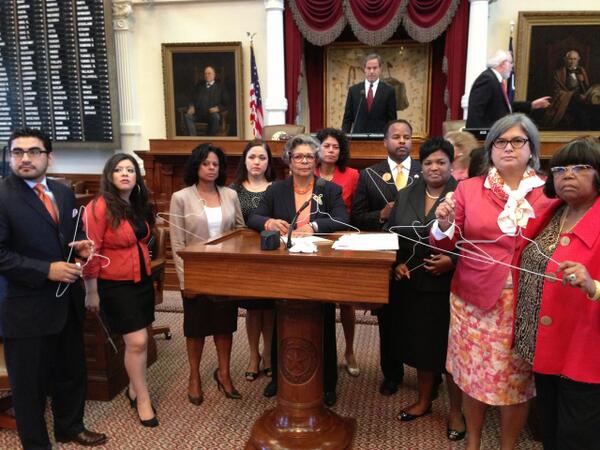
This picture is just amazing:
Yep, they are using hangars as their symbol, that the efforts to essentially eliminate legal abortion in Texas will return the state to the dark days.  Oh my.  And, no, they cannot count on the US Supreme Court to make sure that states do not pass unconstitutional laws as we can never tell how Anthony Kennedy will swing his vote.  Lovely.

Anyhow, I do think that this woman might be right--that the Texas legislators may have unleashed something pretty powerful. It may not win the day today or tomorrow, but Texas's future is going to be mighty interesting.

Shuffle Up and Deal extended

I posted a piece at CIC today on Canada providing a potential alternative to the German Defence Minister as Secretary General of NATO.  The piece got cross-posted to The Globe and Mail where it picked up more than a few critical comments.  It turns out that many Canadians are not big fans of MacKay. 

Frankly, neither am I.  I don't like how DND has been run the past several years, especially with evasion of hard choices and the dumb set of cuts on operations and maintenance.  But Sec Gen candidates are usually ex-Prime Ministers or ex-Defence Ministers.  I cannot imagine Canada putting forth Paul Martin or Jean Chretien, eh?  So I posed the one possibility.  And geez, the response has me admiring the passion of these folks.

I am sure both CIC and G&M are thrilled to get the traffic, but I was not really trolling.  One of the question I get asked a lot and I have a hard time answering is: what did Canada get in terms of influence from the heavy price it paid in Kandahar.  If Canada got the Sec Gen seat at NATO, that would answer the question pretty clearly.

I doubt that Canada will get that seat, as it really is a European game.  If it cannot be Canada, I hope it goes to Poland or Romania.  I am just really glad that CIC kept the poker reference for the title.

Tradition or Squirrel?

I had a running argument on twitter with http://twitter.com/pmlagasse about the new effort by the Harper government to bring back more Royal stuff to smother the Canadian army in tradition.  Phil likes it because it reminds people that the Crown is the fount of all that is Canadian, more or less.  I dislike it because Harper is trying to re-define Canada's identity away from multilculturalism.  Identity politics can be fun, but I tend to worry that efforts to change the status quo often do not ponder the implications very far.  I also hate it when Conservatives are anything but conservative--proposing change almost for the sake of change but definitely not being conservative about change.

The fun part was watching a pair of Ottawa friends, including one who is a reservist with much CF experience, take on Phil last night and this morning, pointing out, among other things, that the old traditional symbols have a history that includes being unkind to women, gays, minorities and so on That was not really my point, particularly since I don't know much Canadian history.  I just think this is a poor time to be revising the various symbols when the military is facing pretty sharp and pretty thought-less cuts.  Sure, the military could stand some cuts, but how about some real choices?  Nope, let's just bring back some old symbols.

Oh, and my favorite part is renaming the various areas of responsibility in Canada from Land Force x Area  (which always seemed a bit long and less than thrilling legacy of unification) to Canadian Division x.  Which would be fine, since the old Canadian divisions have a heap of history.  BUT the fun part is that a division usually has between 10k and 20k soldiers and there are 20k soldiers in the Canadian Army, which means that having five or so divisions listed is just a wee bit deceptive.

So, I am just tired of this royally flavored bit of distraction sauce.  Some other time I will have to take more seriously the identity debate in Canada.

Monday, July 8, 2013

PD Played Correctly

I have often complained about Hollywood getting Prisoner's Dilemma wrong and do note when they get it right. My big regret about the third Matrix movie tanking so badly that referring to its awful PD resolution does not work very well--folks have just not seen the movie.

So, it is silly of me to discuss Falling Skies since it has not been that widely viewed.  However, since I am catching up on season 2 (way behind, since TNT is one of the few US channels that I don't get one way or another on my Canadian sat dish, along with FX), I thought I would mention it. 

Spoilers below

Sunday, July 7, 2013

Best Breast Rap

This piece of art is very much on-target:


I don't remember my wife facing much hassle during the time she nursed Baby Spew, but perhaps sleep deprivation at the time dulled our awareness. 

Anyhow, it is pathetic that we still have so much intolerance for something that the medical profession has advocated so strongly.  It is a boob doing what a boob is supposed to be doing.  If you got a problem with that, stop staring and walk away. Damned few boobs and babies are so big or so bedazzled that one cannot look away. 

For more on the story of this rap, go here.

The Jeff Ross Rule of Politics

When comedians joke about a tragedy, they often will then respond to the groans with "too soon?"  Jeff Ross does this all the time to great effect (I cannot access the relevant videos from Canada so I cannot pick out a suitable one).  Gilbert Gottfried famously made a 9/11 joke no that long after 9/11, and got a heap of backlash.  The classic comedy equation is: pain (yours or other people's) plus time = funny.

When something happens in the political world, the question is how soon is too soon to respond with criticism of the incumbents.  Thomas Mulcair came out immediately after the train tragedy in Quebec yesterday to criticize the government for gutting rail safety.  Is this too soon?  The town is still burning and we don't know the toll yet. 

I don't know, as my immediate reaction to the events in Sandy Hook was to call for gun control.  As in comedy, in politics, everything is in the eye of the beholder.  One is likely to see a politician speaking out too soon if the politician is one you oppose but not if it is one you favor.  Gun control advocates jumped on Sandy Hook because it gave them a ready example of how tragically flawed American gun control policy is.  Gun rights advocates were as quick to jump on this response.  Of course, the messenger has some influence over this as well--Jeff Ross gets away with jokes that others would not because he is aware of "too soon" and plays adeptly with it.

We live in a very quick culture these days where reactions to all events are immediate.  I essentially watched the plane crash in San Francisco yesterday on twitter as it happened. We have long lost our ability to ponder a bit before reaction.  Twitter, facebook, 24 hour networks create pressures/temptations to react quickly.

For politicians, it is a delicate balance between being seen as opportunist, as Mulcair was, and too slow.  We probably should be sympathetic to their plight, but context always shapes this.  For observers of Mulcair, the tempation is to wonder if the fact reaction was part of the broader pattern to pander to Quebec at the expense of the rest of Canada, not just to note that this tragedy happened on the Conservative watch during a time of deregulation.

Of course, I would prefer folks to react too soon than too late.  When it comes to guns in the US, every day is too late, of course, with more dead piling up.  When it comes to re-thinking de-regulation in the light of the Quebec tragedy and those elsewhere, it is probably better to move quickly.  The momentum on deregulation really needs to be reversed not just in the US but in Canada as well.

So, despite my nasty tweet or two about Mulcair's apparent opportunism here, I guess I can see that "too soon" is the least of our problems. 

Biting the Hand That Feeds You

Brian MacFadden takes some big swings at the media, of which he is a member:


Shots fired indeed!

Next Secretary General of NATO?

This story (I used google translate to read it) was re-tweeted this morning by @natosource, and I am flummoxed.  It appears that German Federal Defence Minister Thomas de Maizière is the frontrunner for being the civilian head of NATO--the Secretary General.  

For the past several years, NATO has been led by Anders Fogh Rasmussen of Denmark.  Whether Denmark was more supportive of NATO efforts in Afghanistan and Libya because its former prime minister was heading NATO or vice versa, a country that bore the burdens was represented in that seat.

Germany has gotten far more criticism of its efforts than it deserves (it deserves some), as putting 5000 troops into Afghanistan was costly in money, in blood, and in political capital back home.  Germans got little credit for the effort, as the restrictions imposed partly by the Bundestag and partly by the Defence Minister meant that the Germans had a disproportionate impact on their areas of operation.  That is, smaller than it should have been.  They were the lead nation for police training, which made no sense since their rules meant that the German police trainers and the German army personnel could not cooperate with each other.  This meant only mentoring on bases, which ain't much mentoring.  But Germany was not the only semi-reliable ally--Italy, Spain, Hungary and others also did much less than expected. Germany under-performed even more during the Libyan effort by refusing to even contribute to the naval embargo, along with Poland and several others.

Still, in the aftermath of a decade of doing less than expected, Germany may still get a countryperson to head NATO?  Holy bad optics, Batman!  It would seem to be suggesting that performance and responsibility are unrelated (repeating the "conditions" attached to membership being largely irrelevant dynamics).  That is a bad signal to send.  And how would de Maizière cajole other NATO members into participating in the next mission, given that his own country might be one of the ones that needs the most cajoling?  

I don't think Germany should be excluded from the various decision-making meetings, such as the old QUINT, but this is a lousy time to be thinking of putting a caveat-laden country that refused to do the minimum during the Libyan campaign at the top of NATO.  Perhaps down the road, but now, in the aftermath of Libya and as Afghanistan continues for a while longer?

Update: I got blasted on twitter for being naive--that international organizations make decisions all the time that have little to do with merit.  Yeah, I know that (see the link above to the Pie Crust Promises piece, which is all about deserving having nothing to do with membership [Or ask how the Greeks got into the Euro zone]_.  But I guess my point here should not have been that a German does not deserve this post but that giving Germany this post will have negative consequences for NATO.  The job of the Secretary General is to get countries to do that which is costly, like contribute to operations, reduce restrictions so that the contingents can be more flexible and so on.   I cannot see how having a German in this spot at this time will do anything but weaken the ability of the Sec Gen to do this kind of work.  Having the Secretary General lean on a country is not a supremely powerful tool but given that all NATO ops are purely voluntary, the shaming/persuasion role of the Sec Gen is key.  
I should not be surprised that NATO and others make bad decisions, like this one looks to be, but I can still get riled up.  Cannot we criticize IOs for doing stupid things even if our political science tells us to expect stupid things?  Hmmmm.

Saturday, July 6, 2013

Doonsebury is Back on the Case

Doonsebury has had a nice week on #voterfraudfraud with the key character being a Crow, not as in the folks who took the Oath to be on the Wall, but Jim Crow.


Do check out the rest of the ones that came out this past week.

Big Loss at UCSD

Ellen Comisso died this weekend.  While she was not on my dissertation committee (my work on Eastern Europe developed after grad school), I took one of her courses.  She impressed me with not just her deep knowledge of a part of the world that was in the midst of dramatic change, but with her intense intellect, her passion for the work, and her interest in the graduate students.  Her views long informed my work as I eventually felt the gravitational pull of the region that was the focus of her work.

Phil Roeder, who is now chair at UCSD and had much in common with Ellen given their regional interests, send this to UCSD folks:
Dear colleagues,

It is with a sad heart that I share with you the news that our dear colleague Ellen Comisso has died. Those of us who were fortunate to know Ellen over the years will profoundly miss her.

The little information available at this time is available in the news reports: http://www.760kfmb.com/story/22769639/womans-body-found-in-san-pasqual

It is difficult to summarize in a few words the complexities and richness of any life. This is even more true when reflecting on the ways that Ellen touched so many of us. I will remember Ellen first of all for her caring and sweetness. (I am fairly certain that Ellen would not have wanted me to call her “sweet.” I apologize, Ellen, but it was true.) Ellen cared deeply about justice, ethics, Eastern European political economy, her classes, her students, and—most importantly—her family. I will also remember Ellen for her strength. (I think Ellen would have approved of this remembrance.) Early in her career this strength was expressed through feisty partisanship for social justice. More recently we saw this strength in her continuing deep commitment to her teaching and her students even as the demands of caring for her own health and for her beloved husband grew.

With deep respect,
Phil
My heart goes out to her family and to the folks at UCSD.  Ellen was a force of nature and a force for good.  She will be missed.

Delayed Trip Report: Budapest and Deja Vu

Going to the Third Parties and Ethnic Conflict workshop at Central European University, organized by Erin Jenne, was all kinds of deja vu for me.  First, other than London (mostly one spring/summer program in undergrad plus visits back since) and Stockholm (one July in grad school),  Budapest is the city outside of North American in which I have spent the most time: two weeks of research in 2002-03, a week of summer teaching at CEU a year or two later, and now this trip.  Second, and, more importantly, outside folks getting involved in ethnic conflicts is where my career accidentally started.  I didn't go to grad school expecting to work in this area, but it is the way it worked out.  Third, the cast of participants included some old friends--Erin, Monica Toft, Will Moore, Idean Salehyan, Kristin Bakke, Sara Mitchell, Steffan Wolff and Brandon Valeriano.  The rest of the participants included people I met once or twice before and folks who I had never met, but the balance of people were old friends.  My unplanned journey the through the profession has meant
meeting a bunch of terrific folks along the way.

Anyhow, the real deja vu was the topic at hand--understanding who intervenes and to what effect.  Most of the papers related quite directly to my work and/or that of my students, so when I wasn't saying "this is what I would have done", which is the typical academic question, I was saying, "this is what my students did."  So, when Steffan Wolf spoke about success and failures of UN peacekeeping, I had flashbacks to Sarah-Myriam Martin-Brule's dissertation, especially as Steffan was taking seriously the partial successes (which SMMB broke down into partial successes and partial failures). 

Artak Galyan was focused on how political institutions interact with ethnic diversity in various ways, harking back to my CPS piece about a decade ago.  I liked how he thought about different combos of institutions and ethnic configurations (polarized, concentrated but not fractionalized).

Erika Forsberg, whom I bump into about every five years, has been working on ethnic ties and intervention for almost as long as I have.  So, it was interesting to see how she was doing it similarly to what I did and differently.

Monica Toft and Kristen Bakke presented back to back on North Caucasus stuff.  Monica's paper was an interesting analysis of data to contrast nationalist and religious dynamics within the region, including a very provocative finding about the timing of violence--the religious extremists tend to engage in violence on their holidays.  I pondered whether nationalists attack on their holidays or on the holidays of their targets (Boston Marathon came to mind).  Kristen's paper focused on the impact of outsiders--that the transnational extremists who joined the fray in Chechnya did produce some backlash.

I was a discussant for two papers: Sara Mitchell's on interstate conflicts and the related water disputes affecting internal conflict and Erin Jenne's paper on how regional contexts affect mediation.  Sara's paper was my most recent taste of water stuff, as my very first grad student, Sam Stanton, found that of environmental scarcities, water was the only one that really influenced ethnic conflict (if I am remembering correctly).  I found her finding that water quantity matters more than quality to be most interesting--downstream folks can subsidize the upstreamers to keep the water clean, but a distributional fight is still a distributional fight.  Erin's paper was striking in that regional strife makes mediation hard, but regional peace is no guarantee of success.  It reminded me of hegemonic instability theory.

Will Moore's paper was about as half-baked as mine, but showed how hard the "contentious politics" folks have it as their various obsessions tend to be very much inter-related--protest, rebellion and repression--requiring more complex modeling.  The best line of this session was when Idean, the discussant, said he wouldn't want to co-author with either of us.  You probably had to be there.

I have been doing this stuff for more than twenty years, with 2013 marking the 20th year of my PhD defense (the celebrations and re-enactments will occur in November).  When I started out, few folks were doing the IR of ethnic conflict, with David Carment, now a colleague, writing pieces justifying the endeavor.  No need to do that anymore.*  Now, there are heaps of folks out there doing very interesting and far more sophisticated, nuanced stuff in this area.  That is great because it just means more citations of my stuff ;)  Well, that and more criticisms, challenges, dynamic interactions (arguments) and workshops in cool places like Budapest.
* Only those with limited visions even dare to ask whether civil wars and ethnic conflict are relevant for IR scholarship.
Left to right: Monica, Kristen, myself and Erica


Friday, July 5, 2013

Some Quick and Dirty Democratic Rules

I have seen more strange stuff about Egypt, so let's go through the basic rules of democracy:
  1. People you don't like get elected.  Democracy requires a willingness to accept losing.
  2. Folks who do get elected have to accept losing power via subsequent elections or term limits.
  3. Outsiders will often dislike those who get elected.  US didn't like Morsi.... Well, lots of folks didn't like Bush.
  4. If elections really matter, then outsiders have very little impact.  Indeed, trying to shape outcomes usually backfires, tainting those that you support.  Having great power does not mean that one can actually deploy it successfully when wanting to influence the domestic politics of other countries.  No magic wands or wish machines.
  5. If such efforts don't backfire, the winner is still tainted by your support and is seen as your agent (Karzai?). 
  6. Militaries do not change who governs.  If the military does change who governs, it is not a democracy anymore.  Might become one again but that would require widely accepted/legitimate rules and elections, not just appointments by the military. 
  7. A key ingredient of advanced democracies is that the military is not even relevant during political crises.  The classic case is, of course, Bush v. Gore in 2000.  Nobody sought to ask the Chairman of the Joint Chiefs of Staff what to do.  More recently, where was Brazil's military during the big protests?  Um, not on the front page and not anywhere else that mattered.  The military stayed out of it.  Sure, Brazil has been a democracy since the mid-1980s, so we don't notice the absence of the military.  But we should as silent dogs can tell us as much or more than the barking ones.  
Ok, and while I am doing something that I hate--talking about defintions--as I am not that precise of a person, let's talk about revolutions for a second.  A revolution involves significant, lasting change of the political system.  It ain't a revolution if it is just for a year or two.  The American Revolution was not 1776 but a political process from before that through until at least victory over the British, if not the ratification of the Constitution.  The French Revolution, well, that went on for awhile, didn't it?  The Russian Revolution did not end with the overthrow of the Czar but went on through the Civil War.  The outcome and the effects were in doubt for quite a while. 

Once does not have to buy into Skocpol's definition of a Revolution, which I tend to, where it involves bigtime social change, but a Revolution is not just the replacement of the current leader with another.  It involves a dramatic change in who governs, how they govern, and so on.  Right now, Egypt looks a lot like it did three years ago, with a military regime repressing the Muslim Brotherhood.  Coups, regime change, and civil wars do not equate to or necessarily lead to revolutions.  It is too damned soon to tell if this is Revolutionary, but there has been plenty of time to be able to call this a coup. 

Honest Confusion About Interveners' Obligations

The newest story about the Canadian Forces in Afghanistan is also an old story: that Afghan government personnel--namely the cops--with whom the CF was working were abusing boys.  Man-boy love Thursdays as I have heard it called was no myth but a harsh reality.  There is now an investigation about whether the CF covered it up.  Apparently, some CF personnel experienced post-traumatic stress after observing this stuff.

One person tweeted about where was the CF's moral courage in confronting this.  My current response to all of this is in two parts: did any other outside country react in any public way since this was not unique to Kandahar?  and what could the Canadians have done differently?  That is, given the role of Canada in Afghanistan, with a supposedly sovereign country governing the place, was the CF supposed to arrest ANP (Afghan National Police) when they saw what was going on?  Were they supposed to report them to the Afghan authorities?  Were they supposed to call the media?

I have long argued that the CF and the rest of NATO should have figured out which forms of corruption were most destructive to the effort and addressed those, letting lesser forms of corruption go.  In my conversations about such stuff, the focus became abuse of power--that it was not so much some money lost here or there via corruption but that those in power abused their authority so much that the people were gravely upset.  And then I think about the abuse of boys--was this the abuse of power that people were talking about? Or is this an accepted part of life in Afghanistan, so fighting it would have been endless, unsuccessful and counter-productive?

I simply do not know, but I do believe that demanding that the CF should have done something is problematic because damned if I know what should have been done.  Again, this was a problem facing the entire international community, but I do not think any of the outsiders really sought to take this on directly.  Perhaps indirectly through greater professionalization of the police--if police stations become serious places of police work, then one would not be abusing kids there.  Probably elsewhere instead.

Anyhow, if anyone knows what other countries did or has clear ideas of how to operate in another country with very different social practices, so abhorrent as to cause PTSD in one's troops, let me know.  I am just honestly very confused about all of this.

Thursday, July 4, 2013

Coup Be Coup

Fittingly, I was in Budapest when Egypt's democracy started to come to an end.  Why is this fitting?  Because the tide of democracy can be reversed in spots, if not all over the world, and Hungary preceded Egypt in backtracking.  Hungary's democracy has been eroded by those who won the election and then revised the rules quite significantly.  I am no expert on Egypt, but it seems like the risk of this happening there was, well, pre-empted by tossing the rules aside entirely via military coup.

To be clear, a popular military coup is still a military coup (also see here).  Indeed, what made this coup less coup-ish was not that the public seemed to favor it but that it was no surprise at all.  Most successful coups involve fragments of a military trying to seize power quickly before anyone can react, forcing the first use of force decision to be in the hands of opponents to the government.  In this case, well, not so much.

Political scientists can debate what makes a democracy a democracy and all that in very specific and some arcane ways, but two essential elements that are related are key: one has to accept losing and one cannot play with the rules too much.  I am not a big fan of the Muslim Brotherhood, but in a democracy, one has to deal with reality that your party, whatever it is, is going to lose much of the time.  Trying to avoid that fate is natural, but changing the rules to do so is a bad idea.  That millions of Egyptians are cheering the coup--well, that is disturbing indeed.  On the other hand, the coup happened in part, as far as I can tell, as the government was not so constrained by the rules of the system.  Which poses dangers of another kind.

What makes a democracy mature is when its politicians accept both the rules of the system and the reality that one is going to lose some of the time--in elections, in votes over legislation, and even over rulings by the Courts.  Everyone in the US could be displeased last week, as the Supreme Court ruled in ways where some folks won some battles but lost others--that the Voting Rights Act was stripped of much of its relevance while gays and lesbians won a huge battle at the federal level.  One can work within the system to blunt the impact of whichever decision one finds problematic, but thus far no one has called out the military to adjudicate this stuff, just as the US military did not come into play during the contested election in 2000.

Up here in Canada, I have gotten some pushback on twitter and elsewhere for my post criticizing arguments about Canada's petro-state-ness.   My key assertion is that Canada is not a petro-state like the way such places are commonly conceived--that Canada's stances on oil are subject not just to votes in parliament and decisions by the Supreme Court of Canada but also in the next set of elections.  Which apparently will be contested.  When we think of petro-states, we think of places where there are weak societies that cannot counter authoritarian states--Saudi Arabia comes to mind.  Canada is not that--there will be an election in a couple of years, the Conservatives seem to be facing more competition than I would have guessed, and the politics and process will have implications for how Canada harvests its mineral wealth.  If the people vote for more of the same, well, that sucks for the environmentalists, but democracy means that people lose.  Respect for democracy means that the winners treat the losers decently.  That does not always happen, of course.  But in mature democracies, the prospect of being a loser at some point usually constrains the winners to a degree.  That and the rules of the system.

Democracy is not perfect--it is just better than the alternatives (I am citing Churchill a lot lately).  I am not sure Egypt was especially democratic last week, but it is certainly not today and will not be as long as the guys in uniforms rule.

Happy Identity Day!

Blogging has been light as I have been traveling back from Budapest.  In a post later today, I will discuss what I learned in that very beautiful city.  In this post, I just a few brief thoughts on yet another Fourth of July viewed from my perch north of the Wall.

It was a good thing that I was not in Canada when this list of the 99 ways Canada is better than the US was published.  Luckily, the first I learned of this is when I read Andrew Cohen's column this morning that does a nice job putting things into perspective.  Now, I don't have to come up with 100 ways the US is better than Canada.

Instead, I will focus on just one for this Independence Day.  Every identity includes multiple aspects about who one is, but a key part of that is by defining who one is not.  Canada, because of its proximity and relative size, absolutely has to define its nationalism in large part by what it is not--the US.  Which leads to various stuff that can be good and bad.  I have been less than thrilled with "Americanized" as an insult up here--that Hillier was Americanized, the Harper is Americanized, which explains how they could be so unCanadian

One of the things that makes the U.S. "great" in my humble opinion is that there is no single Other that defines the U.S.  While the US has been in opposition to the British early on and then the Germans twice (and Japanese once) and the Soviets for quite some time, to be an American is not so clearly defined by not being like country x, y or z.  To be unAmerican does not mean acting like a Canadian or a Russian or a Chinese person.  It did mean, for quite awhile and with some nasty consequences, being Communist or seen as a sympathizer to communism.

The U.S., for all of its problems, tends to have loftier targets for what defines it than other countries--the ideas that it represents and the ideas that it opposes.  So, all the goodness in the Declaration of Independence and the Constitution (leaving out the ugly bits, like condoning slavery for more than four score years) are key bits of the content in the American identity that resonate, and the Others that have defined the U.S. and American identity have been colonialism/empire (that would be mostly of the British kind, admittedly), fascism (too many Germans in the US to hate Germans for very long?), and Communism.

The problem today is that Terrorism has much less content than the ideologies of the past, so the Other is really a strategic or a tactic, which means the US ends up defining itself by the strategies it chooses to fight Terrorism.  Alas, the strategies that now definite American identity include rendition, torture, and drone strikes.  Of course, this affects more how others see Americans than how Americans see themselves, but identity is, as academics say, intersubjective.  Our identities are products not just of how we see ourselves but how others see us. 

My American identity is probably a bit more complex than it was before 2002, as I see more clearly (although I am often quite confused) how others perceive Americans, including as The Other.  With Great Power not only comes Great Responsibility but also a Great role in how others construct their identities and nationalisms. 

I am pretty ambivalent these days about the State of the Union and the place of the U.S. in the world.  I have a column coming out later today at OpenCanada.org that addresses this.  But I wanted to just address some identity dynamics as I am too tired from my air travels to come up with one hundred reasons why the US rocks.  Not why the US is better than Canada but why the US just rocks (thanks again, Andrew Cohen!).  Maybe next year.  In the meantime, enjoy Independence Day, which marks the anniversary of an incredible document that mattered not just then and there but since then pretty much everywhere.  Indeed, despite the flaws of the founders, their hopes and ambitions for what this country would become, this imagined potential, is pretty damned terrific and is worth more than a few fireworks and excessive blogposts.

And, yes, this speech still gives me chills.

Monday, July 1, 2013

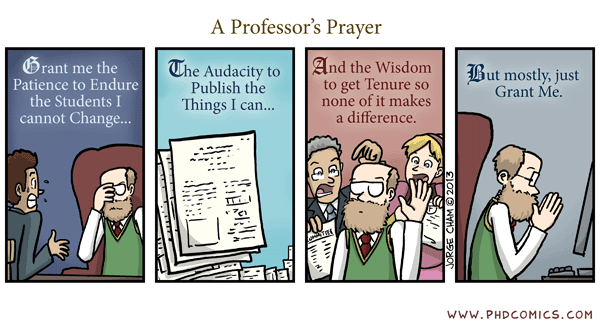
Academic Funnies

I have been catching up on recent PhD comics:

Traveling Principal Agent Problems

I cannot help but notice principal agent problems these days despite ducking the Americanist courses at UCSD 25 years ago.  Nope, it is all due to the NATO book.  Anyhow, I cannot help but notice that the delivery company that Lufthansa uses to deliver delayed bags sucks.

Due to delays in Ottawa, I had a very tight connection in Newark on the way to Budapest, so I was not surprised that my bag did not fly with me.  This is not the first time, so I expect the bag to show up after a reasonable delay.  But we have gone beyond that.  All day, the bag has been at the Budapest airport, as the tracer website has indicated: RECEIVED AT AIRPORT / DELIVERY PROCESS INITIATED.   With that knowledge, I have been reluctant to buy stuff to wear, figuring my bag would be arriving soon.  Yet not so much. 

Apparently, Lufthansa has a new delivery subcontractor with "trust" in its name.  If you have to include trust in your name, you are not so trustworthy....  So, I am very frustrated as it is now past midnight, and I believe that the bag has been in town for something like eight or ten hours.

This is not a huge problem since I have not yet started to reek, but it is my blog, so I can complain here if I want.  All I can guess is that Lufthansa has hired a lousy agent and has not provided adequate oversight or incentives....

Sunday, June 30, 2013

House of Terror Again

I visited the House of Terror in 2003, I believe, when I was doing research in Budapest for the Irredentism book.  I was struck then by how the Hungarian experience of World War II and of Communism was displayed.  Unlike most other remembrance museums I have been to, this one is clearly produced by politics.  The right wing parties established the building in early Aughts and some of the displays do seem to tie the left wing parties of today, the Socialists, with their predecessors of the Communist period--the Hungarian Communist Party.

This time, I noticed even more that the Arrow Cross (the Hungarian fascists of World War II) and the Communists of the Cold War era were somewhat conflated.  There was even a video of people taking one set of clothes off and putting another one--that the society at large put on whatever clothes required of the time.  Maybe I am reading too much in this, but it seemed as if this identification of Fascists with Communists might have been aimed to remove/display the taint that the contemporary right wing might otherwise wear from history. 

My favorite part was altered somewhat but still very much intact in spirit.  The very first part of the exhibition is a map of Hungary that shrinks in 1920 as the Treaty of Trianon (a product of choosing the losing side in World War I) created Czechoslovakia and Yugoslavia at the expense of Hungary plus Transylvania went to Romania.  The map then grows during World War II as Hungary re-annexed the lost territories, and then Hungary shrinks to its current size at the end of WWII.  So, it is a map of irredentism. 

The "new" surprise is how little of the space is dedicated to post 1956 Hungary, after the Soviet crackdown.  From my interviews after my first visit to the Museum, I learned how central the shared experience of post 56 Hungary was to Hungarian identity and nationalism, yet it is not reflected here at all.  

Note: Wifi at hotel is not letting me post picture.  Maybe tomorrow ....

A Great Start in Ottawa

I slightly missed marking the completion of my first year in Ottawa, as I was busy giving my parents tours of the town and then preparing for the trip to Budapest.  But as I wait for my luggage to catch up to me, I thought I would reflect on the past year.

My career has been entirely unforeseen--I went to college expecting to be a doctor or a chemist, and I had not expected to end up in Texas, the Pentagon, or Canada.  But each move has been an improvement, with this latest move being incredibly rewarding.  Folks tend to be confused why I chose Ottawa over Montreal and Carleton over McGill, but it was a no-brainer at the time, and it has been given more obvious as the year flew by.

In the spirit of the site I attacked last week (Foreignpolicy.com, which actually is one of my favorite sites), I thought I would listicle  (in no particular order as I am still too jet-lagged to organize my thoughts): what do I like about Ottawa and NPSIA:
  1. Ottawa is so very manageable.  My commute ranges from being 1/3 to 1/2 of what I had before.  It makes it so much easier to enjoy the place.  Montreal has a lot of great stuff, but I rarely sought it out since getting around was such a huge hassle.  I love being able to run into work for just one meeting or for one event and then run home, instead of having to figure out whether something was worth an entire day of being downtown.
  2. Which means that 75% or more of my ultimate games are within 15 minutes of my house  (and none of the rest require an hour over congested bridges).   This may prolong my playing career by quite a bit.  And the ultimate here is quite good.  I miss my old teammates, but the league here is incredibly well organized and the most of the fields are super-sweet.  I will never play again in Carleton's fieldhouse (worst turf of my career), but otherwise, so much fun to play on such great surfaces.  
  3. The Byward Market.  Such a great place to meet up with friends, to interview folks who did interesting work in or related to Afghanistan, and to network with folks in and near government. 
  4. Living near a national government.  It has been a heap of fun, very productive, and just damn interesting to be in a city where the national government is located.  I have met with folks from the military, the Department of National Defence, Foreign Affairs, the secret squirrels, defence contractors, journalists, and more.  While the McG students thought I was moving to the less interesting place, they didn't get me--I never did the clubs of Montreal.  But the pubs of Ottawa, chock full of interesting people?  Indeed.
  5. Colonel By Drive.  This parkway gets me into downtown quickly and is the most scenic bit of road along the canal in summer and in winter. 

Saturday, June 29, 2013

Adventures in Travel, June 2013 Edition

I am currently bag-less in Budapest.  Due to a delay in Ottawa for several hours, I made my connection in Newark by just a few minutes, which meant that my bag got to stay in the NYC area for the night.  I am in Budapest for the first time since doing research for the Xeno book for a workshop and presentation.  The workshop is how transnational actors affect civil wars--a topic dear to my heart since 1991.  The presentation is on NATO's smart defense effort--to coordinate the procurement of weapons to facilitate cuts without gutting NATO's capabilities.  I am a skeptic, given what I have learned from NATO's performance in Afghanistan and over Libya.

Anyhow, what did I learn on the way to Budapest?
First, some planes are funky--with stairs to a suite of bathrooms in a deck below the passengers:
I saw a couple hanging out in this space but not sure they were trying to qualify for that special club or not.  The restrooms were larger than those in most planes I have experienced, so .... um, yeah.

Second, the most recent Die Hard movie was really quite bad with an awful, awful, awful plot.  Jack the Giant Slayer, on the other hand, was underrated and delightful.  A box office bust apparently but still a heap of fun.

Third, I really don't mind that much losing the baggage--what I mind is having to spend an extra 30 minutes in the airport doing the paperwork and waiting for it to be processed.  That is, as long as it shows up when promised tomorrow morning.  Does remind me of my bag arriving around midnight for my first successful job talk....

Fourth, I learned not to go to dinner with a certain friend--he has very, very expensive tastes.  I would have provided some cheap goulash.... but the company and beer were good.

Re-Visiting the Canadian War Museum

My parents were in Ottawa, so I took my wife, daughter and my folks to the Canadian War Museum--partly to get the Canadian perspective on the War of 1812.  The current government played up that war as a big source of Canadian nationalism, even though Canada didn't really exist until 1867.  And many of the Canadians I have talked to tended not to see that war the way the Harper government see it. 

Anyhow, it is always fun to see history from different perspectives (I am going to Hungary's House of Terror tomorrow--perhaps the most politicized museum of its kind--more on that later).  Like, this exhibit in the Cold War has a header of: Dealing with Washington!  As if the U.S. can be a difficult neighbor!?!  The stuff here relates mostly to NORAD--where the US and Canada share responsibility for defending the North American airspace. 

The museum spends heaps of time on the establishment of Canada, with perhaps a bit overly sunny view of relations with the First Nations; War of 1812; other crises in the lead up to Confederation; the Boer War (the real starting point of the grand tradition of being led poorly by British generals), World War I and II, Cold War, and peacekeeping.  Thus far, Afghanistan is only reflected in a series of pictures taken by one war photographer.  Great shots, but they need to make some space for the most important Canadian international effort since Korea.

On the bright side, my daughter and I got to heft an AK-47.  Heavier than I thought.  And it was fun going through the museum with her, as she paid more attention to the role of women in Canada's military history.

Definitely worth a few hours, even if you are not a big fan of tanks.  If you are, then you are in luck as the lower floor has a heap of tanks.

Pride and the Student

I watched this tonight from my Budapest hotel, and I was stunned.

 
The speaker, Aisha Ahmad, is one of the last students at McGill.  She has engaged in work outside of academia in ways that impress the hell out of me.  She has more guts, more passion, and more commitment than I could ever hope to have.  I take a great deal of pride in my students.  In this case, the stuff she talks about here, I have really no justification to be proud as I contributed very little to this side of her work.  But I will feel pride anyway because, well, simply because. 


Friday, June 28, 2013

Minimal Blogging Ahead

I am currently waiting for my delayed flight for a trip to Budapest.   I expect blogging to e super-lite unless people feed me some ideas.  Otherwise, enjoy the Canada Day weekend and the silenced Spew.

Thursday, June 27, 2013

Ritual Georgia Rant

Once again, the Secretary General of NATO, Andres Fogh Rasmussen, has been saying nice things about Georgia. Why?  Because he is there.
Georgia has now taken on the title for "Most troops contributed to ISAF by a non-member" from Australia as the Aussies pull up and go home and as Georgia increases its comment.  I was surprised to find that Georgia has deployed troops to Helmand, which used to be the most violent part of Afghanistan and is still a pretty rough place.  So, Georgia is doing a good job of playing to NATO.  Too bad NATO's members no longer care that much about Afghanistan.

More importantly, as I have posted here, here, and here (and probably elsewhere), admitting Georgia would be undermining the credibility that is the key to NATO--that an attack upon one is an attack upon all.  Sure, there are caveats that can be applied even with Article V is involved as the response is conditioned by how each country "deems necessary."  One could have some doubts about commitments to the Baltics (which is why NATO countries take turns with a symbolic air patrol over their skies), but Georgia?  There is no doubt, just certainty.  That NATO would not have much capability or resolve to guarantee Georgia's security.  Even if there was, Georgia has proved fairly recently that when it feels like the US has its back, then it can engage in more feisty behavior with Russia.  This is a well known dynamic in alliances--that allies may not show up and allies may drat others into unwanted wars.  If only the folks in and around NATO would read Glenn Snyder's Alliance Politics.

I am sure that many will find this post repetitive, redundant or otherwise saying the same thing over again.  But since NATO keeps repeating the promises to Georgia about membership for good behavior, and since I am a committed skeptic when it comes to the effectiveness of conditions/membership processes, excuse this plea again for re-considering Georgia's path to membership.

Rules for Twitter? Maybe

Kevin Milligan posted his rules for twitter, which apparently sparked some twitter conversation among my Canadian academic friends.  I missed the twitter discussion as my parents are in town.  So, my comments below may have already been considered and rejected by the Canadian twitter community.  Or not. 

To be clear, Milligan does not see these as commandments, but as a way to spawn discussion.  So, here I go.

  1. Develop clear goals and firm limits about what you are trying to accomplish with Twitter. Measure each tweet against these goals and limits. I would utterly fail at this.  My goal in tweeting?  To be part of various communities and conversations.  What am I trying to accomplish?  Just being a bit better networked and, of course, endless self-promotion (because rule number one of twitter is: yo! hear me!)
  2. Prime goal: be an authoritative, fair-minded source on your areas of specialty. Be a scholar. That's why universities pay us; that's what we have to offer society. This is pretty on target--I try to present most of my views based on what I know, have experienced and have researched--ethnic conflict, alliance politics, Harry Potter, Game of Thrones, academia.  Other stuff, not so much, like #voterfraudfraud is based not so much on research, except for my work on political institutions, and more just a sense of outrage. 
  3. Personal / off topic tweets in moderation. I think people follow me to learn about economics, not to learn about my views on Mad Men, civil rights, my lunch, or my garden. A few personal / offtopic tweets in the mix now and then make your feed more human. But oversharing detracts from professionalism.  This really depends on the person.  I thought my twitter voice would be distinct from my facebook voice and from my blog voice, but it turns out I have more discipline/impulse control.  Plus there are too many threads/communities that I want to engage for me to just be strictly professional.  Also, the combinations of personal and professional lead to some very interesting conversations.

Tuesday, June 25, 2013

How is This Beer Ad Not So Creepy?


When it is much less creepy than the original video:


The little keg in a frig seems like a good idea but potentially dangerous, just like lots of Aussie stuff.


Apathetic, My Ass!

I really disliked two posts at foreignpolicy.com so I imposed a theme on my response and ranted at CIC.

Fat, drunk and stupid is no way to go through life, as Dean Wormer suggested, but to argue that Canada is Flounder? Beyond the pale!


Voterfraudfraud Gets Permission

I am not a legal scholar.  My expertise here is non-existent.  But I do study ethnic conflict, and I have studied how the rules of elections affect ethnic conflict.  So, I guess I have some perspective.  Even if I do not, I can take a look at the world and just be gob-smacked.  I have been upset and frustrated the past several years whenever I see efforts made to disenfranchise people because of the bogeyman of voter fraud.  #voterfraudfraud has been my way of defining this: that the real fraud is perpetuated by those who scream "voter fraud is a threat" when the real aim is to try to offset the demographic changes in the US and the political failures of the Republicans by making it harder for Blacks, Latinos and students from voting.  Given the anti-women content of much of the GOP rhetoric these days and how women voted for Obama, I am looking forward to the tactics used by the GOP to select women out of the voting public as well.  Perhaps restricting voters from bringing their kids to the polls?

Anyhow, this is all much worse today than yesterday, as the US Supreme Court has gutted the Voting Rights Act, which, as one of my twitter friends noted, something for which people died.  Some, not all, states had to clear their changes in voting rules with federal officials because of the legacy of discrimination and voter suppression.  Chief Justice Roberts apparently argued that the problems have been solved, no more discrimination.  He apparently has not been watching the news for the past five or ten years. 

Not only does this give the go ahead to the southern states previously covered by the Voting Rights Act, but it sends a strong signal to the Republicans that voter suppression is just swell and they might want to re-double their efforts, knowing that their friends on the court will cover their asses. 

Just awful.  No other way to think of it.  If only I had copyrighted #voterfraudfraud.

Monday, June 24, 2013

When Being Top Ten Is a Bad Thing

The annual list of Failed States is out at Foreignpolicy.com.  My reaction as always: any country above Afghanistan must be truly f@#$%-ed.  This year, that list includes Yemen at 6, Chad at five, South Sudan (4th) is actually just a smidge behind Sudan so secession works (?), DRC at two, and Somalia at number 1.  Zimbabwe lost its "worse than Afghanistan" status from last year and fell to tenth in the world.

The other thing that I noticed is that China is also in dark red on the map.  Sure, it is 66 (so I think the colors should be reset so that a country that is one third down the list is not the same color as the top 10 or 20 or 30), but that China is critical?  I guess it scores poorly on demographic pressures, uneven development, group grievances, human rights, and so on. 

One can pick apart any ranking (a Spew specialty), but the list is instructive in a variety of ways.  The "worse than Afghanistan" group reminds us of the countries that tend to get far less attention but are in worse shape.  Is that an indicator of ISAF's success?  Well, since external intervention is seen as a a variable tied to more fragility (Afghanistan is a 10, Somalia a 9.4 on a scale of 10 is failed, one is Canada), perhaps not.  Is Libya a success at 54 on the list since the external intervention was temporary?  So confused.

The US is stable but Canada, and the Scandavians, Germans, Swiss, Austrians and Aussies are most stable.  After the Snowden affair, perhaps the US dips further down just on the basis of pathetic government competency (both having contractors hire folks like this and then not catching him).

Anyhow, take a look at the map, the tables and the associated articles.  Much to chew on.

Sunday, June 23, 2013

Today's Exercise in Comparing US/Canada Trivia

Last night was the prom at my daughter's old school in Montreal, where folks graduate after 11th grade.  So, we took her back.  What did we learn?  Well, for one thing, there are no Kings and Queens named at the proms in Canada.  At least my Canadian friends on twitter have yet to disagree with the generalization. UPDATE: Ok, far less prevalent up here.

So, to figure this out, I went to my favorite source on all things monarchic: Phil Lagassé:*
* Phil now says he was being sarcastic.  Oops.

This sounded interesting to me--that the Americans continue to be rebellious by giving the titles Kings and Queens rather frivolously to the teens at dances who happen to have the fewest zits and/or the most sycophants. But Phil's response was mocked by another Canadian:
Given the state of Canadian institutions these days (hey, how are your mayors doing?), I see Mark's point.

Others pointed out that homecoming queens/kings are legacy of the surge in football culture
The general concept is subject to scorn by those who never had a prayer of getting nominated to such semi-August titles, including myself and


We who never were popular in high school like to heap scorn on the folks who were, hoping that they got fat, did not succeed, and perhaps had seven kids before they turned 21.  High school is kind of like that--breeding envy, disdain, and intolerance (good preparation for politics), at least in the US. I am sure the absence of such titles is what makes Canada such a polite place.... that and the training everyone up here gets by having to wait in incredibly slow/long lines at Tim Hortons. 

Without such quasi-monarchy and the competition (a game of thrones if you will) that ensues, we would not have this:


And that makes it all worthwhile, right?

Sunday Fetal Funnies

Brian MacFadden once again brings the heat:


Oh my.  The doubling down on this among the GOP is just amazing.  Predictable given how unsafe safe seats can be with the outbidding that tends to follow, but still yowza.

Saturday, June 22, 2013

A Theory of Zombie Speed

I have just returned from seeing World War Z, and I nearly freaked out on the way home as a cop with flashing lights flew by me.  Given how the movie starts, with cops panicking, it seemed like an appropriate start for my trip home.  Anyhow, the movie got me thinking about Zombie speed.  Why?  Because as the trailers give away, these zombies are fast, faster than those in 28 Days Later.  So, beyond the break, I ponder Zombie speed.


Friday, June 21, 2013

The Advice Song

This song was burned into my head when I was a kid: Steve Martin's Grandmother Song:


Sure, he is doing real bluegrass, but I always enjoy the recommendation to be obsequious and to be omnipresent (and criticize things you do not know about). And so on.  Just lovely.

Defence Reform: Drinking from the Firehose

Today, I attended a workshop organized by the Atlantic Council on comparative defence reform--what can Canada learn about improving its procurement processes from the US, UK, and Australia.

As I tweeted, I am the Jon Snow of defence reform--I know nothing.  Ok, I know a bit, but not that much.  So, it was interesting to learn a great deal from these various cases.  I was going to Storify from my live tweets of the workshop, but Storify and I are having some problemos.  So, just some highlights:
  • It seems like all of the democracies (at least the ones that speak English and have majoritarian political systems) have tried to reform their defence procurement systems on a regular basis, like every three to five years.  And the processes seem to remain mostly broken with the same patterns over and over again (the UK rep suggested that they were the exception since they changed their structures).
  • Canada is particularly messed up since having multiple ministers accountable mean that no minister is accountable.  While I am skeptical about the ability of the Canadian parliament to hold any minister accountable, I have at least one friend who believes otherwise.  Still, I am convinced we have the worst of all possibilities--a broken set of institutions and a government that prefers to deny reality than try to change things.  If it only had a majority in parliament, it could get things done (oops, it does!).
  • This procurement stuff is central to civ-mil relations--the tensions and dynamics between the civilians who make the decisions about what to buy and deploy and the military who have to live and die by those decisions.  Militaries would like to tell the civilians not just what their requirements are but also what they prefer in terms of equipment, crossing a line a bit, while the civilians would like to revise the requirements, crossing a line a bit.  Oops, everyone is in everyone's turf, so let's call it a crisis in civ-mil.  Seriously though, today really showed me that my effort to build a Canadian network of civ-mil folks definitely needs to include these kind of people.
  • There was a tendency among these folks to argue that oversight meant delays, risk aversion, and greater inefficiences.  Bad oversight?  Sure.  But it would seem to me that one could construct a system of oversight that provided incentives for innovation and risk-taking.  But we do live in an age of risk intolerance.  Hmmm, something to ponder.
There is probably more, but I am too tired from fighting with Storify.  Strange things were happening with it and with Chrome so I give up for now.  Next time.


Thursday, June 20, 2013

There are Clubs In Poli Sci/IR?

Where do I sign up?  How do I get a membership card?  Patrick Thaddeus Jackson has a great post at Duck of Minerva on the three commandments of editing a journal.  #2 is:
2. Thou Shalt Not Commit “Club Reviews,” in which the only people asked to rule on the publishability of a manuscript are people in the same sub-subfield as the author and already agree with the author on most points. Sure, sometimes you need the opinion of some member of the club to help you decide if an apparently-insignificant-to-the-unintiated claim is something that fellow specialists would find intriguing and worthwhile, but you can’t just let members of the in-group make that determination. If you do need to consult a member of the club, counterbalance that with a review by someone who is very much not a club member.
There are clubs in IR?  I am shocked, shocked!!  Ok, I am not shocked at all.  When I joke here and there about reindeer games to which I don't belong, this is essentially what I am talking about.  I have always felt club-less--that I do not belong to any particular club.  This goes back to high school, as I felt I was in the clique of the folks who were not in any clique--the residual clique if you will.  Of course, other observers at the time might have thought otherwise.  Today, I am sure folks in the field would consider me to belong to various clubs: the UCSD alumni, the Minorities at Risk folks, the Pat James poker gang, the American ex-pats of Canada, friends of the Duck of Minerva, the blogging community, runner ups in Twitter Fight Club, etc.

But in terms of a coherent in-group a la the Jackson Commandments, nay.  Perhaps I am but blind to it.   The funny thing is that this post came out a day after I realized that I am definitely in one out-group.  Well, I have always known I am in a particular out-group, but yesterday's epiphany cemented it.  I realized that I have reviewed multiple articles for pretty much every major North American journal in Political Science and International Relatoins except for one.  There is one journal that has never asked me to be a referee in their publication process.  It is a journal in which I have tried to be published so they know I exist.

What does all of this mean?  Well, one core dynamic in the formation of identity is that one tends to identify oneself by what one is not.  I was "clique-less" in high school because I could not identify with any of the major groupings.  I was not a jock nor a stoner nor whatever Ally Sheedy was in Breakfast Club (although a Sheedy fan indeed).  A brain?  Well, I had friends who were the brains of the school, but I didn't think I fit in there either because I didn't work that hard.  I was only in one play senior year so I was not in the theater crowd (musicals are not my thing if you have heard me sing).  In political science/IR, I know that there are a few groups to which I do not belong: I am not in the high tech quant crowd, I am not a formal modeler, I am not an IPE guy, I am not a post-modernist and I am not part of the security mafia.  I tend to think I don't fit anywhere because I cross boundaries--between IR and Comparative, within IR between security, conflict and foreign policy. 

Does any of this matter?  Only when there is an actual in-group that is semi-organized or more, patrolling the journals, presses, and post-docs to favor those in the in-group, like an old boys network or something.  Luckily, there are far fewer of these clubs than there are cliques in high school.  I have friends who are members of this one club, but I have never been a member nor will I ever be one.  And I am ok with it.  My career has had a few bumps along the way, but I can declare success

I am just very glad that there are editors like PT Jackson who are aware of the clubbiness and do something to make sure the clubs do not effect outcomes as much as some folks like or fear.

Wednesday, June 19, 2013

Counting the Casualties

I was inspired by a piece in the National Post today about a memo that Stephen Harper received in 2007 about the costs Canada was paying in Afghanistan in blood compared to the allies to post this at CIC.

Check it out.