Monday, September 4, 2023

Thirty Years Fly By: Teaching IR

 This week is the 30th anniversary of my first day of teaching and of professing (although I think my first title did not include "professor" as a visiting ABD).  The first day of teaching was my best exemplar of being an absent-minded prof: I somehow forgot to bring the pile of syllabi to the first course of the day--Intro to IR... and then to my second course of the day, which was a different section of Intro to IR..... and then to my third course of the day---also Intro to IR.  This was long before folks had courseware, long before stuff was uploaded before classes started.  Profs brought paper versions of their syllabi (shorter then because of little required boilerplate) to the class. And I failed miserably in that basic task.  Have I said this before?  This is now a constant problem in my teaching (and in my blogging?)

I don't have any pics of my
early teaching so this will
have to do.

The good news is that I didn't fail as a teacher that first year.  As a last minute hire, I was lucky to get three sections of the same course, one that I had TA'ed for a few years earlier.  In my second year of grad school, at a school with a quarter system, I got to assist a terrific class, a bad class, and a class that was a bit of a mess as the prof was figuring out how to revise the class as the Cold War was ending.  So, I built that one course from the terrific class, borrowed a few tricks from the class that was a bit of a mix, and learned what to avoid by not doing what I saw in the bad class.

My aims my first year were modest: try to be clear and organized.  I had very extensive notes although I did not try to read off of them.  I spent much effort producing transparencies so that I could show the students the outlines of the lecture to keep both me and them on track.  I did not build in jokes or elaborate stunts to keep them away--the tricks developed later mostly to keep the 600 students awake and engaged at McGill.  At Vermont, I had roughly 30 students per class, did mostly lecture (much more my strength then and now, rather than leading discussion).  I am trying to remember if the classes had discussion sections... I remember not having TA's, and doing the grading myself.  Papers and exams although it has been forever since I have had in-class tests.  And it went well enough that they brought me back even after being ruled of that year's job search. 

I liked teaching quite a bit.  Sure, I am an attention hound, but talking about the stuff helped me understand it better, they asked good questions which made me think, they pushed my curiosity as I didn't always know the answers (I often did not the answers).  They were a lively, engaged bunch and I fed off of their energy.  It has been a long, long time since I taught three classes a day, but I was able to do it then by being an energy vampire.  It was really a terrific place to learn how to teach and how to manage my classes--I was a visitor whose career there was quickly to become finite, so I could focus on the teaching (no dept meetings for the visitors, no dept service either) and on the skiing.  It was also where I started to learn and theorize about department politics

It is kind of wild to think that particular batch of students of about 90 poli sci students are now around 50. I have not kept in touch with any of the students from that first year (although I did write a few recommendations for some of them shortly after their time with me) and only occasionally a few profs from that experience.  

Of course, I am celebrating my 30th anniversary of teaching my first classes by ... not teaching.  I am on sabbatical this year, so no teaching (except for the Summer Institute last month).  I hope to be refreshed next year, as I am entertaining the idea of teaching a new class (or an old class that I haven't taught in eight or nine years)

Looking back, I realize that I am very lucky to find something that works so well for my personality and for my excessive curiosity.  I don't enjoy grading, but hanging with the kids has kept me youngish, keep pushing me to think about stuff differently, and keep challenging me.  I have had to ditch my old cultural references, and I have to keep track of my stories better.  

I stayed in grad school in part because I could not imagine doing anything else, and, now?  My imagination still sucks, as I can't imagine anything that would have worked as well for me. 


Friday, August 25, 2023

The Perils of Politicization With Maple Syrup

 Last night, a friend informed me that my favorite retired Canadian military officer, Lt. General (ret) Michel Maisonneuve is going to speak at the Conservative Party of Canada's convention.  This gave me a case of deja vu, as the 2016 US campaign had dueling generals at the conventions--Michael (how many foreign payrolls am I on?) Flynn for Trump and the Republicans and John Allen for Hillary Clinton and the Democrats.  I have been meaning to write about Michael Robinson's book, Dangerous Instrument, Politicial Polarization and US Civil-Military Relations, for some time,* but the CDSN Summer Institute and a mad dash to finish the Steve/Dave/Phil book got in the way, but this news has pushed Robinson's book to the front of my mind.

* One of my sabbatical goals is to catch up and write about the latest civ-mil work (and some older stuff).  Robinson's book was at the top of the pile.  Now I am working on Jason Dempsey's book about whether the US Army was "Conservative" or partisan in the early 2000s.

Robinson does an amazing job of taking a variety of surveys and survey experiments (where some respondents read or listen to one vignette/treatment and others get exposed to different ones to see what primes people) to assess a variety of dynamics surrounding the US military: what shapes people's views, what shapes their media consumption, what shapes media coverage, and ultimately what shapes the standing of the US military in the public.  Oh, and how thoroughly screwed the US military is.

The basic idea is that there are different ways to politicize a military.  The military can politicize itself by directly getting engaged in politics or by doing things that resonate beyond the military.  But the book is really a story of affective politicization--that how people see the military depends not just on what the military is doing, but what the other actors in the system are doing that makes it appear as if the military is becoming closer or farther politically.  This is all very important because most modern militaries in most democracies seek to be non-partisan institutions--that they were taught the key to both civilian control of the military and relative autonomy was to stay out of politics.  Indeed, because most militaries are not seen as partisan, they tend to have higher popularity ratings--that most other institutions are seen as belonging to one side or another and thus at least a chunk of the political spectrum is pissed off.  I have delighted in our CDSN surveys showing that only academic folks have higher trust ratings than the military.

In the US, there was an arms race between the Democrats and Republicans amassing endorsements from retired generals and admirals, as each sought to be seen as the party of national security.  This was bad for the military, as it may be that the public sees retired officers as the voices of the active service since the latter are largely restricting from speaking in a partisan fashion.  This culminated in Flynn chanting "Lock Her Up" at the 2016 convention, which is more than a smidge ironic or hypocritical given that Flynn was a far greater danger to releasing classified information than Clinton's email.  Anyhow, things got worse once Trump got into office as he kept referring to his generals, kept making partisan statements to and in front of the military (including announcing the Muslim ban at the Pentagon).

Robinson, in his book, shows that views towards the military have become increasingly partisan--that views of the military now go up and down depending on who is president--that Republicans, traditionally strong supporters of the military, are less enthusiastic when a Dem is president. The key dynamic driving much of this is confirmation bias (woot?)--that partisans will notice only that which agrees with their preconceptions and discount that which does not agree.  As Americans become increasingly partisan--with their identities tied to parties, this gets worse, especially for those who consume only from a very biased portion of the media (you know who).  

What I like about this book is that it uses a word I hate, polarization, quite well.  Polarization generally implies that all parties are spinning away from the center, when studies show that the GOP is becoming radicalized, but the Dems are mostly staying where they were, sliding a smidge to the left.  But what is abundantly true is that all sides are increasingly tied to their partisan id.  Robinson goes on to show that that consumption of Fox is not good, and so on.  And the military is utterly screwed because if they push back at, say, charges of wokeness, they only make things worse.  The results also show that despite all the talk of norms of civil-military relations, the public is not really aware of them, nor that concerned about them.  So, it is up to the politicians to refrain and for the military to ... hope (and hope is not a plan).  

So, it is a great book, with terrific social science, important implications for civil-military relations, and, yeah, we are kind of fucked.  

 And now it applies to Canada, damn it.  The Conservatives are bringing Mr. Cancelled to their convention, imitating the GOP, so he can rail against the Liberals and the wokeness of the Canadian Armed Forces.  The Liberals have dipped into this as they had Andrew Leslie, another retired LTG, in a prominent place when they ran in 2015.  The key difference is that they were just trying to use his credibility and stature to buttress their own, they were not using him to attack the military, nor did he speak out that much in any way that was particularly controversial.  Maisonneuve, on the other hand, used  his Vimy speech and then a regular spot at a national paper, to blast the Liberals, the woke media, the military for daring to make itself more inclusive, and pretty much anyone else he felt spurned by [I am still waiting for some media outlet to note that Maisonneuve was part of the military's abuse of power crisis].  

The Conservatives are embracing some of the GOP's efforts to mobilize populist resentment as they now apparently seek to tear down many Canadian institutions.  When I say this will endanger Canadian civil-military relations, I don't mean there will be a coup.  But it will mean that the public and politicians will view the military as a partisan actor, that appointments and decisions will be viewed through partisan lenses, and then the Canadian military will be fucked, because its efforts to defend itself as an inclusive institution, desperately needed during a personnel crisis, will be seen as partisan.  "Hey, we don't discriminate against x" will be seen by CPC partisans as being too woke. Which will make it harder to recruit and retain, deepening the spiral that may make it very hard to send a ship to the Pacific or sustain the commitment to Latvia.  In short, the Conservatives are starting a process that is going to be bad for the military, despite their bad faith assertions that they care more about the CAF than the Liberals do.  [No, Trudeau does not care much about the CAF, but the CPC does not either].

So, here's a song that goes with all of this.


Saturday, August 19, 2023

Summer Institute 2023: This Is Why We CDSN

Did I just turn CDSN into a verb?  Sure, why not.  We had a tremendous week at our second in-person Summer Institute (see last year's summary here).  I am still jazzed after a week of informative presentations from our various speakers, of scheming by our participants in the simulation, of sharp insights from the participants who came from all over the Canadian defence and security community, and of amazing work behind the scenes by our CDSN team.  

Group pic after DND briefings
It starts with the participants.  The original idea that animated the grant in the first place was to bring together people from military, from the other parts of the government, and from academia (would love to have journalists as well) attend a week-long seminar/workshop/institute/whatever to learn from experts but as/more importantly, learn from each other by seeing the same stuff from different perspectives via the varying lenses of folks in the community. Plus we wanted to facilitate networking that bridge the various divides.  And, yeah, it was really sweet to see it come to fruition this week.  Last year's cohort was wonderful, but was not nearly as representative of the defence and security community.  We still have work to do to include folks from Public Safety, Global Affairs, and other departments.  

Our presenters included CDSN co-directors and other Canadian academics, folks from the policy community, CAF officers, American academics, journalists, and a pollster.  They brought much experience and insights to our discussions, provoking many questions along the way.  Most of the week was at Carleton, but we did foray into downtown one morning to meet with folks at the National Defence Headquarters.  There we meet with folks from defence intelligence, the deputy commander of the Royal Canadian Navy, and some of the top officials on the civilian side of the Department of National Defence.  With Chatham House rule in effect, I can't say what individuals said, but I can say that most of the folks we met along the way were quite open.  

The Valens Simulation ended in tears and dollars?  The scenario had disinformation and arctic sovereignty in play with three teams role-playing the US, Canada, and Meta.  Meta got huge profits as it continued to spew disinformation, while the US-Canadian relationship was torn asunder as they failed to reach an agreement.  Daveed Garenstein-Ross, the head of Valens, had to wake up early and re-write the ending presentation in light of unexpected conflict.  This sim had multiple purposes--to use some of the skills over the course of the week, to get a taste of the strengths and limitations of simulations, to provide a more interactive experience, and to create small cross-sectoral teams.

I am very grateful to the HQ team of Melissa, Sherry, Racheal, Carelove, and Ayshia for doing all of the hard work.  All I did was make cookies and introduce people and ask some pesky questions along the way.  Colonel Cathy Blue, who was our Visiting Defence Fellow for the past year, was so crucial.  Her first week with us last year was during the previous Summer Institute, so she gave us great feedback on what worked best and what did not, and then she helped plan this year's SI.  More importantly, she is an amazing recruiter, so she helped us reach our goal of a nice mix of policy, military, and academic folks.  She couldn't join us for this year's as she has an important job now of Commanding the cadets at the Royal Military College.  

If you are interested in the Summer Institute, we will be putting out ads and accepting applications in early 2024, and you can check out more info at our website: https://www.cdsn-rcds.com/summerinstitute 

Below are a variety of pictures from the week.  Again, Carelove took better ones, but I am quick to upload mine ;)


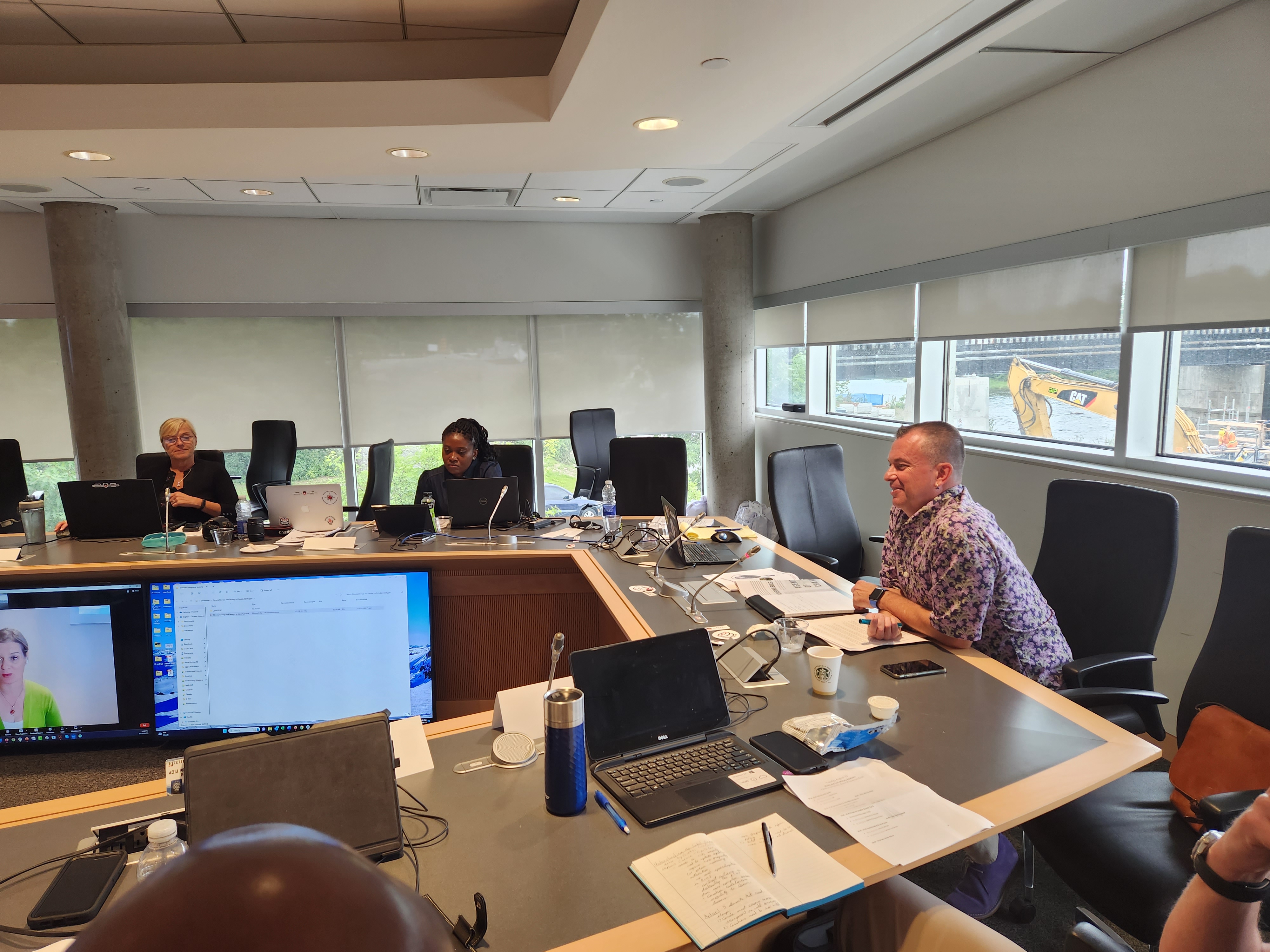
Once again in the Board of Governors room

Our policy process panel with Kristine Ennis-Heise
of DND, retired man of many jobs Vincent Rigby, and
CDSN Co-Director Alan Okros

Valens introduces the week's simulation with
Libby at their hq and Daveed Garenstein-Ross
in Ottawa

Murray Brewster, Amanda Connolly (on zoom), and
Captain (N) Kelly Williamson on the media and
Canadian defence

My first slide for the panel on Canadian
civil-military relations with Andrea Lane, Risa Brooks,
and myself

Co-director Will Greaves, Michel Roy of CSE,
and Saira Bano of Thompson Rivers
discussing variety of threats facing Canada

Stephanie Carvin zooming from Oshawa talking
intel with ...

Battle Rhythm co-host Artur Wilczynski


Much fun at our midweek Networking Reception

Charlotte and Andrea enjoying the picture taking

Our partner for this event was
Women in International Security-Canada. 
WIIS-C is a founding member of the CDSN, and
I greatly enjoyed hanging out with their new team

You know it is a good reception when a large
segment of the group stick around after the event
at the hotel bar.

Grace Scoppio of Royal Military College,
co-director Andrea Charron, and
Conseils de Sécurité host Sarah Myriam Martin-Brûlé
discuss collaborative research

Co-Director JC Boucher, Captain (N) Kelly
Williamson, and Nik Nanos of the Nanos Research firm
discuss Canadian public opinion on defence

Co-director Phil Lagassé looks to be in some
pain as he discusses defence procurement

Twas really great to have ADM (Mat) Troy Crosby
and the always natty Kim Nossal to discuss
defence procurement

Brandon Behlendorf presented red-teaming to us

Alliance dynamics with Carleton poli sci prof
Aaron Ettinger, DND NATO officer Ashley McCauley
and Co-Director Stéphane Roussel

The end of the simulation with US and Canada
breaking up and Meta profiting hugely.


Wednesday, July 26, 2023

Not All Change is Progressive, Canadian Defence Beat

 So, Anita Anand is out and Bill Blair is in as Minister of National Defence.  This is bad news for my civ-mil classes as Minister Anand zoomed into my class both times I taught the class while she was Minister of National Defence.  I think it is also bad news for Canadian civil-military relations, the Department of National Defence, and, yes, the Canadian Armed Forces.  Let me listicle my way through this:

  • the file is not an easy one, and Anand has done a heap of homework and understands the stuff pretty well by this point.  While she has not been able to deliver a defence policy update on time, she has managed the file pretty well given the constraints imposed by the Prime Minister's Office, the world (hey, how about you spend much of your time working to help Ukraine), and resistance within the CAF and maybe within DND itself.  Blair will come in and have to learn from scratch.  Will he have the same determination to read everything (as Anand said on the BattleRhythm podcast)?
  • Speaking of which, DND and CAF aren't very transparent, but Anand did do a fair amount of outreach, including appearing on our podcast. Will Blair?
  • Beyond reading/speaking, Anand seemed more determined than most MND's to actually impose civilian control of the military, rather than just sign off on whatever the CAF wanted.  While this might have been tough for the CAF to swallow, the military had proved that it did not handle its autonomy well at all.  
  • Which gets back to continuity.  How long does it take it to create new institutions, rules, and norms and have them bite--shape the incentives, outlooks, and then ultimately who leads?  Not sure what the magic number is, but I am guessing it is more than two years.  
  • What of that defence policy update?  Will it be scrapped and started again with new leadership?  Will Blair just sign off on the previous work?  🤷.
  • I have written repeatedly about the problems of having a former military officer serve in this spot--O'Connor/Sajjan here, Mattis/Austin in the US.  What about an ex-cop?  Lovely.  Not so lovely.  If there is an agency or entity that has a worse record of civilian control than the military, it is Global Affairs the Royal Canadian Mounted Police as well as the other police forces in Canada.  As an ex-cop, Blair almost assuredly had an attitude that the cops knew better than the politicians and that they should have autonomy to avoid being politicized.  The problem, of course, is that all policing is political.  Is Blair likely to accede to whatever the military recommends, or is he going to, yes, engage in management and even micromanagement?  Gasp!  I am guessing the former.  While there are better leaders in the CAF now than a few years ago, decades of behavior and the dynamics in other countries have proven that giving militaries heaps of autonomy is not the way to go.  
  • So, that is the substantial stuff, but there is also the symbolic.  No, I am not talking about swapping out a women of colour and putting in an old white guy (although, yeah, that might send some signals).  I am talking about removing a super-competent, engaged person and replacing them with someone who has little clout and has mismanaged his previous files.  The message this sends?  Trudeau doesn't care about defence now that it is not burning as much, so he is sending someone who should have been shuffled out of the cabinet to defence.  This is a damaging message to send to those who have been sticking it out in the CAF and DND, hoping for and fighting for change to happen.  Is Blair going to help or hurt with the personnel crisis?  Now that I think about it, that really would have been the first question I would be asking myself if I were PM.  Sure, few folks condition their votes on defence or foreign policy, but when making this decision, I would use that attitude to do what is necessary for Canada's national interests.  Given the primacy of the personnel crisis, that would shape the decision..... or not.

Maybe they need a sharp, detail-oriented person at Treasury Board.  Ok,  But Blair as Minister of National Defence?  


Wednesday, July 19, 2023

My Dream Defence Policy Update

 Since it is taking a lot longer for the Canadian Defence Policy Update to come out (I am using passive voice for a reason),* I figured I would present my ideal one.  This way, I can be properly disappointed when it does come out.  To be fair, I did pushback at media folks who were already doing the disappointment stories.  Who knows, maybe the DPU will provide what we need/want.  But to make that assessment, I thought providing an ideal baseline would useful.

Before I get started, first some caveats and other qualifiers.  I am not a defence economist, so I can't speak with any great certainty about dollar amounts.  I also can't assume that the government will have any clearly articulated grand strategy or foreign policy review.  My basic assumption going in is that as long as ships are not cancelled, none of this will move the needle in any direction domestically.  That is, the public wouldn't mind more spending on defence (the polls show they support it), but they won't give the incumbent party any votes for doing so either.  Yes, my dream defence policy update will require more spending, but what kind of dream would it be if I were too uptight about budgets?  A nightmare!

Ok, let's go:

  • Personnel
    • Specify the legislation that will be required to implement the key parts of the Arbour report (perhaps not every facet should be followed through--the Minister should have some judgment because Arbour is not perfect).
    • Specify the legislation that will be needed to make a significant dent in the personnel crisis including making service in the CAF a fast pathway to citizenship.
    • Allocate $$$ to address the crisis--better pay for all, retention bonuses for those who have excellent reviews, improving bases and providing better housing support, day care for kids, education/training/employment opportunities for trailing spouses.
    • Develop a plan to require fewer moves over a military career including leveraging work from home for some jobs.
    • Shift any jobs that don't require uniformed personnel over to DND (note: this is not sending these jobs to the private sector).  Anything that does not have physical requirement or a legal requirement to have a soldier/sailor/aviator should be civilianized including chief of personnel.
    • Shift more jobs (if not entire bases) to be closer to major urban centers.
  • Latvia/NATO
    • Clarify that the Latvia mission is enduring, beyond a three year cruise, and detail how it will be sustained.  
    • Clarify what the new money is going to and what additional funds will be required down the road. 
    • Agree to be a framework nation at the MND-N level so that command rotates between us, Latvia, Danes.
  • NORAD Modernization
    • Be specific about what will be spent on what over the next 5-10 years including whatever new money there is.
  • Indo-Pacific
    • ¯\(°_o)/¯
  • Domestic Emergency Operations
    • Make clear it is not the last of many priorities, but co-equal with the highest, allocating money to improve the central HQ's coordination/lesson learning effort.
    • Invest in domestic emergency-specific equipment--we don't need to have everything be useful for every possible mission.  
    • Provide for leaves and other benefits similar to what the troops get after a foreign deployment for an extensive domestic emergency deployment.
  • Procurement
    • Set up a new procurement agency so that there is one shop, rather than multiple ones, responsible, with a new minister focused solely on this.  Take it out of DND and out of Public Works.
    • More off the shelf type purchases like the P8, Javelins, Stingers, etc.
  • Improve Civilian Control of the Military
    • Include in culture change plans/conversations discussion of changing perceptions of civilian control of the CAF.
    • Provide better training for new DND civil servants (at the entry level and for those who get moved over from other departments) so that they have a better understanding of the CAF and of military stuff.  One of the sources of tension is the attitude among military folks that the civilian folks don't know military stuff.
    • Review and improve civ-mil components at all of the professional military education spots (including the systematic debunking of Huntington).
    • Reverse the pattern of senior leadership at key L1s--for example, have a civilian chief of defense intelligence with a military advisor.  Sorry, Mike.
    • Make specific commitments for improved transparency. 
  • Future reviews
    • Commit to four year cycle so that DND develops the muscles to be reviewing, assessing progress, being transparent about progress, consulting, etc.  This review has been much delayed for many reasons, creating frustration and problematic expectations.  Our allies do regular reviews for a reason.
  • Academic engagement (i.e. super specific, self-centered stuff)
    • Revise the length of MINDS Network Grants from 3 to 5 years and include a renewal process so that existing networks can use past performance to justify renewed funding.

Note: I am not dreaming of getting to two percent of GDP on defence.  However, I think this defence review should show how the military is spending more money for the things it needs to do, which will have the effect of getting Canada closer to 2%.  If we are a smidge below 2%, the griping at NATO will be less energetic.  But the focus needs to be on outputs and outcomes--that we can keep our promises to do various things (Indo-Pacific, Latvia, etc) at the level of quality we want--rather than inputs.

I will probably revise this as folks give me ideas of things I forgot.  But that is how reviews and updates are supposed to go--being resistant to moving the goal posts is problematic when winning on the battlefield requires adaptation.  

So, what did I miss?  What dreams should I include?


* A friend of mine and I were thinking of wagering on it, but she didn't like my over/under proposition, and I didn't like picking a specific week. 

Thursday, July 13, 2023

Vilnius Summit Review: More Woots Than Not

 Summit success is often a matter of expectations, and, of course, depends on where you sit.  For Ukraine, this may not have been as successful as it would want since they didn't get a fast track into NATO.  But that was an unrealistic expectation.  I didn't expect Turkey to stop blocking Sweden's membership, so my expectations were exceeded and thus huge success.  But the summit is more than just one or two decisions, so I am going to review much of the communique and then the Canadian announcements to figure out how many woots does this summit get.  Of course, since my pals and I didn't get a chance to go to the expert forum side party this year, there is a cap on the excitement--no NATO family dance party for us.

First, as mentioned above, Ukraine didn't get a superfast track to membership, as having Ukraine join while the war is going on would either mean that NATO invokes Article V--an attack has happened against a member and deserves a collective response--or it does not.  In the former case, NATO is now at war with Russia, something that the alliance has rightly been avoiding.  In the latter case, Article V gets eroded as it is not used when a member is attacked in a very serious way.  This is not just a few loose bombs or artillery shells like when forces in Syria hit Turkey.  The question really is how soon after the war would Ukraine become a member, and the answer this time was: very soon.  But it was not more definitive because the alliance requires consensus, and that is all that they could agree to.  I pushed back on twitter about cowardice or manliness.  NATO being at peace while Ukraine has been at war is not great for Ukraine, but the fact that Russia is not hitting the supplies going into Ukraine before they get there is hugely significant.  Expanding the war is not good for most folks, and the risk of nuclear war, which is small but real, is not great even for Ukrainians.  

Second, Sweden is an unalloyed win for the alliance.  It makes defense of the Baltics easier since Sweden sits astride the best ways to reinforce the Baltics in a time of war.  It also means that countries leading the NATO missions in the Baltics, looking for more troops to plus up their battlegroups into brigades (going from 1k to at least 3k) have a robust potential donor to beg (force generation is begging in the words of a NATO military official we cited in our book with the ebook version on sale now!).  It is also a massive defeat for Russia, as Putin has long wanted to break NATO, but finds his aggressions in Ukraine in 2014 and in 2022 have only strengthened and expanded the alliance.  Finland and Sweden would not have asked to join had Russia stayed within its boundaries.  

Ok, onto the communique, which represents a lot of homework and bargaining over the past year, with the summit serving as an artificial deadline to get folks to agree, kind of like an academic conference is designed really to get profs to finally finish their papers:

  • the formation of the NATO-Ukraine Council. This supplants the old NATO-Russia Council which died due to Russia's aggression.  This gives Ukraine much visibility and status and allows the Ukrainians to participate meaningfully in many NATO conversations.  It ain't membership, but it is significant.
  • Finland is now a member, woot!
  • China as a threat--this requires work as some countries (France) want to keep sucking up to China.
  • Lots of stuff on Russia, not recognizing Crimea as Russian, etc.  Naming Belarus and Iran as complicit (although not China).  The language on Russia can't be a partner for now is probably the closest we can get to declaring the NATO Russia Founding Act dead.
  • Lots of stuff about supporting Ukraine, that no need to continue with the Membership Action Plan, which means Ukraine is closer to membership and is increasingly integrated.
  • Some more language about ISIS and terrorism.
  • 2% gets the usual shoutout--making progress but now we recognize that 2% isn't enough.  
  • More forward defense with regional defense plans, more troops at high readiness, moving from battlegroups to brigades in the east as promised last year.
  • Defence Production Action plan--to improve delivery of weapons/ammunition
  • Integrated Air and Missile Defense with emphasis on eastern flank--this represents a response to the roles played by drones and missile attacks in Ukraine.
  • Continued opposition to the Treaty on the Prohibition of Nuclear Weapons since nukes are part of NATO's deterrent strategy.  Not a surprise.
  • No Japan office for NATO since France opposed it.  Consensus decision-making can suck... like how do we dump Hungary?
  • The standing up of a Maritime Center for the Security of Critical Undersea Infrastructure.  This seems in response to Russia primarily monkeying around with cables.
  • Cyber got the longest paragraph, I think, with a new Virtual Cyber Incident Support Capability to help members respond to cyber attacks.
  • Western Balkans get several items--75-78--as tensions are brewing there.  Supporting Bosnia's integrity is directly aimed against Bosnian Serb separatism, KFOR continues to operate and has increased its troop numbers due to violence in the Serb-inhabited areas.  A reference there to conditions based not calendar driven brings me back to my Joint Staff days concern whether exit/reductions are determined by benchmarks (conditions) or milestones (time).  

There was more, but that is the stuff that caught my eye.  So, much progress on some of the most important things, hard time getting consensus on NATO becoming relevant in the Pacific despite clearer language about the threat posed by China.  

What about Canada?  I got asked lots of questions about 2%, and I didn't see anyone put Trudeau in a headlock for not making sufficient progress towards 2%.  Nor did I see Canada making a huge stink about Biden's sending of cluster munitions to Ukraine (a post for another day maybe).  Canada did take part in several announcements--a blueprint for Latvia's defense, a NATO plan for defending the Baltics, and the like.  Trudeau announced sending up to 2,200 Canadian troops to Latvia which is up from the original 450 or so and then 800-1000 that it has been at since last year.  He announced $2.6b in spending on the Latvia mission over the next three years including $1.2b.  I don't know if this is enough to cover the additional costs of sending the larger numbers of troops who have to be rotated every six months, the costs of more infrastructure (barracks, dining hall, training facilities, etc) for not just the more Canadians but the more NATO folks, etc.  

Remember, Canada is the Framework Nation for Latvia, which means it is Canada's responsibility to lead the multinational battlegroup that is now becoming a multinational brigade.  That means providing some infrastructure for those who Canada cajoles to stick around (Albania, Czech Republic, Italy, Montenegro, Poland, Slovakia, Slovenia, Spain, and North Macedonia) and maybe join us (Denmark, Finland, Sweden) to get to 3000+ troops.  Given that there are now eight places for NATO to send troops--the three Baltics, Poland, Bulgaria, Hungary, Slovakia, and Romania--so competition will be fierce to get more troops from some of these countries.  So, Canada has to make the place welcoming and a good training area--which means plenty of ammunition and other logistical support so they can exercise often. 

And no Defence Policy Update.  Which is a disappointment--it is very late.  When will be the next time where announcing it will be handy for the government?  Maybe when parliament is back in session?  ¯\_(ツ)_/¯

So, I think Canada did the minimum to keep the criticism down, but perhaps didn't really do enough to set up the Latvia mission for success.  I don't think getting to 2% quickly is a realistic expectation, but the government could have made it a bit clearer that Canada would be moving in that general direction.  That there have been a heap of commitments made, that the personnel crisis itself needs much money thrown at it, so defence spending should be going up, even if it is not going to increase by 50%.

Overall, the summit went well, the big things happened, the smaller things mostly worked out.  Putin's efforts to divide the alliance keep failing, the media's efforts to set unrealistic expectations and Zelensky's first outburst did not really upset things much.  I am sure many observers would prefer Trump running around, pushing over the leaders of smaller countries.  It would be more entertaining.  But we got enough progress on enough items.  Is it fast enough?  Not for Ukraine.  But a consensus-based organization is not going to move that quickly.  That NATO will soon have something like 30,000 troops forward deployed is pretty amazing.  And definitely not what Putin wants.  


Wednesday, July 5, 2023

Destiny's Name is Adventure

 Mrs. Spew and I saw Indiana Jones and the Dial of Destiny last night, so tis time to re-rank the Indy movies.  My old post set the terms, so I am just going to consider where the new movie stands in the various categories.  To be clear, Raiders was and remains my very favorite movie of all time. So, its ranking ain't changing.  But I do have a question: when did they Star Wars: a New Hope Raiders so that it is now called Indiana Jones and the Raiders of the Lost Ark?

Monday, July 3, 2023

Sabbatical Plans? We Don't Need No Plans!

 Ok, maybe we do.  Seven years ago, I posted my plans for that sabbatical, my second one. Before discussing my plans for this year (July to June), let me check out how I did last time.

  1. Make progress on the legislatures and civ-mil book with Phil and Dave.  Well, I did do a heap of research on that book, going to Japan three times!  The other trips happened later due to impeachments in Brazil and then South Korea.  which should have been finished by now.  We did manage to publish a bunch of articles: on Canada, hCommunity Policing as a metaphor for Belgium/NZ, and the entire set of cases.  But the book itself is not yet complete--we hope to finish it off in the next month or two.  Publishers are interested in it, so we just need to revise to make the entire team-written thing sound like one person wrote it.  
  2. Smaller projects although not policy relevance piece nor the bureaucratic politics piece (more on that below). Instead, I finally published the testing the hypotheses about professionalization piece.
  3. Apply for the partnership grant.  Yep, it took two tries, but we got it.  It has dominated my destiny ever since.  I have no regrets as CDSN-ing has not only helped fulfill the various objectives we had set out (foster a more diverse/inclusive/equitable next generation, become a world-class network that folks outside of Canada will connect with, advance our understanding of defence and security issues, improve the defence/security literacy of Canadians, foster research projects across the various divides, etc), but has been so personally rewarding--I have learned a lot, developed new skills (management?), traveled to cool places, and engaged with so many folks in and out of government.  
  4. Read?  Not as much as I would like.

So, what am I going to do with this sabbatical?  

  1. With the legislature book project winding down, I am hoping to make progress on the Steve, Phil, and Ora project: comparing defence agencies around the world.  What roles do ministries and departments of defense see for themselves?  How are they viewed by the militaries they interact with?  This project will merge with the aforementioned bureaucracies project--what is the nature of each democracy's policy marketplace?
    1.  Mostly the same cases as before but with new ones.  I don't know exactly where I am going to be during this sabbatical, as a couple of fellowship applications didn't work out, one got deferred, and I applied for two more after the initial results came in.  The joy of comparing 15 plus countries means I can go pretty much anywhere.  This fall, I am probably headed for shorter trips to South Korea and Denmark, but that could change.
    2. I do plan to spend much of the winter somewhere, with the contenders right now being Rome, Berlin, and Taipei. 
  2. I plan to do a better job of keeping my promise re smaller projects.
    1. There is the aforementioned policy relevance piece that will have new data soon.
    2. There are a few surveys of the Canadian public I am working on with JC Boucher, and we hope to push out those results this year.
    3. Start the work to organize a workshop on the uses and abuses, pro's and con's of using principal-agent theory in Canadian defence/security stuff.
    4. A few other things that are on the edges of my attention right now.
  3. CDSN-ing!  We have a variety of new and continuing stuff to execute--the Summer Institute, the Year Ahead, the Capstone, the various other opportunities plus a Meeting of the MINDS workshop for the leaders, project directors, and students associated with the nine MINDS networks.  Oh, and I will start prepping the next big grant application to keep us going beyond the first seven years.
  4. Read!  This time, I mean it.  I have a stack of great civ-mil books that I want to catch up on.  I am going to try to set aside one day each week just for reading.  Let's see if that is a pie crust promise!

Sabbaticals are perhaps the coolest thing in academia--a year to reset, refresh, travel, complete old projects, start new ones.  It is not a year off, as we tend to pile on a lot of work into these years--just not service and teaching (especially grading).  I will still supervise the PhD students I committed to, the MA students who have projects underway, and the CDSN-related service.  But I will not be attending department meetings or retreats, and I will not be serving on any committees.  Woot!

It is my penultimate sabbatical unless I want to work an extra five years to get a year of sabbatical.  This is the one for all the marbles, as the next one will probably be a teaching gig someplace that I want to live for a little while.   No pressure!

Last Thoughts on a Great Trip: Lessons from the Narrow Roads of Spain

We had a great time in Spain, as my general observations of each place we visited indicated, but I thought I could provide some general lessons across the entire trip.  Most of our tactics and strategies worked out quite well.  

  1. The Valencia hotel was
    just a couple of miles
    from the beach and was
    just beautiful.

    We treated southern Spain like a tapas restaurant--we tried out a lot of places rather than have one big helping except for Barcelona and maybe Madrid.  And it was great.  We could have spent more time in a few of the places, but each of the cities and towns we visited were so different, each had much to offer.  Would we take the train next time to avoid the awkward few spots of driving? I am not so sure--we tend to pack heavy and dragging bags onto and off of trains every day may have defeated us.
  2. We relied mostly on Expedia for arranging hotel rooms.  I focused on air-conditioned rooms mostly in or near the old quarters that got a rating at Ex of 9 or better.  This worked out really well--none of the hotels were disappointing, all were clean, well located, and staffed with very helpful people. There were no quarrels or confusions about the the arrangements, although we had to contact a few places ahead of time, as Ex told us, to confirm parking spots.  We even chatted online with Ex help to have them contact one place since I could never figure out how to make calls.
  3. The one mistake may have been to stay too close to the city center in Toledo and Granada as that led to, um, narrow driving lanes and more stress than I needed.  

  4. We relied mostly on our guide book to give us ideas of places to eat, but then mostly used google map's ratings, sticking to 4's or better and mostly finding 4.5's.  And, yes, there seemed to be a real different between a 4.3 and a 4.7.  Crowdsourcing works even if I am a collective action shirker by not rating places myself. Google maps was also good for finding out which guidebook-recommended restaurants were permanently closed and for getting the hours right for each place.
  5. We tended to order too much food as the tapas experience means so many tasty options.  But, on the other hand, it allowed to
    sample more widely, so I am not sure how much I would dial it down.
  6. I would distrust the walking directions a bit more next time in terms of distances--things were often much further than I had thought, punishing Mrs. Spew as she tried to keep up.  Likewise, four museums in a day was probably one too much.  We did do just one army museum and one navy museum, as my wife was less interested in that stuff and more interested in gardens. Both of the military museums were interesting for as much as they omitted as they showed us.  The Army museum in Toledo was undergoing some renovations, so we did not get much history of the 1900s.  The Navy Museum underplayed 1588.  And both did not cover the civil war much at all.  I really should have looked more aggressively for Spanish Civil War museums as I was most curious and most ignorant despite reading a certain dissertation a while back.  
  7. We definitely hit our fill of cathedrals.  We were glad to hit the less central one in Toledo that had amazing views from the tower, and those originally built by Muslims were quite special.  
  8. We probably could have hit more markets for lunches.
  9. Torrejas were an important discovery.

  10. Getting rooms near city centers may have made parking hard, but made siestas easy.  And they were key.  
  11. Maybe go sometime that is not late June?
  12. Given that it was late June/July, we should have committed to a day at a beach somewhere--that was dumb.
  13. Oh, and I should tried asking for Sangria Blanco earlier.

Overall, we had a great time, we ate well, learned a lot, saw some spectacular art and architecture and landscapes, met some really nice people, and had a heap of fun. 

Saturday, July 1, 2023

Week 2 in Spain: More Great Food, More Driving Challenges, and Finally Barcelona

 We had a second great week in Spain.  After a hot, hot, hot first week, things mostly cooled off except for Granada and the humidity of Barcelona.  Some themes continued to recur: the food was almost always amazing especially when our initial plans didn't work out--the second choices turned out to be great.  This part of the trip involved more longer drives and more tactical stops to break up the drive rather than just many great places each worthy of a day.  Speaking of which:

 Ronda


  • One of our fave stops--a town perched on both sides of a gorge--great views.  
  • The bullring smelled of horses and bulls, so, yes, the site of historical bull fighting still has it going on.  But not this time of year.  
  • Best example of the first effort to find a place didn't work, finding a hole in the wall tapas place with the best smallest dishes.  I kept ordering--it was fantastic.


Malaga 

  • We stopped here to break up the drive to Granada and to get to the sea.  The hotel was fine, the food at the beach was not despite the great view as we were very much on the beach.
  • For future reference, ask if the lobster and rice dish involves shells and whether we would have tools to break the lobster meat free from the shell. 

Granada

  • We learned that GPS via google does not tell one much about topography as we went on a very difficult uphill walk to get to a mosque (which we didn't get to because, oy, the walk).
  • Granada was also the place where distance/travel times were wrong.  Just had the hardest time getting oriented here.
    I love a good dome

  • But the Alhambra was pretty spectacular.
  • Oh and we experienced an intersection where the lights were green for me and for the intersecting road.  I am still a bit jangled from that experience


Valencia

  • The drive to Valencia was the longest, which was ok since it also had the most castles.  The last two days we must have seen at least a dozen old castles. 
  • Much of the driving reminded me of Southern California--variations of brown, green, hills, mountains, high desert.
  • Great rest stop cafeteria--super fresh bread in the sandwiches.  Tasty and easy to understand.  

Barcelona

  • Was very DC like the first couple of days--very muggy.  
  • But beautiful, funky, with so many great restaurants.
  • We spent the first afternoon at Park Guell which combined great views with very funky architecture/design/etc.  Reminded me of Mont Royal.
  • The two middle days here were the reason I came here--the European Initiative on Security Studies conference.  I got to hang out with a pal, meet new people, and learn a lot.  At most conferences, I tend to stay in my lane and just go to panels that are close to my current/recent research.  Here, I attend each session, learning much about a variety of different security issues. The only civ-mil panel was the one I was on.  I got some really great suggestions there and during the lunch beforehand.
  • Strangest catering choice--no plates.  Just napkins to hold some terrific sandwiches--the best conference sandwiches I have ever had as the bread was so fresh and fluffy and tasty.
    Picasso tested the important theory
    that googly eyes make everything better.
  • The last day, we hit the Picasso museum was good, but reminded me that I prefer Dali. 
  • We walked all over the old quarter, which was full of great food and cheesy souvenirs.
  • We ran into a Pride parade on the way to our last dinner.
    I prefer sangria blanco

I was so glad to drop off our rental car on our first day in Barcelona given the tight streets of Toledo, and the intersecting green lights of Granada.  Yet Spanish drivers were mostly quite good--aggressive at times but alert.  Other than that, not much stress--we found we could communicate ok except at the Catalan restaurant our first day in Barcelona.

Will we come back?  To Barcelona, certainly.  But we will probably explore either northern Spain or Portugal the next time.  It was a great trip, and reminds me how lucky I am.  With the sabbatical starting ... today... there will be much more travel with my wife joining me more often than in the past.  

But for now, I look forward to getting home and getting the kitchen finished.


Gender Discrimination in Security Studies

 Yesterday, I participated in a roundtable on gender discrimination in security studies at the annual conference of the European Initiative on Security Studies [EISS].  EISS is a relatively new network of European security scholars.  This is, I believe, my third time attending, as I have been seeking to build connections between the CDSN and Europe.  It doesn't hurt, of course, that the EISS conferences have been in Paris, Berlin, and now Barcelona.  I presented my very preliminary work on the next project--variations in what Defense Agencies (DoD, MoD, etc) do, receiving lots of very helpful comments during that panel and the lunch that preceded it.  

A couple of months ago, Hugo Meijer, the Director of EISS, asked me if I would be willing to join a panel on gender discrimination.  I had some hesistancy as I am not an expert--as I told the room yesterday, I am a feminist but my work does not take feminist approach to international relations and I don't study gender.  That last bit is not as true as it used to be, as I am involved in a project that has surveyed Canadian security scholars about their experiences, focusing on gender discrimination.  But I agreed to speak since I have seen a lot of problems over the years and was going to be the most experienced (oldest) person on the panel.  Plus I was the only one to give a North American perspective.  I was joined by fellow civ-mil scholar and super kind Chiara Ruffa of Science Po as well as two feminist scholars who were online: Annick Wibben of Swedish Defence University, and Vanessa Newby, Leiden University.

We were asked two questions: when did we first notice gender problems in the field and what is some advice we have for handling this stuff?  The first question was pretty easy: almost immediately as there was a case of sexual harassment in my grad program.  I then discussed that two of the places that I worked had toxic environments thanks to male profs preying upon grad students, as well as citation patterns and hiring stuff.  That men have often reported that women get all of the jobs, which is strange since there are still plenty of men in the discipline.  I didn't have time to get into the love of old boys networks by some senior scholars or how some post-doc funders tended to only give to men back in the day.  In short, lots of problems which I have discussed here from time to time.  Chiara, Annick, and Vanessa had much more to say on this, alas.  

For the second question, I cautioned that I can't really tell women how to behave--not my role--but I had some ideas for making some improvements--building from my CDSN experience--to be deliberate about panel organization--no manels, deny platforms to those who are known to be predators or otherwise assholes, find or found organizations that seek to elevate and mentor women and work with them, as we have with WIIS-Canada, WCAPS-Canada, as well as Out in National Security such as WIIS Europe.  

In the following Q&A, folks raised questions about the pace of change and what can we do in the face of structural problems.  I mentioned this meme: 

 But then I noted an earlier presentation that day invoked structuration theory (something I wrote about in my very first IR theory class in grad school, taught be the gone too soon John Ruggie)--that agent and structure shape each other.   So, we need to act individually and collectively to change the norms, the institutions, and the social structures that, well, maintain patriarchy.  I pointed out that when I started, the room would have been almost entirely male, and that EISS and CDSN are efforts to foster more diverse defence/security communities.  These folks have a right to be impatient, but we ought not be too pessimistic or deterred--we can make a difference and improve things.  

It was a good and important conversation to have, and I hope it spurs further conversations.  It was strange to be discussing this stuff on a day where the US Supreme Court made things worse for women, for LGBTQ2S+, and for other historically excluded groups... but definitely much needed.