Monday, January 27, 2020

Ultimate Ranking

Last night, I had a pretty great night of ultimate--my throws were almost all working, my team was moving the disk great on offense and playing excellent defense, and I have had a few defensive plays including one layout (dive) to block a pass to the guy I covered.  I have always been much better on offense than defense and much more so as I have gotten older and slower (I have never been fast, but can be quick).  Last night also reminded me of the Principle of Conservation of Greatness, which refers to the situation of making a great play (great defensive effort or excellent catch) and then throwing the disk away.  Because I did, indeed, throw the disk away after the layout D. 

It got me thinking about the plays that mean the most to me, both in general and the specific ones over the years.  So, I thought I would rank the potential plays by how much joy they give me and then the specific ones.
  1. The Greatest.  This is when one jumps out of bounds, catches the disk, and then before landing throws it back to a teammate in bounds.  I have never done it, have seen it successfully executed in person maybe once or twice in my thirty five years or so of playing.  It can be seen on highlight films (this video has some plays that are inbounds jump/catch/throw/land but those are not the Greatest)
  2. The Callahan.  This is when a team is backed up near or in their own endzone and then a defender intercepts the pass in the endzone for a score.  Back in the old days, it didn't count as a score, and it definitely didn't have a name.  I have done this a few times, but not recently.  It is very cool when it happens.
  3. Laying out successfully on defense to block a pass.  I love to lay out, as I am much better throwing myself horizontally than moving vertically (jumping).  It started out catching the trash--the tipped disks from the competition of taller, jumpier people.  I manage to do this once or twice a season.
  4. Laying out successful to catch a pass.  This happens far more often--often once or twice a game.  My favorites are when I am running down a pass in front of me, but I have end up laying out to catch a disk thrown behind me (see below!).  I dive often enough, but I only have one video of such an effort.  
  5. Outskying someone.  Rare for me, but it has happened where I outjump someone to catch or block a disk. 
  6. Catching the trailing end of a disk as it flies by me.  In the aforementioned video, it is not just special for laying out but for snagging it from behind.  
  7. Throwing a particularly snazzy throw for a score.  This usually means one that bends one way (inside out) or another (outside in).  My throws (and seeing the field) have been the best part of my game since close to the beginning.  I have been one of the handlers (the folks who are the point guards/quarterbacks) on my teams since my junior year at Oberlin.  So, I tend to be in a position to make a good throw pretty often, with a nice inside out or arcing pass at least a couple of times a game.  
  8. Scoring.  I tend to be the one throwing to the person in the endzone, but I do occasionally score, and it always is chock full of joy.  
  9. Being a good decoy--cutting to take my defender out of the play so that someone else can score.
I am sure there are other plays that bring me joy, but these are the ones that come to mind.

In terms of specific moments, here are my favorite plays of my entire ultimate career:
  1. I will always remember the, um, penultimate point in Columbus, OH against Ohio State. They were always a better team (they had a far bigger pool of people from which to get players).  We were close to the endzone, and I was cutting to one side of the endzone.  Gabe Brownstein decided to throw a hammer--an upside down pass--that had only recently become known to those playing in Ohio.  It was an awful pass.  I had to stop and dive backwards, catching the disk at the end of my fullest extension.  My team mobbed me, stunned by the play.  And, yes, we went on to win, the one time we beat OSU in my four years at Oberlin.
  2. Leaving Montreal.  My teammates and opponents threw me a surprise extra game to send me off.  It was incredibly moving and heaps of fun.  In my ultimate journey, my time in Montreal will always be the most special.  General Admission and Ultimate Angels stand out as my favorite teams of my career, along with the various Obie teams (we changed names almost as often as we changed our shirts).  I have been in Ottawa for nearly eight years, and I still have not come close to feeling as connected to folks in the ultimate scene as I did in Montreal, even though I missed half of the talk (my French ain't great).  I do really enjoy the Grandmaster
    Winter League, and I am starting to know the folks in it, and they are starting to know me (which means I get more chances to score as they know to expect me to stay back and handle). 
  3. The first time I threw to my kid for a score in a real game.  She subbed for one of my summer league teams in Montreal, sometime around 14 or 15.  I found her open in the endzone and threw it to her, and I was a proud papa when she caught it.
  4. My first curvy throw for a score. I remember playing in tournament as a college student and throwing a long bendy pass to our captain, Thomas von Heune (I may be spelling his name wrong), for a score.
  5.  Drinking from the cup!  I have been on the winning side of a few tourneys (mostly the end of summer league tournaments), but this one, with the Montreal Grandmasters (over 40 years old), was mighty special.  And taught me an important lesson: my team is not going to win a tournament if I am one of the best players.  Hurts the ego, but there it is. 
  6. Mooing for the disk!  Fall league in Montreal all tended to have a costume game around Halloween, and I would dress up as a cow (thanks to a Lubbock team trip to a Fort Collins tourney).  And in, I think, my last Halloween game in Montreal, I had to lay out for a long pass and I moo-ed while I caught it.  Yep, I said mooooooo as I dove to catch the disk.  
  7. My first tournament in Texas--a windy day--and our inexperienced Lubbock team was getting crushed in each game.  I remember being elated when I finally connected a scoring pass to one of our women.  She was surprised when I hugged her and picked her up, but I was just thrilled to finally get a point.
  8. Throwing a clever, somewhat risky pass to beat a zone defense in Los Alamos in 2000.  Why?  Because one of the opponents, a captain named Chris, complimented me on the pass.  The very best part of ultimate (besides being a sport that I play very well) is the spirit of the game--that competitors (except perhaps at the highest levels) have much respect and camaraderie for/with each other.  A good example was getting amusingly heckled by one of my opponents who joked that my great D didn't count since I threw the disk away.  It was all in good spirit, and this game has heaps and heaps of good spirit.
  9. The time another team got upset when two older dudes played with a group of 14-15 year olds (including my kid) to school the C/D (the meh) bracket.  
There are other memories, but these are the one that stick out the most.  My memory tends to be lousy, so I am hoping that I remember some key Ottawa moments that I will be having in the latter days of my career.


Sunday, January 26, 2020

The Projection Administration

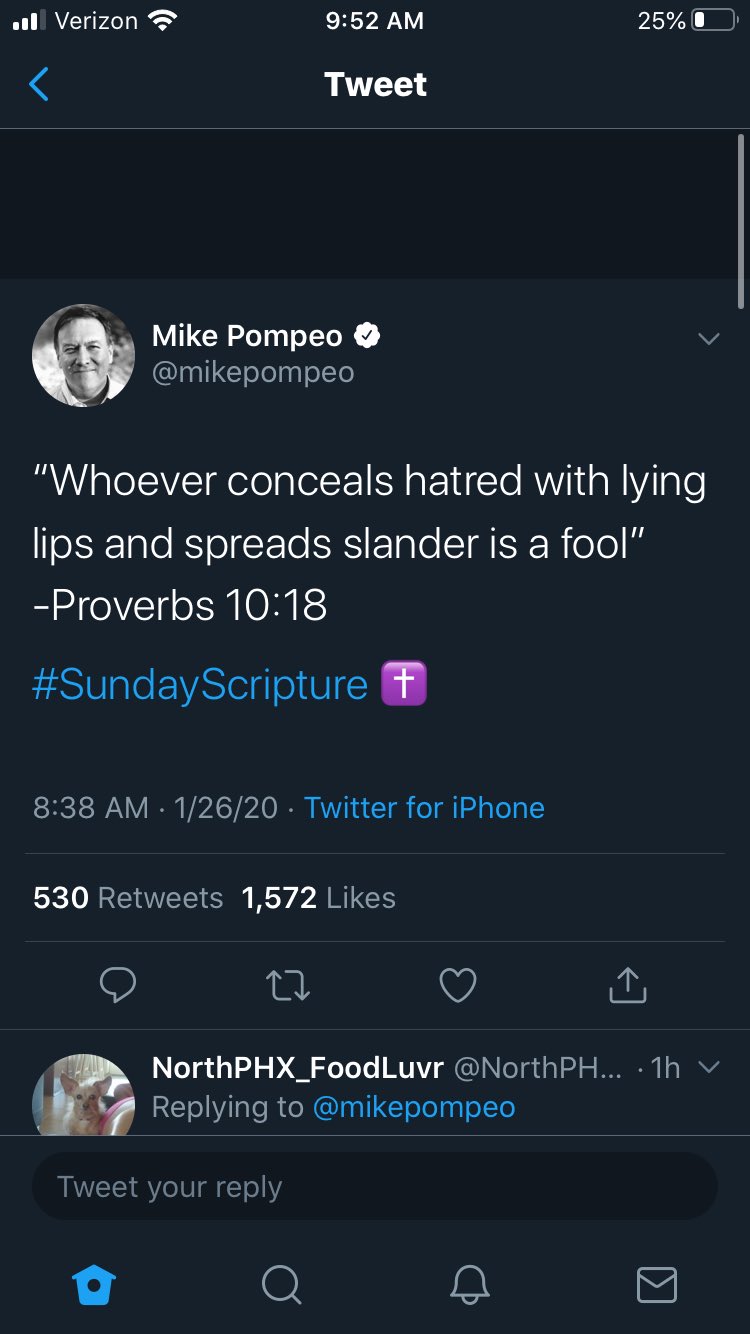
A running theme here and one of the key Trump Rules has been projection. Today's exemplars are:


Why so much projection?  It is quite simply really.  Folks like Trump and Pompeo are thoroughly awful people, AND they think they are normal.  That is, they think everyone else is just like them.  Trump knows he is corrupt, but does not think that is problematic because everyone else is corrupt.  Not being corrupt is foolish, in his mind, since everyone is profiting from their privileged positions. 

Of all the Trump tendencies, this is among the most consistent.  He explains everyone else's behavior from his own personal logic.  His own personal logic is one of corruption, deception, hate, and he assumes everyone else is similar.  This is one reason why there is the whole "there is always a tweet" thing, where some accusation he made--Obama is lazy, Hillary is corrupt, etc--turns out to be something he does.  His basic take on politics is blasting people for doing things that he would do if given the chance, and thanks to the Russians, Comey, Jill Stein, and others, he has had that chance for the past three years. 

The projection also explains his stance on trade agreements and alliances--that all cooperation is a ripoff unless one can get an exploitative deal.  Why?  Because he is trying to rip off the other person, the other side must be doing the same.  The idea that Canada is exploiting the US, for example, can only come from a fevered projecting mind.

Some might argue that this is deliberate deflection, a strategy to avoid responsibility.  The projection, however, is so consistent that it is basic to who Trump is.  If it were just a strategy, he could not do it all of the time because he simply does not have that kind of attention span or focus.

I can't help but think of the eight year old saying "I am rubber, you're glue, etc, etc."  Trump's responses require no insight, no thought, no information, no work, just accusations that everyone else is just like him.  Because he surrounds himself with similar types, his perceptions are reinforced.  The Pompeos, the Barrs, the Kushners of the world make it seem like everyone in the world is just like Trump: corrupt, lacking in integrity, profit-seeking, etc. 

The damning aspects for the United States are:
a) there seem to be plenty of people who gravitate to Trump and serve in his administration who feel the same way
b) it has worked well enough with 40-45% of the American people with, of course, the aid of Fox and the rest of the radical right media.

Just remember the next time Trump blasts someone, it is mostly ascribing to someone else his own personality and tendencies.  It is all projection, all of the time.


Saturday, January 18, 2020

Principal-Agent Theory and the Trump Administration: No Principals, Heaps of Agency

This tweet got me thinking, and since I am at an airport, I have plenty of time to ponder:

A caveat before I begin: I desperately avoided P-A theory in grad school as it was all the rage among the Americanists in my grad program (McCubbins saw himself as, well, either the Emperor or Darth something and I didn't disagree).  Alas, I succumbed when working with David Auerswald on the NATO and Afghanistan book because it was entirely about delegation.  Since then, well, I see P-A everywhere, including the movies.  Plus I assign it in my civ-mil class as a better way to think of civilian control of the military (thanks to Debbi Avant and Peter Feaver).

Once again, the core idea is that whenever a principal (a boss) hires an agent, the agent knows more about what the agent is doing than the principal does.  This information asymmetry means that the agent can do more or less than what the principal desires (tis called shirking either way).  One manages the P-A problem by selection agents carefully, granting more or less discretion depending on trust and risk, overseeing through a variety of strategies (police patrols, fire alarms, community policing), and incentives/sanctions.

How does this apply to the Trump Administration?  Well, of course, the first assumption is that the principal wants to control the agent. Not really sure this is the case here since Trump likes chaos among his advisers and playing them off against each other in the dumbest possible imitation of FDR.   The problem here for any agent of Trump is that one cannot tell what Trump is going to do since he has no principles---yep,  a principle-less principal. One core aspect of being an uncertainty engine is that Trump has no coherent, consistent preferences or values except ego gratification, greed, misogyny, and white supremacy.  His short-attention span, his refusal to read or to do any of the real work of a Presidency means that the agents are both confused and confusing.  While this gives Trump some plausible deniability ("I am too stupid or ignorant to know what I am doing and what my agents are doing"), it does mean control is problematic.

One way to handle the P-A problem is to pick highly qualified, like-minded agents who are loyal.   Hmmm, it seems that Trump's circle of trust is very narrow and not based on quality. Picking folks like Dershowitz and Guiliani suggests that tis far more about fealty than anything else.  While these guys seem quite loyal, Trump's abuse of them and their inherent tendencies suggests that they will turn on him just as quickly as Trump turns on them.  See all of the folks exiting the administration, with Scaramucci being a, um, model.  I keep referring the bottom of the barrel being thoroughly scraped, and the folks Trump/Giuliani used to get Ukraine to throw dirt at Biden exemplify this quite well.  The stream of text messages screams this scene from the Wire (NSFW):


To be fair to Trump, he didn't just hire bunglers.  He also hired the worst possible people, some of whom are way too competent in doing bad stuff. Bill Barr comes to mind.  Stephen Miller as well.  So, among the barrel of awful, there are some who are really good at doing harm, at engaging in arson.

Ok, the agent selection of this administration is, um, problematic but perhaps works for Trump.  What about discretion?  Does Trump grant wide discretion or does he give specific orders with narrowly defined "arcs of fire"?  Um, damned if I know.. but I would guess that Trump does not give well-defined instructions.

Oversight?  Definitely fire alarm.  That is, he relies on pitting his staff against each other and on watching the competitive leaking on Fox.  These are not the most reliable fire alarms as each agent competes to be the favored one at the expense of others.  Not all competition is healthy or productive.  So, stories get planted to make the other agents look bad, and Trump does not possess the information or the energy or the critical mind to assess the competing claims.  Again, the idea of oversight is to get information to overcome the asymmetry problem, and that requires inquisitiveness and critical thinking.  Ooops.

Incentives? Ah, here's the primary way that Trump controls his agents.  As long as one is in the administration, one has carte blanche to earn money at the expense of the taxpayer.  Corruption is not a bug in this administration but a feature.  As long as you serve Trump loyally (or Trump perceives as such), you can extract rents in a variety of ways.  This administration will go down as the most corrupt ever because Trump, the projection machine that he is, thinks that the only real motivation that gets people to do stuff is personal monetary interest.  Machiavelli might have warned that Trump is merely renting support and loyalty rather than buying it, but since Trump has a short attention span, I don't think he cares about that distinction. 

The problem with this tool is that Trump does not have a sophisticated system of controlling the graft--it is really access or no access, in or out.  Which means it is not very good for controlling the agents.  

Together, all this means that the people in the Trump administration are mostly out of control.  This does not mean that Trump is not responsible for what they do.  It means he is very responsible for creating this climate.  He owns all of it, even as he denies responsibility for anything that is reality-based. 

If we survive, the next couple of generations of political scientists are going to puzzle through the debris to determine the dynamics that shaped US domestic and foreign policy in the Age of Trump.  I think a common starting point for these folks will have to be realizing that there is not only no strategy (which requires information and some effort to understand the adversary's preferenes), but there is also little control.  The agents are amok as their boss ruthlessly avoids having information about what they are doing and is quick to throw them under the bus.  So, the key is to get as much cash as possible, commit as much arson as one can before one gets tossed.  And then write a book to make more money and see if one can find a fellowship at Harvard.

Thursday, January 16, 2020

Hard Pass: NATO in the Mideast

Trump had a short line in his speech about Iran about more NATO in the Mideast and has even fancied a new name for NATO: NATOME as in NATO in the mideast.

Nope, it ain't gonna happen (which I have said before).  I am currently in Berlin, doing my last bit of fieldwork for the Dave/Phil/Steve project on comparative civil-military relations--what role do legislatures have?  I had an instructive conversation yesterday that made me feel better about my core beliefs on this.  So, first, let me explain my core beliefs and then what I learned yesterday.

NATO operates by consensus, and I think it is damn near impossible to reach consensus on NATO doing much more in the Mideast.  Currently, NATO is running a training mission in Iraq (as discussed by Stefanie von Hlatky in both ep 15 and earlier episode of Battle Rhythm as she visited there for her research).

Why is consensus highly unlikely?  Let me count the ways:
  1. Trump didn't warn the NATO troops in Iraq that their risk levels were about to go way up due to the drone strike on Suleimani.  He essentially placed these folks at much greater risk without any warning.  They are likely to be most displeased, and Justin Trudeau's statements have heaps of this displeasure in between the lines.
  2. The Europeans come to this pre-miffed--already upset at how Trump has handled Iran.  They find the JCPOA to be far more attractive than the alternatives, so they see tensions with Iran mostly the fault of Trump.  That Trump has repeatedly threatened European countries and companies with sanctions if they don't go along may not be something that gets much play in the US but gets much play, anger, resentment in Europe.
  3. Each member of the alliance has its own domestic politics to consider.   This is especially true for most of Europe where any deployment requires a vote in parliament--only the US and Canadians (maybe Turkey?) seem to be immune from this.   To get any vote through will require the most enthusiastic party to expend tremendous political capital to try to get other coalition partners (most European countries are run by coalition governments) and perhaps others (in some places, the governing coalition tries to get the main opposition parties on board so that there is national backing [and all are implicated, making these things lesser campaign issues]).  Given that Trump is toxic, and voting for such a mission would make a party look like it is standing with Trump, I just don't see it happening.
Maybe that was all in my head, a product of my Trump Derangement Syndrome and confirmation bias.  And then I talked with a Bundestag staffer yesterday.  The topic, of course, was mostly the research project, with me asking questions about how the Defence Committee operates in Germany.  But we got distracted by the on-going discussions about Iran--that many politicians could not talk to me this week because they are busy with extraordinary sessions dedicated to the Iran issue.

It was very clear from that conversation that my basic assumptions and assertions are on target here--that it would be very, very difficult to get Germany to agree to support a NATO decision to extend its efforts in the Mideast.  While Germany has opted out of other NATO operations (Libya), this time not only would other countries also opt out, but I am pretty sure they would fight against NATO deciding to do anything in the first place (more like 2003 than 2011).  Don't expect a consensus on NATO doing more.

So,

Friday, January 10, 2020

Thinking Comparatively About the Iranian Shootdown

Who is to blame for the Iranian shooting down of the Ukrainian plane with many Canadians on board?  Obviously, Iran is.  But folks have been wondering if Trump is to blame.  I said that he owns some of this, not a lot, but some.  How so?

Well, first, if the reports turn out to be true, and the video is pretty damning for the Iranians, then this tragedy will join a post World War list:
  • MH17 over eastern Ukraine, July 17th, 2014
  • Siberia 1812 over Ukraine, Oct 4th, 2001, entirely eclipsed by the post 9/11 stuff
  • Iran Air 655 over Strait of Hormuz, July 3rd,1988
  • KAL 007 over Soviet territory, Sept 1, 1983
  • Itavia 870, over Italy, July 27, 1980, unknown missile.
  • Air Rhodesian flights shot down by rebels, Sept 3, 1978, Feb 12, 1979
  • Libyan Arab Airline 114, Feb 21, 1973 over Sinai
  • El Al, over Bulgaria, July 27, 1955
  • Cathay Pacific Vr-HEU around Honk Kong, July 23, 1954
With two exceptions, the Itavia mystery and Siberia 1812, all of these took place in an environment of severe international tensions. Some seem more deliberate than others (Air Rhodesian flights, for instance).   But the common thread is of this stuff happening in quasi-wartime.  Not wartime, but not peacetime.  The KAL flight was at the peak of the renewed Cold War, the Vincennes shot down Iran Air 655 in the middle of the Iran-Iraq war where it was seeking to protect tankers that had been targeted, Libyan Arab Airlines was shot down in one of the hotter stages of Arab-Israel tensions, etc.

If this was an accidental shootdown by anti-aircraft missiles, how could this happen?  Most likely nervous, poorly trained personnel in a time of high alert.  Why the high alert?  Because Iran had just fired upon US/Iraqi bases and was worried about a response.  What were they responding to?  The drone strike on Suleimani.  Why did that happen?  Trump was responding to attacks on Americans in Iraq.  Why was that happening?  Lots of reasons but partly Iran amping things up.  Why?  Trump's supposed strategy of maximal pressure to get Iran to negotiate over .... damn near everything.

The Trump Administration wants Iran to stop doing everything that bothers the US, which is why the JCPOA (Iran nuke deal) was not sufficient--it didn't stop Iranian support of Hezbollah and other terrorist groups and so forth.  It is not clear why Iran would assent to a deal that would constrain it greatly, especially when it is not clear the US would take yes for an answer.  Regime change has long been at the heart of US ambitions towards Iran.  Anyhow, the point here is that Trump has increased the pressure on Iran, leading to a variety of incidents (nearly striking Iran last summer in response to their downing a drone, for instance).

This short history points to the joint responsibility of Iran and US for creating tensions in the region.  Combine that with the reality that all it takes is for one of many missile batteries to do something hasty/stupid, which is more likely when things are tense, we can see that the US under Trump has some responsibility for what happened.  The timing says as much as the pattern of shooting down of civilian airlines in the past.

The striking thing about yesterday's news to me was that the Prime Minister of Canada did not rule out American responsibility.  That says a lot about the state of US-Canadian relations.  Thanks, Obama ... Trump.


Thursday, January 9, 2020

NATO in Iraq: More, Same, Or Less

Trump included a semi-throw away line about NATO doing more in Iraq or Mideast.  While Justin Ling argued this is something that should be done, here's why it, like fetch, ain't happening:
  1. NATO countries cannot operate without the US on the ground or in the air. The US has unique capabilities (comms), abundant capabilities (medevac helos), strong capabilities (quick reaction forces to defend/rescue allies in harm's way), and so on.  
  2. Why would any NATO member want to put their troops in harm's way after Trump endangered the existing NATO troops by launching a strike against an Iranian official without notifying said NATO countries?
  3. The NATO mission is one of training--the risk of green on blue (trainees attack trainers) is much greater now than it was two weeks ago.
  4. NATO members have domestic politics, mostly governed by coalitions, and with hard requirements to have deployment votes for stuff like this, unlike US or Canada. 
  5. The domestic politics is tougher because Trump is toxic in most countries.  Which leaders are willing to buck domestic opposition to stand next to Trump? Hungary? Sure, Orban wouldn't mind, but Hungary is also one of the crappiest allies in terms of showing up and doing heavy military lifting (the New Zealand forces in Afghanistan patrolled the Hungarian sector next door precisely because they didn't trust the Hungarians to do it themselves).   France?  Nope. Germany?  Nope. UK? Probs not.   There is a price to be paid for all of Trump's antagonizing of European countries.
  6. If Justin Trudeau allows folks to think that maybe the shooting down of the plane in Iran might just be partly due to Trump's behavior, you can be pretty sure that few allies will trust Trump on anything.
So, no, NATO reinforcement in Iraq to replace the Americans.  

Whose Lives Matter in an International Conflict or Crisis

The US-Iran crisis reminds us that, well, not all lives matter the same:
Should we be surprised at how irrelevant the casualties suffered by the Iraqis might be?  No.  Appalled? Always.  This led me to think about how various kinds of people and their suffering varies in the eyes of the media, in the calculations of governments, and in public opinion.  To be sure, there is variation across outlets and countries, but the patterns below seem to be fairly robust.

First, one's own soldiers/sailors/aviators matter much, much more than anyone else.  At least, that is what I have gleaned from both US and Canadian media.  Incidents involving one's own troops get covered, discussed, etc, usually pretty extensively.

Second, one's allies matter a smidge.  Their efforts, their suffering get a bit of coverage, some mention in the overall totals, but far less.  The exception may be that other countries may cover when Americans get hit for the simple reason that if the Americans get hit hard, two things may happen--they may escalate or they may leave.  In either case, their reactions affect both the vulnerability of one's own troops and the viability of the mission.

Third, the locals--Afghans, Iraqis, Vietnamese--their suffering hardly matters.  The idea that the Iranian response was no biggie since it didn't hit Americans even if it hit Iraqis (it didn't turn out that way, I think, but that is what folks seemed to say at first) typifies this attitude.  I am not saying the allied troops do not care about minimizing civilian casualties (although the allies vary in how concerned they are about collateral damage), but that in the media coverage, we tend not to be given the numbers, and in the calculations of leadership about whether to deploy or to engage in a specific operation, these numbers matter far less, if at all.

Fourth, private contractors count for more and less than the locals.  Less in that concern about collateral damage does arise, whereas I have yet to see politicians even utter any concern about the costs paid by private contractors in these wars.  The big exception, of course, is that when one or two or four get very visibly killed.  Then that can trigger a bigtime response--Fallujah in 2004, recent events in Iran.  Private contractors fall into the Stalin logic: one death is a tragedy, thousands are a statistic (see here for a discussion of the origins of what I am paraphrasing). 

Of course, this gets to a key dimension--how visible are the deaths of the troops?  Are the bodies dragged through streets or hung versus just left where they died?  Emotive reactions matter here greatly. 

Which gets to the other key dynamic: killed in action versus wounded.  Most media folks know the total number of their country's troops killed in theatre or a ballpark number.  Same for politicians.  But wounded?  Even if we forget for a second of those suffering non-visible wounds (brain trauma due to concusion, PTSD), the visibly wounded are still largely invisible.  One of the key hidden dynamics of recent wars has been the dramatic improvement in medical care.  This has changed the ratios of wounded and killed.  And it is partly a product of policy--that in Afghanistan, a case I know best, troops were not allowed to operate more than an hour from a major allied medical facility.  Why? Because chances of surviving are greatly enhanced by being treated within the golden hour.  What happens when there are not enough helicopters available to guarantee a less than hour flight back to base?  Either no operations or operations within an hour's drive, which means the mission is covering far less territory.

The point here is that we tend to be quite callous in our coverage and our conversations because not all lives and not all suffering seems to matter.  It is important to remember that there are other folks in harm's way besides one's own troops.  That the use of force can implicate not only one's own troops but others as well, and one might want to care a bit about this.  And no, this is not a subtweet of Trump's inability to remember that he put both allies and locals in harm's way when he decides to whack an Iranian officer in Iraq.  But that too.


Tuesday, January 7, 2020

Nothing at NATO is Automatic Except More Meetings

Lots of speculation about responses to the Trump/Iraq/Iran situation, so let me just clarify a few basics about NATO.
  1. There is nothing automatic about Article V.  Yes, it has meant that an attack on one is seen as an attack on all BUT it requires a decision at NATO HQ among the permanent representatives from the members.  That decision is not a vote but one by consensus.  And getting consensus might just be really hard for reasons I elaborate below.
  2. If Article V is involved by NATO, no member will be obligated to do anything specific as "each country will respond as they deem necessary." Yes, there is an opt out clause in Article V because the US insisted long ago AND it is hard to get consensus if countries have to surrender all decision-making after that. 
  3. Oh, and NATO is a defensive alliance.  So, at least a few countries would not be so thrilled to join an adventure the Americans started.
That gets us to the problem of consensus.  Few non-American leaders have been enthusiastic about the strike last week.  Justin Trudeau keeps meeting with leaders of international organization calling for de-escalation in ways that are essentially subtweets aimed at Trump, and he is hardly along.  The Europeans have been upset since Trump pulled the US out of the JCPOA and after he has threatened European countries and businesses if they refused to sanction Iran.  The whole Iranian issue is a toxic one in US-European relations.  So, getting consensus would be much harder than in other circumstances.

Moreover, rather than investing in good will with American assurances of support in case Europeans need it, Trump has been threatening the allies about mythical back payments and reaching a standard now that was semi-agreed to for 2024--2% of GDP spent on defense.  So, that also does not create a lot of support for what would be seen as a replay of 2003.

Which gets to the heart of the matter: NATO members have their own domestic politics.  To support the US in this effort would require not just looking at the polls, but, if things got serious, votes in parliaments because nearly all European countries require votes to deploy troops.  And with mostly coalition governments, those votes are hardly guaranteed.  Given that Trump is unpopular in most European countries, it would be very, very hard to get NATO members to agree to expend serious money and risk the lives of their troops especially for an administration that is not seen as particularly competent.

One last thing: with the strike on Suleimani without notifying anyone, Trump has endangered NATO troops on the ground in Iraq.  That is something that will weigh heavily in much decision-making in the capitals of NATO members.

Update: One more thing: threatening to commit war crimes (hitting cultural sites) is a great way to ensure that the Europeans do not join in.  Most of these countries are very sensitive to these kinds of issues, and will not want to be present where war crimes are being committed.  So, Trump is making it much harder for any European leader, if they wanted to, to try to join any US-led effort.

There will be meetings, because that is what NATO does.  But don't expect any policy statements anytime soon.  The members are all waiting to see how things develop.

Saturday, January 4, 2020

Deterrence 101: Not Applicable to Big Brothers

Lots of talk about "re-establishing deterrence" with Iran right now.  One can argue about whether it was good or bad to hit Suleimani, but this ain't about deterrence.  The shorthand is: deterrence is about threats, not about the actual use of force.  The longhand is the Big Brother problem.

Let me explain (I am not a deterrence theorist, but I play one on TV):
The basics of deterrence are: if you do x, I will harm you and harm you in ways that are greater than the benefits of you doing x AND (here what is often ignored) I will harm you in ways that are worse than either the current status quo or where you think the status quo is shifting.  The US, for instance, sanctioned Japan in response to its aggression (cutting off oil sales, if I remember correctly) so that the situation was worsening for Japan.  This undercut deterrence because the "doing x" seemed to be more attractive, not less, compared to the shifting status quo.

Much of the focus of deterrence is on the credibility of the threat--will you do the costly thing to create harm for the target (which often creates harm for the deterring country)--but there is the other side of the question--what I call the Big Brother problem.*

For deterrence to work, one has to threaten harm if the target does something you don't want AND one has to assure the target that they will not be harmed if they do something you want.  You have to be able credibly to accept yes as an answer.  Can this administration do that, especially from the Iranian standpoint?  Iran agreed to the nuclear deal which limited its nuclear aspirations (we can argue all day about whether it was good enough, whether it complied fully), and then the Trump Administration said it was not good enough and dropped out of it, threatening maximum pressure. 

For the Iranians, it seems like the US could not take "yes, we agree" as an answer.  For the Trumpers, they can say that they cared more about other behavior, and, yes, other behavior--supporting Hezbollah, doing all other kinds of awful stuff--was problematic.  But in a bargaining situation, when you say, nope, we are not going to take yes for an answer, it changes the dynamic quite a bit.  And, yes, to engage in bargaining, you have to think not just about what you are thinking but what the other side is thinking and preferring.  The whole idea of "strategic" is about getting inside the head of the other dog adversary.

Coming back to the shorthand, to use violence is an admission that deterrence is not working.  It is still coercive diplomacy, but a harder, less successful form: compellence.  Compellence is mostly about using force to get others to change their behavior (see these handy lecture notes from Branislav L. Slantchev).  The Kosovo bombing campaign is a successful example, and there is a lot of regret about that one.  That is much harder for all kinds of reasons:
  • It tends to require the other side to make a visible change in policy, losing face, whereas deterrence simply requires the other side to keep not doing something.
  • It is not just about losing face--the other side had a reason to be doing what they were doing, so altering their preference structure or changing the costs they face is harder than maintaining the status quo.
  • I forget the rest....
While Thomas Schelling was not always right, his classic works about coercive diplomacy remind us that threats vary in how easy/complicated they are (compellence is hard), and that restraint and empathy are required.  Given that this administration is utterly devoid of empathy, is not known for restraint, is also devoid of credibility, and is not very coherent or competent, it is hard to imagine how they can make a compellent strategy work.  This is one of the places where the uncertainty engine comes home to roost--that lying about much stuff and flip flopping a lot has consequences for persuading the Iranians not to escalate. 

So, yes, I am reminded of 2003 in that these are the wrong people seemingly planning the wrong war at the wrong time (the time thing is about how all of this undercutting the ISIS fight).  Any pleasant callbacks or analogies that I am forgetting?


*  No, my big brother didn't abuse me.  Just thinking about a well known kind of dynamic.

Friday, January 3, 2020

US-Iran: Allies and Proxies Be Damned

I have turned down a couple of radio hits to talk about this, because I don't want to be asked about the Iraqi and Iranian politics all of this stuff in the aftermath of the assassination of Qassem Suleiman.  The joy of blogging is that I can talk about what I want and not be asked about stuff outside my limited area of expertise.

So, let's just focus on the alliance politics of all of this.  American allies were not consulted or even alerted, apparently.  If the British weren't, then I doubt that the Canadians or Germans were.  Now we have reports of US planes carrying troops to the region being turned back from Turkey (will update if that is wrong).   Just raising these two examples indicates this is really a poor time for the US to ramp things up in the Mideast--the US alliance with Turkey is in tatters after the Syria shenanigans over the past several months AND the UK's ability to be both reliable ally and whisperer are both greatly diminished thanks to Brexit.  This attack and escalation with Iran put other troops in harm's way, such as the Canadians who are leading the NATO mission in Iraq.  Would have been nice to put them on alert, if one were a good ally.  One of the basics of war in the 21st (and 20th) century is to get one's allies in place ahead of time.  Scrambling mid-war to put an alliance or coalition together is a bad idea.   


As I tweeted last night and have discussed here repeatedly, one of the basic concepts in International Relations is the alliance dilemma (Glenn Snyder and Patricia Weitsman).  That allies fear two things: being abandoned by an ally when one is needed and being dragged into a war that one does not want.  Either an alliance is too loose or too tight.  Because Trump is an uncertainty engine, he has the amazing ability to make allies fear both at the same time.  South Korea gets pushed around for not giving the US enough dollars for defense at the same time that the US is engaged in a war of words and escalating symbolic measures that might risk war.  At this point in time, the best guarantee for South Korea is still the US troops in South Korea--but before, they were there to deter a North Korean attack.  Now, in more than a few South Korean eyes, they are there to prevent the US from unilaterally striking North Korea.  

A second core reality is that allies and proxies have their own domestic politics.  Yes, this attack will be complicated for the Democrats--how to salute the death of an adversary yet criticize a messed up process and potentially dangerous outcomes--but it is a bit simpler for most of the other relevant players:
  1. This is not going to lead to an uprising in Iran, contrary to Ari Fleisher and other "flowers in the streets" folks who appeared on Fox.  It will make it harder for folks to protest the Iranian government because, guess what, Iran is now at war.
  2. While Sunnis in Iraq might be thrilled, they are not in charge.  The Iraqi government has been receiving much aid from Iran, and this attack may have killed a key Iraqi government official.  So, expect to see much noise from the Iraqi parliament, including motions to eject the Americans from Iraq.  This attack is part of a series of escalations where the US was supposed to be coordinating with Iraq about attacks on Iraqi soil and was not.  
  3. Another unilateral effort by the US in the Mideast is going to make it harder for any European politician to stand with Trump.  2003 all over again?  Maybe not quite, but it has already gotten harder for politicians in Europe to work with the US since Trump is so reviled.  
  4. Israel?  Damned if I know--their domestic politics is so screwed up--a third election underway in about a year.
 Of course, these are all second/third order consequences.  Trump's team only focused on the immediate consequence--the US killed a bad guy.  Reminds me of Iraq 2003 where the Bush team also was focused on a singular outcome--getting Hussein--despite all of the potential (and realized ultimately) second/third order consequences--huge $ cost, serving as recruiting videos for terrorist organizations, empowering Iran, weakening the effort in Afghanistan, etc.  I opposed that war partly because I thought the team involved--Rummy and his band of ideologues--was incapable of running the war well.  This time, well, Trump's team makes Rummy's team appear thoughtful and humble.  


Wednesday, January 1, 2020

The CDSN's Year Ahead

In planning the SSHRC grant for the Canadian Defence and Security Network, the idea was to start slowly and then do more in year 2.  In the first seven months or so, we have hired staff, re-arranged the office a few times, developed a logo and associated branding stuff like banners, engaged our partners (adding two), started a podcast, and started a series of research workshops (each of the five themes will be holding annual workshops).  What are we adding in year 2? 
  • A Capstone Seminar: On March 10th at the Canadian Forces College, we will be bringing together some of the best presenters and presentations that took place in 2019 across Canada.  The idea is to give both our partners' events and an all-star team of mostly emerging scholars with the folks getting some mentoring along the way.  We will be setting up a registration page with info about the presentations.  It will be free, but will require registration since the event is at CFC.
  • A Post-Doc competition: Each year over the remaining six plus years of the grant, we will fund a post-doc working on one of the five themes (personnel, procurement, operations, civ-mil, security).  We will be circulating the application info shortly with the post-doc to start in July.  The site of the post-doc will depend on which theme the successful applicant is working on and on the needs of the research project.
  • A Book Workshop: Each year, we will hold one book workshop.  A junior scholar's book will be read by members of one of our research centres plus a couple of experts brought in.  We will circulate application info in the early spring with an aim to having the workshop in the early fall.
  • A Summer Institute: In August, we will bring together emerging scholars, junior policy officials, and military officers for a week-long course in Ottawa on Canadian defence and security.  We will advertise this in February.   
  • A CDSN Conference:  While our partners have a variety of conferences over the year, which we will advertise and amplify, we plan to hold a conference alongside the IUS-Canada event in late October in Ottawa.  The plans regarding this are, um, thin.  
  • Internships: In the second year of the grant and onwards, we will have funds to place undergrads either in research positions at universities or in practical positions as interns.  This will vary across the country depending on the opportunities arranged by each research theme.
  • A Survey:  JC Boucher at Calgary and Nik Nanos of the Nanos survey firm will be conducting a nationwide survey on knowledge and attitudes about defence and security.  While organized by the civil-military relations theme, the questions will address a variety of issues.
  • A Youtube Channel:  It will contain the stream of the Capstone Seminar, presentations from the Year Ahead conference, and more!
We will be holding another series of workshops (one for each theme), supporting the conferences and other events held by our various partners, organizing additional events as things arise (potential speakers coming to Ottawa for other events, responding to requests from partners, etc). 

All in all, it will be a very busy year.  I am very grateful for the excellent work by the CDSN HQ staff-- Melissa Jennings, Alvine Nintai, Jeffrey Rice--and our team of MA students: Jonathan Jung, Ammar Shirwani, and Ramesh Balakrishnan.  The Theme Directors (Alan Okros, Alex Moens, Anessa Kimball, Erin Gibbs van Brunschot, Irina Goldenberg, JC Boucher, Phil Lagassé, Stéfanie von Hlatky,Srdjan Vucetic, Stéphane Roussel) have been key creative forces behind much of the stuff you see above, and, sorry, will be doing a lot of the heavy lifting of evaluating the various applications, serving as presenters for the Summer Institute, and organizing the various Theme Activities. 

Keep an eye on our news page of the CDSN webpage at https://www.cdsn-rcds.com/news for announcements. .  We will, of course, be tweeting at @cdsnrcds about what we are up to, and we will announce our initiatives in our semi-weekly podcast, Battle Rhythm, which is available at all of the usual podcast outlets.  If you have ideas or want to participate in our efforts, let us know at  cdsn.rcds@outlook.com.


Tuesday, December 31, 2019

The Years of Reviews

As I finished up my last review of an article for 2019, I checked out my spreadsheet where I keep track (sort of) of the reviews I do.  I discovered some patterns I wanted to think about:

The figure includes reviewing manuscripts for journals and for book publishers, grant applications for various funders, and tenure letters.  Obviously, the level of work varies--tenure letters are a lot more work than all the others, book reviews vary depending on whether one is reviewing an entire manuscript or just a proposal.  But I didn't choose to code stuff carefully for this blogpost because this is already a relatively unproductive use of my time!

Anyhow, I reviewed before 2006, but hadn't develop the habit of marking down the details in a spreadsheet.  A few things stick out:
  • on average, I review twice as much as I used to.
  • With the exception of 2018.
I tend to say yes to most review requests (see here for decision-making challenge of when to write tenure letters), but I have decided recently (too recently to affect any of the numbers except the last column) not to review stuff in the old field of ethnic conflict.  Because I am way, way behind in that literature and am no longer doing much work in that field (that may change, but not yet). 

I do get fewer requests, I think, to do tenure letters since Carleton is generally not see as peer-ish as McGill was.  Most provosts and deans want tenure letters to be written by scholars at peer institutions, and they tend to have a rather limited idea of what counts as peer.  So, I am guessing I would be getting more tenure letter requests if I had stayed at McGill.  The aforementioned change in research focus--from ethnic conflict to alliances and civ-mil relations--probably helps to explain why I get more requests.  That there are more articles that editors and editorial assistants that fit into what they think of as my expertise. 

There is something else going on--that there are more journals and more submissions to journals, so I may be getting more requests and doing more reviews as the need for reviewers intensifies.  Also, I joined a number of editorial boards, where the primary responsibility for being a member is to not say no when the editor needs to get some reviewers.  I have stepped off of a few as my shift has come to an end and, for one, as mentioned above, I can no longer be of much use. 

Oh, and 2018?  That was the year where I had a great deal of work to do with the second stage of the SSHRC Partnership Application, so I think I said no a bit more often. 

For 2020?  I expect to stay at my recent average of 18-20 or so--about 1.5 reviews a month.  However, if journals and presses do not ask me to review for them, I will not seek them out.  It is unpaid work, but a part of being a professional.  That and I learn a fair amount as the latest work contains all kinds of interesting ideas, useful citations, and stuff I don't know. 

Here's hoping that your new year is chock full of speedy, positive, and helpful reviews.


The Academic Journey Thus Far

A twitter conversation has led me to think about my academic journey

When I finished grad school in San Diego, I had no idea where I would end up.  

Our first stop was Burlington, Vermont for two years of visiting prof-ing.  I took that job hoping to cash it in and get one of the two tenure track lines there, but it didn't work out.  Looking back, I am glad it worked out as it did, even though it meant teaching at a place for a second year after being told in year one they didn't want to hire me for the long-term.  Awkward indeed.  But I learned how to teach, and their students were great.  And I improved my skiing ability and got my wife into skiing.  Plus our dog was most welcome in a community filled with large female dogs--his, um, preferred companions.

If I had a blog at the time, I might have
referred to her as ER-adjacent Spew.
Our second stop was Lubbock, Texas, where I was technically employed for seven years although we lived their for six.  This is where Baby Spew was born, which was handy since the ER was close by, and we visited it often.  I learned how to publish there (I had only one or two pubs before this job), and I learned how to teach large classes, which became pretty important at the next stop.  And we made friends with a great group of folks who all moved on.  While I was itching to get out as soon as we arrived, and I spent too much time on the job market before my record really changed very much, it turned out to be a good experience in retrospect.  It was a good place to get a lot of research done--a good teaching load, short commute, few students asking much of my time.  But the best part of that place--my friends--was the most temporary, as the department turned over quite a bit.

No, I didn't wear a uniform
in the Pentagon.  I just dressed
up like this as a prank
for a retiring colonel/boss.
Our next stop was Washington, DC for a fellowship that put me in the Pentagon.  This year stressed Mrs. Spew as I was hardly around (I left at 5am, returned around 7pm each day), the landlord was suboptimal, and, yeah, the building I worked in got attacked a couple of times (9/11, anthrax).  But it was a great year for me.  I drank from the firehose--learning so much about how the US military works and how the interagency works.  I went there to see the sausage get made, and did I!  Plus it bred questions that have driven my research since then--the NATO book and now legislative oversight.  I went there as an ethnic conflict specialist--the folks in the Balkan policy pit called me The Irredentist--and left seriously interested in civil-military relations.

Got to play with my daughter from
time to time in Montreal.
Which led to Montreal and McGill.  The transition to another country and especially Quebec was more challenging than we expected--importing one of our cars ate about eight Thursdays my first semester.  But Montreal had the best ultimate frisbee community of my life (Ottawa is close, but I feel like I moved here too late to fit in), great skiing nearby, amazing food, and, um, interesting politics.  McGill provided a great place to be challenged by super-smart, engaged students at all levels, and to learn much from sharp younger colleagues.  One consistency in my career is that the folks hired after me at each place have been so very sharp (yes, this is an implicit dig at the old farts at the non-Carleton places.  Ok, not so implicit). 

My colleague, Steph, drafted me to
speak to her class this fall on alliance stuff
And now Ottawa and Carleton.  Being in a national capital is great for someone who studies International Relations.  As I have been more and more interested in engaging the policy community, it helps to be there.  I learn a lot from folks I meet at events, at parties, at bars, etc.  It has definitely facilitated my efforts to build the CDSN.  It is also the first place I moved to where I knew people ahead of time, so it felt really welcome.  NPSIA and Carleton have been terrific to me, supporting my various efforts and recognizing me when I do good stuff.  Oh, and the frisbee fields are the softest, most convenient that I have experienced.  Older bodies need softer fields.

Throughout my career, I have wanted to move on from wherever I was at.  What will make the 2020s different from the prior decades of my career is this: I will not be on the job market.  I have now gone about eight years without having to think about the next place.  I am now of an age and of a job status that it is very, very unlikely that anyone would hire me--I am too old, too expensive, and too entitled (I am addicted to my endowed chair).  Oh, and I am too happy. 

I am well aware that I am much closer to the end of my career than the beginning, but I am ok with that.  The ride has been bumpy along the way, and things never turned out as I expected.  So much for walking from my house to my classroom in a liberal arts college.  Instead, I have had amazing opportunities to see much of the world, to shift research agendas, to teach entirely different types of students (undergrads to PhD students to policy-oriented MA students). 

Sure, I couldn't control where I did my stuff, but I can control what I do and how I do it.  The academic career, if one manages to get on the tenure track, can be a great ride, and it has been for me.


Monday, December 30, 2019

Resolving 2020

Doing resolutions here has been a semi-regular thing, which is so very appropriate.  The first one I find refers to returning to the big grant project, which I no longer have to do! Woot!  Of course, the big grant has not stopped the grant machine from operating as the big one only partially funds a bunch of events, and we need to find other money to make those events work out as well as they can.  Indeed, the big success story has been a heap of fun and helps to provide for the greater good, but is getting in the way of other stuff.  So, what shall I resolve for 2020, a year so nice, they named it twice (sorry)?
  1. I have committed to other outlets for blogging, and I need to keep my promises better this year.  So, I hope to see more of my stuff at Political Violence at a Glance and Duck of Minerva.
  2. I also resolve to pick up the pace here.  I don't need to blog every day or four times a day (ah, 2009 ...), but every other day is something I want to aim for.  As long as I have stuff to say.  The challenge is that I can usually find an old post that says something that I need to say again.  
  3. I now have five PhD students at various stages of their program, so I resolve to be reasonably quick about turning around comments on stuff.   I don't think I have ever had so many at one time (and we have a small program).  It may not be as much as some folks, but this is the limit of my capacity, I think.
  4. I resolve to say no to non-NPSIA students.  My foray into teaching undergrads might mean more requests for honors thesis super visions, but, yowza, if I don't say no more often, resolution #3 will be at risk.
  5. I will say no to any more edited volume chapters.  I have three all due at the same time this spring.  All three are interesting projects, but I need to focus on ye olde booke with Phil and Dave.  We are getting close to actually writing and finishing the book.

  6. I resolve to say no to reviews that are out of my area of expertise.  I know that journals are desperate for reviews, but I do my share and I don't think I do anyone any favors if I don't know the literature.  I can't speak to whether something is a contribution in an area I don't know
  7. I resolve to catch up on my journal reading--which would make me a better review (oh wait!).  This is a regular resolution that goes unmet.
  8. I resolve to stay on top of all of the CDSN stuff, not just the fun stuff like the podcast, but the less fun stuff--reporting, accounting, etc.  Do or do not, indeed!
  9. Continue the positivity.  I was called annoyingly happy this year, and I want to keep that up.  
I would say that I resolve to travel less, but I think Mrs. Spew's snort would scare the cat.  I am sure there are other things I should be resolute about, but this covers it for now.

Happy New Year to you and yours!

Sunday, December 29, 2019

Spew in Review, 2019: It Always Is Darkest Before the Dawn edition

Oy, we thought all those great folks dying a few years ago made that year a bad one, but 2019 has been a pretty miserable one.  Great for me, but bad for Canada, bad for the US, and bad for the planet.  Pretty sure 2019 will be remembered as the year climate change became quite a real, present thing and not a future problem thing, and, yet, regression was the theme on that front given the politics in many countries including Trump's love of coal and the role of pipelines and such making Canadian politics on this issue so very screwed up.

So, on that cheery note, I want to look back at the year of Spew.  This helps me figure out what happened, and also helps me find key posts years later.  So, enjoy or ignore this yearly exercise in narcissism. 

Saturday, December 28, 2019

Revising Rise: Some Ideas While Driving

Mrs. Spew and I returned from visiting her family, and so we had much time to ponder what could made Rise of Skywalker better.  I liked the movie upon second-watching, but rather than revise my first post, (although after watching some of the original movies over the break and seeing Rise again, and, yes, responding to the commentary, I would move Rise from tied with RoTJ to the Ambivalent Tier, perhaps tied with Force Awakens with the conclusion of s1 of Mandalorian pushing it to Rogue 1 territory) I suggest how to revise the movie.

So, various ideas beyond the break, but no wayfinder needed:

Monday, December 23, 2019

Looking Back at the Teens

Tis that time of year where I look back at the year that was.  However, I am too exhausted by the pace of political events, the work put into the Canadian Defence and Security Network, and the emotional drain of seeing the last Skywalker movie.  So, instead, I will ponder a meme that circulated twitter this month: looking back at the 2010's!

There are a few ways to do this:
  1. Compare and contrast where I was on January 1st, 2010 and where I am now personally, professionally and so forth.  
  2. Think about the big events of the decade gone by, especially the more personal ones.
  3. Systematically review changes in culture, politics, and so forth.  
Well, the last would be most interesting and perhaps enlightening, but also the most work.  The easiest is the first, so I will do that instead, with (2) later this week. 

On January 1st, 2010,
  • I was working at McGill, living in Montreal, and searching for a way out.
  • my daughter was a teenager and living at home
  • while I had started working on the NATO project, it was starting to mutate from being about the alliance to being a comparative civ-mil project.
  • I had only recently started blogging and tweeting--both in the spring/summer of 2009. 
 In December of 2019, I am:
  • I am thru running.  I am most happy at Carleton and living in Ottawa.  I just don't imagine any more moves.  Carleton has supported my efforts, provided me with great colleagues, and recognized when I did good.  Ottawa is a great city for an IR person, as I have had so many opportunities to chat with fascinating people.  
  • my daughter is now adulting, living on the West Coast, and gainfully employed. This is all good news, but I miss her greatly.  The weekly skypes are great, but not the same as having her in our lives on a daily basis.  This is the natural way of things, of course.  
  • I am now entirely engaged in comparative civ-mil, taking me from old haunts in Europe to Asia and Latin America.  Ok, engaged in that and adding a heap of administrative work as Director of the CDSN.  I threw up a picture of a dog catching a car when we got the grant, and it was pretty apt.  I know the next seven years and most of the 20's will be spent on this effort.  While it is a heap of work, I have enjoyed the ride, and am very, very thankful for the work done by all of the folks involved and for the continued enthusiasm and support by the partners.
  • Oh, that social media thing?  Oh my.  I may be blogging less these days (mostly because I can re-post old posts that are apt), but I have added podcasting this year to the endless tweeting.  


Friday, December 20, 2019

First, There Was a Trilogy; Then, A Trilogy of Trilogies ...

Next, will we have three series of tri-trilogies?  It is probably too soon to react to seeing Rise of Skywalker, but, I will, because it is my blog.  Spoilers dwelleth below:

Thursday, December 19, 2019

Impeachment? What About My Meme?

I have been tweeting out the same meme for quite some time:

Today, the day after Trump was impeached by the House of Representatives by more votes than any other President (thanks, Jacob, for pointing that out), does this mean this meme is dead?  Only sort of.

I did write here last January arguing that the meme is about not counting on impeachment to solve the Trump problem--that the House might vote to impeach Trump, but there is no way the Senate will vote to convict him and remove him from office.  Hence, stop counting on the impeachment process to get rid of Trump.

The big question right now is not whether impeachment will remove Trump, but whether the process will play out fully as the Founders intended.  Will there be a trial with witnesses and evidence or will Mitch McConnell get a summary judgment and end the process before it really starts?

To do the latter requires two things:
a) McConnell has to have no shame about undermining American institutions.  No problemo there.
b) McConnell deters, inhibits, persuades, bullies nearly all of the GOP Senators to go along.  To have a real trial (still with a fore-ordained outcome) would require a handful of Republican Senators to vote with the Democrats on the rules and various arguments.  Can the Dems get four or so GOP Senators to split?

This latter question is more of a mystery.  Why?  Because there are more than four GOP Senators who are running for re-election in 2020 in purple or even blue states: Cory Gardner of Colorado and Susan Collins of Maine are in blue states; Thom Tillis of North Carolina and Martha McSally of Arizona are in purple states along with David Perdue of Georgia.  Joni Ernst of Iowa, the formerly soybean state, may be vulnerable as well.  Given Collins's conduct on Kavanaugh, don't expect much from her.  One could imagine Lisa Murkowski, who is not up for re-election, mavericking along...

Anyhow, no one knows how this is going to play out, but since I have argued that the GOP is the Party of Bad Faith™, I think the best bet is on a very short trial.  So, yeah, the President will have been impeached, but it will not change who governs, so folks should not have been counting on it.  

Sunday, December 15, 2019

The 2019 Mandate Letter to Minister of Defence: Some Reactions

The mandate letters were released this week, so I thought I would take a look at the Defence letter.  These letters are from the Prime Minister to the rest of cabinet, and, in parlance of principal-agency theory, are the instructions and discretion given by the principal to the agents.  It starts with stuff that applies to all ministers with references to a plan for the middle class and a reference to working within "the minority parliament."  Which ain't easy, of course.  References to dealing with provinces and Indigenous Peoples are part of the generic instructions.  For DND, provincial challenges exist but are not central.  Regarding Indigenous Peoples, they are quite relevant to two obvious areas and perhaps one less obvious area: the Canadian Rangers as the primary Canadian defence force in the north, the desire to recruit a more diverse force, and ... maybe land claims regarding where the CAF bases and exercises.  That last is just a guess, as I don't recall any recent stories. 

The document calls for transparency, which would be a chance for DND, according to those who deal with it.  I remember long ago a parliamentary staffer saying that when they wanted to know what DND was up to, they would call the Pentagon as the Americans would share information more freely. 

The part of the document that is specific to Defence starts with reference to Strong, Secure, Engaged--the product of the 2017 Defence Review.  Given that this was only two years ago and presented a fully costed (or so they say) assessment of the defence picture, it makes sense to stick with it rather have it serve as a baseline.  Indeed, in my interactions with DND/CAF people, it is quite clear this document remains the focal point of thinking and planning for pretty much everyone.

Onto the specifics:

Wednesday, December 11, 2019

Afghanistan Papers Quick Reaction

I don't have time to read many of the documents that the Washington Post attained, but I have read the covering story and reactions by others.  My basic take is that this is not the Pentagon Papers, at least not yet, as the stories are mostly about a lack of a coherent strategy, success or progress was hard to measure, about the difficulties of cooperation within and between countries, that clients are unreliable and inevitably so, and so on.  And these things ... were not the product of malfeasance/malice but unfortunately dynamics that are damned near inevitable and, yes, we (those paying attention) knew about most of this stuff.  Indeed, Stephen Harper, reacting to the messed up Presidential election in Afghanistan in 2009, basically admitted defeat.

I tweeted online about a series of original sins which others added on to.  Here, I just want to discuss a key civ-mil dynamic since many of the other things are getting play elsewhere: relentless optimism by the officers leading these efforts.  I wrote in the conclusion of Adapting in the Dust that this would create a credibility gap between civilians and military folks, and I am pretty sure this WashPo report will have the same effect.

Why are the military folks seemingly so optimistic?  Both American and Canadian officers seem to think that they cannot and should not say no when asked to do something.  Sure, the civilians have the right to be wrong, so the military can't say no, but perhaps they can say "x is going to be really, really hard, and it isn't advisable to do x."  But alas, they seem to think they are Can Do! organizations. 

The funny thing is that this is a big contrast to what we knew about the US military in the 1990s--that it was hard to get the military to support intervening in the Balkans and elsewhere.  Deborah Avant wrote a piece called Are Reluctant Warriors Out of Control, not something you might see these days.  What is different? 
  1. I fundamentally believe that the US armed forces still prefers not to fight new wars, but is also pretty interested in escalating the wars they are in and in not leaving a war once they are there.  I remember stories on the Joint Staff about Hugh Shelton, the previous Chairman, resisting Clinton's various missions in the Balkans.  This is the kind of thing that led to Madelaine Albright famously saying "'What's the point of having this superb military you're always talking about if we can't use it?"  On the other hand, once Mattis became SecDef and Trump delegated to him, we saw an escalation in the use of force and expansion of missions...  So, I am not sure that the US military opposes all missions, but it does seem determined not to leave.
  2. Humanitarian missions of the 1990s?  Not something the military wanted to do.  taking the fight to the terrorists, however defined, not so much opposition.  So, it might be the kind of mission matters.
  3. It could be that 9/11 changed attitudes as the threats to the US and Canada and Europe became more direct. 
Anyhow, we need to improve the civ-mil conversation so that the military can be more pessimistic when it needs to be pessimistic and more optimistic when it is more optimistic.  And the civilians need to listen.  Getting there is really hard, and, yes, the civ-mil relationship needs a heap of trust on both sides.  Is that likely?  Depends on the country. 

Sunday, December 8, 2019

NATO High School: Closer to Reality Than You'd Think

Saturday Night Live finally got there--capturing a bit of International Relations far better than, well, how the US president understands it.  This sketch portrays NATO as if it were high school, with a cool kids table featuring Trudeau/Canada, Macron/France, and BoJo/UK.  Eventually, Merkel/Germany is invited to join and she is super excited to do so, while Trump is left to hang with Latvia. 

With a few quibbles, this is how NATO used to operate with, of course, the US at the cool kids table.  How so?  NATO has always operated with mini-lateralism pushing the multilateralism.  That to push major initiatives forward, a small group of allies work together to develop the agenda and then once they get agreement, they present it to the rest of the alliance.  Oh, and while these mini-groups were led by the US, in my experience, there was a well-coordinated British effort to get the US to do its bidding.  Both the US leadership and clever British manipulation  were lacking from the SNL sketch .... perhaps because the sketch kept up with current events really well, perhaps accidentally capturing Macron's brain death comment.

Let me explain both the past and the present.  In 2001-2002, NATO members became concerned that three separate operations in the Balkans--SFOR in Bosnia, KFOR in Kosovo, and Operation Essential Harvest (really!) in Macedonia--was more expensive and had a variety of seams than if there were a single NATO effort.  So, there were many meetings to "regionalize" the NATO effort in the Balkans, with the idea of centralizing things at NATO's HQ in Naples and developing a better division of labor.  Much of the impetus of this was led by the QUINT: five countries providing the biggest contingents--US, UK, France, Germany, and Italy (not Canada, but I will get to that).  Once these five countries agreed to a plan, they shared it with others.  This is not that controversial or new. 

What was less well known was that much of this was driven not by the US but by the UK--that the British had troops in both Bosnia and Kosovo and desperately wanted to reduce costs by being in one rather than both.  So, the Brits developed a well-coordinated effort to push their agenda, disguised by this larger argument about efficiencies, to get out of Kosovo.  This was most problematic to the French because it meant that they could be alone in the most difficult part of Kosovo--Mitrovica where the Serbs and Albanians bordered each other.  This British effort to work the system, coordinating their personnel in Naples and the various HQ's in the Balkans, with diplomats in Brussels and in DC was best symbolized by something that happened in the Joint Staff in DC.  One day, an early draft of the plan was found on one of the chairs in the Central and Eastern European Division of the Strategic Planning and Policy Directorate of the Joint Staff... where I was working.  We wondered where it came from, but then we realized that the British Defense Attaché had been in the office earlier that day.  So, this is how NATO worked--small groups of the "cool kids" working together with their coolness defined by how much they brought to the mission and then imposing their will gently or not on the rest of the high school alliance.

Now?  How are things different?  Well, in Afghanistan, the group of cool kids was a bit different as it was not just the size of the contingent that determined membership but what they were doing.  So, the US and UK were still the central players because they had large contingents  AND they were relatively unrestricted by domestically imposed caveats (where they could operate, whether they could engage in offensive operations, etc).  The Canadians, while they were in Kandahar, largely got to be in this club as well, because they were willing to move around RC S to help out whoever needed it.  The Germans and Italians?  They had the third and fourth largest contingents, but they got moved to the semi-cool kids table (where Merkel started in the SNL skit?) because they didn't have as much freedom to operate and could not contribute as much to the fight.  The French?  Off in a corner since Chirac was so pissed off at Bush.  Sarkozy got France back into the cool kids table as he removed the restrictions, making France a more valuable player.

Today, NATO is brain dead in Macron's words, as neither the US nor the UK are cool.  Trump hates the club and those in it, British is too busy destroying its relationship with the world to scheme how to get the cool kids to do its bidding.  By default essentially, Trudeau/Canada becomes one of the cool kids, one of the voices of NATO cooperation, as I saw in person at the NATO summit in Brussels in 2018.   And, yes, the audience there ooo-ed and aah-ed when Trudeau appeared, so yeah, definitely a cool kid.  BoJo these days?  Not so much, but I think he was portrayed well by James Corden as being out of synch with the others. 

Anyhow, I never thought I would see the day that a satire on SNL would get NATO better than the President of the US (who thinks of it either as a country club or protection racket).  Did you?


Wednesday, December 4, 2019

The Party of Bad Faith

When did I stop taking seriously the arguments of the Republicans?  Hard to remember now, but I have taken to calling them the Party of Bad Faith.  Why?  Because they are consistently making arguments that are baldy hypocritical.  The arguments they wield to excuse Trump during the impeachment hearings are exactly the opposite of what they argued when Clinton (Bill) was the target.  McConnell has already said that the supposed Garland rule about not letting a Supreme Court nominee be considered during an election year will not apply with Trump as President.  We can go and on.

The point is that the naked pursuit of power and the ruthless burning down of the norms of democratic governance has got to have consequences.  One of them is that I no longer both to think or say "well, if Obama had done that ..."  Why?  Because it mattered not what Obama did--they were determined to defeat him at every turn.  Democracy requires accepting the loss of power, and not burn everything down.  It also requires that winners don't use the system to destroy the competition.  Threatening to prosecute opponents is not the way to govern.  Perhaps the US would have been better off if Obama had give the signal for his Justice Department to prosecute those who enabled torture and did other awful things.  Little did he know that his successor would burn down the entire system, I guess.

With Devon Nunes, who has acted more on behalf of Trump and Russia than as an overseer, seeking to undermine the process, my take is that these Republicans and their whiny complaints about injustice should largely be ignored.  Playing to them to make the process appear to be fair is a waste of effort as they will always find ways to criticize it.  Just follow the procedures, vote on the articles, have the trial in the Senate, and then Trump will get off.  He will be tarnished by the effort, as his crimes will be apparent to those who are not blind.  The GOP will be tarnished by selling out any and all principles and making arguments entirely in bad faith.  It will not affect the diehards, and Fox will cover it as biasedly as it can.

Basically, this rant is: screw those guys. They have chosen party over country.  They are the Party of Bad Faith.  Let them wear that and let us not waste our time trying to persuade them that they need to be less hypocritical.

Tuesday, December 3, 2019

Another Summit, More Embarrassment

Trump's performance thus far is about what one expected.  Lots of focus on burden-sharing, not so much focus on what is NATO supposed to be doing.  I get riled up about all of this for so many reasons, but mainly because burden-sharing problems are inherent to alliances (see the classic econ literature) and the focus should be on doing the stuff that the alliance exists to do.  NATO was not formed to debate burden-sharing but to thwart the Soviet Union.

The Soviet Union is gone, so NATO has other missions, other priorities, including denying Russia opportunities for faits accompli, countering terrorism (although not following Turkey's list of preferred targets), fighting piracy,  perhaps organizing responses to China's challenges, and building the capacities of states in Africa and the Mideast so that they don't generate refugees (good luck with that one).  That is a pretty full list, but the alliance truly is comatose (my take on Macron's brain death) as its traditional leader, the United States, lacks the capacity (State is gutted, OSD is gutted) to do the thinking, planning, and coordinating to set an agenda for the alliance.   Oh, and it is led by a guy who thinks that any deal that is not super-exploitative in his favor is "unfair" and "nasty."

The US lacks credibility thanks to the Uncertainty Engine-in-Chief.  Right now, I am worried that Trump will respond very emotionally to the video going around that has Trudeau, Johnson, Macron and someone else sharing stories and shock about Trump:


While it nicely illustrates the misaimed projection of Trump--he always complains that countries didn't take the US seriously under Obama, but instead, these leaders are contemptuous of Trump, it will cause Trump to have a tantrum.

I worry about what tomorrow will bring.  Don't you?

Thursday, November 28, 2019

The Ben Parker Principle and Jason Kenney

With great power comes great responsibility.  While the Spider-Man comics and movies make this a central point, it is also something that is basic to democracies--that those with significant influence need to be aware of their power and use it wisely.

Alas, this is not always the case.  Jason Kenney, Premier of Alberta, committed two mistakes when trying to dismiss Melanee Thomas's arguments about his actions (dismissing those who investigate election malfeasance):
  1. Kenney made a dumb argument
  2. Kenney picked on an individual.
First, arguing that Melanee Thomas is biased because she ran for office long ago, before she got her PhD, is a dumb argument.  I believe this counts as ad hominen.  Rather than addressing the complaint--that Kenney is seeking to avoid accountability by firing those investigating his party--he says that Thomas is biased because of something she did a long time ago.  Since that time, Melanee went to McGill, earned a PhD, studying Canadian politics (I knew her there but she didn't study with/under me since Canadian politics ain't my field), has written articles and more about stuff, so she has become an expert on Canadian elections. 

The second mistake made by Kenney and then his staff is to pick on an individual.  As a politician, Kenney has followers, so anytime he mentions a person by name, he is essentially sending his followers at a target.  This is the world we live in now.  So, before punching down, any politician should think twice.  That Kenney did not is not surprising--he does not exactly exude responsibility.

One more note on dumb: it is dumb to tell a professor to shut up--kind of like telling a blogger to shut up--it just encourages such folks to keep on  speaking.

So, Kenney's moves here are dumb and irresponsible.  We should expect more from our leaders.