|
Niru, Manu, and some of the other participants.
The post workshop dinner is not way we do this
but it is not not why we do this.
|
This has been a crushing few days, and the hits will keep on coming. But I can take some solace from the work we have been doing over the past few years. Three years ago, the CDSN received funding from the Department of National Defence's MINDS program to address "Global Emergencies and Canadian Resilience." That year, the MINDS program wanted research networks that addressed, among many other challenges/priorities, global health, supply chain vulnerability, the new NATO climate security centre of excellence, and domestic emergency operations. We are coming to the end of this three year grant, and our next MINDS network grant application will focus on other stuff as DND's priorities have shifted.
 |
Our CDSN Post-Doc,
Manu Ramkumar gave a
great talk on the
Singapore case
|
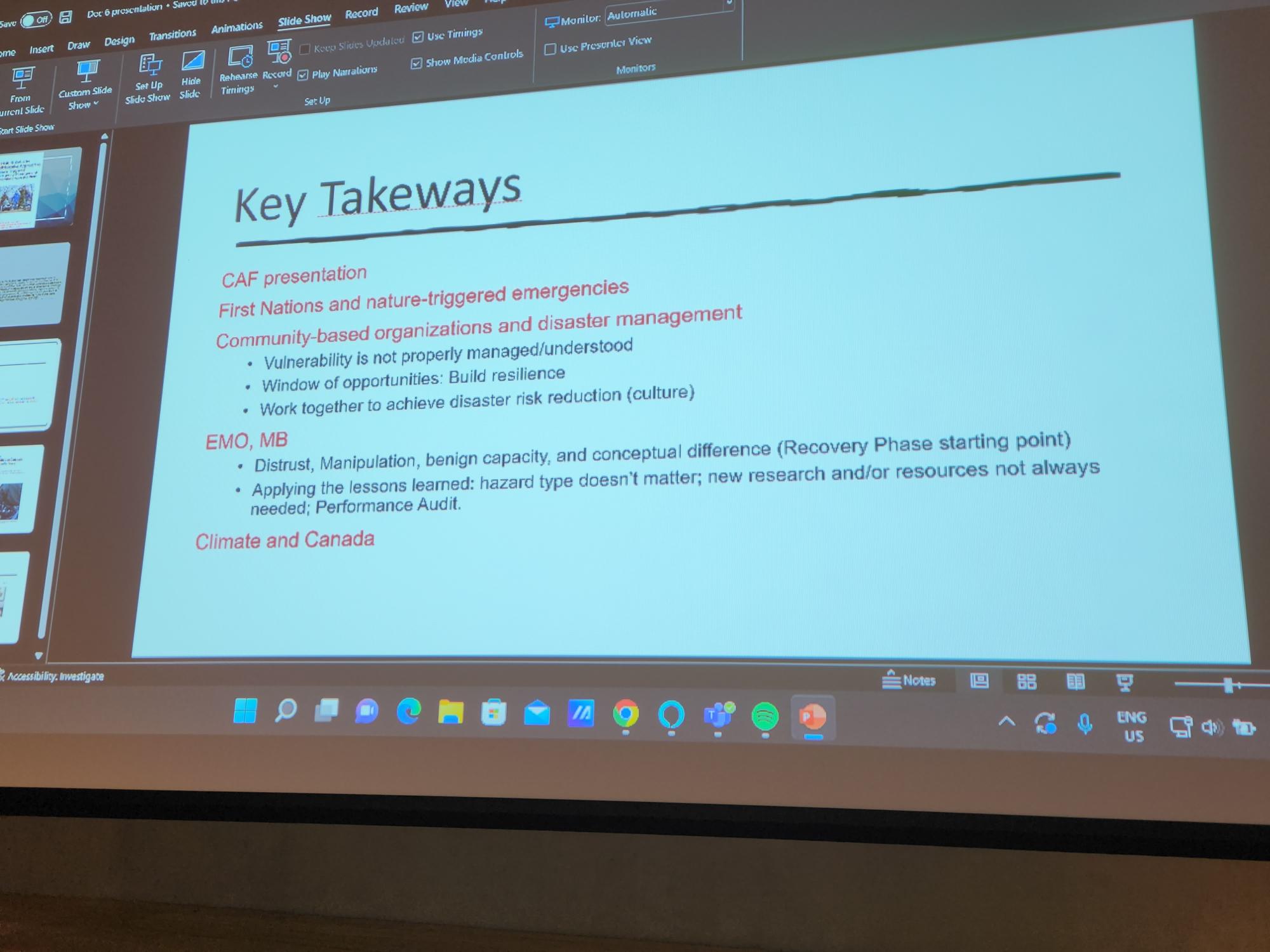
So, this was the last of the three workshops in Toronto run by Nirupama Agrawal, a professor of disaster management at York University, on what we can learn from Canada's domestic emergency operations. She keeps bringing together military folks who are the key connections in Ontario with Ontario emergency management people, Indigenous folks who are involved in this stuff, academics, and municipal folks who do this stuff. I finally attended one of her workshops as she kindly did not schedule it this time as the same time as US Thanksgiving.
I am so grateful to Niru. She got her students involved, they did a great job of running the day. It was held in the Royal Canadian Military Institute, where I got to stay overnight. It is a funky place, with lots of displays, libraries, bars, and history. See the pics below. I did guess during my talk that there are no displays of domestic emergency ops, and I was mostly right. There was some stuff about the Canadian Rangers, who are northerners who play multiple roles as the eyes and ears of the military in the Arctic, but not anything else.

Why does that matter? Well, I opened my intro talk with a discussion of what the CDSN is and does, and then talked about Canadian civil-military relations. My usual shtick that the military wants to be autonomous and has more autonomy than most democratic militaries, and that the civilians are not doing much oversight. When it comes to domestic ops, there is a basic disjuncture--the military doesn't want to do it and it successfully gets it listed at the bottom of the priorities of every defence policy document, and the population values this stuff quite a lot. The civilians in government do not seem to be interested in getting this preference through to the military.

After I spoke, we had a number of speakers who have real experience in this stuff, and I learned that there is far better coordination and lessons learned among the various actors. I still am not sure how much Ontario is really picking up its share of responsibilities on this (there is a basic temptation for the provinces to shirk since they don't have to pay the bills when the CAF does the work even though the CAF could bill them--politically impossible to do so). The military folks there were super sharp and had good stories to tell about how things play out in such efforts. There is definitely room for improvement as the CAF is always asked to do more than their assigned tasks when they do engage in a domestic op (hey, can you take my appliances out of my flooded basement?).
 |
WWI flag with the scars of battle
|
Once again, the biggest challenges are how to deal with natural disasters that affect the Indigenous communities since the history of settler-ness means these places have poor infrastructure and are vulnerable to disasters. Yanking them out in an emergency and evacuating them may be preferable to their being killed, but it is a crappy way to live. So, there was some discussion of some efforts to improve their capacity to protect themselves.
I am very, very pleased and proud of what Niru and her students have
accomplished. This grant is ending, but we will certainly stay in the
Niru business in one way or another, and our civ-mil stuff will ponder
the domestic ops of it all. I am just very grateful for the accidental
networking that led to this partnership.
And now a few random shots from our tour of RCMI:
 |
An original copy of the letter
Ike sent the troops on the eve of D-Day
|
 |
Display of women at war
featuring future CDS
Jennie Carignan
|
 |
| Display of Carignan's A-stan gear |
|