The Carney government has been promising big things when it comes to spending on defence. The question is whether those promises have been exaggerations or not. And then where the money goes. I am not a budget expert--Phil is. But since the MinDef's office sent me their summary, I have opinions besides thinking that the name of the budget, Masters of Our Destiny reminds me of something wildly inappropriate.
First, the trends are impressive but a wee bit deceptive:
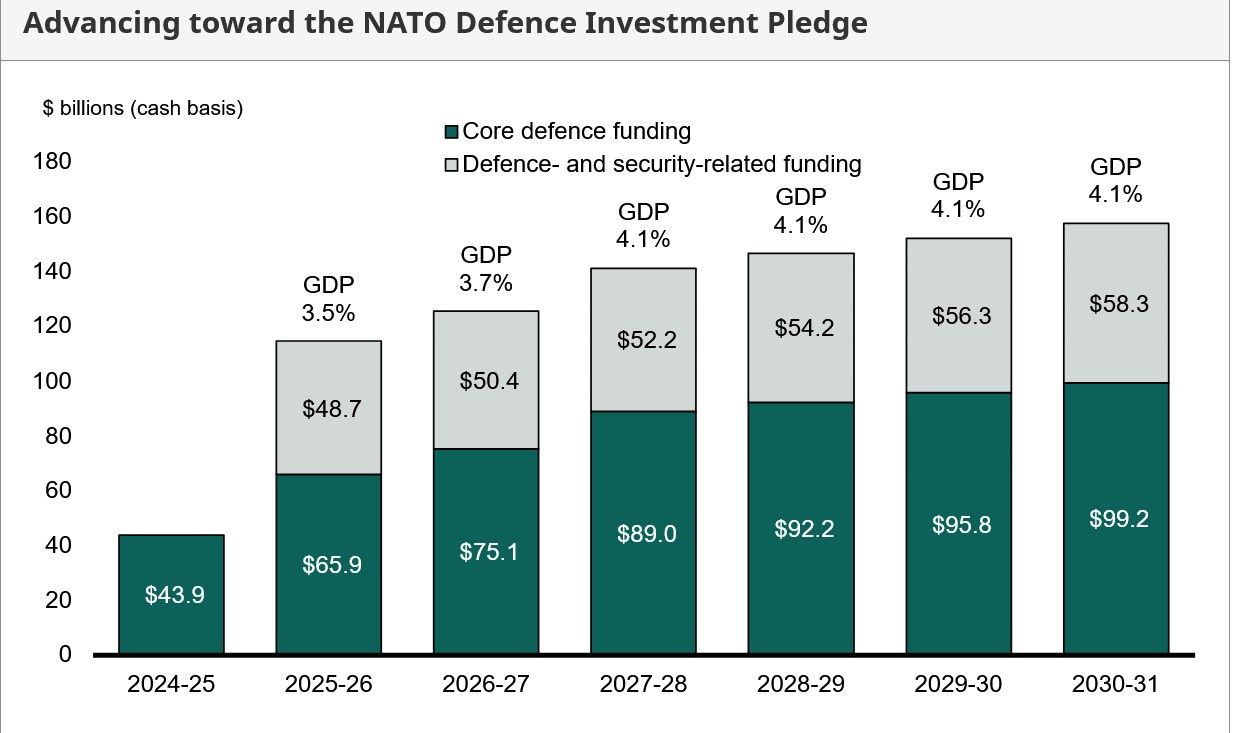
In Canada? The ability to go from nothing to $48.7b in one year should tell you something--that the government is re-coding stuff that they were already spending as "defence and security-related spending." It almost certainly does not represent new money going to new things--government just doesn't work that fast to suddenly go from 0 to $49b. Again, the hint is here--that amount goes from $49b to $58b in give years. Which could just be ... inflation. Which means that government of Canada may not actually be doing that much more five years from now on defence-related stuff. Which is ok if one is not betting/investing anything on more defence-related spending. Which means that whatever is promised for infrastructure in the Arctic, the perfect example of dual-use, defence-related spending is either not much or is coming from reductions elsewhere. In this case, more spending is not really more spending.
On the actual defence spending--this is really significant, but as Phil argues, this gets Canada to 2.6%, which makes the NATO glass more than half-full but not completely full. The promise is 3.5%, and the next five years does not get us from where we are soon to all the way there. This may be the product of honest cost calculations--that procurement is hard so we can't expect miracles. Or it may reflect competing priorities--more spending but not so much as to cause Canada to get into a debt crisis?
Ok, on to the email from the MND's office (my first one, weee!):
- "More than
$700 billion in combined core defence and broader defence- and
security-related expenditures over five years, beginning in 2026-27." See the figure above--that's roughly $140b a year but much of that is the
fakedefence-related spending. So, it is really more like $400b over five years or $80b/year. Which again is quite significant.
- "The Budget identifies $7.6 billion over five years, beginning in 2026-27, to extend and expand Operation REASSURANCE. Supports a planned increase in persistently deployed Canadian personnel to up to 2,600. This funding will be sourced from existing DND resources." I agree that Canada needs to invest in this effort--the more spent now to create a strong force there, the less we will have to spend in bloodshed later--that deterrence requires a credible capability. But this raises huge questions. 2600 troops? First, that number is going to be deceptive--persistently present does not mean based there. The commitment has been something like 2,200, which has in practice meant something like 1600 plus reinforcements during exercises. Can the CAF base 2k and then move up to 2,600 during emergencies/exercises? Maybe, but it will be hard--the army is simply not that big. Second is the part in red--no new money. DND has been stretched on operations/readiness (the day to day stuff, not the sexy new equipment stuff or the much earned/needed raises the troops received). What will the CAF have to cut to cover $7.6b in new costs? Again, not new money means something gets cut to cover this stuff. This is in addition to a 10% haircut DND/CAF is getting along with other government agencies on ordinary spending to cut the deficits. So, the idea that it is raining money on the CAF and DND is quite wrong.
- "Budget 2026 includes several measures to strengthen connectivity, infrastructure, and security in Canada's North." This is the aforementioned defence-related stuff. Good news but again, not new money.
To be clear, as Phil notes in his piece, this is more money. The defence budget is going up and they are spending it on stuff--subs, for instance. So, that helps the CAF develop some key capabilities. But I wonder whether enough money will be spent on the day to day stuff--ammunition, exercises/training, spare parts, operations. More is more and, in this, more is better. But I can't help but think that the Carney government is exaggerating what they are doing.
I will take a closer look at the budget and ask around to find out how much of that defence-related spending is really new money or just re-coding stuff that was already in the pipeline. I need to get smart on this as I may be testifying sometime soon on this stuff.
More to come on this from me and certainly from Phil.


