Showing posts with label war. Show all posts

Tuesday, March 10, 2026

A Tale of Two Lousy Allies: the US and Israel in a War of Their Own Making

 Alliances are hard all the time.  But if the allies share common values and have shared interests, they can find ways to work together.  Watching the US-Israel war with Iran proceed, I can't help but think that those of us who have criticized NATO might have been a bit unfair.  Getting consensus among 30+ like-minded countries is hard, very hard, and the alliance has to have an opt-out for any mission (in Article V, the language is "each contributes as each deems necessary).  But when you have two increasingly autocratic countries both led by criminals (ok, to be fair, Netanyahu hasn't been convicted yet, right?) who are bad faith actors who don't believe in anything but staying in power, things get a bit trickier.

While we are not privy to the actual conversations between Trump's team and Netanyahu, we have had clues in the media---that Netanyahu pushed for this war now, and Trump went along with it.  This would not be the first time a country dragged another ally into a war, as that is one of two horns of the alliance dilemma with the other possibility being a country abandons its ally.  And drag may be a strong word since Trump probably did not have to be pushed hard given his previous attacks against Iran and Iranian interests (killing Solimani, last summer's bombing) and, of course, Trump hasn't thought through the consequences such as oil price spikes and much inflation back home. 

This gets to the larger question: if allies don't agree on the goal, how does an alliance work?  What does Israel want in this war?  It seems to be the destruction of Iran as a state, which means hitting any and all targets that might help fracture the state and destroy its capacity.  For the US?  Damned if I know since the various officials--Trump, Rubio, Hegseth--have all said multiple things.  If it was regime change, the US would want Iran to have infrastructure intact (water desalination, oil refineries) so that the new regime can manage.  If it is ending the missile threat, that too would suggest more limited attacks.  If it is to complete the Christian nationalist dream of ushering in the end of times, well, oh my, I guess that means killing anyone and everyone.

There were some reports that the US was displeased with Israel hitting oil refineries, which raises a big question: how much cooperation is there over targeting?  During the Kosovo campaign, NATO allies coordinated quite a bit over what to hit when?  Libya?  Same thing.  ISIS?  I think so.  Now, hard to tell.  That the Trump regime didn't prepare for or plan for Iran threatening the Strait of Hormuz tells us a lot about American preparation or lack thereof. 

Israel?  Perhaps the epitome of tactically sound, strategically incompetent.  The Israeli military is really good at hitting its targets, but how that relates to security I have no idea.  From my trip back in 2019, I go the impression that hitting hard is not just the key tactic but pretty much the only goal.  Restraint does not make sense for them since they have already priced in world opposition: everyone hates them, everyone is anti-semitic, so they might as well do what they want.  And that has worked really well for them--they have had long periods of peace and stability.*   Oh wait, it hasn't, but the learning curve seems to tilt towards simply escalating whenever they are hit.  It creates deterrence that lasts ... hours or days.  

So, the US has been a lousy but useful ally for Israel as Trump is unreliable and fickle.  Israel is a lousy ally for the US, helping get an all-too-willing US into a war that provides no real benefits to the American people (Americans hate Iran thanks to the hostage crisis, when folks used to sing bomb, bomb, bomb, bomb, bomb Iran, yet they still hate this war--great achievement by Team Trump).  The US is an even worse ally for, well, all of its allies.  It made all of the Mideast targets for Iranian attacks--why should Iran restrain itself when its very existence is at stake?  The US radically increased oil prices for its friends, which only helps Russia and other oil exporting places (Alberta?), and it has made the coalition/domestic political games of its European allies far more difficult.  

All of this was foreseeable, which is why American presidents have refrained from attacking Iran, even, yes, the ideological and dim Bushies.  But the Trump regime hates being told it can't do something, like a toddler, and is deliberately ignorant.  Which led to being very poorly prepared for the likely Iranian responses that came to fruition. 


* I keep putting off writing a post that puts a significant hunk of blame on the increase in anti-semitism around the world on Israel because, yes, yowza.  The Israeli stance of pricing in hate is a self-fulfilling prophecy.  Yes, there is anti-semitism in the world, just like there is Islamophobia, and the actions of states that are seen as the homelands of such religions matter in exacerbating or ameliorating those pre-existing tendencies.  Israel will tell Jews to come home to Israel if they want to be safe, which is, alas, mighty rich given that Israel's actions have increased the danger to Jews outside of Israel and.... yes, to Jews inside of Israel.  We can identify anti-semites and hold them responsible for their own actions (say, most of the Trump regime) and still hold Israel responsible for pouring gasoline on these pre-existing fires. 


Tuesday, March 1, 2022

Why No No Fly Zone?

 I made this a few days ago and it appears to be still required


Why?

Because a retired general in Canada (as well as some elsewhere) have been calling for NATO to enforce a No Fly Zone over Ukraine.  People seem not to be too concerned about the risk of, well, global thermonuclear war.  So, let's play it out, shall we, with a general X and a Minister of National Defence A:

MND A: So, what do you recommend for us to do?
General X: We should declare a No Fly Zone over Ukraine so that the Russians can't bomb civilian targets.
MND A: What about missiles and artillery?
General X: Oh, the Russians have plenty of those and use them to devastate Ukraine.
MND A: So, why enforce a No Fly Zone?
General X: It is the least we can do, we need to do MOAR!
MND A: Ok, so if we do the NFZ, that means we fly over Ukrainian air space and shoot down Russian planes and helicopters and drones, right?
General X: Well, sure, but we would also want to shoot them down while we are flying in allied airspace to take advantage of how far our weapons can fly and reduce the risks to our pilots from their fighter aircraft.
MND A: Oh, so we would be attacking from allied airspace, but keeping our attacks focused only on planes in Ukrainian airspace.
General X: oh, and anti-aircraft batteries.
MND A: In Ukraine?
General X: well, the Russians have built up anti-aircraft systems nearby--on Russian territory including Kaliningrad. 
MND A:  So, we'd leave those alone, right?  We wouldn't want to attack anything in Russian territory, right?
General X: We'd have to take them out.  To enforce a No Fly Zone, the first step is to take out the anti-aircraft systems of the adversary so that our planes could fly safely.
MND A: So, if we attack Russian weapon systems in Russian territory, what would stop them from doing the same--attacking our weapon systems in allied territory?
General X:  Well, if they did that, they would be escalating and risking a war with NATO as it would potentially lead to the invoking of Article V.
MND A: Let me get this straight, we would attack Russian units in Ukraine and probably Russia, but we would expect them to be restrained?
General X: Sure, because they wouldn't want to start World War III.
MND A: Wouldn't we be starting with our attacks on Russian military units, something that everyone has tried to avoid for about 70 years?
General X: I don't think it would raise the risk of nuclear war by that much.
MND A:  So, it would raise the risk of nuclear war.
General X: Sure, but only by ... say ... 10%. 
MND A: So we have gone from nuclear war being improbable to being possible but not likely?
General X: Well, yeah, but, see, we would be doing something more than what we are doing now.
MND A: And we would only be risking a smidge of nuclear war... General, you are fired.

End scene

 To be fair, Hillier is retired, and retired generals can spout reckless stuff all they want.  The nuclear era is a dangerous place, and one of the rules to avoid nuclear war has long been not to shoot at countries that have nuclear weapons.  Sure, we had some pilots from various opponents engage each other over the skies of Korea and Vietnam, but there was heaps of plausible deniability and no risk of allied/enemy territory being hit.  In this case, the NFZ would be most public--no deniability--and NATO/Russian territory would be implicated.


Wednesday, November 11, 2020

Remembrance Day 2020: What Poor Memories We Have

Canadian Memorial at Vimy
It has become a Semi-Spew tradition to post pictures from my various travels to war museums and memorials and war cemeteries on this day to mark this day and to note that the Canadians and the Commonwealth countries do this day so well.  And to marvel that a war that is no longer in living memory resonates so much.  Yet this year, I can't help but think about the other event of that time, the flu pandemic, that we learned .... from which we learned damn near nothing.

I don't know if the COVID responses in the US and Canada would be different now if we had spent the past 100 years remembering the pandemic that killed far more people than the war did.  As an overeducated American, I learned nothing in school about the flu of 1918-1920.  Nothing at all.  I learned more in March than I did in the previous 50 years.  I learned about flattening curves and about how different cities treated the disease differently and getting, unsurprisingly, different outcomes.  I learned about anti-maskers way back when and all of that.  

Aussie War Memorial
But perhaps I can't blame the lack of public education about pandemics because we sure as hell have a lot of information and learning since March yet provinces and states still vary widely in what they are requiring, and what they are closing.  We still see so much variation in what people are doing, even as both countries are facing spikes that exceed the worst of the first wave.  How many refrigerated trucks are moving to El Paso to store the dead?  How many hospitals are near the breaking point?  

As a result of all this, this Remembrance Day is not like any other up here, as the streets are barricaded to keep people away from the War Memorial.  People will have to join online events or contemplate events on their own.  I happened only yesterday to get a poppy as I was, um, buying booze for a lava cake recipe (and it was really, really good).  Usually, there is peer pressure to get poppies as soon as we bring in the Halloween decorations.  Not this year, as I have rarely been outside and have not been to any gatherings since a meeting in July.  I wish everyone was taking this as seriously as my friends and family.  

Memorials to the Canadians who
fell in Afghanistan (Camp Mirage)

Back to Remembrance day, the war definitely helped to take a disease and facilitate its spread. This is one reason why every conflict I see these days, one of my first thoughts is what is this doing to exacerbate the pandemic, whether it is Ethiopia this week or Armenia/Azerbaijan last wee or Syria over the summer.  So, on this Remembrance Day, I remember the soldiers who died of the flu as the various dynamics of the war caused many, many young people to be struck down before their lives could really get started. 


Tuesday, August 11, 2020

War is Like Football or Is Football Like War?

So much crossover between football and war--blitzing and all that.  Well, Trump thinks that the best football coach of our time would "be a as good as any general out there."  Putting aside the question of whether winning many nail-biters in the big game and going 5 and 3 is better than the US military over the same period (narrator: it is), what kind of advice would Belichick give?
  • Norms of civilian control of the military?  Feh!  Belichick doesn't care about the norms.  He is willing to have lineman be eligible receivers while wide receivers report as ineligible.
  • He loves special teams, so what is the equivalent of the overlooked aspect of the war game?  Would he love those who pilot transport planes as much as he loves left-footed punters?
  • Have more press briefings but provide less information.
  • Belichick would seek out mid-priced, older weapon systems that can do more things than faster, slicker, more expensive systems.
  • The officers that study under him would go on to, at best, mixed results for other military units.
  • His mastery of technicalities might mean heaps of almostwarcrimes.
  • Belichick would not care where the generals came from--West Point?  Meh.  It is not so much about prestige as about past performance.
  • Belichick's recommended strategy would change from week to week, driving the generals crazy.
Any other suggestions?  And, no, no deflation jokes since I believe in the law, ideal gas law! 

Thursday, January 9, 2020

Whose Lives Matter in an International Conflict or Crisis

The US-Iran crisis reminds us that, well, not all lives matter the same:
Should we be surprised at how irrelevant the casualties suffered by the Iraqis might be?  No.  Appalled? Always.  This led me to think about how various kinds of people and their suffering varies in the eyes of the media, in the calculations of governments, and in public opinion.  To be sure, there is variation across outlets and countries, but the patterns below seem to be fairly robust.

First, one's own soldiers/sailors/aviators matter much, much more than anyone else.  At least, that is what I have gleaned from both US and Canadian media.  Incidents involving one's own troops get covered, discussed, etc, usually pretty extensively.

Second, one's allies matter a smidge.  Their efforts, their suffering get a bit of coverage, some mention in the overall totals, but far less.  The exception may be that other countries may cover when Americans get hit for the simple reason that if the Americans get hit hard, two things may happen--they may escalate or they may leave.  In either case, their reactions affect both the vulnerability of one's own troops and the viability of the mission.

Third, the locals--Afghans, Iraqis, Vietnamese--their suffering hardly matters.  The idea that the Iranian response was no biggie since it didn't hit Americans even if it hit Iraqis (it didn't turn out that way, I think, but that is what folks seemed to say at first) typifies this attitude.  I am not saying the allied troops do not care about minimizing civilian casualties (although the allies vary in how concerned they are about collateral damage), but that in the media coverage, we tend not to be given the numbers, and in the calculations of leadership about whether to deploy or to engage in a specific operation, these numbers matter far less, if at all.

Fourth, private contractors count for more and less than the locals.  Less in that concern about collateral damage does arise, whereas I have yet to see politicians even utter any concern about the costs paid by private contractors in these wars.  The big exception, of course, is that when one or two or four get very visibly killed.  Then that can trigger a bigtime response--Fallujah in 2004, recent events in Iran.  Private contractors fall into the Stalin logic: one death is a tragedy, thousands are a statistic (see here for a discussion of the origins of what I am paraphrasing). 

Of course, this gets to a key dimension--how visible are the deaths of the troops?  Are the bodies dragged through streets or hung versus just left where they died?  Emotive reactions matter here greatly. 

Which gets to the other key dynamic: killed in action versus wounded.  Most media folks know the total number of their country's troops killed in theatre or a ballpark number.  Same for politicians.  But wounded?  Even if we forget for a second of those suffering non-visible wounds (brain trauma due to concusion, PTSD), the visibly wounded are still largely invisible.  One of the key hidden dynamics of recent wars has been the dramatic improvement in medical care.  This has changed the ratios of wounded and killed.  And it is partly a product of policy--that in Afghanistan, a case I know best, troops were not allowed to operate more than an hour from a major allied medical facility.  Why? Because chances of surviving are greatly enhanced by being treated within the golden hour.  What happens when there are not enough helicopters available to guarantee a less than hour flight back to base?  Either no operations or operations within an hour's drive, which means the mission is covering far less territory.

The point here is that we tend to be quite callous in our coverage and our conversations because not all lives and not all suffering seems to matter.  It is important to remember that there are other folks in harm's way besides one's own troops.  That the use of force can implicate not only one's own troops but others as well, and one might want to care a bit about this.  And no, this is not a subtweet of Trump's inability to remember that he put both allies and locals in harm's way when he decides to whack an Iranian officer in Iraq.  But that too.


Monday, November 11, 2019

Remembrance Day, 2019

American cemetery at Omaha Beach
One of the advantages of doing medium N work that requires a heap of travel is that I have been to war museums and memorials in Australia, Japan, South Korea, France, the United Kingdom, the Netherlands, Belgium, and Germany including American and Canadian cemeteries in Europe.  I have taken to posting pictures from my various trips on Remembrance Day (what used to be known as Armistice Day and is called Veterans' Day in the US).  This year is particularly special one, I think.

Juno Beach
Why?  Partly because I got to see more of Normandy this year--the American cemetery at Omaha Beach is so very beautiful and very haunting, and I got to see briefly Juno Beach, where the Canadians landed.  Partly because there are so few left from those who fought on those beaches and elsewhere during that war.  Partly because the rise of Neo-Nazis and their friends raise questions about the sacrifices and what we have learned and failed to learn.  Partly because we cannot seem to end any of the forever wars.  Partly because this year's Vimy Gala had a bit of a punch to it with the recognition of this year's Silver Cross Mother present (each year a mother who lost a son or daughter in war is recognized).  Partly because I am getting old, I guess. 


Each year, especially since I moved to Ottawa, I realize the Commonwealth countries do this day right, better than the American version.  My daughter when to a school named after John McRae, who wrote In Flanders Field.  Which, I guess, is what made the poppies so central to our remembrance activities.  This year, there has been more discussion of what the poppies mean, whether we should be required (!) to wear them, whether the racists on national television (Don Cherry) should be banned for arguing that immigrants don't wear the poppy, and so on.  Yes, we live in more polarizing times, and it touches on everything.

For this Remembrance Day, I will try to remember the ideas for which these folks sacrificed their lives, knowing that we have fallen short both before and now.  We ought not idealize the conflicts of the past, but we should still take seriously that those who go to war are doing it for their friends, their family, their battle buddies, their country, regardless of whether the politicians and generals who lead them are well-intentioned or not. 

Wednesday, October 9, 2019

A Different Mad King

I was asked to be on TV tonight (and will be on again tomorrow unless the plans change) to talk Turkey/Kurds/Syria/Trump.  What is my take on all of this?  I will give the answers to the questions that I was told to prepare for (note--the anchor people always go off script). 

Q:  Turkey says it will create a safe zone that removes the Kurdish-led forces and resettles millions of Syrian refugees.  What do you make of that?
A:  When I hear safe zone, I think Bosnia and the safe zones that became killing grounds including Srebrenica, where the Bosnian Serbs engaged in genocide.  Who is going to safeguard these refugees from whatever threats?  Will the Turkish forces, which will be focused on killing members of the Syrian Democratic Front--the Syrian Kurds who have been so effective against ISIS.

Q:  Does Turkey's attack on the Kurds jeopardize any gains made against ISIS in the region?
A:  Hell yeah.  First, the SDF is not going to stick around and guard the places where they are holding ISIS prisoners.  Second, the 2.7 million refugees, give or take, who will be forced back to Syria, will be ripe for radicalization since they will be living in awful conditions and will feel betrayed by the international community.

Q:  How is this impacting the relationship between the US and the Kurds?
A:  The US seems to betray some Kurdish group every twenty years.  So, not great.  However, the various Kurdish groups have few friends, so if the US wants to make common cause with them, the Kurds will likely go along, knowing, very much like the Frog of the Scorpion and the Frog tale, that eventually they will be betrayed.

Q:  What is Russia's involvement?
A:  Egging on Turkey and attacking the Kurds from another direction (make whatever parallels to 1939 Poland you want).  Plus the Russians get to watch more of a wedge between Turkey and the rest of NATO and between the US and its allies, as well as helping to remove an opponent to its ally, Syria.

Q:  Turkey is also a member of NATO, what response have we seen from other countries in the alliance?
A:  Canada, UK, Germany, and France have all condemned the attack.  Trump has both given it a greenlight and opposed it.  There have been many discussions of how to kick Turkey out of NATO--this is not going to stop those discussions nor will those discussions go anywhere.

Q:  What am I expecting to see in the coming days in Syria?
A:  Bloodshed.  Turkey's Erdogan has been seeking this for quite some time--he is not going to back down.  Assad will root this on, Putin will celebrate, Trump will twist and lie and get his facts wrong, and America's allies will be frustrated. 

This is all awful.  And, yes, so much for that whole "pay attention to Trump's deeds, not his tweets" thing.  To be clear, at some point, the US had to get out of Syria, but not this way.


Sunday, September 29, 2019

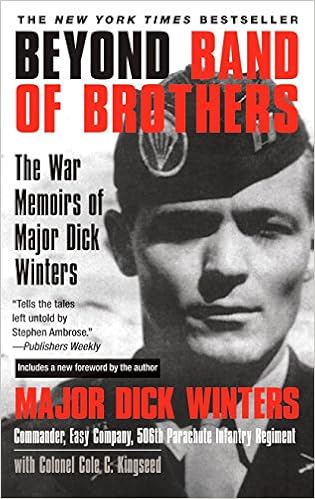
Learning from the Band of Brothers

I just finished reading "Beyond Band of Brothers," which is the book written by Dick Winters about his take on the BoB experience and what he learned from it.  There aren't too many new stories as Winters was really the basis for both Ambrose's book and the tv series.  But there is more perspective in this, as Winters gave his take on the various events and dynamics from before he appeared at Toccoa all the way through to the reunions after the war.  I teared up on more than a few occasions as he talked about the men he led and their passing. I was most pleased to learn that Harry Welsh, one of the officers of Easy Company, taught political science after he came home--that was not mentioned in the show. 

There is much to learn from the book with its concluding chapter addressing leadership.  After the series came out, Winters got many requests to speak on leadership.  Why?  Because the show and the testimonials made it very clear that he was a hell of a leader.  Tis good timing for me to read this, as I am a significant leadership position for the first time in my career as Director of the Canadian Defence and Security Network.  It is hardly the same thing as leading Easy Company, but some of Winters' lessons are most valuable. Of the lessons, the pieces that resonate the most with me are:
  1. Develop the team.  Much of the development of the CDSN was by accident, but I did start by relying on the best people I know, and they have done so much already.
  2. Delegate responsibility.  Absolutely, as the co-directors of the CDSN know far more about their areas of expertise and of their research centres than I do.  While we at HQ have strived to develop some guideliness, I am not going to tell my teammates how they should be running their events.
  3. Anticipate problems and prepare to overcome obstacles.  Not something I am always good at, but I have been thinking through some of the likely problems and figuring out ways to dodge them.  
  4. Remain humble?  Folks don't think that I am particularly humble, but it is humbling leading this thing.  That it is something far beyond anything that I have tried to do before, that it is a pretty ambitious endeavor, that I am leading people who are probably far better able to do this than I am (that would be SVH), and that I am asking people for their time.  So, I try to make sure I don't ask for too much.  I also make sure that the credit for this stuff goes to my staff and to the team.
 There are other items on Winters's list, but I don't expect to stay in top physical shape.

Anyhow, the book is a quick read, quite reflective including taking responsibility.  I was most struck by Winters's realization that as Easy Company's commander, he always used 1st platoon, which had the best soldiers, but this had the effect of having the fewest survivors.  Likewise, when he became CO of 2nd Battalion, whenever he needed something difficult to be done, he relied on Easy Company.  Again, this had some cost.  Winters did not really express guilt or regret, but a realization that he relied on the best for a reason, and then the best paid the highest price.  Luckily, when I rely on the best folks in the CDSN, the price is far, far less costly.

Back to reading stuff that is a bit more directly related to my research.

Sunday, November 11, 2018

Then and Now: 100 Years Since the End of the War to End All Wars

I have so many thoughts running in my head as folks remember and commemorate those who died in World War I.  We have learned so much and yet so little.  So, this really will be a semi-spew as I figure out what I am thinking today.

First, it is hard to imagine a more tragic conflict, as so much blood was shed by generals who thought that they could beat the other side with just a bit more audacity (someone else's blood) again and again.  For what?  For the rise of Communism.  For the prelude to fascism.  For a fun decade followed by a deep depression and then another World War.  Not every front in the war was as wasteful and pointless as the Western Front,

Second, the ending was so very strange--we must fight up to 11 am on the 11th day of the 11th month.  I get it that they could not do it immediately after the signing since comms were not so great.  But to continue offensives when you know the end is near?  How wasteful is that?

Third, when we talk about the origins of the war, much focus is on whether to blame Germany or not, but that misses the larger point--there were both agents and structures in play here.  Not just the people who ran the various countries, but the balance of power, the arms races, the security dilemmas, the alliance structures, the lessons from the past that all combined to lead to this war.  When international relations scholars look back, we tend to focus on the structures.  When journalists look back, they focus on the people.  It is important to learn how individuals handle a crisis, for instance, since the war didn't happen overnight.  Yes, mobilization started not that long after the assassination of the Archduke in Sarajevo, but there were points where individuals made things worse.  Likewise, it is important to consider how structures enable leaders to make good or bad decisions or constrain choices.

For me, a few things resonate loudly 100 years later because of my own biases:
  • Kaiser Wilhelm, if I get the stylized history correct, believed in pushing hard, expecting others to give in.  The idea was that threats and bluster work in international relations, which contradicts much of what we mostly think these days--that the nature of the international system means that threats create counter-reactions most of the time among "peers".  This resonates because Trump's behavior, chock full of bluster, expecting countries to back down, seems just as ill-considered and just as contrary to the way countries react.
  • One of the key parts of the constraints facing politicians at the time was lousy civilian control of the military. This was the war that taught the civilians that "war was too important to be left to the generals" as the war plans seemed to deprive politicians of choices (mobilization meant war) and that the conduct of much of the rest of the war wastefully destroyed a generation of young men.  These days, "we must support our troops" has meant perhaps that oversight is not what it used to be.  And, in the US, politicization of the armed forces is happening, so we need to pay more attention to how civilian control of the military is exercised.  And not just in the US as Dave, Phil and I are discovering, as it turns out that in many democracies, too few are paying attention to what their militaries are doing.
  • The war saw lots of innovation that had marginal effects during the war but ultimately led to revolutions in warfare and expansion in how many civilians would die in future wars--airpower, submarines, chemical weapons, etc.  The technological arms races today--who will develop hypersonic missiles, the best cyberoffensive weapons, AI, and all the rest--may lead to yet greater destruction.  We can imagine better how horrible it can be mostly because we have the exemplars of World War I and II.
  • That the war itself also set the context for a particularly devastating flu epidemic.  I wonder what a new big war would do in terms of global health.
  • And, of course, the war is partly about the mismanagement of the relative decline of the country, the UK,  that led and shaped the international order such as it was, and the rise of several contenders--Germany, Russia and the US.  How are we doing on managing the rise of China, the temporary return of Russia, and the decline of the US?  Not very well right now.  
So, there is much to remember.  Not just the sacrifices of a generation of soldiers and sailors, but the lessons learned and unlearned.


Tuesday, May 22, 2018

Taking the War Cap Seriously

A while back, I posted how we ought to think about American wars as like the salary caps in the NFL and NBA: that at some point, there is a limit of how much you can be doing (paying in the metaphor) at one time.  The basic idea is that the US can only fight so many wars at a time.  Remember when people thought Nazi Germany and Imperial Japan were stupid for opening up multi-front wars?

It is not so much that fighting in multiple theaters opens up the US to attack from multiple directions but that the US does not have infinite numbers of soldiers, sailors, pilots, ships, planes and, yes, dollars, not to mention officials to run many wars at once.  Right now, the US is fighting wars of varying sizes in Iraq, Syria, Afghanistan, Yemen, Somalia, Pakistan (the drone war is still a thing, right?), and some others that I am probably forgetting.  None of these are at the levels of the simultaneous campaigns in Afghanistan and Iraq that quite nearly broke the US Army.  The costs of that particular situation, two wars at once, are still being felt today in terms of readiness (how many planes and ships are crashing these days?) and will be felt for the next seventy years in terms of costs for taking care of those served and were wounded.  The question is not whether the US spent a trillion dollars but how many trillions thus far and how many left to spend. 

Yet the Trump administration seems to be moving towards not just one more war but two.  The new Secretary of State, Mike Pompeo, has issued a list of demands for Iran that kind of resemble the ultimatum given to Serbia before World War I--a list designed to be rejected (h/t to Ben Dennison).  We knew Pompeo to be a hawk on Iran, we knew Bolton to be one as well.  Given that the Iran deal is better than what we could possibly expect for a NK deal, their idea of "fixing the deal" seems incredibly insincere and actually a step towards war,  And, yes, this war would be harder than Iraq--a much bigger population, much greater spaces for the US military to cover, more support for the government the more the US tries to impose itself, and on and on.  Low hanging fruit this is not.  Yet, if the US had to have a new war, I would prefer a war with Iran than one with North Korea.

Yes, the diplomacy pre-summit is turning into a shitshow.  All of the traits of the Trump administration are in full display: a lack of seriousness and preparation, Trump being baited by tweets and by meetings that are as substantial as tweets, the influence of warmongers (NK is not the only ones who feel repugnance towards Bolton), and on and on.  Robert Kelly explained this all very well in a series of tweets and then another one--Moon, South Korea's President has been desperately seeking a way of out of war, which led to this moment of hope and then wildly inflated expectations over de-nuking, and now Trump feeling betrayed.  Which means war is back to being in play in a big way.

The US military is not ready for either an Iran war or a North Korea war.  Either one would disrupt the global economy with oil skyrocketing in price if there is another war involving the Persian Gulf and the destruction of one of the 11 or so biggest economies in the world and maybe the third if Japan gets hit hard if the latter war happens.  The American people are not ready either as either would produce more casualties than they have grown to expect.  A war with North Korea would kill more Americans in the first days than all of the troops lost in combat since Vietnam.  Oh, and the civilian casualties will be unlike anything the US has experienced since .... I have no idea.

Either of these words would explode the deficit even further than the misbegotten tax cut, and each one would wreak such damage as to make us forget that the US is already involved in a half dozen wars (or more).  So, not only are we already above the war cap, this government is contemplating adding one or two super-expensive yet unproductive stars to our team of wars (I am thinking of the Washington football team's free agents, but I will take nominations for other disasters).

All of this is awful and going to get even more so.  Good thing the GOP is getting what it wanted (more bad SCOTUS decisions) when it sold its soul and sold out the country.  All I know is that I wish we could fire the general manager, the coach, and the entire staff of this team.  Alas, it ain't gonna happen.

Tuesday, January 30, 2018

Is It Time to Panic Now? Um, Yeah

My favorite pics lately have been this


 and this


Recent events have moved from concerned and alarmed to frightened.  About what?
About war with North Korea.  The two bits of news that have increased my level of fear:
  • Today's news story that Victor Cha, the man Trump chose to be Ambassador to the Republic Of Korea, was dropped because he was critical of war plans, such as punching North Korea in the nose.  Yeah, they wanted an expert, the expert said this was a bad idea, so they dumped the expert and not the bad idea.  Max Fisher indicated that he had thought the war talk was a bluff, but this suggested otherwise.  I indicated via twitter that the Trump WH will have a hard time finding someone who recommends war and is willing to move to Seoul, which is the primary target for a North Korean response.
  • Trump mused that he'd really like a uniting event to help reduce the divisiveness in the US.  Putting aside how blindingly un-self-aware he is, that his entire campaign and Presidency are not just divisive but deliberately so, this raises the possibility of Trump seeking out a 9/11 or a Gulf of Tonkin or some other event that causes Americans to come together.  He didn't say wag the dog, but he seems familiar enough with the idea.  
Put those two things together, along with Trump's belief that American ballistic missile defense (whose motto should be "Hope is Our Plan"), and, yeah, I am very, very worried.  A strike against North Korea will not end there--there will be a response and it will kill hundreds of thousands, if not millions, of Koreans and then Japanese plus Americans in the region.  Oh, and it will cause tremendous turmoil in the world economy.... What Trump doesn't get is that if he starts this, there will be no rally around him.  He will get the blame for starting a war that is quite avoidable.

So, what should be my go-to pic now?
Because all is not well.

Update: Given that the Korean crisis got more play than nearly anything else and it hints at regime change (depraved character of the regime as the core issue), I am now thinking war is more likely than not.  Not good.

Monday, December 18, 2017

Intro to IR Basic Concepts and Bad Policies

It is pretty easy to annoy an academic these days, especially those who study international relations.  And this does the trick
Media preview

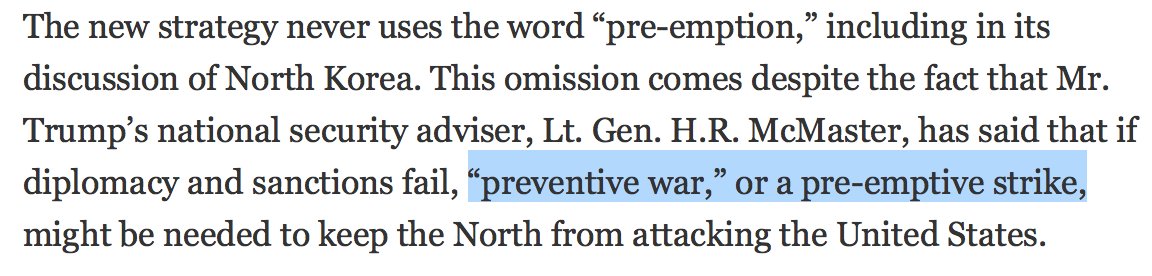
Preventive war and pre-emptive war are two entirely different things. While I got schooled on twitter that these are not legal terms, they basically are in terms of how the world perceives them.

Pre-emptive war: launching a first strike when the other side is about to attack.  Imminence is key AND first strike advantages are hugely important. If there is no advantage in attacking first, one can wait out a first strike.  When pre-emptive war is in the air, it makes war more likely because both sides fear that the other side will strike first. World War I is the cardinal example for IR types even if the reality of that war's start are more complex.  The best example of this in recent times is the Arab-Israel War of 1967.  While that war produced a heap of confusion afterwards, Israel striking as the Arab states were about to launch a war is not seen as illegimate, and, given how near a thing the 1973 war was, not a dumb thing to do.  Pearl Harbor was not pre-emptive since the US was not about to launch a first strike against Japan, although it could be considered preventive.

Preventive war: striking now before the balance of power shifts against oneself.  Far less legitimate since war is not inevitable, and there are many ways to deal with relative decline of oneself and rise of one's potential adversary.  Attacking Iraq in 2003 was a preventive war, as it was an effort to prevent Iraq from getting weapons of mass destruction.  Sure, they didn't find any, but that was the asserted justification. Germany's motivations prior to WWI were in part the desire to deal with Russia before it became too powerful. 

Pre-emptive war can be legitimate--that self-defense may include stopping an attack before it happens with an attack of one's own.  Denying the rise of an adversary by launching a war is not seen as legitimate.  The US lost a heap of legitimacy in 2003 by starting a war that it did not have to fight.

The funny thing is that talk of pre-emptive war with regards to North Korea is rather, um, silly.  Why?  Because any first strike by the US will almost certainly fail to destroy North Korea's ability to wreak havoc and rain destruction upon Seoul, Tokyo and other populated areas in the neighborhood.  But this is not really so funny since the North Koreans might be concerned enough about losing their ability to retaliate that they react hastily to signs that the US might be preparing a first strike.  That is, talk of preemptive war may make war more likely.  Which makes McMaster's talk very bad policy. 

As I have argued before, this notion that we are running out of time and that military options are the only ones available are likely to cause a devastating war that can be avoided.  It may be that North Korea wants more than just maintaining its regime, but it is certain that they care most about that and this talk of pre-emption does not encourage patience or other stabilizing behavior.

So perhaps the McMaster quote is a misquote, but I think it is part of a larger dynamic in DC: that the Trump administration, including McMaster, does not seem to understand the basics of international relations.  That NATO is not a protection racket nor a country club. That protecting one's economy from international competition will lead to retaliation and on and on. Alas, Trump does not study nor read, so I don't expect him to learn no matter how basic IR 101 is.


Thursday, February 2, 2017

Scariest News Du Jour

I am tempted to make this a daily feature here at the Semi-Spew: what have we learned about the Trump Administration on each day that scares us the most?  But that will be exhausting as Jon Stewart suggested on the Colbert Show.  Still, I think this might be a regular feature.  So, which is it for the last 24 hours?

Is it the spat with Australia?  No.  That is just stunning, since it is incredibly hard to screw up that relationship.  The Aussies are perhaps the people on the planet most like the Americans for a variety of reasons, and they still feel a keen debt for that World War II thing.  They have showed up in every American war, no matter how misguided, even when other allies will not (Vietnam, Iraq 2003).  But this does not quite scare me the most.

What does?  Learning that President Bannon, oh, I mean, Rasputin, oh I mean the Trump Whisperer believes that the US will be at war with China in the next ten years.  Why does this bother me so?  Holy self-fulfilling prophecy, Batman!  If one believes that war is inevitable, then one begins to behave in ways that make war more likely.  Instead of trying to avoid war, one tries to find the right moment, the most opportune time for oneself.  Oh, and since this is international relations, where the other side is aware and reacts, they start doing the same thing--making moves to put themselves in the best position to win.  Usually, this means figuring out how to land a decisive first blow.  Which means in a crisis, the US and China would be looking for opportunities to strike first and also fearing the first strikes of the other side, making it hard to manage the crisis.  Neither side would be as willing to play for time to figure a way out because, hey, war's gonna happen.

Whether it is the US launching a preemptive attack to hit Chinese forces before they hit American bases in the region or China launches first to hit American bases and ships in the area (sorry, Japan),  it is easy to imagine the fears of first strikes and how exaggerated they become when war is seen as inevitable.


Yes, this screams to the IR scholar World War I.  There is much controversy about the historiography of that war, but one thing that did operate at the time--the sense that war was inevitable, which encouraged all kinds of behavior that led to the war.  So, yes, IR scholars are extremely nervous right now.  The informal discussion revolves around the question of which war comes first: Mexico, Iran, or China.  As it stands, I would prefer the first two wars to the third, which again reminds me of how low our expectations have become, thanks to Donnie Trump.

Returning to Bannon, he probably doesn't mind a war or two, perhaps would not even mind the US losing a war with China, as his main goal is to break the United States in pretty much every way so that he can usher forth a New Order with white nationalists running everything (into the ground).

So, yeah, I am scared shitless.  How are you doing?

Saturday, September 24, 2016

Best Political Science Books for Military Historians

Tom Ricks asked me for a list of the best political science books for those interested in military history.  This is part of a long-running conversation we have had about the contributions made by political science.  To be clear, I don't see my assignment to be to find the best military history written by political scientists.  That is not what we really do.  The best military history is written by military historians--that is the joy of specialization/training/etc.  Military historians are likely to see the way political scientists use military history to be, um, icky.  Regardless of the methods political scientists use, the focus is almost always on generalizing rather than getting the specifics perfect.  That probably drives historians crazy.

Anyhow,  I see as my mission to be: find some of the best political science that puts into context and develops arguments about recurrent patterns that might interest  those who study/care about/read military history.

  1. How and why insurgents organize as they do and how their organizational development shape how they use violence--Jeremy Weinstein, Inside Rebellion.  For different but equally sharp approaches, see Paul Staniland, Networks of Rebellion and Fotini Christia's Alliance Formation in Civil Wars.
  2. Speaking of likely foes, there is a lot of work on terrorism, and I am hardly an expert, but I find the work on organizations, rather than individuals, to be far more compelling.  Jacob Shapiro's Terrorist Dilemma considers how terrorist organizations must deal with difficult tradeoffs between secrecy and controlling their members.  For a sharp book on individuals and what causes them to join such organizations, see Mia Bloom's Dying to Kill.
  3. How and why do weaker countries challenge stronger ones in non-military ways that still threaten much conflict, such as forced migration--Kelly Greenhill, Weapons of Mass Migration.  I love this book because it reminds us that weaker foes have imaginations that allow them to turn the strengths of more powerful countries (democratic norms) into leverage.  Or at least, the weaker states think they have leverage. 
  4. While folks may not buy the Democratic Peace (that democracies don't fight each other), the post-Cold War era has seen democracies fight mostly authoritarian regimes, so understanding why some of these countries can fight more effectively than others is probably important.  I have just started reading Caitlin Talmadge's Dictator's Army, and it is mighty good.  A related question is when do miltaries fall apart or remain coherent enough to keep up the fight.  Jasen Castillo's Endurance and War addresses this. 
  5. Coups are back in fashion, and while one can just go back and read Luttwak, a more social scientific approach that analyzes why coups happen rather than provide instructions, see Naunihal Singh's Seizing Power.
  6. Given all of this stuff going on the world, what shapes the intervention strategies that the U.S. chooses?  Elizabeth Saunders is an unusual political scientist as she focuses on Leaders at War.
  7. If you care about the armed forces, then you should care about civilian control of the military.  While Peter Feaver has written a lot on this, I think the key work is Armed Servants.  While it can be a bit intimidating with some formal modeling, one can get the gist from the rest of the book, which clarifies the basic questions about oversight.
  8. Technology plays such an important role in military history, so people interested in such stuff should be interested in the The Diffusion of Military Power by Michael Horowitz.
  9. One of the basic realities of war is that countries rarely fight alone--they have allies of some kind.  I know this area a bit better because I have actually researched and written on it, and the two best books of late (ahem, besides the one I co-authored) are by Sarah Kreps, Coalitions of Convenience, and Patricia Weitsman's Waging War.  They both deal with the tradeoffs of relying on alliances, coalitions of the willing or on no one else. 
This is an idiosyncratic list of books that I happen to like on topics that interest me.  There are many books and infinite articles on these and other topics.  These all contribute to our understanding of important dynamics involving violence within and mostly across international boundaries, using a variety of methods.  If you have suggestions of other books or topics that I ignored (hey, no ethnic conflict, Steve?), comment below and maybe I will do some reading while I sabbatical this year.

And, yes, this is a very American-centric list in terms of authors and presses and, of course, language.  The topics, however, are not so much.


Wednesday, June 8, 2016

Arlington, About Time

Over the past several years, I have been to many cemeteries in Europe and have seen war memorials around the world, but I had never been to Arlington despite working around the corner for a year and visiting DC on a regular basis [Update: my big sister reminded me that I went there as part of a family trip when I was 6 or 7--I have no memory of that trip although I seem to remember visiting the White House in the two years we lived in DC].  So, I was due.  And D-Day +1 + 72 years made for good timing. As a scholar of conflict and war, it pays to spend some time being reminded about the costs.  One can snark and be blase about the costs of using the military as an instrument of policy, so seeing these resting places is a good reminder of the costs of the policies one advocates.

Women's memorial
 I am in DC for about 24 hours--to present how blogging can help bridge the gap beteween policy makers and academics, so I had time in between lunch with my dissertation adviser (unbreakable vow indeed) and a 4pm beer call with my natsec twitter friends.  I spent that time wandering around Arlington National Cemetary.

The site is beautiful, peaceful and full of respect for those who gave their all and then some.  The location is perfect because:
  • More by accident than by design, the land was taken from Robert E. Lee to use as the Union was running out of places to put the dead.  So, the traitor lost territory (his descendants got a big check to compensate, alas) to put the dead that he helped cause (had Lee been a lousier general, the Union might not have lost as many lives).
  • It is around the corner from the Pentagon, so those who plan and deploy the troops have a constant reminder of the costs of their decisions.
  • It is across the river but quite nearby the White House and the Congress, which should but does not always remind these folks of the gravity of their decisions.  It is easy for folks elsewhere to declare the need to do MOAR in Syria, Iraq, etc. since they do not work near the place where the folks lost in previous military efforts rest.  
  • 101st memorial
  • And it is so close to the other memorials nearer to the Mall that also mark the big efforts of the past--the Vietnam memorial, the WWII memorial, Korea, etc.
 I wish I had more time and was better equipped (nice clothes and a heavy bag were not great for exploring on a warm DC day), but I was glad I made the trip and will definitely try to get a guided tour since I missed much on this trip.  Oh, and, just like last year's trip, at the airport, the gate next to mine was full of vets from Peoria who had spent  a day visiting Arlington and other DC sites.  Mostly very old folks, but very feisty ones. 


Supremes

JFK/RFK and eternal flame
Teddy Kennedy
Memorial for those who died in the
failed Iran hostage rescue effort

Challenger Memorial
Columbia Memorial

Tomb of Unknown Soldier
 And, yes, blogger does really give me good control of how the pics appear.


Monday, May 18, 2015

Are We Winning Yet?

Good news: US Special Ops raids ISIS in Syria, frees an enslaved woman.
Bad news: Iraq lost Ramadi to ISIS.

Image result for are we there yet
So, are we winning or losing?  There are a few ways to answer this, but my overwhelming urge is to ask for patience and skepticism of all claims.  Why?  Because wars are complicated things, especially wars of this kind, where the daily news tends not to be a good barometer of progress.  Were the Nazis winning on Dec 20th, 1944?  Well, no.  The Battle of the Bulge was a setback, but by that time, Germany's future was already determined.  The only question was really where the line would be drawn between the Soviet occupation and Western occupation.  I can only imagine the abuse Ike would have gotten on twitter on June 15th: sure, you landed the troops on Normandy, but they are stuck, so #epicfail #Ikeisanidiot etc.

So, the US and its allies seem to be getting better intel if they can find the guy they sought with no serious casualties.
But the Iraq training/mentoring effort clearly has not had enough time or size to make that much of a difference, I think.

Of course, the key to all of this is not how many guns are in the hands of "our friends" but the politics of the place.  And that, alas, is not going well, at least as far as we can tell from here.  The Shia dominated government has not made a deal with the Sunnis ... worse, the government has become more dependent on the Shia militias and Iran.  This makes it harder for any Sunnis fed up with ISIS to switch sides.  No credible commitments made by the Iraq government means no flipping by the Sunnis, which means that the bad guys have easy recruitment and we may not get as much actionable intel.

In war, it is always about politics but much more so in counter-insurgency.  So, yeah, skepticism is the order of the day.