Showing posts with label administration. Show all posts

Thursday, June 30, 2016

Centres of Adequacy

I saw a story last week about a NATO Centre of Excellence, and it just bothered me.*  Carleton is also creating Centres of Excellence.  So, I did a modest twitter poll:


Centres of Adequacy it is.  I get it that various organizations want to focus resources and bring visibility to a specific effort, but I cannot help but think the following when I see the term:
  • Overcompensation.  If a centre is truly excellent, won't it make a name for itself?  And relatedly, isn't centre of excellence just inherently forgettable? 
  • The Incredibles' Lesson: If everyone is equally special, is anyone special?  If nearly any new centre is a centre of excellence, then are any of them really excellent?
  • The bureaucratic politics of empire-building.  Some new centres are important additions, but many are created so that some administrator can declare progress/victory/something to point to as their mark on the larger organization.  

I probably should not whine about this since I am in the process of writing a major grant that would fund a research centre at Carleton and also give funds to research centres elsewhere.  However, my aim is not to create new centres, but give existing ones the funding they need to be adequate and then some.  Sure, we will aim for excellence, but just naming something excellent is like another classic phrase: confusing hope with a plan. The name does not make it so.

This blog post was funded by the new Semi-Spew Institute of Amazeballs.


* No, this post was not inspired by my learning that my old place now has a Vice Principal of Innovation.  Yuck, but no.

Sunday, April 17, 2016

Rule Number One of the Internet

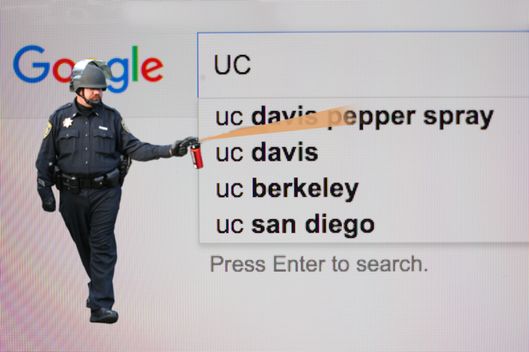
Rule number one of the 21st century is that you cannot control the internet unless you are China or North Korea and only maybe then.  When UC Davis tried to get its bad PR off the net, this happened:
Yep, the top entry for searching for UC (not even UC Davis) is pepper spray.  So, well done, UCD.

It is not that dissimilar from when universities tell bloggers not to blog.  It just does not work, as both the internet and those who dwell on it cannot be censored much.  The examples of UCD, UBC and even Carleton demonstrate that administrations just don't get it--that trying to restrict what goes/stays on the internet has the opposite effect as the linked article suggests.  This should not be that surprising, but yet many higher ups just have not gotten it.  Maybe when hiring for upper level admin, applicants should be given a basic internet test and see if they can figure stuff out.

Why? Because the internet has made that whole idea that the cover up is worse than the crime a much bigger deal since efforts to cover up tend to produce much outrage that spreads pretty widely. 

If I were an adviser to a university president/provost/governing board, my first piece of advice for any crisis would be: suck it up.  Trying to deny is unlikely to work, and telling people to shut up will not work, especially when those people are cranky folks who expect to be able to say what they want.  Academic freedom may be fuzzier than profs think, but the basic expectation profs have about being free to say what they think means that telling them to shut up is not going to work.  And now they have platforms which can be their megaphones.


Wednesday, August 19, 2015

More on the Art and Science of Dean-ing

I really don't know that much about the opportunities and constraints Deans face, despite speculating wildly about such folks yesterday.  So, I am glad that a Dean responded to my post yesterday thusly:
In general, I think deans have as much discretion as the provost and president give them.  But it generally varies by issue and by priority.  There are some issues where you have absolutely no discretion and are expected to carry out upper-admin's wishes even if your faculty disagree (that doesn't mean that you can't argue for a different solution behind the scenes, but once you've lost the argument, it's over).  There are other issues where your discretion is almost total.  Faculty sometimes forget that deans are middle managers, and that upper administration sets the broader policy and strategic goals, as they should.
I suspect that there are probably differences between inside and outside deans.  While it's not universally true (and probably less true at the R1s), outside deans are usually brought in to solve a problem or to be a change agent.  Neither augurs well for their popularity with the troops, at least initially.  In a way that chairs don't, deans have to balance the good of the institution against the best interests of the college, something that faculty rarely appreciate unless the balance goes their way. 
I am inclined to believe that, in general, administrators (academic and otherwise) are popular when times are good and unpopular when times are bad, even when the circumstances are beyond their control.  Think presidential approval ratings: no president is popular during a recession; but when times are good, everyone loves you.  That's probably why you're seeing a lot more no-confidence votes coming out of universities lately, given the financial condition of many states and the stinginess of many legislatures.
I think the best you can do as dean is to be as honest and transparent as possible (even when that means telling people that you can't talk about certain matters), and to treat everyone fairly and with respect.  Just as important, deans can't become part of the drama, something which often frustrates the faculty when things don't go their way.  I have been accused of rolling over for the administration in cases where I definitely did not, simply because I refused to take my internal disagreements with my bosses public (something which would be bad for both the college and, of course, for me).
The other bit involving the Berdahl story involves the administration's relationship with its trustees and benefactors.  One of the great administrative challenges can be protecting faculty who do or say outrageous things (or are perceived by trustees as having done so).  Sometimes this involves appearing to be tough in hopes that the situation will blow over and the trustee in question will move on to other things.  That may have been what they were trying to do at UBC, but Berdahl either didn't want to play along or didn't realize what the administration was up to.  Or maybe they were being just as heavy-handed as she imagines; who knows?  I've never had a case that went complete off the rails, but I have sympathy for administrators in that situation.  Whatever one thinks of Phyllis Wise at Illinois, she was in a completely no-win situation with Salaita, and to the people who say that she should have stood up for principle and all that, I would answer (and not disingenuously), "What are you willing to risk your career over?"  For administrators in at-will positions, this is not a rhetorical question.  "What hill do you choose to die on?" is a question that tenured faculty never have to face.
A very valuable perspective.  As I said, I have been lucky to have mostly very good deans and very few poor ones.  Perhaps places to a better job of selecting deans than chairs (I have had only two excellent chairs and, yes, one of them is my current chair/director).

The UBC debate continues, reminding me of a twitter conversation I had today about the NFL/Brady context: