Showing posts with label academic freedom. Show all posts

Sunday, February 25, 2024

Pondering Platforming

 A controversy broke out on social media this weekend: Taylor Lorenz interviewed the (or one of the) truly horrible people behind the far right Libs of Tiktok account.  It raised questions of whether one should platform the truly awful.  I have been thinking of platforming such for awhile  now, so I am using this as an opportunity to think through my stance (which is not at all based on a strong standing of the legalities of all of this).

Let's start with the basics that people get so very confused about:

  1. No one is entitled to a platform, everyone is entitled to free speech.
  2. To be clear, when we talk about free speech, we need to be clear that the 1st amendment in the US (and probably the Charter of Rights and Freedoms in Canada) only restricts governments from restricting people's right to engage in free speech.  Clubs and, yes, businesses can restrict the speech of their members/employees in ways that the state cannot. 
  3. Free speech does have some restrictions--the classic is you can't yell fire as a prank in a crowded theater as that is dangerous.  Inciting violence is also not so free, although your mileage may vary on what counts as incitement.  Is "Free Palestine" incitement? I don't think so. 

Now, that whole platform is not the same thing as free speech thing. One is not obligated to give time/space/bandwidth/whatever to anyone (in ye olde days, US tv stations had to give equal time, and when it went away, that gave room for Fox and its ilk).  Universities, for example, don't have to provide stages and fora and audiences to far right speakers or even not so far right speakers.  Or far left ones. 

In an op-ed, I argued that the Conservative Party of Canada should not provide a prominent speaking position to a far-right retired general as that would politicize the Canadian armed forces.*  Of course, the supposedly cancelled retired general then used his perch at the National Post, a right wing newspaper, to argue that I was trying to deny him free speech.  Nope, I didn't say he couldn't rant in public, I was just arguing it was a bad idea for the CPC to amplify him.  He is entitled to say what he wants, he is not entitled to having his speech amplified.  There is a distinction here, and he is smart enough to get it, even if wants to play coy about how a dual citizen might dare to question him.

So, the question is rarely whether to deny someone free expression (although when it comes to jury tampering or inciting violence, gag orders on the Trump family seem to be not only fair but wise), but rather who to platform and under what conditions.  Obviously, the starting point is the intention of the potential actor that might be platforming someone.  The example of the CPC: they wanted to attack the government and found a handy tool that might make it look like they presenting mainstream military views that contradict the government.  Yeah, tis bad faith bullshit, but they had that intent so they didn't care what the downstream effects will be on the military.

The example of this weekend is a lot different: it is not just giving space for a hater to speak at length, but providing a critical interview where the interviewer pushes back and gets the hater to be revealed as shallow, incoherent, virulently racist and xenophobic.  To be honest, I haven't watched the entire thing because, well, yuck.  I am online enough (understatement) to know what Libs of Tiktok have been doing--inciting violence against Black Americans first and now LGBTQ+ folks. That the account deliberately names individuals so that its followers can then threaten those people.  Truly, truly awful.  But folks who are not so online may not be aware of this, so a WashPo reporter doing an extended interview with the source of all this hate is a good way to expose what's going on.  People can disagree about whether we need to hear from the source directly, but this is not platforming in the sense of giving someone a megaphone and letting them spread their views.  Recently, the governor of Oklahoma gave this far right white nationalist a position on the state's library advisory council.  That is giving someone a platform.  And then a non-binary kid gets killed, and the governor then acts all shocked.  

Anyhow, sometimes these decisions are tricky because we want to expose awful people, but we don't want to provide awful people with greater audiences.  Folks might argue that we need the marketplace of ideas to sort this out, but like most markets and most invocations of the market metaphor, it really doesn't work like the metaphor. Ideas do not win or lose based on the quality of their debaters or the quality of the ideas themselves.  They win or lose based on what people do and who has the power.  That a far right white supremacist owns and controls twitter is a real problem that cannot be sorted out by everyone sharing their competing ideas online.  Musk is platforming far right racist and xenophobic stuff, and he is blocking stuff that is critical.  Suspending Navalny's wife a day or two after his death is a real tell.  

Ultimately, journalists and organizations have to be prudent about who they give platforms and who they do not.  Again, no one is entitled to the front page or the editorial page or the university's biggest stage. Every decision to give someone a platform is just that a decision, which should be based on the benefits and the costs.  Academic freedom suggests giving space to a wide range of views, but there is no need to bring back that which has been thoroughly discredited--like flat earthers or those who buy into eugenic stuff or bell curves and IQ tests or antivaxxers.

And, yes, we live in a time where Democracy is under threat. Which is a bigger danger: giving anti-democratic forces the megaphone or denying them platforms and then having those forces try to make those institutions feel bad for being hypocritical?  The bad faith actors want to use our values against ourselves.  It can be tricky about how to respond but respond we must.  

So, that's my incoherent rambling on this topic.  You are required to read it, to respond, or to share it via social media.


* I realize that folks can argue whether Maisonneuve is right wing or far right, but my coding rule these days if one uses "woke" disparagingly and essentially slurs those who are not cis straight folks, they are far right. If right wing folks want to say that is not fair, that those are mainstream views of the right, well, they are telling on themselves about where they are. 

Sunday, April 2, 2017

Now We Are Talking Attacks on Academic Freedom

The only real surprise about Viktor Orban's attack on Central European University is that it has taken him this long.  Orban has been creeping/dragging Hungary towards autocracy for years now, way ahead of Trump and way ahead of Erdogan.  Central European University was founded and funded by George Soros, the bete noire and then some of all anti-semitic conspiracy theories.  So, opposing CEU plays to that crowd, but the university is a threat to Orban more because it is where folks engage in and train critical thinking. Just as Erdogan targeted Turkey's universities in a big way, Orban is targeting the most prominent university in Hungary.

The legislation aimed against CEU is being opposed around the world.  I signed this letter, although my name is not on the list for some reason. The APSA has put out a statement, as has the ASN.  Other folks are also making statements.  However, I am not optimistic as Orban has a majority in his legislature, and having the world arrayed against him is probably a bonus for him.  Justifies his autocracy, his fear-mongering.  The real threat to Hungary is the EU, but it is hard for that institution to sanction members.  My friends who understand the EU can explain better than I can, but neither NATO nor the EU were built in ways to punish members.  Conditionality--setting conditions for good behavior--only applies to applicants, if at all.  So, while I have not given up all hope, I will keep an eye out for jobs for my friends who work there, because, I am afraid, they are going to need them. 

Saturday, March 25, 2017

Public Engagement and The Realities of Universities

The Potter mess (I refuse to call it -gate) has got folks thinking about public engagement and universities.  There are some basic facts that folks need to consider, with my basic recommendation is  that people need to grow up.
  1. Public engagement is not new even if it is easier and faster via social media.  Profs have been on TV since ... well, sometime after TVs were invented and news programs sought out experts.
  2. There is greater pressure for professors to engage in public engagement.  To justify the expenditure of tax dollar and/or grant dollars.  To make their universities more visible.  To insure better access to the knowledge that is created.
  3. Colleges and universities consist of many professors, tenured and not tenured, and with the exceptions perhaps of the Liberty Universities of the world, these professors are not on the same page on everything and probably not on the same page about most things.  So, it is impossible for professors to match a university viewpoint--the math just does not work.  With so many profs with so many views, it would be impossible for any university to be expected to endorse all of the views of their faculty.  Again, basic math.  
  4. So, the default assumption should be that whatever a prof utters or writes is owned by the prof and only that prof.  Because universities do not vet everything their professors say or write, it is impossible and unrealistic and actually profoundly dumb to expect universities to agree with/support/endorse whatever their profs say.  
  5. While the heart of this matter is academic freedom, there is just a basic math dynamic that should serve as a challenge to anyone who thinks that professor y's statements represent the views of a university.
  6. When professor y says something and it upsets people, well, then those people should be upset with the professor.  If they want to blame the university and call up the Dean or whoever, they can do so.  But the right response of the university is that the views of the professors are the views of the professors. 
While the twitter age is still young, these basic realities have long existed.  Universities owe no apologies or explanations for what their profs say with, of course, a proviso that universities have a role when their profs incite violence and or abuse people (the guys who keep calling and harassing the Sandy Hook families come to mind).  And folks--the media, the government, boards of governors, whoever--should just grow up and accept that universities are not responsible for what individual profs say. 

Friday, June 3, 2016

What is Risky For Professors?

Faculty governance?
Public engagement?
Working in government or somewhere else that is not academia?
Investing in long term projects that might not work out?

There is an interesting piece that studies the work of economists (and finance folks) and finds that they do their best work (most publications, most cited stuff) before tenure.  This is problematic because one of the major justifications for tenure is to give professors the chance to do risky work that may not pay off in the short run but could be beneficial in the long run.  Job security is supposed to free professors from playing it safe. 

They definitely find something:


Their key measure for risky work is citation.  Huh?  This is strange because gambling on risky stuff should produce fewer citations, not more, as risky gambles, by definition, are low probability exercises, right?*  That they should fail far more often than they succeed.  Maybe I don't understand the methodology of the paper (yes, I read it), but their focus is on average outcomes, that average citations and home-run averages decline after tenure.  Perhaps because many professors are working on projects that are less safe? 
* While people probably overrate citation cartels, clearly there are strategies to maximize citation that are all about minimizing risk.  So, I am very puzzled by this indicator.

The second problem is, yes, perhaps the average person does publish less stuff and less quality stuff after tenure, but tenure is to protect the ambitious, not the average?  

The third problem is that junior professors at many places are protected from doing as much service and are also seen as less desirable supervisors, so the pressure of tenure and the reduced service load may matter here in producing more work AND make it harder for tenured professors to keep up the old pace as they serve in a variety of capacities that they had mostly dodged before tenure.  The authors take that into account but then make assumptions about how this affects the gambling of professors--that those doing more service would "presumably reduce effort on low-impact projects (p.17).  Really?  Isn't tenure again about freeing up professors to gamble, so why assume that professors would gamble less?  Didn't we political scientists get "gambling for resurrection" from the economists?

Econ is an article business as far as I can tell.  In poli sci, it varies, but it might be that folks invest more in book efforts after tenure as they can take the time to do longer projects with no six year clock above their head.  The book game is, in my experience, less painful than the article game, so maybe profs past tenure change how they publish? 

Or maybe they do other stuff that is risky but cannot be measured in citations: participating in faculty governance where one pisses off deans and provosts; spending sabbaticals focused on improving teaching rather than getting heaps of articles out (not that I know of many/any folks who have done this); doing more public engagement, which can attract the ire of politicians and boards of regents/trustees/governors/whatever.

I am not denying that incentives matter.  I do wonder if professors in unionized shops have more or less decline after tenure than those in non-unionized shops, as the former tend not to have merit increases that could encourage tenured profs to keep on publishing. I also do not deny that there are deadwood associate professors who get tenure and then kick back.  The thing is that such folks are scorned, and grad school and pre-tenure life has a powerful way of socializing folks into developing certain patterns.  Perhaps it is my confirmation bias speaking, but I really have not seen my friends and colleagues tune out much.  To be sure, the previous generation certainly had a significant share of such folks when research expectations were lower. 

Again, I come back to the basic question that this article raises but mostly misses: what the hell is risky behavior?  How do we measure it?  All I know is that measuring it by citations seems strange.  Citations are a blunt but not awful measure of productivity, but of gambling?  Not so much. 

I have already navel-gazed this week about my own research trajectory, but I didn't evaluate then whether I was gambling more later than earlier.  I do think that shifting my research from ethnic conflict stuff, where I made my name, to civil-military relations and alliance dynamics could be seen as a gamble and one that paid off (the 2012-2016 peak).  Was I more willing to gamble after tenure?  After I finished my second book and felt as if I had earned Full-ness even if my full colleagues did not see it that way?  After I moved out of that place?  Probably not.  The big change in my career has been more public engagement since I got tenure and especially since 2009 when I started blogging and tweeting.  Was that due to tenure?  Probably. 


Sunday, April 17, 2016

Rule Number One of the Internet

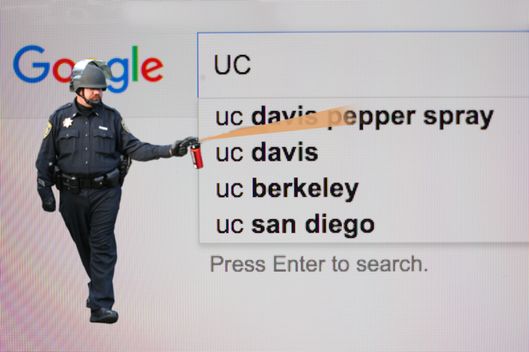
Rule number one of the 21st century is that you cannot control the internet unless you are China or North Korea and only maybe then.  When UC Davis tried to get its bad PR off the net, this happened:
Yep, the top entry for searching for UC (not even UC Davis) is pepper spray.  So, well done, UCD.

It is not that dissimilar from when universities tell bloggers not to blog.  It just does not work, as both the internet and those who dwell on it cannot be censored much.  The examples of UCD, UBC and even Carleton demonstrate that administrations just don't get it--that trying to restrict what goes/stays on the internet has the opposite effect as the linked article suggests.  This should not be that surprising, but yet many higher ups just have not gotten it.  Maybe when hiring for upper level admin, applicants should be given a basic internet test and see if they can figure stuff out.

Why? Because the internet has made that whole idea that the cover up is worse than the crime a much bigger deal since efforts to cover up tend to produce much outrage that spreads pretty widely. 

If I were an adviser to a university president/provost/governing board, my first piece of advice for any crisis would be: suck it up.  Trying to deny is unlikely to work, and telling people to shut up will not work, especially when those people are cranky folks who expect to be able to say what they want.  Academic freedom may be fuzzier than profs think, but the basic expectation profs have about being free to say what they think means that telling them to shut up is not going to work.  And now they have platforms which can be their megaphones.


Sunday, February 28, 2016

Free Speech, Conspiracy Crap, Anti-Semitism and Oberlin

A caveat: I have not followed closely the events at Oberlin nor have I been back in quite a while.

But people are asking me my take on my alma mater as a professor, as an alum, as someone who posts stuff online quite a bit, and perhaps someone who was raised Jewish (I am not a believer).  So, what is the story and what is my take?

Seems like there is a lot of tension at Oberlin about Palestine and about anti-semitism and various other overlapping identity conflicts that are coming to a head with one prof in the middle: Joy Karega, who is an Assistant Professor Rhetoric and Composition.  She has posted various things on her facebook page that are quite offensive to many folks, including supporting 9/11 truther stuff and suggesting Israel was behind the various attacks in Paris.

I am not going to be the first to hang Karega even though I am deeply, deeply hostile to 9/11 truther crap.  Why not?  First, I am not a big fan of taking people's facebook posts and using them to get people fired (although I can be prone to schadenfreude).  Posting on a personal page is distinct from teaching in the classroom or publishing in public outlets.  Second, even teaching/publishing is obviously protected by academic freedom--that professors should be allowed to be provocative.  I have never been confident about whether that applies to stuff that is clearly/factually wrong--like the anti-vaxxer teaching stuff in health classes at U of Toronto.

So what should Oberlin do?  Not fire her, for one.  Although insta-promotion of her (as was apparently on the list of demands that student protesters put together) is also a bad idea.  She should be promoted and kept or dismissed based on whether she is a good teacher and researcher or not.  One can have controversial views and still do those things well.  I do have concerns when people go outside their lane (oops, guilty), so what does a writing prof know about terrorism?  The school has issued statements disassociating from Karega's statements while acknowledging her right to her (awful, awful, awful) views.

The list of things people are raising are a mix.  That the Kosher Halal co-op got kicked out of the student co-op association is strange, but I lack info about the dynamics.  Does the school have any oversight over the co-op association?  It may not, and thus be powerless.  What was the reason for this expulsion?  I find this complaint to be an important one, and that as an alum, I would like to know more about it.

The BDS movement is a real challenge, as students are rightly (in my view) upset about the treatment of Palestinians in Israel and Netanyahu's awful policies BUT both the BDS program (boycotting Israeli universities) and the way it is often conveyed (via threats) are not great.  Still, while Obie Jews can be upset that there were protests during Rosh Hashanah, that is the price of liberty.  People can choose to protest at times that are highly visible, and one just has to deal with that.  So, it might create tension, but I actually don't think this is worthy of complaint--protests on high holidays are just something to deal with.  Now, if there were efforts to block entrances to chapels, that is problematic.  My basic stance as always is that your freedoms are your freedoms unless they impact my freedoms, and then we have to figure stuff out.

One key part the matter is this: one can be anti-Israel without being anti-Jewish; one can be Jewish and not be pro-Israel; one can be pro-Israel and either Jewish or not (I do think that the demise of the one state solution is forcing Israel into the position of being Jewish or democratic but not both). But the reality is that this stuff gets tangled fast.  So, Jews think that folks who are critical of Israel are critical of Jews, and that is sometimes but not always the case.  That Karega cites Louis Farrakahn approvingly puts her on the wrong side of that line, that she approves of conspiracy theory that puts the Jews and/or Israel behind many events puts her on the wrong side of that line.  The protesters at Oberlin?  I have no idea.

What I do remember about my days in Oberlin is that protesters ranged from well informed and thoughtful to knee-jerk and determined to be divisive.  So, I cannot generalize about the students of today.  I know that the college is in a difficult spot, as the African-American students have some serious concerns (I am not a fan of their list of demands), that the Jewish students have serious concerns, and those who are concerned about the Palestinians have legitimate concerns.  Figuring out ways to take all of this seriously without upsetting any one group or violating someone's academic freedom is not easy at all.

All I can say is that I am one embarrassed Obie, but I am used to that, as the student activism is passionate and often finds itself directed in both productive ways and in silly ways.


Thursday, October 15, 2015

Semi-Victory for Academic Freedom and Online Media

Today, the Hon. Lynn Smith issued her report on the UBC academic freedom controversy that I discussed here.  Jennifer Berdahl issued her response at her blog.

The key pieces of the report are:


  • "UBC failed in its obligation to protect and support Dr. Berdahl’s academic freedom. The Collective Agreement Preamble creates a positive obligation to support and protect academic freedom. Through the combined acts and omissions of Mr. Montalbano, the named individuals in the Sauder School, and others, UBC as an institution failed to meet that obligation with respect to Dr. Berdahl’s academic freedom."
  • Nobody infringed .... 
Which, together, is pretty damned confusing.

The next key piece is this:


The Collective Agreement identifies two “essential functions” of the University to which academic freedom is essential: the pursuit of knowledge and understanding, and the dissemination of knowledge and understanding. The means by which scholarly understanding is disseminated have evolved, and electronic publication is now common, including through vehicles such as blogs. The protections of academic freedom extend to the dissemination of scholarly research and opinion through these new electronic media.
Woot!  Despite the muddling of responsibility for who caused this ruckus (not Berdahl!)

Finally:
Although the UBC Collective Agreement definition of academic freedom does not refer to commentary on university governance, in my opinion such commentary falls within its ambit.
Thus, online media, such as blogging and twitter are within the realm of academic freedom and thus to be protected AND discussing/criticizing one's institution's governance is fair game--tis part of the stuff covered by academic freedom.

So, a major decision in clarifying what academic freedom means in the 21st century.  This is very important, given recent controversies.  Will it serve as a precedent? Not really since it is not a court decision.  But it might serve notice to administrators that they have to get used to the new reality and realize, as always, the attempt to cover up ends up producing far more damage than that which they are seeking to cover up.  In other words, let the profs rant--they are often ignored ... unless someone tries to silence them.