Showing posts with label health. Show all posts

Friday, June 20, 2014

Necessary Unnecessary Infographic Du Jour

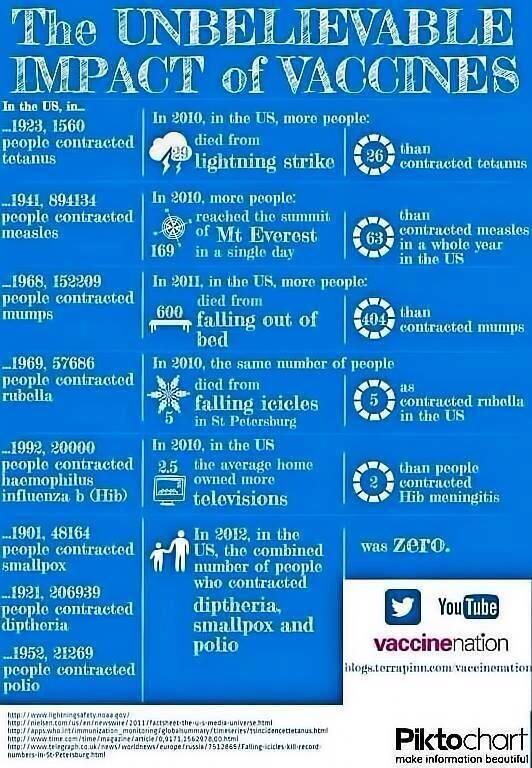
We really should need to be educating people about vaccines these days, but I guess we do.  So, here is today's infographic that should not be necessary but is (thanks, Jenny McCarthy).


 For 2014, these numbers may not work so well, as we have measles outbreaks, whooping cough outbreaks, and other otherwise avoidable diseases spreading.  This is sad on so many levels, but one is that the US health care system does prevention so very badly except when it comes to vaccines.  Now, thanks to the no-nothings, that one success is now being eroded. 

One other note--600 people falling out of bed each year?  That makes that old claim that more people die falling out of bed than via terrorism in the US still valid.  If we take not 2001 but the entire 2000's, then we can suggest that we need a Patriot Act for beds more than we do for terrorism.  Of course, 9/11 had big economic costs and we should not diminish the actual suffering of the families.  But some comparative context is not a bad thing.

Anyhow, this is really about the anti-vaxxers and the idiots who follow them.


Tuesday, February 28, 2012

Prevent This!

When people argue about ethnic conflict and civil war, one of the questions that comes up is: can we prevent stuff?  The answer is no.  Why?  Not because there is no warning, not because there are not measures to take, but because people do not act to prevent stuff because it is harder to get folks to invest when the threat is low and not imminent.

Why am I talking about this today?  Because of this map, which shows that we are not preventing preventable diseases.  People are not getting vaccinated as much as they should, even in the advanced democracies.  Jeez!

Some places seem to be doing a good job--Scandinavia to no surprise.  Brazil to some surprise.  My guess about Libya and Iran would be about data availability.  New Zealand looks pretty scary--all that wind must blow diseases everywhere?!

Anyhow, check it out and ponder why we don't prevent the stuff we can prevent as well as could.

Tuesday, January 4, 2011

Correlation Means Confusion

Very interesting set of figures on food prices and health problems:


 The obvious conclusion to draw is that cheap food causes obesity, diabetes, and heart disease.  This makes sense, but the comparative statics here may be the product of something else.  It could be that the US health care system is responsible for all but the first figure, and so the correlation might be spurious.  It would be interesting to see what the figures look like over time and whether correlations change over time, as that might help us figure out how much of this is new and which way the causal arrows are going.  My guess is that the institutions that have led to more equality and better health come are independent of the price of food.  I'd also like to see where Canada fits in, as the food here is more expensive in the US, but perhaps not as much as in Europe. 

The interesting implication here is that ethanol, by driving up the prices of corn and corn-based products (that would corn syrup that is in heaps of processed food), would actually be improving American health in the long run.

But the author of this stuff has another axe to grind, suggesting that cheap food facilitates or is perhaps even caused by income inequality--that the American system of inequality works by providing underpaid working folks with cheap food.
To me, cheap food underpins our highly inequitable income system. If we're going to have a large low-income class, a perpetually squeezed middle class, and a small caste of super-rich, then a cheap food system plays a vital role in keeping those at the bottom fed -- if under-nourished.
Interesting conclusion, but it is not clear that raising food prices would create the revolution that this guy apparently seeks.  Going back to the top, I guess I would want to distinguish between cheap good food and cheap bad food.  Is it that Americans have lots of cheap broccoli?  Or lots of cheap potato chips?  I have not read all of the books and articles that address the food industry's manipulation of our taste buds, so I cannot say much about what is going on here.  I can raise two questions: why is food so expensive in Europe and why is it tolerated?


HT to Brian Sala for the FB link.
Wednesday, May 12, 2010

I Am Allergic to This Article. Or Am I Intolerant?

Interesting report that our science of allergy actually, ahem, blows.  Allergies are over-diagnosed--not a surprise.  We don't know why people shed them or develop them.  Well, that I didn't know, and is a huge gap in our knowledge.  Holy future dissertations, Batman!  Not to worry, Robin, as we have plenty of PhD students who need topics. 

Does this mean I am merely intolerant of all things that grow (trees, weeds, etc)?

The good news is that the report the NYT article is explaining is:
is part of a large project organized by the National Institute of Allergy and Infectious Diseases to try to impose order on the chaos of food allergy testing. An expert panel will provide guidelines defining food allergies and giving criteria to diagnose and manage patients.
We were approached as in a sense the honest broker who could get parties together to look at this question,” said Dr. Matthew J. Fenton, who oversees the guidelines project for the allergy institute.
Authors of the new report — and experts on the guidelines panel — say even accepted dogma, like the idea that breast-fed babies have fewer allergies or that babies should not eat certain foods like eggs for the first year of life, have little evidence behind them.
 Some clarity:
Part of the confusion is over what is a food allergy and what is a food intolerance, Dr. Fenton said. Allergies involve the immune system, while intolerances generally do not. For example, a headache from sulfites in wine is not a food allergy. It is an intolerance. The same is true for lactose intolerance, caused by the lack of an enzyme needed to digest sugar in milk.
Ok, I have allergies.  But my relatively new yet sporadic reflux is not.  Too much food and beer apparently is simply too much food and beer. 

It is interesting to note that the chairman of the project is a mere associate professor.

Anyhow, this article is very interesting because it shows, if the authors are correct, that a basic part of health is so very poorly understood.  The next question is for the sociologists of medicine--why do we know so little this late in the game?

Tuesday, April 13, 2010

H1N1 Update

Very interesting op-ed at NYT on a year after the outbreak started.  Interesting facts plus a good perspective on it all.
But the struggle between people and pathogens is a part of life itself. We cannot continue to be surprised every time a new virus emerges. Instead, we must use the lessons we’ve learned during the year since H1N1 arrived to develop more effective public health responses.
 Some highlights
  • Mexico took a big risk and hit--it reported the possible epidemic quickly despite the likelihood of a steep penalty economically.  The cost--one percent of GDP!  Pretty significant for a country beset by all kinds of problems.
    • Much better than China and SARS
    • Demonstrates a need for perhaps providing incentives for countries to be as swift as Mexico.
  • Health officials screwed up: kids were contagious up to three ways after fever disappeared (if it appeared at all), and adults were contagious between 5-7 days.  So, folks were going back to school and work to spread the disease.
    • What is it about kids that make them contagious longer?  Just a funky reality to note.
  • The article takes seriously that a "mild" epidemic in a developed country does not mean the pandemic was mild across the globe.  Of course, the US faced a less nasty outcome.
  • We really have no clue about how many people were infected since not everyone got a fever.
    • 1/3 of British kids in a survey showed antibodies--which meant they had been infected, which was ten times more than the estimates.
We need more international cooperation to head off the next one, as there will surely be a next one.

I guess this leaves me a bit uncertain about whether we are better prepared or not for an outbreak of the Z virus.