Showing posts with label tenure. Show all posts

Thursday, July 28, 2022

Some Self-Imposed Reviewing Rules

 Tis that time of year: to write tenure/promotion letters.  Usually, sometime in the late spring or early summer, chairs/associate deans/etc reach out and ask academics of the right rank (tenured for tenure decisions, full profs for promotion to full) to write letters evaluating candidates for promotion.*  This is a big ask because one is expected to review someone's entire research output (outsiders are in a lousy position to evaluate teaching/service), and, no, we don't get paid to do it.

We feel obligated to do it because others wrote letters about us and because there is an understanding that saying no might be interpreted as saying that person should not be promoted.  I have written about this before, but I am writing now to provide some rules I use to get through this.  I had whined about this on facebook, and someone asked where my rules came from, which inspires this post.

But before proceeding, a few caveats:

  • these are my rules--they are not the norms of the profession.  I don't know how they impact candidates since I have not been on a tenure/promotion process in some time (Carleton does this stuff by subcommittee)
  • I don't get hit as hard as women and people from historically excluded groups as deans/chairs/whoever seek representation and thus pile on more work on these folks.
  • I don't get hit as hard as people with bigger names or people at more prestigious places.  Moving to Carleton from McG helped me in this regard.
  • I also don't get as many requests as those who have work that is quite broad.  Working on ethnic conflict then and civil-military relations now means getting requests to review people in both areas but not in an area such as "Congress" or "IR Theory."

Ok, so what are my rules/procedures?

  1. I try to do only three letters a year.  Each review takes multiple days to the reading and then drafting the letter.  As a way to manage all of the stuff I have to do, containing this unpaid and unrewarded stuff to just three is necessary.  I have told my friends who get hit hard that three is enough for them too.  Given that we do this every year after tenure and we don't need that many letters ourselves (one per promotion and then maybe for a move or two), we are definitely paying far more forward.  
  2. Comparison is the thief of joy.  I actually love to compare, and it is essential to my research.  But I HATE being asked to compare a candidate to other people.  In my view, academia is not a competitive bloodsport but an effort to make contributions to knowledge.  Did someone do interesting research that informed debates and moved the discussion forward?  Not did person x do more research than person y.  Some places will give a specific set of names and say: did the candidate do better than these people?   I have decided not to play this game, as I don't know the conditions at each university of each potential competitor that might facilitate or inhibit the research of the various folks involved--variations in course loads and course releases, help or lack thereof for grading, service requirements, internal funding, etc.  Some people will write letters that evaluate the work but don't recommend promotion because they don't feel they have a good understanding of the rest of the record--they stick with what they can know and say.
  3. When I get the package, I try to figure out which five pieces to focus on.  I have finite time and I am easily distracted.  So, I am not willing to read the entire package.  And I don't think I need to. If I can't figure out if a person has made a contribution from reading either their five most well placed publications or five publications in my area of expertise, I am not going to find it in publication 7 or 10.  I have no idea how this plays with promotion committees, but I am explicit about it.  For promotion to full, I only read the stuff since they got tenure.  I don't need to re-hash the tenure decision--the question is whether they continued to contribute.
  4. I will not dodge a negative review.  If I am asked to review someone who falls short of the tenure standards at my school (the letter requests often ask whether person x could get tenure or promotion at my place), I will still agree to write the letter.  I don't want universities to think that no letter means a negative review, and my limited capacity to influence that perception is to write negative reviews when the situations arise.  And, yes, I have done it a few times.  It was not fun, but I try to fairly assess each file--does the person make a contribution, does their trajectory look good, would I promote them at my place?  If the answers are no, no, and no, then I write the letter that way.  

What are my general standards, subject to instruction from the place requesting the letter?  Completion of an original research project--that can be a book, a series of articles, or a mix; the start of a second project.  I do check the citation record, but don't focus on it since the committee can do that.  My job is to assess the intellectual contribution of the work--have they asked relevant questions, have they developed persuasive arguments to answer those questions, have their methods been appropriate for testing their arguments, how has their work advanced the debate?  Not every aspect has to be original.  It can be a classic question with a new answer, or a new method or dataset to test existing arguments, but something has to be different than that which has been done before.  While replication is something we should do more, one's tenure should not be based on replicating previous work.

Finally, I have no idea how my tenure letters are received.  All I know is that almost everyone who I have written a positive letter for has received tenure/promotion.  The exceptions?  The places that deny most/all people--the Harvards and their ilk.  Of those who I have written a negative letter?  I think most or all of this handful have been denied.  And this is one reason why I impose limits on my work in this area--I am not sure I am making a difference (not that I want to--to be the one person standing in the way of someone's tenure).  Since much of this is pro forma one way or the other, it does not make sense that I spend my entire summer reviewing five or six tenure cases and reading every single piece of written work.  

Or at least, that is my rationalization.  I am not sure what other people use as their rules, but I wish we had more transparency on this so that we could all have reasonable expectations and so that committees and deans and provosts would understand the collective action problem they are generating.


*  I just got two requests and said no to both since I am full up.  Asking for letters in late July is not a good strategy in my humble opinion.

Sunday, September 8, 2019

Ranking Movies? Sure. People? Not So Sure

Sunday mornings are for tenure reviews.  Huh?  I am reading stuff to evaluate a scholar for whether he/she is worthy of tenure.  This is a standard part of the tenure process--to have outside scholars read a bunch of a candidate's work and then indicate whether they have made a significant contribution and whether they are likely to continue to do so.  As I have written elsewhere, this is a fair amount of work, almost always unpaid.  So, I have gotten a bit cranky when I do it these days.

What makes me really cranky?  Being asked to compare a tenure/promotion candidate to the top scholars in the field.  I don't even like comparing people to others who are at the same point in their career.  Why?  Because in my mind, tenure is not about whether you are the most cited person (probably what administrators think of as "best"), but whether one has made a contribution and whether one is likely to continue to do so.  When I consider a tenure candidate, my basic question is whether they have done enough interesting, well-executed research and whether they are likely to continue to do so.  That latter part is mostly a guess based on whether the person's research has moved beyond the dissertation--if they keep asking new questions and managing to publish their answers to such stuff, that suggests a good trajectory.

Asking folks to be ranked is problematic unless I have very good knowledge of the support they receive.  Person x may have five more publications, but they may also have a much lower teaching load, free research assistants, and ample funding compared to person y.  How does one rank different scholars if one does not know how much support they have received from their schools?  It would seem to be unfair to penalize with lower rankings those who got a lot of good work done despite limited resources if there are other folks who got as much or more work but with far more resources. Given that there are all kinds of problems that breed path dependencies that lead to people getting less support (discrimination due to race, gender, first generation-ness, etc), it would also seem that ranking, rather than focusing on contribution to knowledge, would be replicating or intensifying the legacies of the past.

I decided to include this text in letters I write from now on:
I got have gotten much support on twitter for this stance, and folks have asked if they could borrow this text.  Of course, because if we all agree not to rank candidates, then the universities that ask for it will have to drop their focus on that question.  I understand this is a collective action problem, and, as the text above indicates, I am worried that by not following the instructions given to me by some of the folks wanting letters, I might be hurting the candidate.  Hence, I am explicit about it and want more company.

It would be a minor revolution, but it would also perhaps reduce that whole "comparison is the thief of joy" envy/jealousy/competition dynamic and return our business back to where it should be--fostering better understanding.  And, yes, sometimes I get idealistic.  Perhaps I get more idealistic when it makes it easier for me to dodge work, as ranking candidates is not only unpleasant but requires more research.


Sunday, February 18, 2018

Tenure Letters and Cohort Comparisons: This Way Lies Confusion

Tenure and promotion letters are one of the services academics do when once they get past tenure themselves.  I have blogged in the past about whether or not to write these letters, so today's post is about a frequent challenge when writing such letters: some (many?) provosts/deans/whoevers ask the letter writers to compare the candidate to the candidate's cohort--other people in the same area of research who have been at it for a similar time.*
*This post only addresses research since outside letters can only speak to research and because my only experience has been in research universities.

This request poses both practical and normative challenges.  The practical challenge is this: how does one know who the comparative cohort is?  As far as I know, there is no handy search engine that will pop out names of people in a subfield or research area sorted by year of PhD completion.  I don't have an encyclopedic memory for who finished in what year, nor, because I am far behind in my journal reading, really know who is doing what.  Reading all of the materials is extra work enough without systematically going through "peer institutions"** and identifying folks in the relevant subfield who are at the same stage of their career. I posted on facebook, essentially asking my IR friends for names of folks who would be in this person's cohort.  Instead of giving me names (ok, one or two people did), this led to a long and interesting discussion of the entire exercise of comparing.
**  One of the basic problems in all of this is that every Dean/Provost has an inflated sense of what their institution is, so the list of peer institutions is quite small--the Ivies, the top public schools and a few others.  It does help me, however, that I moved from a school seen as peer (McGill) to one that is not (Carleton), so I get fewer requests now than I did at the old place.  Woot.

The folks arguing for comparing to a cohort argued this was one of the most valuable pieces of information in the letter since everyone mostly writes super positive letters lest their few criticism arm those who are opposed to a candidate for whatever reason (not infrequently illegitimate ones like sexism, racism, animus, retaliation, etc).  More importantly, some folks argued that to evaluate a candidate, they should be compared to their peers.***  This is what many letter requesters want, and some even name specific scholars (usually the most well known/cited/productive).   Even if focused on a person's contributions sans comparison, competition ultimately enters as one evaluates the quality of the presses in which the candidate publishes, the selectivity of the journals in which their work appears, citation counts and h-indexes are essentially comparative and so on.

***One friend argued with me that competitiveness is productive, that folks who are competitive will be motivated to continue to publish after tenure, and that those who are not motivated by comparing themselves to others are likely to become deadwood.  I think curiosity and professionalism bred into us is sufficient, but I am sufficiently ego-driven that I see something to that argument.


But this raises a question of what is the point of being a scholar, of being promoted and tenured?  To be better than others?  Or to be productive, to make a significant contribution?  What difference does it make if candidate x is not as productive as the most productive people in the discipline?  Not everyone can be above average.  Perhaps the idea is only to tenure/promote people who are above the people who are at the average level of productivity?  How I write the letter depends on how I see the profession, and while there is a heap of competition in it--to get into grad school, to get grants/fellowships, to get into the more selective journals and presses, to get jobs--I think the larger enterprise is not competitive. It is about making contributions to knowledge, building on the work of others (past and present).  That co-authoring, for instance, and other forms of collaboration should not be penalized (I wrote the linked post in the aftermath of my co-authored work being dismissed by my senior colleagues because .... motivated bias, so that post might be a bit strident).  Moreoever, as one friend argued, relative comparisons may be unfair when there is a heap of bias--in who gets cited, who gets published in the top presses, etc. 

The tenure/promotion letter, in my view, is about addressing whether this person has made a contribution and is likely to continue to make a contribution. To me, these are absolute questions, not relative ones.  Which is why most of the letter is about what the person has researched and written and what their stuff contributes rather than the bean counts and comparisons with cohorts.  When asked to compare, I try to do so because, like saying no to the request, not following the instructions can be seen as criticism. But I don't like it, and I have a hard time because I do not have a good grasp of who is in the cohort.  So, what else do I do?  I whine here about it.

Sunday, February 21, 2016

De-Mything the Tenured Professor

I have been seeing lots of retweeting of Stephen Walt's post on How to Get Tenure.*  There is some truth to what he says, but it is also much more narrowly applicable than he suggests.  Why?  Chicago/Harvard (where he has worked) are atypical,** where attaining tenure is rare and difficult.  He acknowledges the narrowness of his experience but not the exceptions that these places are. At most colleges and universities in the US and Canada, tenure is not that difficult to achieve--failing to get tenure is the exception.  Instead, the real challenge is getting that first tenure-track position, something that has become increasingly difficult over the years.
* I missed much of the discussion as I was on the road during my school's winter break, skiing and presenting Adapting in the Dust to a couple of universities in Quebec (not simultaneously).
** I was once asked to write a tenure/promotion letter for a candidate at Harvard, and I was given eight names or so and asked whether this candidate was equal to or better than these eight names--all people at the very tippy top of the profession in terms of impact/citation count/reputation.  No other place for whom I have written letters have been that specific about the comparables.
A key caveat here: one of the Iron Laws of Academia, the Iron Law of Hostility and Favoritism, is that merit only matters when there are forces within the department/school that are determined to deny promotion/tenure or determined to grant promotion/tenure.  If folks are arrayed against you, it does not matter what you do.  If folks are arrayed in favor of you, then you don't even have to check that much of the list.  Sorry, but that is the reality.  There are checks and balances--outside letters and committees/officials up the university chain of command--but they can fail.

One more disclaimer: I have taught mostly in research-oriented programs: one near the bottom of the food chain in the US, one at the top of the rankings in Canada, and a university that is ranked in the middle but within the premier international affairs policy school.  But I have not taught at a liberal arts college, in part because I blew one or two of the few chances I had to get positions at such places (and also that Iron Law above came into effect once or twice).

Ok, with those caveats out of the way, let's go through Walt's listicle:

Friday, January 8, 2016

Sexism in Economics:WTF?

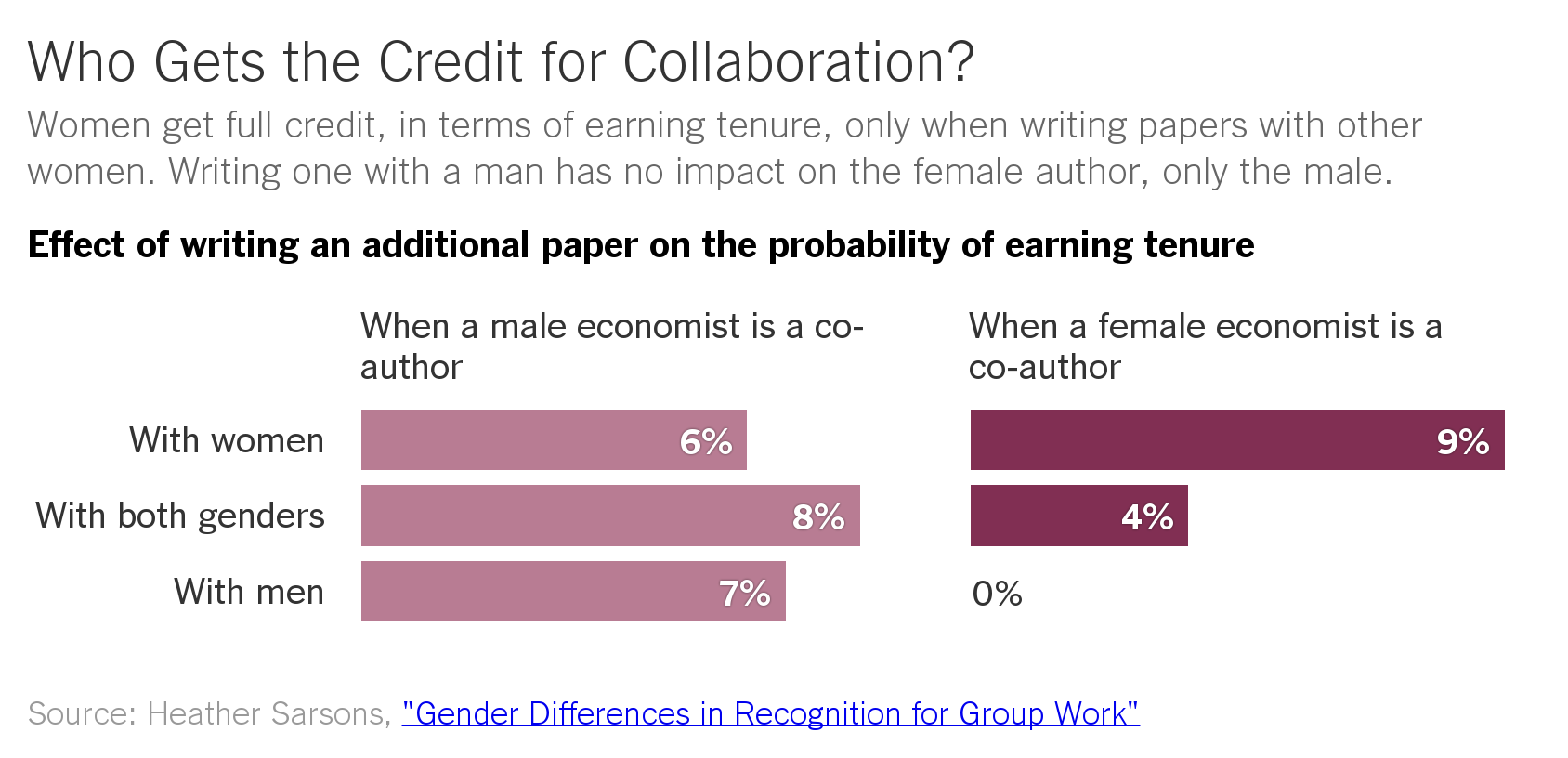
I have written previously about sexism in political science, mostly focused on anecdata--the plural of anecdote.  Today, Heather Sarsons has a piece in the NYT based on much more advanced analysis than anecdata, an argument that was terrific in both senses of the term:
  • the popular sense of wow, amazing, cool
  • and the original sense of this is so awful that I feel scared.
The gist: women who co-author with men in economics get no credit for their publications in terms of affecting their chances of getting tenure.  Women are seen as assistants and not as content originators/thinkers when teamed with men, apparently.


Co-authorship does present challenges when assessing someone's record, no doubt.  Indeed, I was denied promotion to full professor at my previous job since my second book essentially counted as zero because it was co-authored.  The signalling of my name going first despite not being in alphabetical order was ignored.  Why?  Not sexism and not because co-authorship is wrong as one of my leading opponents had co-authored stuff.  No, the problem was that a handful of individuals didn't want me to get promoted and then read the file the way they wanted to, even if it was hypocritical or logically inconsistent or both.

It may be that economists on tenure committees just tend to devalue the contribution of female co-authors in general or it may be that they use the co-authored work to diminish records so that women are denied tenure.  It ain't pretty either way you look at it.

This sends such an awful message, particularly given the other inequalities that already exist.  Since the econ profession is still male dominated, co-authoring with senior faculty means co-authoring with men mostly.  So, this article's findings suggest that women should avoid doing that.  Indeed, the way to proceed is to solo author.  While it is fine to solo author, doing so to avoid the slings and arrows of sexist senior males puts women at a competitive disadvantage as they lose publishing opportunities.  The catch-22 is this: publishing with other folks can help get more/different stuff out and cited but then it gets discounted?

I don't know if this bias is as bad in poli sci.  The paper indicates that it is not as big a problem in sociology.  Maybe partly a function of how male dominated each discipline is.  I do know that political science is far more co-authored now than in the past, that folks struggle with how to evaluate co-authored work, and, yes, there is still sexism in poli sci.

The real Iron Law that matters here is this: people will read a person's tenure package positively if they want to, and negatively if they want to.  They can find things to nitpick if they want to deny tenure and they can come up with justifications if they want tenure someone with a shaky record.  The best way to shield against that particular dynamic is to have the best record possible, making it hard but not impossible for those motivated to vote now to do so AND to give folks up the chain of decision-making reasons to overturn bad decisions AND to have a record that makes one competitive elsewhere if things go awry.  What that means for co-authoring in political science for women?  Not sure, although the safest bet has always been to do some solo work to demonstrate one can work on their own.

Wednesday, March 18, 2015

It is All About the Small Pleasures

It is important to smell the roses and all that.  And it is important to enjoy some good snark:

Of course, the U of Tennessee undermining tenure is pretty ugly, but gallows humor has a purpose--to take a bit of the pain out these kinds of things.

Either you laugh or you cry, and I choose to laugh.

Thursday, May 22, 2014

Tenure Wins The Day?

Yesterday, the U of Saskatchewan Provost quit.  Today, its president, Ilene Busch-Vishniac, was fired by the Board of Governors.  And Robert Buckingham can return to his tenured job.  Does this mean that tenure wins the day, that academic freedom is treasured not just by professors but even by the Premier (equivlent of a governor of a state) of the province?

Maybe.  Or maybe it is just that the board and the Premier realized that bad press is bad press, that there is such a thing as bad publicity.  Or maybe just that they understood that the President lost the ability to do her job because she no longer has credibility in the aftermath of this fiasco. Or perhaps these folks simply realized that having amateurs at the university's wheel is a bad idea.

Lots of lessons to be learned here, and the protection of academic freedom may be one of them.  I am not sure, but the response is suggestive and people will infer that the board, the Premier, the press and the public all seem to share the view that professors should not lose tenure because they criticize the administration.  If only Kansas equivalents had similar views....

Wednesday, April 16, 2014

Edited Volumes?

Chris Blattman got some heat for his post on advice he gave to junior faculty.  Specifically, folks got upset that he pooh-pooh-ed edited volumes.  So, he elaborated today.  I did not think that his advice was very controversial.  Indeed, I labeled it conventional wisdom but in a good way--this is what folks generally think. 

Why are edited volumes problematic? To be clear, there are two roles here: editing a volume and contributing to one.  A junior prof should be reluctant to edit one for at least two reasons--it is a huge time suck, and junior folks do not have a heap of time; and they could end up alienating senior faculty if they have to edit (reject or ask for substantial revisions) a big name who is contributing to the volume.  Contributing is a bit different, but that is what Chris was talking about.

One of his key claims is that people do not find such work as accessible.  Even in the gated community that is academia, fellow academics can usually get pdf's of articles in most journals pretty easily, but book chapters?  Not unless you want to buy the book or hope that the library has a copy.  So, it is simply less likely to be cited and less likely to be influential.  There are other problems as well--that the speed of an edited volume is very much like the speed of a naval convoy--it goes as fast as the slowest contributor/ship.  I have two contributions to edited volumes outstanding--and I have no clue about when they will appear in print.  I am ok with that because I can be ok with that.

Chris's basic calcuation is: could the time spent on a book chapter be better spent on an article that would appear in a refereed journal?  There are a couple of things that he overlooks: the networking and the feedback.  Edited volumes are usually not about sending off a piece to be joined with other stuff (it happens), but most usually part of a conference/workshop where one meets others doing work in related areas.  My first edited volume experience was terrific because it had multiple meetings (the last one in a cool location--Palm Desert) with a heap of smart people, only some of whom ended up in the edited volume.  The feedback was terrific, it inspired some new research directions that led me to interesting places, and the edited volume made a big splash.  My contribution has been well-cited, so the whole experience was very much worth.  But it was hardly typical.  I have had other good experiences but none so good as that one, not even when I was the editor.

Still, junior faculty can and perhaps should say yes to the occasional edited volume if it is attached with a workshop that would involve people one wants to meet and if the project is either not that much work or is the start of a promising direction.  But even then, the junior prof should be cautious. 

The value of a chapter in an edited volume depends on where one is working, how much the senior faculty value chapters versus articles, and how much one's subfield seems to value chapters versus articles.  Editing a volume, unless it does really, really well, does not help one's tenure chances as much as writing articles, and editing one volume takes a lot more time than writing one article.   I think Chris was right in emphasizing the time tradeoffs, but the networking/intellectual development possibilities were underplayed in his piece.

I think the answer is much clearer about book reviews, which was in the same entry for Blattman, as edited volumes--only do book reviews if you would read that book anyway.

As always, tradeoffs exist so one needs to be attuned to the opportunity costs of the various choices.


Wednesday, August 22, 2012

Tenure 101

I have spent the past several days at orientation meetings at my new place of employment.  I am coming in with tenure (just as I did the last time), so I am not concerned about tenure directly.  I do care about tenure procedures because the granting of lifetime employment (essentially) is a pretty serious enterprise and how academic units deal with it shapes the culture of the place.  So, in the course of events, I asked questions about it, and I also watched the folks around me get heaps of advice from the various panelists.  As a result, tenure is on my mind.  Not the first time of course, as as a search of my blog will turn up many posts related to the future of tenure, the apparent randomness of tenure decisions, what a strange institution it is, how poorly it is portrayed in movies, that promotion to full can be problematic,* and so on.
*  One of the strangenesses at Canadian schools (I know have an n of two) is that tenure seems to be easier than promotion.  At Carleton, the tenure and promotion to Associate Professor are two distinct decisions and processes, and only one of them seems to have university-wide standards, and it ain't tenure.  I don't understand it at all, but that does seem to be the reality.

While one can give lots of advice, I just have two pieces of advice for this post: think about the profession's expectations and do not think big.

First, your department/school/college/university may or may not provide clear tenure guidance.  Do consult your colleagues, do try to observer what has happened in the recent past, and so on.  But as you strategize towards meeting the local standards, do try to get a sense of your discipline's standards** and try to match those.  In many places, the profession's standards are the same as or tougher than the local department. Those places that seem to be far more strict than the profession's?  Well, you should know that going in and prepare accordingly.
**  This is mostly written with research intensive schools in mind.  Liberal arts colleges will be similar but not identical.  The norms regarding research output for folks at liberal arts colleges may be different than for research universities, so keep my bias in mind--based on my experiences at the research schools.
Why care about the profession?  Well, since it includes more people, it is unlikely to change quickly.  A department can radically revise its standards in a short period of time.  But that is not really the important reason.  The two reasons are:
  1. Many places require letters to be written by folks outside the department to provide an external check. These folks are probably not familiar with the local standards and will probably rely on their judgment of what it means to be a good x ... a good political scientist, a good economist, whatever.
  2. Besides personal glory, satisfaction, ego, whatever, one should try to meet the profession's standards to maintain at least the appearance of mobility.  It is almost certainly always better to be seen as mobile than not.  You don't have to constantly threaten to leave.  But if you can leave by getting a job elsewhere, then you can if that needs to happen (your state/province goes to hell, the department blows up, you need to flee an ex, whatever).  Also, one of the only ways to get a pay increase is to be desirable.  Some places may give you a pre-emptive offer so that you do not even go on the job visit.  Most of the time, you will only get a big raise if you have a job offer from elsewhere.  That is not going to happen if you do not at least match the profession's expectations.  

Sunday, January 29, 2012

Tenure Anxiety Over-rated

Sure, it is easy for me as someone with tenure to think that anxiety about tenure is over-rated.  But let me put it into context a bit.  Over the past few days, there has been a thread on whether single or married people are advantaged or disadvantaged at that reservoir of erudition--Political Science Job Rumors.  While nearly everything said there can be and is discounted, the questions and concerns raised there perhaps (trolls aside) indicate the general level of anxiety about tenure. 

To be clear, the process is fraught with enough uncertainty that when my first job offer from McGill suggested that I start without tenure and then go up for it when I arrive, I politely said no thanks.  I had received from Texas Tech, and folks tend not to give up tenure when they move.  I was no exception even if I felt confident that my record exceeded McGill's standards at the time--you never know what might happen.  When you have a contract that essentially says you cannot be fired (tenure means both more and less than that), you tend not to give it up.  Also, I am not so far beyond tenure to forget that "anything can happen" when a small group of folks with little accountability get into a room to decide one's fate.  Especially when that fate can then be randomly revised by folks up the chain (the Dean, the Provost, the President, the Board).*
* My previous employer, TTU, had a record of doing exactly that--intervention from on high, even at the board of regents level.  Definitely an outlier in academia.

Having said that, the focus of that thread on expectations of single vs married people over-thinks things.  There are basically three kinds of departments in academia:
  • Those where tenure is almost always granted. Many, if not most, fit into this category.  This can occur if standards are very low or non-existent, or if the standards are very clear and the department hires well.
  • Those where tenure is rarely granted.  Harvard, Princeton, and a few other places are known as having a low tenure rate and where being denied tenure is almost a badge of honor.  Certainly, folks denied at these places can get good jobs with tenure either in hand or promised much of the time.
  • The troublesome places in between--where tenure is often uncertain.  This can be because the standards are unclear, where the political dynamics within the department lead to unpredictable outcomes.  The department could be divided along methodologies, along generations, along personalities, or some combination. 
In the first two places, it almost does not matter what you do or do not do no matter how much you publish.  In the third kind of place, things might be entirely within your control or entirely beyond it.  In such cases, it often matters far less what one has done (and one's marital status will be entirely irrelevant), but how one fits into the various department cleavages and in the hearts of the key folks on the tenure committee.  People can read your file however they want, using slippery standards that contradict their last vote.  There is no accountability for the tenured folks doing the voting (which is why one wants to get into that club and then not leave).

Saturday, July 24, 2010

Tenure's Future

Lots of debate these days about tenure, especially given the economic crisis facing universities.  The NYT has five perspectives on it to promote debate.  I guess I think of tenure the way that we tend to think of democracy and capitalism: the worst systems except for all of the others.

Yes, tenure does provide lots of perverse incentives, including tenured folks doing less once the pressure is off, the challenges of maintaining accountability in the face of job security, and so forth.  I am just not sure that a market of free agency would be much better. 

First, why tenure?
  • The obvious reason is intellectual freedom.  The ability to teach, research and write without being fired for producing unpopular stuff is important for the development of probably all disciplines.  Critics argue that folks are never hindered by the prospect of getting fired.  Hmm, hard to observe non-events.  We do know that state officials regularly grand-stand at the expense of academics at public universities, including most recently the Virginia attorney-general targeting a scientist studying climate change.  Would the absence of tenure create a chilling effect?  Maybe.  
    • People worry about the impact of corporations upon universities as funding may cause administrators to bend (as we have seen with BP recently), and this could be worse if administrators gained more power over the professors.
  • There is also the tradeoff between job security and pay.  Aspiring professors are, in part, willing to take lower salaries when compared to folks with similarly high pay for job security.  Would people seek out jobs in the academic world if there was no job security at the end?  Would they be willing to move across the country/globe for jobs if they could lose their job after five or seven years (whatever the new contract term would be)?
    • Critics would say we need fewer profs, so discouraging folks is a good thing.  Perhaps, but what kind of selection effect would result?
  • Lifetime employment, more or less, also has benefits for the colleges and universities as the folks who tend to run much of these institutions are the professors who develop lots of knowledge about the institutions.  Lots of service by profs is required to make these places work.  If you introduce lots of turnover, what will that do to the running of these institutions?  Shorter term temp-faculty do not provide much service or any in most places, just teaching classes.  So, you could see whatever savings there are in the greater efficiency on the hiring of professors lost by hiring more and more administrators 
    • Numbers of administrators are almost like body counts---just as you cannot have less total deaths from a war (unless resurrection is possible), it is almost as nearly certain that number of administrators does not decline.
How would the academic world run in the absence of tenure?

Thursday, April 30, 2009

Professing to Generalize or Generalizing Professionally

In recent days, there has been much discussion about the profession of professor. Whether it is Joseph Nye arguing that we political scientists are not policy relevant (see also this) and punish those who try; or Francis Fukuyama asserting that we need to get rid of tenure. My first instinct is to think and say that we ought not generalize about all professors or all political scientists. But then I realized, my job is to generalize about political events, including how politicians, military officers, bureaucrats, and even voters behave.

So, I guess I am stuck with the generalizations of others about what I do. Turn about is fair, after all.

Still, to start my blogging career/hobby/new form of not-working, I gotta say that it is funny that these two, with very non-traditional careers, standing at the commanding heights of the profession, may be taking a key nugget of truth and running way too far with them.

First, regarding Nye, political science aspires to be a science, which is pretty arrogant perhaps, but the idea is to create a better understanding of the political world. If physicists and biologists range from those who do very basic research that appear unconnected to today's problems to those who are directly involved in policy-making, what is wrong with those who study politics having the same range. We have scholars doing all kinds of work that seems obscure to the layperson, but actually may provide the foundations for those who are closer to the policy world.

My own perspective may be somewhat unique, as I was lucky enough to get a fellowship from the Council on Foreign Relations in 2001-2002 to hang out in the Pentagon in the Strategic Planning and Policy Directorate of the Joint Staff on the Bosnia desk. I learned a great deal from that experience, some of which ran directly counter to my theoretical orientations gained through graduate school and beyond, including the importance of personality and process. It also opened up a new set of questions that is now occupying much of my research time (civil-military relations, how countries manage their military when operating in alliances/coalitions), etc. While this opportunity is somewhat rare, political scientists of all stripes interact with voters, interest groups, media, policy-makers and other relevant audiences all the time. And, fundamentally, we interact with citizens in democracies (most of the time) who then vote. So, we are not entirely excluded from the policy realm and most of us do care about such stuff, if I am permitted to generalize. Of course, much of our professional incentives point away from policy relevance and public engagement, towards academic journals and the like. But we are all ego-driven and want more people to hear us, rather than less, as the existence of this blog suggests.

Regarding Fukuyama, I will be briefer--ours is a strange profession with complete job security--after a harrowing start with a very difficult job market and a probationary period. He may be concerned about the stultification that may come with job security, but there are other solutions to that problem, mostly focused on developing incentives for continued good performance. Merit pay is the obvious answer that exists at most places. The job market is another one, as any effort to move before or after tenure requires a record that resonates beyond one's locale.

And this gets to the heart of the challenge. Academia is rewarding in many ways, but it requires a great deal of sacrifice as well:
  • 5 plus years of minimal income in graduate school,
  • followed by a very stressful and uncertain job market (see the various rumor blogs to get a quick taste of this not-so-quiet desperation),
  • then having to move somewhere that may not be entirely desirable (I spent six years in Lubbock, TX, which has good points, but has undervalued housing and a near zero population growth for more than a few reasons),
  • wages that are generally not competitive with professions with similar levels of education.
So, if you want to eliminate tenure, then you will have to come up with some other way to compensate those who thirst for greater knowledge but have to live in the real world.

PS See Dan Drezner's take on this debate.