Showing posts with label job market. Show all posts

Tuesday, January 24, 2023

Mama, Don't Let Your Kid Get PhDs in Poli Sci

 One could look at this figure and say things are getting back to normal.

Woot?  Well, maybe, but the old normal was awful.  The academic job market has been bad, really bad, for a long time, with a few bursts of good years.  We have been overproducing PhDs for a long time.  I wish that figure had included a line for number of PhDs produced as I am pretty sure it would exceed the line of jobs by quite a bit.  

Of course, folks will say: hey, that does not count the number of non-academic jobs that poli sci PhDs get, and that people should look there.  My responses to that are as follows:

  • Most of the folks going to academic PhD programs want academic jobs (and so too do a number of folks going to policy PhD programs).  
  • How much added value do folks get from academic PhD programs that help them get jobs in the non-academic sector?  Do the five or more extra years give them a leg up over those who just get MAs?  Is that leg up = or > the five+ years of opportunity costs?

I teach at a policy school where our aim is to train folks for the policy world, not the academic work.  In Canada, alas, there is not that much of a market for policy-oriented PhDs.  We don't have much in the way of think tanks, there are only a few govt jobs that either require PhDs or where the PhD gives one an advantage over an MA, and, the govt does not pay someone more if they have a PhD.  So, I have spent my time here wondering why we have a PhD program.  It may be a bit different in the US where there are more job opportunities for policy Phds--more think tanks, etc.

So, I have spent the last twenty plus years discouraging students who approach me about PhDs.  How many have I discouraged?  Pretty sure the answer is between zero and two.  They tend to think that what may be true for other folks is not true for them, that their interests are in demand and super-interesting.  Why am I posting this today?  Because I have a bevy of folks reaching out to talk to me about PhD programs this month.  It must be the season.

I haven't tracked what has happened to all those for whom I have written letters of recommendation.  I do know that a couple of the MA students I had at McGill got great PhDs and then great academic jobs.  I do know that all but one of my PhD students in my previous stops (McG but also TTU) have gotten tenure-track positions, and I am old enough now that all of them have gotten tenure and are either Full or Associate Professors (one is still in the tenure decision process). Oh wait, those are the PhD students who completed their PhDs.  Most did, but some did not.  One thing I have gotten better about is telling those working and flailing at their PhDs to move on.  

At Carleton, I have been asked by students: what happens if I get a policy job offer before I complete my dissertation?  I say, "TAKE IT!"  They say "but it might mean I don't finish my dissertation."  And I respond "Take the job!"  Jobs are not street cars.  So, the percentage of my PhD students who finish here is not as good as it was in the previous spot partly because these students are looking at the policy world and being done is not quite as crucial.  My ego here is not as invested in having students finish--I just want them to be happy and getting paid by someone who is not me.  

I will post this and then folks will ignore it and apply anyway.  Why bother posting it?  Because spewing is venting.


Sunday, August 8, 2021

Ten Years Off the Market And I Feel Fine

I saw a tweet yesterday about how wrong it is for academics to accept that they can't choose where they live.  For me, I never had more than a binary choice, starting with move for a temp job or ?  and then move to Texas or leave the profession and then move to a foreign country or stay in Lubbock and then move to Ottawa or stay in Montreal.  Not quite a wide range of choices at any stage.  And that was after managing to get a job offer, and it all reminded me that sometime this week will be the tenth anniversary of a strange email that put me on the path of ... chill?  

In the spring of 2011, I applied for a job for which I had no real shot and I knew that going in.  But I was looking for practice and networking, and then something strange happened: I got a different job.  In August of 2011, I contacted a friend I had at NPSIA and I asked whether they could tell me what I had done well and what I had done poorly so that I could improve for the next round of job applications.  That friend said, no, wait, we have a new Dean who will call you soon.  The next week, I got the call and the offer.  Which meant many things including that I was not going on the job market in the fall of 2011.  I had been looking to move on for about four or five years, and that was pretty much my normal state for most of my career--my last year of grad school, my two years as a temp at UVM, pretty much my entire time at TTU, and then the second half of my time at McG--about 3/4s of my career until I got the Carleton job.

Over the course of my career, I applied to hundreds of jobs, got about 20 interviews, and got three offers--TTU, McG, Carleton--and had to explain the job market to those outside academia again and again.  This thread puts some of this into perspective for the current day.  In my experience, being on the market was a constant source of stress, a significant hunk of time, very distracting, and, yes, a significant source of stress (deserves mentioning at least twice).  I did meet some great people along the way, even at job talks where I failed and flailed.  Looking back, I see how each step helped me get to the next step.

And now, what is the next step?  Keeping on keeping on, as I am quite happy where I am at, and I am through running competing for a new job.  I forget how stressed I was for much of my career, but junior folks sharing their experiences on twitter remind me of the bumps along the way.  Losing to none of the above, forgetting a key hunk of my argument, invoking a really bad example that served to distract rather than inform, being delayed so that I arrive unfed just before the plane leaves only to have that plane diverted and then miss my connection home so that I had to sleep at the gate at DFW, ....

I am really grateful for all of the help I received along the way and for all of the solace I received from my family including the dog that accompanied us from grad school through to the first three jobs.  And I am really grateful I don't have to compete for another job ever again.  Now the questions are not about when and where I will move to next but when I will retire.  The answer: not soon.  I really like what I do, who I do it with, and where I do it.  Each step was an improvement along the way, and I am, COVID aside, happier than I have ever been.  

Much sympathy to those on the market in this most difficult time.  Good luck!

Friday, January 11, 2019

Move to Canada? Still More Complicated But A Bit More Realistic

The Washington Post had a piece on folks moving to Canada due to the Trump Administration, and, at first, I was like, no, not again.  As someone who moved to Canada, I have long pushed back at the whole "I hate who won this election, I am moving to Canada" thing as immigration is hard.  This piece had four distinct differences from ye olde silly stories:
  1. twas focused not on just dissatisfied liberals (or conservatives in 2008/12 if you can imagine that) but on immigrants to the US, so folks who didn't have deep ties and face significant risks
  2. due to a xenophobic regime.  Trump's presidency is not ordinary, so the idea of leaving it makes more sense--escape the fascist hellscape while you can.
  3. that these people are valued--the programs discussed are for those with tech skills.  Canada is not seeking to get any and all immigrants in the US--just those in science/tech areas.  I remember back when I moved to Canada, I could have gotten five years of no Quebec taxes (a significant hunk of money) had I been a hard scientist.  Social science?  Nope, doesn't count.'
  4. there are private actors setting up firms to facilitate the transitions.
This last thing is key, as it is not easy to move.  Mrs. Spew remembers the first few years in Canada as being rather difficult--that Canada is not simply a colder version of the US.  My favorite story is of having difficulties driving across the border since I owed money to Honda-America on my car.  It took me eight weeks or so to get it imported--it was stuck on my driveway (Customs thought of that as a generous exception--they preferred that I had parked the car on the US side of the border).  Oh, I couldn't simply transfer the loan to Honda-Canada because the two Honda entities do not work with each other.  I couldn't get a car loan since I was seen as a flight risk and had worse credit as a temporary resident than a high school kid.  So, it is not easy.

The article mentions the cold.  That can be an issue, but mostly not.  As it suggests, if you get the right clothes and get your commute sorted, you will be ok.  The problem is really the length of winter, not how cold it gets.  Well, in Ottawa and Montreal.  I have no idea how cold it gets in Edmonton, but I imagine most of these folks are moving to Calgary, Vancouver, Toronto or maybe Montreal.  Of course, if they are moving to Vancouver or Toronto, they will be saving some money as they are probably a bit cheaper than Silicon Valley but not much.

The taxes are higher, but that is probably a wash when you consider the cost of health care insurance in the US.  And with higher taxes come not just health care that will not bankrupt you, but maternity leave (and paternity leave in many cases) and other stuff.

Lastly, as my dissertation advisor reminds me, there is xenophobia in Canada.  Quebecois politicians have competed with each other to alienate Muslims and Jews with laws about wearing religious apparel.  A former Minister of Foreign Affairs is starting up a xenophobic (and transphobic) party, and the more mainstream Conservative Party is dancing with xenophobes as well.  Given the diversity of Canada combined with the existing parties and electoral system, I think that xenophobia will not win.  Then again, I was wrong about Trump.  So, this place is not perfect by any stretch of the imagination. 

Canada is a great place to live, but it is not a colder version of the US--it is a different place.  And the provinces are different from each other, and there are other complexities.  I am happy that Canada is smart to try to lure smart people who face potential problems due to the awful xenophobia coming out of the White House, but I am also sad that the US is losing the next generation of talent because it elected Trump.  That incredibly bad decision will continue to have ramifications not just for the next couple of years but for a generation or more.  The movement of smart people to Canada to avoid Trump makes clear the costs will be enduring.  

Wednesday, July 25, 2018

How to Explain the Academic Job Market to Non-Academics?

This topic came up on twitter--how do we get our friends and relatives to understand the academic job market?  My first take: don't bother.  It can get really confusing really fast.  I consider my family well-educated, yet deep into my career, my mother thought that my appearances on TV and radio would help me get another job.  Nope. Given that job market season is approaching (sorry!),* here's my listicle of things you have to explain:
  1. The Adjusted Bar Closing rule: you can't go home, but you can't stay here.  Few grad programs will hire their own products at all, and very, very few hire their own students straight out of grad school.
  2. "You can control what you do, but you can't control where you do it" rule.  That academia mostly provides a lot of autonomy about what you research, how you research it, what you teach and how you teach it (military schools are a big exception here and perhaps other places), but the tradeoff is that you have very, very little control over where you do it.  I compare myself to the flotsam and jetsam that gets washed ashore by the vagaries of the tides. That may be too much but close.  I had one student who only wanted to live/work in one spot on the Earth.... and she got it.  But that is far, far, far from the norm.
  3. The Rummy rule: you have to go with the job market you have, not the one you wish for.  Again, not completely true, but almost: job listings exist and you react.  You cannot cause a job to come into being.  Each year, there are only so many spots in one's area of expertise.   
    1. Fads are a thing.  When I was first coming out, "new topics in International Relations" were hot.  I thought I was in good shape since the IR of ethnic conflict was new-ish.  But I ended up being behind all of the hot IR of the Environment folks.  Seriously, the same four or five people got most of the interviews, and then the job market settled once the first few decided where to go.  Feel sorry for those who were studying the Soviet Union in 1990.  Feel good for those who study trade wars these days.
    2. Which gets to something that has been tweeted lately: 
  4. The Networking Rule: Networking matters, but not the kind of networking that civvies think.  How many folks have heard: well, I know someone who knows the Dean of Engineering, they can put in a good word for you?  Nope, those kinds of contacts are utterly irrelevant.  It does help if one's adviser or oneself has some relationship with professors in the department one is seeking employment.  As one progresses in one's career, having a wider network can help.  How much is up for dispute.
  5. "It Just Doesn't Matter" Rule:  Most of what people think matters doesn't.  While this varies as places vary in how much they care about teaching, what matters most of the time is some combo of ability to publish, being seen as smart, being articulate (that does not mean being a good teacher), and that prestige thing.  Let's break this down.
    1. Publications uber alles: most places want to hire people who can get tenure and who can advance the reputation of the place.  Even at teaching schools, if you can't get published, you can't get tenure.  And with very competitive markets, even those places will be able to compare strong teachers with meh publication records with strong teachers with good publication records and choose the latter.  At research universities, it is all about the pubs.  How do you know someone will publish in volume and in quality (at the more visible, selective spots)?  Past performance.  And, yes, we get this wrong a lot.  To get a job interview, one's CV should have some indication that one is going to publish.
    2. Being seen as smart.  I remember the word "Smart" being used a whole lot in job searches of yore.  Yes, anyone with a PhD might be bright, but some folks are seen as smarter--that they ask really interesting questions, they have a strong ability to think theoretically, they have sharp methods skills.  This "smart" thing is mostly socially constructed--that if the community of people think someone is smart, well, then they are.  A topic for another post someday.
    3. Being articulate--can you talk about your stuff very clearly and persuasively?  I am fundamentally convinced that some of the most influential people in the discipline are not those with the smartest arguments or best research, but are best at articulating them.
    4. Oh, and prestige matters.  Sorry, but the students from Harvard and their ilk get heaps of play in the job market just because of their school's name.  Is there a correlation between prestige of a place and the quality of the student (that they are smart and well trained)?  Um, not always.  The worst talks I have seen are those by folks from the schools with the best reputations---because mediocre students from lesser schools don't get invited to job talks but lesser students from big name schools do.  A selection effect.   
  6. Any Given Sunday Rule: While everything else matters, what one does during the job talk is most important.  Not everyone in the department will read the file (most people will not).  They will vote in large part on what they see at the job talk and perhaps the other interactions they have (one on one chats, committee interrogations of candidates [I have only experienced that a few times], meals).  So, one can do good work, be prepared, and yet, well, choke.  And one can give that same exact talk brilliantly a week later.  I had a talk deep into my career where I didn't present the independent variables slide and then brain-farted about what my IVs were.  Probably because the person before asked: "so, your topic explains why war happens, so what?"  Anyhow, job talks matter far more than they should, kind of like athletes performing great at the combine (the event where various measurements are taken), as performance in the job and performance in a job talk are not entirely related.
  7. Arrow Rules: Yep, Arrow's Paradox plays a big role in who gets the offer.  Sure, sometimes, one candidate is superior on all measures in obvious ways.  However, in many cases, there are multiple attributes that people are considering, and you will get different outcomes depending on which attributes are more salient at a given meeting.  And this is where department politics comes in--is there someone advocating for your candidacy?  Are there folks advocating against your candidacy?  Yep, politics can matter.  Less so if the other 1-3 candidates blew their job talks.
So, good luck conveying this to your friends and family.

*  All of this applies maybe to US/Canada and only to Poli Sci. I have no idea how other disciplines work or how it works elsewhere.  All I know is that the UK is strange.

Thursday, January 25, 2018

Mama, Don't Let Your Kids Grow Up to Be PhD Students Anymore

This graphic was circulated today:
Media preview
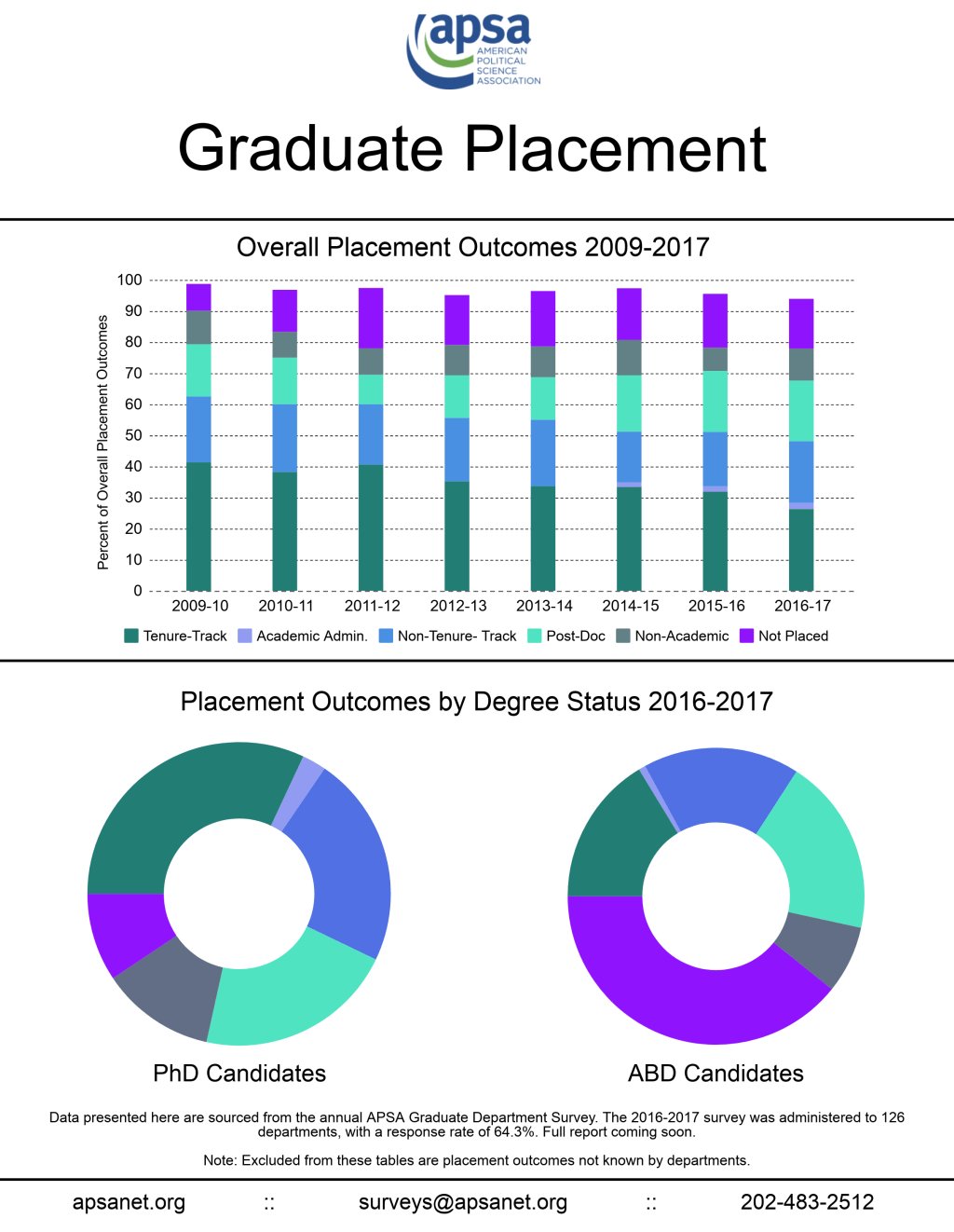
Oh my.  The job market was not good before 2008 (has it been "good" at any point since the recession of 1992-93?), but the most recent trends suggest things are getting worse.  A much smaller hunk of folks are getting placed in tenure track positions--from 40 percent (which ain't great) down to 25ish percent.

This all raises some big questions:
  1. Have many (any?) departments reduced how many graduate students they admit?
  2. Have many (any?) departments engaged in serious efforts to train their graduate students for non-academic jobs?
  3. Have many (any?) departments engaged in serious efforts to place their graduate students for non-academic jobs?
  4. Have universities stopped creating new PhD programs in political science and adjacent programs?
I have no idea, but I have little confidence that things have changed much, given what I have seen.

NPSIA aims to produce policy-oriented folks for non-academic jobs BUT the history of the program seems to be that graduate students come here expecting to get placed in academic jobs.  Not great.  One reason I left my previous job is that I didn't want to be producing heaps of new Phds as the market for them crashes.  Sure, damn near all of them got tenure track positions, but I saw the writing on the wall.  I do have Phd students now--but fewer of them and I am very clear about their job prospects.   Oh, and leaving McG means writing far fewer recommendation letters for students who want to ignore my advice about pursuing Phds.

Sure, folks can still succeed, but the odds have changed and our guild is not really adapting very well.  

Friday, September 9, 2016

Job Talk Advice

Seems to be the time of year when folks post their advice for aspiring professors on how to succeed at the job talk.  For non-academics, the job talk is the heart of the interview for folks seeking jobs (especially tenure-track or tenured positions) in academia.  While there are other parts of the process--being interviewed one on one by various members of the department or getting grilled by a committee (something that happens far more in Canada than in the US), the most important (and probably not deservedly so)* part of the "fly-out" is giving a talk based on one's research and responding in the Q&A.

I tend not to be very humble here and offer all kinds of unsolicited advice, but I hesitate on this particular question because my record, um, ain't great.  I have been given three job offers (TTU, McGill, Carleton) in my career.  That's it.  And I have interviewed and been rejected many, many times--more than sixteen ... .  I might have blogged my advice about job talks before, but I can't seem to find the post.  So, here is just a few tips to go along with the stuff circulating this week (see the link's in Tom's post).

Some basic technical stuff:
  • Don't use a software platform for your presentation that is finicky or otherwise not widely available.  In other words, no Prezi.
  • Do have a PDF of your slides in case your software does not work so that you can at least page through on the projector through your outline/figures/tables.  Keep your files on your laptop and on a usb key and on dropbox---plan for technical failure.  Have a printout.
  • Don't make the slides overly busy with noises, things sliding dynamically, etc.  The focus should be on you and your message and not anything fancy. Also, large fonts, please.  Keep the tables of stats clear and big and use color.  Really!
  • Not too many slides--if you cannot present all the slides in an unhurried manner in 30-40 minutes, you have too many slides.  Keep to the time limit or even a bit short of it.
  • Ignore Axelrod's advice about asking people not to ask questions.  They will if they want to.
  • Damn near every place expects the talk to be about your current/recent research.  Pick one project and talk about it, maybe putting it into the context of your larger research program.  Don't talk about your entire research portfolio.  You need to demonstrate that you can speak about a question and how you handled it.
The Big Stuff:
  • It is kind of like a first date but with much bigger stakes--so be the best version of yourself.  Be confident but not arrogant.  But don't be someone else.  Don't lie about who you are, what you do, what you plan to do, but shape your presentation to fit the school/program/department (try to get students directly engaged if it is a liberal arts college--another lesson learned the hard way).
  • Nobody in the room knows as much about your stuff as you do.  But many will think that the they do.  Stick to what you know and don't offer up examples that you don't know about (that killed me in my second talk).  Oh, and Saideman's rule of dissertations applies here as well: just because you learned something does not mean it belongs in a job talk.
  • Make it interesting to someone who does not work in your subfield or even field.  I had someone ask me during one of my talks: so, you explain why war happens under certain conditions, so what?  Um, because war is kind of important, right?  Good thing I really screwed up other parts of that talk so that this did not matter so much.
  • Practice, practice and practice including among friends who can pretend to be hostile audiences.
  • The Q&A is key: anticipate the likely questions, perhaps even have slides that might address likely questions, answer what you can by staying within your theoretical approach as much as you can.  If they ask you to talk about a current event, show how your approach makes sense of it.  Acknowledge the limitations of your approach.  It is ok to say "I don't know" once or twice.  Don't be defensive but don't agree to every criticism of your approach either. It is a balancing act.
Aftermath:
  • Getting the job or not is often very idiosyncratic.  Don't take rejection too personally--if they are interviewing three people, the odds are against you.  
  • Try to figure out what you could have done better.  If you have friends or contacts in the places you have interviewed, ask after it is all over what you could improve.  

This is all basic stuff, but it is amazing how many people screw up the basics ... including this guy.


*  I wrote a while back that academics are not so great judges, that the process seems as random as drafting good NFL or NBA players.

Tuesday, November 11, 2014

Early Observations from 2014-15 Job Search

NPSIA has two positions this fall, both in the area of intelligence, terrorism and national security.  Our first deadline passed in mid October, and our second passed yesterday.  I have only seen the first batch of files for a pretty specialized spot, but already have some observations that might be useful for those might be applying for later jobs elsewhere and in the future:
  1. Read the job description.  And then revise one's standard pitches (cover letter, research statement, teaching statement) so that you appear to fit the job description.  
  2. Read my CV rules.  So many violations including:
    1. Started listing publications on page four or five instead of page one or two
    2. Listing non-publications as publications.  These would include papers under review, papers in progress, and other things that have not yet be accepted by a journal or press.
    3. Lots of extra text about previous jobs (this is a CV, not a resume).
  3. Something out of control of applicants: letter writers who put their entire letter of recommendation in bold.
  4. The line between arrogant and confident can be a fine one--try to be on the non-arrogant side of the line (and, yes, I am self-aware enough to know that some people think that I am arrogant AND offering unsolicited advice on a regular basis can also be viewed as arrogant).
  5. These processes are slow.  Our committee has not met, and is having a hard time figuring out a time for all of us to get together.  Don't think that hearing nothing means that one has been selected out.  My experience is that Canadian schools move with less urgency, but also that all search committees have many people with "day jobs" which make it hard to get everyone together.

The good news is that there are plenty of interesting people doing impressive work.  Well, good news for those doing the hiring.  The second job we have is less specialized so I expect many more applications and perhaps more lessons to learn and pass on.

Saturday, October 4, 2014

Second Job at NPSIA: Intl, Terrorism, National Security

We finally got approval for a second position at NPSIA (here is the first ad):


Norman Paterson School of International Affairs (Intelligence and National and International Security) - Assistant Professor (Applications Closing Date: November 10, 2014 or until position is filled)

The Norman Paterson School of International Affairs (NPSIA) invites applications from qualified candidates for a Tenure Track appointment in Intelligence and national and international security at the rank of Assistant Professor beginning July 1, 2015.

The successful candidate will be expected to research, teach and supervise undergraduate and graduate students in fields broadly related to intelligence, terrorism and counter-terrorism, and national and international security. The position is linked to the development of a new undergraduate specialization in intelligence and national security, and will also support our current graduate programming in this and related fields. We are particularly interested in applicants with expertise in intelligence and security operations and who are focused on applied and practical policy issues.

NPSIA is a recognized centre of academic excellence in international affairs and public policy.  It is the largest and oldest school of its kind in Canada with an international reputation and full membership in the Association of Professional Schools of International Affairs (http://www.apsia.org/). We offer M.A., M.A.-J.D. and Ph.D. degrees in international affairs (http://www.carleton.ca/npsia), and contribute to the Master’s in Infrastructure Protection and International Security (MIPIS) degree that is jointly offered with the Department of Civil and Environmental Engineering at Carleton University. NPSIA also contributes to specialized undergraduate programs in the area of international affairs and development.  The School’s multidisciplinary faculty is engaged in a broad and growing array of research projects, innovative teaching initiatives, and linkages with the policy community. 

Applicants should have, or expect to have, a completed Ph.D. at the time of appointment (July 2015) in Political Science, Economics, International Affairs, Law, Public Policy, Public Administration or other relevant discipline. The ideal candidate will have a strong record in teaching and research (including relevant publications) and demonstrated potential for excellence as a teacher and researcher in the identified fields. Candidates should be committed to working in a policy-oriented multidisciplinary environment; related policy experience in the public or private sector will be an asset.

We will begin to review applications starting November 10, 2014.  Candidates should submit applications electronically to Karen Howard (Karen.Howard@carleton.ca) in three PDF files including: 1) a curriculum vitae; 2) a statement of teaching interests, a teaching portfolio and any evaluations or other evidence of teaching performance, and a statement regarding their approach to teaching; 3) a plan for ongoing and future research, a short description of papers or monographs published or in progress, a summary of the doctoral thesis, and links to any publications or some sample publications. Candidates should also arrange to have three confidential letters of reference sent to the School.  All candidates invited for an interview will be asked to deliver a research seminar to faculty and students.

Please indicate in your application if you are a Canadian citizen or permanent resident of Canada.

Located in Ottawa, Ontario, Carleton University is a dynamic and innovative research and teaching institution committed to developing solutions to real world problems by pushing the boundaries of knowledge and understanding daily. Its internationally recognized faculty, staff, researchers, and librarians provide more than 27,000 full- and part-time students from every province and more than 100 countries around the world with academic opportunities in more than 65 programs of study. Carleton’s creative, interdisciplinary, and international approach to research has led to many significant discoveries and creative work in science and technology, business, governance, public policy, and the arts.

Minutes from downtown, Carleton University is located on a beautiful campus, bordered by the Rideau River and the Rideau Canal. With over 12 national museums and the spectacular Gatineau Park close by, there are many excellent recreational opportunities for individuals and families to enjoy. The City of Ottawa, with a population of almost one million, is Canada’s capital city and reflects the country’s bilingual and multicultural character. Carleton’s location in the nation’s capital provides many opportunities for research with groups and institutions that reflect the diversity of the country.

Carleton University is strongly committed to fostering diversity within its community as a source of excellence, cultural enrichment, and social strength. We welcome those who would contribute to the further diversification of our University including, but not limited to, women, visible minorities, Aboriginal peoples, persons with disabilities, and persons of any sexual orientation or gender identity. Those applicants that are selected for an interview will be requested to contact the Chair of the Search Committee as soon as possible to discuss any accommodation requirements. Arrangements will be made to accommodate requests in a timely manner.

All qualified candidates are encouraged to apply. Canadians and permanent residents will be given priority. All positions are subject to budgetary approval.

Friday, August 22, 2014

Jobs at NPSIA

We are hiring this fall.  We will have two jobs both in the area of intel, terrorism and national security.  I am posting the first job ad below.  It is more specific than the second job, which I will advertise when I get the final ad copy.


Norman Paterson School of International Affairs (Infrastructure Protection, Intelligence, and International Security) - Assistant Professor (Closing Date for applications: October 10, 2014 or until the position is filled)

The Norman Paterson School of International Affairs (NPSIA) invites applications from qualified candidates for a tenure track appointment in infrastructure protection, intelligence, and international security at the rank of Assistant Professor beginning July 1, 2015.

The successful candidate will be expected to research, teach and supervise students (primarily at the graduate level) in fields broadly related to critical infrastructure protection (CIP), intelligence and national or international security. The position includes teaching duties in the Infrastructure Protection and International Security program, where we are interested in offering courses in areas such as risk assessment, counterterrorism and cybersecurity.

NPSIA is a recognized centre of academic excellence in international affairs and public policy.  It is the largest and oldest school of its kind in Canada with an international reputation and full membership in the Association of Professional Schools of International Affairs (http://www.apsia.org/). We offer M.A., M.A.-J.D. and Ph.D. degrees in international affairs (http://www.carleton.ca/npsia), and contribute to some specialized undergraduate programs.  The School’s multidisciplinary faculty is engaged in a broad and growing array of research projects, innovative teaching initiatives and linkages with the policy community. This position is associated with the Master’s in Infrastructure Protection and International Security (MIPIS) degree that is jointly offered with the Department of Civil and Environmental Engineering at Carleton University (http://graduate.carleton.ca/programs/infrastructure-protection-and-international-security-masters/).

At the time of appointment applicants should have a completed Ph.D. in Political Science, Economics, International Affairs, Law, Public Policy, Public Administration or another relevant discipline. The ideal candidate will have a strong record in teaching and research (including relevant publications) and demonstrated potential for excellence as a teacher and researcher in the identified fields. Candidates should be committed to working in a policy-oriented multidisciplinary environment; related policy experience in the public or private sector will be an asset.

The deadline for applications is October 10, 2014.  Candidates should submit applications electronically to Karen Howard (Karen.Howard@carleton.ca) in three PDF files including: 1) a curriculum vitae; 2) a statement of teaching interests, a teaching portfolio and any evaluations or other evidence of teaching performance, and a statement regarding their approach to teaching; and 3) a plan for ongoing and future research, a short description of papers or monographs published or in progress, a summary of the doctoral thesis, and links to any publications or some sample publications.  Candidates should also arrange to have three confidential letters of reference sent to the School.  All candidates attaining an interview will be asked to deliver a research seminar to faculty and students.

Please indicate in your application if you are a Canadian citizen or permanent resident of Canada.  [Steve says: if you are not, you are still eligible for the position and go ahead and apply]

Located in Ottawa, Ontario, Carleton University is a dynamic and innovative research and teaching institution committed to developing solutions to real world problems by pushing the boundaries of knowledge and understanding daily. Its internationally recognized faculty, staff, researchers, and librarians provide more than 27,000 full- and part-time students from every province and more than 100 countries around the world with academic opportunities in more than 65 programs of study. Carleton’s creative, interdisciplinary, and international approach to research has led to many significant discoveries and creative work in science and technology, business, governance, public policy, and the arts.

Minutes from downtown, Carleton University is located on a beautiful campus, bordered by the Rideau River and the Rideau Canal. With over 12 national museums and the spectacular Gatineau Park close by, there are many excellent recreational opportunities for individuals and families to enjoy. The City of Ottawa, with a population of almost one million, is Canada’s capital city and reflects the country’s bilingual and multicultural character. Carleton’s location in the nation’s capital provides many opportunities for research with groups and institutions that reflect the diversity of the country.

Carleton University is strongly committed to fostering diversity within its community as a source of excellence, cultural enrichment, and social strength. We welcome those who would contribute to the further diversification of our University including, but not limited to, women, visible minorities, Aboriginal peoples, persons with disabilities, and persons of any sexual orientation or gender identity. Those applicants that are selected for an interview will be requested to contact the Chair of the Search Committee as soon as possible to discuss any accommodation requirements. Arrangements will be made to accommodate requests in a timely manner.

All qualified candidates are encouraged to apply. Canadians and permanent residents will be given priority. All positions are subject to budgetary approval.
[Steve again]: NPSIA is a great place to work.  I have been very happy in my two plus years there as it is a very supportive, engaged placed with sharp students and good connections to where foreign/defence policy happens in Canada.

Shoot me an email if you have questions about the position.