Showing posts with label statistics. Show all posts

Friday, December 19, 2014

Art Imitating Life, Stats Edition

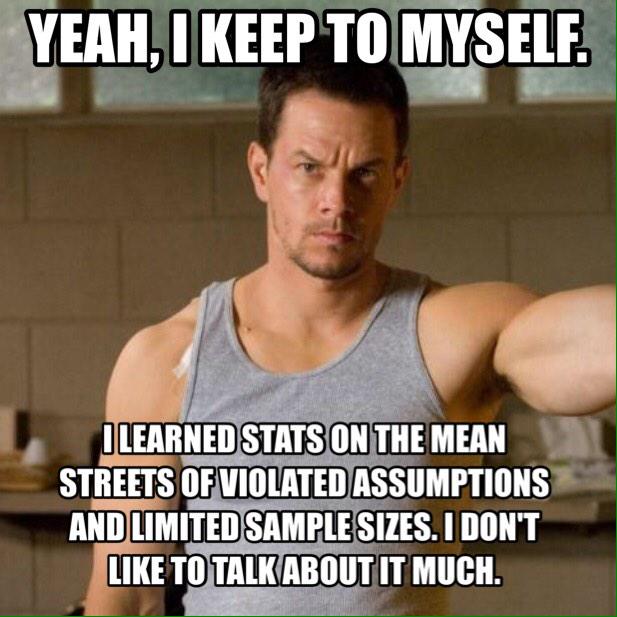
I have long joked that I learned stats on the streets, as I did not leave grad school with a heap of experience or understanding of how to actually do quantitative analyses. 

Turns out that I am not alone:
Unlike @ResearchMark, I don't mind talking about it.

Blogging to be light while I reside with my computer-less, wifi-less mother-in-law over the holidays.   May the holidays and the New Year be happy and chock full of fun stats for you and yours!


Thursday, December 5, 2013

Share Your Damn Data: Converging Logics

One of the recurring subjects among folks using data is: why does person x not share their data with me?  Mostly because they are fearful and ignorant.  Fearful?  That their work will get scooped and/or their data might be found to be problematic.  Ignorant?  That they don’t know that they are obligated to share their data once they publish off of it and that it is in their interest to share their data.  There is apparently a belief out there that data should be shared only after the big project is published, not after the initial work has been published.  I will address this as well as the the converging logics of appropriateness and consequences here.


Let me address first this new belief.  The idea that one can hold onto one’s data after publishing an article because one has not yet published the book is not the norm.  The norm, the obligation imposed by the National Science Foundation and expected from the discipline, is that when the first piece is published, then the data for that piece is supposed to be accessible.  That way, people can replicate that study.  If the larger study is years later (and it almost always is), that means that we would have to wait years to replicate initial article  Not only that but there are no guarantees that the scholar will finish the book project AND find a publisher.

Ok, let’s move from the specific myth to the broader logics of replication.  It has become clear over the decades that providing access to data is the right thing to do from the standpoint of a logic of appropriateness.  The discussions make it clear that scholars need to be transparent about their research and make it easy for others to replicate one’s findings.  This is the basic expectation for doing any research but especially quantitative research.  Providing interview notes can be problematic due to confidentiality issues (although the NSF is funding a project to figure this out), but providing data that one has created/collected is the standard expectation of social science.  Many journals now have replication policies and store data at their websites.  The question these days is not the obligation to share data but to share the “do” files, macros, or programs that are used to analyze the data.

Sharing data is clearly right from an appropriateness standpoint, but it is also right from a rational self-interest perspective as well.  People worry that citations are over-rated, and they may be so.  But if you want to get cited, one of the best ways to do that is to share your very useful dataset.  According to the ISP symposium linked above (p. 21): “An author who makes data available is on average cited twice as frequently as an article with no data.” If you check out the various lists of who gets cited the most, those who create datasets and share them get cited more.  Will Moore shared with some folks a story at a recent conference, saying how he got pretty famous in the discipline long before he published much because his name was attached to the Polity dataset.  He had no idea that this was going to happen.  One of the requirements of new grant applications is to show how one plans to disseminate one’s research.  Sharing data is one basic and very important strategy.

We are in the business of creating public goods–knowledge.  Not just the findings but the data we develop along the way.  It does mean that some folks may free ride, but it also means that the collective enterprise moves forward.  Holding onto data is not only selfish but short-sighted.  Having others work on the same dataset is likely to lead to feedback, which mean your work gets better, and to broader imaginations of what is possible.  When Ted Gurr developed the Minorities at Risk project, he really had no idea how others would use it.  Those that followed him used it in a variety of ways, adding bits and pieces of data (I took some of the IR data they had collected but not coded and used that to test some stuff that Gurr never intended to ponder), asking different questions and developing some very interesting findings.

Yes, folks along the way also discovered problems with the dataset, but Gurr and the larger MAR team (which I subsequently joined) worked on ways to improve the data (and, hey, we got NSF money do that–the next batch of papers will address the improvements and then the revised data will become available with better instructions).  This is how social science works.  Keeping the data to oneself, if even only for a few more years, is completely contrary to our enterprise.
Friday, November 1, 2013

Belated But Good

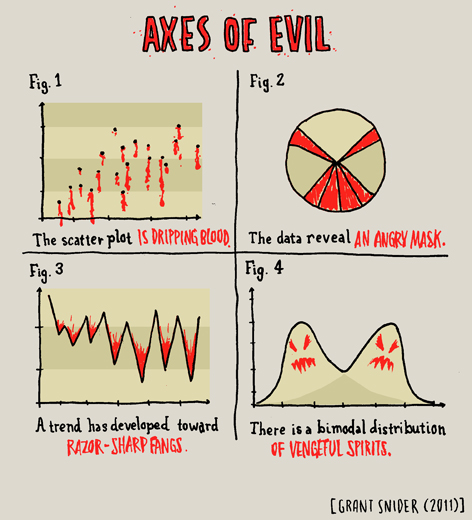
Boo!  I found this site a day late, but thanks to our new pal, I now have another go-to silly site.  First came I love Charts and now love stats!

Sunday, February 12, 2012

Graphic Weekend, Part II

We are going be seeing a heap of stats, tables and figures over the next several months as STATSCAN rolls out the results from the latest census.  The first set of big news was two-fold and related--that the western part of the country was growing faster than the rest and that immigrants were settling more in the western parts of Canada.


This figure illustrates who is coming from where and going where.  I wish they had used another color than black to indicate the provinces--makes immigration appear to be a black hole when the stats are very clear that Canada's future rides on immigration.  That is, Canadians are not birthing babies at a rate that would sustain the welfare state--not as severe as in Europe but still problematic.  The inflow of immigrants largely resolves this as the inflow of new folks to work pay the taxes necessary to cover the retirements of the older generations.

Anyhow, this will be an interesting set of stats to study for the next ten years or so.

Sunday, August 7, 2011

Political Science Geek Out Moment of the Week

The New York Times Book Review does a pretty good job of explaining a key concept that I had largely learned by osmosis: Bayesian updating.  How ought we update our beliefs?  I have not read the book that is being reviewed here,"THE THEORY THAT WOULD NOT DIE: How Bayes’ Rule Cracked the Enigma Code, Hunted Down Russian Submarines and Emerged Triumphant From Two Centuries of Controversy" by Sharon Bertsch McGrayne, but I should, given how often Bayes comes up in political science.  

The funny thing is that we live in a time where there seems to be no updating--no matter how much evidence is revealed, folks do not seem to be updating and revising their prior beliefs.  Will this book change my mind about this belief?  Um, maybe.

Friday, March 26, 2010

Foreign Aid--Getting the Facts

Me love some good data, and if you study development aid, there is now one place to go: http://www.aiddata.org/home/index.   AidData is pretty much what the site is--heaps and heaps of data, that can be separated out by recipient, donor, activity, and year (and more, I think).  It is basically daring me to start asking questions about development and aid.  I now have to sic a student or seven on it.

If you are interested in development, foreign aid, foreign policy, or particular countries' economic inputs/outputs, this is good place to go.

Monday, March 8, 2010

Girls Discovered

Great website with comprehensive data illustrated via maps about adolescent girls around the world.  This is interesting for a variety reasons:
  • I live with one.
  • I think the status of women is the biggest clue about the trajectory of a country--democratic stability in particular--both as cause and effect.  
  • Nice to see how data can be displayed well.
  • Just for curiosity's sake.
Check it out.

Tuesday, May 26, 2009

Perhaps Stopping Baseball Might Have Been Better

Check out this review of this book that tries to enumerate all of the deaths have occurred on the baseball diamond. So, perhaps, the new Supreme Court nominee, Sonia Sotomayor, did not do a great deed by ending the baseball strike.

However, given what we know about stats and such and our tendency to worry too much about rare events, we should perhaps take this book's ability to find nearly all of the deaths (perhaps they missed 50 or so) and realize that given the time spent on the baseball field, it is a far safer place than a car or a home. I also wonder how football would compare as it tends to get away with things like steroids and career-ending injuries in ways that baseball cannot.