Showing posts with label pop social science. Show all posts

Sunday, January 7, 2024

If the United Federation of Planets Were an International Organization

Yesterday, a bluesky discussion focused on whether the Federation of Planets was essentially the UN with US domination or something else. 
While I have written far more here about Star Wars, I have actually used Star Trek more in my teaching, and I have watched far more Trek (there is simply many more hours of Trek content).  Plus having written about NATO (the ebook is less than $18!), I have a few views on the matter.

To start, what is the United Federation of Planets and what is Starfleet?  The Federation is an alliance of planets, more so than it is a true federation a la the US.  Not even a confederation like Canada.  How so?  The planets still have their own foreign policies--we see plenty of meetings of diplomats from members to various proceedings.  Note, diplomats, not just leaders or representatives.  Just as I always like to make fun of Texas secessionists for having their embassy in Texas when it should be in Washington, DC or London or some place beyond the territory of the "country" it is representing, federal units (with the funky exception of Quebec) don't have embassies and ambassadors.  This is a short cut, a bit of evidence, for the basic idea that the units in the federation are more independent, more akin to nation-states than they are to units in a federal country.  So, yeah, the name is deceptive.  

Starfleet adds to the confusion because it is the military (despite denials) of the Federation.  This would make the Federation appear more like a country if it had a monopoly--if Starfleet was the only armed force within the federation.  However, I seem to remember various planets within the fed having their own armed starships including Vulcan.  

So, despite the name, the Federation is not akin to a single country.  It is easier to dispense with the idea that the Federation is the European Union.  How much of the series and movies are about economic regulations and subsidizing agriculture?  Ok, more directly, the European Union, despite many attempts, does not really have a military, and it does not have a common foreign policy.  The EU forces that have shown up in Bosnia and elsewhere only do so (this will be brutal, sorry) after NATO has done all of the heavy lifting. It was NATO that ended the Bosnia conflict, it was NATO that compelled Serbia to let peacekeepers into Kosovo, it is NATO deterring the Russians from attacking the Baltics, and so on.  In trade negotiations, the EU acts as a single actor and with great power.  In other stuff?  Not so much. 

Which leaves the United Nations and the North Atlantic Treaty Organization.  Clearly, from the name and from Gene Roddenberry's idealism, the United Federation of Planets is just a spacey UN, right?*  The stuff above that makes the Federation not a country but many countries or nation-states works toward the UN idea--a bunch of different sovereign entities constantly negotiating, sending diplomats hither and yon to settle all kinds of issues.  The big questions are what is the Federation for and what is Starfleet for?  The classic answer is collective security: to deter aggression by any member against any member by providing assurances that any target of aggression will receive assistance from the rest of the community.  Until Alexander Wendt has his way, the entire imagination of the role of the UN is focused on members.  The UN is a universal organization...on Earth--the only countries that are not in the UN are Taiwan and ... depending on how you count the Vatican and Palestine and various unrecognized separatist folks.  The key things about this notion of collective defense are that no member is excluded from its protection, and it is not aimed at any particular aggressor. 

The UN does not have a standing military, but has "sent" massive interventions when the membership have agreed, to thwart North Korea's aggression in 1950 (because the Soviet diplomats were stupidly boycotting the UN Security Council at the time) and Iraq's in 1990-91.  In both cases, it was really the US military and some allies under a UN banner in the former and nearly so in the latter.  One could argue that Starfleet is mostly a Terran/American endeavor and its activities are simply under a federation banner.  But again, the aim is at members.  In the original Trek, maybe some of it was aimed at fostering peace among members, but for most of Trek's history, Starfleet was aimed at protecting its members from non-members.

Which gets us to NATO, which is not really a collective security organization, but a collective defense organization.  It is not so much aimed at protecting Greece from Turkey, but all of the members from external threats--mostly the Soviet Union/Russia but also terrorism, maybe China, etc.  "An attack on one is an attack on all", Article V, the heart of the alliance, is aimed at outsiders. All of NATO's military endeavors have been on the border of or entirely outside the territory of its members.  Kind of like how much of Starfleet's activities are at the borders, patrolling nearby neutral zones, or going beyond to intervene, despite the Prime Directive, in non-members.  How many episodes are akin to the Kosovo effort?  A boodle. 

Of course, the parallel is not perfect, since Starfleet is a coherent military organization from the academy to the command staff and in between, which NATO is not.  Its captains may buck orders (Kirk more so than others, but all of them did so), but not because their home country/planet had different rules than the Federation for operating in place x or y.  That is, the Steve and Dave book on the Federation would focus far less on the political systems of members states and far more on the personalities of individual ship captains, compared to our work on NATO (our book and articles focused mostly on whether countries had coalition governments or not, what kinds of coalitions they had, and personality of presidents and prime ministers only kicked in if there were no coalitional bargaining).

Of course, there is no perfect parallel between the Federation and an existing Terran international organization, but given the focus of the Federation and the activities of Starfleet, NATO appears to be the closest, and I didn't even discuss enlargement.


*  I'd argue that Babylon 5 comes a lot closer to that, but that is a post for another day. 


Monday, April 13, 2020

Everything I Know About Social Science I Learned By Watching Reruns in the 1970s

I basically got challenged and trapped by Seva:

What did these old shows teach me that is relevant for contemporary social science and especially the stuff that I do.

Tuesday, August 20, 2019

Self-Esteem, Group Status, and Comparison: Understanding US Politics Today

I have blogged here before about the insights of social identity theory, and I am returning to it because it is screaming right now.  How so?  Let's first consider the basics.

Social identity theory (as I learned via the work of Donald Horowitz) asserts that people's sense of self, their self-esteem, rides in large part on how they feel about the group with which they identify.  The logic of invidious comparison (my favorite academic phrase of all time) deduces (or induces?) that individuals will feel better about themselves if their group is doing better than other groups, and they will feel worse if their group is slighted or does worse.  And this can then get quite emotional, as people get quite upset when their self-esteem is being harmed.... perceived to be harmed is the key. 

The epiphany for me was the page in Horowitz's book that identified adjectives used around the world to describe "others"--groups other than one's own that either doing better or worse (advanced or backwards):

I found this persuasive for understanding ethnic conflict, but it can also be useful for explaining soccer riots.  The old Jerry Seinfield routine about rooting for laundry--the uniforms of a team, regardless of who is wearing them--is on target because one identifies with "our" team. 

This simple and not so simple insight (heaps of social psych I have not read on this) is very useful for understanding much around us today.

For instance, the crazy debate of the past few days has been folks who are upset about the NYT 1619 series--which marks the 400 anniversary of the start of slavery in North America with a bunch of pieces that elaborate on how much of today's politics, economics, and even traffic jams are the product of the past, particularly of slavery in the US.  Some folks are very, very upset.  Putting aside the ridiculousness of Newt Gingrich supposedly being upset by this (with the best twitter response of this or any era), some people are upset because they see it as a critique of white Americans.  By being critical of the founders of the US, by showing that racism is hard-wired into so many facets of American politics, society, and economics, the 1619 series is seen by members of a particular group as diminishing the value of that group and thus the self-esteem of its members.  If much of the success of white Americans relative to other groups is due to unfair advantages, and that is what slavery and its legacy has produced, then the members of that group will feel their self-esteem diminish.  They must attack those efforts that might make their group look bad. 

Yes, I am a white guy writing about this, but not all (sorry) white Americans share the same sense of their identity.  My identity and my self-esteem, like many other folks, does not ride or die on the sense of the United States as a white country.  Indeed, my self-esteem takes a hit when the US as a multiethnic country is attacked or undermined. The key is this: while others have some say in one's own identity (Nazis don't think I am white), the groups with whom one identifies is actually somewhat within the control of individuals.  This is how people can leave white supremacist organizations--they start to identify less with white people and more with some other group.  One does not have to be a Mets fan all of one's life (damn it), but it can be hard to see the world differently and identify differently. 

Things get complex because people have multiple identities (this is where intersectionality comes in), and often one identity has more salience than others. One of the events of the past week that truly annoyed me from an outside perspective was to see the Log Cabin Republicans re-endorse Donald Trump. This group consists of gay Republicans, and it is abundantly clear that Trump has been awful to the LGBTQ community.  These individuals, well, most of them, find it more important to identify as Republican than as LBGTQ apparently.   

Similarly, in the election of 2016, we saw many non-Muslim Indian Americans line up in favor of Trump because they shared a common animus--Muslims.  It is not so much that the group had the same identity as Trump, but both they and Trump felt better as Muslims in the US were marginalized.  Some Indian Americans may be re-thinking that now as it turns out that white supremacists hate not just Muslims but Indians. 

The larger point here is that we are seeing various people lash out against criticisms of their group because they feel their own status, their own sense of self, is diminished. 

How to combat the dynamics of social identity?  Cross-cutting cleavages used to be a favorite--that it is ok to have different identities as long as people are not always divided into the same groups.  That is, it is better if class, race, and party are not always dividing a place into the same sub-groups.  Political polarization is so dangerous precisely because everyone now is either in group a or group b.  Having racially, religiously, linguistically diverse parties reduces the tensions because not every political decision implicates one's identity.  The Republicans as a largely white, predominantly evangelical party are more likely to have to suffer from the identity dynamics because the fortunes of the party are connected to these groups' sense of self.  The failure of Democrats to win an office (hmm, the Mets seem to come to mind again) may or may not have a big emotional impact as the identities of its members are not so lined up with the party.  It might suck to lose, but it does not feel as much of an insult to the identities of atheists or non-orthodox Jews or LGBTQ or other members of this plural coalition because it is not so much about any individual group.  For the Republicans lately, any defeat is a defeat for whites and for evangelicals.  Which is why this is so much more of a blood sport for one party than another.

It is usually seen that the multiethnic party is at a disadvantage compared to the monoethnic party in the game of outbidding--that the monoparty can peel off voters of the same identity from the multiethnic party.  These days, those voters are called white working class in the US.  But perhaps the multiethnic party is better off in this competition for not being so easily captured and tied to a random outbidder precisely because they simply don't have as much invested in the party's well-being.  That is, to say it as ruthlessly as I can, the GOP is now a bunch of cultists tied to Trump.  The Democrats are too diverse to be quite as chained to any leader and especially one as awful as Trump.

This might make it hard to win elections, but it makes me feel good.  See, I am subject to social identity dynamics.

Tuesday, September 25, 2018

Accusations Cascade Again: Two Key Dynamics Combine

When the personal and the political intersect: just as Brett Kavanaugh is facing several accusations now, a friend of mine reported to me about someone we know and how there is an accumulation of stories about that someone that broke the dam. We should not be surprised by these cascades:
  1. People are often consistent in their behavior.  A man who is apparently a belligerent drunk and has retrograde views about women and says "what happens at Georgetown Prep stays at Georgetown Prep" is unlikely to have been awful to just one woman.  In my voyages through academia, the guys who have been caught/accused of being sexual harassers did it not just once but repeatedly.  The combination of hard-wired personality flaw (putting it mildly) and impunity tends to mean, in my limited observation, tends to lead to the person doing the same stuff over and over and over again.  This could be applied to Al Franken with his form of sexual harassment--serious but not the level of sexual assault that Kavanaugh is being credibly accused of--and Bill Cosby, whose modus operandi was quite consistent.  While it is possible to engage in awful behavior just once, it is unlikely.
  2. I wrote last year about permission structures: that situations exist that make it harder or easier to come forward.  That once there is one or two accusations, people realize that they are not alone, that it is ok to come forward.  What this post missed is that people may start to come forward not just because they feel that they are more likely to believed and that something might actually be done, but because they find common cause with the initial accuser and want to buttress their legitimacy with their own story.  
Combine these two dynamics together, and you get cascades.  One accusation leads to another and then another because both the person in question has done awful things repeatedly and those who have been harmed in the past feel more empowered and more obligated to say something.

No, it is not a smear campaign, but the opening of a Pandora's box of one's awful past behavior.  Kind of hard to get closed.  There are, of course, three ways to avoid this: don't do awful shit; realize and show real remorse; or avoid the national spotlight rather than feeling entitled to the highest positions in the land.  Alas, those who have done awful things and have gotten away with it for years are unlikely to show real remorse or shy away from the highest offices.

[There is real social science on cascades, starting with Timur Kuran, but I am not really building on it here]

Tuesday, April 24, 2018

Most Puzzling Insult

There are plenty of ways to insult people, so why do folks sometimes refer to the preferred oxygen pathway?

Why would a mouthbreather be someone who is not as bright, who is an ape or caveman or whatever?  I just don't get the association.  And, of course, I take it personally since a lifetime of allergies (modest--I can breathe, just not well--to anything that grows: grass, trees, weeds, plants, etc) means I breathe through my mouth.  The only person who should object, and object she does from time to time, is my wife since I don't sleep quietly. 

The key is that the oxygen gets there, one way, or another, so me and my fellow mouthbreathers do not want associations with those who deserve heaps of insults.  Indeed, I discussed with Mrs. Spew the proper way to insult MRAssholes as calling them pussies, for example, is reinforcing their notion that women are lesser (Slack friends also pushed in that direction).  So, calling the guy who killed ten Torontians yesterday a quitter works since he and his ilk (if the info on him is correct) are chock full of failure and toxic masculinity and thus sensitive to being called LOSERS and QUITTERS in ways that don't insult others.

Calling them mouthbreathers?  They probably don't mind, and it confuses me.  So, pick the right insults for these guys who have the attitudes of seven year old boys who don't understand girls.  Most boys grow out of it--these guys don't. 


Wednesday, December 21, 2016

Pondering Hope

Thanks to Rogue One and Keeping It 1600, I have been thinking about hope
Sure, but false hope is at best a distraction.  For example, hoping that the electoral college would not produce the expected result was a false hope.   The problem is, as Mike Lombardi and others have said, hope is not a plan.   Yet, we need hope to avoid despair, which produces nothing.  People will only invest in the effort to change the situation if there is some expectation that one can help to produce a positive outcome.  So, hope and resistance are inextricably tied, as the movie demonstrated nicely.

We should not expend effort on false hope and weak plans, such as expecting the GOP to impeach Trump.  But we can and should invest in candidates, campaigns and protests at all levels. There is much to be done, and it requires, as Jon Lovett harped on in the latest Keeping It 1600 podcast, much work. 

What to do?  Damned if I know.  It can be hard to tell what is a low probability but real chance versus an utterly fruitless effort.  Focusing on real issues that affect people is what the experts recommend, which means, alas, foreign policy is probably not the right area to place attention.  While SecState nominee Tillerson might be the easiest target, the lowest hanging fruit--an oilman with ties to Russia and with GOP senators already concerned, it will probably not make much noise in the US.  On the other hand, the Sec of Treasury choice, David Mnukin, might be a better target since Mnukin was involved in foreclosing lots of people. 

The focus will have to be on policies, and not the noise that Trump generates.  Corruption?  The press will cover that, but, again, no impeachment since the GOP is not going to stand up.  So, the Democrats must put their effort on stopping those that will hurt people and then publicizing the effects of the policies that the GOP passes. 

The hard part is that there is a second focus that the Democrats have to have, even if it does not sell to public--protecting the ability for the Democrats (and others) to win elections.  So much effort by the GOP to suppress the vote of likely Democrats and so much effort to subvert the results when the Democrats win--North Carolina!!  So, it will essentially be a two front fight--fighting the policies that affect the most people AND fighting to protect the institutions that permit the Democrats to win future elections. 

While there will be negative noise generated by Trump and his policies, we must resist responding to it all.  As someone pointed out on twitter today, Trump is a living denial of service attack, overcoming institutions and media via too much damned noise. 

The trick will be to get diverse audiences together, fighting Trump.  They don't all need to attack the same policies, but they need to coordinate so that they work in synergy.  In NC, the various anti-GOP groups agreed to support Protest Mondays, with different protests each week but always on Monday and each group supporting the protests of the others.  That Trump generates opposition from across the spectrum will make this hard--how to keep Never Trump conservatives, Libertarians, Democrats of all stripes, and the left together will be difficult. 

The good news is that the bad news is good news--that while it may be hard to coordinate and cooperate among so many groups, the forces arrayed against Trump and Trumpism are many and will only get larger as the costs of Trump's policies start to affect people.  This is real, and thus something upon which we can build, something that is the foundation of hope and resistance. 

One last thing that can provide a source of hope: the US has failed before and come back.  While there will be grave costs due to the mistakes of this fall, we can come back and we will.


Monday, November 7, 2016

Confirmation Bias For the Win, 2016 Edition

I have grown increasingly annoyed at Nate Silver.  No, not for the relatively high degree of uncertainty when compared to other poll aggregators.  No.  It has been his twitter game.  No, not his rant against those who criticize him.  His clickbait tweets and my responses:


Maybe I should be glad that he is pushing back against complacency, but I am just annoyed that most of his tweets have been aimed at getting attention with panic, rather than being clear that Trump needs to run the table of the swing states to win.  And that is very unlikely to happen.

People are annoyed that Silver seems biased against HRC.  That is not my complaint--that his predictions are more conservative, having been burned by Trump's win in the primaries.  I am simply frustrated with how the stuff is being communicated--that the chances of Trump winning is like the Cubs coming back.  No, not at all.  The two events may have the same % probability assigned but the processes are so very different that the analogy is less than helpful.  Winning three games in a row is hard, where each one can be decided by a bad pitch or fielding mistake.  What is the equivalent of that in this race where the candidates have been mostly apart by 5% with noise causing that number to go up or down a bit?  Being uncertain because one's model builds uncertainty into things is different than the actual history of baseball where teams have come back down three games to one.  I have not been able to articulate an alternative metaphor than the lotteries and sports and Russian roulette that people use to discuss uncertainty and probability in this campaign.  All I know is that the current set sucks.

And the responsibility for communicating this stuff is on Silver and those of his ilk.  I wish they would get it right.  But that might be my confirmation bias speaking.  Mine ... or Silver's.

Tuesday, October 25, 2016

Trump's Secret Plan

I have figured out Trump's secret plan--to deny political scientists the ability to understand why he lost (he is going to lose, might as well put it in the past tense already).  What is the problem?  He is doing EVERYTHING wrong, so it will be hard to discern what mattered the most--his failure is going to be over-determined.

Trump could lose because:
  • careless statements alienated key constituencies (veterans, women, disabled people, etc).
  • his campaign staff were third string at best and some (Bannon) seemed more focused on destroying the GOP.
  • he alienated the GOP establishment, attacking Kasich and thus losing the chance to turn out the vote in Ohio and other places.
  • he spent more money on hats than on ads.  Seriously, do campaign ads matter?  This would be a perfect time to draw the contrast since HRC has many more and much better ads, but the effect of this will be hard to discern due to the other stuff
  • he has no real Get out the Vote effort--I have been joking that Trump can't spell GOTV.
  • he is a misogynist and women happen to be more than 50% of the electorate.
  • Pence is just an awful sidekick.  Would be Palin-esque if not for Palin and Trump lowering expectations.
  • he didn't spend much money compared to HRC.
 I could go on and on, but you get the idea--Trump is a thoroughly craptastic candidate so political scientists will have a harder time explaining his loss than his rise.   Oh wait, there is Trump's Razor....

Monday, September 19, 2016

Latest in Poll Reading: When Up is Up

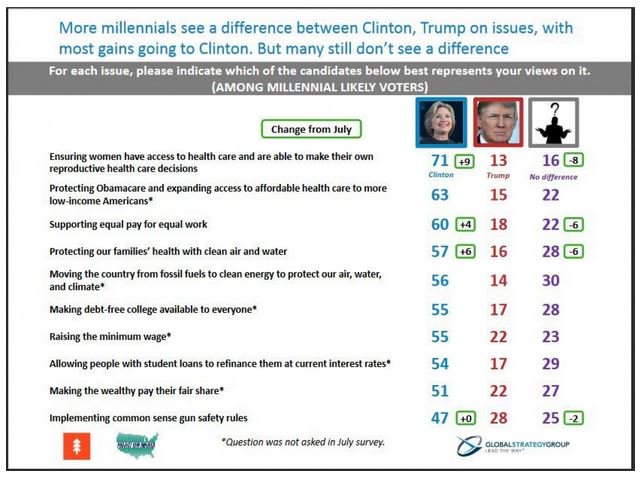
The way this poll is being pitched is strange to me:

In nearly all of the questions, Clinton has 30-40 point lead over Trump.  Isn't that good news?  Oh, wait, "many don't see a difference!"  Trump gets around 20% on each question, which as I have always asserted, is about what you can expect from any poll--that a decent chunk of people are, um, reality-averse.  Anyhow, asking all millennials these questions will certainly turn up people who are pro-Trump because there are both the "deplorables" and the party loyalists in the pool.  That 25-30% are uncertain also makes sense because Trump has often taken both sides of an issue, making it hard to discern what his real stance is.

So, letting confirmation bias be my guide, I would say that this poll is outstanding for Clinton.  It shows a commanding lead with millennials on these issues.  The hard part is not so much getting the undecideds to take a pro-HRC stance, but getting the pro-HRC folks out to vote since young folks are less likely to vote than Trump-friendly old voters.

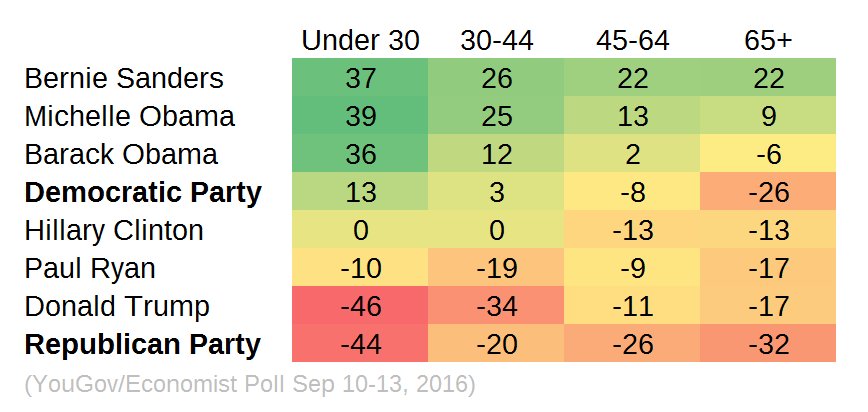
Oh, and another thing to keep in mind: how people vote when they are younger tends to shape how they vote when they age (from what I remember of previous coverage of this).  Which might just mean that the GOP is alienating the next generation of voters not just in 2016 but for the future.

So, consider this a good news survey if you are a Democrat.

For a really interesting survey, see this from a very helpful comment:

Tuesday, August 9, 2016

An Iron Law of Polls

I long ago wrote something about how in any community 15-25% of the folks are, um, problematic

Well, we have been seeing many polls that remind me of that, such as this:


Media preview
from http://www.publicpolicypolling.com/main/2016/08/clinton-leads-in-nc-for-first-time-since-march.html
The math for me is something like this: if Trump voters are now something like 40% and 48% believe, somehow, that Obama was able to influence the rules of engagement when he was a state Senator, it means that roughly 20% of the American people (probably less) believe this crap. 

Over the course of time, I have come to the conclusion that any poll will get roughly 15-20% answering: "Yes, I am ignorant/reality-averse."  Yes, it is bad that so many people believe stuff that is so clearly wrong, wrong, wrong.  On the other hand, these people always exist no matter what the issue.  Do we pander to them?  Trump does, but I say we should not.  Can we lure them into being reasonable, reasoning, informed people?  Um, not so sure.  Should we marginalize them as we should marginalize dysfunctional professors (see the link at the top)?  Not sure, as marginalizing people deepens alienation and that can lead to violence.  But I would not want these folks to be shaping outcomes either. 

I have no solution, but just want to note that we should not be surprised when 20% of the polled say stuff that is just very wrong.  Appalled? Maybe, but surprised?  No.


Sunday, August 7, 2016

When Ignorance Is Bliss: Friends?

The NYT has a piece reporting that only about 50% of the people one thinks of as friends see one as a friend.  Friendship is not reciprocated nearly as much as people thing.  This is perhaps one of the cruelest pieces of social science to float its way onto the internet and the NYT because it gets at a basic insecurity: do they really like me?  Not all of us get a Sally Fields moment.

Ok, maybe it just seems cruel to me as this has long been one of my most basic insecurities.  I spent my childhood/teenage years/way beyond wondering if people liked me or just put up with me.  I never felt like I was a member of a group in high school as my group seemed to be the group-less--not the brains, not the athletes, not the stoners, not drama folks, just the residuals.  Perhaps were were Hufflepuffs before they were a thing?  My imagination of college (thanks, Hollywood) and my reality were two separate things--as I did not have a solid group of the same friends from freshman year to graduation.  Yes, I played on the frisbee team for almost four years, but I never felt like I fit in there--I didn't eat at the co-ops nor hung out with them very much.  Grad school?  Jeez, everyone around me was so smart and worked so hard and also lived so close together (my girlfriend/wife and I kept moving to find cheaper places and eventually one that would accept dogs) and they were so cool, I just felt like an outlier.

The funny thing is that I really felt like one of the group, rather than an outside, perhaps first in my life (except for summer camp) at my first tenure track job.  Perhaps the junior/senior split created an us-ness that I felt apart of.  Or perhaps because most of us didn't fit into the town very well, but we did fit with each other.  Anyhow, I felt part of the group for the first time.  Surprisingly, my time on the Joint Staff made me feel included, rather than Rudolph.  Despite being one of a handful of civilians with no military experience, I felt like I fit in.  Mainly because the folks there accepted one if one dealt as much friendly abuse as one received.  Perhaps because the Joint Staff itself is a group of group-less folks--everyone is out of their comfort zone of their own service.  That the folks at the old job still hang out with me now that I have left is another bit of evidence that I should feel good about my 50%. 

Professionally, when I started out, my time at the conferences was mostly empty, and I would spend time walking around, hoping to find a few people that I might recognize.  These days? I spend most of my time in the bar, meeting with folks who I have met over the years.  Conferences are much more fun these days, and I don't see them as reminders of being an outsider anymore. 

Tis a good thing I read this article the morning after I had my big birthday bbq.  Being surrounded by friends last night makes me a bit less vulnerable to this piece although it reminds me of how I felt for so many years. 

As it happens, someone on twitter posted something that reminded me of this video, and watching it also compensates as my closest friends do resemble the core essence of the song.


Saturday, May 7, 2016

Who Guards the Guardians? Not the UN

Every time I think I am out, they pull me back in.  No, not leading the mafia.  Principal-agent theory.  Yep, and I blame Stan Lee.  How so?  I saw the new Captain America: Civil Wars movie... explanation below the break:

Thursday, April 14, 2016

The Political Science Math Problem of the Week

This was circulated on twitter:


Folks answered it with snark:

Of course, no political scientist would kidnap somebody who scoffed at political science as a scientific endeavor.  Otherwise, they would not get anything done.  Ours is not called the dismal science because people at least give Econ that much.  Nope, we have Tom Ricks and his ilk who dismiss what we do, and all we do is respond with words, not kidnapping. 

If political scientists were to kidnap those who scoff at us, well, then we would have to resolve the prisoner's dilemma--how to make sure the kidnapping team do not turn on each other.  Here's the good news--with an endless supply of those who hold us in contempt, it would be an iterated game that might never end.  So, the kidnapping political scientists could manage to cooperate, if Robert Axelrod was right.

So, if a few political scientists were to kidnap a poli sci skeptic, how would one answer the question above?  The first step would be to ascertain their subfield:
  • one could get theorists talking about the nature of justice for hours, distracting them while one gets loose.
  • if they are americanists, then one just has to figure out who is the principal and who is the agent in the relationship and then try to exacerbate the hidden information problem.
  • if they are comparativists, then the best tactic would be to ask about how contingent repression and dissent are.  They will be so confused that you can escape pretty easily.
  • if they are IR folks, then the best strategy is to get them arguing who is really a realist.  Could take them weeks to figure it out.
I am sure there are other ways to play the game, as political science is not nearly as linear as this math problem.

Sunday, April 10, 2016

Lessons in Politics

The Canadian left-wing party, the New Democratic Party, is moving further left with its Leap Manifesto.  So, this reminded me of one basic idea in politics and other stuff online reminded me of a few others.  So, what are the basic lessons or rules of politics:
  • Lesson #1:  Everything is political.  I get very frustrated when someone says that x or y is not political.  If it is something that can be or is allocated by public officials, then it is political.  Politics is about the allocation of stuff via someone making decisions (as opposed to the market making decisions, but then again, letting the market decide is a political decision). 
  • Lesson #2:  All politics is local.  Tip O'Neil was not wrong about this.  Politicians care about those who control their future, which means that those within constituency boundaries matter more than random folks elsewhere.  For autocrats, it means those who can coup or otherwise remove them.  For democratically elected people, it means those within the voting districts and especially those who show up.  In primaries, that means the less moderate, more passionate people (which makes the NDP decisions this weekend akin to Feel the Bern folks or, dare I say it, Trumpsters who show up when others do not).
    •  The temporal corollary of this is that nearly all politics is in the short term.  Hard to look at the distinct horizon when one's future is decided every 2/4/6 years.  So, local can also mean near term.
  • Lesson #3: What individuals want and what is rational for the collective are often two different things.  The fundamental lesson of the prisoner's dilemma and the fundamental problem posed by the collective action problem is that what is rational for individuals often leads to bad outcomes for the collective. And then once one builds in psychology/personality and other stuff, getting from individual desires to outcomes that are collectively good is a pretty hard trick.  

I have a deadline or two, so this quick rant is woefully incomplete. What am I forgetting?

Wednesday, January 6, 2016

Damn Millennials?

On the way into work today, I was listening to Five Thirty Eight's HotTakeDown podcast, where the folks there analyze, assess, and comment on the various hot takes in sports.  Recently, the owner of the Phoenix Suns asserted that one of the players was problematic because he was a millennial and thus could not handle setbacks.  The 538 folks decided, perhaps because they are all millennials, to rip this apart with glee, first suggesting that the owner perhaps needed work on dealing with setbacks.  Indeed.

Anyhow, they proceeded to define a millennial as someone born between 1981 and 1998, based on the various numbers listed at wikipedia and elsewhere.  This shocked me because I had never thought what really counted as a millennial or not.  It means that anyone from 17 to 34 is a millennial.  Yowza. 

I have always found generalizations about generations to be problematic since it means that anyone in a certain time frame shares similar qualities, and that is a generalization too far UNLESS there is some kind of common experience that shapes outlooks.  So, American boomers are boomers because they all grew up in the Vietnam era and then the age of free sex and all that in the 1970s.  And, of course, this was all over-generalized as people reacted to Vietnam, the civil rights movement, shorter hemlines and all the rest in different ways.

As a Gen X-er, I don't think our generation had much in the way of bonding experience that shaped attitudes in the same way.  Reagan?  Really?  AIDS?  Maybe. 

What do millennials share?  What common experience do they have that bonds them?  9/11 and the tense times after that.  Not sure the Iraq war had the same impact.  Of course, what people usually come back to is that this generation was the first that had the internet for most of their life and now have cell phones that they stare at and all that.

But that is weak sauce for generalizing about an entire generation.  Mostly, when folks say those damn millennials, they mean "damn that next generation" because the older folks have always said that about the younger folks.  Again and again.  As a professor, I have been interacting with millennials since 1999 (I guess), and I never found them to be much different  than the students before, except perhaps more stressed since tuition is higher, they have to work more, and the job markets they have faced seem less promising.  Setbacks?  Yeah, they have had a few.

To return to the 538 folks, they ascertained that 97% of the current value of the NBA is created by ... millennials.  It would be closer to 100% if it were not for Dirk Nowitzki's amazing longevity. 

The point, of course, is that it is silly to condemn everyone from 17-34.  Instead, let's just condemn those over 60 for their support of Trump, their voting for stuff that helps them and not the kids, and for all other sins that we lay at the feet of the boomers.


Sunday, December 6, 2015

Using Pop Culture to Teach IR

A couple of weeks ago, Stephanie Carvin and I taped a segment for CBC radio on the use of science fiction (and pop culture in general) to teach International Relations.  It is being broadcast today, but is already online.  It is an interesting 11 minutes or so.  Much got cut, such as my defense of simplifying (we are political scientists, not historians) and my use of Babylon 5 to contrast with the Star Trek episode I mentioned.

Anyhow, check it out.  Historians will be examining it some day as it will be seen as the origins of the legendary podcast: "IR Stuff with Steph and Steve."

Monday, August 17, 2015

The Social Science of Sucking Up

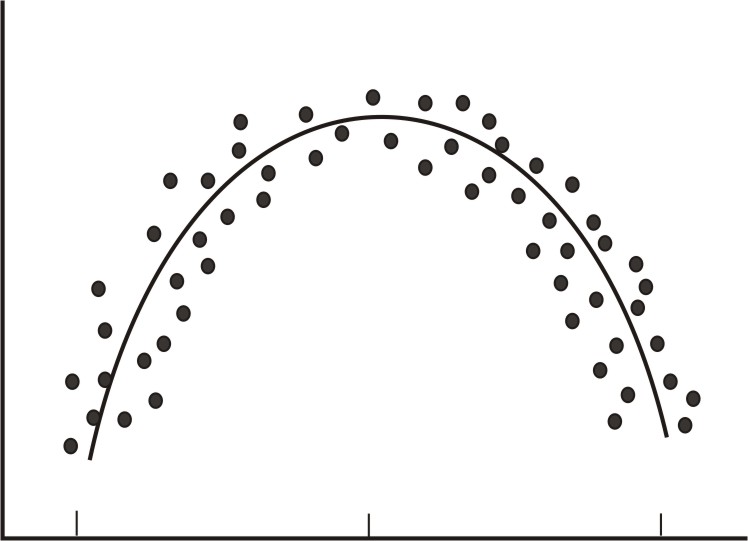
Hypothesis: There is a curvilinear relationship between sucking up and professor approval.
Literature Review: None. [This is the ultimate joy of blogging--no lit review requirements]
Theory: A little goes a long way, and a long way goes a little.  A little bit of sucking up lets the professor know you exist, learn your name and think you are attentive and studious.  A lot of sucking up makes the professor think that the student is being strategic rather than studious and that too much sucking up can be time-draining and annoyance-increasing.  
Data:  Two plus decades of teaching
Research Ethics Board Clearance: None.  Oops.
Findings:  See figure 1.1*

*  Figure is actually from here.

The vertical axis measures professor approval, the horizontal access is the sucking up effort.

That I am reminded of my old post and energized to write this new one in August is not good.  My fb post with hashtag of ‪#‎syllabuswillbereadybythefirstdayofclass‬ got heaps of support from my academic colleagues, so I think I am on to something here.

Policy recommendation:  Don't nag your professor even if it is to demonstrate studiousness.
Theory implications: More work is required to ascertain the variables that make sucking up more or less effective.  The study here does not take into account timing, frequency, or various sucking up strategies. 

Monday, December 1, 2014

Tenure Peace Theory? More Like TP Myth

The Georgetown Heckler has a tremendous post about the takeover by Realists who have conquered the Liberals in the Poli Sci dept.  It is a heap of fun, as it is very playful with both IR theory and the professors in the department (oh where is Dan Nexon?).  However, it has one problem:
"Most ascribe to the “tenured peace theory” which maintains that tenured professors, though on average not less violent than non-tenured professors, will nevertheless not fight with one another. With nothing to gain from each other and recognizing the legitimacy that tenure confers, there will be no cause for conflict between the parties, so the theory holds."
Please, Liberals are not naive, although that is the accusation made by many realists.  Liberalism in IR theory focuses largely on whether the pattern of interests leads to cooperation or conflict.  Democratic peace theory fits into this larger approach precisely because there are logics about accountability, norms and transparency that make conflict costly.  Two countries with such properties are less likely to fight.

We Liberals would not apply Democratic Peace Theory to tenured faculty precisely because there is not much in the way of accountability or transparency for the tenured.  Conflict is not that costly because no tenured jobs are at risk.  Plenty of departments have decades of virulent conflict among tenure faculty precisely because the combatants do not pay much of a price for their behavior--although bystanders (grad students, un-tenured faculty, job candidates) frequently pay a heavy price indeed.

A core Liberal logic is tit for tat--that mutual cooperation can emerge when reciprocity is deployed.  That a cooperative act leads to a cooperative response and on and on.  The idea is that the long relationship of cooperation will outweigh the short-term temptations of cheating and conflict.  The problem is that reciprocity has a dark side--that one should reward cooperation with cooperation and conflict with conflict.  So, one can easily spark a series of unending recriminations even if we stick within the Liberal world.  One does not need to be a Realist to understand or expect conflict.

So, I salute the Georgetown Hecklers for their great work, but find their "Tenured Peace Theory" to be a mockery of good Liberal IR theory.  And, yes, I have engaged in much empirical work, examining tenured conflict theory.  In each of my first three departments, there were tenured folks who had no problem sparking conflict with each other.  As any good Liberal would expect, there was plenty of both conflict and cooperation. 

Saturday, November 22, 2014

Rebel Economics

There was a question raised at PSR about the financing of rebels.  Well, not just any rebels but the Rebel Alliance.  This is a good question to ask, as the 1990s and 2000s raised heaps of questions about the role of financing in civil wars--how do insurgencies and other rebellions fund their operations.  The early answer was diamonds and other lootable resources:  other minerals, lumber, drugs (poppies in Afghanistan, for instance).  So, much study went into asking whether the prescence of such resources were associated with more conflict.  Not so much really, although duration of conflict, somewhat.

The stance of the economists making these arguments was that grievances are ubiquitous but that financing varies.  Since rebellions are not so frequent, maybe it has more to do with funding and not so much with grievances.   The problem is that funding requires not the existence of resources but just enterpreneurs.  How so?  Lootable resources requires little imagination, but rebels often have much at stake, and can imagine all kinds of ways to finance their efforts.  Such as?
  • Smuggling.  Even if you don't have stuff to smuggle, you may have location, location, location.  So, smuggling of drugs, girls and women, cigarettes, etc were a key source of income for various groups in the Balkans.  Proximity to Europe was sufficient.
  • Diasporas, ethnic kin, and the like minded.  Lots of money flows from people who left the homeland.  Similarly, those who share identity but are not from the homeland--those who speak the same language, share the same religion, are of the same/similar race--may contribute money, equipment and personnel to the cause. During the cold war, one sure way to get funding was to put a red star on your helmet if you were fighting an American ally or call the US if your adversaries could be called Communists.
  • Kidnapping.  This can be a big $ kind of business.  One of the frustrations the US has with its allies is a willingness to pay big bucks.  All the US does is trade prisoners... ooops. 
  • Protection.  Organized criminals are not the only ones who run protection rackets--insurgencies engage in the same kind of enterprise: donate and you will not be harmed.  Tilly made this clear a while back.  The Viet Cong taxed the people in the areas they controlled with their punishment for tax evasion being just a bit more "kinetic" than the penalties the IRS imposes.
So, you don't really need lootable resources--you just need relatives, location, a willingness to engage in crime or coercion.  The problem is that the Rebel Alliance was a high-minded effort by principled people to fight an evil empire.  I am sure their Jedi allies would object to kidnapping for profit, for instance.

Given that the Rebels required a constant supply of non-Imperial ships (they could not just steal from the Empire as the Empire did not use X-wings, Y-wings, A-wings and the like), they had to have money from somewhere.  Sure, they allied with smugglers (Han, Chewie and their pals), but did they rely on smuggling glitterstim and other forms of drugs to fund the alliance?  Not so clear.  They may have tried to work with the Hutts, but that was very tricky business.

It is clear that ethnic ties mattered.  That the Empire, always human-centric and xenophobic, abused certain species.  The Wookies, who had been enslaved, were most willing to lend their resources to the cause.  The big ships were mostly made by the Mon Calamari, who had joined the alliance at the beckoning of their kin, Admiral Ackbar.   They were conducive to such appeals because they too had been abused by the Empire.

The history of the Alliance contains no stories of kidnapping for profit (for romance? That is something else), but it is pretty clear they relied on protection rackets--taxing the systems that they freed from the Empire.  That might look like state-building to some, but it looks like organized crime-style protection rackets to those who are fighting the rebels.

Clearly, there is a need for more fieldwork to examine the archives of the Rebel Alliance to assess how they funded themselves.  Not every major figure in the alliance had the wealth of a planet and the property that comes with royalty to help finance the effort (and unless one counts mining concessions, exploded planets are not so helpful for funding a rebellion).  Some were just farmers from planets far off the beaten path (although that path seems to be well traveled nonetheless).

Monday, September 22, 2014

Zombie or Immortal

Today's Monkey Cage post about Clash of Civilizations raises an important question: what is the best analogy/metaphor for Sam Huntington's crap-tastic (and some would say racist*) take on International Relations: zombies or Highlander's Immortal?
*  That some would include me.
CoC is like zombies in that the theory has been killed many many times.  That it suffers from logic, from bad conceptual stretching/residual categories, from being rather unlike how the world actually works (identity matters, but not via civilizations), that there is more conflict within than between civilizations, etc.  See the MC piece for cites to all of the abundant literature that has made the theory seem like the walking dead.

But Zombies can be killed and killed easily.  Any movie or tv show (Walking Dead, Z Nation) has people killing zombies with guns, knives, baseball bats, chain saws, and so on.  Any individual zombie can be killed easily.

How about Highlander's Immortal?  They can only be killed via decapitation.  And immortals become more and more skilled in using swords, so they become harder and harder to kill.  In the end, there can be only one.  Which then means that decapitation becomes incredibly unlikely.  The problem here, of course, is that the Highlander that won, Duncan MacLeod, was a good guy, fighting evil-doers.  Clash of Civilizations?  Just enables evil-doers by making bad social science popular.  More problematic for the metaphor battle is that Immortals are rare and become rare still--they cannot re-produce.  The Darwinian battle amongst them does not help propagate the species at all.

So, neither zombie nor Immortal.... but zombie virus?  Ah, yes, there we have it.  You can kill heaps of zombies, but can you get rid of the zombie virus?  Thus far, only love seems to conquer the virus.  Otherwise, in most zombie pop culture, fear, anxiety, panic (the clash both is fear and is strengthened by it) all serve to help the zombie virus spread. While the carriers may die easily, the virus lives on and on.

We social scientists have been doing the best we can to fight the virus, but all we have done is slay some of those carrying the disease.  The disease is now worldwide, alas.  So, we keep fighting and fighting, and hope that some day a cure, perhaps a vaccination via intro to IR classes, can reverse the tide and eventually lead to the marginalization of the disease that is Clash of Civilizations.