Sunday, April 14, 2013

The Carly Simon Collorary of Academia

I am behind in reviewing articles for academic journals. This obligation, for which we get paid nada, is a fundamental part of the academic enterprise.  Journals are respected if they deploy a double-blind referee system:
  1. where submissions are sent out for review without any identifiers so that the referees do not know who the author is,
  2. and the author does not know who will be the referees.

Sure, in the modern day, with google, one can figure out who the author is pretty easily.  I resist the temptation, but can still figure out the author some of the time if the work is close to mine (so that I have read the author's other work or know what she/he is doing these days).

Carly simonThe more interesting part to me today (hence this post) is the second part--that the author does not know the reviewer is but can perhaps game the system, including cites that might lead journal editors to send the piece in particular directions which is where Carly Simon comes in.  Well, while reading the piece du jour, I am wondering: is this citation of my work in this piece really necessary or is it just to play to my ego in case I am a reviewer of it?  Yes, I am so vain I think this citation is about me.  The next question is this: will I be more likely to accept the piece because it cites me?  Because it cites me a bit gratuitously?

To be sure, reviewers will be off-put if their highly relevant work is omitted.  The academic ego can be a fragile thing.  Plus if an author does miss some central work in the field, that might be part of the legit justification for recommending a revise and resubmit or rejection.  But I do wonder if playing this game too nakedly, with gratuitous cites, might be akin to being too much of a suck up.

So, academic readers, how do you respond when you are refereeing a journal article and the author seems to be making a pitch directly to you?  Today, the issue is largely irrelevant as the piece is a revise and resubmit that has done everything the reviewers (including myself) have asked of the authors and more.  But I do wonder--am I being played?  Are you?  Should I try to play this game myself?

Saturday, April 13, 2013

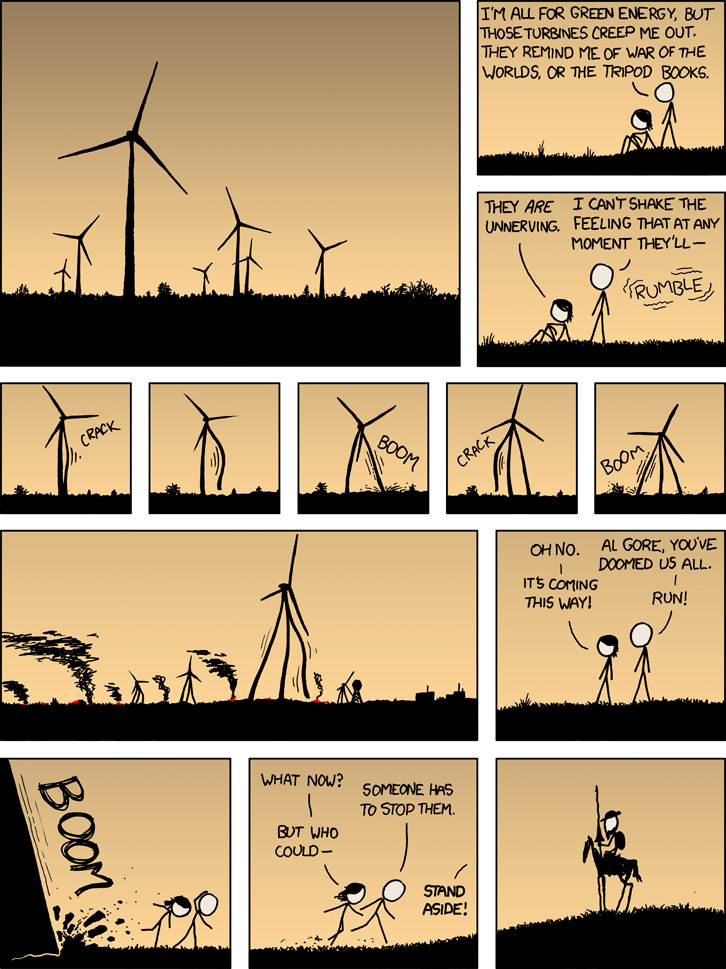
Sci Fi meets the Classics

Great xkcd:

Pseudo-Tax Epiphany

I just spent most of the day tussling with my American tax forms.  Yep, I am an ex-pat but the long reach of the IRS means that I still do the paperwork.  Good times.  As I went through the forms, I had a fleeting Republican thought: jeez, this is so much work that perhaps I should work less, make less money, and then this would be easier.

And then I remember that the folks who pay far less than they should can afford accountants and can figure out ways to dodge taxes, so they really are not deterred by "high taxes" from working and earning as much as they want. 

One weekend of suffering versus making some bucks to spend on my family and myself?  Oh yeah, easy choice.  I am just whining today.  Given that the real solution to the US budget situation is to return to a day of reasonable taxes (say, 1996?), I really cannot complain even if the forms cause my skull to ache.  Flat tax?  No thanks.  Easy but bad for the country.  If being in a free and progressive society means an annual headache, I will take it.  I just need find my aspirin.

Happy tax weekend to y'all from all of us at ye olde Spew.

Friday, April 12, 2013

Sit On It, Potsie!

Yes, an old Happy Days reference to start a post about department chairs.  I searched my blog to see if I have written much about department chairmen (all of mine have been male), and only found references to such folks, rather than a post dedicated to the topic.  As this year marks my 20th in the profession, I guess it is about time.  I am inspired to do so today by this post at Forbes on Cowardly Leadership

My pre-Carleton total number of chairs is six: one at UVM, three at TTU, and two at McG.*To be clear, not all of my previous chairs have been lousy (2/3's), and not all of the lousy ones have been cowards.  Or, thanks to Game of Thrones, craven.  While I am most critical, as you will see below, only the last one at McG really affected me directly.  The dysfunctions of the rest largely hit other people and the departments at large. 
* It sounds like sucking up, but I am big fan of the Director of NPSIA.  Does all the stuff right--consulting, listening, etc. 

Thursday, April 11, 2013

Wednesday, April 10, 2013

Almost Enough to Make Me a Giants Fan


Not quite but damn close.

Rand Paul and the Tweet of the Day

Perhaps I will start posting a tweet of the day to encourage folks to check out twitter.  Perhaps not.  Either way, this thus far is the tweet of the day:


Top Three SQUIRREL! Moments in Lecture Classes

Yesterday's tale about an NYU prof reading the riot act to an entitled student got me thinking about the moments in my big lecture classes where I was flummoxed by unexpected behavior.  Sometimes I responded well, other times not so much.  Here are my top three (and please submit your own in the comments section) in chronological order--you can tell me which one is the most reeking of distraction sauce:

  • It must have been the summer of 1997 or so at TTU--teaching a summer class in an era where cell phones only began to spread.  A student's phone rang, the kid answered it, got up and left the class to finish the phone call.  This had never happened in one of my classes before (or since).  I just stood there utterly shocked by this as were the students.  So, I told the students what I was thinking:
    • "I have never had this happen before.  I guess because it used to be the case that the only people who had cell phones were drug dealers.  I am not saying this guy is a drug dealer.  Or that he isn't."
    • So, they stared at him when he came back with the thought that he might be a drug dealer in their heads.
  •   At McGill, I taught the big Intro to IR class to 600 plus students.  While nearly every McG student ends up taking a class in this room, I never understood why it was a standard stop on the tour of the campus.  Anyhow, I regularly noticed a tour group standing at one of the entrances at the top left entrance to this huge lecture hall.  They would stand there quietly and I would do my thing.  But one time, a group entered at the top right entrance and proceeded to walk through the class to the top left entrance/exit while I was lecturing.  I just could not believe my eyes that any undergrad guide could be so thoughtless.  Especially since the path they trod was in front of the last three rows of seats.  So, the tour group was walking thru the sightlines of the last rows.  
    • My reaction was to do a running commentary on how wildly inappropriate this was.  I complained to the admissions department later on and they were abashed. 
  • The third distraction was in the same lecture hall for the same course but a different year.  Some guy stood up to ask a question.  I didn't recognize him because, well, it is a big class.  So, I let him ask the question although no one really was in the habit of standing to ask questions in that class.  This guy then tried to profess his love for his girlfriend and to give her a gift.  I shut him down and told him to leave.  
    • I regret not asking him to come to the front of the class so that I could take the gift from him.
    • What I did do was track down the girlfriend since she had a rare first name.  I emailed her and suggested that her boyfriend showed a profound lack of judgment and that she ought to consider that in making any long term plans with this guy.  She mostly agreed as she was highly embarrassed and apologetic.
Of these three instances, I think I reacted best to the cell phone incident.  I made the guy look and eventually feel bad for being inconsiderate/rude and sent a message to the rest of the class that I will embarrass anyone who distracts a class.  Plus summer classes were longer so the three minutes or so were a pleasant break.  I think I managed the zealous boyfriend thing the worst--that I fell for his "question," that I didn't get his name, that I didn't steal his gift, etc.

So, what is your most distracting moment in class?

Pro-Military? Epic Fail

Like any good party on the right side of the spectrum, the Conservatives of Canada want to appear to be pro-military.  Oh, and they want their opponents to be seen as undermining the patriotic lads and lasses that go into combat.  In the past seven years or so, Harper and his folks have been pretty effective at this, even as Paul Martin was the one that started the boom in defence spending. 

Lately, however, despite a re-naming and re-framing enterprise (Royal, Armed, etc.), Harper is losing his touch.  While we could consider much, two recent things stand out--one short-lived and one long term.

The short-term one is this: the trainers in Afghanistan are having their "danger pay" reduced since they are not in as much danger as the combat rotations of yore.  Sure, but given the threat of green on blue, Afghan trainees attacking their trainers, threat, the danger is still significant.  Indeed, the mission was designed to reduce the danger, but it has not been eliminated.  Cutting danger pay halfway through one of the last rotations seems to be a strange place to save money.  So close to the end, and now the Conservatives seem to be wanting to lose their status as being super-supportive of the CF.

The funny thing is the comparison with the other dynamic of 2013: maintaining the size of the CF while cutting funding.  Because the big costs are personnel and big weapons projects, which are not being cut, the money must come from the magical admin costs that are always seemingly easy to cut AND from operations and maintenance.  In the US, this is called hollowing out the force, as the military is degraded when it cannot practice/train. 

Which is less supportive of the military?  Keeping the numbers at the same level with strains on ops and maintenance or dropping the numbers some but keeping ops and such at normal levels? 

My guess is that the Conservatives hope no one notices any of this.  If only everybody kept to the approved talking points.

Tuesday, April 9, 2013

Get Your Stuff Together

This blog post reports of an interesting encounter: that a student at NYU's business school was shopping for classes and entered a business prof's class an hour late; he told student x to come back on time the next class; student wrote letter saying that x was just jumping in and out of class on the first day to shop and didn't know the rules; prof wrote long email explaining that manners, humility and such were basic requirements and the easy stuff one should master if one wants to succeed. 

And I say: hell, yeah!  I tend not to have the guts to take strong stands since I am soft and squishy, but I hate, hate, hate with a burning passion when students leave class early.  I tend to expect folks to come a bit late (although an hour late would set me off), but leaving early really distracts me and my students.  I used to have my TAs at TTU chase down early leavers to get their names and dress them down, but that proved to be a big distraction. 

If I were really smart and teaching a big lecture class, I might actually game it so that a fake student comes by very late, I kick them out, and then send around an email like this.  Not saying this event is fake, but it is almost as good as a friend of mine who stages a cell-phone call at the beginning of the term which leads to a planted phone being throwing somewhere.

Anyhow, I find the entire story plausible even if some folks on twitter do not: entitled student, outraged but articulate prof, email that digs the hole deeper and then counter-email which edu-micates quite well.

Adjuncting Mystery

Path dependence and sunk costs must be powerful forces.  Why?  Because I cannot imagine why people would continue to teaching as adjuncts, making, on average, $2700 per course.  This means that to make a meager wage of $30k per year, one has to teach eleven classes.  These jobs have few, if any, benefits, that they often require someone to drive all over a locale (adjuncts often do not get enough courses to teach at one place), and that these folks are essentially second-class citizens, left out of department meetings (bonus?).  The high teaching load means that people cannot work their way into better jobs with more publications--they have no time to research and publish. 

So, the question du jour is this: why do people do it for any length of time?  I get it that one might want to try a year or two while struggling to find a tenure-track position or even a visiting assistant professor position (which has a more finite teaching load and benefits).  Yet it seems unsustainable, so do folks do it for years?  If so, is it because they are only looking for partial wages and a part-time job?  It is a tough job market outside the academy, but there must be jobs that either pay more or require less time?  Given that this is not a new problem or just a recession problem, I guess I wonder what folks were doing in 2005 adjuncting? 

While there is much data on the trends, there is not so much on who is doing the adjuncting.  How long does an adjunct professor stick with it?  I could imagine a world where the folks who adjunct do so for a few years and quit and then are replaced by the next generation of folks washing up on the shores of a bad academic job market, but staying in such a spot for the long term?  I just don't get it.  I do not mean this to be a failure of empathy but perhaps a failure of imagination.


Monday, April 8, 2013

To Live Tweet or Not To Live Tweet

To do so would ensure the slings and arrows of outrageous fortune, right?

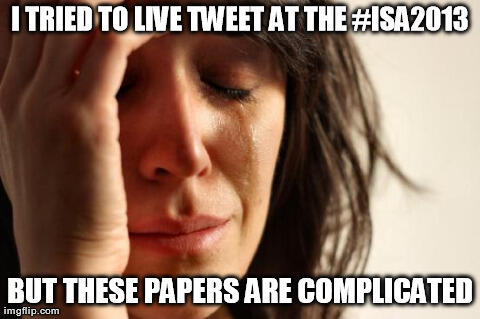
In the course of discussions about the ISA and in my failed live-tweeting of a panel, the question of what to tweet, how to tweet, and whether to tweet came up.  As judges of twitterfightclub suggested: tweets from a conference?  Yuck.  So, we will have varied opinions about whether tweets of an academic conference would be sufficiently interesting to one's followers.  Well, one's followers are going to follow you for whatever it is you do that interests them.  Live tweeting might be a turn off but your followers are most likely to be folks who would be interested in getting a second hand take on an IR/poli sci paper.

How to tweet?  I need to get a keyboard for my ipad.  Otherwise, the typing is too hard.  But even that is not enough, as it is easy to lose track of the presentation and discussion when one is tweeting.  I learned that in my first attempt.  I can live tweet TV shows because of commercial and the DVR.  But hard to roll back and see what I missed during a panel at a conference.  So maybe not tweet panels that present formal models?

But is it ok to live tweet?  I raised this possibility as some people (mistakenly in my view) do not want their conference papers cited.  They put "Do not Cite" on the papers.  I have never really understood this but then again, I am a narcissitic attention-hound/self-promoter.  But isn't the point to disseminate ideas?  Only if they are fully baked?  Hmmm. 

But the point here is that people who do not want their work cited will not want it tweeted either.  However, as Dan Nexon pointed out while chatting about this (in reality, not just virtually), ISA (and APSA) requires people to upload their papers and anyone can walk into the panel rooms to watch a presentation.  The badges that come with the conference registration fee are only necessary for getting into the book room where the publishers are.  So, no real expectation of privacy. 

But is there an expectation of good manners?  That is, live-tweeting can distract presenters.  However, since these presenters are almost entirely professors, if they are distracted by a distracted audience, then they have more problems than just live-tweeters. 

I don't expect live-tweeting to take over the ISA or APSA or other conferences because
  1. not that many people are on twitter;
  2. tweeting tv shows is much easier since one does not need to explain the content--one is usually tweeting to others who are watching the same show (which is why I am not paying as much attention to twitter until I catch up on last night's Game of Thrones and Mad Men).  
  3. the people most likely to be interested are attending that panel or otherwise busy at the same conference.  
Still, there will be more of it simply because there is not much right now.  The only direction is up, really.  I expect there to be more than a few arguments along the way.  And those would be fun to live-tweet.

My ISA Trip Report

Erica Chenoweth does an excellent job of summarizing her ISA experience this year.   I am so drained from the trip and from the twitter-fighting that preceded it and overlapped with it, that I did not blog daily reports as I have done in the past.  But I do have some observations I noted during the time in San Francisco:
    View image on Twitter
  • Twitterfightclub and ISA are not a good match in that I had a hard time competing while ISA-ing (was not willing to roam on my Canadian cell phone).  But I was approached by people who were watching the competition, including a couple of the book reps.  
  •  Live tweeting is very hard--as typing while keeping up with formal models is not easy.   More on twitter down below.
  • The new work in bureaucratic politics and foreign policy is most promising.  I served as a discussant on a panel dedicated to the topic.  I have a dusty paper on a shelf somewhere on the topic, so I put myself on this panel to get inspired, and it worked.  I now have some renewed energy.  Why?  Because focusing on "Where you stand depends on where you sit" produces lots of problematic predictions, my approach (to be unveiled when I get more written) may gain traction by avoiding that part of the BP debate.
  • With great power comes great responsibility, but it only works in one direction.  With great responsibility, power may not come.  
  • Turns out the most contagious thing at the ISA was diffusion exhaustion. The theme of Diffusion was run slightly into the ground.  Having said that, I participated in a roundtable on the diffusion of nationalism, and it was pretty delightful.  I was a skeptic, arguing that confirmation bias and the complexity of nationalisms make it hard for any one nationalism to spread very far.  
  • Bloggers are stars!  The reception was well attended, amusing and educational. I definitely think this will be annual tradition.  But as I also discussed, far fewer folks are blogging or tweeting than often seems to be the case.  I ended up in a twitter conversation with a bunch of folks while I was waiting for my plane to go home.  The topic was whether to organize a panel/roundtable next year on twitter.  Should we just run a session to teach people how to tweet? To compare strategies of our tweeting?  To consider the effects of twitter? 
  • The best part of twitter is when virtual friends become real ones.  I had many conversations with folks who had only been twitter handles before.  Meeting these folks in real life, including a fairly raucous dinner at a great Chinese restaurant with some former twitter-fighters, was a big highlight of the week.   
  • The other really fun part was when people would say: did they really say "old boys network" and I would say indeed they did.  The lamenting in that piece is so misplaced for so many reasons, but one demonstrated this past week is that the new folks, as Erica noticed, are doing such interesting and important work.  They are articulating their questions so very well, and taking quite seriously the demands of doing social science.  If the IR world is more of a meritocracy today than 20 years ago, we have much to celebrate given the kids today (even if one of them kicked my ass in twitter fight club's final match). 

Saturday, April 6, 2013

Everybody Is Doing It?

When one spends as much time online as I do (even when I am not playing poker) tweeting and blogging, it is easy to think that most other folks are doing it.  But that is simply not the case.  The ISA reception for bloggers produced a very crowded room as you can see here -->

But that is deceptive, as most ISA attendees were not that interested in us.  But we notice the folks who do show up and not those who do not.  Likewise, on twitter, I am amazed at how many people follow me and the people I follow.  Twitter fight club, as silly as it, is very useful in expanding my networks of followers and followed.  But it provides an illusion of sorts, as most IR types seem not to be on twitter, even passively.

When I talk to folks, twitter seems to be a mystery--what can 140 characters contain?  Heaps.  I was a reluctant adopter as I was skeptical about it, but that was nearly four years ago.  Twitter is far more mainstream now, but it is not like the cell phone--people are not adopting it quite as quickly. 

Blogging--how much time does it take?  The answer is: as much time as you want to give it.   It is funny because I now get the questions that I asked Dan Drezner about four years ago.

The enduring realities are these: lots of academics are shy, nervous, busy, and/or lazy.
  • Shy?  Yes, lots are worried about how they will be construed and are not that interested in engaging the people outside academia.  Most profs are not self-promoting narcissists like me.
  • Nervous?  Yes, lots of folks put "DO NOT CITE" on their papers because they are drafts, not perfect work.  But then their work only gets cited and gets spread after publication, which may happen a year or three later or not at all. Perfecting a blogpost?  Ah, perfection is the enemy of the good enough.
  • Busy? Twitter can be a time suck.    Believe me, even when I am not twitter fighting, keeping up on the feed can take time.  Blogging?  Actually, not so much but some people cannot spit out 500 words reasonably quickly.  My posts range from taking 15 minutes to taking an hour if it is something that requires reading and rumination (rare).  But folks are busy, so why do something that adds to the workload?   
  • Lazy?  Given how lazy I tend to be, I get this.  Why do something I don't have to do?
To be clear, I do not mean to suggest that those who are not twittering/blogging are bad people or are irresponsible.  So, please add to my list.
The answers for me are pretty obvious, but I know this is not universal: that we need to engage the public.  Our grant money implies an obligation.  Our jobs also require service to the community, and disseminating our research and insights is part of that, I think.  Of course, with NSF story and all the rest, public outreach might seem more imperative today, but for me, the reality is that the technology is now there to facilitate conversations with non-professors and with professors outside my area much more easily than ever before.  So, it makes sense to take advantage of it.


Friday, April 5, 2013

Here A Blog, There A Blog, Everywhere A Blog Blog

Last night, the folks at Duck of Minerva held a reception for those who blog about International Relations.  Two events played out: a series of folks presented essentially blog posts to the crowd, and awards were given to the best blogs of the year. 

The former starred Duck folks (Charli Carpenter, Rob Farley, Amanda Murdie), Erica Chenoweth and Dan Drezner.  The presentations were heaps of fun.  I especially liked Rob's bit about multiple hats since I have been thinking about folks who wear many different roles since my time on the Joint Staff, interacting with the staffs of SACEUR and EUCOM commander (the same guy). 

The latter was most interesting, as I learned about a new blog or two, and one of the places where I post stuff, Political Violence at a Glance, was awarded best new blog of the year!  Woot, indeed.  I was already proud about participating in PVatG's reindeer games as their lineup of folks is awesome.   Now I am part of an award-winning group, which is pretty cool, too.  Of course, this means more pressure to provide more and better stuff.  Congrats to Erica C and Barbara Walter (in the pic), as they are the folks who conceived of and run PVatG and congrats to the rest of the winners. 

Anyhow, I am headed back into the fray that is ISA2013.  Consider this post my #ff and follow PV at a G as well as the Duck.

Thursday, April 4, 2013

Gated Communities Are Almost Irrelevant

Now that twitterfightclub 2013 is over (my Cinderella story ended yesterday, losing in the finals, as Prince Charming [the voters] chose someone else), it is time to return to my day job (which is actually not my day job) of blogging about stuff that is not TFC. 

One of the topics online and at the ISA has been the gated-ness of academic writings.  Journal articles are almost always behind a paywall so that ordinary folks cannot get at them.  This is likely to change as many folks are now complaining and the threat of ditching academic publishers for the net may force the journal publishers into being responsive.  We are already seeing more journals temporarily providing open access to various articles and issues. 

But, I am afraid, my friends, that is almost entirely irrelevant.  Why?  Because why would any ordinary person want to read a jargon filled hunk of social science?  That is, the academic articles we are produce are indeed intended to be read by other scholars, so paywall or not, these pieces are not accessible. 

I am not advocating that journals and academics change the way articles are written.  Peer review and all that have problems, but I do think we need an intra-poli sci conversation, presenting our research to each other.

What we need to do is provide supplements to that intra-academic discussion so that our work can be digested by those who have not been trained in social science.  Folks should be required to provide, dare I say it, blog posts or something like it to journals when they submit their articles--a less arcane, more transparent, more accessible summary of the research paper that they seek to publish.  Then, when the article gets published in the journal, the journal's website would post the blog post.  Yes, you can see abstracts already but they are too short (750 words is 3x 250 and 5 x 150), and they are not written for non-academic audiences. 

Yes, it would require academics to develop their writing skills so that they can communicate beyond the academy, but most of us are getting public support one way or another.  So, we should be obligated to disseminate. 

The funny thing is that ungating will be easier than my alternative.  Easier to get journal publishers to be threatened by the web and figure out ways to improve access than to get all academics to write 750 words more and in more everyday language.  Even though the latter is far cheaper in $ spent than the former. 

Wednesday, April 3, 2013

Twitter Fight Club: The Quickening and Then Some

I will not give away my entire strategy for today's competition, but I do want to explain what I will be doing.  Transparency is the thing today except when it is not.

First, I have set up tweetdeck to post a series of tweets throughout the day, especially at times where I will be unable to tweet much (during my first panel, during lunch off -site, etc).  So, much of my posting will be punching and not counter-punching as I will not be able to read @texasinafrica's (Laura Seay) tweets and respond quickly when I am off wifi or in the first panel.

Second, I will live tweet the panel on Violence and Nonviolence in State-Dissident Interaction that has many interesting folks involved: Will Moore, Christian Davenport, Kathleen Cunningham, Erica Chenoweth, David Cunningham, Will Moore and some other folks.

Third, I will not be responding to or attacking Brett Friedman, who has been acting as @texasinafrica's hatchet man.  Twitter fight club is about two people going toe-to-toe, and Brett is not the opponent.  Plus I just have to wonder if his insistence on attacking on Laura's behalf is not just a bit paternalistic.  So, I will ignore him.  I recommend you do the same--Laura's skills and enthusiasm are impressive enough--no need to be distracted by less than innocent bystanders.

Fourth, I will try to post tweets and respond to Laura while spending time with the various folks I have plans to meet.  Some are friends who are used to me being rude.  Others are not, so I will tweet less during those times.

Fifth, I have done heaps of pre-pandering with the two announced judges--Dan Drezner and Will McCants.  I had a lovely dinner with Will when he was in Ottawa last week, so consider that (plus his defeat of me last year in the Elite Eight) as my pandering.  Dan has gotten semi-rich off of his Zombie book, which I blurbed and also assigned to my Intro to IR class back when I was at McG.  I don't know how many of the 600 students actually bought the book, but I would guess about half.

Anyhow, follow me at @smsaideman, follow the hashtag #tfc13, and most importantly vote for me at http://twitterfightclub.gunpowderandlead.org/.

I promise this is my penultimate post on #tfc13.  I will post a wrap up tomorrow.

Tuesday, April 2, 2013

Twitter Fight Club Finale: the Quickening


Written on the plane to SFO from DC (what else would I do with six hours of my time)

There can be only one.  But will it be me?  I changed planes at Dulles Airport, and did not learn whether I won or lost my semi-final match.  I think I won for the simple reason that my adversary had a terrific day in real life—an Easter event at the White House and then kind of special dinner.  Yet he might have outpolled me or had gotten heaps of support from the judges with his tale of his kids at the White House (apparently, Defcon was changed from 4 to 2 thanks to the aggressive nature of Creep’s Easter Egg rolling) plus dining with one of the judges.  UPDATE: I won!  Woot!

I would like to have won as I learned from Dan Drezner’s post this morning that there is much glory and perhaps even a cool gift for coming in second.  Also, 2nd means that next year I get to be a judge and not a contestant.  Which means I can get work done next spring and revel in the schadenfreude. 

Have I given up?  Nay, but I am aware of the challenges facing me if I am, indeed, in the finale.  First, whichever combatant won the other semi-final is going to be mighty tough. TexasinAfrica has been the overwhelming favorite, not just in Vegas* but in the hearts and minds of those following the event (she is the COIN-master). 

*Her pre-tourney odds started at 5-1 as she was a top seed and showed tremendous prowess last year.  The updated odds were 2-1 as of Sunday.  I am guessing that if she won her seminal, the odds would now be 1-2. 

Monday, April 1, 2013

A Nice Take on the Discipline

See Melissa Harris-Perry on how political science is different from punditry:
Visit NBCNews.com for breaking news, world news, and news about the economy


Well said. 

The Resource Curse Curse

I am not a huge fan of the tar sands industry, so I don't want to be seen as a defender of it when I criticize an anti-tar sands op ed. But I cannot help but point out some huge problems with this piece by Thomas Homer-Dixon.   THD has crossed over into the real world from the academic one with books that capture more eyeballs than most.  However, he takes a contested concept, the resource curse, and utterly breaks it when talking about Canada. 

How so?
  • as others have tweeted, the oil industry is not that big a part of Canada's economy.  Really. 
  • it violates basic social science--unless you factor in time travel, causes MUST precede outcomes.  But much of the stuff in the piece happened before the big oil boom of late
    • Whatever Canada's position as an innovative country relative to the rest, most of that is not news.  Whether that is the brain drain that the Canada Research Chair program sought to reverse by hiring me (oops) or the tax structure or whatever, it is not a recent phenomenon.
    • The Conservatives won a big majority without gaining a majority in seats?  Um, this happens all the time in first past the post electoral systems, which Canada has had forever
  •  Yes, the Conservatives are nasty to their opponents, as the piece notes "environmental and other radical groups."  But remember how members of the party accused those opposed to new internet regulations as being pro-Child p-ngraphy?  This is a party that takes extreme us vs them kinds of spins on things, and it has nothing to do with oil. 
There are a lot of problems with tar sands, but one might be more convincing if one focuses on the stuff that is really going on due to the tar sands versus that which is just part and parcel of Canadian politics and of the Conservative Party.  

I am not worried that a negative US decision will destroy US-Canadian relations, but I am also not worried that continued exploitation of the tar sands will lead Canada into becoming Nigeria, Saudi Arabia, or oil state x.