I had a good conversation yesterday at the ISA with a former student as we argued a basic point--does it matter to the individual Customs Border Protection agent whether Congress is not engaged in oversight. This conversation reminded me how often I am wrong.... alas.
I argued last month that one hope in the Trump era is that the various agencies would shirk--would do less than what Trump wanted, would perhaps undermine his policies by implementing them in ways that Trump/President Bannon didn't intend. It turns out that it probably depends on the agencies and the agents more than I speculated.
My original post was about the CIA, which had been attacked by Trump and might just have heaps of people who see Trump as a threat to the US. What we can learn from the immigration fiascoes is that the ICE/CBP people might have attitudes, dispositions, preferences that either align well with Trump or are more enthusiastic.
When the first immigration ban came down, it was a mess, which gave agents more discretion to do more or less. That they could interpret the guidance that was poorly developed however they wanted. And what did they do? They did more: during that hectic weekend and since, they have prevented not just Muslims from the seven key countries from entering the US, but despite agreements between Trump and Trudeau and Trump and the UK, the CBP and associates have kept out Canadian and British Muslims.
How does this make sense in a principal-agent framework? That these folks have two principals (President and Congress). The first has pretty much told them via his speeches and tweets that he would not mind if these agents exceed their authority. The second, Congress, has shown no interest in investigating what went wrong. I argued with my student that Congress could matter if one could imagine that it would do oversight--hold hearings about what happened, call to testify individual officials up and down the chain of command in DHS, and maybe even move money around to punish those offices that transgressed. OK, STOP LAUGHING--it could happen. Ok, hardly likely, especially with key Congress people making it clear that there will be no oversight over the Trump admin--just ask Jason Chaffetz, head of the House Oversight Committee.
The argument with my student was whether the folks on the ground care about Congressional oversight. I think so--based on my experience hanging out with the officers in the Pentagon, but I could be wrong. Right now, it does not matter, since the GOP have no intention of overseeing anything.
The larger point is that shirking can mean agents do more or less, so in this time of less oversight, the question is really about agents and their dispositions. Which means agent selection and self-selection matter a great deal. And that probably is bad news with many agencies populated by people who might actually have some enthusiasm for Trump's agenda, such as the FBI, ATF, ICE, and other law enforcement. It may be that the foreign policy types--CIA, State, US military (sort of)--might be opposed to Trump's bad ideas, but, alas, it looks like the forces of repression may just be very enthusiastic. Not good at all.
Thursday, February 23, 2017


Tuesday, February 21, 2017
My Quick McTake on McMaster
I am traveling to the ISA, so I only have a few quick things to say about the new National Security Adviser:
But woot, of course, because Trump has so thoroughly eroded our standards that we will celebrate that he chose a good guy, eclipsing all of the problems--that the Bannon gang is still ensconced in the White House, that McMaster may not really have the ability to hire and fire staff, that Trump makes policy by tweet and I don't see that changing, etc.
Still, this is good news, even if McMaster can only make a marginal difference. Damn, there I am embracing lowered expectations. Oy.
- McMaster is hell of a lot better than Flynn. Very much on the opposite side of the sane, good for America spectrum. He has made good decisions in hard places, he's been anti-Islamophobia, and opposed to Russian aggression. So, woot for that!
- I am skeptical it will make much of a difference. The NSC process may become less messy, but if big decisions still go through the alternative structure set up by Bannon, bad decisions will still be the output of this admin.
- As Exum notes, the key is: who is the last person to talk to Trump before he makes a decision? Trump is that open to manipulation, and I can't help but think Bannon will be closer to Trump. Unless and until Bannon is kicked out of the WH I have only ruthless pessimism about this government's foreign policy.
- I am not sure what KT MacFarland means--if she stays, it could mean that McMaster is neutered already or it could mean he is confident that he can marginalize her. BUT the Deputy NSA runs the Deputies Committee, where many decisions are made and where much implementation is monitored. If the DC is broken, then McMaster will have to do a heap to work to compensate.
- Finally, yet another military guy?! FFS, the NSA can be a civilian. But Trump has a limited imagination--Bolton or a general/admiral. With the SecDef being a retired general, it is more important than ever to have an NSA who is not a military guy.
But woot, of course, because Trump has so thoroughly eroded our standards that we will celebrate that he chose a good guy, eclipsing all of the problems--that the Bannon gang is still ensconced in the White House, that McMaster may not really have the ability to hire and fire staff, that Trump makes policy by tweet and I don't see that changing, etc.
Still, this is good news, even if McMaster can only make a marginal difference. Damn, there I am embracing lowered expectations. Oy.
Sunday, February 19, 2017
Sweden Vs. USA
Sometimes I post a tweet here just that I have it for future reference:
We look forward to informing the US administration about Swedish immigration and integration policies. https://t.co/x5G3euOWRh— Embassy of Sweden US (@SwedeninUSA) February 19, 2017
Go ahead and set the "Days without an international incident caused by Trump parroting something he saw on Fox News" counter back to zero... pic.twitter.com/1fm1IugPFI— Logan Smith (@LoganJames) February 19, 2017
Saturday, February 18, 2017
NATO 2% Myth Busting
Lots of stories this week about NATO and the 2% thing this week, thanks to Mattis threatening the rest of NATO.
This has led to a lot of folks on my twitter feed repeating all kinds of myths about this. So, let's bust some myths.
This has led to a lot of folks on my twitter feed repeating all kinds of myths about this. So, let's bust some myths.
- No, there is nothing in the NATO charter about 2%. Nil, nada, zip. Good luck finding it. The NATO treaty has no language that sets a particular expectation.
- To be clear, since Trump gets this confused, the 2% expectation is about each country spending on its own defense, not giving back to the US for its defense spending.
- At the Wales Summit (I may be confusing summits), NATO countries agreed to aspire to reach 2%. Yes, that is a dodge, but one the members agreed to. Why? Because more than a few knew it would be politically impossible to get to 2% any time in the near future. Canada would have to double what it spends on defense, for example. So, again, there is no requirement to spend two percent.
- There is an expectation that countries stop cutting their defense budgets and start spending more. And this is mostly happening (well, except for Canada).
- Spending two percent of GDP on defence is only one metric and not a perfect one. Greece is always among the countries that spends more than two percent. Partly because it has a lousy economy, partly because it spends much to keep up with Turkey which it sees as its most significant threat (and Turkey is a NATO member, oops). Greece rarely shows up when NATO does anything difficult. In Afghanistan, for much of the mission, Greece had around 15-20 soldiers--the lowest % of troops they deployed/troops they have in the alliance. Canada spends more $ than most allies, but because it has one of the largest economies in the alliance (really!), % of GDP does not look so good. Oh, one could measure burden sharing in blood--where the Estonians, Danes and Canadians would lead, based on troops they lost in Afghanistan as percentage of population. Hmmm.
- Burden-sharing is always a problem in alliances, as countries have different domestic political dynamics and different levels of interest. That the US spends more has a lot more to do with its global role than what it is dedicating to NATO.
- Oh, and as a reminder, the defense of Europe is not American charity, but in the US national interest. Peace and prosperity in Europe is good for the US--something we recognized after joining two bloody wars in progress.
Friday, February 17, 2017
Hysterical? Moi?
I have now been accused of being hysterical* a couple of times in two days. First time in my life that I can recall. Why? Because Trump is freaking me out. Now, the question is am I unreasonably freaked out and thus suffering from hysteria or am I reasonably freaked out and suffering from too good of an understanding of the risks and dangers of today? I, of course, vote for the latter.
Let me explain. Yesterday, at the Ottawa Conference on Defence and Security, there was a panel on US-Canadian relations, which was all about Trump. One of the panelists insisted that Trump might be the normal one and the establishment might be out of touch. That didn't go over well with me. In my question which was actually a comment, I contested this, starting by saying that I left sorry for the speaker since he was speaking exactly when Trump was press conferencing in a most, um, hysterical way. After I had my say, a second panelist suggested I was being hysterical. I had to get out of my seat to respond to that.
What is my case for reasonably being concerned about the dangers Trump poses?
And it is not just me--GOP folks too.
So, who's hysterical? Me or this guy?
* Hysterical is, of course, gendered as it tends to be applied to women, as if women freak out and men don't. The nice thing here is that the term is being applied to men--me, Donnie Trump, etc.
Let me explain. Yesterday, at the Ottawa Conference on Defence and Security, there was a panel on US-Canadian relations, which was all about Trump. One of the panelists insisted that Trump might be the normal one and the establishment might be out of touch. That didn't go over well with me. In my question which was actually a comment, I contested this, starting by saying that I left sorry for the speaker since he was speaking exactly when Trump was press conferencing in a most, um, hysterical way. After I had my say, a second panelist suggested I was being hysterical. I had to get out of my seat to respond to that.
What is my case for reasonably being concerned about the dangers Trump poses?
- His National Security Adviser turned out to have ties to Russia. Oops. And this is the third, THE THIRD, of his advisers being fired, with two of them, Flynn and Mantafort, being tied to Russia.
- Trump has been exceptionally critical of the judicial system, the one branch that is checking and balancing.
- The whole Taiwan thing... which now has China convinced that Trump is a paper tiger--which is not good.
- Trump's contempt for NATO
- Jeff Sessions: how come he is too racist to be a federal judge in 1986 and just racist enough to be Attorney General?
- The immigration ban--both in substance and in process.
- Trump empowering an avowed Leninist who seeks to bring down the existing order and thinks that war with China is both inevitable and desirable. This would be Steve Bannon, white supremacist.
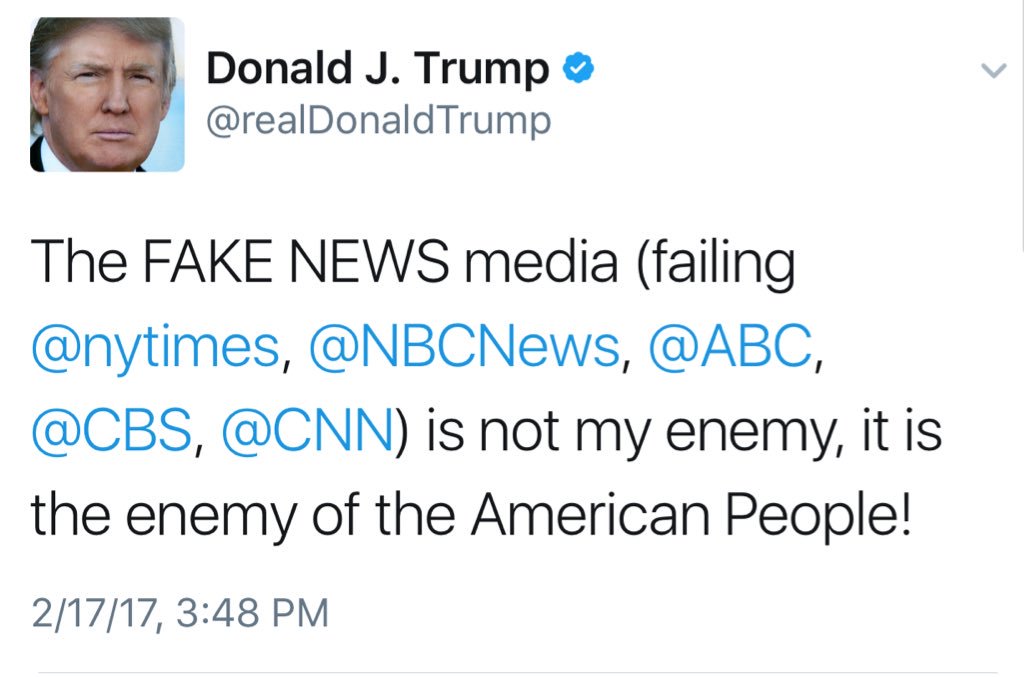
- His attacks on the media, complemented by Kushner's meeting with Time Warner people about problematic CNN folks (Ann Navarro, Van Jones). The latest:
And it is not just me--GOP folks too.
So, who's hysterical? Me or this guy?
* Hysterical is, of course, gendered as it tends to be applied to women, as if women freak out and men don't. The nice thing here is that the term is being applied to men--me, Donnie Trump, etc.
Woot! Leaks! Am I a hypocite?
I am thrilled about the leaks spilling out of the Trump administration about ties to Russia and all that. But I consider Snowden to be a spy, and was not a fan of Chelsea Manning. Am I a hypocrite? Hells yeah, but not over this.
How so, Steve? The big difference between what Snowden and Manning and these leaks? Volume mostly. What I minded about Snowden and Manning was the indiscriminate theft and release of information. What I like about the latest leaks? It is selective--the leaks focus on particular policies/stances/conversations that are important for national security. That Flynn had way too much contact with the Russian ambassador. That other members of the Trump team have had way too much contact with Russia. That DHS was proposing to have the National Guard round up illegal immigrants. These are specific things that the public had a need to know, not whole catalogs of stuff that had been sucked up and pushed out into the internet.
Is this a distinction without a difference? I don't think so. To be clear, I do think that Obama's team spent too much time focused on leaks, that they should not have pursued reporters for their reporting of leaks. Every democratic government leaks, and the iron law of leaks is that the more you seek to block leaks, the more leaks you are likely to have. For a similar dynamic, see Princess/Senator/General Organa classic line, with English accent for emphasis.
But overall, I find leaks not to be as problematic as floods. Democracies actually need leaks form government to reveal things when the government is not behaving ethically, legally, wisely (the last one is the tricky one). We do need secrecy for a variety of reasons, and, yes, we do need to spy on friend and adversaries. International relations is not so civilized that we don't reach each other's mail. So, am I a hypocrite? Not on this. But call me out on my other stuff.
How so, Steve? The big difference between what Snowden and Manning and these leaks? Volume mostly. What I minded about Snowden and Manning was the indiscriminate theft and release of information. What I like about the latest leaks? It is selective--the leaks focus on particular policies/stances/conversations that are important for national security. That Flynn had way too much contact with the Russian ambassador. That other members of the Trump team have had way too much contact with Russia. That DHS was proposing to have the National Guard round up illegal immigrants. These are specific things that the public had a need to know, not whole catalogs of stuff that had been sucked up and pushed out into the internet.
Is this a distinction without a difference? I don't think so. To be clear, I do think that Obama's team spent too much time focused on leaks, that they should not have pursued reporters for their reporting of leaks. Every democratic government leaks, and the iron law of leaks is that the more you seek to block leaks, the more leaks you are likely to have. For a similar dynamic, see Princess/Senator/General Organa classic line, with English accent for emphasis.
But overall, I find leaks not to be as problematic as floods. Democracies actually need leaks form government to reveal things when the government is not behaving ethically, legally, wisely (the last one is the tricky one). We do need secrecy for a variety of reasons, and, yes, we do need to spy on friend and adversaries. International relations is not so civilized that we don't reach each other's mail. So, am I a hypocrite? Not on this. But call me out on my other stuff.
Understanding the CAF's Slow March to Latvia
One of the puzzles I have had is why Canada has been so slow to get to Latvia. As readers of the Semi-Spew have read here, I have been most concerned about getting NATO forces to the Baltics before Putin is tempted to launch a fait accompli now that Trump is president.
I was relieved when Obama sent early a Brigade Combat Team, which meant not only that the US commitment to Poland was covered, but here would be spare troops to wander around the rest of the Baltics. The Germans have arrived. I have not seen any reporting about the British, so Canada has been either the slowest "Framework Nation" or the second slowest. Because this Liberal government tends to be slow in everything it does (the joy of cabinet government), I assumed it was mostly that.
But when I had the opportunity to ask CDS General Jon Vance at the big CDAI conference on Defence and Security, I grabbed (see here at 40:50). I was less obnoxious or provocative than I was yesterday (I got many kudos for pushing back at panelists who suggested that Trump was not abnormal), but Vance called my question pejorative anyway--"why so slow?"
His answer was many reasons:
The one I really buy, thanks to my biases, is number 4. Canada has the smallest deployment of the framework nations (420 or so), which means it needs more partners. Canada (either because it was slow--my previous belief--or because countries didn't want to operate in Latvia--see below) got the least reliable partners. The Danes and Norwegians, for instance, went elsewhere. Canada has as partners Albania, Italy, Poland, and Slovenia. Poland proved willing to serve in dangerous parts of Afghanistan (although their troops lacked the kind of benefits that would encourage going outside the wire--don't know if that has changed). Italy did lead in RC West in Afghanistan and has much multilateral experience elsewhere, but always with pretty tight restrictions. Albania and Slovenia? Hmmm.
Vance cannot say critical things of allies, but I can (tenure has been very, very good to me). It turns out that it might not be the allies that are going, but the ally that is receiving. I heard at the conference during coffee break that Latvia is a challenging ally to help out. That they were thinking Canada would be in the Latvian chain of command. No. NO. So, working that relationship out AND building the infrastructure (Latvia is apparently less ready to receive troops than others) takes time. So, I will stop being a good South Parkian--blame Canada, and focus elsewhere.
Overall, Vance did give an interesting talk, answered the Q's quite well. I didn't mean to jerk his chain, but was glad to get an answer to something I have been puzzling about for a while.
I was relieved when Obama sent early a Brigade Combat Team, which meant not only that the US commitment to Poland was covered, but here would be spare troops to wander around the rest of the Baltics. The Germans have arrived. I have not seen any reporting about the British, so Canada has been either the slowest "Framework Nation" or the second slowest. Because this Liberal government tends to be slow in everything it does (the joy of cabinet government), I assumed it was mostly that.
But when I had the opportunity to ask CDS General Jon Vance at the big CDAI conference on Defence and Security, I grabbed (see here at 40:50). I was less obnoxious or provocative than I was yesterday (I got many kudos for pushing back at panelists who suggested that Trump was not abnormal), but Vance called my question pejorative anyway--"why so slow?"
His answer was many reasons:
- We are not slow--we are moving at a rate that we told NATO and they didn't complain.
- We need to get the area prepared
- We need to get ready for Russian cyber/signals challenges
- We have the most multinational unit, which means things take longer
- Germans are closer so it was easier for them to get there.
The one I really buy, thanks to my biases, is number 4. Canada has the smallest deployment of the framework nations (420 or so), which means it needs more partners. Canada (either because it was slow--my previous belief--or because countries didn't want to operate in Latvia--see below) got the least reliable partners. The Danes and Norwegians, for instance, went elsewhere. Canada has as partners Albania, Italy, Poland, and Slovenia. Poland proved willing to serve in dangerous parts of Afghanistan (although their troops lacked the kind of benefits that would encourage going outside the wire--don't know if that has changed). Italy did lead in RC West in Afghanistan and has much multilateral experience elsewhere, but always with pretty tight restrictions. Albania and Slovenia? Hmmm.
Vance cannot say critical things of allies, but I can (tenure has been very, very good to me). It turns out that it might not be the allies that are going, but the ally that is receiving. I heard at the conference during coffee break that Latvia is a challenging ally to help out. That they were thinking Canada would be in the Latvian chain of command. No. NO. So, working that relationship out AND building the infrastructure (Latvia is apparently less ready to receive troops than others) takes time. So, I will stop being a good South Parkian--blame Canada, and focus elsewhere.
Overall, Vance did give an interesting talk, answered the Q's quite well. I didn't mean to jerk his chain, but was glad to get an answer to something I have been puzzling about for a while.
Wednesday, February 15, 2017
Mishandling NATO 101
When SecDef Jim Mattis warns NATO allies that "they do not boost their defense spending to goals set by the alliance, the United States may alter its relationship with them," I can't help but thinking:
 Sure, SecDefs hector Europeans on a regular basis... this is old news. EXCEPT this is a piss poor time for such stuff and a piss poor person to convey the message. How so?
 Indeed, to be clear, NATO is not a charity! Someone said that to me on twitter--that the US gives and does not get. BULLSHIT! I cannot say it more directly, but NATO exists to serve the US interest. The US not only gets peace and prosperity in Europe (and thus avoiding to fight in any major wars), but also gets influence in Europe and beyond as NATO has gone to Africa, Afghanistan and elsewhere. It is not charity precisely because the NATO is in the US's interest and is not just benevolence. Also, the allies have paid steeply--in political capital, in money and, yes, in blood. Most of the allies spent billions of dollars in Afghanistan and lost more than a few soldiers. In per capita terms, the losses were quite significant (see the table from NATO in Afghanistan).
The good news is that NATO countries are increasing their spending. Well, most of them. So, Trump can declare that he influenced them to spend more, even if the increases started before he came into office. Just like his claims about businesses deciding to invest in the US because of his pressure even as those decisions preceded the election in November. It won't take much more spending by NATO countries for Trump to declare victory.
Of course, all this misses the larger point--NATO currently hangs by a thread. And that thread is not about burden-sharing but about the credibility of a pro-Russian US President when push comes to shove in the Baltics. So, I am very pessimistic about the future of NATO, but my pessimism is not due to the burden-sharing problem, which is inherent in any multilateral alliance and is more or less problematic, depending on what measure one uses
"“If you take him literally, then the message is indeed that there’s no unconditional guarantee of security any more”
- The current US administration can't keep a promise to save its life. To make threats like this, and it is, indeed, a threat, one has to make credible commitments. This Trump administration can't do that.
- The current US administration is the most pro-Russian administration ever, even with Flynn being dumped, so threatening NATO at this time is most un-cool.
- Oh, this current US administration is the most anti-NATO administration, given Trump's comments about it being obsolete.
- The US has just spent an incredible amount of effort to make its commitment and NATO's commitments to the Baltics/Poland more credible, so perhaps this is not the time to crap on the alliance?
- Russia is kind of on the march, so not a good time.

The good news is that NATO countries are increasing their spending. Well, most of them. So, Trump can declare that he influenced them to spend more, even if the increases started before he came into office. Just like his claims about businesses deciding to invest in the US because of his pressure even as those decisions preceded the election in November. It won't take much more spending by NATO countries for Trump to declare victory.
Of course, all this misses the larger point--NATO currently hangs by a thread. And that thread is not about burden-sharing but about the credibility of a pro-Russian US President when push comes to shove in the Baltics. So, I am very pessimistic about the future of NATO, but my pessimism is not due to the burden-sharing problem, which is inherent in any multilateral alliance and is more or less problematic, depending on what measure one uses
Tuesday, February 14, 2017
Traveling to the ISA: The New Tips
This post is both the most useful and most depressing I have ever posted....
From the International Studies Association:
From the International Studies Association:
Dear ISA Convention Attendees,
In response to the recent travel ban and the concerns of the ISA membership, we have been in contact with the ACLU of Maryland. They have passed along some great resources and suggestions for travelers to the U.S., and what to do/who to contact should you not be allowed to board your plane to the U.S., or if you are detained at BWI or other airports.
1. International Refugee Assistance Project (IRAP): Know Your Rights.
2. ISA HQ will act as a liaison with the ACLU of Maryland prior to Friday, February 17 to help address any questions members may have. They can compile more information specific to the kinds of questions being asked. Please contact Jennifer Fontanella at jfontanella@isanet.org
- http://www.isanet.org/Portals/0/Media/Conferences/Baltimore2017/IRAP%20KYR%20Packet.pdf
- This includes the most recent temporary restraining order from the U.S. District Court of Washington that prevents Customs and Border Protection from denying entry to the United States if you have a valid visa to enter. The Ninth Circuit has continued to block enforcement of the Muslim ban, so anyone entering the U.S. with valid immigration documents should be able to enter. Customs and Border Protection is currently treating people entering the U.S. in accordance with the pre-executive order status quo.
- Please be aware however, that the Trump Administration may appeal the 9th Circuit decision to the Supreme Court, or they may revise the current executive order seeking to withstand legal challenge. Your ability to travel to the U.S. might change significantly if the current executive order is revised. As explained in the IRAP Know Your Rights materials, it is recommended that you travel to the U.S. as soon as possible, while the temporary restraining order protects the pre-executive order status quo. If the executive order is revised, we will provide updated information on any travel restrictions.
3. Travel with the any/all of the following documents in hand. Show to any official if you feel your right to travel is being questioned.
- Department of Homeland Security statement on compliance with the recent court order:
- https://www.dhs.gov/news/2017/02/04/dhs-statement-compliance-recent-court-order
- https://www.dhs.gov/news/2017/02/03/statement-countries-currently-suspended-travel-united-states (applies to those people who are dual nationals, who are nationals of countries other than the 7 banned countries as well as others).
4. We recommend that you coordinate with either someone back at your home or a friend arriving in Baltimore to check in and confirm your safe arrival.
- A copy of the letter of invitation from the International Studies Association stating that you will be attending the Convention in Baltimore, Maryland. Please feel free to contact Jennifer Fontanella (jfontanella@isanet.org) for a Letter of Invitation if you haven’t already.
5. The ACLU is recommending that if anyone is nervous about being detained, complete a Dept of Homeland Security Form G-28 (Notice of Entry of Appearance as Attorney or Accredited Representative) which you can give to any official to show that you have representation. Links to help find immigration attorneys are listed below.
HOW TO FIND AN IMMIGRATION ATTORNEY
American Immigration Lawyers Association: Lawyer search http://www.ailalawyer.org/
Immigration Legal Directory (available in multiple languages): https://www.immigrationadvocates.org/nonprofit/legaldirectory/
Immigration Advocates Network: https://www.immigrationlawhelp.org
National Immigration Project of the National Lawyers Guild’s online find-a-lawyer tool: https://www.nationalimmigrationproject.org/find.html
National Immigrant Justice Center: Schedule a legal consultation by phone (312-660-1370) or email immigrantlegaldefense@heartlandalliance.org
The immigration courts’ list of lawyers and organizations that provide free legal services: http://www.justice.gov/eoir/list-pro-bono-legalservice-providers-map
Immigrant Legal Resource Center has a comprehensive online client intake form: https://www.ilrc.org/screening-immigration-relief-client-intake-form-and-notes
As always, please feel free to contact ISA headquarters with any questions or concerns you may have.
Wednesday, February 8, 2017
Some Basics in Burden-Sharing
I shouldn't have to do this, but because of Trump's profound ignorance, I thought I should spend a few minutes explaining the NATO burden-sharing challenge.*
Trump said this:
How does it work? While NATO HQ does get contributions for all members to run, the burden sharing debate is not about that. No, it is about whether countries are spending enough of their own money on THEIR OWN armed forces. Canada is among the worst countries (ssshh!!! Don't blow Canada's Duck and Cover or 5D strategy),** as it spends less than one percent of its gross domestic product on its armed forces. The NATO standard is 2% which very few countries meet.*** The US spends far more, but much of what the US spends is not for the defense of Europe/Atlantic.
Anyhow, the key point is this: if NATO countries were to share the burden better, the US would not be getting any more money from the allies. Indeed, Trump plans to spend more money on the military (despite being a confused isolationist), so even if NATO countries kick in more, the US will not save anything.
The problem? My guess is that Trump sees NATO as a protection racket that is not fully exploited. That NATO countries should be paying tribute to the US for defending Europe. Of course, what this blithely ignores is that peace and prosperity in Europe is in America's interest. But Trump just sees Europeans as competitors. If only we can explain to him that Europeans buy our stuff, invest in the US since our workers are cheaper and our standards are lower, etc.
In short, FFS!
* By the way, heaps of academic literature on the problem of alliance burden-sharing, starting with Mancur Olson.
** Dodge, dip, duck, dive, and dodge.
*** the 2% metric is not perfect as Greece ranks highly despite not actually doing much for the alliance. Canada does a whole lot whenever the alliance deploys, but its defence spending shortfalls are proving problematic
Trump said this:
It is as if Trump thinks that NATO members pay the United States to protect them, and that they have fallen short of their dues. THIS IS NOT HOW IT WORKS!!Trump call with Fr Pres Hollande, obsessed with money: France can protect NATO, but the U.S. “wants our money back” https://t.co/KX38HcgxZv— Peter Eisner (@PeterEisner) February 8, 2017
How does it work? While NATO HQ does get contributions for all members to run, the burden sharing debate is not about that. No, it is about whether countries are spending enough of their own money on THEIR OWN armed forces. Canada is among the worst countries (ssshh!!! Don't blow Canada's Duck and Cover or 5D strategy),** as it spends less than one percent of its gross domestic product on its armed forces. The NATO standard is 2% which very few countries meet.*** The US spends far more, but much of what the US spends is not for the defense of Europe/Atlantic.
Anyhow, the key point is this: if NATO countries were to share the burden better, the US would not be getting any more money from the allies. Indeed, Trump plans to spend more money on the military (despite being a confused isolationist), so even if NATO countries kick in more, the US will not save anything.
The problem? My guess is that Trump sees NATO as a protection racket that is not fully exploited. That NATO countries should be paying tribute to the US for defending Europe. Of course, what this blithely ignores is that peace and prosperity in Europe is in America's interest. But Trump just sees Europeans as competitors. If only we can explain to him that Europeans buy our stuff, invest in the US since our workers are cheaper and our standards are lower, etc.
In short, FFS!
* By the way, heaps of academic literature on the problem of alliance burden-sharing, starting with Mancur Olson.
** Dodge, dip, duck, dive, and dodge.
*** the 2% metric is not perfect as Greece ranks highly despite not actually doing much for the alliance. Canada does a whole lot whenever the alliance deploys, but its defence spending shortfalls are proving problematic
Monday, February 6, 2017
The New NSC, Take 2
I already have written about the decision to elevate Arsonist-in-Chief Steve Bannon to the National Security Council and the placing of the Chairman and Director of National Intel on the to be invited list. But there is still much confusing, including by Trump, who, of course, didn't read the executive order. He is lazy, uninquisitive, and reckless. But we knew that.
What is new? That the former Chairman, Mike Mullen, is so pissed off that he entered the fray. TO be clear, he may not be as apolitical as Martin Dempsey, his replacement, but is still legit enough that his entry into this debate is remarkable. His concern:
What can we do about it? Not a whole lot. A friend keeps pushing for lawsuits, but that is misguided. The PC, as far as I know, is not a statutory body but something a President can form or not. Even if Bannon was not formally listed as regular member, Trump could invite him to appear all the time. The real threat of Bannon is that he has got Trump's ear, not that he is part of a decision-making group. No legislation or court can separate the Trump Whisperer from Trump. Like impeachment, some external force getting rid of Trump is not going to happen.
The best bet to get rid of Bannon? The theme of President Bannon. SNL played it up, twitter is playing it up. If Trump's thin skin gets scraped by the accusation that he is not really in charge and that Bannon is, he might dump Bannon. A thin reed? Maybe, but betting on Trump's narcissism and insecure ego is, alas, a better bet than the limited reach of institutions on a President's decision-making process.
What is new? That the former Chairman, Mike Mullen, is so pissed off that he entered the fray. TO be clear, he may not be as apolitical as Martin Dempsey, his replacement, but is still legit enough that his entry into this debate is remarkable. His concern:
Having Mr. Bannon as a voting member of the Principals Committee [PC] will have a negative influence on what is supposed to be candid, nonpartisan deliberation. I fear that it will have a chilling effect on deliberations and, potentially, diminish the authority and prerogatives to which the Senate-confirmed cabinet officials are entitled. They, unlike Mr. Bannon, are accountable for the advice they give and the policies they execute.I love a military officer embracing not just civilian control of the military but democratic control--note the whole bit about being accountable to the Senate. Bannon is different from the other NSC folks in many ways (most are not committed to the destruction of the United States), but the key for Mullen is this: usually, the only person in the room who might be thinking mostly about the domestic politics of big decisions might be the President. Everybody else's day job is on their institution and on the national interest of the United States. Bannon's job, besides burning down the US, might be to focus on Trump's domestic political standing.
What can we do about it? Not a whole lot. A friend keeps pushing for lawsuits, but that is misguided. The PC, as far as I know, is not a statutory body but something a President can form or not. Even if Bannon was not formally listed as regular member, Trump could invite him to appear all the time. The real threat of Bannon is that he has got Trump's ear, not that he is part of a decision-making group. No legislation or court can separate the Trump Whisperer from Trump. Like impeachment, some external force getting rid of Trump is not going to happen.
The best bet to get rid of Bannon? The theme of President Bannon. SNL played it up, twitter is playing it up. If Trump's thin skin gets scraped by the accusation that he is not really in charge and that Bannon is, he might dump Bannon. A thin reed? Maybe, but betting on Trump's narcissism and insecure ego is, alas, a better bet than the limited reach of institutions on a President's decision-making process.
Friday, February 3, 2017
The Canadian Armed Forces: Misunderstood?
General Jon Vance, Chief of the Defence Staff, is upset at how the CAF is being covered these days. The focus, he perceives, of the media is on "toxic narratives" related to sexual harassment in the military, the PTSD and suicide crises, and the like.
I get it--the media tends to cover bad news stories. This can be incredibly frustrating. And the more the military takes seriously and reports the problems, the more the media will cover those problems. Like counter-insurgency, a challenge in all of this is how to measure progress? How do you tell your story that is transparent and provides some optimism?
Well, the way not to do it is to be too optimistic. I found the CDS complaining about the media far less disturbing than Vance's attitude about the CAF in a Trump Era:
I get it--the media tends to cover bad news stories. This can be incredibly frustrating. And the more the military takes seriously and reports the problems, the more the media will cover those problems. Like counter-insurgency, a challenge in all of this is how to measure progress? How do you tell your story that is transparent and provides some optimism?
Well, the way not to do it is to be too optimistic. I found the CDS complaining about the media far less disturbing than Vance's attitude about the CAF in a Trump Era:
Great things? Oh my. As Canadians (and Australians) get seriously scared about what Trump might do, saying that great things are on the horizon creates a huge credibility gap. It is just incredibly hard to believe that pro-Putin, anti-NATO, unilateral and white supremacist Trump is going to cooperate well with the Canadians. Will Trump keep American commitments to defend the Baltics? Well, if Trump can't keep Obama's commitment to let in 1250 refugees from stalwart ally Australia, every other commitment is in doubt. Share intel with the US when its top decision-makers have more affinity with Russia than Germany?On another issue, Gen. Vance said he is an “eternal optimist” about the path ahead, and despite the alarm in some quarters about the U.S. direction under Mr. Trump, “We are on the verge, I think, of great things together with the new administration.”
He talked of common interests in procurement, the ability to share intelligence with close allies and his close professional relationship with the chairman of the U.S. Joint Chiefs of Staff – the body of senior uniformed leaders of the American defence department.
- Step 1: avoid making statements that raise questions about one's credibility.
- Step 2: provide more media access to those doing the good work. I already quoted Mr. Rogers once today, but if we can highlight the "helpers", we can give people hope. The CAF does a whole lot of helping: training the Ukrainians and the Kurds, disaster relief at home, humanitarian missions abroad, and on and on. I am sure they try to get coverage of such stuff, and it is hard as the media prefers to cover the hottest stuff (which is usually the most negative). Here's a positive story: Canadian troops arriving in Latvia to present a deterrent against Russian aggression. Perhaps it is the government's fault Canada is moving so slowly, but once the troops deploy, that will be a very visible story for the media to cover.
- Step 3: Support the efforts of academics to build partnerships with the CAF, DND, defence scientists and private actors. Oops, is that a plug for a SSHRC grant I am submitting this month? Ok, just a bit. But the more we communicate, the more we understand each other, the better informed Canadians will be. Not just about the dark stuff, but also the progress the CAF is making within and its contributions beyond.
Thursday, February 2, 2017
Aussie, Aussie, Oh I am So Sorry
That Trump is now pissing off Australia is simply bad news. But it has implications beyond a bilateral relationship that was solid, easy to manage, and downright fun until yesterday.
Remember, the turning point in the conversation seems to be this: Turnbull asked if Trump would respect the deal that Obama had made--taking a very small number of refugees off of Australia's hands. Trump went ballistic. Because he has a thing about brown people. And poor people.
But the larger importance is this: America's word is no longer good. Trump is willing to break agreements with America's best allies* even when these deals impose modest costs on the US. Imagine if you are not America's best ally or if the exchange involves higher costs than less than 1500 refugees.
So, as SecDef Mattis goes to Asia and as NATO SecGen goes around Europe, both trying to reassure allies of America's commitment, no one should buy what these guys are selling. NO ONE. Trump is demonstrating that the US is now thoroughly unreliable. It is not just Trump's zero-sum, transactional view of the world. It is also that he has long stiffed those who trusted him--wives, banks, contractors. He is not changing at age 70, and the office is not going to mature him. He is what he is: a temperamental brat who insists on getting 110% of his way all the time.
So what are allies supposed to do? Dodge, dip, duck, dive and dodge? That is what Canada is doing now, and it really might make the most sense. Perhaps offering to take refugees off of the US's hands (the Australian refugees, those stuck in the pipeline due to Friday's mess, etc) would allow Justin Trudeau to uphold Canadian values in a way that helps Trump. All I can say is that no ally should count on the US for anything. And that is mighty, mighty disturbing. Given that these countries have relied on the American nuclear umbrella for generations, they may have to find another umbrella (France, anyone?), or appease the autocrats nearby (perhaps that is South Korea's path) or develop one's own nuclear deterrent. Remember, Trump was not so upset at the prospect of Japan developing nuclear weapons. The unthinkable is now easily imaginable.
* I have often written about the contest for worst US ally (Pakistan and Saudi Arabia usually vie for the top spot although Turkey sometimes comes close). I haven't written about best ally, but a country that shows up to help out the US in every war, even the most ill conceived (Vietnam, Iraq 2003) is near the top of the list.
Remember, the turning point in the conversation seems to be this: Turnbull asked if Trump would respect the deal that Obama had made--taking a very small number of refugees off of Australia's hands. Trump went ballistic. Because he has a thing about brown people. And poor people.
But the larger importance is this: America's word is no longer good. Trump is willing to break agreements with America's best allies* even when these deals impose modest costs on the US. Imagine if you are not America's best ally or if the exchange involves higher costs than less than 1500 refugees.
So, as SecDef Mattis goes to Asia and as NATO SecGen goes around Europe, both trying to reassure allies of America's commitment, no one should buy what these guys are selling. NO ONE. Trump is demonstrating that the US is now thoroughly unreliable. It is not just Trump's zero-sum, transactional view of the world. It is also that he has long stiffed those who trusted him--wives, banks, contractors. He is not changing at age 70, and the office is not going to mature him. He is what he is: a temperamental brat who insists on getting 110% of his way all the time.
So what are allies supposed to do? Dodge, dip, duck, dive and dodge? That is what Canada is doing now, and it really might make the most sense. Perhaps offering to take refugees off of the US's hands (the Australian refugees, those stuck in the pipeline due to Friday's mess, etc) would allow Justin Trudeau to uphold Canadian values in a way that helps Trump. All I can say is that no ally should count on the US for anything. And that is mighty, mighty disturbing. Given that these countries have relied on the American nuclear umbrella for generations, they may have to find another umbrella (France, anyone?), or appease the autocrats nearby (perhaps that is South Korea's path) or develop one's own nuclear deterrent. Remember, Trump was not so upset at the prospect of Japan developing nuclear weapons. The unthinkable is now easily imaginable.
* I have often written about the contest for worst US ally (Pakistan and Saudi Arabia usually vie for the top spot although Turkey sometimes comes close). I haven't written about best ally, but a country that shows up to help out the US in every war, even the most ill conceived (Vietnam, Iraq 2003) is near the top of the list.
Scariest News Du Jour
I am tempted to make this a daily feature here at the Semi-Spew: what have we learned about the Trump Administration on each day that scares us the most? But that will be exhausting as Jon Stewart suggested on the Colbert Show. Still, I think this might be a regular feature. So, which is it for the last 24 hours?
Is it the spat with Australia? No. That is just stunning, since it is incredibly hard to screw up that relationship. The Aussies are perhaps the people on the planet most like the Americans for a variety of reasons, and they still feel a keen debt for that World War II thing. They have showed up in every American war, no matter how misguided, even when other allies will not (Vietnam, Iraq 2003). But this does not quite scare me the most.
What does? Learning that President Bannon, oh, I mean, Rasputin, oh I mean the Trump Whisperer believes that the US will be at war with China in the next ten years. Why does this bother me so? Holy self-fulfilling prophecy, Batman! If one believes that war is inevitable, then one begins to behave in ways that make war more likely. Instead of trying to avoid war, one tries to find the right moment, the most opportune time for oneself. Oh, and since this is international relations, where the other side is aware and reacts, they start doing the same thing--making moves to put themselves in the best position to win. Usually, this means figuring out how to land a decisive first blow. Which means in a crisis, the US and China would be looking for opportunities to strike first and also fearing the first strikes of the other side, making it hard to manage the crisis. Neither side would be as willing to play for time to figure a way out because, hey, war's gonna happen.
Whether it is the US launching a preemptive attack to hit Chinese forces before they hit American bases in the region or China launches first to hit American bases and ships in the area (sorry, Japan), it is easy to imagine the fears of first strikes and how exaggerated they become when war is seen as inevitable.
Yes, this screams to the IR scholar World War I. There is much controversy about the historiography of that war, but one thing that did operate at the time--the sense that war was inevitable, which encouraged all kinds of behavior that led to the war. So, yes, IR scholars are extremely nervous right now. The informal discussion revolves around the question of which war comes first: Mexico, Iran, or China. As it stands, I would prefer the first two wars to the third, which again reminds me of how low our expectations have become, thanks to Donnie Trump.
Returning to Bannon, he probably doesn't mind a war or two, perhaps would not even mind the US losing a war with China, as his main goal is to break the United States in pretty much every way so that he can usher forth a New Order with white nationalists running everything (into the ground).
So, yeah, I am scared shitless. How are you doing?
Is it the spat with Australia? No. That is just stunning, since it is incredibly hard to screw up that relationship. The Aussies are perhaps the people on the planet most like the Americans for a variety of reasons, and they still feel a keen debt for that World War II thing. They have showed up in every American war, no matter how misguided, even when other allies will not (Vietnam, Iraq 2003). But this does not quite scare me the most.
What does? Learning that President Bannon, oh, I mean, Rasputin, oh I mean the Trump Whisperer believes that the US will be at war with China in the next ten years. Why does this bother me so? Holy self-fulfilling prophecy, Batman! If one believes that war is inevitable, then one begins to behave in ways that make war more likely. Instead of trying to avoid war, one tries to find the right moment, the most opportune time for oneself. Oh, and since this is international relations, where the other side is aware and reacts, they start doing the same thing--making moves to put themselves in the best position to win. Usually, this means figuring out how to land a decisive first blow. Which means in a crisis, the US and China would be looking for opportunities to strike first and also fearing the first strikes of the other side, making it hard to manage the crisis. Neither side would be as willing to play for time to figure a way out because, hey, war's gonna happen.
Whether it is the US launching a preemptive attack to hit Chinese forces before they hit American bases in the region or China launches first to hit American bases and ships in the area (sorry, Japan), it is easy to imagine the fears of first strikes and how exaggerated they become when war is seen as inevitable.
Yes, this screams to the IR scholar World War I. There is much controversy about the historiography of that war, but one thing that did operate at the time--the sense that war was inevitable, which encouraged all kinds of behavior that led to the war. So, yes, IR scholars are extremely nervous right now. The informal discussion revolves around the question of which war comes first: Mexico, Iran, or China. As it stands, I would prefer the first two wars to the third, which again reminds me of how low our expectations have become, thanks to Donnie Trump.
Returning to Bannon, he probably doesn't mind a war or two, perhaps would not even mind the US losing a war with China, as his main goal is to break the United States in pretty much every way so that he can usher forth a New Order with white nationalists running everything (into the ground).
So, yeah, I am scared shitless. How are you doing?
Wednesday, February 1, 2017
SecDef Mattis: Another Thin Reed
Apparently, the allies see SecDef Mattis as the canary in the coal mine. "If Mr. Mattis were to leave the job or lose influence within the administration, it would be seen as a troubling omen, said one foreign official." I have only one reaction to that:
That the canary is already mostly dead. Why? Because Mattis was left out of the Muslim Ban executive order. Why is this problematic? The ban had significant military equities (a term I learned in 2001-02 referring to when the US military had some stakes in a policy):
I am not sure what the allies should do, but counting on Mattis is a thin reed upon which to rest their hopes. As I discussed on twitter with Colin Kahl, an academic and former National Security Adviser to the Vice President, there will be a lot of self-help going on, and with that, spirals of increasing insecurity.
Sorry to be a Debbie downer, again....
That the canary is already mostly dead. Why? Because Mattis was left out of the Muslim Ban executive order. Why is this problematic? The ban had significant military equities (a term I learned in 2001-02 referring to when the US military had some stakes in a policy):
- The ban means that Iraqi pilots were supposed to come to the US to train to fly the planes the US sold them can't.
- Some of the folks whose travel to the US was blocked were interpreters who had served in harm's way to help American forces. So, who is going to serve as interpreters now that the promise of a life in the US (staying in one's country is often no longer possible after working closely with foreign forces) is gone?
- Predictably, Iraq may ban Americans, including the contractors who provide vital support for the war effort.
- Previous American generals have noted that Islamophobia in the US is a recruiting tool for Islamist terrorsts. ISIS is already making much of this ban. Indeed, Islamophobia in the US may endanger American troops. Remember green on blue attacks where the people the US trains shoot at the trainers?
- Many members of the US armed forces either themselves are green card holders or their families are (or both). So, this executive order directly impacts a significant number of the troops. (Thanks to Heather Hurlburt for reminding of this).
I am not sure what the allies should do, but counting on Mattis is a thin reed upon which to rest their hopes. As I discussed on twitter with Colin Kahl, an academic and former National Security Adviser to the Vice President, there will be a lot of self-help going on, and with that, spirals of increasing insecurity.
Sorry to be a Debbie downer, again....
Tuesday, January 31, 2017
Betting on Disaster
I just got this via email and was so amused and amazed that I had to share it:
Which bets would I place if I had some money to do so?
I'd bet the under on the Wall costs, because I think they will do half a job and declare victory.
I would pound the no, Mexico won't pay for it, since it would be political suicide to do so.
The odds are not good enough to touch the number of new border guards bet.
I would pound the No, repealing Obamacare would not lead to lower rates.
And I would pound the Yes, Starbucks will hire a heap of refugees.
We do, indeed, live in interesting times. Profitable times for those willing to gamble.
The betting odds related to President Trump's recent executive orders: What will be the cost of the wall? Will Mexico pay? How many Starbucks will close? Will Starbucks hire 10,000 refugees? When will congress repeal Obamacare? This is your insight into what oddsmakers and gamblers think about these questions and more.
Not familiar with the betting lingo? A negative number (generally representing the "Favorite") = how much you have to bet to profit $100. A positive number = how much you profit if you bet $100.
Analysis on Wall Bet: The research group Bernstein estimates that the wall – standing 40 feet tall and 10 inches thick – will cost around $15 billion just for the materials. Bernstein told Fortune that costs could exceed $25 billion when labor and land acquisition are included.
- Cost that the U.S. will Pay to Build a Wall Covering the Mexican Border?
Over $25 billion: -170 (Bet $170 to profit $100)
Under $25 billion: +150 (Bet $100 to profit $150)
Analysis on Mexico Paying for Wall: This was one of President Trump’s biggest campaign promises, vowing to make Mexico pay for the border wall that would keep illegal immigrants and drugs out. Enraged over Trump’s insistence on the wall, Mexican President Enrique Peña Nieto canceled a late January meeting between the two. Both sides had a “friendly” conversation over the phone, but neither is budging right now.
- Will Mexico Pay for the Wall? (Tariff Tax Doesn’t Count)
Yes: -450
No: +600
Analysis on Madonna Meeting: This idea comes from satire in the Vanity Fair, but if things get any worse between President Peña Nieto and Trump over the wall issue, you never know what will happen. Both Streep and Madonna have been very critical of Trump over the last few weeks, so this would be the perfect revenge.
- Will President Enrique Peña Nieto Meet with Madonna or Meryl Streep During Trump’s 4-Year Term?
Yes: -150
No: +1200
Analysis on US and Mexican Presidents Meeting: Relations aren’t good right now between Trump and Peña Nieto, especially after the canceled meeting and wall issue. But Trump’s first term lasts until 2020, giving these two sides plenty of time to meet.
- Will President Trump and Peña Nieto Meet within Trump’s 4-Year Term?
Yes: -130
No: +110
Analysis on Starbucks Closing in Mexico: A social media campaign has risen in Mexico to boycott US companies. And for some reason, Starbucks is bearing the brunt of this campaign. Statista.com states that Mexico has 402 Starbucks, and it’s possible that at least 10 could close if the boycott lasts any measurable amount of time.
- How Many Starbucks will Close in Mexico during Boycott within 2017?
Over 10: -150
Under 10: +130
Analysis on Border Patrol Agents Being Hired: According to MercuryNews, President Trump wants to hire an additional 5,000 Border Patrol agents to keep illegal immigrants out of the US. But there are already 2,000 vacancies in the department because two-thirds of the applicants can’t pass a polygraph test. Furthermore, adding 5,000 agents would significantly increase the cost of maintaining the project.
- Number of New Border Patrol Guards Hired during Trump’s Term?
Over 4,000: -130
Under 4,000: +110
Analysis on Repealing Obamacare: Tom Price, Trump’s pick to head the Department of Health and Human Services, hasn’t had a confirmation hearing yet. Price and Congress’ Republican majority want to repeal Obamacare, but they don’t have a replacement plan yet. This bet hinges on their ability to get this done and repeal the law before April ends.
- When Will Congress Repeal Obamacare?
Before April 30, 2017: -210
After April 30, 2017: +170
Analysis on Obamacare Repeal Raising Insurance Rates: According to eHealth, average health insurance rates for individuals are $321, while family plans cost $833. The motive behind Trump and the Republicans’ campaign to get rid of Obamacare is to lower health insurance rates. Will repealing the law have this effect by the end of his term in 2020?
- Will Repealing Obamacare Lower Health Insurance Rates within 3 Years?
Yes: -170
No: +150
Analysis on Trump’s Order on Banning Muslims being Overturned: Trump’s order bars refugees from Iran, Iraq, Libya, Somalia, Syria, Sudan, and Yemen from entering the US for 90 days. Trump says that the “new vetting measures” are designed to keep out radical Islamic terrorists. But with judges already moving to block the executive order, and more states expected to join the fight, it seems likely that Trump’s decision could be overruled across the US.
- Will Trump’s Order to Ban Muslim Immigrants be Overturned?
Yes: -170
No: +150
Analysis on Pakistan Immigrants being Banned: As seen above, Pakistan isn’t on Trump’s list of seven banned countries. But Imran Khan, Pakistan’s leading opposition politician, is begging Trump to suspend Pakistani travel visas to the US. Khan wants the country’s youth to stay and build their home country, rather than pursuing American travel dreams. Considering that Osama bin Laden famously lived in Pakistan, it seems like any coaxing from Khan could prove successful.
- If Trump’s Immigration Ban is Accepted, will Pakistan Immigrants also be Banned?
Yes: -130
No: +110
Analysis on Starbucks Hiring 10,000 Refugees: Perhaps trying to save his country’s international image (refer to prop bet #5), Starbucks CEO Howard Schultz said that his company will hire 10,000 refugees around the world. Schultz wrote an open letter explaining how he wants to help refugees “navigate through this confusing period” following Trumps executive order. But Americans are already boycotting Starbucks amid their plans to hire refugees over American vets and young adults.
- Will Starbucks Really Hire 10,000 Refugees within the Next 5 Years?
Yes: +210
No: -170
Which bets would I place if I had some money to do so?
I'd bet the under on the Wall costs, because I think they will do half a job and declare victory.
I would pound the no, Mexico won't pay for it, since it would be political suicide to do so.
The odds are not good enough to touch the number of new border guards bet.
I would pound the No, repealing Obamacare would not lead to lower rates.
And I would pound the Yes, Starbucks will hire a heap of refugees.
We do, indeed, live in interesting times. Profitable times for those willing to gamble.
Subscribe to:
Posts (Atom)