Showing posts with label Riga. Show all posts

Friday, June 9, 2023

Strategic Communications Conference, Riga 2023: Day 2

Yesterday was the second and final day of the Strat Com conference.  I discussed day 1 here.  The first panel was on Deterrence of the Next Decade.  I thought this would be more about deterring electoral inference and other comms stuff, but it turned into a nuclear deterrence panel.  Interesting, scary, but not what I expected.  Francesca Giovanni talked about the renaissance of nuclear weapons--that they are more relevant these days.  Woot?  Her talk basically reinforced my concerns about the autocratic advantage in the stability-instability paradox--that when countries are deterred by mutual destruction at the nuclear level, they may not be so deterred at lower levels, and that autocratic countries can play the risky game of escalation at lower levels better due to narrower audiences.  Fun!  She argued that lots of the guardrails from the Cold War aren't here--like the officials of the PRC don't pick up the phone during a crisis.

She also made an important point--that deterrence works when the other side is assured that your side will not attack if they don't do the thing you are seeking to deter.  My take on this is the big brother syndrome--big brothers are bad at deterrence because they may pound you whether you submit or not.  Not that my brother did that.  The relevance here is that if one threatens, say, regime change or sending someone to the Hague for war crimes even if they give in, then the incentive to give is low....  So, deterring Putin only works if we don't threaten him if he goes along with the status quo.  

The next panel was the Global Battle of the Narratives, moderated by the CDSN's own and Canada's own JC Boucher.  I believe he was the only Canadian on any of the panels.  Good thing he repped us all very well.  It was a very interesting panel where folks from a variety of places--Japan, US, Australia, and Microsoft--presented their takes on mostly China.   Key points include: we need to be better at explaining our value proposition in the world especially in the Global South (although panelists hate this term as it makes it seem more homogeneous, unitary, other, etc); that the Russia/China partnership is not going away as they need each other, some speculation about another Trump adminitration (oy), Japan's government is moving but its public is not.

 I missed the last panel, but did not miss the concluding reception, which was lovely.  Very good beer in a very nice venue.  They brought in a group of folks representing traditional Latvia.  They did some games, including one where young women would throw wreathes onto a tree--if the wreath stayed, the women would be married soon.  Not too soon given the outcomes, but once they started throwing the wreathes like frisbees, they got better results. 


Over the course of the two days, I meant a bunch of folks from across Europe but also Americans and Canadians.  The NATO Field School, a course run by Simon Fraser University (a CDSN partner), led by Alex Moens and a few key young women (Hannah and Amy) had 45 young people from North America and Europe asking good questions during the panels and then afterwards.  It was great to meet them, and our group of Canadian scholars will be meeting with them on our last day in Riga and their halfway point of their course.  They went to the NATO Defense College for two weeks, now here for two, and then Brussels for 2.  

I learned a lot and will still learn more on our last day with meetings at the Latvia Ministry of Defense (where I will be tempted to ask questions for my comparative defense agency project) and the Canadian Embassy.  This trip was definitely worth it, as I have clearer ideas both about what is going on here in Latvia and the trends in Strategic Communications.


Wednesday, June 7, 2023

Strategic Communications Conference, Riga 2023: Day 1

Our team of Canadian academics and fellow travelers are here in Riga this week because of NATO's Centre of Excellence on Strategic Communications, based here, is throwing their annual conference.  The folks from ADM Public Affairs built visits to various interesting folks before and after, but the timing is driven by this event.   So, what did I learn today besides these folks having amazing production values--the AV and all that was terrific.

One consistent theme throughout the visit thus far: "we told the West that Russia was aggressive and you didn't believe us--we were right."  This is not just "I told you so," which, well, it is, but it is also, "hey, don't get smug, we are still in danger."  So, the Latvians are definitely putting out that message strategically so that they get the help that they really believe that they will need.  

I thought a good related message made by Latvia's President, Krišãjanis Kariņš, was that WWII generation and those who remember it may be passing from the scene, but those who lived through Communism and Totalitarianism are still very much around.

Graham Brookie, I believe, made the point in the second panel that to do Strat Comm well, you have to stand for something.  This was a recurring theme as well.  He also argued the battle was not between us and them controlling the info space but us fostering a free info environment.  Talk to Elon Musk, I did not shout.

My favorite panel was the Masterclass by Ukraine, which the folks on the panel then spent much of the time discussing how Ukraine has done it well but not perfectly.  Hanna Sheslet, who is a Ukrainian PhD working in a couple of different jobs--Director of Security Programmes at the Foreign Policy Council (No idea what that is) and editor-in-chief at Ukraine Analytica--was easily the best speaker of the day (the President was pretty good, too).  She was clear, persuasive, and had great bits of data and stories.   Among the things she said:

  • Narratives come back.  You can't be satisfied with winning one battle against a specific narrative, as it will come back.  
  • We are winning but still in the middle of an info war.
  • We need to be better about our language--saying it is the Ukrainian conflict allows Russia to avoid agency/responsibility.  The passive voice (!) does the same--kids were kidnapped?  No, Russia kidnapped the kids.  She also used a Voldemort reference, so between that and the passive voice rant, she won me over.  
  • She was asked that since the democracy/autocracy thing didn't play in the Global South, why not try Russians as imperialists/colonial power (which, well, is true)?  She responded that in her focus groups with folks from the Global South, they rejected that appeal for two reasons--that Ukrainians are white so they can't be victims of imperialism and that the Russians have inherited the Soviet mantle of being anti-imperial.  Damn.
     

 The panel also had a relatively less coherent speaker who also hit my sweet spot by showing NYT stories about the dam bursting (see, the passive voice denies agency, don't do this, kids) covering it with their favorite flavor--false equivalence sauce (been a long time since I have developed a new sauce!).  Would you really want to be a journalist saying: hey, we gave the Jews five minutes, we need to give Hitler five?

Patrick James Christian, the third speaker on this panel, explained that there are some key ingredients to a successful strategic comms effort: reality, responsibility, right/wrong.  Reality means that you have to speak to the basic facts and not deny them.  Defeats happen, acknowledge them, don't pretty them up.  Responsibility means emphasizing how everyone is responsible for each other--this ties people together and reduces despair.  What is the right thing to do?  Give guidance to what you want folks to do and not do.  Help the people understand with meaning so they don't break.

I met a variety of folks during the various breaks including some of the NATO Field School people who will soon be sharing their experiences via the CDSN Podcast Network's new podcast--NATO Field Notes.  The 45 students plus their leaders spent two weeks in Rome at the NATO Defense College and will be heading off to Brussels after two weeks here in Riga.  They are getting some of the same briefings we did.  It was good to see them.  I also met a variety of other folks and got their impressions.

 The conference is in a neat space--a former railroad station. Overall, a very good first day of StratComm stuff.  Tomorrow, one of our crew, JC Boucher, moderates a session so we will try to make things difficult for him.


Monday, June 5, 2023

Moving from Deterrence to Defence: First Day of Briefings in Latvia

 I am in Riga this week for briefings with various NATO/Canadian/Latvian players in this area's defence scene and to attend a conference on Strategic Communications run by the NATO centre focused on this stuff (and based in Riga).  I was in Riga in 2017 to check out the new NATO battlegroup led by Canada and to go to the Riga Conference.  
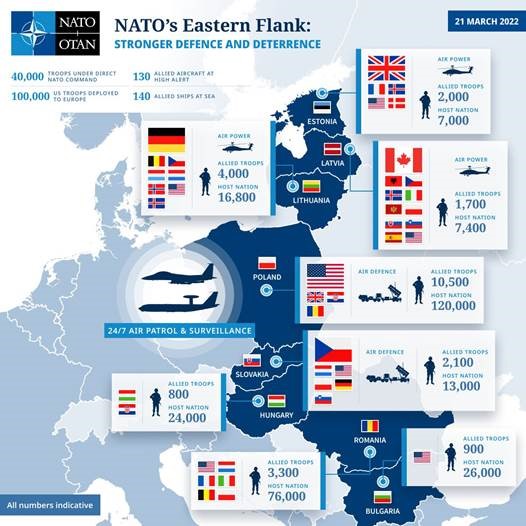
At that time, the Enhanced Forward Presence was a relatively new mission--four countries led small contingents of NATO troops in Estonia, Latvia, Lithuania, and Poland (UK, CA, Germany, US respectively).  This force was, despite all the denials, a tripwire--that any Russian attack would kill Americans and Brits and Germans and Canadians and  many other NATO soldiers, which might then trip a serious response that could lead to things spiraling out of control.  Now, the contingents are all somewhat larger and are on their way to being brigade size--3000 per spot and four more spots (Hungary, Slovakia, Romania, and Bulgaria).  The claim/aim is now that these contingents will be more focused on defending these countries, thwarting Russian aggression rather than just deterring it. 

Today, we first met with a Latvian Major in their defense headquarters. He started off by showing a 2016 amendment to their national security law that had two key features: 1) in case of surprise attack, any/all Latvian commanders shall engage in defensive efforts without waiting for orders; 2) resistance cannot be forbidding. The former was a lesson from Crimea--that if Russia blocked the comms, the local forces would still react, rather than waiting for orders.  I had heard something a few years ago that suggested this was the case, and this was good deterrence signaling.  That an effort to establish a fait accompli wouldn't work here.  The second piece was a lesson from WWII where their leader surrendered to Stalin.  I also learned that they re-started conscription this month, but they may not need it if they get enough recruits.  

Things have gotten complicated as Canada is a Framework Nation, which means it leads a multinational unit within a Latvian brigade, while the Danes are leading a NATO Multinational Division-North, which includes the other Baltic countries.  

I asked how the Canadians in Latvia compared to the Brits in Estonia and Germans in Lithuania, and the response was quite favorable to the Canadians (although the major knew he was talking to Canadians so 🤷).

We had a great lunch at a gas station across the street from the base (the food situation at this base is pretty strange), and it was really quite tasty.  

We then met with Colonel Kirstein, who spent a lot of time chatting with us along with his command team.  Canada now has 10 partners in their battlegroup, and the problems are still focused on differing alky and leave policies as I had heard in 2017.  Force generation (which is begging countries to give troops to the multinational force, as Dave and I found out in our book on NATO) still is hard, as the move from Battlegroup to Brigade means more troops and more competition for these troops since every one needs more and a few of those in Canada's space are leading some of the missions.  One of the big differences between EFP and Afghanistan is that most of the force generation in the latter was done by top officials at NATO (SACEUR, Deputy SACEUR, Obama), and for the battlegroup in Latvia, Canada is doing the begging.

So, I asked, how can Canada do this with far less political capital/coercive capability than the US?  The answer in part was working with Canada is precisely attractive because of the absence of strings.  Also, since Canada is not Germany, it also does not present any EU strings or complications.  My own view of Canada's position here is accidental--by being chosen last to lead one of the first four, Canada got the less useful allies.  Tiny contingents from Montenegro and Albania and North Macedonia.  But this has become sold as a plus (and probably is plus-ish)--that Canada is good at managing the complexities of many countries operating in one spot.  I did ask about caveats, and they certainly exist, and the Colonel is tracking them.  Some countries need permission from home, for instance, if they want to train outside of the Latvia base.  

One of the challenges here is that there was resistance to permanent NATO basing in the Baltics as this would violate the NATO-Russia Founding Act.  What's that?  In my view a dead, dead, dead piece of paper.  I have been asking about this for years, and I did hear previously that the Germans recognizing its dead parrot-like state because they want to keep some institutions that they can build on some day.  Today, it was articulated that NATO does not be the one killing the agreement.  I retorted that NATO is the coroner, not the killer, declaring that the time of death was 2014, and the cause of its death was Russian aggression in Crimea.  Anyhow, the way it works with Canada is that it has a three year agreement with Latvia, and it got renewed last year.  This prevents long term planning, because you can't build a schedule out several years.  Which means, for instance, while there might be some major advantages to making the Canadian mission here like ye olde Cold Warre deployments--have troops come over for three years with their families, build schools for the kids, and just settle in for the long haul--it ain't gonna happen.

My colleagues asked a variety of sharp questions about tradeoffs between sending arms carried by Canadians to Latvia versus sending arms to Ukraine to be wielded by the folks there, whether the government understood what it committed to when it agreed to move to a brigade-sized force in Latvia, can Canada do strategic communications (no), and, of course, where we should drink beer.

We have a day at the battlegroup tomorrow, two days of Strategic Communications conference, and then a day meeting folks at the Latvian MoD (time to ask questions about my next project) and the Canadian embassy before hanging out with the cool kids at the NATO Field School, which is run by a CDSN Co-Director--Alex Moens.  

I have already learned a lot, and will continue to drink from the fire hose tomorrow.  This stuff touches on past research (my IR of ethnic conflict stuff way back when, my NATO stuff) and my current stuff (who is minding the store?).  And, no, I have not yet started a crisis among allies.  But I have several days left.