Hitler was really bad. Like really, really bad.
That's it. There is no "hey, he was a man with a plan that got out of hand" b.s.
Friday, February 8, 2019


Thursday, February 7, 2019
Confront or Appease: Canada (and Others) Face Tough Choices
Canada is facing a tough time as of late (the Economist agrees), which will be much fodder for this year's elections up here. In yesterday's post and in my talk with the diplomatic community in Ottawa, I raised a key question that Nicolas Kristof also raises: as we face more challenges to the rules-based international order, what is a country supposed to do? Appease or confront? Critics of Trudeau, including the former Prime Minister have advised that Canada should give in to Trump, to China, to the Saudis. At other times, these folks have said that Canada should not appease them. What is Canada doing? What should it do? Is it really a model for the world as Kristof suggests?
To be clear, as I have argued and as much IR scholarship argues, bullying produces backlashes, that it is counterproductive, but countries have a choice about whether and how to be part of that backlash.
The key is this: there is no one obvious way to do this. While the whole "never appease aggressors" thing was a lesson learned after World War II, it was overlearned. Sometimes, giving an aggressive country something of what it wants actually does address the grievance and prevents the escalation of conflict. Sometimes, however, it encourages the aggressor to do more. The challenge for Canada, for Germany, for Japan and others is that there are multiple bullies out there now, and they have varying appetites: Trump, China, Russia, and the Saudis. Yes, there may be others, but these are the most visible and most relevant at this moment (call me when we really care what Bolansaro's Brazil does on the world stage).
The revision of NAFTA occurred through a drawn out process where Trudeau and Canada tried to pander to Trump and pay his family (via helping Ivanka recover her brand). For a while, it seemed to work, but then Trump started getting far more aggressive, including imposing tariffs on steel and aluminum and threatening the Canadian auto industry. Trudeau mostly held his ground--NAFTA 1.01 or USMCA or whatever you want to call the new deal did not give the US much but gives Trump the chance to declare victory. Yet Trudeau was willing to sign it while steel and aluminum tariffs remained in place. Is that appeasement or confrontation? Probably a bit of both, but I think Trump reacted so strongly in tweets and statements because he thought he could roll over Canada and Trudeau, and he found out that he could not. The question now is, if the deal gets ratified, will Trump come back for more? Will Trump ever drop the tariffs? So far, Trudeau's mixture of pandering, accepting reality (NAFTA 1.01), and pushing back on Trump's more outlandish statements seems to be the least bad way to respond.
China? Oh my. China has pushed back very aggressively after Canada responded to a US request to extradite a key Huawei official, taking hostages. Whatever one makes of the McCallum statement and then firing, it looks like Canada is not going to hand over this woman to the Chinese. Which means any progress on a trade deal or anything else is mostly dead. Canada didn't ask for this, but is now stuck.
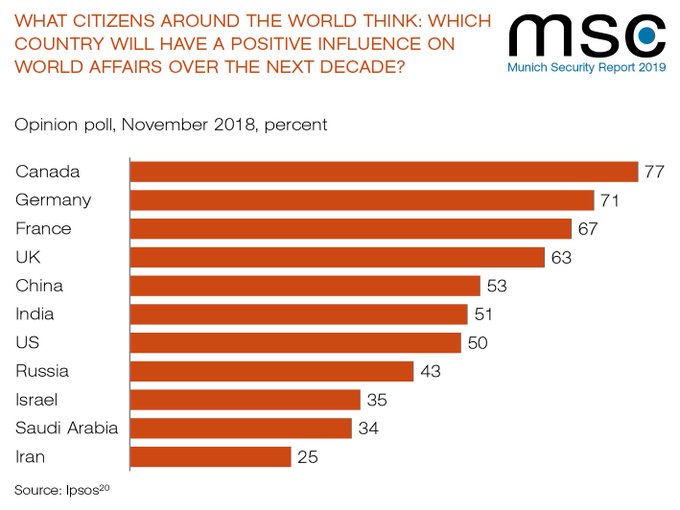 What does it mean? Well, the good news is that s that folks around the world see Canada positively:
Opposing the bullies, who are near or under water, is good for Canada's reputation apparently. It is probably not bad for domestic politics, as it will be hard for the Conservatives or NDP to argue that the Liberals should have been more willing to appease Trump, given the outcome thus far and reality that Trump is not easy to manage or that the Liberals should have ignored its legal obligations re extradition. Indeed, now the Liberals have an excuse for what was a botched effort to engage China. And maybe, just maybe, this might lead to improving relations with India despite the messy trip there.
A Canadian-German alliance against bullies and, ironically, against appeasement may not be a bad way to help buttress the international order. Kristof overstates the Canadian role, but this is a role that serves Canada's interests and is not bad for domestic consumption.
To be clear, as I have argued and as much IR scholarship argues, bullying produces backlashes, that it is counterproductive, but countries have a choice about whether and how to be part of that backlash.
The key is this: there is no one obvious way to do this. While the whole "never appease aggressors" thing was a lesson learned after World War II, it was overlearned. Sometimes, giving an aggressive country something of what it wants actually does address the grievance and prevents the escalation of conflict. Sometimes, however, it encourages the aggressor to do more. The challenge for Canada, for Germany, for Japan and others is that there are multiple bullies out there now, and they have varying appetites: Trump, China, Russia, and the Saudis. Yes, there may be others, but these are the most visible and most relevant at this moment (call me when we really care what Bolansaro's Brazil does on the world stage).
The revision of NAFTA occurred through a drawn out process where Trudeau and Canada tried to pander to Trump and pay his family (via helping Ivanka recover her brand). For a while, it seemed to work, but then Trump started getting far more aggressive, including imposing tariffs on steel and aluminum and threatening the Canadian auto industry. Trudeau mostly held his ground--NAFTA 1.01 or USMCA or whatever you want to call the new deal did not give the US much but gives Trump the chance to declare victory. Yet Trudeau was willing to sign it while steel and aluminum tariffs remained in place. Is that appeasement or confrontation? Probably a bit of both, but I think Trump reacted so strongly in tweets and statements because he thought he could roll over Canada and Trudeau, and he found out that he could not. The question now is, if the deal gets ratified, will Trump come back for more? Will Trump ever drop the tariffs? So far, Trudeau's mixture of pandering, accepting reality (NAFTA 1.01), and pushing back on Trump's more outlandish statements seems to be the least bad way to respond.
China? Oh my. China has pushed back very aggressively after Canada responded to a US request to extradite a key Huawei official, taking hostages. Whatever one makes of the McCallum statement and then firing, it looks like Canada is not going to hand over this woman to the Chinese. Which means any progress on a trade deal or anything else is mostly dead. Canada didn't ask for this, but is now stuck.
Saudi Arabia? Ah, this is one Canada has chosen and keeps on choosing. Perhaps Canadian officials didn't think that a tweet would lead to such a backlash, but it has. And what does Canada do? It welcomes a Saudi teen who desperately wants asylum. It does not stop selling armored vehicles because, well, the previous government signed an onerous contract and there are jobs at stake in Ontario. But, in pretty much every other public way, Canada is responding to Saudi bullying by standing firm. Again, aside from arms sales, this is not that hard to do since Canada does not really depend on the Saudis, and the Saudi sanctions have pretty much wiped out any incentive to play nicely with the Saudis. The Saudis are making themselves very unpopular, so this policy does not have the steep costs that conflict with China has or antagonizing Trump.
Opposing the bullies, who are near or under water, is good for Canada's reputation apparently. It is probably not bad for domestic politics, as it will be hard for the Conservatives or NDP to argue that the Liberals should have been more willing to appease Trump, given the outcome thus far and reality that Trump is not easy to manage or that the Liberals should have ignored its legal obligations re extradition. Indeed, now the Liberals have an excuse for what was a botched effort to engage China. And maybe, just maybe, this might lead to improving relations with India despite the messy trip there.
A Canadian-German alliance against bullies and, ironically, against appeasement may not be a bad way to help buttress the international order. Kristof overstates the Canadian role, but this is a role that serves Canada's interests and is not bad for domestic consumption.
Wednesday, February 6, 2019
Foreign Policy in the 2019 Campaign?
Some elections are closer than others. While many eyes are focused on the veritable cornucopia of candidates for the Democratic nomination for the 2020 Presidential campaign (and some are wondering if the GOP will allow Trump to face any competition for that party's nomination), here in the north, we have an election in the fall. Sure, Canada has a much shorter official election season--the PM will call the election this summer, but the campaign is already underway.
I have been asked to join a panel of three members of parliament today to speak to a gathering of diplomats based in Ottawa by the Pearson Centre for Progressive Policy. This, of course, will test my ability to address everyone with their appropriate titles. My role is to suggest some of the foreign policy issues that might play in the campaign in the summer/fall. My first response, of course, is that foreign policy won't play much as Canadian voters, like American voters, focus far more on economic issues--jobs, wages, inflation, etc. My second response is that because Canada is a much smaller country with far more of its economy dependent on international dynamics, economic policy is foreign policy and vice versa.
Anyhow, here is what I am going to talk about, with much thanks to Phil and Roland for chiming in on stuff that I might have overlooked.
What am I forgetting? Anything I should sub out and put something else in? Note, no Russia here, but that could be subsumed in a "how about them bullies?" question. I will mention election security and whether the Canadian parties will do better (like France) or worse (like US) in cooperating to confront that challenge.
I have been asked to join a panel of three members of parliament today to speak to a gathering of diplomats based in Ottawa by the Pearson Centre for Progressive Policy. This, of course, will test my ability to address everyone with their appropriate titles. My role is to suggest some of the foreign policy issues that might play in the campaign in the summer/fall. My first response, of course, is that foreign policy won't play much as Canadian voters, like American voters, focus far more on economic issues--jobs, wages, inflation, etc. My second response is that because Canada is a much smaller country with far more of its economy dependent on international dynamics, economic policy is foreign policy and vice versa.
Anyhow, here is what I am going to talk about, with much thanks to Phil and Roland for chiming in on stuff that I might have overlooked.
- USMCA and All That Jazz: The focus of Canadian foreign policy is always its relations with the US. The Trudeau government came into power thinking that this important file would be relatively straightforward. Trudeau had a good relationship with Obama, and, while folks thought that the relationship might not be so friendly with Hillary Clinton as President, it would not be that difficult either. Ooops, Trump. We forget since time in the Trump era is funky, but it was not that long ago that folks thought that Trudeau had managed to be the Trump whisperer via a good mix of pandering and pay to play. Trudeau lent Ivanka some credibility when her brand was failing. Anyhow, once Trump focused on NAFTA, things turned sour quickly, leading to more than a year of drama and tension. What did the Liberals get out of it? USMCA, a mediocre deal. Which leads to two questions for the parties in the fall?
- Could they have done better than what the Liberals got either through accommodation or more aggressive stances (Conservatives have said at different times that they would have done both)?
- What will they do when Trump returns to this issue and demands more?
- Speaking of bullies and how to respond, the second most important relationship these days is with China. Hoping to diversify Canada's trade situation and reduce dependence on the US led Trudeau to seek a better trade situation with China. That was going poorly before the US asked Canada to extradite an Huawei official. Now, China is literally taking hostages. So, again, what would the parties have done and what will they do to deal with China as China becomes more aggressive not just with Canada but with everyone?
- Speaking of bullies, how about that Saudi deal? The Conservatives inked an incredibly bad contract that stuck the Liberals with the difficult situation of selling arms (and thus paying the bills for some jobs in Ontario) for the Saudis to use as they act in most unhumanitarian ways. So, what to do about this lousy relationship? Yes, the opposition parties will blame the government for upsetting the Saudis by criticizing its human rights policies, but in the aftermath of the Khashoggi murder, how should Canada handle its bully problem there? (I am sensing a theme)
- The last issue I will bring up (as I will have finite time and the Canadian media/electorate have limited attention span) is Mali/UN. What did Canada get out of it? What will Canada do next as it rotates its helicopter unit from Mali this year? How is the quest for a UNSC seat going and what would the various parties do to improve it?
What am I forgetting? Anything I should sub out and put something else in? Note, no Russia here, but that could be subsumed in a "how about them bullies?" question. I will mention election security and whether the Canadian parties will do better (like France) or worse (like US) in cooperating to confront that challenge.
Monday, February 4, 2019
A 20 Year Plan? I Don't Have A Plan for Next Week
One of my favorite people, Sara Mitchell, was tweeting about falling short in her aspirations for 2019.
I made fun of her sending out only two papers to journals and so forth, but what got my attention was her not making progress on a twenty year plan to carry her through the rest of her career. Which got me thinking about academics planning ahead and maybe use this as an opportunity to force me to think about my future.
Have I ever really planned my career? Um, no and yes. Here are two of my "plans":
Anyhow, while the first book was definitely planned, the next steps were not--spending a year in DC on the Joint Staff was something that interested me as I thought about the possibility. I didn't plan that to be the launching point for a new job or new research agendas. It was just something that I thought would be cool (and would allow Mrs. Spew to be closer to family for a year) and might help my career. I had no idea what I was getting into. Moving to Montreal? A great opportunity but I didn't plan to move there, I just tried to get out of Lubbock. I didn't plan to move from TTU--I just kept trying. There was not much strategy besides publish more and keep on trying. Which was pretty much my "plan" for moving on from McGill and Montreal. Indeed, my application to NPSIA was mostly aimed to meet people, make an impression (a good one, I hoped), and practice the job talk. Because of the nature of the job, I didn't think I had a shot. And I didn't--they gave me a different job. So, not much of a plan.
But now that I am settled, what is my plan for the rest of my career besides "wait for sabbatical, take sabbatical, etc?" Glad you asked as it forces me to think about it. And I have done some thinking. Just as I don't think about a book each day as I write a piece of it, I tend to break things down. So, there are a few key cycles that may help organize the next twenty years (I do plan to retire in about 18 years, more or less, depending on economic cycles, changing incentives, etc--to be at Carleton for about 25 years): grant cycles, Paterson Chair renewal, and book ideas. These are all related.
Apply for new grant funds (Success; plans for Minerva app)— Sara Mitchell (@sbmitche) February 4, 2019
Develop new online civil war class (Success, working on it!)
Spend more time with friends (Success!)
Come up with a 20 year plan to manage rest of career (Fail so far)
Better organization of the IR dart club (Success)
/2
I made fun of her sending out only two papers to journals and so forth, but what got my attention was her not making progress on a twenty year plan to carry her through the rest of her career. Which got me thinking about academics planning ahead and maybe use this as an opportunity to force me to think about my future.
Have I ever really planned my career? Um, no and yes. Here are two of my "plans":
A) Publish my dissertation as a book and get some articles published so that I can get tenure.
B) Wait for sabbatical, take sabbatical, wait for sabbatical, take sabbatical, .... retire.Plan A was what I imagined the tenure track to be, and it pretty much was even though I was in a department that valued articles far more than books. TTU did provide some incentives/feedback/coercion along the way so that I ended up applying for more grants--that as an institution, it wanted to be ranked as a reseach institution, so that meant more grant money. But really, my focus was at first just on getting the minimal number of pubs that would help me get tenure at TTU AND make me marketable to get out of Lubbock. That is where the book came in. Also, I later learned via observation of others that the best way not to get tenure is not to publish your dissertation.
Anyhow, while the first book was definitely planned, the next steps were not--spending a year in DC on the Joint Staff was something that interested me as I thought about the possibility. I didn't plan that to be the launching point for a new job or new research agendas. It was just something that I thought would be cool (and would allow Mrs. Spew to be closer to family for a year) and might help my career. I had no idea what I was getting into. Moving to Montreal? A great opportunity but I didn't plan to move there, I just tried to get out of Lubbock. I didn't plan to move from TTU--I just kept trying. There was not much strategy besides publish more and keep on trying. Which was pretty much my "plan" for moving on from McGill and Montreal. Indeed, my application to NPSIA was mostly aimed to meet people, make an impression (a good one, I hoped), and practice the job talk. Because of the nature of the job, I didn't think I had a shot. And I didn't--they gave me a different job. So, not much of a plan.
But now that I am settled, what is my plan for the rest of my career besides "wait for sabbatical, take sabbatical, etc?" Glad you asked as it forces me to think about it. And I have done some thinking. Just as I don't think about a book each day as I write a piece of it, I tend to break things down. So, there are a few key cycles that may help organize the next twenty years (I do plan to retire in about 18 years, more or less, depending on economic cycles, changing incentives, etc--to be at Carleton for about 25 years): grant cycles, Paterson Chair renewal, and book ideas. These are all related.
- The major grant agency here is the SSHRC, and the primary grant, the Insight Grant, funds five years of research. So, I tend to think of things in terms of five-year projects. While it generally takes me longer than five years to publish a book, most of the research and writing does take about five years. So, the real question is whether I have three or four book ideas lined up, and the answer is: hell no. I tend to think only one book ahead of the current book project. I have an idea for the next project, and a faint idea for the one after that, but as I learn stuff, my curiosity changes and my attention shifts, so I cannot be certain that these will be the projects until I start writing the next grant application.
- The Paterson Chair is not a lifetime thing, but renewable every five years. I like the money and title and all that comes with the chair, so I will keep aiming to produce enough to be renewed. Which means trying to produce enough articles and grants over each five year period to be worthy of renewal. The overlap in this cycle and the SSHRC cycle is not perfect, but they are in enough harmony that they will not crash into each other.
- There is another grant cycle that may or may not matter--if the CDSN is funded this spring, that will mean seven years of administering the grant and heaps of work focused on Canadian defence and security (it would also pretty much ensure the next Paterson Chair renewal)--that might shift my next book project's topic as I get exposed to all kinds of questions and research agendas. It would almost certainly lead to more edited volumes and special issues. Oh, and getting it would probably defer for a few years a significant increase in department service (directing a graduate program or the entire school would probably have to wait).
- Then there is that sabbatical cycle, which is a real thing. My real plan there is for the next one (in about five years) to be a teaching one--where I go someplace, teach and use that as a base to travel to explore an interesting part of the globe. But that may change, depending on whether my next project requires me to use that year in a different way. The key is this: I have probably two sabbaticals left in my career. Unless I stick around past age 70 to get one more sabbatical. These are great opportunities so I will have to figure out how to maximize them.
Saturday, February 2, 2019
Japan's New Carriers: Why Am I Concerned?
 |
| From the National Interest. |
That is, why is Japan doing this? I raise that simple question. Folks think the answers are obvious:
a) China is bad and spending heaps on a larger navy
b) Trump is unreliable so Japan needs carriers more now than before.
And my response to these answers is this: how do carriers solve these problems? Maybe they do, maybe they don't. But my study of Japanese civil-military relations suggests that damn few civilians are asking any questions at all.
I have submitted a piece to a journal about Japan and its recent investment in amphibious capability, arguing that this is a way for the Army to continue to get funding but not a good thing for Japan's security (see this draft presented at the EISA). I am not sure whether I see the carriers in the same light, but am tempted to do so. That the Navy might want them because it would be good for the Navy's image, autonomy, budgets, etc--basic bureaucratic politics. But how does it fit into Japan's grand strategy?
 Given where Japan sits--close to Korea and within range of China's missiles and all that, what good would the carriers do AND what are the tradeoffs and consequences? First, the latter: the helo carriers were anti-submarine platforms. Japan had a nice division of labor, given the restriction on offensive capability (Article 9 of its Constitution has been reinterepreted but not revised), where the Maritime Self-Defence Force could protect the US ships that would be doing the striking. So, if Japan puts a bunch of planes on the carriers, this means fewer helos on these ships--space is finite. Second, like the amphibious forces, the development of aircraft carriers scares the neighborhood since the last time Japan had carriers, well, things did not go well for the neighbors. Sure, that is 80 years ago or so, but memories of WWII have been kept alive and shape perceptions far more in East Asia than in Europe. So, there are some consequences for having carriers--it is not a cost free thing. Japan's defense budget is relatively fixed at 1% of GDP, and Japan's economy has been stagnating more or less for a couple of decades.
Ok, what can F35-bearing carriers do for Japan? Um..... Not sure. Japan can reach Korea and the seas off of Japan with land based planes. They can build more air bases on their chain of islands that reach down a far way. See the typical Japanese map of the region makes it clear that Japan's islands contain China--maybe the better investment is in anti-air and anti-ship missiles?
Would it make sense to send these carriers to the South China Sea? Um, only if the Japanese want them sunk in a time of war. The US is already pondering whether its carriers could survive there, and they have a wee bit more capability in both directions--to attack and to defend. Where else can these carriers go? Pearl Harbor? Oops. Again, the basic question is whether the plan to modify these ships and buy F35Bs fit into Japan's larger grand strategy--what is the master plan for defending itself and where do the carriers fit in? There may be good answers to this, but I don't know if any one is asking or answering these questions. I do know from my interview work in Japan over the past few years that it is unlikely that anyone in the Diet (Japan's parliament) is asking these questions, that the Ministry of Defense is far more focused on protecting the Self-Defense Forces from scrutiny, that the Minister of Defense is rarely around long enough to know much about the SDF, and that the only actor who has the access and power to shape the SDF is usually too busy to spend much attention--the Prime Minister. The media? Tends not to ask difficult questions. Think tanks? Not quite the same vibrant think tank culture in Japan on defense issues as in the US, UK or even Australia.
So, this random academic is just asking: what the hell are these carriers going to do and what are the consequences? Maybe it is a great idea, but I tend to bet on bureaucratic politics, which might be good for vetting policy (see this paper) but not great for procurement.
Friday, February 1, 2019
An Old But Still Relevant Whine: Read My First Book!!!
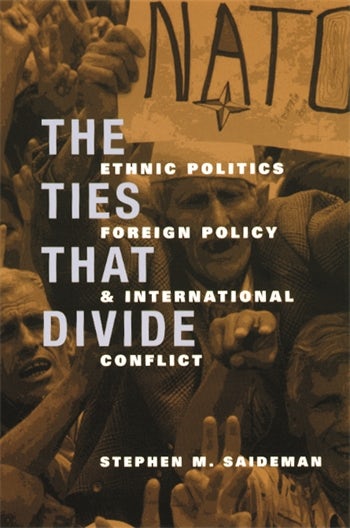 Yesterday, a twitter thread developed about people whining about their first books and why no one pays attention. Well, I haven't whined about The Ties That Divide in some time, so I felt I was due. cheap used, surprisingly not cheap kindle price). So, why should we care about that dusty volume?
That and because the book preceded this blog by about eight years, I never ruthlessly promoted it (
Because, damn it, it did not kill the conventional wisdom with fire:
I haven't read your book but the four introductions to African politics I've read for courses puts forth this explanation for the norm expressed in Article III of the OAU charter, and claiming that Somalia was the only explicitly irredentist state in Africa.— Greg Olsen (@gtotango) February 1, 2019
For gosh sake, jeez, Somalia might have been the only explicitly irredentist state in Africa at the time BUT African countries still did support secessionism on the continent AND Somalia was vulnerable to secession--Somaliland did not just happen out of nowhere.
I first started doubting this conventional wisdom when I noticed that vulnerability to separatism didn't stop either Pakistan or India from supporting separatists in their neighbors. I decided then to compare Africa to South Asia to find out why the norms developed in one place and not the other--it might say something about when Liberal arguments prevail and when Realist dynamics seem to matter more. Then I noticed that in each African secessionist crises, some countries supported secessionsts. Ooops. Sure, more supported the host state, but those supporting secessionists included those with their own secessionists. In the dissertation, I looked at the Congo Crisis of the early 1960s and the Nigerian Civil War as well as the secession of Bangladesh.
I also analyzed Somalia's behavior as the one irredentist country in Africa, and realized pretty quickly that Somalia had its own separatist issues. More obvious now with Somaliland, but even pretty obvious way back when as Northern and Southern Somalia were governed by different colonial powers, which is often a recipe for secessionism. Not to mention that the whole idea of Somalis being unified by a language and by religion and all that ignored deep clan divisions, which, again, became more obvious after 1991 but were always known to scholars of Somalia.
I dropped the creation of Bangladesh when I revised the dissertation into a book for two reasons: a) it was really about India and was not so comparable; and b) while I was working in my first job, a newer and more relevant country imploded so I could show how the dynamics applied not just in the 1960s in Africa but in the 1990s in Europe. So, Yugoslavia worked out as a case, where I again found countries willing to support separatism despite being vulnerable to it. Most notably, Croatia was supporting irredentists in Bosnia as it was combating Serbian irredentists in Croatia.
Oh, and another addition to the manuscript: quantitative analyses that showed that vulnerability to secession did not stop states from supporting secessionists. I published that separately at JPR and then tested it dyadically in a piece that was accused of plagiarizing Saideman but eventually got revised and published in CJPS (I can send interested parties PDFs of these pieces if you can't get beyond the gated access). Not only do the findings support my argument about ethnic ties mattering quite a bit, but that vulnerability is associated with more support, not less.
Anyhow, one of the questions about blogging is whether one should repeat what one has said before. The reluctance to do so has had an impact on my blogging--I don't blog as much as I used to. However, as some have reminded me, folks may not have read my earlier posts, and, of course, this also applies to earlier work. As a result, here I am post-promoting my first work, in part because the conventional wisdom about the international relations of secession is still, alas, conventional wisdom. Vulnerability does not deter support for separatists... not then and not now.
Wednesday, January 30, 2019
Intel Folks? Do Dems Trust Too Much?
One of the pushbacks I get from time to time when discussing FBI/CIA/NSA stuff, like yesterday's Trump performance of running directly against the intel community's findings on Russia (bad), North Korea (not disarming), Iran (not so bad) is that the intel folks got 2003 wrong.
Um, not quite and what they got wrong was partly on Hussein. Huh? First, there were a lot of reports before the war. The intel community did not have a consensus that there was a nuclear weapons program in Iraq. What mattered was that there were enough hints and rumors that a motivated person could extract those and make a case for a WMD program that needed to be attacked. Oh, and that person was Dick Cheney. He cherry-picked the intel to find the stuff he wanted to find. In my interactions with military folks, they like to say that intel drives policy--that the info drives what the country/unit should do. In the case of 2003, it was very clearly the case that policy--we need to attack Iraq--drove intel: "hey, lookie, this says that there might be a chance Hussein is pursuing WMD!"
Moreoever, Hussein did little to dissuade folks because his strategies to both stay in power and deter the neighbors. That is, Hussein created heaps of ambiguity about the weapons programs inside the country, with many military officials wondering mid-war why these capabilities were not being deployed, so that potential opponents within Iraq would be frightened of him. Likewise, after the failed war with Iran and other foreign misdventures, he wanted to deter the outsiders. Of course, it was a dumb move since aspiring to develop WMD puts a target on one's country. The point is that the confusion in 2003 about what Iraq was doing was partially intended by Hussein.
The intel community might have gotten wrong how fragile Iraq was, that it would be hard to govern after an invasion--I am not sure about that since it has gotten less coverage. But the intel about WMD was gamed by the White House and Rummy's shop and not by the CIA or NSA.
Sure, folks were upset about what the NSA has been doing thanks to Snowden. And, yes, the FBI has not been a force for social justice. So, none of these agencies have been loved by Liberals and those further to the left. However, those who want a sensible foreign policy tend to want to have functional intel agencies--knowing more about the world is usually conducive to better policy. As it turns out, the intel agencies, despite much efforts by the Trump administration to politicize them, are still mostly reality based organizations who have clearer eyes about what Russia/China/North Korea/Iran are doing. That their reports are dismissed by Trump is a tell--that he would rather do what he wants rather than what the US national interest happens to be. Trump does not like folks to disagree with him, but disagreeing with the intel agencies is inevitable if one is deliberately and inherently ignorant.
This leads to a strange dynamic where the enemy of my enemy is my friend, so Liberals have reduced their criticism of the intel agencies despite the FBI leaking to the GOP about HRC and on and on and have embraced these organizations, even has they have done much that is not so nice in the past (and present). For me, this is where I tend to be more centrist--that foreign policy requires secrets, requires trying to read the mail of the adversaries, and even sometimes requires subversion and violence.
Anyhow, this is a longer post than intended. The key is this: 2003 is not a good way to de-legitimate the secret squirrels who are putting out reports in 2019. It is a good way to to criticize the GOP, which has been the party of ignorance for more than just the Trump administration. The difference is now it is not in service of a convoluted view of the national interest but is an effort to reduce Trump's vulnerability to prosecution.
Um, not quite and what they got wrong was partly on Hussein. Huh? First, there were a lot of reports before the war. The intel community did not have a consensus that there was a nuclear weapons program in Iraq. What mattered was that there were enough hints and rumors that a motivated person could extract those and make a case for a WMD program that needed to be attacked. Oh, and that person was Dick Cheney. He cherry-picked the intel to find the stuff he wanted to find. In my interactions with military folks, they like to say that intel drives policy--that the info drives what the country/unit should do. In the case of 2003, it was very clearly the case that policy--we need to attack Iraq--drove intel: "hey, lookie, this says that there might be a chance Hussein is pursuing WMD!"
Moreoever, Hussein did little to dissuade folks because his strategies to both stay in power and deter the neighbors. That is, Hussein created heaps of ambiguity about the weapons programs inside the country, with many military officials wondering mid-war why these capabilities were not being deployed, so that potential opponents within Iraq would be frightened of him. Likewise, after the failed war with Iran and other foreign misdventures, he wanted to deter the outsiders. Of course, it was a dumb move since aspiring to develop WMD puts a target on one's country. The point is that the confusion in 2003 about what Iraq was doing was partially intended by Hussein.
The intel community might have gotten wrong how fragile Iraq was, that it would be hard to govern after an invasion--I am not sure about that since it has gotten less coverage. But the intel about WMD was gamed by the White House and Rummy's shop and not by the CIA or NSA.
Sure, folks were upset about what the NSA has been doing thanks to Snowden. And, yes, the FBI has not been a force for social justice. So, none of these agencies have been loved by Liberals and those further to the left. However, those who want a sensible foreign policy tend to want to have functional intel agencies--knowing more about the world is usually conducive to better policy. As it turns out, the intel agencies, despite much efforts by the Trump administration to politicize them, are still mostly reality based organizations who have clearer eyes about what Russia/China/North Korea/Iran are doing. That their reports are dismissed by Trump is a tell--that he would rather do what he wants rather than what the US national interest happens to be. Trump does not like folks to disagree with him, but disagreeing with the intel agencies is inevitable if one is deliberately and inherently ignorant.
This leads to a strange dynamic where the enemy of my enemy is my friend, so Liberals have reduced their criticism of the intel agencies despite the FBI leaking to the GOP about HRC and on and on and have embraced these organizations, even has they have done much that is not so nice in the past (and present). For me, this is where I tend to be more centrist--that foreign policy requires secrets, requires trying to read the mail of the adversaries, and even sometimes requires subversion and violence.
Anyhow, this is a longer post than intended. The key is this: 2003 is not a good way to de-legitimate the secret squirrels who are putting out reports in 2019. It is a good way to to criticize the GOP, which has been the party of ignorance for more than just the Trump administration. The difference is now it is not in service of a convoluted view of the national interest but is an effort to reduce Trump's vulnerability to prosecution.
Sunday, January 27, 2019
Conference Strategery: Banffing It Up
After the conference in Calgary, I drove to Banff, which serves as a base area for my forays into the mountains--skiing, that is--at Lake Louise. As with everything, it was a learning experience. I shall listicle since that seems to be my twitter tendency this week.
I was here last year, again due to an academic trip to Calgary. I didn't see much of the mountain or the views last time since it was snowing heavily. This time? Beautiful:

- Flat light is bad when there is clumpy snow. I ended up having a few spills as I slammed into some unexpected snow clumps.
- There is a reason we have chair lifts--the old alternatives sucked mightily. I took a "platter" (seemed like a j-bar) to me up the highest peak. I wanted to do one of the winding back of the mountain routes. Which leads to the next lesson.
- Trailed named boomerang will.
- Chocolate milk remains superior to hot chocolate as the apres-ski beverage unless it is super cold and it was not.
- When one is tired enough to nearly fall asleep on the chair lift, it is time to quit.
- No need to let ego get in the way--many green (less advanced) runs can be much fun. Lake Louise, like Whistler, has a bunch of fun green runs. I spent most of the day on blue runs, but the greens were fun. I didn't ski on any black runs, as I didn't run across any that were bumpless. No moguls for this guy's knees.
- Banff has much to offer as well. Lots of good restaurants, much souvenir shopping, some history as the local hot springs helped generate Canada's first national park, and, yes, more beautiful mountains.
I was here last year, again due to an academic trip to Calgary. I didn't see much of the mountain or the views last time since it was snowing heavily. This time? Beautiful:

As a friend of mine put it, I live a charmed life. That I can do side trips like this is so very fortunate. While my listicle might seen like a bit of whining, I really appreciate where my life is now.
As Joe Walsh has said,
Saturday, January 26, 2019
The State of Canadian Defence and Security Studies
I was in Calgary the past couple of days for a conference on the State of Canadian Defence and Security Studies. There were profs from across Canada, some grad students, reps from the Journal of Military and Strategic Studies, and some folks from relevant funding agencies. Because it was a Chatham House Rules event, I can't cite what individuals said (other than me, of course, see below), but I can give the general gist.
And, well, the mood was fairly grim. Why? Because there is not much hiring these days and not much university support for defence and security stuff. History departments long ago moved away from hiring military historians. Poli sci? Depends. The challenge is that those who focus on Canada are limiting their own careers as work on Canada tends not to published outside of Canada and tends not to get cited. If cites and publishing in top journals are the ways to get ahead, departments may not hire those who choose to write on Canada. Oh, and the end of the Security and Defence Forum about seven years ago hurt the regeneration of the Canadian defence and security community.
I was not so grim for a couple of reasons. First, Carleton and NPSIA has built defence/security as a key strength--there have been new positions created (mine, for one) and retirements/departures have been replaced. Second, I think there is a pathway to getting good pubs and cites for those who study Canada: either compare with other cases or work with others elsewhere. The basic reality is that most folks are disinterested not just in Canada but in many countries--there are few countries that are viewed by many as intrinsically interesting--US, Russia, China and a few others. So, scholars of Australia or Belgium or many others are more likely to publish more visible work in partnership. This may not work for other people, and it may be a product of my biases--I have always engaged in comparative work. Third, there is the CDSN.
I presented the status of the Canadian Defence and Security Network. There is a defence and security community, but it is like a body without a nervous system or skeleton. The CDSN would help energize the community, work with a variety of partners, and build the next generation. So, let me talk through the slides I presented.

The CDSN builds on but does not replicate the old SDF research centers, adding units from schools that were not involved before and CIRRIQC (a Quebec network that didn't exist in the old days). The members include not just political scientists and historians but also sociologists, psychologists, and folks from yet other disciplines. We have had government agencies involved all along the way, with members of the leadership team including a defence scientist and a prof from the Canadian Forces College. We have involved non-gvernmental organizations and think tanks interested in defence/security. We include groups that will improve our ability to involve women (WIIS-Canada) and, well, Bridge the Gap between academics and policy-types. We have also built on our individual networks to connect to institutions in the US and Europe.
 What do we seek to do? To build a network--so that scholars and elements of civil society and the government know what research is being done, what questions folks want answered, and foster teamwork within and across various divides. To share data so that there is less duplication and we get more bang for our research buck. To engage the public so that the citizens understand better this critical sector. And, yes, to regenerate but do so in ways that are more inclusive.
 How? We have five themes to serve as focal points: defence procurement, personnel issues, operations, civil-military relations and security. Each one will have annual workshops that will focus on specific issues. For instance, the personnel group will focus in the first three years (if we are funded, more on that below) on how to reduce discrimination against women in the Canadian Armed Forces. The civil-military relations node will focus on using surveys (with Nanos (and analysis of social media to assess how the media shapes attitudes and knowledge of the forces. If funded, we w
 ill connect students at all levels with the various CDSN efforts, mentoring, training and giving them fora to present their work. And, yes, connect to the network. It turns out that there are summer institutes on defence/security so our idea is not that original except our aim is to include not just younger academics but also policy officers and military officers--to give each varying perspectives from the other sectors while getting drinking from the firehose of knowledge from the profs in the network. I'll save the Capital Capstone idea for now.
 Where do we go from here? Well, we will know soon whether we will be funded by SSHRC. If so, then we are off to the races. We will also throw our hats into the next DND network grant competition (one bit of news from this conference is that we don't know when that competition will be, so the "this winter" may be spring?).
What challenges do we face? Some may not want academics to interact with the armed forces. I think we have handled that well by not including defence contractors in the partnership and by bringing in groups from civil society who are known to be critical of the CAF and DND. One challenge is that we don't look new because we have been working at it for five or so years.
My presentation was well-received, so we shall see. I feel pretty good about the CDSN's chances. So, that is a key reason why I don't feel grim. That and I drove today to Banff so that I can ski tomorrow!

And, well, the mood was fairly grim. Why? Because there is not much hiring these days and not much university support for defence and security stuff. History departments long ago moved away from hiring military historians. Poli sci? Depends. The challenge is that those who focus on Canada are limiting their own careers as work on Canada tends not to published outside of Canada and tends not to get cited. If cites and publishing in top journals are the ways to get ahead, departments may not hire those who choose to write on Canada. Oh, and the end of the Security and Defence Forum about seven years ago hurt the regeneration of the Canadian defence and security community.
I was not so grim for a couple of reasons. First, Carleton and NPSIA has built defence/security as a key strength--there have been new positions created (mine, for one) and retirements/departures have been replaced. Second, I think there is a pathway to getting good pubs and cites for those who study Canada: either compare with other cases or work with others elsewhere. The basic reality is that most folks are disinterested not just in Canada but in many countries--there are few countries that are viewed by many as intrinsically interesting--US, Russia, China and a few others. So, scholars of Australia or Belgium or many others are more likely to publish more visible work in partnership. This may not work for other people, and it may be a product of my biases--I have always engaged in comparative work. Third, there is the CDSN.
I presented the status of the Canadian Defence and Security Network. There is a defence and security community, but it is like a body without a nervous system or skeleton. The CDSN would help energize the community, work with a variety of partners, and build the next generation. So, let me talk through the slides I presented.

The CDSN builds on but does not replicate the old SDF research centers, adding units from schools that were not involved before and CIRRIQC (a Quebec network that didn't exist in the old days). The members include not just political scientists and historians but also sociologists, psychologists, and folks from yet other disciplines. We have had government agencies involved all along the way, with members of the leadership team including a defence scientist and a prof from the Canadian Forces College. We have involved non-gvernmental organizations and think tanks interested in defence/security. We include groups that will improve our ability to involve women (WIIS-Canada) and, well, Bridge the Gap between academics and policy-types. We have also built on our individual networks to connect to institutions in the US and Europe.


What challenges do we face? Some may not want academics to interact with the armed forces. I think we have handled that well by not including defence contractors in the partnership and by bringing in groups from civil society who are known to be critical of the CAF and DND. One challenge is that we don't look new because we have been working at it for five or so years.
My presentation was well-received, so we shall see. I feel pretty good about the CDSN's chances. So, that is a key reason why I don't feel grim. That and I drove today to Banff so that I can ski tomorrow!
Wednesday, January 23, 2019
Bullies in the Field of IR
When I posted the other day about Bullies in IR, I was referring to leaders/countries making threats hoping to cow others into submission. The IR scholars on my facebook page thought I was going to discuss bullies in the field of IR and were disappointed that I did not. Are there bullies in our field? Absolutely. Should I out the ones that I have observed? Um, I don't know. Yes, there are still costs, even to a full professor, to antagonizing those who wield power in ways that are cruel and abusive, as they might target my students, for instance. There were bullies in each of the departments I have worked, but their impact varied depending on how the larger community reacted. In some places, they were contained/constrained, and, in others, they were empowered.

What kinds of bullying are there? Senior folks picking on junior faculty (I have heard about one sending unsolicited tenure letters to sink the candidacies of scholars elsewhere), majority folks (white, male, etc) picking on less represented groups, profs abusing their power over students (including but not only sexual harassment), profs abusing their staff, etc. Things can work, of course, in the opposite direction, but since power plays a role in much of this, bullying the more powerful seems unsustainable to me.
What motivates bullying? The obvious answer is insecurity, but people can try to push others around for all kinds of reasons--because they enjoy it, because they get stuff out of it, because they have been trained to do so, etc. Impunity certainly plays a role--why change your behavior if there are no consequences?
The problem, of course, is that bullies are successful in creating climates of fear--that they are not outed because people worry that they will face retaliation directly or indirectly by the person or by their friends. Yes, I was willing to out a sexual harasser because I knew the case very well and, well, I knew that he had limited ability to harm me, so it was not so brave.
Some might suggest developing reporting mechanisms that allow for anonymous complaints so that the bully can't target those who blow the whistle. However, anonymity is problematic since it can be used not just to report bullying but to do bullying (see Political Science Rumors and its predecessors).
Within a department, one should be able to find allies to organize collective action (always easier in smaller groups). But that collective action won't go very far if the administration is not interested in improving things. And, yes, administrators may care less about bullying and more about how much money a person brings in or how often their work is cited. I wonder about the incentive structures not just of bullies but those in administrative positions.
Perhaps the most feasible solution in the short term in the profession is rather than calling out the bad actors is to call out the good ones. #academickindness and #scholarsunday and other twitter threads dedicated to identifying the positive influences, the kind people, the non-bullies, may help create positive environments and norms, and provide less space, less implied tolerance of bullying. At least, that is the easiest collective action we can do. As administrators, as convenors of meetings, as hiring committees, and in our other roles, we can reward kindness and punish bullying. Why invite an asshole to one's edited volume project or to one's conference? It is beyond me when I see a particular bully hired again and again. At some point, the reputation should become clear and that people ought not hire such folks even if their work is highly cited. When bullies get to be named President of an association, I am appalled. Can't we do better? Can't we include decency as a criteria?
I have spent far more time studying the role of power in international relations than the role of power and the behavior of bullies in academia, so I am out of ideas. What ideas do folks have?
What kinds of bullying are there? Senior folks picking on junior faculty (I have heard about one sending unsolicited tenure letters to sink the candidacies of scholars elsewhere), majority folks (white, male, etc) picking on less represented groups, profs abusing their power over students (including but not only sexual harassment), profs abusing their staff, etc. Things can work, of course, in the opposite direction, but since power plays a role in much of this, bullying the more powerful seems unsustainable to me.
What motivates bullying? The obvious answer is insecurity, but people can try to push others around for all kinds of reasons--because they enjoy it, because they get stuff out of it, because they have been trained to do so, etc. Impunity certainly plays a role--why change your behavior if there are no consequences?
The problem, of course, is that bullies are successful in creating climates of fear--that they are not outed because people worry that they will face retaliation directly or indirectly by the person or by their friends. Yes, I was willing to out a sexual harasser because I knew the case very well and, well, I knew that he had limited ability to harm me, so it was not so brave.
Some might suggest developing reporting mechanisms that allow for anonymous complaints so that the bully can't target those who blow the whistle. However, anonymity is problematic since it can be used not just to report bullying but to do bullying (see Political Science Rumors and its predecessors).
Within a department, one should be able to find allies to organize collective action (always easier in smaller groups). But that collective action won't go very far if the administration is not interested in improving things. And, yes, administrators may care less about bullying and more about how much money a person brings in or how often their work is cited. I wonder about the incentive structures not just of bullies but those in administrative positions.
Perhaps the most feasible solution in the short term in the profession is rather than calling out the bad actors is to call out the good ones. #academickindness and #scholarsunday and other twitter threads dedicated to identifying the positive influences, the kind people, the non-bullies, may help create positive environments and norms, and provide less space, less implied tolerance of bullying. At least, that is the easiest collective action we can do. As administrators, as convenors of meetings, as hiring committees, and in our other roles, we can reward kindness and punish bullying. Why invite an asshole to one's edited volume project or to one's conference? It is beyond me when I see a particular bully hired again and again. At some point, the reputation should become clear and that people ought not hire such folks even if their work is highly cited. When bullies get to be named President of an association, I am appalled. Can't we do better? Can't we include decency as a criteria?
I have spent far more time studying the role of power in international relations than the role of power and the behavior of bullies in academia, so I am out of ideas. What ideas do folks have?
Monday, January 21, 2019
The Rise of the Bullies and IR Theory
The past few years challenge much of the conventional understanding of international relations. One of the big lessons from the IR scholarship of the 1970s is that the nature of international relations is that threats and bullying don't work. As Robert Jervis discussed it, the world can be either a constant chicken game or a repeated prisoner's dilemma--aka deterrence vs. spiral model. In short, is international relations an environment (a system!) where countries cave into threats or do they balance against them, that those who believe that pushing countries around are usually confronting with coalitions created by such bullying. Kaiser Wilhelm, as IR scholars use as a example, threatened everyone, hoping that they would back down. Instead, these countries solidified their alliances and showed up in Europe in August 1914. Oops.
Over the past several years, we have seen a series of countries engage in bullying behavior--Russia, Saudi Arabia, Trump's US and China. Russia has wielded nuclear threats to encourage Europeans to not deploy troops to the Baltics and to dissuade them from supporting Ukraine. How has that worked so far? Saudi Arabia has seemingly become unhinged as of late, overreacting to Canadian discussions of Saudi human rights and all but warring upon Qatar. Trump, well, is a bully, so we ought not be surprised by his threats nor by his ignorance of IR scholarship. Threatening the allies has led them to ponder hedging and alternatives. He might think the North Koreans have submitted after last year's threats, but I am pretty sure the North Koreans think they have the upper hand.
The big surprise, to me anyway, is China. China has managed its rise so very well in large part because it has mostly wielded a velvet fist. Yes, it has buzzed American planes and ships, had friction with Indonesia, and other stuff. But generally, the China of the 2000s and early 2010s has been replaced by a more aggressive and obnoxious China. The tiff with Canada is important since Canada was the western democracy least likely to object to the Huawei company getting inside Canada's 5G. Well, not any more. The current standoff is causing Canadian parties to rally against China--who is arguing now that Canada should submit? Moreover, a conversation with a European diplomat today reminded me that Canada has more influence than folks think. Not necessarily to push China back into the straight and narrow but to serve as bellwether. If a country has a problem with the US or EU, well, those are powerful entities that can antagonize. But a country has a problem with Canada? That suggests that the particular country is problematic... and, jeez, is China problematic these days.
I am not a China expert so I don't really know what is driving China to behave this way. I would guess domestic politics and nationalism (populism? Not quite). But everything I have learned in my career tells me that China's choices now are self-destructive--that being aggressive does not pay in the long run. That bullying is counter-productive. Perhaps China is encouraged because the US led by Trump is so incompetent and unreliable, which means balancing will be late, inept and weak. But it is still a dumb move--the Chinese have been gaining strength with little opposition because they were not overly aggressive.
The thing about IR theory stuff--it didn't say that bullying didn't happen. It just said it was not productive. So, the question for future IR scholars, if we live so long, is whether China, Russia, Saudi Arabia and Trump's US are punished or not. We shall see.
Over the past several years, we have seen a series of countries engage in bullying behavior--Russia, Saudi Arabia, Trump's US and China. Russia has wielded nuclear threats to encourage Europeans to not deploy troops to the Baltics and to dissuade them from supporting Ukraine. How has that worked so far? Saudi Arabia has seemingly become unhinged as of late, overreacting to Canadian discussions of Saudi human rights and all but warring upon Qatar. Trump, well, is a bully, so we ought not be surprised by his threats nor by his ignorance of IR scholarship. Threatening the allies has led them to ponder hedging and alternatives. He might think the North Koreans have submitted after last year's threats, but I am pretty sure the North Koreans think they have the upper hand.
The big surprise, to me anyway, is China. China has managed its rise so very well in large part because it has mostly wielded a velvet fist. Yes, it has buzzed American planes and ships, had friction with Indonesia, and other stuff. But generally, the China of the 2000s and early 2010s has been replaced by a more aggressive and obnoxious China. The tiff with Canada is important since Canada was the western democracy least likely to object to the Huawei company getting inside Canada's 5G. Well, not any more. The current standoff is causing Canadian parties to rally against China--who is arguing now that Canada should submit? Moreover, a conversation with a European diplomat today reminded me that Canada has more influence than folks think. Not necessarily to push China back into the straight and narrow but to serve as bellwether. If a country has a problem with the US or EU, well, those are powerful entities that can antagonize. But a country has a problem with Canada? That suggests that the particular country is problematic... and, jeez, is China problematic these days.
I am not a China expert so I don't really know what is driving China to behave this way. I would guess domestic politics and nationalism (populism? Not quite). But everything I have learned in my career tells me that China's choices now are self-destructive--that being aggressive does not pay in the long run. That bullying is counter-productive. Perhaps China is encouraged because the US led by Trump is so incompetent and unreliable, which means balancing will be late, inept and weak. But it is still a dumb move--the Chinese have been gaining strength with little opposition because they were not overly aggressive.
The thing about IR theory stuff--it didn't say that bullying didn't happen. It just said it was not productive. So, the question for future IR scholars, if we live so long, is whether China, Russia, Saudi Arabia and Trump's US are punished or not. We shall see.
Friday, January 18, 2019
Not Gonna Happen, Explained
Every couple of weeks, one of my colleagues at NPSIA, an economist, asks me, "Come on, Steve, are you still so sure Trump will not be impeached?" (Caveat: I got 2016 wrong, so what do I know?) We had that conversation again yesterday. I wish I could just flash this thing I created at him
 To be clear, there are a few stages to the impeachment process: the House of Representatives considers one or more articles (charges) of impeachment (you can bet on multiple articles); then the House votes and a majority of yea's sends it to the Senate. So, when folks say a President has been impeached, they might mean just this part of the process, and, if so, my meme above doesn't apply. However, there is the next stage, where the Senate holds a trial and then the entire Senate acts as jury, with a 2/3s vote needed to convict. My meme above refers to that--don't count on Trump losing his office due to impeachment precisely because I don't think that 67 Senators will vote to impeach.
Let me explain. I have changed my mind about the first stage. The latest revelations--that Trump directed his lawyer (and probably others) to lie to Congress--are definitely impeachable. As someone on twitter reminded me, the first article against Nixon was exactly this. I am sure that the Mueller report will contain enough stuff that it will be hard, if not impossible, for the Democrats in the House to avoid voting on impeachment. Nancy Pelosi can count votes, and I am pretty sure she will get a heap of pressure by much of the party to put impeachment articles on the agenda.
It comes down to this--Trump is only leaving the White House in six ways (in increasing order of likelihood):

Let me explain. I have changed my mind about the first stage. The latest revelations--that Trump directed his lawyer (and probably others) to lie to Congress--are definitely impeachable. As someone on twitter reminded me, the first article against Nixon was exactly this. I am sure that the Mueller report will contain enough stuff that it will be hard, if not impossible, for the Democrats in the House to avoid voting on impeachment. Nancy Pelosi can count votes, and I am pretty sure she will get a heap of pressure by much of the party to put impeachment articles on the agenda.
Quick tangent: why wouldn't Pelosi want to have Trump impeached? Because she and other Dems think they would be in the same position as the 1998 Republicans who got smacked pretty hard for trying to impeach Clinton. I think this is different--that Trump has proven to be unfit to a majority of Americans. Yes, his base will be pissed and turn out more in 2020. However, this will also energize the Democratic base, and, since turnout is a Democratic problem and there are more Democrats than Republicans, and since Trump is not appealing to independents either, I don't think this is 1998. I am guessing Pelosi will agree eventually.So, I think impeachment in terms of the first stage will happen. But here's the thing--if they can't even get 60 Senators to keep sanctions on Russian companies linked to Putin, how will an impeachment vote get 67 votes? Keeping sanctions on the Russians is EASY--no one's base is demanding the reduction of sanctions on the Russians yet the GOP, including the supposed voice of moderation Mitt Romney, held the line. FFS. So, no, the President will not be impeached. Nor will he be 25th Amendment-ed, as that would require his cabinet to turn against him and then getting a super-majority vote through the Senate (and House).
It comes down to this--Trump is only leaving the White House in six ways (in increasing order of likelihood):
- Trump loses the primaries to another Republican. Fun to imagine, not going to happen. The GOP is his party now, and a large chunk, the most likely to show up at a primary election are a bunch of cultists.
- Trump quits. One could imagine him making a deal where he and his family get to keep their ill-gotten gains and go free but leave office. I doubt it, since he has been trained to think being President gives him immunity and allows him to pardon anyone he wants. And why should he not believe these things.
- Trump is impeached as the GOP in the Senate realize that their states actually contain a good number of folks who have been hurt by Trump's policies (these policies tend to hurt GOP voters but not GOP donors).
- Trump leaves at the end of his second term.
- Trump has a heart attack, stroke, or other medical problem that either kills him or permits 25th amendment to be applied.
- Trump is defeated by a Democratic candidate in 2020. This is the only path that Democrats can really count on. Trump can still win, of course, but this the one where Democratic activism, effort, donations, organization, etc can make a difference. The Dems can't make the Republican Senators value country over party, but they can do their damnedest to turn out and win.
Wednesday, January 16, 2019
Civil Oversight? Lessons from Belgium and New Zealand
Yesterday, a piece co-authored by Phil Lagassé and myself hit the streets. Ok, it was moved from "early view" to actually published. Woot! Phil wrote a blog post to celebrate to explain what he did (his fieldwork, my title)*:
When Civilian Oversight is 'Civil': Parliamentary
Oversight of the Military in Belgium and New Zealand
In October of 2016, Russia accused the Belgian air
force of killing civilians in Syria. In many political systems, this might
cause the opposition to attack the government either because they feel betrayed
by the government’s secrecy or because it is an opportunity to score
points. Instead, Belgium’s secret-cleared
parliamentary committee overseeing military operations met, sufficient
information was provided to prove that the Russian accusation was baseless, and
the opposition was then satisfied. What
could have been a conflict within Belgian politics and perhaps a civil-military
confrontation was quickly defused. This
was possible because Belgium has a cooperative form of civilian oversight of
its armed forces. We find a similar type
of cooperative oversight in New Zealand. Drawing on principal-agent theory,
which identifies two types of oversight --police patrols and fire alarms-- our
study argues that Belgium and New Zealand use a third type of oversight to
scrutinize their military affairs: community policing (Steve says: because we need more metaphors!)
Existing principal-agent studies note that principals,
such as legislatures, use 'active police patrols' or 'reactive fire alarms' to hold
agents, such as executives, to account. Police patrols and fire alarms tend to
rest on suspicion and confrontation toward the agent by the principal.
Community policing, on the other hand, refers to oversight that emphasizes a
comparatively higher degree of trust and collaboration between the principal
and the agent. The aim of community policing is not to detect the agent's misbehaviour
through intrusive measures or alerts, but to satisfy the principal’s concerns
that the agent is being transparent and to assure the agent that the principal
respects their autonomy in return. Rather than stressing confrontation,
community policing relies more on confidence-building between the principal and
agent.
Our paper argues
that oversight operates along a spectrum of trust (Table 1):
Table
1. Trust and Oversight Strategies
|
Trust
|
High
|
Moderate
|
Low
|
|
Form
of Oversight
|
Community Policing
|
Fire Alarms
|
Police Patrols
|
The higher the trust between the principal and the
agent, the more likely that a community policing approach will be adopted. As
trust diminishes, principals will rely on increasingly more intrusive oversight
efforts, from fire alarms to police patrols.
Community policing is an inherently fragile form of
oversight, insofar as it depends on collaboration between the principal and the
agent, and on rewards instead of sanctions to ensure that the agent acts as the
principal demands. But community policing also has important advantages over
police patrols and fire alarms. Notably, under community policing, principals
can get a high degree of information from the agent for relatively little
effort. Under police patrols, information usually comes at the cost of more effort,
while fire alarms trade-off minimal information for less effort. As long as it
holds together, therefore, community policing can be an attractive form of
oversight as compared with police patrols and fire alarms (Table 2).
Table 2. Forms of Oversight
|
Oversight
|
Police Patrol
|
Fire Alarm
|
Community Policing
|
|
Approach
|
Confrontational
|
Confrontational
|
Collaborative
|
|
Effort
|
High
|
Low
|
Low
|
|
Information
access
|
High
|
Low
|
High
|
|
Tools
|
Sanctions and rewards
|
Sanctions
|
Rewards
|
To illustrate how community policing works, we examine
how the Belgian and New Zealand Parliaments oversee their military and defence
officials.
In Belgium, community policing involves satisfying all
political factions that they know what the defence minister and military are
doing and why, while leaving the executive to set policy and make military
decisions. In keeping with the nature of Belgian federalism and the country's
factional political culture, the aim is to build confidence amongst Belgium's political
parties. As a result, the Belgian Parliament emphasizes sharing information in
secret committees that include representatives from these parties. The system
focuses on making all parties and factions feel that they have been properly
consulted and informed.
In New Zealand, by contrast, community policing
involves ensuring that the defence ministry and armed forces operate and make
decisions with a high degree of transparency and openness. The New Zealand
Parliament's Foreign Affairs, Defence, and Trade committee reviews and
scrutinizes estimates and military acquisitions in a public setting, using
unclassified information provided by the Ministry of Defence and New Zealand
Defence Force. This process is enabled by the New Zealand government's efforts
to increase transparency and establish a bipartisan defence consensus between
New Zealand's major parties. Underlying New Zealand's approach to community
policing is the government's belief that confidence in its ability to control
the armed forces is best achieved by showing Parliament, and by extension the
public, that the defence ministry and armed forces have nothing to hide.
Our research
suggests that community policing may be a response to past failures of
oversight. Indeed, one avenue for future
research would involve examining whether failures tend to encourage the
adoption of a community policing approach. Belgium developed new parliamentary
procedures to oversee defence procurement and military operations because of
scandals that revealed the limitations of its Parliament's oversight powers. These new procedures and the lessons of the
scandals fostered a greater effort by all sides to improve transparency. Likewise, a severe crisis in New Zealand’s
civil-military relations led to a new consensus among the major parties, the
Ministry of Defence and New Zealand’s military that produced greater
transparency and, with it, greater trust.
Our article
concludes that more work is required to see if community policing oversight
happens in larger countries and within other kinds of political structures,
such as presidential systems. Our
purpose was to establish that there is a third form of oversight that relies on
trust and collaboration, instead of suspicion and confrontation. The next step is to see if the concept has
limited or wider application.
Subscribe to:
Posts (Atom)