Showing posts with label separatism. Show all posts

Saturday, October 26, 2019

Albertan Secession or Sore Losers

Well, I vote for sore losers.  In response to this:
I was told that Alberta is deserving of self-determination like the Basques, the Catalans, Tibetans, and the Scots...  And, yes, I scoffed.  Three of those four developed separatism when the central regime was autocratic. 

So, I dipped into my past as a separatism scholar and pondered whether Alberta has any of the characteristics shared by the others:
  • Has Alberta ever been independent?
  • Has Alberta had some kind of autonomy that has been revoked?
  • Do Albertans speak a different language, worship differently, etc than the majority of Canadians?  Being a wee bit more Christian might count if they faced serious discrimination.  
  • Have Albertans been excluded from governance at the centre for decades? 
The answers here are clear--Alberta would fit into the "one of these things is not like the others" category.


So, until Albertans are facing serious discrimination/exclusion, I shall continue to scoff at the idea of Albertan separatism.  This kind of stuff happens after an election--we call it being sore losers.  Next time, maybe don't make someone so lame as Andrew Scheer as the leader of the national party that can't get much support outside of one's bastion...


Friday, February 1, 2019

An Old But Still Relevant Whine: Read My First Book!!!

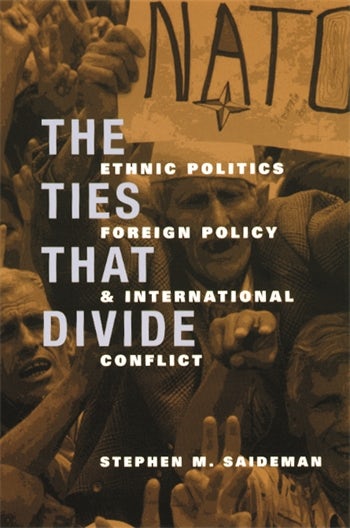
Yesterday, a twitter thread developed about people whining about their first books and why no one pays attention.  Well, I haven't whined about The Ties That Divide in some time, so I felt I was due. cheap used, surprisingly not cheap kindle price).  So, why should we care about that dusty volume?
That and because the book preceded this blog by about eight years, I never ruthlessly promoted it (

Because, damn it, it did not kill the conventional wisdom with fire:

For gosh sake, jeez, Somalia might have been the only explicitly irredentist state in Africa at the time BUT African countries still did support secessionism on the continent AND Somalia was vulnerable to secession--Somaliland did not just happen out of nowhere.

I first started doubting this conventional wisdom when I noticed that vulnerability to separatism didn't stop either Pakistan or India from supporting separatists in their neighbors.  I decided then to compare Africa to South Asia to find out why the norms developed in one place and not the other--it might say something about when Liberal arguments prevail and when Realist dynamics seem to matter more.  Then I noticed that in each African secessionist crises, some countries supported secessionsts.  Ooops.  Sure, more supported the host state, but those supporting secessionists included those with their own secessionists.  In the dissertation, I looked at the Congo Crisis of the early 1960s and the Nigerian Civil War as well as the secession of Bangladesh.

I also analyzed Somalia's behavior as the one irredentist country in Africa, and realized pretty quickly that Somalia had its own separatist issues.  More obvious now with Somaliland, but even pretty obvious way back when as Northern and Southern Somalia were governed by different colonial powers, which is often a recipe for secessionism.  Not to mention that the whole idea of Somalis being unified by a language and by religion and all that ignored deep clan divisions, which, again, became more obvious after 1991 but were always known to scholars of Somalia.

I dropped the creation of Bangladesh when I revised the dissertation into a book for two reasons: a) it was really about India and was not so comparable; and b) while I was working in my first job, a newer and more relevant country imploded so I could show how the dynamics applied not just in the 1960s in Africa but in the 1990s in Europe.  So, Yugoslavia worked out as a case, where I again found countries willing to support separatism despite being vulnerable to it.  Most notably, Croatia was supporting irredentists in Bosnia as it was combating Serbian irredentists in Croatia.

Oh, and another addition to the manuscript: quantitative analyses that showed that vulnerability to secession did not stop states from supporting secessionists.  I published that separately at JPR and then tested it dyadically in a piece that was accused of plagiarizing Saideman but eventually got revised and published in CJPS (I can send interested parties PDFs of these pieces if you can't get beyond the gated access).  Not only do the findings support my argument about ethnic ties mattering quite a bit, but that vulnerability is associated with more support, not less.

Anyhow, one of the questions about blogging is whether one should repeat what one has said before.  The reluctance to do so has had an impact on my blogging--I don't blog as much as I used to.  However, as some have reminded me, folks may not have read my earlier posts, and, of course, this also applies to earlier work.  As a result, here I am post-promoting my first work, in part because the conventional wisdom about the international relations of secession is still, alas, conventional wisdom.  Vulnerability does not deter support for separatists... not then and not now.


Sunday, November 18, 2018

Brexiteers Are the Worst Separatists?

One of the basic tendencies of separatists (non-decolonization edition) is that they soft-pedal the costs of transition and overplay the benefits.  This makes sense as a political strategy: "hey Quebeckers, you get to keep everything you like about Canada, but get to be independent."  Of course, these promises are contradictions--if you are an independent country, then you can't have someone else issuing passports for your country.  You can rely on someone else's currency, but that basically means that you cannot have your own monetary policy. When the Scots tried to secede a few years ago, the Scottish National Policy changed its stance on NATO, saying that they would not mind staying in an alliance that they had long opposed.  Why?  To get more votes.

The problem is this: in a normal political campaign, you can make all kinds of promises, including ones that are in contradiction with each other and then finesse the differences afterwards.  Separatism is different--if one is successful, then one has an independent country and suddenly face a lot of new realities that are much harder to finesse.  Why?  Because becoming a different country does indeed mean breaking with the old country and so many of those promises either cannot be kept or must be kept but are very costly to do so.

Part of this is that a party that comes into power after winning an ordinary election in a democracy has to bargain with other parties, but they can ultimately pick and choose which parties and which issues to negotiate.  When one secedes, one can't choose the bargaining partners--they will be the rump state and the international organizations that one wants to (re-)join.  The rump state will have far less incentive or desire to bargain than parties after an ordinary election--the politicians of the rump state are no longer responsible for the well-being of the citizens of the new state nor do they feel a compulsion to appeal to some kind of subset of the citizens of the new state.  I am probably downplaying coalitional bargaining (of which there is much, much literature I have not read), but it almost certainly pales in comparison to the amount of bargaining power one surrenders when one secedes.

Maybe Canada would have been gracious to a Quebec that a separatist referendum. Maybe a UK minus Scotland would have been kind to a departing Scotland (I doubt it).  Part if it is, of course, that the rump states want to make the transition painful to deter other separatist units.  But part of it is just the nature of the politics of the situation--the power imbalance usually favors the rump state because, here's the dirty secret, many separatist entities are among the better off in their previous country relative to the other units so they have more to lose.  Quebec gets far more from Canada in terms of equalization payments and other benefits than Canada gets.

How does this apply to Brexit?  Besides the fact that some of the Brexiteers were lying sacks of xenophobia (Nigel Farage), prior to Brexit, the British had the best of all worlds--they got to participate in much of the EU that they wanted, they got to opt out of what they did not want, and they had a goodly amount of decision-making power.  Post-Brexit, they lose all decision-making power except if they are smart bargainers (they aren't), they lose the ability to opt into the stuff that they want, and they are forced to accept what the EU has to offer.  Oh, and the EU has no incentive to make it easy for them.

Was this foreseeable?  Absolutely.  Just the whole Ireland/Northern Ireland issue was patently obvious, to name one aspect.  Which is why the Brexiteers lied about the process and the outcomes.  Brexit is one of the biggest unforced errors a country has made (other than invading Iraq without a good post-war plan, electing Donald Trump, ....).  Could we have predicted it would be this big of a shitshow? Probably not because we wouldn't have known that Labour would suck this much.

David Cameron has much to answer for, as he let this happen.  Theresa May has not played this well, but she has faced a tough situation.  Corbyn?  Oh my.  Labour could have walked into power how many times if it was not led by such an awful person.

And, yes, it reinforces my confirmation bias about one thing--massive political and social change should not be decided by 50% plus one.  All you need is for some drunk frat boy voters or, to be more specific, resentful voters seeking change but having no clue what change really means and lying politicians to pander to the worst instincts to temporarily bridge 50% to start something that any sane, sober person would regret quickly enough.  Britain was not broken before Brexit, but it surely is now.  Whatever flaws the EU had and continues to have, ripping the UK from it is far more destructive.  And, again, we knew that two years ago.  Who has the political courage to risk their careers by suggesting going back?


Thursday, September 28, 2017

What Do I Know About the Kurdish Situation?

Not much as I haven't studied the Kurds.  McGill Phd David Romano has studied them a great deal, and there are others who are far more expert.  However, I do know something about separatism, referenda and irredentism, so here's what I think:
  1. Separatism is not as contagious as advertised. The only folks who really get encouraged by an effort, successful or otherwise, are those who are kin.  Everyone else is far more focused on their own incentives and constraints.  They will learn from the examples elsewhere whatever lessons that support their pre-existing inclinations.  Yes, I was a fan of confirmation bias long before it was cool.
  2. The Sunnis will not be pleased.  It is hard enough for two smaller groups to attempt to balance the Shia in whatever semi-democratic institutions, but with Kurds leaving, Sunnis are dwarfed by Shia.  Hard to craft a democracy or anything else that gives Sunnis some chance of not being dominated.  So, yeah, Kurds leaving would screw Sunnis just as Slovenia screwed the Bosnians.  Everything old is new again.
  3. Irredentism is not in the cards.  Sure, one could talk about a Greater Kurdistan, but which Kurds get to rule it?  Milton (and Khan) was right: better to reign in hell than serve in heaven.  So, no, despite what Turkey might say, there will be no significant effort at Greater Kurdistan.
  4. I am not a fan of secession from advanced democracies--the costs of changing are too high and always underplayed by the secessionists, democracy depends on losers staying in the system, and usually there are ways to get what you need, if not what you want.  But the Kurds have some reasonable grievances, starting with how they can't trust the Shia dominated government of Iraq.  
  5. The timing makes sense--Kurdish strength is at an alltime high given that the US, Canada and others have armed and trained the Kurds.  Those efforts are already declining now that ISIS has been mostly removed from the Kurds' neighborhood.  Iraq is still weak due to the ongoing war with ISIS, so now makes sense....
  6. But a referendum does not mean independence.  It can mean a process, a bargaining process that can take quite some time.  The question of violence really now depends on what the Iraqi government will do.  Governments generally don't let secessionist regions leave--lots of work on this especially by Monica Toft.
  7. Countries will support whichever side they have ethnic ties (article version).  If no ties, then other interests, such as seeking stability will kick in.  The one thing, for damn sure, is that countries will not be deterred by their own vulnerability to separatism.  
  8. Turkey will overreact.  Duh.
What does it mean for the war against ISIS?  Damned if I know.  Anyhow, my past work suggests this will be bother better and worse than what the pundits say.  Woot?

Thursday, February 11, 2016

The Kurdish Complications

Now that Canada has decided to continue to train and support the Kurds in Iraq along with the Iraqi government, the question of the future of the Kurds is being questioned.  Indeed, yesterday, I received a phone call from a magazine in Kurdistan asking me about referendums and why some secessionist movements get to become states and others do not.  My short answer: "fair ain't got nothing to do with it" which could probably use a bit of nuance.  This is not just a Canadian issue but one for all of the countries intervening (or not intervening) in Iraq and Syria.

The one thing I do know and am very confident about is this: vulnerability to secession does not deter other countries from recognizing an independent Kurdish state.  Sorry, I know this is the conventional wisdom (as presented in this piece), but the conventional wisdom has always been wrong and always will be wrong.  How do I know that?  Well, see my first book, see this article, and this one, too.  Perhaps notice which countries recognized Kosovo (hint: Canada).  Oh, and check out Russia's foreign policy, given that it is vulnerable to secession yet have been sponsoring separatists frequently and enthusiastically.  And yes, countries can be irredentist even as they face separatist movements at home.

Canada, as the story linked above indicates, that despite arming and training Iraq's Kurds, wants these Kurds to stay in Iraq.  Why?  Two primary reasons: a) Turkey is an ally, and Turkey fears that an independent Kurdistan in Iraq and/or Syria would strengthen the Kurdish separatists in Turkey;* b) most solutions to the Iraq political problems need the Kurds.  Sure, there are folks who advocate partition of Iraq into three hunks of territory, but partition is never as easy or as beneficial as the advocates argue.   Having the Kurds in along with the Sunnis to balance the Shiites might just be key ingredients in some shot of power-sharing deal.  Of course, that is hard when the Shiites have been pretty committed to crushing the Sunnis (which is why the Sunnis have chosen the less bad alternative of ISIS).  But in the long run, Iraq will need a political solution that is not just handing over the largest part of it to Iran to the Shiites.
*  While I am a committed skeptic about how contagious ethnic conflict can be, one of the few ways that ethnic conflict travels is among ethnic kin who are separatist.  See also this.
So, Canada is aiding a group but not promoting its eventual aims.  Not that new, but definitely tricky.  The article from the National Post makes clear that Canada has been clear to all sides about its stance.  Which is the same stance as the rest of the coalition.

Of course, there is another Kurdish problem: we are sinking resources into training the Kurds, but their aims (other than independence) are quite limited.  They don't want to fight to win territory that they cannot keep.  And the downside of being the most reliable force in the region is that they have won most of the territory they claim.  It is not clear that they can do much more to push ISIS back into Syria.  Oops.

But that is why I keep calling this region the land of lousy policy alternatives.  As for the Kurds, I do feel for them in a big way.  They have been betrayed many times before.  This time, we are being honest and using them for what we see as the greater good.  And they are using us for their interests.  As always, the hard part in these interventions is figuring out how to align the interests of those who live there with those of the interveners.

Friday, October 30, 2015

Twenty Year Anniversary of Phew!

Today is the 20th anniversary of the 1995 referendum that might have led to an independent Quebec if the yes side won and if people could have figured out what the question meant.  All I can say is: phew!

I would not have ventured to Montreal and McGill had Quebec seceded.  Easy for me to say in hindsight, but I am pretty sure that is the case.  First, there would have been no Canada Research Chair for me, since Quebec, despite the best efforts to diminish the costs of transition, would have been hosting a Canada/federally funded educational program.  So, McG would either not have had the position or would not have had the sweeteners to compensate for a salary that represented a pay cut from my previous job due to the exchange rates.  Second, the Quebec nationalists have frequently taken hostile positions towards McGill, so I doubt that McG would have been creating new positions or filling old ones, except perhaps for those English speakers who were fleeing the new country.  Third, Canada seemed like a good place to live.  A newly independent nationalist state with some degree of animosity towards English-speakers?  Yuck.

Canada dodged a bullet in 1995.  While support for independence is low now, the issue remains the third rail of Canadian politics.  Which helps to explain the NDP pandering about 50% plus 1 and all that.  It also means that Canada cannot amend its constitution because Quebec's issues would arise anew. Still, the province did give far more votes to the man with the wrong last name (Trudeau senior apparently alienated the province long ago). 

So, I am thankful that a small majority of Quebeckers turned out and made the right decision.  Not only has Canada been better off together since 1995, I am better off for Canada remaining together.  As I have repeatedly posted here, Canada has been very, very good to me and mine.  Now that 2/3's of us are citizens (Soph Spew needs to swear....), we are in big-time. 

Let's celebrate Canada unity day by  ... watching some hockey and feeling smug about the Canadian health care system!  Woot, eh?!

Friday, September 19, 2014

The Other Side of Ethnic Domino Theory

I have been railing for days weeks months years about how a successful secessionist effort in one place does not increase the chances of another elsewhere [unless they are in the same country to begin with].  Perhaps I am irrelevant as folks continued to argue and worry about the effect of a Yes vote in Scotland would be on potential or actual secessionist movements in Europe and even beyond.

Maybe it is my confirmation bias at work, but I am pretty sure it is the conformation bias of others that matters here.  After all, how could Scotland move towards secession when the example of Quebec demonstrated that secession was out of fashion.  The last provincial election showed that Quebecker were tired of referenda talk, as once that issue came up, the Parti Quebecois dropped and flopped in the polls. Did that negative lesson spread to Scotland?  Maybe so, as Scotland failed to reach 50% Yes.  Failed by a good bit.

Yet this morning we still have the Catalans saying they are going ahead with their vote.  I certainly expect a different outcome, as the Catalans face a much less friendly bargaining partner in the Spanish government.  I would bet on Yes there.  The key here as always is not the processes elsewhere that demonstrate something but the domestic politics, the domestic dynamics that shape the real and likely and perceived benefits and costs of independence. 

People thought that Arab Spring was contagious.  Well, protest of authoritarian, corrupt rule was.  But the outcomes?  Not so much.  Only Tunisia became a democracy.  Libya had a civil war.  Syria has a civil war.  Egypt has had two coups with a pretty unattractive but yet democratically elected government briefly in between.  Bahrain?  Successful repression.  And on and on. 

People seek massive political change for many reasons.  The dynamics elsewhere can suggest strategies and tactics, but they do not shape interests.  Social mobilization is hard, so one really has to make the case that the situation in place x matters for people in place x and that independence might solve more problems than it will cause.  This is hard to do in democracies since most advanced democracies give minorities multiple ways to access the political system.  Which is why that Washington Post list of eight places as Next is pretty foolish.  Sure, Catalans but they are the exception that proves the rule.  They face a government that has limited their autonomy.  The Flemish?  Might be a Czechoslovakian case of agreeing to disagree. 

The rest of the list is pretty weak--yes, there are separatist groups in the places but mere existence is different from success.  The Scottish Nationalist Party compares well to the rest of these in terms of size, experience, organization and the rest yet it fell short, quite short.

I would like to see the folks who yammer about the ethnic domino theory to now come out and argue that this means that there will be less separatism in Europe.  They will not.  I will not.  But in my case, it is because I take seriously how self-centered nationalist movements are. 

Thursday, September 18, 2014

Real Consequences Matter

Heaps of discussion about Scotland and what happens if the Yea votes > Nay votes.  As I have argued, it will not change much for most of the rest of the world, but it will change much in the UK.  How so?

The balance of voters will change.  The Conservatives will find it easier to win elections without all of those anti-Tory votes.   That is, until people get tired of the party that helped to break up the UK.  And then the groups of folks who vote Conservative might break up a bit.  But in the short term, a huge win for the Conservatives.

It will change who governs in Scotland.  This might be swell for the Scottish National Party, which can claim a big win with the referendum.  It is not so swell for other groups in Scotland that are not fans of the SNP.  The irony is if the SNP says: we want out of UK because the Tories tend to win elections in the UK, the Shetland Islands and other spots can say: we want out of Scotland because SNP wins elections.

The new equilibrium will be better for some folks and worse for others.  There would be winners and losers, in other words, on both sides of the new boundary.  That causes me some concern as does what the new boundary means for the Hogwarts Express.

Friday, August 1, 2014

Things Getting Interesting in Scotland

We should not be too surprised to see the surveys narrow as the Scottish Referendum approaches.  This tends to happen as the ambivalent folks leaning towards Yes start saying yes rather than undecided.  Mobilization is occurring. More importantly, this study shows that the range of outcomes includes a Yes victory. 
Woot for the Scottish separatists?  Well, sort of.  The probability distribution still shows that it is likely that the Nays will have it. 

The biggest threat for the No movement, other than the British government doing something really stupid (like threatening to pull out of the EU some more), is complacency.  Turnout matters.  And that is really where the uncertainty is.  Between now and September 18th, people may not change their minds much about whether Scotland should be independent or not, but they may change their mind on whether they will vote or not. 

I am no turn-out expert, but I think this news story, if it gets played up in Scotland, might be good for the No side.  While it might encourage more Yes people to vote, complacency is the big threat for the No side--I don't have to vote because the referendum will fail.  Well, now they might just be a bit less confident and a bit more mobilized as well.

So, perhaps the folks at Monkey Cage are doing the No side a favor?

Thursday, July 17, 2014

Reacting Too Soon to Ongoing News Story

Guilty.  With the Malaysian plane crashing in the Ukrainian war zone, it is easy to start blaming folks.  It may not be the Russian separatists.  It might not have been shot down by missiles.  Lots of stuff could have happened.  So, I am going to speculate anyway because that is what we do either implicitly or explictly.  I prefer to be explicit.

What we do know is that commercial aircraft were flying over/thru a war zone.  This should be the first WTF question.  The Ukrainians said that they would not fire at any planes over 7800m apparently.  How reassuring is that?  The FAA decided months ago, before there were a series of planes (and helicopters) shot down in the region, to ban American planes/pilots from flying through this area [or not, see comments].  Why didn't other authorities (Dutch, Malaysian, European, ICAO) re-direct flights from here?  We know, thanks to the Vincennes disaster, that commercial planes flying over a war zone might be confused for something else. 

Some might say that something else caused this plane to fall out of the sky: bomb, pilot error, malfunction.  But given that the plane crashed in an area where anti-aircraft activities had been quite energetic and relatively successful, I think Occam's razor would cut all but the missile explanations.  Three different sets of actors could have launched a missile to this height--about 33k feet or 10km: Russia, Ukraine, and the Russian separatists.  All had access to weapon systems designed to knock down high flying planes.  Ukraine inherited Russia's anti-aircraft technology when it split from the Soviet Union.  The separatists apparently captured Ukraine's systems (the web is chock full of pics and claims on social media by the separatists that they had these missiles).  And Russia has what Russia has.

It is very unlikely that Russia would have shot down this plane.  No rational reason to do so (would only escalate a conflict that they have been kind of hoping to go onto the back burner), and unlikely to accidentally shoot down a plane over Ukrainian territory.  The separatists and their fellow travelers might blame the Ukraine government for staging such an event.  Again, this is unlikely as things were more or less moving in Ukraine's direction lately with some victories on the ground.  Why cause a major international crisis and hope that the other sides gets the blame?  That is a very dangerous game, and unlikely when, again, things were not getting worse but potentially better for Ukraine.

The separatists?  Well, knocking down planes and helicopters has been its primary means of imposing costs on Ukraine.  With significant losses of territory, offensive land operations seem not to be a good option to make Ukraine hurt.  But knock down expensive and very visible symbols of Ukrainian military might (relatively speaking)?  Yes, that makes sense.  So, if I had to bet, I would bet that the separatists did this by mistake.  They wanted to shoot down Ukrainian military aircraft and had gotten pretty good at it.  Governments try harder, usually, to avoid such mistakes, but then again the US shot down an Iranian passenger jet in 1988, the Soviet Union shot down a South Korean plane om 1983 and so on...

Will we find out the truth?  Probably.  There are far more intel assets dedicated to watching this part of the world than the waters to the west of Australia.  Will everyone buy into the explanation with the best evidence?  Probably not.  I mean, if tweets touting the success of shooting down a transport plane are being erased, then denying reality is likely to be the order of the day.

Again, I could be wrong about all of this.  So take all of this with a large grain of salt. 

Tuesday, April 29, 2014

Beware of Contagion? Or Beware of Those Wary of Contagion?

Nice, flashy title for a piece on whether there will be more separatism in Europe this summer: "if at first you don't secede."  It raises all kinds of fears about Europe blowing apart as each country facing a separatist movement might suddenly disintegrate.

To be clear, the situations in most of Europe versus Ukraine are not so much apples and oranges but apples and bear-savaged campgrounds.  Huh?  Separatism is not spreading from Crimea to Donetsk via some kind of learning process.  No, it is spreading within one country (a point I made long ago when other stuff seemed contagious) and not via a learning process or any kind of osmosis but via separate and distinct interventions by an outside power--that would be Russia.

So, the political processes that have caused irredentism in Crimea (or aimed at Crimea) and something akin to it in Eastern Ukraine are entirely irrelevant for the Scots, the Basques, the Bretons, and so on.  The funny thing about the list of suspects in the piece is that it ignores the recent developments that push in the opposite direction.  Quebec's recent provincial election might not mean that the sovereignty movement is dead, but it sure as hell is not on the march towards independence.  Scotland?  Sure, it has a referendum coming up, but the no side is ahead, and just gained another key ally--comedians uber alles.

The article goes on and on, listing a bunch of potential separatist movements and actual ones as well, regardless of how serious their prospects are. 

The question is less absurd than it sounds. Just look at that foundering transnational project, the European Union. The bitter irony is that one of the only things uniting the 28 public opinions in the fledgling superstate is their common resentment of their common project. The telegenic figurehead of the U.K. Independence Party, Nigel Farage, is but one of a new generation of populist politicians across the continent, all popular insofar as they rail against "Brussels" -- that symbol of the wasteful, undemocratic, and bureaucratic European behemoth that threatens to crush each member country's uniqueness.
I hate to compare the US to the EU because one is a country and the other is not, but folks have been running against Washington, DC for as long as anyone can remember.  Yet the US has managed to stick around.  The EU? Yes, there is lots of friction, but that happens amid and after a Great Recession.  The only real threat to leave is the UK's, and I am not sure how realistic that is these days.  But neither the US, nor the EU, nor the rest of Europe are what the Soviet Union and Yugoslavia and Czechoslovakia were in the late 1980s and early 1990s: authoritarian systems built on the suddenly fragile ideology that promised "full employment" and fell short.  
Some of the European Union's most vocal opponents scoffingly compare it to the Soviet Union and eagerly anticipate its similar fate. The implosion of the European Union could prove to be just as much of a Pandora's box of secessionisms as the end of the Soviet Union is still proving to be: today in eastern Ukraine, tomorrow perhaps in France, Spain, and Italy. 
So, the conclusion of this piece is to support the wild speculation that is the favored stance of Europe's fringe?  I am tempted to Lloyd Bentsen this Dan Quayle: I have met Pandora's Box, I have written about Pandora's Box, my friend, this Europe is no Pandora's Box.   But that is a dated and insulting reference, so I shall refrain.

Again, there are good reasons to be concerned about what Russia is doing in its neighbors.  There is also good reason to ponder each separatist movement in the rest of Europe, but each is almost entirely driven by domestic political dynamics--of the group and of the country in which they reside.  Unless Russia starts sending its little green men to Scotland, to Venice and to wherever else, there will be limited inspiration and contagion from East to West this summer.


Sunday, March 23, 2014

Comment Dites-Vous Voterfraudfraud en Francais?

Yes, it is that time of the election cycle where the PQ's self-destruction leads to focusing not on how to appeal to more voters but get certain voters out of the pool.  Who would be such folks?  Students and non-Francophones.  Perhaps the PQ move to the right is leading to some GOP imitation?

The challenge for the PQ is that their xenophobic stances of late are not only good for mobilizing rural folks who fear immigrants and dividing other parties (the CAQ), but are also good for mobilizing those who are opposed to race-baiting.  Non-Francophones are very much more likely to turn out in an election where they are a target for discrimination.  The PQ has made it very clear that Anglophones who are not Sikhs nor Muslims nor Jews have much to fear since they want to tighten existing rules that limit English in the workplace and in society (no more bonjour/hi).  Allophones--those whose first language is neither French nor English--are mostly immigrants and do realize the symbolic politics of the Charter of Xenophobia is aimed directly against them.  So, yes, PQ, use xenophobia at your peril.

Students?  At first, I thought this was just about limiting McGill students from voting, but it may be more than that.  The PQ role the student opposition to tuition increases into power, but then became less friendly to student interests.  Plus the kids are not the fans of sovereignty/secession that the old folks are.  So, another constituency that is not so likely to vote PQ these days.

So, what to do?  Limit their ability to vote, of course.  Making actual appeals to people is just too damned hard.  This, like other measures, reeks of desperation.  The Charter of Values was very much aimed to win this election, but the PQ seems to be snatching defeat from the jaws of victory with all of its bad moves.  It has brought on board a right wing nationalist that was sure to alienate the unions that play a big part of Quebec politics and in the PQ.  It started talking about sovereignty when a super-majority of the province just does not want to think about such stuff.  And then it waffled on that issue, which raises the natural question for a separatist party: if you don't want separation, why do you exist?  So, what does it have left to enhance its appeal?  Not much, so the resorting to #voterfraudfraud makes all the sense in the world.  After all, the party proved with the Charter of Values that it has no shame.


Tuesday, November 12, 2013

Short Games vs. Long Games vs. Long, Long Games

There is a pretty good take on the Quebec Charter of Values mess in the NYT today.  It reminded me of a conversation I had last week in Scotland--what is the aim of the Parti Quebecois in pushing forth a hugely controversial but largely symbolic hunk of legislation?

The first explanation is that the PQ needs to play to its xenophobic base, as the CAQ might inherit its predecessor's xenophobic appeal.  With sovereignty/secession not so popular these days, the PQ has to do much to emphasize the Us by targeting a Them--immigrants.  Of course, this also helps mobilize the anti-Montreal folks since much of what goes on in Quebec is part of the Montreal versus everyone else dynamics.

But the problem is that this strategy by the PQ is in direct contradiction to its previous stance of reaching out to immigrants.  Why reach out?  Because if there were to be another referendum, the PQ would need votes from the new citizens of Quebec as well as the old ones in the hinterlands.  The turn to xenophobia (especially its anti-Muslim themes) might be due to a realization that the French speaking immigrants may never want Quebec to be independent regardless of how nice the PQ plays.

Someone in Scotland suggested a longer term strategy--perhaps the PQ wants to drive out the immigrants, so that the potential No-voters are no longer an issue.  The PQ and its policies have already done a nice job of alienating many Anglophones, leading to significant flight of those folks around the time of the last referendum (which meant that the house I bought in 2002 in Montreal was mucho cheaper than it might otherwise have been). 

So, the short term strategy of solidifying the base might run against the long term strategy of making immigrants good Quebeckers and more likely independence voters, but may also play into a longer term strategy of producing greater homogeneity in Quebec.  If Quebec becomes less diverse as Anglophones and immigrants leave, then Quebec separatists win.... even as Quebec loses.  Yes, Quebec would be worse off if Montreal lost its diversity flavor not just economically but culturally as well. 

But it has long been clear that what is bad for Montreal is good for the PQ: plus ça change, plus c'est la même chose.  The more things change, the more they stay the same.

Wednesday, November 6, 2013

If A Referendum is Scottish, Is It Not Crap?

I posted this at CIC, arguing that the Scottish referendum will not be very relevant for Canada/Quebec as no matter what happens, folks will derive the lessons they want to derive.  It is a Canada-focused version of the argument I am presenting Friday in Glasgow. 

Yes, the upside of separatism is that I got a trip out of it.  I have never been to Scotland, so be prepared for heaps of pics, Highlander references, kilt jokes, and many re-postings of

Tuesday, September 17, 2013

Examining the Intolerance Numbers

A friend tweeted thusly:
So, I decided to take a look at the slides, using my best French.... well, not hard since numbers are numbers, right, Hugo?

Before getting to them, one thing to keep in context: the way the ridings (districts) are drawn in Quebec, Montreal is under-represented.  Combine that with the "safe seats" where the Anglophones have local majorities on parts of the island of Montreal, it means that Montreal is almost entirely irrelevant for provincial campaigns.  For referenda, it is different, because then Montreal is a big hunk of votes.  And that leads to a real conflict between the short term and long term interests of the Parti Quebecois--the strategies to win elections to run the place compete pretty directly with the requirements to win an independence referendum.  So, embracing of the short term here suggests that the PQ has given up on independence.  

Anyhow, the latest polls suggest some interesting stuff.  First, the PQ is actually behind the Liberals by a smidge (p.4).  Not surprising given the PQ's performance but it also shows that the PQ has not gotten a bounce yet from the Charter debate.  Of course, it could if Harper gets too loud about it.  The other thing to note from this is, of course, that the PQ faces a two front war for the nationalist vote as the CAQ competes for the xenophobes just a bit (as the successor to the ADQ) and Quebec Solidaire claims to be more faithfully separatist.  Nationalism is a many splendored thing, and Quebec demonstrates that two threads of Quebec nationalism are a bit at  war--the separatism vs. the xenophobia.

Page 6 addresses the Charter of Quebec Values.  Turns out that it is not so rabidly popular, at least in this poll with a statistical tie between yes and no.  Francophones favor it but not decisively so--49%.  Funny that Allophones are less opposed than Anglophones, but Allophones refers to those whose first language is not English nor French.  They are a diverse lot, with some not so opposed to a fistful of secularity.  Montrealers are not so favorable, but also not so opposed.  This result is not quite the unanimity that is represented by the various municipal councils on the island.

Page 8 reveals that the PQ may not be that dumb after all: the Liberal voters are not fans, but those are largely lost to the PQ; the PQ voters are huge fans so the PQ is playing to the base; but most importantly the CAQ, the rival for the Francophone vote, is divided pretty evenly.  So, one could see this legislation to be aimed both at energizing the base (says something sad that this is the base of the PQ) and dividing a key competitor. 
The other slides address various nuances--such as whether there is a problem, who should be banned from wearing religious garb, etc.

From the standpoint of political science, this makes a heap of sense: when a homogeneous party faces a heterogeneous one, the temptation/logical thing to do is to outbid the heterogeneous one--promise to be the best defender of the group's interests.  This would weaken the heterogeneous one and strengthen the homogenous one.  Of course, it depends on the numbers involved, but with Quebec having large majorities of Francophones and a majorities of non-religious folks (people who do not wear large crosses, kippas, turbans, hijabs, etc), the PQ is just doing what makes sense for the party.... in the short term.


The problem is that in the long run that any vote on independence will lose because they need to have cross-over voters for that, and today's minorities are unlikely to do that tomorrow.  To be clear, the PQ does not have the Republican problem quite yet--the demographic trends are not as dangerous to the PQ's future chances in part because stances like this will continue to encourage immigrants to move to other parts of Canada.  See, xenophobia can work!