Friday, July 25, 2025

Why is Calling It Genocide So Hard?

 I have been thinking about this for quite some time, and I have a few half-written blog posts addressing the G word: is the Gaza operation genocide?  I learned today that calling it such may be "anti-semitic" according to the standards of the International Holocaust Remembrance Alliance, so that could be a deterrent.  However, since the guy who wrote the IHRA guidelines is opposed to the weaponization of his guidelines, maybe that shouldn't deter us.

One of the big challenges in calling something genocide is that it is supposed to require not just heaps of war crimes but proven intent.  I have gotten into arguments with a friend about this.  What counts as intent?  Heaps of statements by those in the Israeli government but not by Netanyahu himself?  Does Israel need to issue a statement that their intent is to commit genocide for us to call it genocide?  And to be clear, most genocide scholars have called it genocide while most holocaust scholars have not.  

Again, the crime of genocide is "“intent to destroy, in whole or in part, a national, ethnic, racial or religious group, as such.”  I find this strange because it makes intent more important than the actual reality of what is being done, and what is being done in Gaza and what is starting to be done in the West Bank is the destruction of a people because of who they are.  It is more than a few war crimes but an operation defined by war crimes--killing of kids and of journalists, destruction of hospitals and water facilities, and now the perfection of starvation.  For me, genocide is the attempted destruction of a people in whole or in part because of their identities.  How is what is going in Gaza not that?  I think we can discern intent from the fact that this has been going on for some time and that the violence has been systemic.  It is not an accident that the destruction has been this complete.  It is not an accident that Palestinians are dying of starvation.  I think we can infer intent from the patterns.  

Yet, for me and for others, it has been very hard to use the G-word.  Why?  There are two reasons, I think, with one being far more important than the other, but both probably matter.  The lesser reason is that if you call something genocide, you are obligated to do something about it.  The Genocide Convention and all the discussion around it involves not just an obligation not to engage in genocide, but also not to stand by when one observes it elsewhere.  I am old enough to remember when the Clinton Administration was reluctant to call the Rwanda Genocide what it was as it was happening because that would mean doing something about it less than a year after the mess in Mogadishu.  

How do you stop a country from committing genocide?  The efforts by countries to invoke international law have failed to stop Israel.  Of course, cutting off arms shipments would be a first step that should have happened long ago.  But that too would be insufficient given the commitment made by Netanyahu to stay in power to continue the war against the Palestinians.  Regime change?  That would seem to be the way to go, but that opens all kinds of questions that people don't want to consider.  But, still, I don't think that is driving discomfort with the G-word. 

The biggest problem for Jews to call it genocide is that it cuts to heart of Jewish identity.  Note that one of the IHRA restrictions is comparing Israel's actions to the Nazis.  Why is that?  While anti-semites may do that all the time, why is it inherently anti-semitic if the behavior is similar?  Because the Holocaust is so burned into Jewish identity, that Jews as victims, as survivors, is part of what it means to be Jewish.  As an atheist, I don't feel my Jewish identity when it comes to religious stuff,* but I feel it when the Holocaust comes up as a topic.  I have joked that I learned three things in Hebrew school (2-3 times a week, mostly afternoons after my public school education): how to read (not understand) enough Hebrew to barely get through my Bar Mitzvah, various mythologies about the creation of Israel (I cannot express how mind-blowing and nauseating it is to hear Israeli politicians refer to a second Nabka, which means they are acknowledging what was long denied--that Israel expelled the Palestinians in 1947),** and the Holocaust.  

It is now fundamental to Jewish identity that genocide was done to us.  Indeed, some of the discourse around the Holocaust is disturbing because it focuses on the six million Jews and not the eleven or so million victims, in an effort to make the Holocaust a uniquely Jewish experience, rather than including Roma, LGBTQ, the disabled, opposition politicians, and others.  Anyhow, if being the target of genocide defines in part what it means to be a Jew, how can Jews engage in genocide?  It is possible but really hard to recognize this reality, as it hurts.  It feels awful, it creates much emotional conflict within oneself and with others, including family.  It is far easier to label the behavior of others, such as Serbs in Bosnia, as genocide than to consider one's own people guilty of it, especially when it is key to one's identity.  

And, yes, another element is that others in bad faith use the genocide word.  But again, as the Superman movie reminds us (as did a series of books that have now been betrayed by their author), it is the choices we make, it is what we do that matters.  What the Israeli government is doing is horrifying.  The scale of destruction, of collective punishment, is appalling.  What is the appropriate life for a life ratio?  Yes, Hamas killed more than a thousand people in October a couple of years ago, but does that justify killing tens of thousands, if not hundreds of thousands?  Again, collective punishment is inherently evil, it is what Nazis did to Lidice because of the assassination of Reinhard Heydrich.  

There I go, making comparisons to Nazis.  I guess that means I am anti-semitic.  I don't hate Jews, but I do hate the government of Netanyahu.  And there's the rub--Jews in Israel are protesting that government, so they aren't anti-semitic, are they?  So, if folks on this side of the Atlantic protest the actions of the Israeli government, does that make them anti-semitic?  I would think not, but the weaponization of the IHRA standards, mostly by actors of bad faith (the Trump administration and the GOP are full of anti-semites from the top down), says otherwise. 

There has been plenty of real anti-semitism directed at American Jews, including members of my family.  But what is not anti-semitism are accusations that Israel is engaged in genocide.  Sure, that makes Jews uncomfortable, but being made uncomfortable is not a hate crime.  Here's another parallel that will surely annoy people--being informed about the slavery and its legacy makes white people uncomfortable in the US but is not a hate crime and should not be driven out of classrooms.  Similarly, criticism of Israel for its war crimes and, yes, for its genocidal campaign, will make Jews uncomfortable, but is not necessarily anti-semitism. That depends on the speaker and, yes, their intent.  

So, yeah, what the government of Israel is doing is genocide.  It does not make Hamas right or justified or good.  Hamas is evil, perhaps more evil than Israel because it deliberately endangered the people they claim to represent to score points.  Israel, for all of the harm it does, is doing it in the name of protecting its people, even it is mostly about keeping Netanyahu in power and out of prison.   But one can think the two things at the same time--that Hamas is evil and Israel is engaging in genocide.  It is awful, it is uncomfortable as hell, but it is also reality.  

* I have long been a "bad Jew" not just for being an atheist but also for marrying a non-Jew.  So, devout Jews can take all of what I say and throw this blog post out.  But again, I feel this identity keenly when Nazis are back in fashion in the US as I know that I would be sent to the gas chambers along with those who believe.  

** Israel is also central to Jewish identity, something I am reminded of as I read Sandra Fox's book on Jewish summer camps.  But is it the government or the place that is central?  I think making any government central to one's identity to be problematic, but that is a topic for another day.  I have dodged all kinds of questions and issues, but this post is long enough.  We can discuss Zionism some other day. 


Saturday, July 19, 2025

Why Scream When I Can Blog?

It has been one of those travel days, and since I am traveling alone, I can't vent with anyone, so I will vent here.

To be clear, I had an awesome family vacation--had lots of fun, lots of great meals made by family members (took us decades to figure out the best way to feed us is for us to rent places and feed ourselves rather than go to restaurants with 10-15 people).  So, today's frustrations were worth it, but,  yeesh.

 So, what happened?

  1. I had to wake at 4am to get to the airport for my flight, and that was fine, although the rental car's tire has too little air caused me some anxiety.
  2. The Reno airport was fine even if I didn't get any money back from my $1 wager at the slot machine.
  3. The flight boarded fine, and I got bumped to first class.  Managed to sleep ok, but storms over Chicago meant that our landing was delayed until just the moment my next flight took off for Ottawa.
  4. I used the United app to get a flight to Ottawa via Newark since I missed the last flight to Ottawa.  So far, so good, eh?  
  5. No.  The plane was late to take off, first because it was short one flight attendant, and then once we were sitting around a while, they decided to swap flight attendant crews, and then we sat around for a while longer.
  6. So, we landed just about the time the last flight to Ottawa was to take off.  Oh, but we had 7 passengers on the plane who were supposed to go to Ottawa.  So, would they hold the plane for about 1/3 of the passengers?  
  7. Sort of.  The app told us upon landing that they were holding the flight for us, because, of course, with so many passengers, why not wait a few minutes.  They did... for the first four passengers but not for the next three.  I don't know how the others got ahead of us--we didn't sprint, but we didn't dally either.  So, our plane took off without us.  
  8. The gate people were of absolutely no help but gave us a qr code so that we could text with someone with a shaky connection.  I chose to go to the United lounge since that seems to be the only place on this side of the airport to get a real person to help.
  9. But I couldn't get in the lounge since I could no longer access my boarding passes on my app.  So, eventually they let me through.
  10. Where I found a super helpful person who got me on the first flight tomorrow and got me vouchers for hotel and food.
  11. I discovered that I lost my water bottle along the way.  That's ok--it was a freebie from a conference two weeks ago and it was very much worth what I paid for it--very leaky. 
  12. I tried to eat a dumpling place at the airport, but they were closing.
  13. I then tried the cheese steak place, but they were closing.
  14. I went to the Italian sandwich shop which had one guy making sandwiches and was taking forever.
  15. So, I left and sought the shuttle--the text I had with the vouchers indicated that I could just call up and they would send a shuttle.  Nope, it comes every hour so I would have to wait 45 minutes.
  16. I had no patience for that, so I went to get a taxi, but I was on the wrong floor.
  17. So, I went to get a taxi--$37 for a very short drive.  And the guy couldn't zip the credit card--had to enter it manually.
  18. Got to the hotel, phew.  Got my keycard but went to their restaurant before it was to close.  
  19. Who the fuck puts cilantro on garlic shrimp?  So, I got my dinner, spent most of it peeling cilantro off of the shrimp, which were fine otherwise.
  20. Went to my room where the key card didn't work.
  21. So I went back down and the desk guy's solution, since "the card should work" was to send a security guy back up with me.  And, yes, the card still did not work, so the security guy let me in.  Good thing I have no plans to leave the room until my 5am shuttle.
  22. My ice cold room since the AC was set on blasting the coldest air. 
  23. Oh, and one last annoyance (I hope): the room not only has no bottles of water but no glasses or cups of any kind.  I'd like to have some water with my pills/vitamins.  So, now I am waiting for someone to drop some off since, yes, I can't leave my room.  
  24. Oy.
  25. I just hope my bag goes with me tomorrow, but if it does not, no biggie, since I am done traveling until September.

And no, I was mostly nice to the united people except for the unhelpful gate people.  It is not their fault, but damn it, they should have waited just a couple more minutes.  Or at least been a little bit more sympathetic about fucking us over.


Thursday, July 10, 2025

Rabat and the Fake Sociologist

I finally made it to Africa.  Five years ago, I had plans to go to the International Sociology Association's meeting in Stellanbosch, South Africa, and then off to a safari in Kruger National Park and a trip to Victoria Falls.  Alas, Covid got in the way.  This time, the reason was most the same--to network with the research committee of the ISA focused on the armed forces and other stuff--and the outcome was much better.

It can be confusing since I almost always go to a different ISA every year--the Intl Studies Association, which is multidisciplinary but mostly poli sci folks.  This ISA is almost entirely sociologists, but there is much overlap in how sociologists look at civil-military relations as political scientists.  Indeed, RC01 was founded by Morris Janowitz, who was one of the Gods of the field way back in the 1960s and much read/cited by both political scientists and sociologists.  

My purpose was mostly aimed at buttressing the partnership that is the CDSN and will be the CMRN.  The Canadian Defence and Security Network is in its 7th year of a 7 year grant.  So, we are applying anew, but to be successful, we need to be both more ambitious and more focused.  The Civil-Military Relations Network is both--global and very explicitly comparative but focused on only a slice of defence/security--civil-military relations.   Our summer (me and the co-directors and hq staff) are spending the summer revising older grant docs, writing new ones, and engaging partners to make sure they are on board and are willing to suffer through the grant agency's webpage.  Coming to this conference helped clarify for me how the CMRN can help the RC01, and how the RC01 can help the CMRN--this will make for clear, more authentic partnership letters and also a better actual partnership.  

Along the way, I went to panels and learned much from the various presentations.  My fave was by Helena Carrieras, a very prominent sociologist in the field of civ-mil, who had served as an officer in both RC01 and ERGOMAS (the European Research Group on Miltiaries and Society--another CDSN/CMRN partner).   She discussed her experience of serving two years as Portugal's Minister of Defense as a very self-conscious, self-aware sociololgist who had written on gender and the military.  Her talk discussed a variety of topics, including the challenges of being the first, how to deal with being the token woman, how to be self-reflexive but not too much so as sometimes decisions had to be made quickly.  Her term was dominated by the Ukraine war.  Just a fascinating discussion.

But, of course, I also came to Rabat to come to Rabat.  While this was the first time I visited a Muslim country or a real monarchy (sorry, Canada/Netherlands/UK/Sweden/etc)*, my previous experiences were tightly constrained--the 2007 trip to Afghanistan with a brief stop in both directions in Dubai.  I don't remember hearing the calls to prayer in Afghanistan--maybe we were too deep in the base at Kandahar--and my amazing hotel in Rabat was next to one.  So, this definitely produced a rhythm during the day and night.  The monarchy part was mostly amusing as I passed by the Royal Moroccan Surf Club while checking out the beach, and the idea of royal surf club just tickled me.

It was not as hot as I feared, but it was mighty warm.  It was San Diego-esque in that some mornings, there were clouds that kept things cooler, but they would burn off.  The legions of very small, very thin cats seemed to be mostly drained by the heat---the sleepiest, least hyper kitties I have ever seen.  The people were all very kind and helpful.  I tried to get by with my lousy French, which led to more than a few folks speaking English to me.  The diversity of the people was most amazing--people of a variety of colors, multiple languages, quite a range of what the women would wear from quite western to very conservative to in between.  The food was good, but I think I would have greatly benefited from a food tour or a guide showing me the better places.  Google maps led to me to a variety places that either didn't seem to exist or were hard to navigate, but it did led me to an awesome hole in the wall street food place that had awesome kefta.  I found it easier to order food in Japan than in Rabat as there were usually pictures to point at in Tokyo, no such luck in many places here.  As often occurs, I walked by some great places on my way out, leading to some regret.  

 I did enjoy staying in the old quarter which had a lot of markets and a really cool hotel.  I had a beautiful room, and they served a terrific breakfast each morning.  As always, better to be lucky than good. 

The beach was pretty close by, so I went swimming to check the "other side of the Atlantic box."  I have swum on both sides of the Pacific, both west and east sides of the Med, and grew up on the western side of the Atlantic, so I was due.  The mistake?  Choosing the side with more surf.  I love to play in the surf and they had some great sets.  But the ocean floor was the most dangerous combination of slippery and sharp.  I didn't get cut or bruised, but it would have been quite likely had I stayed for every long.  Still, a nice relief from the heat and it was fun despite the near death experience of it all. 

The challenging part has been the travel--that my addiction to United meant many hours in Frankfurt (so I took a quick train to Mainz and accidentally found a beer festival) and strange times to land and take off in Casablanca--as in landing at 1230am and taking off tonight at 130am.  Which meant having to find a nearby hotel for when I landed (and that worked out great), and having to spend a lot of time waiting for my flight tonight.  No plugs to be found, so I will run out of juice on each device eventually.  

Anyhow, it was both a fun and successful trip.  I go home very briefly and then take off for the  annual Saideman summer trip, which will include everyone--my siblings and all of the next generation--except, of course, for my mother who passed last year.  We couldn't travel far and wide during last few years, so this is the first time we are getting the entire gang back together in a non-Philly locale.  We shall see how it goes now that everyone is much older--whether they enjoy being dragged around a lake as much as they did ten years ago.  A key difference: we are heading west, where hopefully cannibalism does not break out again.

I plan to come back next winter for some research.  Hey, if they are willing to have protests across from the parliament, their defense types might be willing to talk to this wayward researcher.  Especially if he brings along one of his former grad students who speaks Arabic.


*  On my way out, I was surprised to see a small protest across the street from the parliament building.

The protest

The Parliament Building


Wednesday, June 25, 2025

Five Percent Is a Lie!

 Or perhaps we can call it a polite fiction.  What am I talking about?  Today, the leaders of NATO countries met and agreed to .... very little.  It is probably the shortest communique in history (see 2023 and 2024 for typical end of summit agreements/commitments).  They agreed to new spending targets and not much else.  No Ukraine, no China, no southern front (how to prevent immigrants from going to Italy, Greece, Spain, Portugal), no nothing else.  

And this drives me crazy.  Before I get to the Big Lie, let me explain why I hate this 2% and now 3.5% madness. NATO does not exist to nag members to spend more on their defense, NATO exists to provide security for those in the North Atlantic community (broadly defined).  The 32 members are supposed to work on a variety of security issues, to create greater certainty, to deter Russia and other adversaries, and to reassure the allies.  This involves a lot of issues and lot of challenges.  These summits are like academic conferences--we academics need artificial deadlines to write our papers and leaders need these meetings to force them to reach agreement on tricky negotiations.  That all they got was "historic" commitments to spend more money represents a huge lost opportunity.

The other problem is that % of GDP spent on defense tells us ... that a country spent money, it is an input measure, so we don't know if they spent it well, or whether the country will use those funds to develop capabilities that would help the alliance.  Greece always did well in this measure despite spending mostly on troops aiming their rifles at Turkiye.   Not helping the alliance much especially as Greece never showed up when the alliance needed help.  It is a lousy measure, but it is easy to understand.  It might mean a bit more in the next few years for reasons I suggest below.

But this is life in the Trump era where this summit is a huge success because the alliance still exists.  Woot?  So, maybe we should be happy?  Depends on what you want out of an alliance.

Sure, the first clause of the communique refers to the iron clad commitment of Article V--that each country will respond (as each deems necessary, see the Dave and Steve book) to an attack on any one.  Let's not be too reassured by this since Trump is, well, almost as much as a threat to members as Putin is--given the threats he has made towards Greenland and Canada.  Plus Trump raised doubts about what he thinks A5 means on his flight over.  I am sure I have missed some utterance of his over the course of this day that undermines this "ironclad" commitment.  

Moving on to the big news 5%.  Wow!  Except it is not five percent but 3.5% plus 1.5%.  That is, the countries promise to move from the 2% promise to spending 3.5% of their GDP on defense stuff--planes, ships, tanks, other war material, pay for soldiers, sailors, aviators,etc.  What we usually think of as defense spending.  The 1.5% is spending on stuff that is "defense-related" which can mean pretty much anything--it is pretty elastic.  So, Germany can spend money on infrastructure--roads, ports, railroads, etc that benefit their citizens and that also help the transport of British, French, American, etc tanks, artillery, personnel to the front in the east.  For Canada, this might mean spending on northern ports and infrastructure, subsidies for mining rare earth metals, and other stuff that Mark Carney wants to do and they can call it defense stuff.  So, don't freak out at the 5%Freak out at the 3.5% instead as that would move Canada from spending $60b per year to $150b per year by 2035.  Yowza.  I doubt that Canada will get there (unless the economy tanks as the metric is defense spending/GDP).  But Canada will move in that direction.

Are countries doing this to placate Trump?  The change in the math to 5%? Yeah.  The 3.5%?  Perhaps not so much. The 2% standard was set after Crimea. The war in Ukraine since 2022 has taught NATO countires that 2% is not nearly enough--we all need drones, anti-drone tech, anti-air and anti-missile defenses, heaps and heaps of ammunition of all kinds, and a lot more.  So, the standard was going to shift and should shift (as much as I hate the idea of setting a % input standard).  Why 3.5% and not 3?  Well, part of it may be that the Baltics, Poland, and some others were already at 3% or beyond so they want the rest of NATO to catch up.  Part of it is appealing to Trump AND part of it is figuring out how to build militaries that can operate if the Americans stay home.  Europe and Canada have to develop the capacity to fight if the US ops out. 

Because no one can count on Trump to show up in a crisis, and no one knows what the next Republican will be like, but the Euros didn't like that unilateral Bush that much either. 

One more thing--the additional spending on defence is .... not going to fund American defense contractors.  That may be what Trump expects, but everyone wants a heap of strategic autonomy from the unreliable Americans.  Carney has talked much about how buying 75% of defense stuff from the US is not right.  Monday, he signed a deal with the EU as part of an effort to buy more European defense stuff.  Will this tilt the sub purchase towards Germany/Norway and away from South Korea?  No idea.  But expect other stuff to be made in Europe and then perhaps assembled or something in Canada.

 I am a bit buzzed right now since I have had half dozen media interactions today--lots of concern, confusion, consternation about the big announcement.  Again, the key is this: it is a massive increase in defense spending--to 3.5% of GDP.  The extra 1.5% is just justification for other spending priorities in most cases.

 Let me know if you have questions or additional info.   

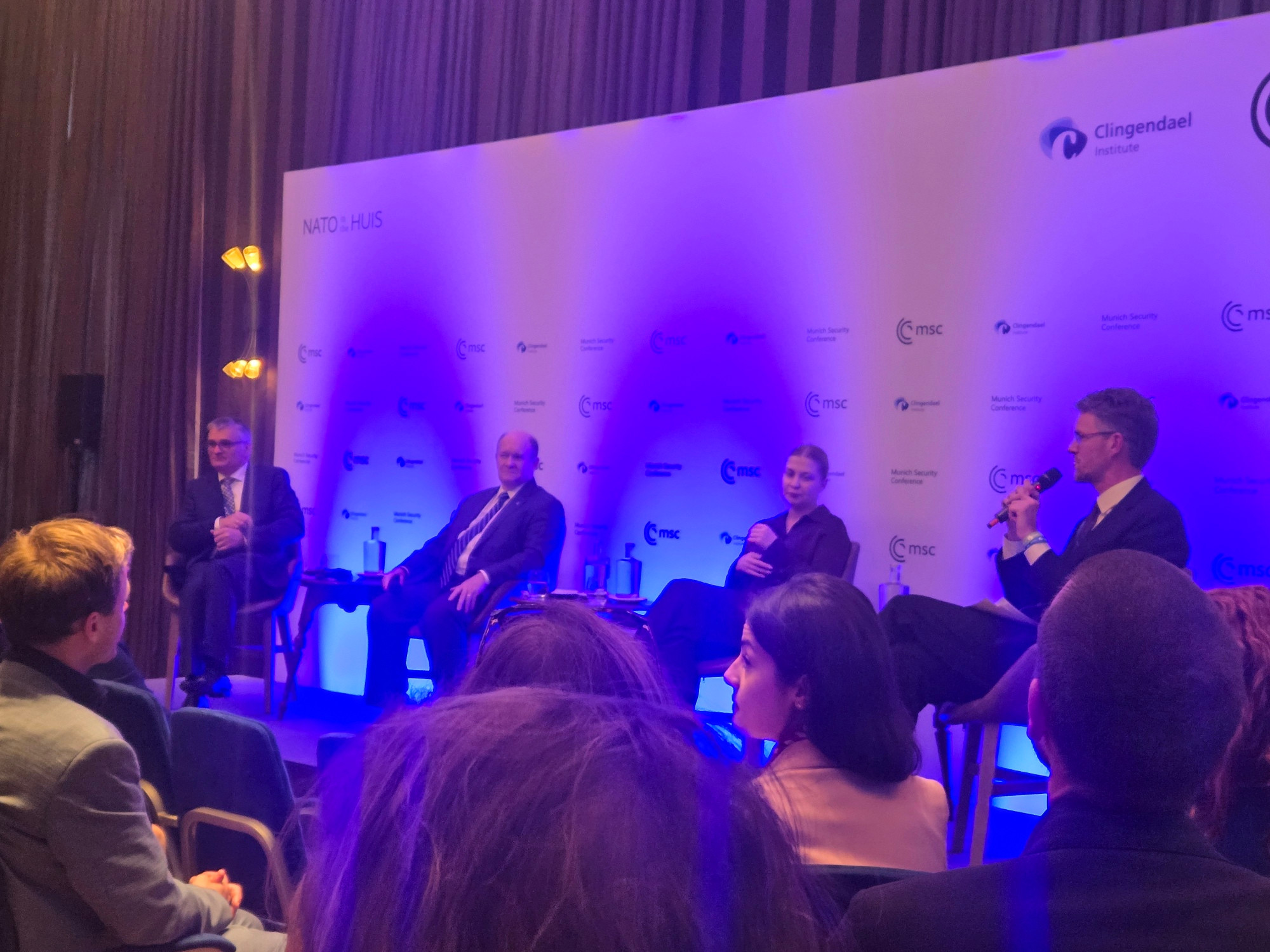
Tuesday, June 24, 2025

Angry Steve Asks Angry Question

 I was at a side event for the NATO Summit tonight--a nightcap roundtable that featured a German government spokesperson, the Deputy Prime Minister of Ukraine, and Senator Coots of Delaware.  I think that Coots is mostly a good guy and is definitely taking the right stands on Ukraine, but I was in a bad mood due to the Democratic Party's shenanigans.  So, I asked a pesky question: essentially, wtf are the Dems doing, lining up with Andrew Cuomo and also shooting down a doomed impeachment effort?  Coots said that he is tired of being told they are not fighting since they are fighting the awful budget bill.  And I get that, but I have a few simple rules:

a)  Don't support a sex pest. There is no reason the Dems should be lining up in support of Andrew Cuomo, who was a shitty governor, a shitty democrat (his moves helped NY's Republicans), and a shitty human being.  It really is not a hard call.  Maybe you don't like his main opponent, but, to be blunt, fuck that, the enemy of your enemy is not always your friend.  Cuomo should have been run out of town on a rail or tarred and feathered.

b) Instead of opposing a doomed to fail impeachment effort, the Dems should be impeaching Trump every single day.  If Trump is engaged in impeachable acts every day (and he has), then the Dems need to keep up.  Just in the last week: deploying Marines to LA, continued blackmail of Harvard, not consulting Dems before/as he bombed Iran, and ... damn, I have lost track, so many, so many.  Coonts said that if they fought everything, it would shut down the government.  And, I wish I could have had a chance to reply: shut down ICE?  Yeah, that would be ok.  

c) and oh, yeah, don't vote for a fucking crypto bill.  FFS.

d) maybe support younger pols so that you don't have so many dead members of Congress that you can't block votes when the possibility could otherwise arise.

 I get it--the system and the media are gamed against the Dems. But the elections since November make it clear that the voters want fighters, not appeasers.  And, yes, this summit itself might become viewed as an Appeasement Summit (someone asked if this was the worst summit ever, and it was as serious question).  

The Democrats need to take this moment seriously.  DOGE, impoundments, Trump's incredible level of corruption, the politicization of the US military, the crushing of free speech/assembly, the many abuses of power, the faithlessness when it comes to executing the laws of the US, and the defiance of the courts are simply the starting point for the list of high crimes and misdemeanors.  To try to game out the 2026/2028 elections one must first think about how/whether those elections will be compromised by a weaponized Department of Justice.  They have started arresting Democrats and judges who are inconvenient.  FFS, this ain't politics as normal.

Ok, that's my rant of the late summit evening.  I probably didn't come across as too dispassionate tonight at the nightcap.  But it is hard not to be irate and disappointed when the Dems side with sex pests and against their own party members who seek to challenge the president.  For Fuck Sake!


Wednesday, June 11, 2025

How to Politicize A Military In Under 150 Days?

Yesterday, I ended up posting the same meme as a few months ago and wondered why I posted it the first time:


 And then I realized: Trump hit another item on the checklist of how to turn the military into a partisan actor--to politicize it.  

Here's the checklist:

  1. Choose a highly partisan Secretary of Defense. ✅  This individual, besides the president, is the most important for managing the relationship between the civilians and the military.  The Democrats often have chosen Republicans (Hagel, Gates, Cohen) for this spot to ensure bipartisan and essentially nonpartisan leadership over the military.  Trump chose a wildly unqualified and disqualified person to do his bidding, one that is on the very far right side of the political spectrum. 
  2. Fire senior officers for not being sufficiently loyal to the man in charge as opposed to the Constitution. ✅Senior officers have been fired before, but not because they were accused of being insufficiently partisan--McChrystal, MacArthur, etc. Perhaps getting rid of the JAG's, the top military lawyers, fits here (thanks to the commenter for this).
  3. Encourage the troops to be partisan.✅  Trump's speech yesterday where he encouraged the troops to boo the Democratic leaders of LA and California.  In the past, leaders of the military refrained from voting because they didn't want to be seen as partisan.  While retired officers have helped politicize the military by visibly supporting candidates and parties with the aim of making it appear as if they represent the active forces (Flynn for the GOP is the most obvious case, Allen for the Dems in 2016 sort of paralleled this.), this is far worse--active troops booing Democrats.
  4. Use the military to do law and order stuff domestically.☑️  This is where we are now--on the verge of this.  We have national guard and maybe Marines escorting ICE as they seek to toss people into concentration camps or deport them. But the Insurrection Act invocation, coming soon, will greatly expand that.
  5. Partisan screening at all levels of the military. ☑️ We already have it at the top, but thus far the closest we get is: don't come to the Fort Bragg speech if you are not a fan of Trump. 
  6. Mandatory party membership for officers.  Not there yet.
  7. Commissars--placing party officials inside military units to vet the decisions of commanders.  Not yet. 
  8. Indoctrination. ✅ Having political education at the various military schools is another step, and given what is happening now with the personnel at the US Air Force Academy, the courses and books at the War Colleges, this is already underway (h/t to the commenter for this suggestion). 

These are just the steps to politicize the military.  There are plenty of moves one could and Trump has made to move the US to an autocracy, such as developing paramilitary units that are loyal to one person--that would be ICE.

And, yes, to be clear, politicizing the armed forces like this has the impact of moving the US into autocracy.  A nonpartisan military is an essential foundation, if underappreciated, of democracy.  Dictators have partisan militaries.  Democracies have militaries that largely stay out of partisan politics even if they are inherently political entities.  

The Bright Line Watch folks can identify all the steps taken thus far to cross into autocracy.  My top three or so are: refusing to spend as Congress allocates, violating the due process rights of many people, and politicizing the military.    

There are other truly awful consequences besides ending American democracy: reducing military effectiveness (partisan armies tend to suck at combat), raising the risk of civil war (civil wars often start when a military breaks apart and takes competing sides), Americans getting killed (escalation of force is not great, Bob).

 The other meme I am using a lot these days: 


H/T to James Vizzard and other bluesky dwellers for helping me compose this list. 


Sunday, June 1, 2025

The Line Is Drawn Here: No Room for Transphobia

 As Pride month is upon us and as folks are still learning the wrong lessons from the last election, I realized I had tweeted and skeeted much over the years about transphobia, but haven't written much here.

The BLUF is pretty basic: we have no reason to hate or fear trans people, but we have a lot of reasons to hate and fear those who demonize trans people.

Over the past decade or so, the Republicans and their allies in the media and elsewhere as well as a certain horrible author have been fostering all kinds of fears about trans people--that they will assault women in bathrooms, that they will unfairly dominate the sports they compete in, that kids are transitioning because it is cool, and so on.  There is so much wrong with all of this, but let's focus on the most important points:

  1. Trans people are people, they are not threats.  
  2. Trans people, because they are so marginalized and face such hostility, have a high rate of suicide, and face a great deal of violence.
  3. Trans people, because they are small and marginalized, don't have much power so anyone targeting them is always punching down.
  4. Actors are mostly targeting them because it is handy politically. 
  5. The relative harm or costs/benefits of regulating trans people is clear.

1.  Trans people are people, not threats.

One can go with all of the lies and threat inflation, and it becomes quite clear that these people are no more threatening than anyone else.  Indeed, like immigrants, these people are less likely to engage in bad behavior precisely because they are more likely to pay a higher price.  Who is assaulting kids and women?  Clergy.  Cops.  Teachers.  Parents.  There is simply no evidence that trans people are engaging in crime against women or children at a rate higher than everyone else.  But, like past efforts to demonize minorities, such as when rape accusations were (are) weaponized against Black men, this is an effort to make people fearful of those folks who are different. 
Let's go to sports: how many trans girls (notice, it is always fear of boys and men transitioning) are dominating their sports?  How many are actually in sports?  The advantages that trans girls/women are supposed to have over cis girls/women are, um, not as much as feared. The idea that someone would just transition so that they can compete better in high school or collegiate sports is just offensive and dumb--transitioning is not easy and it is quite costly in money, emotions, and all the rest. There is no risk of trans kids taking over sports.  Maybe a few trans kids will win some competitions.  And the cost of that to those who finish second or third?  To foreshadow, that's not worth having every girl's genitals checked at every competition or in the bathrooms of malls and stores.  
How else are trans people threatening?  Do they have motorcycle gangs holding small towns hostage?  Have they secretly joined pivotal organizations and can now control them at the expense of everyone else?  What exactly is this threat?
One last threat: kids are transitioning too much.  It is so hip, there's so much peer pressure, that kids are making irrevocable decisions without parental permission.  Oh wait, that's not happening.  Certainly, more kids are reporting gender dysphoria with this piece putting the number at 42,000 in 2021.  Wow, that's a lot of kids.  Oh wait, there were something like 72 million kids in that year, so this is something like .06% of all kids. But so many kids are on puberty blockers, right?!  Um, no.  1,390 in 2021. How does that compare to the percentage of kids being sexually assaulted?  28%, with 3/4 of those being assaulted by someone they know, mostly parents.  Given how few trans people are parents, I am guessing they are not responsible for most of sexual abuse of kids. Just putting this "threat" into context.  And, yes, the number of cops abusing kids over the past twenty years or so (actual reports, not total number of cops doing this) > kids getting puberty blockers in 2021.  Fewer kids are getting puberty blockers than being abused by priests: more than 4200 allegations of Catholic clergy abusing kids in one year.  

So, no, trans people are not a threat, kids are not facing a severe risk of being bullied into being trans.  Other people, supposedly trustworthy people, are far greater threats, but you would not be able to tell that from the NYT or other media outlets and certainly not the Republican party. 

2. Trans people, because they are so marginalized and face such hostility, have a high rate of suicide, and face a great deal of violence.

What makes all of this threat inflation and incitement of violence truly awful is that trans people have long been at great risk.  The threat is not that they will harm others but either they will harm themselves or others will do so.  Somewhere between 30-40% of trans people have attempted suicide and around 80% have considered it.  I knew it was bad, I didn't know it was this bad.  Transgender people are four times more likely than cisgender people to experience violent crime!

Again, the threat here is not by trans people but to them.  The NYT and other outlets should be focused on how to protect this vulnerable minority, not how to protect the majority of people from them.   

3.   Trans people, because they are small and marginalized, don't have much power so anyone targeting them is always punching down

Trans people are about .6% of the US population.  They are not a huge group, they are not tied to a strong lobbying organization, they do not control the commanding heights of the media or the political system. Are there even conspiracy theories that try to position trans people as powerful?  I doubt it.  It is striking that one of the loudest and most aggressive voices in this is, well, the richest woman in the UK and one of the richest people in the world has decided to make her post-bestselling book mission to attack trans people and support transphobes.  Whenever someone of that level of power attacks, they are punching down, so maybe it is unfair to be critical of such folks since they lack targets to punch up?   

 4.  Actors are mostly targeting them because it is handy politically

Trans people are attractive targets for politicians who want to whip up hate. Why?  The size of the group means that many people do not know trans people, so they will have less empathy and understanding, and they are easy to define as "other."  It is basic social psychology and thus basic comparative politics that people will feel more in common with each other if there is some "other" out there that is alien, that is seen as less than, that is viewed as strange.  Politicians have always targeted those who are different.  Since most people are cisgender, trans people are "other" to most potential voters, campaign contributors, etc.   

Sure, a party or a politician could offer a more hopeful, unifying vision of the political community, but when a party has a political agenda that hurts most people, it is best to spray the most rancid distraction sauces.  Most of the GOP's stances are out of touch with the mainstream, but if they can get to the media to portray their opponents as captured by this tiny special interest, if they can cause parents to be concerned about their rights (to oppress their kids), then they can grab more votes.   

And yes, hating trans people is bad enough.  It is also a strategy to try to roll back rights for the entire LGBTQ+ community.

 5. The relative harm or costs/benefits of regulating trans people is clear.

This is a very small group that faces much risk of violence, so how do the benefits of restricting their freedom to live as they choose measure up against the costs?  Hey, Steve, that's unfair, when you put it like that, of course, there is no way that their freedom should be abridged.  This is kind of like the voterfraudfraud stuff that I have harped about here and there for years but much worse.  In the case of voterfraudfraud, it is the supposed threat posed by voter fraud (which is not a threat) that justifies restricting people's rights and abilities to vote.  That math never works because the history of the US has always made it clear that the threat/reality of voter suppression is far greater than that of voter fraud.  The math of regulating/restricting trans people's rights is even more obvious: they pose no risk yet restricting their rights, limiting their lives, presents tremendous costs to them.   

 I am outraged by transphobia.  Why?  Maybe a bit of guilt that I was homophobic in high school (not violently so, just in attitude).  It took going to college where I got to meet gays and lesbians and bisexuals to make me shed stereotypes and fears (I was "radicalized" not by my profs but by my peers, of course).  But it is also because it is so obviously awful to be inciting violence and seeking to restrict the freedom of very vulnerable people.  As a result, I have absolutely no tolerance for anyone being "concerned" about kids being rushed into transition or "concerned" about trans women beating cis women in swimming or whatever.  I see people making those argument as enablers of hate.  They may not be conscious of that, but damn it, the reality is so obvious they should be.  

Some loose threads/additional explanation/more unedited spewage: 

When I started to see trans people increasingly become targets ten or fifteen years ago, even though I did not know any, I could see these people as ....  people deserving of dignity and happiness.  That and it is not my business to tell these people how to live. To be honest, transphobia has become a pretty useful indicator for evaluating politicians--are they hateful, are they cowardly, are they so opportunistic as to use hate against a vulnerable group?  That old poem about "first they came for the socialists" isn't quite right. First they came for the disabled and the trans people...  And  today's Nazis are doing the same thing.  I pointed out Pierre Poilievre's transphobic stances to the woman who was seeking my vote for her and by extension for him.  

Over the past few years I have gotten to know some trans people, and a relative recently transitioned.  So, yeah, that increases my outrage, my contempt, my frustration, but it has been there a while.

Finally, I didn't mention Voldemort by name and I didn't mention the shitty form of feminism these transphobes adopt because my arguments here stand on their own, no matter how captured significant hunks of the UK are by this hate.  And, yes, I focused mostly on the US case because the stats were easy to find, but these transphobe dynamics are part and parcel of the far right effort around the world to mobilize hate.  Transphobes tend to travel with anti-semites, Islamophobes, racists, misogynists, eugenicists, of course, homophobes, and other haters.

Wednesday, May 28, 2025

Canada and Golden Dome: A Trump Trap

Trump is putting his most expensive fantasy into the 51st state bullshit machine.  This is quite predictable, even as the US Ambassador to Canada is doing his best to alienate Canadians by portraying the US as a victim in all of this.  Why is the Golden Dome a trap for Canada?

To be clear, this is no longer about being pro or anti ballistic missile defense.*  Canada didn't join ABM in the early 2000s because George Bush Jr. was violating an international agreement, and Canadian leaders didn't want to be on the side of tearing down the international order.  This meant that NORAD became a difficult place, as the binational arrangement meant that Canada was providing sensor data to the Americans but couldn't be in the room where the defense stuff was being planned/operated.  The political salience of ABM has declined, and the treaty is now mostly dead.  So, it is no longer as much of a constraint on Canadian policy-making, nor does the Canadian public care that much.

But Golden Dome?  Oh my.  I had been suggesting it was a trap before Trump issued his social media blast that it would cost $61b if Canada didn't become a 51st state.  Why is it a trap?  Because Golden Dome is incredibly expensive and, yes, it is a fantasy.  It won't stop the US or Canada from being devastated in a first strike by China or Russia.  It probably won't be able to stop a North Korean attack either, and that has long been the default excuse for missile defense fans when it becomes obvious that their magical thinking hits reality--that a big nuclear power can always get enough nukes through in a first strike.   

But the trap really snaps when the US demands that Canada pays its fair share of this incredibly expensive, doomed to fail project.  Lo and behold, Trump has randomly decided on $61b as the price tag.  Canada has already committed to spending nearly $40b on modernizing its share of NORAD--mostly the sensors that would detect all kinds of attacks coming mostly from across the Arctic.  This is over a long time frame.  Is the Trump demand of $61b over the long run or a payment up front?  Canada and PM Carney can probably convince Trump that their already planned $38b or so is their contribution, that it is new money (Trump can't do math, isn't very aware of anything anyway) aimed at Golden Dome. An additional $20b?  Canada could say that it will be increasing the investment in these sensors by 50% in the long run--we are quite accustomed to cost overruns on major defense projects (see the ships).  In the long run, Trump will be gone and the promise can be broken.

But if Trump wants Canada to spend fast, to spend $61b now?  That is not going to happen.  That would crowd out all of the other defense spending, the stuff that is really needed right now to have a functional military.  Plus Trump is toxic and Carney came to power by promising to resist Trump.  Carney's first statement on this was: we will do what is in our best interests and we will look into this.  So, he is not going to realign Canadian defence spending to satisfy Trump.

One more thing: imagine a world where Trump gets his magic shield, do you think Canadians would be sure that Trump would use it to protect Canada?  No, not with this 51st state bullshit.

So, the trap has been set--Canada is screwed either way. Comply with Trump and distort the economy and the military spending or refuse to comply and kiss NORAD goodbye.  Waiting out Trump and hoping he gets distracted is probably the best bet.  That, or just lie to him while assuring Canadians (say it in French) that we won't be complying. 


* I try to be consistent and spell it defense when it is about the US, defence when it is about Canada, but when it is US-Canadian defense/defence stuff, I just go wherever my fingers tell me.

Thursday, May 22, 2025

Anticipating the NATO Summit in The Hague: Ambushes and Canaries

 Today, we held an event at Carleton to discuss the upcoming NATO summit at the The Hague. We were asked by the Dutch Ambassador to do so, and it was our pleasure.  Both the Dutch and Polish ambassadors spoke about what they are hoping for, and the academics, encouraged or baited by me, largely focused on the Trump of it all.

Ambassador Vonno of the Netherlands spoke about the 80 years of freedom as we just passed the anniversary of Canada (and the US) liberating the Netherlands and of the important role of NATO in guaranteeing that freedom.  Ambassador Dzielski of Poland spoke of the Ukraine war and its impact on Poland and the need for NATO to stay steadfast in Europe.  

Amb. Vonno
The three speakers were Frédéric Mérand of the Université de Montréal, Aaron Ettinger of Carleton, and Stéfanie von Hlatky of Queens.  I was originally just the emcee but our moderator, Robert Baines of the NATO Association of Canada couldn't make it.  Each had a lot of sharp things to say.  Frédéric focused on more on the European dynamics, Aaron on the US-Canadian relations, and Stéfanie more on the NATO-ness of it all.  

Key points along the way:

  • Frédéric:  
    • Europe needs more contingency planning, 
    • The French were right--that we can't count on the US.
  • Aaron: 
    • Amb. Dzielski
      Time is a big factor here--how do we avoid wasting time.  That muddling through is an approach but it might not get us very far.
    • Canada should continue to be "boring."
    • We can't count on Trump being "transactional" as that is too rational.  He reneges on deals all the time. 
    • The donut strategy may be what Canada has to do again--focus on everyone else in the US and their interests in/with Canada and not focus on Trump.
  •  Stéfanie:
    • The NATO summiteers will probably be focused less on advancing an agenda and more on protecting past agreements.  Try to keep various initiatives alive.  But Ukraine is probably not going to like the outcome as consensus on that will be very hard to reach.
    • Maybe have fewer summits to provide Trump with fewer triggers.   

I mostly just asked questions, but I did chime in here or there, including arguing that Trump is an uncertainty engine and that NATO for so long reduced uncertainty ... until now.   I did discuss how the Europeans hadn't really taken the 51st state thing seriously, but perhaps they mi

ght see us as the canary in the coal mine--that Trump might have some limits to how awful he is.  But if he continues to beat up on Canada, then Europe will know that they have be far warier and be better prepared. The bad news is that canaries in coal mines are often ... dead.  So, Canada might end up paying a huge price before Europe gets serious and united on this stuff.

Finally, Hannah Christensen, who works for us but used to be the key staffer running SFU's NATO Field School (and she often co-runs their podcast), had some concluding remarks.  The big one: she noted that Vance essentially ambushed Europe at the Munich Security Conference, that Trump ambushed Zelensky in the White House, so they might set up a trap at the NATO summit.  Given that I see the 5% discussion to be a pretext to reject NATO, I can't say that Hannah is wrong.  I think she nailed it.  

And that will make for an interesting trip for Stef and me, as we are going to be going to the NATO Expert Forum, which is a side party that happens next to the summit. We have done this a few times before including Warsaw in 2016, Brussels in 2018, and DC last year.  So, look for a blog post or two in late June as we go into very blue rooms and watch as the communique comes out (or not?), specifying what gained consensus.


Oh, and the Dutch embassy was very generous with its gifts--orange stuff including chocolate in orange wrapping paper.

Tuesday, May 20, 2025

If Only the Golden Dome Were Just a Corrupt Grift

 The Golden Dome scheme is going to be such a disaster on so many levels that I am compelled to listicle:

  1. It won't work.  That is, there can be no shield blocking all missiles.  So, what's the point?  How many nukes getting through would ruin your day?  The challenge of knocking down hypersonics is huge, and, yes, it is not like the US had solved the problem of shooting down the ballistic missiles of yore.  And, yes, the adversaries would invest in ways to fool the sensors, to evade the counter-fire, or just break the system via cyber attacks or anti-satellite attacks.
  2. The good news is that having a partial shield is incredibly destabilizing.  Oh wait, that is bad news.  Deterrence in the nuclear age requires the major players to each have enough forces that can survive a first strike to heaps of   damage to their adversaries.  A partial shield might be handy for blocking someone's second strike--hit the other side first, take out enough of their weapons that their second strike is small enough that the defenses block most of the response.  This strategic situation would encourage each side to pre-empt rather than wait, so that an accident or a false alarm or a crisis might lead to a nuclear war.
  3. It will be incredibly expensive.  The estimates are probably way too low, as the adversaries get a vote, and they would be responding imaginatively and intensely.  Which means that the US would then have to invest even more in countering their counter-measures.  Arms races are really, really expensive.  
  4. It would be awful for the environment. Lots of space launches burning fuel in the atmosphere, occasional accidents in space creating yet more debris (does that count as an environmental disaster?).
  5. It would fuck over Canada in a huge way.  Why?  Because Trump expects Canada to join and then pay how much?  At a time where Canadians detest Trump and find him to be thoroughly unreliable.  Would he protect Canada?  Probably not.  So, Canada is screwed either way.  Participate and spend a shit ton of money on stuff that won't work and won't be used for your defense OR don't participate and face Trump's increased wrath.  Lovely. 
  6. What is it with demented Republicans imagining magic space shields? This is the Strategic Defense Initiative all over again.  The billions spent on SDI led to what exactly?  Definitely not a sound nuclear defense system protecting the US.  If you want to argue that it helped spend the Soviet Union into oblivion, who is the Soviet Union now?  And, yes, this President is the same guy who thought stealth planes are as invisible as Wonder Woman's jet.
  7. Would divert defense spending from areas where it is needed, like developing local defenses against drones.   

It sucks that there really is not a good solution for replacing mutual assured destruction, but wishing it away through massive defense spending on magical thinking is not the way to go.


There Can Be Only One .... Litmus Test

 The friends of Tapper are doing their best to promote his book, even suggesting that the Dems will be evaluated in 2028 based on where they stand on Biden's health during the latter stages of his term.  If only those folks were not so self-interested and perhaps read a smidge of political science, they might not say something so outrageously stupid.  So, first, why this ain't going to be the litmus test and then what will be the litmus test for the Democratic nomination fight in 2028 (if we have free and fair elections*).

What do we know from social science? 

  • Voters have short memories.  Did Trump's first term crimes and failures sink his 2024 election run? Nope.  Lots of reasons for that, but partly because people (voters and those who chose not to vote) either forgot how bad it was or discounted because we tend to discount that which is not in our immediate present (we discount both the past and the future).
  • Scandals of non-candidates do not matter.  If this is a scandal at all, it is Biden's, and I am pretty sure he isn't running in 2028.  Sure, the media will ask each Democratic nominee about what they thought about Biden four years earlier, but the smart pols can dodge pretty easily.  If this matters at all, it won't hurt the governors or Congresspeople in the race, just those serving in the Biden Administration (Harris, Buttigieg).  
  • Primaries matter a great deal.  Some might even say they select the nominee.  Are Dems going to outbid each other on who was quickest to realize that Biden was declining and did something about it?  Oh wait, nobody but Pelosi did much about this, and I am pretty sure she isn't running either.  

Speaking of outbidding, what will Dems outbid each other on in 2028?  How about resisting/fighting Trump and his team of far right arsonists?  Remember how much juice Cory Booker got for filibustering for over a day?  Oh wait, the same Cory Booker just voted to confirm the Ambassador appointment of Jared Kushner's dad. You know, the guy who was corrupt AF and even hired a prostitute to set up his brother-in-law.  So, Booker, in one incredibly dumb move, destroyed whatever cred he had.

I don't know who will win (I am bad at predicting outcomes), but I can guarantee you that the focus of the competition will be on who did the most to block the worst that Trump was doing.  Think back to the big nomination battles of yore:

  • 1992: many of the Dems who might have run were constrained by voting against the Gulf War, leaving a field wide open for a guy who couldn't take that stand since he was not in the Senate at the time (that would be Bill Clinton for the youngsters, an important Semi-Spew demographic**).
  • 2008: the key litmus test was who voted for the invasion of Iraq, helping Obama defeat Hillary.
  • 2020: the outbidding was mostly on health care, but the key litmus test ended up being who was thought to have the best chance of defeating Trump.

A reminder to all the pundits: the folks who vote in primaries are not the centrists, but the extremes.  For Trump in 2016, that meant the racists, the misogynists, the xenophobes.  For the Dems in 2028, it will certainly mean the people most aggrieved by the harm committed by the Trump administration.  They will turn out the most as they will be the most passionate.  And they will not be voting for the folks who tried to work with Trump.  As much as the media likes for Dems to bend the knee (the Republicans are never really pushed to be bipartisan), the Dem primary voters will cut any such compromiser off at the knees.  Newsom is already a dead candidate walking.  Whitmer is on the edge.  Booker may survive this week's vote because confirming incredibly corrupt ambassador picks may not get much heat.  Who has got the heat now?  AOC, Buttigieg, Walz, and Pritzker.  Why?  Because they are speaking out against Trump and his band of autocratic criminals.  They aren't making any deals.  The good news for three of them, like Obama and Clinton before them, won't be in any position to cast votes for Trump's appointments or policies.  And I am pretty sure AOC won't be voting for any such stuff either.

Watch the elections in 2025 and see what the politicians do and who is rewarded for trying to work with Trump (no one) and who is rewarded for opposing him?  We have already seen some elections in the US (and a heap across the world) where those opposing Trump the most win.  Expect more of the same and expect the pols to learn from this.

So scoff at those who say anything else, including a Biden-focused issue, will be a litmus test.  There can be only one, and this ain't it.


 *  For those who think things will be swell, note that Trump's weaponized DoJ has started charging Democratic politicians with crimes.  My only surprise is that AOC was not first.   

** I am pretty sure the youths are not reading this.  If it were on tik tok, maybe.

Thursday, May 15, 2025

Is the Rubicon One River Or Many?

 A friend on social media suggested that Trump has crossed multiple Rubicons, which got me thinking.

To start, the reference is to Caesar who sparked a civil war once he crossed the Rubicon river, which divided Gaul (France) from Rome.  So, when folks say someone crossed the Rubicon, it generally means they broke some major precedent, took an irrevocable step that challenges the existing order.  There is no going back, and it is the first step towards breaking the current order.

So, when did Trump cross the Rubicon?  He has taken so many transgressive steps that should have led to successful impeachment (except that does not work in systems where there are parties and the incumbent party has enough votes in the relevant bodies), to his not being on the ballot, to his not winning the election.   I think the focus here should be on transgressions that violate the constitution and turn the US into a competitive (or not so competitive) autocracy. 

So, we can quibble whether the following steps are crossing a minor Rubicon tributary or the main Rubicon river, but they are all transgressive enough that they do not so much cause the US to backslide towards autocracy but are actually pushing the US away from democracy (backsliding seems way too passive to me).:

  1. Turning ICE into a secret police force that sends people abroad with no due process.
  2. Impoundments.  Trump has taught us words that we did not really know (see emoulements), such as when a President refuses to spend money allocated by Congress.  I remember being shocked in Brazil when doing research there that their finance minister didn't have to spend money appropriated by their Congress.
  3. Defying court orders.   
  4. Emoulements galore.  Last time, Trump didn't pay a price for the modest (modest compared to now) corruption of foreigners spending heaps of money at his hotel near the White House. This time?  Oh my.  The Qatar Air Force One knock-off is so obviously corrupt and wrong, but the big money is involves insider trading and the crypto coin crap.
  5. Empowering an illegal entity to close down government agencies, plunder the data those agencies save, and even destroy a so-called independent entity--the US Institute of Peace.  All of Musk's destruction is ultimately Trump taking a huge step across the main Rubicon river.  
  6. Coercing law firms and universities to bend their knees.   
  7. Firing senior officers because they were either not the right color or gender or because they were not sufficiently loyal to the man, not the office.   

I am sure I missed a few tributaries.  Pretty much all of these are impeachable offenses with the possible exception of the last one--as it can be a bit gray in theory anyway.  Which one is the widest Rubicon stream, that is the most irreversible, most responsible for turning the US into an autocracy?  It is a tough call, but the top two are definitely the impoundments for usurping Congress's power and the breaking due process.  

From here on out, there is no more crossing the Rubicon as Trump has crossed the river any way you, um, slice it.  He can and will do more damage, but we are on the other side now.  Not the side of civil war (although he is inciting political violence) but the side of autocracy.  We can go back, but it is going to be very, very difficult especially with so many actors (leading Democrats, the media, and the Supreme Court) not taking seriously what is happening.


Wednesday, April 30, 2025

Talking Civ-Mil With the CAF

 The past two days I had the honor/honour to talk civil-military relations (some in the room called political-mil or mil-pol) with pretty much all Canadian generals and admirals (day 1) and a hunk of colonels and captains (N) (day 2).  I don't which was more intimidating--the audiences each day (that was a heap of leafs on shoulders that first day) or the other speakers.  I was joined on the panel by Peter Feaver, the biggest name in the study of Civil-Military Relations, former US Chairman of the Joint Chiefs of Staff Richard Myers (day 2), retired 4 star general John Allen, retired CDS Wayne Eyre, and retired Deputy Minister and National Security Adviser Jody Thomas.  The soundtrack in my head was very Sesame Street.

The first event was part of an annual symposium of the senior officer corps of the Canadian military, and the second day was taken advantage of us being around.  I had never done anything like this before.  I had met a few of the GOFOs before yesterday, so I had some folks to chat with before the event kicked off.  And I had met and chatted with Jody and, um, Wayne? (feels weird to call him by his first name) on multiple occasions including when we had them both on our podcast.  

It was a very cool event for a variety of reasons--I learned much from the other presentations, I really enjoyed listening to Eyre, Thomas and CDS Carignan talk over lunch, and I also learned much from the other officers I spoke with, including the rounds of "knowledge cafe" which followed our talks on the first day, where we would speed-date/chat.  For 10-15 minutes, each SME (subject matter expert, pronounced smee) would sit with a group and chat about whatever civ-mil questions/thoughts they had and then rotate. 

I was chosen to speak at the event in part because there aren't that many civ-mil scholars in Canada (Peter couldn't really speak to the Canadian case) and because I tend to be, um, blunt.  I don't think I can say what the others said, but I can discuss what I presented. 

I started by arguing that some of the foundations of civ-mil that they have been exposed to are wrong.  That Sam Huntington was wrong to argue that there are two worlds--political and military (yes, some civ-mil pedants will contradict me, but I was there and they weren't).  This has caused a variety of problems as Risa Brooks identified quite well, but I focused mostly on the notion at the military is apolitical.  Nope, Clausewitz rightly argued that war is politics by other means, which means essentially that everything a military does or does not do is inherently political.  What we want the military to be is not ignorant of politics but to try as hard as they can to stay out of partisan politics.  I explained that politicization refers not to the military doing political things, but getting involved in partisan politics, mostly by getting dragged into it by one party/politician or another.  I didn't get deep into Michael Robinson's stuff, but it did inform what I had to say--that a military can stand still but be seen as moving closer to or further away from one party or another due to the other actors moving. I had another analogy in the Q&A (see below).

I then discussed how the conception of civilian involvement in military stuff in Canada is often seen as an intervention or a series of interventions, which is inherently problematic since interventions are episodic, temporary, unwelcome, and unnatural.  That it sets up expectations in a very bad way--civilian control should be continuous, dynamic, and expected.  

My third opening point was referring to a reading that they were assigned--former Chairman Martin Dempsey's take on civil-military relations, where he talks about two cultures.  I referred to an important omission--that military folks tend to think that expertise is only gained through experience where as academics and other civilians tend to think expertise can be gained through analysis/research.  Oh, and that perceived expertise gaps play a big role in creating tensions in civil-military relations.

Yes, I used this moment to plug the
forthcoming book.
In my next slide, I went through the various civilians in Canadian civ-mil and argued that most fall short of what is required.  The PM has many jobs to do so they can't be focused on overseeing the military.  It should be the Minister of National Defence's job, but we have had a mixed record there. I should have talked about the Prime Minister's Office, but I really don't understand it so much.  Something I should figure out one of these days. I talked about how one didn't know what is job was and said so in parliament and should have been fired.  I then discussed what we (me, Phil, Dave) had learned about defence committees and legislatures--that the Canadian case inspired the book project because I was so profoundly surprised by what the Canadian Defence Committee (NDDN) does not know, what it isn't interested in, and what little power it has.  I then moved onto DND, which was fun since that spoke directly to Jody Thomas's former bailiwick.  I argued that since DND sees itself as a supporter of the military, that limits its ability/interest to engage in oversight.  I then argued that in 2021, a few journalists--Mercedes Stephenson, Amanda Connolly, and their team were the only real overseers over the CAF as they tenaciously broke the sexual misconduct story.  But I also noted that we have only two full time defence journalists and one of them is seen as not so legit. I did suggest that we shaggy academics have a role to play since we are critical and we are, dare I say it, experts on some of this stuff.  Finally, the public is the ultimate principal and thus the ultimate overseer, but they don't focus much on who is doing good oversight. Because I talked my slides but didn't actually present them, I didn't really hit hard enough the conclusion that the CAF actually faces much less oversight than most other militaries except when it comes to procurement.

My last slide focused on what the military can/should do about this. I argued that the norms, what is standard, expected, correct conduct is not always clear.  That "Fighting Spirit" which is the military's latest document about professionalism is a good statement, but is just something on paper.  The hard part is figuring out what it means and how to live it.  General Eyre did ask me as I talked about this whether I noticed the language about retired officers speaking out, as well, he and others know quite well my, um, relationship with a certain retired LGen.  I had.  I argued that the military needs to speak truth to power but behind closed doors. Eyre did get that I was criticizing him a bit as he was a bit too vocal about defence spending.  I didn't remark that his fondness of Eliot Cohen's Supreme Command book and its conceptualization of the Unequal Dialogue is interesting because the book tends to focus on leaders, such as Lincoln, firing generals until they found one that followed their intent.  I argued that the military needs to be more transparent and welcome oversight, as one of the themes of the two days was about trust as a lubricant reducing friction in the relationship.  Being transparent helps build trust.  While the military folks kept saying that it was their job to educate the civilians about civil-military relations, I argued that the responsibility lies more in civilian hands since, yes, the civilians are the bosses.  We live in a time where some civilians are trying to drag the military into politics in a variety of ways (Trump), and putting the military into difficult spots where saying something is seen as being partisan, such as when Trump filmed a campaign ad in Arlington National Cemetery, breaking the rules, but staying silent can be seen as being partisan and complicit.  It is on the civilians to try not to put the military in such spots.

The Q&A for both days went in a variety of directions.  One of the questions was about whether there was a crisis not in Canadian civ-mil but in Canada's international relations.  Folks argued that the mil-to-mil relationship is still strong.  Of course, I got to play the role of doomsayer by suggesting that the CAF needs to re-think damned near everything as the foundation of Canadian defence policy is the relationship with the US.  Who will provide medevac if things get hot in Latvia?  Who will provide air defence or deep strikes?  That with Trump as President, we simply cannot count on the US to show up when needed, so plan accordingly.

The organizer, Dr. David Emelifeonwu, asked about the realities of being attuned to politics but being non-partisan suggesting that they are not two coats that one can choose to wear one or the other.  I think that was the question, so it led me to a different metaphor.  That partisan dynamics are like someone spinning a can of paint that is spewing paint in all kinds of directions. If one is aware of the political dynamics of the moment, they can dodge and weave and avoid some or most of the paint, but that some might end up getting some stains along the way.... but if one is not aware, one is very likely to step into big puddles of paint or get splattered in a big way.  And once stained by the paint, it is hard to get off.  I used the example of  Chairman of the Joint Chiefs of Staff Mark Milley making the mistake of walking in Lafayette Park in combat dress (more or less) after the park had been forcefully cleared of protestors. This made Milley seem like the US military supported the suppression of free speech, and he spent much of the rest of his term trying to remove that stain.  Instead, his efforts ended up leading him to being covered by more and more partisan paint.  I wish I had shown this video because he is saying the right stuff, but how we says it makes it clear he is being anti-Trump rather than just pro-Constitution. 


Again, I learned a lot.  Having these conversations with sharp people on the other side of the civ-mil relationship forces me to think harder about this stuff, how to communicate it better, and to nuance my views (ok, sometimes.  Nuance and me are acquaintances at best).  I am very grateful to have had this opportunity, and I am very glad that these folks are taking very seriously the challenges facing Canada (and not just Canada). 


Sunday, April 27, 2025

My Local Politics is National

Coming home to Canada days before the election, and, on the drive from the airport, I saw plenty of Poilievre and Carney signs.  But not because they are their party leaders but because the route went through PP's riding and the riding (district for Americans) that Carney is running in.  I live in the latter and bike through the former (not today as I am a fair weather biker, so the cold rain will deter me).  

The election has stakes nationally, and, locally, who wins my riding really matters not just in terms of one seat more or less but whether the leader of the party gets to sit in parliament and have legitimacy to serve as the Prime Minister.  Right now, Carney has no seat, and that has happened before, as party leadership can shift in between elections, but he couldn't carry on as PM if the Liberals win but he does not (a very unlikely outcome).  

I don't know Carney, never met him.  He does have a heap of credentials, and he has run a very solid campaign.  I have met his Conservative opponent (the NDP candidate is barely visible and has no chance).*  Barbara Bal was knocking on doors last August, and I happened to be home.  I was not impressed. This was at the same time that the Republicans were inciting violence against Haitian immigrants re the supposed missing dogs and cats, so I remember the timing and content of this conversation well.

What did we talk about? She asked me if I would vote for the Conservatives.  Since she didn't know who I was and hadn't read my blog/bluesky posts (nor did I expect her to), she had no reason to expect she was going to get some pesky questions/opinions from, yes, a political scientist.  I responded first by saying that a politician who weaponizes hate against a vulnerable minority, trans people, is not worthy of my vote, like the way the GOP is behaving in the US.  She made a side comment about having spent time in Haiti so she didn't find the GOP hate-mongering to be problematic.  She then talked a bit about parental rights, and I said that was a canard used to appeal to the far right.  

The other topic that came up, although I forget how, is that I also said that I didn't like how her party was undermining the oversight over intelligence by its stances re the relatively new effort to create a hybrid oversight committee.  She had no idea what NSICOP is, which is not that surprising since, yes, my work with Phil Lagassé has focused directly on parliamentarians preferring to know less and speak more than know more and speak less--the original title was "Ignorant Critic or Informed Overseer." So, not really that disqualifying that she didn't know about the role of parliament in intelligence oversight, although since her party was sabotaging that effort, one might think she would have some awareness.

Sidenote: The issue of preferring to be ignorant has come up in this election as Poilievre has refused to get a security clearance.  Party leaders tend to get these, it has become more important lately with foreign election interference, as it has been the position of the government that each party should police the interference within their own party.  PP can't do that without knowing stuff.  But he refuses as he claims this would prevent him from being critical of the government.  This is, of course, bs as there are plenty of Westminster systems where party leaders get access to some info but can still criticize the government.  It would just require him to be, dare I say it, responsible

Obviously, I wouldn't vote for a Conservative Party candidate at a time where that party is promising to cut higher education and research funding, but my vote was determined in 2022 when Pierre Poilievre welcomed the far right anti-vax convoy that disrupted live in Ottawa for two months with donuts and smiles.   A more moderate CPC might get my vote after, yes, ten years of Liberals in power (democracy requires alternation in my mind, but the LDP of Japan might disagree), but that was never in the cards given PP's ascendance.  I have also taken to calling him the Ted Cruz of Canada--willing to support many far right causes just to get a bigger crowd, to appeal to those to the right of the traditional Conservative Party.  And just being someone who is easy to hate.

Anyhow, Bal didn't know what she was getting when she knocked on my door, but I do have a good understanding of what would happen if she won--she can't win without the Conservatives getting a sweeping victory--which wouldn't necessarily mean selling the country out to Trump. It would just mean selling the country out to far right causes, and that is a very good reason to vote against her and her party. 

*  Canadians get strategic voting--that because it is a first past the post (whoever gets the most votes in a riding wins) rather than proportional representation or another form of allotting seats, those who would prefer a 3rd or 4th party often will vote for the lesser of two evils.  In this election, the NDP, the Greens, and the Bloc are polling poorly for a number of reasons (the NDP leader is not seen as a good politician, for example), but one of those reasons is that these voters really care that the right wing party does not win at this moment.  This is much to do with Trump but not entirely so as Poilievre is both personally pretty easy to hate and has taken stances that position him much further to the right than his predecessor (including the aforementioned transphobia).