Showing posts with label Ukraine. Show all posts

Thursday, September 19, 2024

Participant-Observer Methodology Strikes Again: Appearing before Canada's Defence Committee


 Today, I got stretched pretty good, as I was asked to testify before the House of Commons Standing Committee on National Defence.  The focus was supposed to be the Baltics/Ukraine security situation, but I ended up helping to, um, expand the conversation.  I was on with two sharp people who are far more knowledgeable about Ukraine and Baltic security stuff, so I made that clear at the top of my initial statement.

Because dropbox no longer lets one share files easily, I will just summarize my opening statement: lots of uncertainty, much hinging on the US election (which had the effect of derailing the conversation a bit, I think), that Canada is contributing to NATO via the mission in Latvia, that it is no longer doing the air patrolling stuff, that my civ-mil hat is causing me to ponder how is Zelensky managing his military and how likely is it for the Russian military to mutiny.

The committee was smart to keep the regional questions aimed at my colleagues.  Marta Kepe of RAND spoke about hybrid warfare and other unconventional threats facing the Baltics.  Arel was quite critical of the lack of political will on the part of the west in general in not supporting Ukraine earlier and letting its fear of escalation inhibit support now.  I found myself agreeing with them on pretty much everything they said except for that political will stuff.  The Q&A ran for nearly 2 hours with each MP getting somewhere between 1 and 5 minutes to ask questions (the MPs from the NPQ and Block got 1 minute each--smaller parties get less time).  

The first question to me was by Conservative MP Cheryl Gallant asked about very specific drone capabilities and why don't we have more systems to combat higher level air threats.  My response focused on the fact that our allies have anti-aircraft capabilities to help us, and that the drone procurement thing is happening.  I forget when I mentioned that there had been opposition to weaponized drones a while back because of concerns about their being used to assassinate individuals, but that the Ukraine war has shown us of the importance on a conventional battlefield.

The second question to be was by Christine Normandin of the Bloc, who is one of the Vice Chairs of the committee--wouldn't Poland paying more than 2% of its GDP on defense insure that Trump would still respond to an attack on Poland?  Nope, that Trump couldn't be counted on for anything like that given his hostility to NATO and his positive attitude towards Russia/Putin.

The next question to me was from the NDP's Lindsay Mathyssen about the links between the far right and Russia, and I, well, really went to town on that one--mentioning their joint interest in eroding trust in democratic institutions, their weaponization of all kinds of hate (transphobia, misogyny, racism, xenophobia, anti-semitism, Islamophobia) to divide democracies, and their joint fondness for autocracy.  I didn't mention DeSantis by name, but I did link Orban to all of this.  This got picked up by some far right media folks so here's the video of that sequence.

Conservative Don Stewart pushed again on drones--whether it would be right to train our troops on them before shipping them out to our troops in Latvia and why we don't have so many.  I mentioned the procurement challenges, here or later, including the fact that with everybody wanting to buy drones, there is a supply problem.

Liberal Emmanuella Lambropoulous asked a question of Arel that she then directed to me--why support Ukraine?  In addition to the stuff Arel mentioned, I pointed out that our inflation was partly caused by the commodity shock of Russia invading Ukraine's grain growing area.  I also mentioned our commitment to NATO, and this is a war that directly implicates NATO.

Normandin asked again about Trump, and I forgot if I said much different from the first time.

Liberal Marcus Powlowski asked about a reference I mad to Russian soldiers mutinying.  I said that what we know from civ-mil is not that we can pinpoint when one might happen, but the reckless disregard for the welfare of Russian troops might lead to units munitying.  He asked for evidence, and I had none except stories of individual soldiers attacking superior officers.  That time was not necessarily on Russia's side.

Conservative Vice Chair James Bezan asked about whether we should have sent some of the LAVs to Ukraine earlier, and I basically said yes.  

Liberal Chad Collins asked a long question about disinformation, which followed up from my previous answer about democratic institutions and the far right.  Either here or before, I pointed out that across the democracies, a key for preventing the rise of the far right is for right-wing parties to oppose them. 

My notes deteriorate from there.  We were asked about Ukraine and membership in NATO--I pointed out that won't happen until the war is over, as admitting a member mid-war is essentially NATO declaring war.  I was then asked if Ukraine could become a member if Trump was President, and I reminded folks that NATO operates by consensus, and Trump, having been impeached the first time for trying to extort Ukraine, would probably not support membership for Ukraine.

One can find the video online to get the whole hearing--the other two folks were super sharp and I learned much for them.

Did I tell the parliamentarians that my next book, with Phil and Dave, compares defence committees around world and found that the Canadian version was deliberately irrelevant?  No.  I will save that for the book launch.  I was very conscious that all parties were trying to play me and the others into giving them the soundbites that they wanted.  Perhaps I am biased, but the Conservatives seemed the most consistent, focusing on a particular message--that the Liberals are responsible for the CAF being under-equipped--which is not wrong, but I didn't want to get pinned down to say this was a uniquely Liberal problem--the Conservatives helped to get us here as well.  I probably gave the Liberals and the NDP the soundbites they wanted, but I did sense that there was a bit more genuine interest in the stuff and a bit less ruthless focus on point scoring.  As I said, I might be more aware of the stuff on the right than on the left.

I was asked by someone later whether this was stressful or whether I was frustrated.   Nope, this was fun--talking about this stuff is what I like to do, and talking to a committee that is, um, sort of responsible for this stuff is still cool even if I am a critic of how it does its business.


Saturday, March 2, 2024

Zeitenwende All Over the World!

 Two years ago, Olaf Scholtz, the German Chancellor, announced that we were at a moment of Zeitenwende in the aftermath of Russia's renewed invasion of Ukraine (2014 was the start, 2022 was much deeper with greater intensity and more far-reaching aims).  The term refers to a watershed moment, a rupture, a turning point that ushers out the old way of thinking and ushers in a new one.  That alters the ideational foundations of foreign/defense policy and grand strategy.  I am lucky enough to be in Berlin and at the Hertie School as they held an event aimed at seeking to understand whether this was just a German thing or whether other parts of Europe were also changing their worldviews/mindsets.  The public event was advertised thusly.

For the Germans, a key was that rather than thinking that there is no security in Europe if it is not cooperative security with Russia, now the thinking is that there is no security in Europe if it is not cooperative security against Russia.  The big question, of course, is whether there have been changes not just in thoughts but in deeds.  And, yes, Germany is doing stuff it had not done before: spending at least for now more than 2% of its GDP on defense, sending arms to a war zone, reduction of energy dependence on Russia, etc.  But does it have a clear idea of what the new world view is?  Not so sure.  

The panelists from all over Europe were asked a bunch of questions by the organizers including: has your country or region had a zeitenwende, if so, what is it, when was it?  How is the match between the governing elites and the public on attitudes about all of this?  We folks in the audience asked whatever questions that came to us (yes, I tended to ask civ-mil questions).  And hanging over all of this was Trump potentially winning in November and the meaning of that--can there be a European NATO (with a Canadian appendage?)*

Since we had three workshop panels and one public panel essentially covering most of Europe, I am not going to repeat everything I learned.  I did learn a lot and will remember some of it.  But here are some of the highlights:

  • The Baltics and Poland did not have a change in worldviews in 2022, but could simply say "we told you so," as their views towards Russia and European security were either formed around 2007-8 with Russia's cyberattack on Estonia and war with Georgia or... always saw NATO and European security as against Russia not with Russia.  UK was also in this camp, more or less, and is better able to respond as it has reduced the dependence on Russian capital in the financial sector.
  • France has made some significant policy shifts, but providing extended deterrence if Trump pulls back the US commitment is not going to happen.  
  • Lots of lag--several countries want to make adaptations but implementation is slow.  I got some knowing laughs at lunch today when I said that everyone's procurement was broken in different ways--kind of the way every snowflake is different.
  • Everybody has recruitment/retention issues in their militaries--Canada is far from alone in that.
  • Germany is trying to find the old playbooks from the Cold War--how did West Germany contract with the US and others about the long term bases--providing schools and infrastructure and the like--as they need to know for their plan to have such bases in Lithuania.  Yes, they are moving not just a brigade of troops but their families as the US, UK, Canada, and others did during the Cold War. This contrasts sharply with the Canadian strategy of shipping troops in and out every six months.  It shows how long term and how serious the Germans are.  Significant up front costs but probably less expensive in the long run.
  • Carlo Masala's public talk started the three known unknowns that frame thinking--will Russians win in Ukraine, what will happen in the US election, what will be the future of EU/will the far right gain more ground?  
  • Speaking of Trump, there is still some wishful thinking in Europe--that Trump will not follow through if elected. I kept telling folks that he wouldn't have sent forces to help an invaded ally before and he certainly won't do so in the future.
  • Sweden and Finland had public opinion flip after 2022 invasion, so, yes, some zeitenwende here.  But an interesting contrast as for Finland, neutrality was a strategy, but for Sweden, it was an identity.  
  • Poland having nuclear thoughts?  Irony is that this almost makes Mearsheimer right as he predicted that Germany would develop nukes after NATO falls apart after the end of the Cold War.  Instead, after the end of the after the cold war, due to the possibility of American withdrawal, Poland, not Germany, is now pondering proliferation.  Much talk in that part of the world about whether the Russian timeline for invading Poland/Baltics is 2-3 years or more like 5-7.  And yeah, I don't think that is likely, but it is easy for me to say from distant Canada.  One thing is clear in Poland--no one is wondering where the money will come from as they move beyond 2% to 3.5% or more.
  • The Baltics convo started with a reminder that Trump was so ignorant he thought World War I started there and not in the Balkans.  
  • The NATO-Founding Act is not dead enough.  It no longer restricts conventional deployments (see German permanent basing in Lithuania above), but it does restrict the nuke stuff.  Which enrages the Baltics who think that agreement is dead, dead, dead.
  • Ethnic politics is alive in the Balkans as the various stances of countries towards Russia-Ukraine is complicated by the ethnic politics within.  Three cheers for my first ten years of research!  Serbia is pro-Russia, the Serb entity in Bosnia is pro-Russia.  This leads to actors in the region that are not pro-NATO. Of course, those that benefited from NATO intervention are pro-NATO--Albania, Kosovo, Northern Macedonia.  This discussion raised another complication from a Trump victory--NATO is still in Kosovo.  But probably would not be if Trump is President again.  
  • Romania's relations with Ukraine did go through a big swing from tensions over old territorial claims to friendship as they both are threatened by Russia.
  • A side discussion mines floating in the Black Sea reminded me that the consequences of this war will outlast the war, just as the Germans at the conference reminded me that construction workers discover a old bomb from WWII in Berlin every couple of weeks.
  • Why is Hungary such an outlier in all things these days?  Mostly because it wants to be exactly that.  Since there is no real competition domestically, Orban can fixate on foreign policy and wants to pull Europe in his direction.  I had forgotten about the Hungarian minority in Ukraine, but, of course, an optimally obnoxious nationalist country such as Hungary (see the Steve and Bill book) would want to keep that tension alive.  
  • The challenge of potential Ukrainian membership in the EU is mostly about the fact that Ukraine is big--it would have a major impact on the distribution of agricultural benefits/competition and also specific sectors like transit.  So, Portugal and Spain (and others) are more concerned about the economic impact of Ukraine joining the EU than any implications regarding Russia or anything else.
  • Greece is in surprisingly good shape.  Its spending on defense is now more focused on modernizing the force, it is attempting rapprochement with Turkey, and is even participating in the US-led op in the Red Sea (if I heard correctly).  Greek support for Ukraine is ahead of where the public is. 

Some big themes drawn by the organizers at the end:

  • Distance matters--those closer to Russia either already had shifted their stances and were in "I told you so" mode or flipped quite dramatically, changing decades of orientation (Finland/Sweden).  Those furthest away and least energy dependent on Russia didn't really have to shift.
  • Everyone is holding their breath for the next zeitenwende--if Trump gets elected---what happens with NATO (Steve says it essentially dies or becomes far weaker with Europe plus Canadsa)?  
  • Some ZW was a matter of time--some revolutions in thinking started with Crimea in 2014, some started in 2022, some started in 2007-08.  And some have not had a major re-thinking.

The only Canadian content was injected by... me.   During the lunch on the second day, I got some questions about whether there has been a Canadian zeitenwende, and I basically said no.  That would require some real hard thinking on Canada's role in the world and how it has changed and what should be the Canadian response.  And, no, this Canadian government is not doing that thinking (nor would a Conservative one lead by PP).  Instead, as someone asked me: is Canadian foreign policy diaspora politics, I pretty much said yes.

It was a great event for me.  First, I came to Europe in part to get European perspectives on the state of play, and this I got in a big way. Second, I met a number of people who I hope to interview for my current project, so I am a bit less anxious about getting to talk to the right people and enough of them.  I have plenty of time between this three month trip and next year's, but always good to have a more in-person, human connection with the sharp folks on the stuff I am studying.  Third, it was just fascinating.  I got into IR because this stuff engages me, and this conference did so.  Finally, the folks involved--the organizers and the speakers--are simply nice, sharp folks, and so it was fun.


Monday, December 12, 2022

The Year Ahead 2023

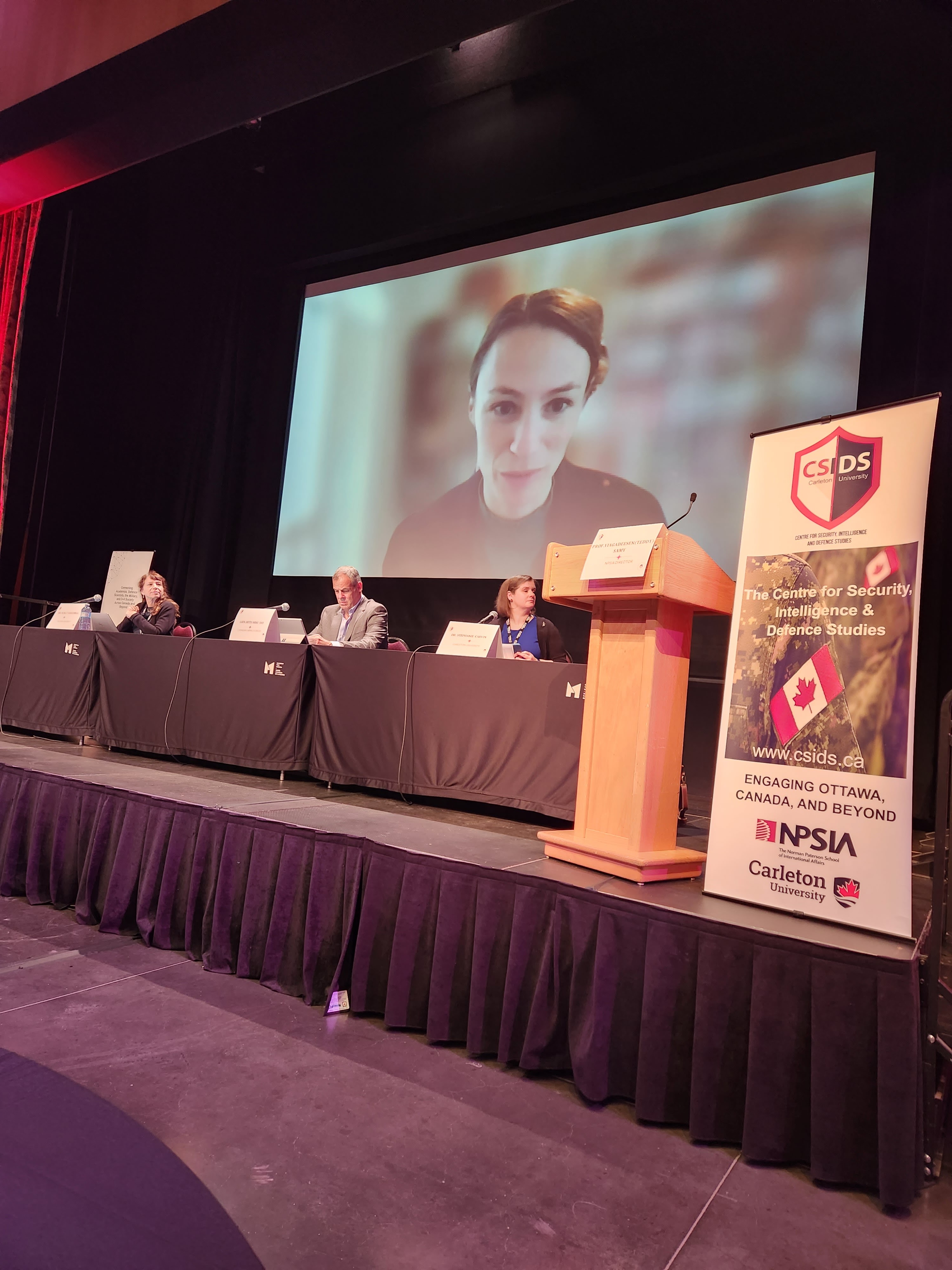
 The Year Ahead conference, which started before the CDSN came into existence, has become a flagship event for both the Carleton research center, Centre for Security, Intelligence, and Defence Studies, and the CDSN.  It provides NPSIA-based scholars with a chance to interact with experts we bring to town and folks from in and around government who attend the event.  We consult our partners in government to see what is on their radar screen for the next year, and try to have panels that are relevant to them.  This year, we had panels on:

  • learning from Ukraine's successes and Russia's aggressive failures
  • the state of Canadian civil-military relations
  • xenophobia and national security, organized by our collaborator Women of Colour Advancing Peace and Security.

We also had a fourth session that was a little different.  We started with a Q&A between myself and Colonel Cathy Blue, our visiting Defence Fellow.  An Air Force officer, she is spending the year with us, auditing a few classes, working on a research project, advising us, providing us with a military point of view, engaging the students, and continuing her professional military education program that comes out of the Canadian Forces College.  She has been an incredible asset this year, a great sounding board.  

After that, we launched the CDSN Podcast Network!  We decided to build our own network so that we could provide opportunities to new podcasts across the country to be heard.  In addition to BattleRhythm, the CDSN's podcast for the past 3.5 years and Conseils de Sécurité, our partnered podcast with RAS/NAS en français, we will have SecurityScape and NATO Field Report.  SecurityScape is a podcast by graduate students at Calgary's Centre for Military, Security, and Strategic Studies, a partner of the CDSN.  They have had one season thus far, and they will drop six episodes of season two in 2023.  NATO Field Report will be a completely new podcast, run by the students and professions involved in the NATO Field School, which brings students to Vancouver for classwork and then onto Europe to various NATO facilities and headquarters.  They will be be dropping episodes episodically--as the field school approaches and then have interviews and reports during the field school's trips to Brussels, Latvia, and wherever else they go.  That we include a podcast that is a different model from the original ones helps to open our imagination for future additions to our network.

Along the way, we fixed a problem with had with our Apple feed. While we have consistently been producing episodes of BattleRhythm, those that relied on our Apple field were not getting automatic downloads of episodes.  Our stuff has always been available at the other outlets (Soundcloud, Spotify, Stitcher, etc.), but now we fixed this problem.  Folks just have to go to the Apple podcast app and search for CDSN and subscribe to get all of our podcasts.  

At the conference, we did a Q&A with the producers and hosts of the various podcasts.  We are very excited about all of this.  If you have an idea for a podcast on defense/security broadly defined, let us know, as we are looking to connect and amplify--the basic CDSN mission.

Nina Tannenwald
Back to the panels, we had Brown University Professor Nina Tannenwald, who discussed the nuclear weapon issues related to the war, retired LGen Mike Day who delineated the lessons from the war itself, and, via zoom, U of Texas Professor Sheena Greitens, who analyzed China's responses to the conflict.  It was a fascinating discussion.  

I moderated the Civil-Military Relations panel where Calgary Prof. Jean-Christophe Boucher and Charlotte Duval-Lantoine of Women in Defence and Security presented a survey they (and me and Lynne Gouliquer) are working on whether the various scandals are affecting Canadians' trust in the military, Andrea Lane of Defence Research and Development Canada presented the challenges posed to the Canadian Armed Forces by political polarization, and Alexandra Richards of Simon Fraser U. analyzed differences among the various generations and their attitudes.  

The final panel on Redefining National Security, organized by WCAPS-C, included Dr. Nadia Abu-Zahra of both Carleton and U of Ottawa, Azeezah Kanji of the Noor Cultural Centre, Jillian Sunderland and Aaron Francis of U of Toronto.  They presented critiques of the defence and security apparatus and community, especially the treatment of historically excluded communities.

We streamed the event, and it will appear on our youtube channels (CDSN and CSIDS) once we get things cleaned up. We will also be circulating a report and related policy notes in January.

I am very grateful for Team CDSN, especially Melissa Jennings, Sherry Laplante, Cathy Blue, Carelove Doreus, Racheal Wallace, Robyn Lalecheur, David Le, Duncan Herd, and Daniel Kholodar, and to the presenters and moderators.  It was great meeting both presenters and audience members, as the event is also a great networking opportunity.  We will do a "hot wash" to figure out what worked best and what could use improvement.  We are open to feedback so if you have suggestions, let us know.

And, yes, we do this stuff so we can eat food and hang out.  

Indeed it was.


I love Charlotte's expression as she realizes
that I am taking a mid-meal pic


Tuesday, November 15, 2022

This is Not How NATO Works

 I spent part of this afternoon being interviewed by television outlets about the missiles that hit


Poland today and NATO might do.  This is one time where TV is going to get it much more right than the newspaper.  Why?  Because the major paper of record in Canada got it spectacularly wrong:


FFS!  NATO is a collective organization--one country cannot wave a magic wand and shout "Accio alliance!  Tada, Article V is invoked!!!"  Nope.  What any country in NATO can do is call a meeting so that the alliance could consider invoking these famed article.  A5 is the "an attack upon one is equal to an attack upon all."  The Dave and Steve book on NATO explored how obligatory that is (it's not) and what explains how countries behave when asked by the alliance to do something.  

But getting back to that attacked thing: it only counts as an attack that deserves a collective response if a consensus among the members.  Everything at NATO operates by consensus--no one is ordered to do anything by any specific country or any sub-group of countries.  This means there is a lot of lowest common denominator kind of decisions with opt out clauses (did you read the Dave and Steve book yet?).  

So, one of the first things Poland (or anyone else seeking to invoke A5) has to consider is: can they get consensus?  If not, don't ask because it is more than a bit embarrassing to ask and then be denied.  Ask Turkey about that.  It is kind of like going up for Full Professor when you don't know what the result will be--it only ends in pain and sadness (and moving which then leads to joy).  Can Poland get damn near all of the alliance (Greece or Hungary or Turkey can agree not to be too disagreeable but not support the decision and then not deploy troops)?  Um, no.  France, Germany, and Italy, to name a few obvious, more powerful members, have been just a wee bit ambivalent all the way along, and they certainly don't want to be involved in a shooting war with Russia.

One of the other things Poland has to consider is: would A5 be good for Poland?  Um, no.  Because if NATO would go to war with Russia, which is what invoking A5 means, that would mean that Russia is no longer restrained from attacking the supply lines leading from the West to Ukraine through ... Poland.  

The existence of A5 in the treaty is working--for both the alliance and for Russia.  Until today, after nine months or so of war, Russia had refrained from hitting any NATO country and specifically Poland.  And today was probably an accident.  An accident that may have been made more likely by a loosening of Russia's rules as they hadn't attacked border cities all that often.  But Kherson and other developments may have changed the risk calculus for Russia.  Anyhow, A5 has been good for NATO's eastern members as it has restrained Russia.  It has also been good for Russia since it has restrained NATO from engaging in direct violence.  

So, no, Article 5 is not going to be invoked.  Article 4, which is a way to indicate the need for serious discussions against a threat, will be.  Poland will get reinforcements as will other NATO allies, Ukraine will get more anti-aircraft equipment, but Ukraine will not get what it wants for an early Christmas present--a NATO intervention.  This would be great in the very short term, but might also lead to nuclear war, which would be bad for a very long time.  As I said at the start of this, rule #1 of avoiding nuclear war is for nuclear powers not to fight each other directly.  India and Pakistan have made us all very nervous.  US and Russia have stuck by rule number one, and that is not going to change now.

So, as I told CBC Kids last month, no, Virginia, there will not be a nuclear war.  

But then again, some elements of the media want to scare folks for sales and market share and ratings, I suppose.  For shame, Globe and Mail, for shame.