Friday, December 11, 2020

Logical Cowardice

 We now have a couple dozen, give or take, GOP Attorneys General and more than a hundred Republican members of the House of Representatives supporting this b.s. lawsuit by Texas trying to overturn the results of four states so that Trump can stay around.  Is this irrational?  No, it is not.  It is wrong, it is craven, but it makes sense.  How so?

First, let's go back to 2016.  Remember when Trump was running for office and few of the dozen or so other competitors for the nomination refused to attack him head on?  They were not afraid, necessarily, of Trump as a sharp debater.  They were afraid of alienating a key part of his base--the extreme wing of the Republican Party.  Cruz and Rubio were particularly craven.  Their miscalculation, of course, was that they thought they could win enough of the rest of the GOP to offset Trump's strong support among the extremists.  Turns out the party was a wee bit more extreme, at least those turning out.

Now?  Republicans may or may not fear angry tweets from Trump, but they don't really have to worry about retaliation via the normal means of a President changing priorities, shifting resources, etc, because, well, he is only going to be in office for 40 or so more days.  But what these Republicans do fear is alienating the Trumpists within the GOP.  Due to Fox, Sinclair, QAnon, and other malignant forces, the ratio of Trumpists in the party have increased.  But even if they were only 10% of the party, losing that hunk in a general election in many districts and most states would be enough to turn elections.  

So, the fear of these potential voters is real and quite rational.  They may vote for a third party (if Trump blesses one) or not show up at the polls if they are dissatisfied.  Or they may primary those GOP who are not sufficiently loyal to Trump.  

But what of the national interest?  What about the preservation of institutions and of democracy?  Well, those concerns would matter if these folks were "Conservatives" but they are not.  They are reactionaries and opportunists.  Plus there is the collective action problem--that the incentives to contribute a bit to a cooperative effort with few direct benefits to oneself are outweighed by the temptations to defect, to free ride on the democracy that others are providing.  

Yep, it is rational and awful.  And we should not be surprised by this, given what the GOP went along with for the past four years and what they did to the Obama Administration when it was trying to deal with one of the worst economic crises of our time. This is the party of McConnell, it is the party of Gingrich.  It is not just the party of Trump--it has been rotten for some time.  But now it is out of the control of the party establishment, in the hands of Trump.  

And that is not going to end on January 20th.

Thursday, December 10, 2020

If I Had Missed the Policy Path?

Yesteday, Thomas Juneau and Philippe Lagassé posted a piece discussing the benefits and possibilities of academics working in the policy sphere (it does not happen much in Canada) and policy-makers spending time in academia.  I indicated that such an experience, my year in the Pentagon, via the Council on Foreign Relations International Affairs Fellowship (designed for this explicit purpose) was career and life changing.  For the better.  

How so?  First, it altered my research agenda.  I started asking questions about NATO because I sat at the Bosnia desk for a year, watching the alliance at work.  This then led, because most decisions are made by NATO members more than the alliance itself, to my focusing on comparative civil-military relations.  Which is where I still am.  I am also working on a belated project on the bureaucratic politics of the US national security process, which came directly from the stuff I observed in 2001-2002.  Second, the year in the policy world almost certainly led to the last two jobs.  The two final candidates for the McGill Canada Research Chair position in 2002 both had CFR IAF experiences.  Probably not an accident.  I am sure having policy experience was important for getting a job at a policy school ten years later.  Third, it changed my teaching.  I not only teach civ-mil relations, but I use the stuff I learned in that one year in my classes all the time.  My students are most practiced at eyerolling to my constant references to "my year in the Pentagon."  I have not only specific stories about the year but learned far more about the processes that operate, the role of personalities, and the intricacies of how the US military operates.  It was a brief but very intense experience.  Fourth, it increased my desire to foster engagement between academics and ... everyone else--the public, the policy world, and so on.

But if I had not had that experience, what would have happened to me and my career?  Well, I might not have gotten the McGill job, which means I would not be Canadian now.  I might still be in Texas, as opportunities to change from one tenured job to another are not that abundant and I don't always interview well.  The McG interview was one of the best ones in my career.  Maybe I would have ended up somewhere else, but the job market is not nearly as predictable as the tides.  So, I don't really know.  I do know that I probably would not have shifted from the International Relations of Ethnic Conflict to Alliances and Civil-Military Relations.  I certainly would not have had as much access to grant money, so I would not have engaged in such ambitious projects as comparing 15 or so democracies and how their legislatures oversee (or not) their militaries.  I would not have spent about half dozen years building a grant to fund a Canadian defence and security network.  I would not have had as many PhD students as there were few at TTU interested in working with me.  So, I would be much poorer with a much smaller TeamSteve.  And I would not have lived in Ottawa or Montreal, which means fewer friends, less ultimate, and less Canada in my life. 

Looking back, I realize that every step along the way has helped me get to where I am (even as I was unhappy and eager to move a few times across my career) and where I am is a pretty cool place.  I love the place I work, I love the work I am doing, I really appreciate the friends I have made in the Pentagon, Montreal, and Ottawa. 

So, yeah, if I had not gone to DC for that one amazing, intense, enlightening, exhausting year, I would be worse off.  I can't recommend enough that academics pursue the rare opportunities to get into the policy world.  It might be as amazing for them as it has been for me.  It may not be as life and career changing, but who knows?


Tuesday, December 8, 2020

Biden Undermines Civilian Control of the Military

It is just a bit beyond the four year anniversary of the post where I blasted Trump for putting Mattis into the Secretary of Defense position and a few weeks after I posted my key rules for cabinet posts.  And we see Biden selecting General (ret.) Lloyd Austin to the position.  Civ-mil twitter is infuriated.  Why are we so upset?  And why is there is so much consensus?  Jim Golby covers it well, but I will post here because I want to have a post that I can link to when I regularly refer to this great mistake.  And because he does not go far enough.

The basic idea is this: civilians should control the armed forces.  This is a lesson learned the hard way during World War I--"War is too important to be left to the generals."  Yes, the President is the ultimate commander-in-chief, but he has a lot of stuff to do.  The person whose day job is to manage the US military is the SecDef.  Indeed, it is his (I wish it were her) job to manage civil-military relations.  Why do we need civvies in this job?  For many reasons, but mostly due to this basic principal that civilians need to be in charge.  Some specific reasons:

  • Military officers are socialized throughout their career to develop various attitudes and mindsets that cause them to see the world in particular ways.  Mattis revealed some of these by talking about the superior integrity of those in uniform (given the war criminals that Trump has pardoned, maybe not?).  
  • Military officers are tightly networked at the top, so they will have close person ties with the three and four star officers, making it harder to have the proper distance. The military tends to generate patron-client networks which are not healthy.
  • Military officers may have much experience playing politics in the military, but their attitude that they are nonpolitical and nonpartisan sets them up for trouble when acting as SecDef, a very political job.
  • Their tendencies towards secrecy and preference for escalation do not serve them well when in the top spot.  

The Congress, when it created the SecDef post, required that any SecDef had to be out of the military for at least ten years.  That was later changed to seven.  They did provide the possibility of a waiver, which has happened twice.  Congress waived this in the case of George C. Marshall who not only served very adeptly to run the Army during WWII but served quite ably as Secretary of State.  He was a unique figure in US military history.  

Mattis was given a waiver four years ago in the misbegotten hope that surrounding Trump with adults would temper Trump's worst impulses.  What happened instead?  Trump, after being blamed for a raid in Yemen that went awry in his first month, delegated all decision-making to the Pentagon.  Mattis and his general/admiral friends escalated most of the wars the US was in.  Why?  Because there is the aforementioned tendency to want to use all means at one's disposal.  It may be a stereotype, but the past four years certainly did not disprove it.  Mattis also decreased transparency.  He did not restrain Trump from risking war with North Korea in 2017.  He did not restrain Trump from ditching the Iran deal.  He stood by while Trump signed the Muslim ban.  He only slow rolled on decreasing troops in various places and regarding the parade in DC.  Mattis was a bad SecDef.  And much of it had to do with his attitude of being an uber-general rather than a civilian controlling the military.  He let the military make policy.  .  While I tended to favor that in my year in the Pentagon because Rumsfeld was so awful, it is not a good idea. 

One of the most important sets of norms that Biden should be reaffirming and reinforcing is civilian control of the military.  I get it that he wants to put a Black American into this spot, and it would be the first time (Colin Powell served as Chairman and as National Security Adviser).  The apparent lack of non-military alternative Black Americans is a condemnation of the existing National Security community where "opportunity hoarding" (thanks, Josh) is a thing.    

To be clear, there is abundant civilian expertise.  One of the basic problems with the US armed forces (and others) is the hard-wired belief that they are not just experts on the use of violence but they are the only experts (thanks to Sam Huntington).  But they don't have a monopoly of expertise.  And their expertise is often quite limited/directed/biased.  We need civilian eyes and ears in the room and hands on the wheel.  

This is not an emergency where we need a military officer needs to be in control.  Indeed, that is a dangerous signal to send and entirely wrong.  In my visits around the world, I found some places where the Minister of Defence is always a retired military officer.  And I found that problematic in the extreme.  Maybe it makes some kind of sense in some of those places because there is not a vibrant civilian community of experts.  But the US has that more so than any place else.  Michele Flournoy is not the only civilian who is qualified for this post, although she might be the most qualified.

You know who is disqualified for this position?  Any retired admiral or general.  I don't think one should ever serve in this post, even if they are ten years past serving.  The military socializes so powerfully that it cannot be undone in a decade, or, as someone put it on twitter, a lifetime.  

Civ-mil scholars disagree on a lot, but the consensus here is quite strong.  I have yet to see a serious civ-mil scholar think this is a good idea.  Some wavered four years ago, but none are now, as far as I can tell.  

Oh, and this is bad politics as well, as Biden will need to do a lot of work and make compromises to get Austin waived.  And if he fails to do so, Biden will have wasted a lot of effort and alienated a lot of folks along the way.


Sunday, December 6, 2020

Canadians Remember Better, Misogny edition

One of the differences between Canada and the US is that Canadians tend to remember stuff better and longer.  I always note this on November 11th, as poppies and ceremonies here remind folks of World War I far more clearly and directly than either Veterans Day or Memorial Day in the US.  Today is another one of those days. 

On December 6th, 1989, a man killed these 14 women in very cold blood

He separated out the men from the women and then executed the women.  It was the biggest massacre since the 1800s until this past year (the Nova Scotia spree).  The guy killed himself.  He might have been the first incel terrorist.  Certainly, the violence was misogynist as he declared he was attacking feminism.  He went to a school and systematically killed the women.

Every year, this day is marked across Canada, not just in Quebec.  Violence against women was not new then or now, but this is the largest attack by a misogynist in Canada.  This summer's attack in Nova Scotia was a bit more complex, but the perpetrator had a history of "domestic violence" as well.  I put that in quotes since the phrase, to me, sanitizes the beating of women (yes, it applies more broadly).  

Anyhow, I can't help but notice that the US does not have national remembrance of its various massacres.  Maybe because there are so many, maybe because 14 women is small compared to Tulsa Race Riots (which were lost to history for most Americans until the past few years) or Las Vegas or Orlando.  Columbine?  Well, we know it is April 20th (Hitler's birthday and all), but we don't mark it.  Nor do we mark Sandy Hook, which we damn well should.  

Anyhow, I am sad and angry that women face so much violence and other forms of abuse.  Today, we are reminded of the toll it has taken.  Remember the women who paid the price.  And let's not give the man any additional attention or notice.  That is what these guys want, so let's deny them that.  It is the very least we can do.


Saturday, December 5, 2020

Quarantine, Week 38: December Brings the Busy

 The end of 2020 is near but not near enough.  The academic calendar has both obvious and less obvious implications for our pace.  The obvious is that the semester is ending, which means the end of lectures (I actually have one live one left), the start of grading season, and, oh wait, preparing the new term.  The less obvious is that people seem to pile on conferences and meetings around this time.  And this week was a busy one for me and the CDSN.

Our YearAhead2021 conference was a big success.  It was entirely virtual due to the spike in Ottawa, but, aside from the Dean's message crashing, it went really well.  We opened with a panel on China that was really interesting, shedding light on what Canada could possibly do despite the asymmetries between the two countries.  Always smart to lead off with Roland Paris (U of Ottawa), a pal and the sharpest IR guy in the country.  Dawn Murphy of the US Air War College provided a good perspective on what China has been doing and why.  Cesar Jaramillo of Project Ploughshares presented a more fine grained analysis by talking about how China's involvement in the Arms Trade Treaty revealed a bit of how China's soft/hard power combo is playing out.  The next panel focused on global perspectives on health/pandemic organized by Erin Gibbs Van Brunschot (Calgary) and Andy Knight (Alberta) with Jonathan Luckhurst of Soka U, Winston Dookeran of U of West Indies, Srikanth of U of Ottawa, and Christopher Afoke Iske of U of Zululand.  

The keynote speaker was Ambassador for Women, Peace, and Security Jacqueline O'Neill, and she wanted a conversation so Beth Woroniuk of the WPS Network-Canada did a great job of doing more than moderating but having a great conversation.  Beth then moderated our Fireside Diversity Chat with Sgt. Karen Pelletier of the RCMP, LtColonel (ret) Bill Shead, and Artur Wilcynski of Communications Security Establishment (kind of Canada's NSA).  Again, a great conversation discussing their experiences and perspectives as the first two are Indigenous Canadians working in law enforcement and the military, while Artur is gay and working in a national security institution.  They discussed the contradictions and challenges they have faced throughout their careers.  

The last panel was on Greyzone warfare with Philippe Dufort of St. Paul University and head of one of the MINDS networks, Marina Miron of King's College London, and Isabelle Duyvesteyn of Leiden U.  They not only addressed Russia's efforts to mess with pretty much everyone, but also the challenges posed by asymmetric warfare.  The virtual experience enabled us to bring in people from the Caribbean, Europe, and South Africa, which might have stretched our budget in ordinary times, but, alas, we could not have the networking experience.  The dinner beforehand, the coffee breaks and lunch during the event--those didn't exist.  And because zoom can be tiring, we had to keep the presentations and q&a shorter.  Still, the event went very well.  The CDSN/CSIDS staff did all of the heavy lifting so I could just focus on being nervous about the whole thing.   And I was so busy worrying and fussing that I didn't take any pictures.  At a physical event, I tend to be the photographer for the CDSN.  Not this time.  We will have to get some screen shots once we get the video from the AV firm.

The busy-ness accelerated as a grant competition I had been preparing for was announced far earlier than I was expecting.  Which means an earlier deadline and a far busier Steve over the holidays.  It also means more mid-December meetings, with me being the organizer.  Sorry, folks.

The joy of the election is that we can go an entire week and only think about Trump once or twice.  Yes, he is doing more damage on his way out, clearly seeking to tie Biden's hands in places like Afghanistan and Iran.  But he is mostly moping and golfing.  If he wants to spend the next few years "running" for 2024, that is money and attention going to him and not the rest of the GOP.  Which is fine.  He might run in four years, but he might also be just extracting the last few dollars out of the gullible folks.  He didn't enjoy being president, and he is going to be really old and even more addled in four years.  So, I don't expect him to campaign, but I do expect him to make everyone in the party suck up to him.  Which is why only a handful of GOP Representatives have recognized the election outcome.  

The other joy of the election is watching how bad lawyering can be.  Oh my.  

This weekend will be very winterfest-y as we need to get the cards out, and the family baking challenge (my brother's idea!) is cupcakes.  So, I will sign off as I have three cupcake recipes I am going to be trying.

 Be well!

Thursday, December 3, 2020

COVID and Pre-existing Conditions

 One thing has been quite clear since March: if you have pre-existing conditions that you did not know about, COVID revealed them.  This is not just true for the human body but for people and political systems.  Today's exemplar:

The Premier (Governor) of Manitoba Brian Pallister said: ""This puts Manitobans at the back of the line. This hurts Manitobans, to put it mildly." Apparently, First Nations folks residing in Manitoba aren't Manitobans.  Hello, white supremacy!  I don't know much about Pallister, but what I have observed for the past several months is that many of the Premiers of Canada have been utter failures as leaders.  They didn't use the summer to improve the testing/tracing system, they didn't set up their schools for success, and they mandated masks mostly too damned late.  The US is not alone in having weak leadership in this crisis.  The epidemic revealed how weak these leaders are.

Likewise, Canadian federalism has not performed great.  While folks want to blame Trudeau for a lot, and they should for much stuff, many of the big decisions and big failures are out of his reach unless he invokes the Emergency Act.  Given the usually dire state of federal-provincial relations, that has been a non-starter.  Trudeau can't force the provinces to shut down or mandate masks apparently.  

COVID 19 also revealed the weaknesses in the international health system, with WHO pandering to one of its key funders (China), and with US desertion of its leadership role greatly undermining the international response.  

I could go on and on, but this pandemic has revealed that I have an attention deficit problems.


Saturday, November 28, 2020

Quarantine, Week 37: Ups and Downs

The highlight, of course, of this week was Thanksgiving.  I got to see nearly all of my family via a Thanksgiving zoom.  I got to eat a lot--the apple hand pies were fun to make and more fun to eat.  Alas, I could not find canned yams, and I didn't boil the fresh ones long enough.  So, that classic dish didn't work out.  But I did have extra mint so the mojitos were a pleasant new Turkey day tradition.

The schadenfreude of the week was the realization that Trump spent $3m on recounts in Wisconsin, ultimately increasing Biden's lead there.  It is clear that Trump will burn everything down before he leaves, almost certainly giving a green light for the assassination of the Iran nuclear scientist, for instance.  The pardon of Michael Flynn was to be expected, and it reminds us, of course, that Flynn plea-bargained, admitting his guilt, because he and his son committed other, more severe crimes than just lying to the Feds.  

The frustration of the week was that while Biden's announced team thus far looks excellent, the dawdling over who gets to be SecDef has led to the names of retired officers being bandied about.  And that is one thing worries me the most.  I have already blogged about my preferences for Biden's cabinet with the most important rule for SecDef being no generals or admirals (maybe one somewhere else might be somewhat ok).  I have contacted those I know in Biden-world to argue that civilian control of the military requires civilians.  We knew it was a bad idea before Mattis was named, and it was proven by how Mattis as SecDef played out.  He didn't see the job as a civilian overseeing the US armed forces but as an uber-general.  Transparency declined, delegation without oversight to the commanders in the field increased with the result of more kinetic efforts (more drone strikes, etc), domination by the Joint Staff over defense decision-making, etc.  I am hoping, as others are, that this effort to raise the names of General Austin and maybe others is more to push back against the progressives so that Michele Flournoy (the consensus candidate) will be more acceptable.

I was less frustrated by the news that Canada would be behind the US and UK in getting the vaccines out because Canada lacks the capacity to produce them.  The media made much of this news this week, but this was always in the cards, especially after the one small capacity for vax production was tied to a Chinese vaccine effort.  With China doubling down on its belligerence towards Canada, that domestic line became a non-starter.  I am annoyed that Trudeau and his team keep blaming his predecessors (although there is blame to be had there) as they have been in power for five years.  But much of the problem in Canada, the spikes, are related to provincial mistakes--in Ontario, in Alberta, in Quebec.  Canada is more federal than the US, so there is less the federal government can do to push around the subunits.  And, alas, Ontario and Alberta are led by folks who are the closest candidates for Canadian Trumps.  In Quebec, it is far more important to worry about the possible decline of French than to develop good policies for keeping French speakers (and others) alive.  

Back at home, it was a busy week as the zooming continued.  I met with some folks to develop the next grant--to focus more research on defence and security issues amid and post-pandemic.  It looks most promising but will depend on the grant gods, often a fickle bunch.  It is also letter of recommendation season, and the penalty for teaching undergrads is that I end up writing more letters.  The joy of the MA program that dominates NPSIA's mission is that those students need references mostly, not letters.  We are prepping for The Year Ahead, the one big conference that we run out of NPSIA/CSIDS/CDSN-HQ.  It is on Friday and should be a very interesting discussion of the challenges ahead.  See this page for more information as well as the poster to the right.


We are seeing that this winter is going to be very difficult, with cases spiking and isolation increasing.  As always, I encourage folks to connect, whether it is by phone, zoom, skype, or whatever.  This will, alas, get worse before it gets better.  But the vaccines are most promising, so I am hoping that I will see my family in person next Thanksgiving.  And I am relying heavily on my narrow memory of the 1920s--bars, drinking, dancing, theater-going--to inspire me--that we will get together and have fun and such in the not-too-distant future.  Be well!


Thursday, November 26, 2020

A Distanced Thanksgiving: Giving Thanks Anyway

The upside of a distanced Thanksgiving: no driving through snow and ice to get to my relatives or flying during the busiest time of the year.  The downsides?  Everything else.  My streak of not seeking my daughter in person continues, not to mention not seeing the rest of my family since ... last Thanksgiving.  The summer family trip didn't happen, so it has been zooms only.  While I will enjoy the fruits of my own baking and cooking today, I will not be enjoying my sister's.  And she does a great job every year as host and chef.  I will miss playing poker with my herd of nieces and nephew.  They learned poker from me when I sought to dodge the annual argument about Bush v. Gore, a loud and annoying discussion despite the fact that my parents and my sister's in-laws were on the same side.  Yet, even in this pandemic, there is much to be thankful for.

First, within the immediate family, we are relatively healthy.  Two nieces have gotten COVID with one having lasting effects long past her bout in March.  Given the rates of infection and how much damage this thing can do, we are doing ok.  And the family has been communicating more than ever, I think, with twice weekly zooms.  One with the next gen and one without.  My other sister got sick of the Trump and pandemic talk, so we now all bring various games to the zooms.  Some are quite revealing, so I have learned much about my siblings and mother that I did not know before.  Chuck Klosterman's Hypertheticals: 50 Questions for Insane Conversations was my contribution, and it has been pretty good.  It often puts people into having to consider bizarre tradeoffs.  

Second, I am so grateful to my friends from all stages of my life.  I have been zooming with many of them over the year.  The poker games (no stakes) with both the local crew and the IR crew have provided much solace.  Speaking of solace, my cohort at UCSD lost one of our own in May, so the zoom wake we had did, indeed, provide a great deal of solace.  I got out of the habit of zooming as much this fall because I had so many work-related teleconferences.  But I am returning to the evening zooms with friends--it makes a big difference in getting through this.

Third, I am very thankful for my friends and colleagues in the academic business.  We have been exchanging tips about teaching online, we have been organizing virtual workshops and conferences, and we have been busy making sure our community remains communal in this strange time.  

Fourth, as someone who usually is quite critical of my own employer, I have to say I have been most impressed by and grateful for Carleton's handling of this crisis.  They not only made quick decisions to go online in the fall so that we had all summer to prepare (and again an early decision to go online in the winter) but provided a heap of resources so that the teaching and learning folks could help us with our online stuff.  Having the VP for Teaching as a co-teacher was lucky, as he not only had great ideas for our class but could call on those aforementioned staffers of his to fix whatever mistakes I made.

Fifth, I am thankful that my daughter majored in Film Production, as she became our editor of online materials.  She had the time because she had been furloughed, and, yes, I did pay her.  She is now un-furloughed, for which we are all grateful as well.  I will have to muddle through next term without her help, but glad she is back assisting those who manage Hollywood's talent.

 Sixth, despite twitter and facebook being conduits of evil, the people I have met and hang out with on these platforms have provided me with laughs, insights, and info.  It makes it far easier to feel connected in this time.  

Seventh, I am thankful that Biden won and that the vaccines are on the horizon.  While Trump is going to cause much damage on this way out, with pardons and a potential strike on Iran, the US (and as a result the world) will have better leadership.  Next year, I will give thanks for not thinking about the American president for days at a time.  And it is likely that we will be able to spend Thanksgiving next year together.  

It may not be quite normal, but 2021 promises to be better than 2020.  While my education did not focus much on the 1920s, my understanding of the boozing and partying and theater-going in the aftermath of the Spanish Flu has given me hope that the post-pandemic era will be one of much fun and adventure.  We will not forget those we lost and those who were harmed, but we will feel much relief.  We will have earned our hangovers and all the rest.  

So, yes, even in this dark year, I am most thankful.  I hope y'all have as good as a Thanksgiving as you can even if you can't be with those you love.  Be well and stay home!


Saturday, November 21, 2020

Whither Canada in a World of American Decline

 Alex Usher asked this:

I have been thinking about this for the past four years with no answer.  It was more about Trump being unreliable and potentially hostile and less about American decline (although Trump being President accelerated American decline).  And I have not yet figured out a good answer.  Alex used the example of Finland in the latter stages of the Cold War, but I am not sure that is the best analogy.  Findlandization was all about a forced neutrality to keep the Soviets at bay.  Canada's position before Trump was of willing partner with common interests (although not identical).  During Trump, it was perhaps more of abused partner.  With Biden as President, there will still be tensions regarding some trade issues, but the issue will be about relying on a country with declining abilities.  

So what can Canada do?  The traditional answer is Diversify Canada's trade markets.  So much dependence on selling to, buying from, and co-producing with the US.  Sure.  But what are the alternatives?

  • China?  A huge market full of ... people stealing IP, holding Canadians hostage, extracting more from investments in a Tony Soprano kind of way, and so on.  Not great.  
  • India?  There are many reasons why India has been a tough nut to crack for not just Canada.  India has tended to protect its markets and that is not likely to change.  That the country is now run by Hindu nationalists makes it far harder for any country with multicultural values to work with India.  India only looks good because it has not put millions of Muslims in concentration camps (that would be China).  For Canada, all of this is more complicated because Canadian leaders see their own domestic politics in India--playing to Sikh communities in Canada while in India alienates the rest of India including the aforementioned Hindu nationalist folks.  
  • Japan?  There is a lot to be had in a partnership with Japan, but Japan faces a demographic cliff and it has been a long time since it was dominating trade.  
  • Europe?  Um, they have their own problems and don't see Canada as a solution to any of them.  While the EU could have been as replacing or supplementing the US, Brexit has done so much damage along with the lousy response to the 2008 financial crisis that it is not a good alternative for Canada.
  • Germany?  Merkel and Germany have been good partners, but, again, Canada is not a priority for Germany, and we have no idea how Germany will operate post-Merkel.
  • UK?  Oh my.  What a shitshow.  And, yes, the UK's misery makes an Anglosphere (sans US) a non-starter.  Not that UK-Aus-NZ-Can would sufficient heft.

And there is security.  Bandwagoning with the new rising power--China--is not going to happen for all kinds of reasons.  Right now, there are more folks who want to confront China.  How?  Damned if I know.  One running argument this week was with folks who accused those concerns about Chinese power of being cowards.  I did not enjoy that.  Canada faces a huge problem here because it has few levers, it faces much asymmetry with China's power, and China has no conscience about using its power as a bully.  All of the stuff I have heard about what Canada can do are pin-pricks whereas China can devastate entire markets by turning off access.  In my corner of the world, universities have become dependent on tuition by Chinese students.  Turn that off and ouch!  Anyhow, Finland, at least, had some idea of the possibility of allying with Russia's adversary.  Canada has no option to ally with the US's primary adversary.

India is too far away to a helpful ally although a multilateral partnership with Japan, Australia, Indonesia and others to contain China would be cool ... well, if the US provided most of the ships/planes/logistics/glue.  How can Canada improve its security in a world where the US is in decline?  Well, it could develop its own nuclear deterrent.  Nope, not gonna happen.  

Oh, and Canada's greatest asset in international relations is, alas, not that people like us or our brand.  It has been its mineral wealth.  And guess what?  Folks are moving away from oil and especially from, dare I say it, emissions-rich oil.  So, Canada has to figure out what comparative advantages it has and try to use those more strategically.  Yes, the brand still matters and has some use, but it is not going to buy Canada a seat at the UN.  Maneuvering through a multipolar, uncertain world will require more creativity, more adaptability, and a greater understanding of the tradeoffs.  For instance, pushing human rights will risk arms sales since most of the big buyers are ... awful.   So, realize that making a choice will mean getting gored by one of the horns of that dilemma.  And, yes, even choosing not to decide is still a choice.

So, yeah, a blog post of shrugging shoulders.  I still have no answer.  Sorry.


Quarantine, Week 36: When the Media Loses It

 As a scholar of irredentism, I was delighted by this Fox oopsie:


Sure, the dueling irredentisms of Armenia and Azerbaijan caused a spike in the sales of For Kin or Country, but now we have the upper part of Michigan being given to Canada by Fox.  Which will inevitably lead to the US seeking to gain this lost territory inhabited by Americans that will yearn to be joined back with their people.  The pull of national health care will not crush the spirit of those seeking to rejoin their homeland, where u's are not wasted, where the sportschannel is not obsessed with hockey, while there is not a confusing melange of both metric and imperial systems, and, yes, where there are few damned bags of milk.  

Of course, irredentism requires not just a territory and a people seeking to be redeemed, but also a motherland that seeks to unify with that lost territory.  While the GOP may want to play this up, the Dems can play with this kind of nationalism as well.  Biden can start his administration promising to reverse all of his predecessor's misbegotten policies including the ceding of Upper Michigan to Canada.  After all, does not Biden claim to be the unifier?  And what unifies more than territorial expansion?  Michigan'ers will jump on this as they hope to replace Texas as the Irredentist Americans.  

Ok, I did promise that these quarantine reports would chart my descent into madness, so ... yeah.  

Of course, the Fox map mistake is dwarfed by the genius legal teams Trump has sent out, confusing Minnesota and Michigan, sweating hair dye, and other shenanigans. 

What have I spent the past week doing?  Mostly arguing that these attempts were not a coup.  Some folks found this consensus of the civ-mil folks (see here and here) to be overly pedantic.  Given that a coup usually refers to the security forces of a state removing the incumbent, it is a meaningful distinction:

  1. the US military is not involved, so talking about a coup is looking in the wrong place
  2. the US military has never couped, but talking about a coup helps to degrade the long-standing norms about coups.  Why?  Because coups happen mostly where coups have happened before.  In the US, it has long been unimaginable for the US military to seize power.  Now people are imagining it, which undermines the norms.  Not great.
  3. there is the pesky thing about it being Trump, the President, who may be seeking to stick around longer, a very different process than someone else coming in and taking power. 

 These are different dynamics, so we need to take these differences seriously so that we can focus our attention and our activism where it belongs--the US Congress, state legislators, and media outlets (ok, the last one is the same for a coup--let's seize the radio stations).  As I write this, the Wall Street Journal has pushed out an op-ed against this effort.  Other right of center media outlets are pushing back.  If Trump has to rely only on OAN and maybe Sinclair, he will not just lose power (well, he is losing power anyway) but also the narrative of this season.  

Besides that, it has been a very busy week.  I met with different students thinking about grad school (tis the season), I "went" to a couple of web-based workshops/panels that were chock full of smart people doing interesting stuff.  One presented the CDSN survey to a large crowd--I was most proud of JC Boucher, Nik Nanos, and Colleen Bell for doing a great job of presenting the survey and thinking about its implications.  

The RAS-NSA network, the bilingual network that is a partner of the CDSN, had another webinar on capacity building (training other militaries).  This one was focused on NATO, so I got to see Stef von Hlatky talk about her work on NATO implementing gender training/policy, Carla Machain Martinez (one of the hotshots of the next gen of civ-mil folks) talk about the US case, and then the commander of the Canadian mission in Latvia talk about adjusting to COVID.  I was most interested to learn, in response to my question about whether the restrictions of past missions and differences among contingents made it hard to cooperate mid-pandemic, that Canada benefited from working along side Spain and Italy.  Since those two countries experienced the pandemic intensely earlier than everyone else, they developed policies for their troops abroad that were then adopted by the rest of the NATO troops in Latvia.  I wanted to ask whether being with the lamest countries (Canada picked last, got mostly troops from countries with highly restricted, less experienced troops), but instead, I got an answer that suggested that past performance has different implications in a pandemic.

I also met with different folks to figure out a grant application in the winter and the next directions of the CDSN.  Thanks to the generosity of these folks--they gave me their time and expertise--I feel like we are in good shape.

The highlight of the week was playing poker online with my IR friends.  Not just because I was the big winner, but because I had fallen out of the habit of zooming with friends.  I need to get back in the habit, because those kinds of zooms provide much solace even as work zooms are, um, anti-solace?

The big waves in the US and Canada are disturbing, that people need to be cajoled to stay apart.  US Thanksgiving is next week, and too many folks will organize their own super-spreader events.  Yes, we have had bad leadership in both countries--Doug Ford has the wrong priorities but he is not alone--but it is up to every individual and family to do what is right.  I am lucky in that my family and friends are smart and reasonable and patient about this thing.  The vaccine news is great, but we have to live long enough to get there. So, please, don't travel to see friends/family for this set of holidays or the next.   There will be other Thanskgivings and Winterfests ... as long as we do the right stuff now.


Monday, November 16, 2020

The Biden Cabinet: Some Basic Rules and a Few Suggestions

 The joy of a new administration, well among many, is that we can play the game of predicting the next cabinet.  I am not sufficiently up on the who's who in the DC zoo or in Biden's team to guess who will win which seat.  I do, however, have strong opinions about who should and should not be in the cabinet.  First some general rules and then some specific recommendations.

To start, it is great to see that Biden's transition teams are quite diverse--more women than men, plenty of people of color.  There are all kinds of good reasons for this--moral ones, efficiency ones, and so forth.  It is not just the right thing to do but also the smart thing to do, as there is much untapped talent that will provide varied perspectives.  There is also this: if you want less sexual harassment, less racism, less trans phobia in the government, modeling that at the top is the way to go.  Again, not only right but smart as a less harassed workforce is likely to be more effective.  

My second guiding rule is this: no retired admirals or generals in the cabinet (my old post from four years ago holds up better than my predictions).  We need to re-assert civilian control of the military, something that the Trump Administration greatly undermined.  While military officers have much expertise, governing is actually not one of them.  Running a large military unit/entity is not the same thing as running a government agency.  It simply is not.  Military officers like to think they are not political (they are), and running an agency is so very political.  Mattis might have been a Warrior Monk but he really didn't do the job well.  We can blame Trump all we want, but Mattis was poorly suited for that job--he acted as he were a super-general and not really as SecDef.  The bright side of having a diverse cabinet is that it decreases the likelihood of generals and admirals being put in top level positions--because it is not a diverse set of folks.  If you want military expertise, just ask the military assistants that are abundant in DoD.  And rely on the Chairman of the Joint Chiefs of Staff to give advice.  No need to have that replicated in the SecDef or those under the SecDef at the Office of the Secretary of Defense.  

My third guiding rule: limit the hacks and bundlers.  There are lots of experts out there, so best not to stack positions with those who have less expertise and more conflicts of interest.  I am not saying no Wall Street people, but I am saying few of them, please.  And one thing to imitate from the Obama Administration--vet very carefully.  Note how few scandals Obama had.  We need to reassert not just civilian control over the military but propriety at the top.  No corruption, nobody who has any corruption scandals in the past.  The norms need to be rebuilt and reaffirmed.  

Fourth, focus on what we have done well and not so well.  There is a whole kerfuffle about whether Susan Rice should be Secretary of State.  Whether fair or not, she is viewed as being stronger on Europe than on Asia.  From my experience watching Canada mess up in Asia and do fine in Europe, I think Europe is relatively easy, Asia is relatively hard.  So, put into place a team that does Asia well.  The stakes are higher, there are fewer institutions to provide guardrails and standard operating procedures, the alliances are harder to manage (South Korea vs. Japan makes Greece vs. Turkey look silly and easy).  

Fifth, don't sweat what Fox will say.  And probably not what McConnell will say.  Trying to reach across the aisle sells out those who brought you here.  A team of rivals approach only works if the "rivals" operate in good faith, and there is little good faith in the GOP.  John Kasich has already outed himself as someone who can't play well with key constituencies in the Democratic Party.   So, nope.  There are plenty of moderate, technocratic, independent types that one can bring in along with progressive folks.  Lots of talent out there.  Make the best use of it.  

Update:  Oh and no Senators.  The Senate is tough to balance anyway right now, no need to take smart people doing great work where they are at and put them in a spot where they have not much experience (running an agency) and putting the Senate at risk.  

So, that is my starting point. What's yours?

Sunday, November 15, 2020

The Empathy Gap: The Source of So Much Polarization

The stories about people not wearing masks creating endless chains of COVID victims and how the GOP is so tied to these people and vice versa made me realize today something that I have been thinking about for some time: that the two parties have many differences but at the core is an empathy gap.

The GOP and its supporters do not care about others, only about themselves.  They want to gut policies that help others, especially others who are different.  The Democrats constantly fight for those who are different from themselves.  They disagree often about how to do that, but they aim to foster policies that help others.

The masking stuff is the most obvious manifestation and maybe we would have gotten more masking by GOP if Trump had rallied in favor of masks.  I can't remember how many times a Republican switched on an issue because it affected someone in their family.  One would become less intolerant of LGBTQ because their child came out.  Why?  Why does it take something happening to a family member to take an issue seriously? Because they and their party are blind to the concerns of others.  It is hard-wired into their ideology and their identity.  Stuff only matters if it happens to themselves and their immediate kin.  

One might think this is only a Trump thing but it existed before Trump AND Trump is also a product of the lack of empathy.  He is not only the candidate for racists, misogynists, homophobes, xenophobes, anti-semites, etc but also those that are simply bitterly resentful of the success of others.  Think of how much of his stance and his supporters are simply to trigger the Liberals.  Jealousy, envy, resentment--these are pretty much the opposite of empathy.  

Perhaps the big failure of the pandemic was to tell people that masks were more effective at protecting others than protecting themselves.  It might have been a lie to suggest otherwise, but it might have led to more mask-wearing.  Then again, we know that social distancing works to protect oneself yet people aren't doing that either, so the lack of empathy can't explain everything.  

I just grow incredibly angry and frustrated that the selfishness of people is a key engine for the pandemic.  The pandemic is hard to manage everywhere, but the US is finding it harder than most.  Why?  Because people do not care about their impact on others.  Well, that and having leadership that say it is a hoax, leading to so many people denying the reality even when it is literally shoved down their throats via intubation.  

This really will be the winter of our discontent, as it didn't have to be this bad, and people are still making bad decisions that get other people killed. 

Saturday, November 14, 2020

Quarantine, Week 35: The Five Stages and So On

It has been a busy week for everyone, I think.  I spent much of it pushing back, along with the rest of #civmil folks, against the idea that there will be a coup in the US.  Erica deBruin wrote a great piece that represents the consensus of the civ-mil folks I know.  I even created a new fetch meme:


Melania has referred to this being their last Christmas in the White House, the Trump lawyers are quitting, and Giuliani is being given the role of leading the legal processes, which is itself an admission of defeat.  So, we are moving beyond denial.  The next stage for the GOP and for Trump will be anger--its perpetual state--which will focus on blamecasting.  Who lost the election for Trump?  Certainly, he won't think it is his fault.  

The five stages of grief are in my head this week, as the IR community lost a great guy.  Sean Kay, a professor at Ohio Wesleyan, died yesterday.  I believe it was sudden since everyone seems surprised.  I knew Sean via twitter and blogging mostly, which led to multiple shared beers and meals at conferences.  I really did not know him that well, as the various remembrances are informing me of how much of a life he lived and how many multitudes he contained.  The threads by his students and the facebook comments demonstrate that he was so very caring, so very dynamic, and so very loved.  Gone way too soon.  So, yeah, I am in the anger phase, I think.

I am also a bit depressed--that the entire US is red and so is much of Canada is in terms of COVID spread.  Both countries have botched the response but in different ways.  In Canada, there seem to be sharper limits on what the federal government can do, so we have had to rely on provincial leadership, which has sucked bigtime with a few exceptions.  In the US, the country has to wait two months for decent leadership.  Trump is not going to do what is necessary, so cases are going to continue to spiral.  Governors gave into restaurants and bars and churches and didn't enforce mask mandates as much as they should have.  So, there will be no Thanksgiving and no Christmas except for those who don't mind killing grandma, and, alas, there are too many people who are willing to risk their families' lives.  The news of a reliable vaccine gives me much hope that the fall of 2021 can approach normal, but the bodies are going to pile up (see the pics of freezer trucks in El Paso) before we get there.  

There are signs of hope.  My daughter is back to work as Hollywood is picking up the pace.  My undergrads are seeking advice about our grad program.  The Biden team is building lists of incredibly decent and smart people, and diverse lists at that, for the transition.  I recognize some of the names on the DoD and State lists, and that gives me much hope that the new administration will only be competent but more than that--staffed with experienced people who bring with them not only expertise but good judgment and, yes, good hearts.  

My guess is that we are probably around the middle of this thing or even a bit past it.  It is going to get worse this winter before it gets better, and it will have a hell of a tail as COVID survivors are going to dealing with the effects of this for a long time.  So, the only way out remains through.  Be distant, be masked, and be well!


Friday, November 13, 2020

Trump's Record of Piece

I was asked on the radio about whether Trump was a peaceful President--no new wars.  Trump did make noises about trying to end US involvement in a number of wars and has reduced troop levels in Syria, Iraq, and Afghanistan.  So, there's something to it.  But I argued mostly that the "less new wars" was something that happened more by luck.  How so?

Remember all the way back to the beginning of .... 2020.  Yes, feels like five years ago.  Drone-striking Iranian senior leader Qasem Soleimani in Iraq lead to a series of moves which produced an air-strike that was called back at the last minute.  Yes, the US was very close to a shooting war with Iran.  True, Trump stopped it at the last second, but we got that close because Trump's policy of amping up tensions with Iran.  Rather than live by the nuclear deal, the Trump Administration not only pulled out of the deal but engaged in a series of moves-- "Maximum Pressure"-- to push Iran into a corner.  None of this worked to cow Iran.  This was not the first attempt to bring back ye olde Kaiser Wilhelm's risk theory--be a bully.

Remember all the way back to 2018 and the situation on the Korean peninsula?  I do because was planning to go to South Korea to do research, and I wondered if I would be in the middle of a war.  Trump was not only escalating the rhetoric with Kim Jong Un but the various exercises and flybys.  I don't know if they knew exactly where the line was for the North Koreans between an American exercise and an American first strike, but I felt that things were getting close.  Then, Trump had his moment where he offered to have a peace summit.  Which did stop the escalation.  Did it stop the North Korean nuclear weapons and missile programs?  Nope.  

Speaking of which, has the effort to corner Iran been more effective at restricting the Iranians from developing nuclear weapons than the JCPOA?  Nope.  

While Trump did not enlarge the number of countries the US is bombing, he did allow the intensity of those bombing campaigns to increase.  Trump didn't like being held responsible for US military activity, learning from a failed raid in Yemen in his first month that he prefers to let the generals make the mistakes and then own them.  Well, one of the old maxims of military attitudes is that the US military does not want any new wars but tends to prefer to escalate the ones they are in, and that is what they did.

But at least he has been tougher on China, right?  In terms of trade war, sure.  In terms of building an alliance of countries to counter Chinese moves?  No.  Trump's threats to pull out of South Korea and Japan if they don't pay more for American bases in those countries have weakened American credibility.  While most of the blame for tensions between South Korea and Japan goes to those two countries, the US has not managed that relationship.  Instead, the dalliances with Kim Jong Un and the focus on the costs of bases have done much to exacerbate the always problematic relationship between the two American allies in the region.  Oh, and China?  Its leaders think that Trump is a paper tiger--that he makes threats that he will not back up.  Either they are right, and this encourages them to engage in more aggressive behavior.  Or they are wrong and it produces a crisis that might escalate.  Either way, not good.  I wonder if China's coercion towards Canada would have happened had China been more certain about American support for its ally.

Russia?  Yes, the US sent more troops to Poland as part of a reassurance initiative.  Yet how reassured was the entire region every time Trump focused on his misunderstanding of how NATO works and how much countries owe the US for back payments rather than how to work together to deter Russia?

I have constantly referred to Trump as an Uncertainty Engine.  He raised doubts about American commitments to allies, he blew hot and cold in his relationships with Kim Jong Un and Xi Jinping, he pandered to Putin.  All of this created uncertainty.  And uncertainty is seen by most scholars of international relations as a bad thing.  Why?  Wars tend to start due to miscalculations about the intent of possible third parties.  The US has helped to maintain much peace and stability in Europe and Asia for much of the cold war by providing certainty.  When there was doubt about the American commitment to South Korea, North Korea invaded in 1950.  The repeated crises over Berlin during the Cold War was all about testing American commitment. 

So, was Trump good or lucky? He was very lucky. Plus he sold out US interests without countries having to coerce the US.  The adversaries could get what they want without war and without worrying too much about an American response.  Did Trump do anything right on foreign policy?  A group of friends came up with a list of things Biden should keep doing, but it was a short list.  The un-do list is going to be far, far longer, but that is a post for another day.

Wednesday, November 11, 2020

Remembrance Day 2020: What Poor Memories We Have

Canadian Memorial at Vimy
It has become a Semi-Spew tradition to post pictures from my various travels to war museums and memorials and war cemeteries on this day to mark this day and to note that the Canadians and the Commonwealth countries do this day so well.  And to marvel that a war that is no longer in living memory resonates so much.  Yet this year, I can't help but think about the other event of that time, the flu pandemic, that we learned .... from which we learned damn near nothing.

I don't know if the COVID responses in the US and Canada would be different now if we had spent the past 100 years remembering the pandemic that killed far more people than the war did.  As an overeducated American, I learned nothing in school about the flu of 1918-1920.  Nothing at all.  I learned more in March than I did in the previous 50 years.  I learned about flattening curves and about how different cities treated the disease differently and getting, unsurprisingly, different outcomes.  I learned about anti-maskers way back when and all of that.  

Aussie War Memorial
But perhaps I can't blame the lack of public education about pandemics because we sure as hell have a lot of information and learning since March yet provinces and states still vary widely in what they are requiring, and what they are closing.  We still see so much variation in what people are doing, even as both countries are facing spikes that exceed the worst of the first wave.  How many refrigerated trucks are moving to El Paso to store the dead?  How many hospitals are near the breaking point?  

As a result of all this, this Remembrance Day is not like any other up here, as the streets are barricaded to keep people away from the War Memorial.  People will have to join online events or contemplate events on their own.  I happened only yesterday to get a poppy as I was, um, buying booze for a lava cake recipe (and it was really, really good).  Usually, there is peer pressure to get poppies as soon as we bring in the Halloween decorations.  Not this year, as I have rarely been outside and have not been to any gatherings since a meeting in July.  I wish everyone was taking this as seriously as my friends and family.  

Memorials to the Canadians who
fell in Afghanistan (Camp Mirage)

Back to Remembrance day, the war definitely helped to take a disease and facilitate its spread. This is one reason why every conflict I see these days, one of my first thoughts is what is this doing to exacerbate the pandemic, whether it is Ethiopia this week or Armenia/Azerbaijan last wee or Syria over the summer.  So, on this Remembrance Day, I remember the soldiers who died of the flu as the various dynamics of the war caused many, many young people to be struck down before their lives could really get started. 


Tuesday, November 10, 2020

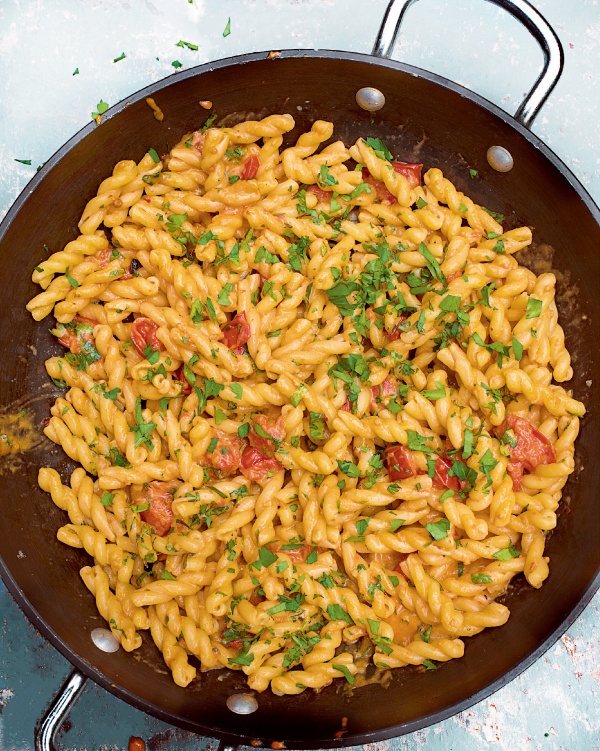
Anchovies? Yep, Going Beyond the Food Frontier

I shocked Mrs. Spew last night as I made pasta with anchovies, mascarpone, and cherry tomatoes.  Why so shocking?  I have never made anything with any of those three ingredients before.  It represented the height of a trend that began somewhere along the way in this pandemic.  I have always been a picky eater, although my family's memories of what I did when I was nine are not representative of what I have been eating since then.  Sometime after my siblings went to college, I started eating the veggies in the Chinese dishes we got when we went out.  And, yes, spending time in Tokyo a few years ago definitely expanded what I ate.

There remains stuff that I don't like: cilantro, raw tomatoes, eggplant.  But the vast category of things that I wouldn't try, out of fear, has become a wee bit less vast over the last seven months or so.  I mostly blame Nigella Lawson, but the Weekly Saideman Family Baking Challenge™ has also pushed me on occasion.  For instance, I made a Peach Pie a few months ago, despite never making or eating peach pie before.  And, well, I will stick with apple pies, as I found peach pie to be meh.  

The real Nigella gateway drug

Why the change now?  First, I have been cooking six days a week--we order out once a week to, um, "save the local restauranteurs."  In the days before the pandemic, Mrs. Spew would cook a couple times a week, especially on days that I came home relatively late.  She has now mostly recovered from non-covid stuff, but was not up to cooking for most of the last seven months.  Also, in most seasons, there was some form of ultimate in the evening, which meant just grabbing something. And, yes, much travel.  So, instead of having lots of changes of pace, it was just me.  I like my old repertoire of dishes, but they can get old.  


Peas in pasta!
So, I started googling dishes to make.  A lot of the early stuff was bland--throwing lots of stuff on a baking sheet and roasting.  Then, a twitter friend turned me onto the Nigella Lawson app--a gateway drug to her books.  While we have plenty of cookbooks in the house, I found Lawson's stuff to hit the sweet spot of being relatively quick, requiring not too many non-ordinary ingredients, and tasty.  So, I started doing things I had long resisted, like throwing frozen peas into pasta recipes.  


The baking adventures are mostly to provide opportunities to stress eat and then stress exercise.  King Arthur recipes have not failed me, as they have consistently produced mostly easy to make, always tasty stuff.  

Not every dish I have made is very tasty but Nigella has failed me only once and King Arthur maybe only once as well.  The NYT recipes are usually quite good, but tend to require more time, more ingredients, and more steps. The other stuff I find on the internet?   Often bland.  

 The anchovy pasta sauce was not the only high point.  Last week, I was too lazy to go shopping--I try to keep that to once a week to minimize exposure doing this latest spike--so when we ran out of bread, I made some (my first bread of the pandemic).  When we needed pitas for my greek dish (one I have been making forever), I made some.  Thanks to King Arthur for both.  So much baking this summer has made me very comfy in just making something I need pretty quickly.

Anyhow, my mid-life, mid-pandemic crisis has led me to a wider array of stuff I am willing to make and to eat.  The next challenge is chocolate lava cakes for a special occasion.  

I cooked with shrimp before
but am far more comfy now
(and they defrost fast!)


Monday, November 9, 2020

One Potential Trump Future

 Lots of discussion of what Trump will do once he leaves the White House.  I have already suggested that he might flee to Saudi Arabia: no extradition treaty, golf courses open year around, and less risk of accidentally swallowing polonium... oh, and orbs! 

While listening to the Bingemode podcast about the Marvel Cinematic Universe and specifically the episode of the Hulk, I could not help but think about the possibility that Trump spends the rest of his life wandering from town to town.  He finds ways to make a living and getting to know people, but then something sets him off and a rage monster erupts, doing significant damage.*  And then he goes on to the next town.

So, when I see Trump from now on, I have the theme to the Incredible Hulk tv show in my head.  And all apologies to the late Bill Bixby.  


*and yes, I am aware that the MAGA fans have created much stuff envisioning Trump as the Hulk.  I guess we agree that Trump has a crappy temper and does much destruction.  They, of course, see this as a good thing.  Somehow, I don't think wandering Trump-monster will be doing acts of good along the way.

Saturday, November 7, 2020

Too Much Exuberance But Close Enough: 2020 Prediction Edition

 I have delayed evaluating my predictions for this election because ... I am so tired.  It is not that we don't know who won or where they won, but simple exhaustion.  I fared much better this time at the Presidential level than the Senate level ... just like everyone else.

So, re the Presidency, I let my enthusiasm get the best of me as I chose Texas to go blue.  It was not close, but it was closer than previous elections.  It may happen one day, but not this time.  I also got Ohio wrong--I thought that Trump's failed trade wars would make a dent and that Joe would be able to reach out to blue-collar whites.  In both cases, I thought that the reports of bigtime turnout would help the Dems.  But it turns out that the GOP also showed up.

I got right Arizona (so far), Georgia, Pennsylvania, and the upper midwest.  I also was right to be skeptical about Florida.  If they hadn't been able to poll tax the re-enfranchised African-Americans, who knows what might have happened there.  But I had faith in Florida's ability to mess things up.  Biden won the election with a record number of votes, but not as big of a margin as we expected.  Which leads to what I got wrong about the overall dynamics.

It is too soon to say what really happened because the exit polls may be trash--that they only really sample those who voted and we know that is a biased sample. But we know that the GOP turned out and didn't leave Trump.  We do know that those independents and the few GOP who did leave Trump split their tickets to limit what Biden can do.  I don't know if talk of court packing and creating two new states helped to push these folks to split their tickets.  What I am pretty sure of:

  • Fear of loss of power is a thing, that prospect theory (this week's concept for my IR class) tells us that people will gamble more to avoid losses than to get gains.  And white folks fear losing power.  So, they turned out and voted for Trump.
  • Trump's messaging, as dumb as it seemed, worked--that Cuban-Americans and others believe the shit about Biden being a socialist.  
  • The pandemic probably hurt the Dems, rather than helped, as they didn't do much of a ground game.  Those places where they did have a ground game, they did pretty well, but door-to-door campaigning favored the GOP this time because, well, they don't care about spreading the virus.  
  • What I got wrong was expecting Trump to get blamed for the crappy pandemic response or for the breaking of the US Postal Service.  I just thought there would be some attrition due to those related processes, but nope.
  • Probably because the two separate Americas has become even more distant.  I was reminded it is not just Fox but Sinclair--the network of local tv stations pushing out far right garbage systematically every day across the country--that means that a large chunk of America just does not grasp the reality of the day.  People will blame the Dems for not being able to reach rural voters, but it may be that they are so bubbled that they are essentially unreachable.  
  • The GOP has a harder problem--they can't reach the cities and the suburbs.  They have alienated the youth with their intolerance, and they are literally killing their base by encouraging anti-masking, crowding (that is the opposite of social distancing), and anti-science.  In the Georgia runoffs in January, there may be fewer GOP able to vote because of the spread of the disease, which is ripping through rural America.  
  • The Dems do need to move beyond gerontocracy--they need to have a non-Schumer run their side in the Senate, Pelosi should start prepping the way towards a successor.  

Tuesday, November 3rd, was a good day.  It was not a great day, but it was a necessary day.  Trump will be out of power come January 21st.  The arsonists will be on the run, seeking to avoid prosecution.  And the hard part of governing will begin.  Good luck, Joe and Kamala, as the hand you have been dealt is actually worse than the one that Obama started with, and that is pretty hard to imagine.  


Quarantine, Week 34: All Over But the Screaming and Shouting

I still haven't posted an assessment of my pre-election predictions because we still do not know ... oh wait.  We do know.  Just don't know the details yet, but Biden will be the next President.  The networks are afraid to say so because of 2000 and 2016 and because there is a tantrum monster in the White House.  But they have declared winners with less evidence before.  Biden broke through in places Dems hadn't won in 20+ years--Georgia and Arizona--and won more votes than any other candidate in history.  Not as much condemnation of Trumpism as the GOP voters turned out in far bigger numbers than I expected, and that gives us some pause.  Fear of the loss of white power, the control of the media by Fox/Sinclair, and maybe a few other factors are driving this, and none will disappear anytime soon.  So, it is a good but not great week.

One way I have been getting through this has been enjoying the Meme of the Week contest in my undergraduate class.  So much so that I have decided to add this to my grad class next term.  The big teaching challenge of the week is that Carleton extended winter break to give its employees a few more days off (with no negative consequences for leaves/pay/etc).  Which means that classes that meet on Thursdays and Fridays lose a day.  So, I lost a week for my seminar and don't know which week to drop.  Not a huge problem, but something to figure out.  

The CDSN had a great week as Irina Goldenberg and Stéfanie von Hlatky ran a great Personnel Theme workshop for two days where they had military and civilian academics, defence scientists, government officials, military officers, and others come together and discuss the progress and challenges facing efforts to build a diverse and inclusive Canadian Armed Forces.  It was exactly the kind of thing that I was hoping for when we started building the CDSN.  

This week was also the culmination of pandemic baking.  I kept needing baked goods that I didn't have in the house--pita bread for my favorite greek recipe, wheat bread for sandwiches.  Rather than shop, I just made the stuff.  Not something that I did often pre-COVID.  

There was other good news.  My daughter is unfurloughed.  It might make it harder to get my stuff edited for classes next term, but she will be fully and maybe more than fully employed.  She will still find time for activism, but maybe the pace of that goes down a bit after the election.  I stress shopped for a new laptop, so that was fun.  My current laptop is not very old, but I lost the chance to get its various problems repaired since I was going to take it in and drop it off just before the ISA in Hawaii in mid-March.  So, yeah, a new machine in the mail. Other stress-shopping has produced new winter sporting gear--snow shoes and cross country skis.  Hopefully, the $ spent will commit me to actually doing that stuff when it gets cold enough and snowy enough.  A long winter of sticking inside on a treadmill needs some changes of pace.  And, yes, climate change means that I get to bike this weekend and maybe for a bit longer.  But I still live in Canada, so winter is coming indeed.

Trump's time is ending, even if Trumpism is not going away.  There is much executive power for Biden to exercise, and just the removal of the arsonists from the cabinet will make a huge difference.  I don't know if Biden will have the fortitude to push back and do what is necessary or whether he will vainly try to get Mitch to cooperate.  I hope Joe learns quickly that the GOP is determined to see him fail, so that he must circumvent them as much as he can.  And, yes, my nieces are contemplating moving to Georgia to vote in the runoffs in January.  The Senate is not yet lost.  I am still hoping for an NC miracle.  It is hard to be positive as COVID is escalating in the US and around the world, but we are now much closer to the end of it this weekend than we were last weekend.  Elections do indeed have consequences, and I am going to be getting heaps and heaps of joy out of the misery of the Trumpers. 

So, keep on keeping on. 


Monday, November 2, 2020

Giving Thanks for Trump

As the Trump Administration enters its last lap, it is time to give it some props for all the good it has done.*  No, he hasn't given us roads or aqueducts as infrastructure week has been perpetually postponed.  But thanks to Trump:

  • We know more clearly than ever that the GOP is the Party of Bad Faith, as they have let him violate the laws with no restraint, they have acted blatantly hypocritically about SCOTUS seats, and more.  They are now encouraging violence being deployed against the Democrats--thanks, Marco!  So, we know now not to take seriously any qualms they have about ... damned near anything.
  • We know that those who claim to be the most Christian are actually the least.  Evangelical types in the US have proven to care far more about power than about life, given their support for kids in cages and anti-masking and all the rest.  Holier than thou?  No, hole-ier than thou, absolutely.  Again, in the future, we can tell them to shove their righteous indignation as we know with absolute certainty that they are willing to sell out their supposed values for a little bit of power.
  • We know more clearly than ever that those who claim that they need their guns to fight against tyranny are actually ... tyrants in waiting.  When faced with the government's abuse of power, they sided with the government, not those protesting governments harming innocent people.  It turns out the NRA and the gun rights folks are really more about racism and being on the right side of autocracy than about liberty and freedom and all that.  They don't want to water the tree of liberty, they want to burn it down
  • We know more clearly the costs of trade wars--that real people pay the price for raising tariffs.  
  • We know more clearly that civilians should be the ones controlling the armed forces, not recent retirees from the armed forces. 
  • We know that corruption is not just a moral bad but a public policy bad, as it leads to bad outcomes beyond the loss of $.  
  • We know more clearly that national health care is desperately needed.
  • We know that prevention is better than a cure, pandemic edition.
  • We know more clearly than ever that nepotism is bad, thanks to Don Jr., Eric, Ivanka, and Jared. 
  • Oh, and we know that businesspeople with no policy experience suck at governing.

I could go on, of course, as it has been a long four years.  We knew most of these things before Trump, but he has taken what was theoretical or posited and provided more than enough definitive proof of these dynamics.  There is something to be said for having clear eyes.  Oh yeah:


 *  To be clear, all of this good stuff does not outweigh the unnecessary COVID deaths, the kids in cages and family separations, and the burning down of institutions and norms.

Predicting the Senate: Now We Are Gambling!

 I am very certain that Trump will lose and that Biden will win.  I am a bit less certain about the Senate outcome.  I am pretty positive the Dems will get a majority, but am not nearly as confident.  Of course, as my sister would say, I was wrong four years ago (but I wasn't 2 years ago).

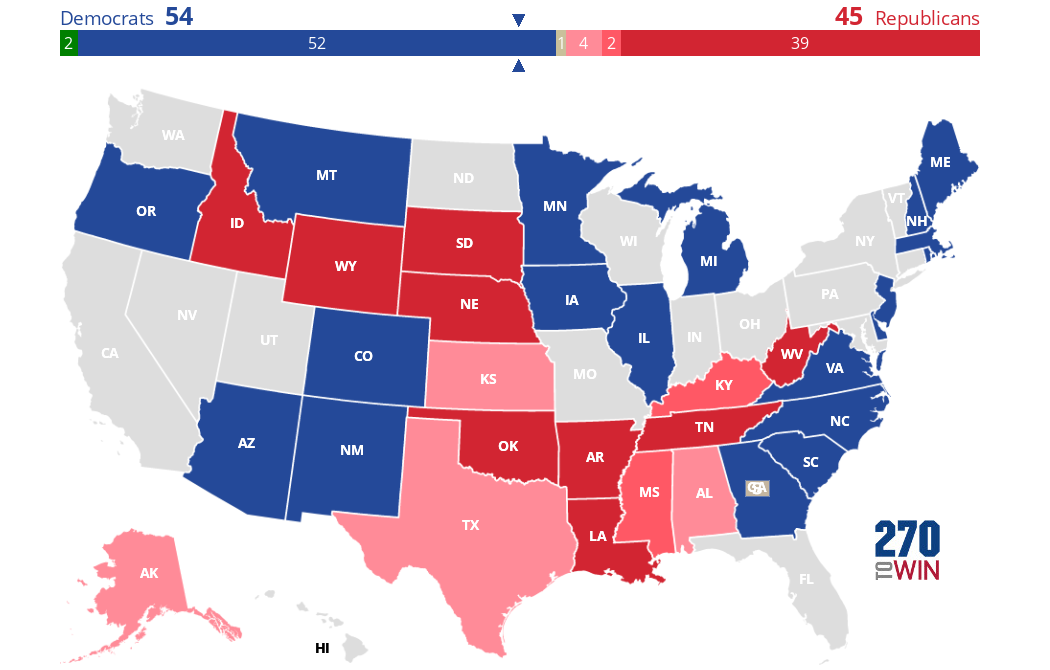
So, here's my Senate map and then some explanations/rationalizations:


Click the map to create your own at 270toWin.com

Much of this is obvious and clear.  My big swings are Montana, Georgia, and South Carolina.  Michigan is supposed to be questionable, but I think Peters has enough of a lead.  Same with Cunningham where his sexting scandal is overwhelmed by how awful Tillis has been in a state that is becoming increasingly blue.  I do think that Biden will have coattails as Dem turnout is going to be high across the board, and, as people have always said, the Dems win when they turnout.  Plus the GOp has done its best to govern poorly and alienate people by not passing pandemic relief, by approving awful justices and other officials, and by being incumbents during a deep economic downturn (3rd quarter only recovered part of the losses of the 2nd, and 4th quarter is not looking great).

 So, I have not been following Montana, but I am coding that as Biden-tails thing.  Regarding Georgia, Ossoff and Warnock may not win now.  I am betting that Ossoff actually does since there is much less vote-splitting and he crushed Perdue on the recent debates.  Bigtime turnout in Georgia is a bad portent for Perdue.  Re SC, well, there is a chance for GOP folks to split their vote, so I am wagering on that.  Harrison has run a great campaign, and Graham is just so thoroughly detestable.  What a parasite he has turned out to be, glomming onto anyone who is more powerful.  

So, that's my guess: 54 Blues/indies!