Saturday, June 10, 2023

The Big Lessons from A Week Near the Front

 Tis a dramatic title as we were nowhere near the battlefield, but the atmosphere here is very distinct from the US, Canada, and my last Germany trip.  War is not only nearby but is viewed as close to inevitable.  The perception of risk is quite high.  I kept asking: but the Russian military is weaker than we thought.  They kept responding that Russia can rebuild and can be stupid/risk acceptant again.  I am still a skeptic since that magical line separating NATO and non-NATO seems to be quite powerful.  But I don't pay much of a price if I am wrong--they do.

And then they mention Trump and I get it.  Nobody here wants Trump back, as they know he would be quick to sell them out.  Which, of course, raises the question why Putin didn't attack while Trump was still in power.  Even if he thought Trump would win the election, Putin could have launched the war in December of 2020.  

Anyhow, what else did I learn across the many meetings, the two days of conferences, and much arguing with my colleagues over a Baltic Sea of beer?

First, I have always been on the hill that 2% is a shitty metric.  That the NATO aspiration for each member to spend at least 2% of their GDP is a bad way think about things.  That input measures suck, that Greece is over 2% but a shitty ally.  Well, norms/expectations are mutually constituted--it is not up to me, nor is it up to any Canadian leader to say--this norm is lousy, let's move on.  It, alas, shapes the debates.  I don't think it would be so damaging if it were not for ...

Second, follow up on your promises in a timely way.  Canada has burnt most of its political capital in the region not because of 2% but something that travels with it--not making timely decisions and not delivering in an expeditious manner.  When Trudeau was here over the winter of 2022 and promised to do more. At the last NATO summit, Canad agreed (reluctantly is my guess) to increase the size of the effort in all of the nearby countries including Latvia.  For Canada, that means leading not a Battle Group but a Brigade, which means increasing the Canadian force from 500 and then 800 to 1800.  That is going to stress the hell out of a military that is short of personnel.  It also requires $$$ to build infrastructure so those soldiers can have a place to live.  So, everyone in Latvia is holding their breath, hoping for a decision to be announced in the leadup to the next NATO summit in July.  Minister of National Defence Anita Anand will be at the next NATO Defence Ministerial meeting next week, and she will be asked to make serious commitments.  New money.  NEW MONEY.  I am guessing that this new money will appear in the Defence Policy Update that will be released just before the summit (no accident).  I just hope that the size of this does not disappoint.  I still don't think 2% should be the target, but I do think spending should reflect the commitments that are made, which means it needs to go up.

Third, yeah, I am an advocate.  This kind of trip, where the govt helps us meet people (but does not foot much of the bill--my grants do), raises questions about my independence and those of my colleagues.  Are we just a tool of CAF info ops aimed at the public?  Not really, but the public affairs people do hope that by sharing heaps of info and getting us to talk to the folks here, that we will say nice things about the mission.  They may not get that since some of my colleagues are more skeptical.  I am probably biased in this as I lived the NATO life when I was in the Joint Staff, and I did co-write a book about the organization, so I want it to succeed.  And I do think the Russian government is a force for evil and needs to be deterred.  Defense?  I am not so sure about, but deterred, absolutely.  And NATO is doing that quite well.  So, I am in favor of investing more here.  I don't think it is that problematic for Canada to make this the single major military commitment, although my pals were suggesting that as soon as the war in Ukraine ends, that will become the shiny mission that Canadian leaders will want to join.  Committing to the long run in Latvia does reduce discretion since the CAF can't be at 1800 here and then do much elsewhere.  Does Canada send troops Cold War-style to live here for three years and bring their family along?  Maybe the military would be happy to have only one commitment--that it could say no to peacekeeping ops due to the stress of this single effort?

Fourth, we did go to a Strategic Comms conference, and the group of us mostly, I think, view Canada as being lousy at Strategic Communications.  What is the story here?  What is a good story to tell the Canadian people?  It should not be a story that is the military's to sell.  It should be the government's, and it should be other agencies.  I am not a Strat Comm person or an expert in marketing.  I get that they have a hard time getting media coverage since good news does not make much news, and journalism is facing $ problems, so if they spend on expensive trips, they will go to Ukraine, not Latvia.  But it should not be that hard to create videos, graphics, and such and flood Canadian social media to raise awareness.  Arranging this trip may help, but they can't run lots of these kinds of trips because:

  • most Canadian academics don't have heaps of grant dollars or time to spend on a trip like this
  • so sending the same ones back again and again means having the same voices again and again
  • these trips are a huge time suck for those whose shared their expertise with us.  They were terrific, but they can't do this all the time.
  • they could, you know, pay for these trips, but then we would be seen as tools of the military-industrial-academic complex.  Oh wait, there are folks already making those claims. 
     

 I think the best strategic communications is when you have a good story to tell, which means doing the right stuff, the good stuff.  The contribution/leadership of this multinational force is big, but it needs to be supported.  They need $ and procurement projects that move along.  Trudeau needs to back his promises up with actions.  Sometimes he does that, and sometimes he doesn't.  Doing more here may not win him votes, but it won't lose him votes either.  Indeed, committing to big bucks puts the Conservatives in a pickle--do they want to cut defence spending to get to a balanced budget?

I will probably write more about this as I remember stuff and as we see decisions and announcements roll out.  So, this is what I have thus far.  Let me know what you think.

Third Day of Roundtables: MoDs, Pols, Dips, Oh My


 Enjoying the fresh cc cookies in the United lounge while I await my third leg to get back home, so tis time to catch up on my trip blogging.  This post focuses on yesterday (yesterday was Friday, right? where we meet with folks at Latvia's Ministry of Defence, at their parliament, and at the Canadian embassy, the next post will focus on the bigger lessons/implications.

The MoD briefing started with Ronald Reagan's evil empire speech, so that set the context.  The sense here is that war with Russia may be delayed by Ukraine's stand, but is likely down the road.  The Latvians monitor the Russian messaging at home, and it does not reassure at all. Latvia has shipped off quite a bit of what it had to the Ukrainians because they need for Russia to lose, to learn the lesson (which they doubt the Russians will learn).  Justin Massie asked again whether it might make more sense for Canada just to send its military equipment to Ukraine, and the Latvians said--why not both essentially.  That we need to build up Latvia for that day when the Russians invade and we need to delay that day by arming Ukraine.  Latvia is aiming to spend 3% of its GDP on defense, and I refrained from snarking about how having a tiny GDP makes that easy.  They are quite serious.  The Latvians also made good arguments for why Canada operating in Latvia is good for CAF readiness. 

I asked about how their MoD relates to the military as that is the next Steve and Phil and Ora project, and they said they have a British model (which sounds better than the Canadian model, but Phil will have to find that out fo rus). 

A recurring theme--waiting to hear whether Justin Trudeau will back up the promises made about spending more on the Latvian mission as it moves from battlegroup to brigade (from 1k to 3k).  Finns got mentioned for the first time as a potential new contributor to the multinational group Canada is herding.

The second meeting after a quick fast food lunch (I chose poorly) was at the Parliament where we spoke with an MP and a leader of a think tank (I think).  Lots of fun discussions of Latvian domestic politics--five parties, in govt and in opposition, mostly on the same page.  The Canadians were envious of the MP focus on good governance, not just point scoring.  JC asked about their parliamentary oversight--he is a pal. They are definitely closer to European/German standards--the MPs have security clearances, defense committee is chaired by former defense official, engaged in serious debate.  In other words, tis not Canada.

The big split on defense/foreign policy in the parliament is whether parties lean to US/NATO or lean towards EU.  Any change in government (coalition wrangling going on now) is not going to make much of a difference for the stuff we have been discussing.  

We had heard of Germans and Lithuanians fighting in the media--the Latvians said that won't happen here even if JT falls short.  Was fun to hear a reference to the BattleRhythm episode we recorded earlier in the week

We had an interesting conversation about the gender debate regarding their conscription.  Their draft starts soon, men can be drafted, women can volunteer.  They discussed challenges for absorbing heaps of people.  

We asked about their Russian population, and another recurring theme--the Russian speakers aren't all alike--diverse by age, by what they speak, by social groups.  The very interesting thing was the results of the recent election caused the usually leading party for the Russian-speaking minority to fall short of 5%, which means they don't get any seats.  And they were the one Russian-speaking party that was critical of Russian aggression, so oh my.

The conversation at the Canadian embassy was much different, as we asked tough questions and pushed our own views, rather than just being in receive mode.  Why are we here?  What is our interest?  Just NATO?  Doing this mission does reverse the view that Canada doesn't care about NATO (holy short memory, Batman, they forgot about Kandahar so quickly.  Well, Robin, we did leave combat years before everyone else so....). 

They folks at the embassy did a good job of articulating to us what Canada gets out of the mission, including a better understanding of fighting disinfo since the Latvians get heaps.  The irony, of course, is that Latvia does strategic comms well and Canada .... doesn't.  I mean, we, the group as a conduit for Canadian info ops (more in the next post)?  Not the best way to do strategic comms even if we academics are the most trusted (hey, our suveys say that, really!).

The meeting egan to end as we discussed the best metaphors and analogies.  Did Trudeau propose and ihs now delaying the wedding?  Or are we married, but not really keeping our vows?

Friday, June 9, 2023

Strategic Communications Conference, Riga 2023: Day 2

Yesterday was the second and final day of the Strat Com conference.  I discussed day 1 here.  The first panel was on Deterrence of the Next Decade.  I thought this would be more about deterring electoral inference and other comms stuff, but it turned into a nuclear deterrence panel.  Interesting, scary, but not what I expected.  Francesca Giovanni talked about the renaissance of nuclear weapons--that they are more relevant these days.  Woot?  Her talk basically reinforced my concerns about the autocratic advantage in the stability-instability paradox--that when countries are deterred by mutual destruction at the nuclear level, they may not be so deterred at lower levels, and that autocratic countries can play the risky game of escalation at lower levels better due to narrower audiences.  Fun!  She argued that lots of the guardrails from the Cold War aren't here--like the officials of the PRC don't pick up the phone during a crisis.

She also made an important point--that deterrence works when the other side is assured that your side will not attack if they don't do the thing you are seeking to deter.  My take on this is the big brother syndrome--big brothers are bad at deterrence because they may pound you whether you submit or not.  Not that my brother did that.  The relevance here is that if one threatens, say, regime change or sending someone to the Hague for war crimes even if they give in, then the incentive to give is low....  So, deterring Putin only works if we don't threaten him if he goes along with the status quo.  

The next panel was the Global Battle of the Narratives, moderated by the CDSN's own and Canada's own JC Boucher.  I believe he was the only Canadian on any of the panels.  Good thing he repped us all very well.  It was a very interesting panel where folks from a variety of places--Japan, US, Australia, and Microsoft--presented their takes on mostly China.   Key points include: we need to be better at explaining our value proposition in the world especially in the Global South (although panelists hate this term as it makes it seem more homogeneous, unitary, other, etc); that the Russia/China partnership is not going away as they need each other, some speculation about another Trump adminitration (oy), Japan's government is moving but its public is not.

 I missed the last panel, but did not miss the concluding reception, which was lovely.  Very good beer in a very nice venue.  They brought in a group of folks representing traditional Latvia.  They did some games, including one where young women would throw wreathes onto a tree--if the wreath stayed, the women would be married soon.  Not too soon given the outcomes, but once they started throwing the wreathes like frisbees, they got better results. 


Over the course of the two days, I meant a bunch of folks from across Europe but also Americans and Canadians.  The NATO Field School, a course run by Simon Fraser University (a CDSN partner), led by Alex Moens and a few key young women (Hannah and Amy) had 45 young people from North America and Europe asking good questions during the panels and then afterwards.  It was great to meet them, and our group of Canadian scholars will be meeting with them on our last day in Riga and their halfway point of their course.  They went to the NATO Defense College for two weeks, now here for two, and then Brussels for 2.  

I learned a lot and will still learn more on our last day with meetings at the Latvia Ministry of Defense (where I will be tempted to ask questions for my comparative defense agency project) and the Canadian Embassy.  This trip was definitely worth it, as I have clearer ideas both about what is going on here in Latvia and the trends in Strategic Communications.


Wednesday, June 7, 2023

Strategic Communications Conference, Riga 2023: Day 1

Our team of Canadian academics and fellow travelers are here in Riga this week because of NATO's Centre of Excellence on Strategic Communications, based here, is throwing their annual conference.  The folks from ADM Public Affairs built visits to various interesting folks before and after, but the timing is driven by this event.   So, what did I learn today besides these folks having amazing production values--the AV and all that was terrific.

One consistent theme throughout the visit thus far: "we told the West that Russia was aggressive and you didn't believe us--we were right."  This is not just "I told you so," which, well, it is, but it is also, "hey, don't get smug, we are still in danger."  So, the Latvians are definitely putting out that message strategically so that they get the help that they really believe that they will need.  

I thought a good related message made by Latvia's President, Krišãjanis Kariņš, was that WWII generation and those who remember it may be passing from the scene, but those who lived through Communism and Totalitarianism are still very much around.

Graham Brookie, I believe, made the point in the second panel that to do Strat Comm well, you have to stand for something.  This was a recurring theme as well.  He also argued the battle was not between us and them controlling the info space but us fostering a free info environment.  Talk to Elon Musk, I did not shout.

My favorite panel was the Masterclass by Ukraine, which the folks on the panel then spent much of the time discussing how Ukraine has done it well but not perfectly.  Hanna Sheslet, who is a Ukrainian PhD working in a couple of different jobs--Director of Security Programmes at the Foreign Policy Council (No idea what that is) and editor-in-chief at Ukraine Analytica--was easily the best speaker of the day (the President was pretty good, too).  She was clear, persuasive, and had great bits of data and stories.   Among the things she said:

  • Narratives come back.  You can't be satisfied with winning one battle against a specific narrative, as it will come back.  
  • We are winning but still in the middle of an info war.
  • We need to be better about our language--saying it is the Ukrainian conflict allows Russia to avoid agency/responsibility.  The passive voice (!) does the same--kids were kidnapped?  No, Russia kidnapped the kids.  She also used a Voldemort reference, so between that and the passive voice rant, she won me over.  
  • She was asked that since the democracy/autocracy thing didn't play in the Global South, why not try Russians as imperialists/colonial power (which, well, is true)?  She responded that in her focus groups with folks from the Global South, they rejected that appeal for two reasons--that Ukrainians are white so they can't be victims of imperialism and that the Russians have inherited the Soviet mantle of being anti-imperial.  Damn.
     

 The panel also had a relatively less coherent speaker who also hit my sweet spot by showing NYT stories about the dam bursting (see, the passive voice denies agency, don't do this, kids) covering it with their favorite flavor--false equivalence sauce (been a long time since I have developed a new sauce!).  Would you really want to be a journalist saying: hey, we gave the Jews five minutes, we need to give Hitler five?

Patrick James Christian, the third speaker on this panel, explained that there are some key ingredients to a successful strategic comms effort: reality, responsibility, right/wrong.  Reality means that you have to speak to the basic facts and not deny them.  Defeats happen, acknowledge them, don't pretty them up.  Responsibility means emphasizing how everyone is responsible for each other--this ties people together and reduces despair.  What is the right thing to do?  Give guidance to what you want folks to do and not do.  Help the people understand with meaning so they don't break.

I met a variety of folks during the various breaks including some of the NATO Field School people who will soon be sharing their experiences via the CDSN Podcast Network's new podcast--NATO Field Notes.  The 45 students plus their leaders spent two weeks in Rome at the NATO Defense College and will be heading off to Brussels after two weeks here in Riga.  They are getting some of the same briefings we did.  It was good to see them.  I also met a variety of other folks and got their impressions.

 The conference is in a neat space--a former railroad station. Overall, a very good first day of StratComm stuff.  Tomorrow, one of our crew, JC Boucher, moderates a session so we will try to make things difficult for him.


Should We Stay or Should We Go?

 One of the big questions here in Latvia (and in the rest of Eastern Europe) is whether this is going to be a series of temporary things or is it a Cold War-esque, long term deployment.  Sure, Russia's military sucks and is broken, but Putin and perhaps his successors have proven to be risk acceptant and likely to do stupid things again and again.  Indeed, I asked folks about that--are you less worried because the Russian military is not so mighty or more worried because they aggress?  The answer is the latter for these folks.  So, Canada feels a real choice--invest in the long run ... or not.  I know what Canada will do (see below), but what should it do?

The pro's of investing in the long run

  • One could post more people in Latvia as opposed to temporary deployments--they could bring their families so there is less friction, people don't get in a spin cycle of every six months.
  • The development of the forces here could advance beyond a six month cycle where the first two months are about getting one's shit together and the last month is about leaving.
  • Everyone develops better relationships--with the locals, with the other countries operating here and nearby.
  • Cost savings of not having to ship over stuff and people every six months.
     

The cons's

  • The Canadian Army wouldn't be able to do much elsewhere.  No Haiti missions, no peacekeeping elsewhere (as if that is likely to happen).
  • For the politicians, no new places to go so you can't make a new shiny announcement (Justin Massie's point, if I remember correctly).
  • Folks may not want to leave Canada for 3 years.
     

Note, either way, Canada is committing to having 1800 troops here.  So, those questions of sustainability are not so relevant for staying for short term stints or longer term.  Once that choice was made (maybe unwittingly), those challenges will have to be confronted either way.

I have to run to the Strategic Communications conference, so I will provide a clue as to what Canada will do:


Monday, June 5, 2023

Moving from Deterrence to Defence: First Day of Briefings in Latvia

 I am in Riga this week for briefings with various NATO/Canadian/Latvian players in this area's defence scene and to attend a conference on Strategic Communications run by the NATO centre focused on this stuff (and based in Riga).  I was in Riga in 2017 to check out the new NATO battlegroup led by Canada and to go to the Riga Conference.  

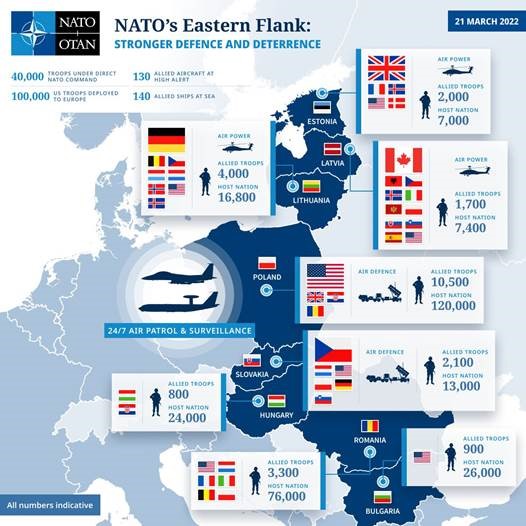
At that time, the Enhanced Forward Presence was a relatively new mission--four countries led small contingents of NATO troops in Estonia, Latvia, Lithuania, and Poland (UK, CA, Germany, US respectively).  This force was, despite all the denials, a tripwire--that any Russian attack would kill Americans and Brits and Germans and Canadians and  many other NATO soldiers, which might then trip a serious response that could lead to things spiraling out of control.  Now, the contingents are all somewhat larger and are on their way to being brigade size--3000 per spot and four more spots (Hungary, Slovakia, Romania, and Bulgaria).  The claim/aim is now that these contingents will be more focused on defending these countries, thwarting Russian aggression rather than just deterring it. 

Today, we first met with a Latvian Major in their defense headquarters. He started off by showing a 2016 amendment to their national security law that had two key features: 1) in case of surprise attack, any/all Latvian commanders shall engage in defensive efforts without waiting for orders; 2) resistance cannot be forbidding. The former was a lesson from Crimea--that if Russia blocked the comms, the local forces would still react, rather than waiting for orders.  I had heard something a few years ago that suggested this was the case, and this was good deterrence signaling.  That an effort to establish a fait accompli wouldn't work here.  The second piece was a lesson from WWII where their leader surrendered to Stalin.  I also learned that they re-started conscription this month, but they may not need it if they get enough recruits.  

Things have gotten complicated as Canada is a Framework Nation, which means it leads a multinational unit within a Latvian brigade, while the Danes are leading a NATO Multinational Division-North, which includes the other Baltic countries.  

I asked how the Canadians in Latvia compared to the Brits in Estonia and Germans in Lithuania, and the response was quite favorable to the Canadians (although the major knew he was talking to Canadians so 🤷).

We had a great lunch at a gas station across the street from the base (the food situation at this base is pretty strange), and it was really quite tasty.  

We then met with Colonel Kirstein, who spent a lot of time chatting with us along with his command team.  Canada now has 10 partners in their battlegroup, and the problems are still focused on differing alky and leave policies as I had heard in 2017.  Force generation (which is begging countries to give troops to the multinational force, as Dave and I found out in our book on NATO) still is hard, as the move from Battlegroup to Brigade means more troops and more competition for these troops since every one needs more and a few of those in Canada's space are leading some of the missions.  One of the big differences between EFP and Afghanistan is that most of the force generation in the latter was done by top officials at NATO (SACEUR, Deputy SACEUR, Obama), and for the battlegroup in Latvia, Canada is doing the begging.

So, I asked, how can Canada do this with far less political capital/coercive capability than the US?  The answer in part was working with Canada is precisely attractive because of the absence of strings.  Also, since Canada is not Germany, it also does not present any EU strings or complications.  My own view of Canada's position here is accidental--by being chosen last to lead one of the first four, Canada got the less useful allies.  Tiny contingents from Montenegro and Albania and North Macedonia.  But this has become sold as a plus (and probably is plus-ish)--that Canada is good at managing the complexities of many countries operating in one spot.  I did ask about caveats, and they certainly exist, and the Colonel is tracking them.  Some countries need permission from home, for instance, if they want to train outside of the Latvia base.  

One of the challenges here is that there was resistance to permanent NATO basing in the Baltics as this would violate the NATO-Russia Founding Act.  What's that?  In my view a dead, dead, dead piece of paper.  I have been asking about this for years, and I did hear previously that the Germans recognizing its dead parrot-like state because they want to keep some institutions that they can build on some day.  Today, it was articulated that NATO does not be the one killing the agreement.  I retorted that NATO is the coroner, not the killer, declaring that the time of death was 2014, and the cause of its death was Russian aggression in Crimea.  Anyhow, the way it works with Canada is that it has a three year agreement with Latvia, and it got renewed last year.  This prevents long term planning, because you can't build a schedule out several years.  Which means, for instance, while there might be some major advantages to making the Canadian mission here like ye olde Cold Warre deployments--have troops come over for three years with their families, build schools for the kids, and just settle in for the long haul--it ain't gonna happen.

My colleagues asked a variety of sharp questions about tradeoffs between sending arms carried by Canadians to Latvia versus sending arms to Ukraine to be wielded by the folks there, whether the government understood what it committed to when it agreed to move to a brigade-sized force in Latvia, can Canada do strategic communications (no), and, of course, where we should drink beer.

We have a day at the battlegroup tomorrow, two days of Strategic Communications conference, and then a day meeting folks at the Latvian MoD (time to ask questions about my next project) and the Canadian embassy before hanging out with the cool kids at the NATO Field School, which is run by a CDSN Co-Director--Alex Moens.  

I have already learned a lot, and will continue to drink from the fire hose tomorrow.  This stuff touches on past research (my IR of ethnic conflict stuff way back when, my NATO stuff) and my current stuff (who is minding the store?).  And, no, I have not yet started a crisis among allies.  But I have several days left.


Friday, June 2, 2023

Looking for Some Defence Tech? My Day at CANSEC

Eric and I next to
the one staffed
aircraft on display


 Yesterday, I spent much of the day at CANSEC, which is the tradeshow for the Canadian defence industry.  I was able to go because one of the former participants in the CDSN Summer Institute, Eric Dion, had an invite and could have me as his +1.  I was most grateful because of two basic elements of my personality: I am deeply curious and I have a serious case of FOMO (fear of missing out).  And, yes, some good networking opportunities as well--mostly the government types, less the industry types, including one senior officer who will be on the podcast soon.

I missed the protests the day before--perhaps because the Minister of National Defence was there.  Some may wonder if going to this show makes me a tainted part of the military-industrial-academic complex.  I, of course, don't think so, since I am critical of the defence contractors most of the time, and their swag wasn't that great.  If they had given me a ride in an F-35, maybe I'd be a bigger fan?  Anyhow, as always, I think engagement pays off.  I learned a lot from walking the floor and chatting with people.  Such as:

  • tear gas antidote!
    What a vast array of firms/products there are.  I was going there expecting mostly guns, armored vehicles, planes, artillery, etc.  But armies do run on their stomachs/logistics, so there were folks pushing their cables, their popup tents/buildings, clothing (lots of arctic gear), red team hackers, drones, medical stuff (including antidotes to tear gas--I was tempted to ask if they sold to protest groups), and much more.  There were artillery shells, but not much arty, no tanks.  But all of the major shipbuilders of Canada and many from Europe were there. The biggest displays/terrain were Lockheed, General Dynamics, and a few of random initial folks.
    Small pic, big display
    They even had
    firms pushing their
    boxes and racks!


  • There's more than one way for a firm to get attention. These folks wearing Pac-man suits also had a pac-man game.  They obviously knew that their market is folks in their mid-50's, I guess.


  • The place is kind of like Disneyland or Universal Studios--if you want to do the coolest things, go their first thing.  I didn't, so I didn't do any of the flight simulators.  

  • Carleton STEM undergrad are quite employable, as I met several on the convention floor, part of various firms hawking their wares.
  • Culture change has a long way to go in this sector as a friend from CPCC (the culture change agency) that the only non-dude tactical dummy in the place was a tactical dog dummy.  I did spot one firm with a pregnant mannequin for a display of base layers, but apparently women in infantry is not something these folks are really building for. 
  • If you grab some swag from a firm, you end up talking for a few minutes.  The swag was not that great, so I was not so motivated.  My partner in crime was more interested in each spot, so he did a lot of chatting.  I didn't have that many questions for most of the firms, but I did learn that ...
    The GD LAV display
  • Canada sent its best light armored vehicles, not its castoffs, to Ukraine, as the General Dynamcs display of their ambulance variant (nice play to Canadians who prefer not to think about the  shooting part of, um, war) had friendly folks tell us about their systems.  The outside display area was otherwise not that exciting.


  • Speaking of Ukraine, Zelensky was used to sell some pop up buildings:
  • Drones are hip--heaps of drone displays 


    •  
     
    •  
     
  •  


  •  My fave display was explained by an aforementioned Carleton undergrad STEM student.  It featured an anti-drone missile system, where the missiles drop rubber spaghetti when they get close to the drone, aiming to foul up the drone's propellers (the red thing in the banner behind the system).  The missiles can be 3D printed!  One key in the anti-aircraft fight is whether one's system's ammunition is cheaper and easier to make than the incoming threat. 
     

  • We are coming close to the technicals with this GMC Colorado SUV converted to Mad Max vehicle


  • This comms company caused me the greatest temptation to snark about my work on multilateral military ops--that these systems may be filled with curses as countries learn what their allies can't/won'
    t do.


  • That defence contractors hate the offset game but play it anyway.  I talked with one defence contractor at a reception two days before about how much it adds costs to appeal to Canadian politicians by promising jobs in Canada.  They apparently need tech to help figure this stuff out -->


  • To play the game, they do stuff like this:


 I raised with one defence contractor that those jobs in Canada (which might not be the best investment for jobs) depend on selling weapons to unsavory places like Saudi Arabia, and they were, like, yep.

  •  That baby F-35s like to cuddle:


  • The defence community is small.  Great to bump into some twitter pals.


Wednesday, May 31, 2023

When Did DeSantis Become Trumpish?

 I saw this post


and I had a case of deja vu.  I flashed back to when I pondered about when did Trump cross the line of no return.  When did he do something that he couldn't take back, something so awful that he would alienate so many people and couldn't get them back?  I was, of course, wrong about how many people would be alienated, but the point was really that he had revealed enough about himself before that the latest revelation should not have made much of a dent.  People were discussing Trump joking about NRA and death threats against Hillary Clinton way back in August 2016--was that too much?  And I pointed out that he started his campaign with racist stances that should already been too much.

Well, the cycle is starting anew and folks are saying that the latest thing DeSantis is doing means that he might not be really an alternative to Trump but another version of him, and my response is: ya think?  Jill responded back to my tweet, asking if I had read it, so, yeah, I hadn't and then I did, and my point remains that her focus was on the very recent stuff--not DeSantis's original "Don't Say Gay" position but his punishing of Disney for opposing that stance (weakly, belatedly but enough to set off this thin-skinned bad faith hater).  

At what point did DeSantis cross the line of no return?  Once again, I draw a handy graph:

To be fair, there are lots of bad things DeSantis did and anyone of them would be disqualifying if, you know, Republicans had values.  But shipping off immigrants to another state without providing resources or warning is just appalling. So, everything else he has done since then does not really change things much, maybe making him asymptotically closer to Trump in awful, but not very significantly.  Does this mean he is not electable?  Alas, I learned my lesson in 2016--that just because a politician is thoroughly deplorable does not make them unelectable when party id is a hell of a drug.  Trump still polls well among Republicans because they care more about power and domination (what they call freedom) than anything else.  

Bill Simmons used to write about the Tyson Zone--that once a person reaches a certain level, nothing they can do should be all that surprising--even biting an ear off an opponent.  Well, in politics, there is the Trump space--that once you get inside of it, no matter what evil thing you do or so should not be that surprising since you have already done enough to be considered thoroughly and completely irredeemable.  Trump is there, Cruz is there, DeSantis is there, as are heaps of other Republicans.  Indeed, Alito, Thomas have lifetime appointments to the Trump space.

There is no coming back.  Not even if they showed a hint of remorse, and, no, don't hold your breath for even that.

Oh, and for the Canadian equivalent, once you hug extremists occupying Ottawa, you can't go back either, sorrynotsorry, Pierre.


A Real Canadian? An Epiphany

The Swedish Residence has
a better view than Sparks St.
I was hanging out on Sparks Street yesterday with a former government official, and I had an epiphany.  No, it was not about how underwhelming Sparks Street is.  It was about the affinity Canada and I have for each other.  

I have long had a chronic case of FOMO: fear of missing out.  I attribute it to being the youngest of four kids.  I distinctly remember only hearing about how wonderful the first few years of Saturday Night Live were, but not being able to stay up late enough to watch for myself.  Had I know that years later I would be able to consume heaps of old SNL via videotapes and repeats, maybe I wouldn't feel so left out?

Canada, similarly, has a deep and abiding case of FOMO. Hey, folks, there's a small club of folks buying nuclear subs, but you can't join since you have no plans!  Oh noes, no C in AUKUS, the Australia/UK/US group of advanced weapons tech sharing.  Yeah, it may be more than subs, but it is mostly about subs.  In talking to my friend yesterday, we talked a bit about AUKUS, that the FOMO was mostly coming from outside of government among the pols and the pundits.  It was not the first time  I sensed Canada's FOMO panic about various things.

And I have internalized it.  When folks talk about transatlantic relations, emphasizing US-Europe in NATO-adjacent stuff, I am quick to remind folks that Canada is in NATO, too.  

Pre-CANSEC reception at
Swedish residence
So, Canada and I both identify with Rudolph, who was left out of various reindeer games.  Which leaves us both trying to get into various collaborations even if they don't always make sense.  For Canada, that is AUKUS.  For me, it could be CANSEC.  I am spending tomorrow at the annual tradeshow of the Canadian defence industry.  Yes, I will be hanging out with arms dealers.  Ok, not the exotic ones, but those carrying business cards bearing BAE, Saab, General Dynamics, Lockheed, whatever (I lead with the Swedes since I was at a nice reception last night that was the pre-CANSEC party hosted by the Swedish embassy).  Will I be in the market for some fancy new artillery?  Anti-aircraft weapons?  A helicopter?  No, of course not.  I will be in the room, which is all I need.  I have seen pics and tweets in previous years and felt left out.

I do think I will get some benefit from being inside the room besides assuaging my FOMO--meeting both government and industry folks and hearing them complain about each other.  Last night, one rep from a company I will not name suggested that all of the requirements that are piled onto a defence contract by the government of Canada almost make it not worthwhile to do business here.  He was speaking of the offsets--that each contract needs to be way more expensive because they have to pay for jobs in Canada.  Which reminded me of my fave campaign graphic--the cover of the Liberal Defence Platform of 2015: 

Notice that the promise eight years ago was not to buy ships to defend Canada but to create jobs by investing in the Navy--which nicely omits .... ships.  Just spending money on jobs where shipbuilding might be happening but ships actually being finished ... not so much.  

I go to these things because I never know will the networking will lead.  That I have met a lot of folks over the years, and I was never very strategic about who I needed to meet--but that enough of those connections paid off in unexpected ways.  For example, there was a dinner where I sat next to a pollster which lead to inviting that pollster's firm to join the CDSN, which happened to mean that the Chancellor of Carleton at that moment was a key participant in a CDSN organiational meeting since Nik Nanos of the Nanos survey firm was also heading Carleton's Board of Governors.  Completely unintentional on my part, but super handy ultimately.  

So, yeah, the times I have been in the room have been sufficiently beneficial that my FOMO has not been sated--that I might miss something if I am left out.  And thus I understand why Canadian punditry and media get into conniptions about being left out of AUKUS and other groups even when Canada is not going to buy any subs anytime soon.  So, the irony is that I fit really well in Canada, that I don't feel left out, because I always fear being left out.


Wednesday, May 24, 2023

Four Years of CDSN-ing

Our first dinner of Co-Directors and HQ
 While we could choose the day we got the big SSHRC Partnership grant as the anniversary of the Canadian Defence and Security Network, I prefer to use May 24th as it is the anniversary of our rollout and associated reception.  It is hard to believe that we are more than halfway through the first grant.  To be clear, we are not halfway through the life of the CDSN because we fully intended to keep on going after the original source of funding ends.  We have a variety of ideas for making that work, but that is for later.  Today, we celebrate heaps of researching, connecting, and amplifying!  Melissa Jennings, who started out as our Communications Officer and is now our Chief Operating Officer, came up with Research-Connect-Amplify as our mantra when she built our website

In terms of research, we started out with five themes/focal points, went down to four, and are now up to eight thanks to the grant from DND's Mobilizing Insights in Defence and Security program.  We are focused on military personnel, civil-military relations, CAF operations, security broadly defined, supply chain vulnerability, global health, climate security, and domestic emergency operations.  One of the ironies of this effort is that our funding from DND has helped us meet the promise of the S in our name by addressing a variety of contemporary security issues, whereas our initial focus was more on the D.  Our research teams have produced articles, books, edited volumes, special issues, policy paper, datasets, surveys, and other hunks of research.  We have also supported three post-doctoral scholars as they move beyond their dissertations--Linna Tam-Seto (now a co-host of one of our podcasts), Johanna Masse, and Thomas Hughes.  We have also organized book workshops to turn the work of junior scholars into publishable books. Stephanie Martel was our first victim and is the first to publish her book.  We have run one big survey and a few smaller ones to ascertain Canadian attitudes about defence and security. 

Connecting refers to building and sustaining the network.  We have started with 34 partner organizations from government, academia, the private secure in Canada and beyond.  We have added twelve since then.  We have also worked to foster new organizations such as Women of Colour Advancing Peace and Security-Canada.  I am not sure exactly how many individuals who have joined the CDSN, but our mailing list has grown exponentially.  Even four years into this, we are still figuring out our partnership strategy to move beyond my initial Borg-like assimilate all idea towards a more strategic effort to bring in organizations that help facilitate our goal of making the Canadian defence and security community more diverse, equitable, and inclusive.  Another key effort has been the hosting of military officers at Carleton's Norman Paterson School of International Affairs.  The idea is that we help these officers on their research projects, while they give us advice for making our work relevant to the defence and security community.  We have had four officers, and each one has brought heaps of insights and useful advice.  The pandemic and then renovation of NPSIA's kitchen have disrupted this a bit, so we have had less lunchtime chats than we did at the start.

Amplifying refers to helping our partners and our researchers get the word out on what they are doing, what they are producing.  One of the first ways we did this has now bloomed into multiple channels--our podcast has become a podcast network with four different programs: BattleRhythm, Conseils de Sécurité (en français) in partnership with Réseau d'analyse stratégique, SecurityScape, and soon NATO Field Notes.  All are available at all the usual podcast outlets and including Apple via the CDSN Podcast Network.  Our annual Capstone event brings together some of the best speakers from our partner's events from the previous year and has also connected us with some of the sharpest folks in the next generation of defence and security scholars and scientists.  We have also held a variety of conferences and workshops--traditional, virtual, and hybrid.  

There have been small bumps in the road, some turnover at our headquarters, and, of course, the challenges posted by the pandemic, but, overall, we are very happy with what we have achieved and are excited about what we plan to do both over the remaining three years of the original grant and how to sustain ourselves beyond that.  I am so very grateful to the hard work, fantastic ideas, and energy we get from our co-directors, our advisory board, our research teams, and especially the team at our headquarters: the aforementioned Melissa Jennings, our amazing Grants and Partnership Coordinator who has been handling our finances and increasingly our event planning, Racheal Wallace, our research assistant for the past couple of years, our rotating teams of MA research assistants, and the folks at NPSIA.  We are more a network of people than of institutions--that everyone involved has made this effort fun, insightful, dynamic, relevant, and delightful.  

Let us know what we can be doing more/better!


Friday, May 19, 2023

A Summer Sans Ultimate

 While I played year around for so many years, summer was always ultimate season.  Facebook is now reminding me of posts of opening games from seasons past.  I don't regret my decision to retire from the sport, but I regret having to do so.  I just can't cut without pulling one tendon or muscle or another.  Alas, my quest for another summer pastime has thus far not borne fruit.  Instead, I took the occasion of the start of summer ultimate season to ask ChatGPT to write a series of poems.

A Haiku

Throws soar in the air,
Retirement claims the disc's flight,
Memories take flight.

A Limerick 

There once was a frisbee champ,
Whose throws were a marvelous stamp.
With retirement in sight,
They bid their game goodnight,
Leaving foes in a permanent cramp!

An Ode to the End of Steve's Ultimate

Oh, Ultimate Frisbee, beloved game,
A chapter now comes to a close, how time does wane.
With joyous bounds, I soared and leapt,
Through fields and skies, my spirit kept.

From early mornings 'til twilight's gleam,
I chased the disc, in the realm of a dream.
With teammates, united in pure elation,
We forged a bond, a shared dedication.

On hallowed grounds, where friendships bloomed,
We wove a tapestry, where passion consumed.
Sweat-soaked jerseys, worn with pride,
Together we laughed, together we cried.

Each throw and catch, a symphony in the air,
A graceful dance, a moment rare.
The disc, an extension of my soul,
In its flight, I found myself whole.

Through every layout, in the dirt and grass,
I felt alive, as time did pass.
The camaraderie, a treasured gift,
In victory and defeat, our spirits lift.

But now, the time has come to step away,
To bid farewell to the ultimate fray.
The body, weary from battles fought,
It's time to pass the torch, a lesson taught.

Yet, the memories remain, etched deep within,
The victories, the losses, the competitive din.
The friendships forged, forever strong,
As I retire, a bittersweet song.

Oh, Ultimate Frisbee, you've shaped my soul,
Instilling lessons, making me whole.
I carry your spirit, within my heart,
As I embark on a brand-new start.

So, thank you, dear sport, for all you've bestowed,
For the highs and lows, and the love that flowed.
As I hang up my cleats, I'll always treasure,
The moments we shared, beyond measure.

Farewell, Ultimate Frisbee, with gratitude I part,
A journey cherished, forever in my heart.
Though I retire from the field's embrace,
Your spirit, forever, I shall embrace.

Wednesday, May 17, 2023

When I Am a Better Jew

 I have often struggled with my Jewish identity since I don't believe in any of the religious stuff, but I am aware that identity is socially constructed--it is not just up to me but to society to shape who I am, what groups I belong to, what groups I don't belong to.  That if a Nazi party were to come into power where I live, I would be targeted for execution whether I am a believer or not.

So, when I see tweets like this:

I realize that I am a better Jew than some.  How so?  Rule #1 of post-World War II Judiasm is Never Again!  That is, we must work to make sure nothing like the Holocaust happens again.  Yet there are Jews who have other priorities.  I have often wondered how an LGBTQ+ person could be a Republican, a Log Cabin Republican, can stay in a party that targets them as a dangerous other--a groomer, a pedophile--to be ostracized and targeted for violence.  But I am not a part of that community, so I guess I can't really judge.  

I am Jewish by descent, which is good enough to get me killed in Nazi Germany and targeted in 21st century Charlottesville.  So, I am beyond bewildered by "Republican Jews."  How can they support a party that is inciting violence against a variety of minorities?  

Maybe they think that these white supremacists, these misogynists are not likely to target Jews?  Well, again, Never Again starts with that famous statement by Martin Niemöller who said 

First they came for the socialists, and I did not speak out—because I was not a socialist.
Then they came for the trade unionists, and I did not speak out—because I was not a trade unionist.
Then they came for the Jews, and I did not speak out—because I was not a Jew.
Then they came for me—and there was no one left to speak for me.

A movement of hate does not really discriminate--the resentment politics will ultimately target women, racial minorities, Indigenous people, LGBTQ+, and, yes, Jews.  So, thinking one is safe because a movement is targeting, say, Muslims, is foolish in the extreme.  Indeed, some of these folks are so ignorant they may attack the wrong people because they cannot tell a Sikh from a Muslim.

Maybe the Republican Jews think they can change their party to make it either tolerant or more selective?  That is the height of arrogance and also ignorant of history.  These Republican Jews are useful idiots who allow the white supremacists, the far right reactionaries that now dominate the party to claim that they are not these things because some of their "friends" are Jews.  That's right, these Jews are not only not helping, they are actually harming by giving cover, aid, and comfort to those that want them dead.

Maybe they care more about tax cuts?  Or about support for Israel even as the party only supports Israel to please the evangelicals, who see Jews as a means to an end--that a Jewish state controlling Jerusalem is a necessary step towards the End of Days.  Oh, and what happens when all the good Christians are sent to heaven on that day?  Nothing good.

Maybe they think that Trump can't be an anti-semite because his daughter married a Jew and he has Jewish grandkids?  Um, have they met Trump?  Yes, he claims to be a philo-semite, but most folks who claim such again see Jews as a means to an end, that their positive views about Jews are all the stereotypes, that Jews are only focused on Israel and not other stuff, like democracy, liberalism, etc.

So, when I see Republican Jews, I think those who have joined the Leopard Face Eating Party--what do they expect but to ultimately be a victim of those that they support?  Again, to put it as simply as I can, they are giving aid and comfort to those who seem them as less than, to those who would go along with or enthusiastically support depriving Jews (and other folks) of their rights and send them off to camps.  

So, I may be a lousy Jew, but I do remember one of the most consistent lessons of Hebrew school: Never Again.  These Republican Jews?  Either forgot or are selling out everyone else for their own narrow self-interests.


Friday, May 12, 2023

Is Military Service Qualifying or Disqualifying?

Thanks, John Kelly!
 Today, I got into a twitter argument with Dan Gardner, who I respect a lot.  He was making a claim about the next Trump administration being worse than the first one, which is something I readily agree, but asserted that the first batch of appointees restrained Trump.  I scoff at that as I documented here quite often that his first batch included many arsonists and incompetents.  I brought up John Kelly who was a xenophobe in charge of Homeland Security.  Gardner responded that Kelly was highly accomplished when he was appointed.  Which caused the conversation to turn: how was Kelly highly accomplished?

Kelly was a retired three star marine general.  And?  To me, that means he had the qualities that the Marines desired.  Because of a number of awful folks getting promoted to the top of various military hierarchies, I can't say that because a dude has a bunch of stars or leafs on their shoulders that they have done great things.  Tommy Franks was great at sucking up and kicking down and got four stars along the way, and then mismanaged Central Command, helping to birth the failures in Iraq and Afghanistan.  I would have swerved off the highway on the way out to California when we passed the Tommy Franks Institute for Leadership if my daughter was not the one behind the wheel.  Yesterday, I gave a talk at the Canadian Club of Kingston, and I ran through some of the senior officers in the CAF who rose despite (or because of) their abuse of power and sexual misconduct.  Art McDonald might have been good at driving a ship, but commanding the CAF?  He showed his incompetence in so many ways but most obviously by sending an email to the entire community of senior officers telling them that he was coming back after being "exonerated," etc.  

So, my first point was simply that the promotion processes are far from perfect so accomplishing high rank does not mean as much as one might think.  My second point is that whatever they were good at to get promoted in the military did not mean they had the skills to operate on the civilian side of government.  There is a critical contradiction or irony at play here.  One of the key widely shared characteristics of contemporary military officers in many democracies is that they define themselves as the only professionals in military matters--that they have expertise on the management of violence and such expertise civilians know not (thanks to Sam Huntington).  Indeed, this can lead to contempt for civilians who "interfere" as those who are not "professionals" are amateurs.  The contradiction is that these same military officers, when they retire, often think they can serve in civilian roles without any significant training despite lacking expertise.  These military officers are often far more amateurish in civilian capacities than those civilians working in defence agencies.  Running through the list of senior officers who served under Trump: which ones covered themselves in glory and competence?  Kelly? Mattis? McMaster?  Flynn (the shortest serving National Security Adviser)?  

Another contradiction is at work.  Military officers, thanks again to Sam Huntington, think that they are apolitical.  This can mean many things, but militaries are hardly apolitical and working within any large organization requires politics.  But they are trained not to think politically, a paradox of professionalism, despite the fact, you know, war is the continuation of politics by other means. So, dumped into a civilian spot, they need to be sensitive to the politics of their job and of their agency.  Which they are often not.

Finally, for cabinet-style governments, where there is some collective decision-making, the decision-makers should not be retired senior officers.  I have written about the mistake of making retired officers SecDef or MinDef.  I am not alone in arguing that retired senior military officers are unfit for being the top civilian in the chain of command as they are not really civilian--they have military mindset and they are embedded in military networks.  What is true for the head of the defense agency (department/ministry/whatever) is somewhat less true but still applicable for other cabinet officials when there is collective decision-making.

Some will say: hey, you need military expertise.  The answer to that is that there are plenty of military folks to ask for advice.  Indeed, democracies tend to have specific folks designated as the senior person responsible for providing military advice--the Chairman of the Joint Chiefs of Staff, the Chief of the Defence Staff, etc.  

Some will say: hey, Ike was a former general, Marshall was a former general, etc.  And the answer is: sure, they were incredibly exceptional people.  Ike, as Supreme Commander of the European theatre had to engage in much politics to manage the competing American generals like Patton, not to mention foreign generals like Montgomery and De Gaulle and civilians like Churchill.  Marshall's experiences managing the US Army during the war gave him a sense of strategy and of politics so that he could be a pretty terrific Secretary of State.  Those individuals did not just earn stars on their shoulders but performed amazingly well in difficult circumstances heavily laden with politics, and they were self-aware as they engaged in politics.  Does that describe Tommy Franks or Wesley Clark or Art McDonald?  Hardly.

To be fair, I don't think that all military officers, retired or active, are as flawed as these folks.  I just don't think that military service and promotion to the highest ranks are signals that someone is going to be a great cabinet secretary.  It may be unfair to use the retired/active folks who served under Trump because that was such a shitshow.  But perhaps only a shitshow would focus more on stars on shoulders than real qualifications for the job at hand?  I have the same attitude here as I do towards term limits--I prefer to have experts in important positions, not rookies.  Would you like to be the first patient for a brand new surgeon or dentist or the first client for a brand new lawyer?  Retired military officers would have to learn the job while on the job--and that is not good when the stakes are high.