Thursday, January 18, 2024

So Lucky: My Top Ski Days

 Today, I had one of my favorite ski days of my life: my sister is a great ski buddy, the conditions here were quite good, and skiing my fifth day in a row (never have I ever done that before) meant I am skiing about as well as I ever have and challenged myself pretty well.  So, to celebrate, I thought I would rank my fave ski days, which is distinct from my fave ski places (there is some overlap, of course).  

  1. The highest we could go without hiking--there
    was a long line of folks hiking from a nearby lift
    to get to the top, but we were not so compulsive.
     Today with my sister Susan.  Recency bias?  Maybe.  We had great snow here a few days ago, but a bad experience with a ski instructor put a damper on that day.  Today?  My sister who is a bit less
    confident and much less experienced was quite willing to travel far and wide across the mountain today. Willing to go in the trees--as long as they met my preferences of being wide apart and not on a steep slope.  Plus many of them were more like shrubbery, and I have always been wanting to meet the Knights who say Ni!  We played in a gully that had fun stuff on both sides, we went down some steeps, we went to the top of the mountain which was finally opened after several windy days.  My skiing is peaking after so many days in a row plus three days at Alta last month.
  2. My only medical interaction
    with the ski patrol was
    receiving an off the record bandaid.
    Oran and Arthur are super fun to
    ski with.  JC?  Hmmm. :)
     Last year with JC and his family at Lake Louise.  JC and his family are also great ski buddies.  I love Lake Louise, and was able to show them around the mountain.  The only bump in the road ended up being a bump on my face as I face planted on a flat part, leading to more blood loss than any other Steve ski experience


  3. I have had some amazing bluebird days.
    At this time, Susan really hated
    traverses, so this ridge run was not
    much fun for her.  It was for me, one of my
    very favorite trails'
    A couple of years ago at Whistler with Susan.  Each time at Whistler seems to be better than the last.  This one led to my exploring the Blackcomb side, which, yes, may be better than the Whistler side.  We had super blue skies and good conditions on the ground.


  4. Cullen isn't there anymore, but to quote Jack
    from Lost: "We need to go back!!!"
    A pre-book promotion trip to Copper with Cullen Hendrix.  Cullen was a great host, directing us all around the mountain, avoiding moguls neatly.  I loved the place, and then he took me into the back bowls, which were awesome.


  5. So many times with my daughter, it is hard to figure out which one but probably one of our trips to Sutton or Orford in the Eastern Townships or Tremblant.  It was great watching her improve and then seeking out small bumps so that she could get a few inches of air.

Honorable mentions: my two hours at Whistler due to my daughter having sore legs; skiing in Chile during a research trip, Alta this winter with my sister and one of her pals, Smugs/Jay Peak with my family and my wife's pals, various Lake Louise trips on my own, a half day with Roland Paris at Sunshine. 

Least favorite ski days: Hunter Mountain with my brother as I slid for 100s of meters after falling on a very icy trail, Hunter Mountain during the senior class trip as it rained on us and I had to waste time waiting to be tested to see if I could ski on my own, the day my wife and I hurt our knees in separate accidents at Mount Sutton (one of my fave places near Montreal).

How is my skiing better?  Partly I am less fussed about the snow--I am less concerned with skiing the snow immediately in front of me (maybe a function of how great the snow is, east coast skiing means trying to avoid ice and ice nodules).  I am more pointed downhill with my upper body thanks to a lesson a few years ago.  The first lesson of the week at Rusutsku emphasized going up and down to unweight the skis, and that is working nicely.  Oh, and thanks to skiing with my generous sister, I have gotten more lessons the past few years than in the previous 20.  Even the subpotimal lesson here at Niseko (she took us immediately into deep powder on the first run rather than building up to it and took a while to provide some specific suggestions, some that conflicted with other lessons) had some useful info.  I have also been trying to reverse an old age trend--getting nervous about speed.  I have had some thrilling runs this week.

Oh, and my fave ski places are now:

  1. Whistler and it remains not so close
  2. Niseko---just so much fun terrain including widely spaced trees and shrubs and a great gully and fun steeps.
  3. Lake Louise
  4. Copper
  5. Alta
  6. Sunshine
  7. Rusutsu
  8. Jay Peak 
  9. Tremblant
  10. Sutton
     

I may be changing this listing as I hope to hit the Austrian Alps this winter during my time in Europe.  I am very lucky, as my body has held up for this sport, unlike for ultimate.  Good thing I don't need to cut hard in this sport.

So lucky to have these opportunities, so very grateful.  


Wednesday, January 17, 2024

Resistance to Culture Change

I have written about the effort to change the Canadian military's culture here although, to be clear, I am focused and expert (ish) on only one aspect of the culture change effort--changing attitudes and practices of civilian control.  Most of the conversation is about making the military more inclusive, diverse, and equitable, and the CDSN has done much in this area via our personnel research theme.  We have also discussed this much at the Battle Rhythm Podcast.  We know, thanks to Machiavelli, that any reform will face resistance from those who benefited from the old way.  And this is the case today, but there is more to it as I will explain.  

The story right now is about a special issue of the Canadian Military Journal and the storm that has been generated in response.  Transforming Military Cultures is one of the nine networks currently funded by the Department of National Defence's Mobilizing Insights on Defence and Security program.  The TMC group organized a special issue of this journal to present a critical perspective on the military and what needs to change.  Yes, they used all kinds of buzz words that greatly annoy the right wing: critical race theory, decolonization, and anti-racism to name a few. *

These kinds of analyses can be hard to read and process because they say: the way things have done has been harmful, and we need to change.  This calls out those who have been influential in the military (and their civilian overseers) in the past as complicit--either encouraging or condoning an environment in which those in power could act within impunity and those without power suffered quite significantly.  We know about the purge of LGBTQ2S+ from the military and intelligence services deep into the 1990s, we know about the problem of sexual misconduct from multiple reports by multiple retired supreme court justices, we have some understanding of the challenges Indigenous people have faced in and out of the CAF, and so on.  So, yeah, it calls out mostly white men because white men have generally had power when this bad stuff was happening.  It hurts the feelings of some apparently to be called out for the sins of the past.  Suck it up, snowflakes.

Anyhow, this special issue got a heap of attention when a far right propaganda outlet blasted it, essentially siccing its readers on the TMC people who have now faced some significant harassment.  This is typical far right behavior, stuff that Trump does all the time (including providing Obama's address which led to a potential assassin showing up near Obama's house).  Some of the judges and prosecutors involved with Trump's various prosecutions have been swatted--that is when someone files a false report with the cops that indicates there is an emergency that requires the heavily armed special police types to go to a certain address with the caller hoping that the police end up killing the target of their animus.

The ruckus this has stirred up has also led opponents of culture change to engage in a writing campaign aimed at CMJ.  Again, opponents to culture change largely but not entirely fit into one basket--those who find the ways of the past--of purged gays and lesbians, of women and men facing little recourse when sexually harassed, of senior officers abusing their authority, of historically excluded groups being relegated to inferior positions--to be the traditions they want maintained.  

There is one additional complication--that the far right outlet's take on all of this was included in a Royal Canadian Navy news summary that was widely distributed.  The idea is that those in the navy should be aware of news stories, positive or negative, that are relevant to the navy.  While the far right is quite relevant and the military should be kept abreast of what it is up to, I think including such outlets in a news summary is akin to putting the press releases of Al Qaeda or the Islamic State in a news summary.  Again, the public affairs folks in the CAF should know what is being said about them, but I would not platform far right outlets in regular email summaries.

And to be clear, while I want to avoid any false equivalence, I would not include press released by Greenpeace or Amnesty International or the Communist Party in a news summary either.  To be absolutely clear, we live in a time where the violence and the incitement of violence is coming from one side of the spectrum.  Far right terrorism has been far more harmful the past 20 years than far left violence.  So, we need to keep in mind where the threat is coming from, and we need to be clear that platforming the far right without context is very problematic.  I don't think there was ill intent here, but as one of my favorite bluesky follows often says,

So, yes, the RCN needs to re-think what it sends around.  And I stand with TMC and others who are fighting the good fight of changing the culture of the military so that almost all Canadians would be welcome to join and to serve with pride and success--all except the far right, white supremacists that is.


*A reminder that basic logic suggests that if one is anti-anti-racism, one is pro-racism.


Monday, January 15, 2024

Rusutu: I Hardly Knew You

It was a cold day so I wore
my silly fake gray beard face mask
and it did a nice job of
showing how much snow fell.
[No, no face plants that day]
 I am spending this week in Hokkaido skiing with my sister, her boyfriend, and his kids.  Well, to be more accurate I am traveling with all of them and skiing with sister.  The others are very advanced skiers and like to hang out in the trees and ski off of cliffs.  So, my sister needed a ski buddy willing to hang with her on the blues (or reds, as they are here in Japan and other places outside if North America).  

Getting here was a bit of a challenge as I was deplaned from two different planes trying to get from Newark to Toyko.  It created a bit of stress, but I only lost one morning of skiing, so not a huge deal.  The plan for them is to be here for three weeks or so, going to four ski places and stopping by Tokyo.  My plan is to be here a week, so I get to experience two ski areas--Rusutsu and Niseko.  

Too tired to go night skiing
but a nice view from my room
The classic saying is that comparison is the thief of joy, but that refers to envy, as comparative analysis is delightful and the source of much joy.  So, how is skiing in Japan similar and different from elsewhere?

Well, the obvious thing right now is the powder--the lightest, deepest stuff I have experienced.  I have had a few powder days at Whistler, Fernie, Lake Louise/Sunshine, but this stuff is just so much easier to ski through.  In previous outings, I would get tentative and feel like I am skiing through sludge and insta-moguls.  This was just delightful.
They did a great job of grooming so we could move from a few inches of powder to a foot to ... oh my and back. 

For the more specific differences about the design/setup:

  • The chairlifts were a bit different as most quads were housed in big warehouse-like buildings
  • The lift attendants talked to us each time we got on the list--not sure what they were saying but it sounded welcoming.  North American lift folks sometimes chat, but mostly are just sweeping snow off and moving it around and such.
  • The lifts mostly had bubbles that automatically came down--which keep out the window and the snow and limited our vision.  A sacrifice I was quite willing to embrace.
  • No sharing! That is, we were two people for four person chair lifts and for six person gondolas.  No one ever joined us, and there seemed to be no pressure to max the people going up on each lift.  Not sure this is just a post-covid thing or was always thus.  We didn't experience much in the way of liftlines so not a big deal.  May be more of a problem at the more crowded Niseko.
  • In Canada, you hear lots of Aussie and Kiwi accents--mostly younger people providing much of the service staff.  Here, the Aussie accents are ski tourists--including many families.

  • Ski school for kids is funky--all of the kids wear the exact same stuff so only the pinneys with numbers distinguish them. 

We shall see how much of this was Rusutsu specific and how much is more either Japanese or Hokkaido.


What was clearly Rusutsu specific was the silliness of the resort:

The resort has a two levell
carousel!


They had a couple of
animatronic bands, including
one inside the Oktoberfest
buffet place.
Good prep for Berlin?


Funkiness of translations: more general.

It is a sign for a spa,
not a bathroom


This is a super once in a life time experience!  I have been addicted to Japan since my last sabbatical, regretted not skiing then, so getting the chance to return, to visit a different island, to get heaps of powder, and to hang out with my sister and her guy and his kids--I am very lucky.


Sunday, January 7, 2024

If the United Federation of Planets Were an International Organization

Yesterday, a bluesky discussion focused on whether the Federation of Planets was essentially the UN with US domination or something else. 
While I have written far more here about Star Wars, I have actually used Star Trek more in my teaching, and I have watched far more Trek (there is simply many more hours of Trek content).  Plus having written about NATO (the ebook is less than $18!), I have a few views on the matter.

To start, what is the United Federation of Planets and what is Starfleet?  The Federation is an alliance of planets, more so than it is a true federation a la the US.  Not even a confederation like Canada.  How so?  The planets still have their own foreign policies--we see plenty of meetings of diplomats from members to various proceedings.  Note, diplomats, not just leaders or representatives.  Just as I always like to make fun of Texas secessionists for having their embassy in Texas when it should be in Washington, DC or London or some place beyond the territory of the "country" it is representing, federal units (with the funky exception of Quebec) don't have embassies and ambassadors.  This is a short cut, a bit of evidence, for the basic idea that the units in the federation are more independent, more akin to nation-states than they are to units in a federal country.  So, yeah, the name is deceptive.  

Starfleet adds to the confusion because it is the military (despite denials) of the Federation.  This would make the Federation appear more like a country if it had a monopoly--if Starfleet was the only armed force within the federation.  However, I seem to remember various planets within the fed having their own armed starships including Vulcan.  

So, despite the name, the Federation is not akin to a single country.  It is easier to dispense with the idea that the Federation is the European Union.  How much of the series and movies are about economic regulations and subsidizing agriculture?  Ok, more directly, the European Union, despite many attempts, does not really have a military, and it does not have a common foreign policy.  The EU forces that have shown up in Bosnia and elsewhere only do so (this will be brutal, sorry) after NATO has done all of the heavy lifting. It was NATO that ended the Bosnia conflict, it was NATO that compelled Serbia to let peacekeepers into Kosovo, it is NATO deterring the Russians from attacking the Baltics, and so on.  In trade negotiations, the EU acts as a single actor and with great power.  In other stuff?  Not so much. 

Which leaves the United Nations and the North Atlantic Treaty Organization.  Clearly, from the name and from Gene Roddenberry's idealism, the United Federation of Planets is just a spacey UN, right?*  The stuff above that makes the Federation not a country but many countries or nation-states works toward the UN idea--a bunch of different sovereign entities constantly negotiating, sending diplomats hither and yon to settle all kinds of issues.  The big questions are what is the Federation for and what is Starfleet for?  The classic answer is collective security: to deter aggression by any member against any member by providing assurances that any target of aggression will receive assistance from the rest of the community.  Until Alexander Wendt has his way, the entire imagination of the role of the UN is focused on members.  The UN is a universal organization...on Earth--the only countries that are not in the UN are Taiwan and ... depending on how you count the Vatican and Palestine and various unrecognized separatist folks.  The key things about this notion of collective defense are that no member is excluded from its protection, and it is not aimed at any particular aggressor. 

The UN does not have a standing military, but has "sent" massive interventions when the membership have agreed, to thwart North Korea's aggression in 1950 (because the Soviet diplomats were stupidly boycotting the UN Security Council at the time) and Iraq's in 1990-91.  In both cases, it was really the US military and some allies under a UN banner in the former and nearly so in the latter.  One could argue that Starfleet is mostly a Terran/American endeavor and its activities are simply under a federation banner.  But again, the aim is at members.  In the original Trek, maybe some of it was aimed at fostering peace among members, but for most of Trek's history, Starfleet was aimed at protecting its members from non-members.

Which gets us to NATO, which is not really a collective security organization, but a collective defense organization.  It is not so much aimed at protecting Greece from Turkey, but all of the members from external threats--mostly the Soviet Union/Russia but also terrorism, maybe China, etc.  "An attack on one is an attack on all", Article V, the heart of the alliance, is aimed at outsiders. All of NATO's military endeavors have been on the border of or entirely outside the territory of its members.  Kind of like how much of Starfleet's activities are at the borders, patrolling nearby neutral zones, or going beyond to intervene, despite the Prime Directive, in non-members.  How many episodes are akin to the Kosovo effort?  A boodle. 

Of course, the parallel is not perfect, since Starfleet is a coherent military organization from the academy to the command staff and in between, which NATO is not.  Its captains may buck orders (Kirk more so than others, but all of them did so), but not because their home country/planet had different rules than the Federation for operating in place x or y.  That is, the Steve and Dave book on the Federation would focus far less on the political systems of members states and far more on the personalities of individual ship captains, compared to our work on NATO (our book and articles focused mostly on whether countries had coalition governments or not, what kinds of coalitions they had, and personality of presidents and prime ministers only kicked in if there were no coalitional bargaining).

Of course, there is no perfect parallel between the Federation and an existing Terran international organization, but given the focus of the Federation and the activities of Starfleet, NATO appears to be the closest, and I didn't even discuss enlargement.


*  I'd argue that Babylon 5 comes a lot closer to that, but that is a post for another day. 


Saturday, January 6, 2024

Three Years Later and Multiple Proceedings: Jan 6th Apologies and Still Hill Standing

 I looked back at my post three years ago, the day after Jan 6th.  With so many people revising their views, hey, it was not an insurrection, just a rambunctious group of FBI-led rioters, I thought I would see where I stand now after investigations, trials, and finally the application of the 14th amendment to he who can't be held accountable.

Before getting into this, one key difference between learning and bad faith is that while both can cause someone to take a difference stance three years later, the former is about learning new information and revising beliefs, and the latter is about taking whatever is a convenient stance no matter the previous one.  A bit of a subtweet in all of that.

Anyhow, looking back, I was the most wrong about the capitol cops.  They were far from complicit, as many paid a huge cost, including the ultimate price, for doing their jobs.  Not much shirking that day.  What we saw initially where cops cleverly misdirecting the insurrectionists away from the vulnerable Senators and Congresspeople.  

I am less certain of my second stance--people referred to this as a manifestation of fascism.  I pushed back because I didn't think and I still don't think Trump has a coherent ideology.  Not all racist autocrats are fascists, with fascism having broader implications for how to organize society.  There are enough people around Trump and enough forces in the US who are not just pushing for autocracy and for white supremacy but also reordering institutions to support, yes, the master race and master religion, that it is close enough to count.  To be clear, to me, Trump is still not thinking about putting the nation over individual interests, but rather himself over everything.  The ultimate expression and empowering of narcissism does not make Trump a Nazi.  But he is changing permission structures to allow Nazis to flourish.  So, there is a fascist movement complete, yes, with swatiskas and Nazi flags.  When they tell us who they are, we probably should be believe them (applies to occupiers of Ottawa as well).

The third stance got the most heat--that it was not a coup.  Folks were upset because it seemed like I was not taking the event seriously... as if a coup is far more serious than an insurrection.   But I also underestimated how much of a role Trump and his team played in inciting the insurrection--that it was part of a sustained effort, a conspiracy out in the public eye for the most part, to keep Trump in power despite losing the election.  Which made it an autogolpe.  Which, yes, is a kind of a coup--a self-coup--an effort by those in power to usurp the powers of other institutions so they can perpetuate their reign, their regime.  All of the investigations, all of the incriminating stuff Trump has said, has made it clear that he caused the insurrection--it would not have happened without his sustained efforts.  I am sure we will learn more once the trial starts.  

But, yes, I will resist using "coup" without modifications because of two key parts of general definition: coups are usually focused on changing who is in power--hence the need for autogolpe or self-coup--and they involve some component of the security services.  In this case, the military was not involved.  It is still not entirely clear whether we dodged literal bullets by not bringing the National Guard in earlier.  But the point remains--the danger, the threat, the violence, the effort to prevent the transfer of power were not coming from the uniformed armed folks.  A significant number of veterans involved in the insurrection is disturbing but do not make it a coup.

Folks have and will accuse me of pedantry on this.  I tend to speak loosely and am not a definitions-enforcer, but on this hill, I (along with many folks who study civil-military relations) remain.  Again, it shifts attention in the wrong direction, and it does not mean the event itself was not serious.

My post also called for accountability--that folks had to go to trial and to lose their jobs.  We have had a fair amount of that, but the wheels of justice has been grinding too slowly when it comes to Trump and his minions.  There is very much a deadline.... especially as the GOP seeks to game the institutions governing the next election.

We should remain outraged--that something unprecedented happened and it was caused by a sore loser who should never have become president in the first place.  But those seeking power didn't care about personal responsibility or values, so they supported a candidate who was so very disqualified then and then proved it through how he governed and then again with his refusal to accept losing.  So, yes, the 14th amendment should be applied to Trump, but will it stick?  Damned if I know.


Sunday, December 31, 2023

2023: Not Quite Post Pandemic

Throughout 2023,I kept being sarcastic about being post-pandemic, knowing that COVID was still a major problem, even as we stopped acting as if it was.  And then, of course, I got it the last week of the year.  The year started with COVID--my wife and her family got it when she went down to help her mother when she was hospitalized--as well, so it was a strange year of acting like it was not a thing while it was very much a thing.  Since I am not going to be productive today due to my current bout, I thought I would post about the year so that I could remember now and down the road the non-covid-y parts to the year.

Friday, December 29, 2023

Thinking about the G Word

Maybe not genocide, almost
certainly a war crime.
 I have been reluctant to call what Israel is doing in Gaza genocide.  I am not an international lawyer so my hesitance is less about the fine points of international law and more about how fraught the word is--that it is a very inflammatory accusation, that it turns people's minds off, that it ends conversations.  It is pretty much the worst thing you can accuse someone of doing, especially an Israeli given the history of the Jews.  It also raises in some people's minds a false equivalency between this event or that event and the Holocaust.  For the legal beagles, the question is of intent--is the aim to kill in part (the in part thing is important) or entirely a group of people because of their race, religion, language, or some other ethnic marker.*  For an excellent discussion of much of this, see Page Fortna's op-ed.

And then I got into a conversation with a family member about ethnic cleansing versus genocide.  I am far more confident that what is happening in Gaza is ethnic cleansing.  We have had a variety of statements from Israeli officials referring to this as a/the nabka--a repeat of something that had long been denied--that the new Israelis expelled the Palestinians from contested territories in 1948.  Reports that Netanyahu has been looking for other places to settle the Palestinians are very disturbing. The level of violence and its targeting, as this WP analysis illustrates only too clearly, is suggestive.  Israel has more done more damage to civilians and civilian infrastructure in a couple of months than other contemporary campaigns and it is not close. Remember, the 21k civilian casualties in Gaza is almost certainly an undercount that will get worse as the destruction of the health care system and the shortages of food and water kick in.

Israel and its fans will claim that they need to eradicate Hamas because it has genocidal intent.  I sympathize with that, but genocide is partly about power.  One cannot engage in mass killing unless one has the powers of a state or something close to it.  So, in the genocide conversation, one can argue that one side might have intent, but it is the other side that has the ability to engage in large scale destruction and is doing so.  Hamas may present a threat to engage in genocide, but it is Israel that is actually killing large numbers of people, mostly civilians including many, many children.

I need to mention one dynamic here: conflating all Palestinians with Hamas and arguing Hamas needs to be eradicated leads to the conclusion, intentionally or not, implicit or explicit, that to destroy Hamas, one needs to eliminate the Palestinians.  Which leads to the biq question:

Is the intent of Israeli leaders to eliminate all Palestinians?  Just those living in Gaza? Not so clear, so one could argue it is not genocide.  But that is really a quibble.  Israel is forcing Gazans to move south, and so-called safe zones are not so safe (which reminds me of Bosnia).  Israels and its supporters can argue about genocide/not genocide, and maybe that is a conversation that could be more comfortable than addressing the contemporary situation--Israel is killing large numbers of innocents out of revenge, rage, and/or a misconception that hitting much, much harder will ultimately lead to deterrence.  I included the bluesky post because it illustrates something very, very powerful--that Israel is engaged in a variety of horrific tactics and no strategy (if Israel had one) could justify it.  Attacking hospitals and refugee camps is simply wrong--it is immoral and it is also bad strategy.  Netanyahu recently said he was seeking to destroy Hamas,** demilitarize Gaza, and deradicalize the Palestinians.  This campaign may be temporarily successful at the second, but it will not destroy Hamas, and it will do the opposite of deradicalizing the Palestinians.  

I remarked that when Israel had hit the 20,000 casualty figure, was that disproportionate enough, given that something less than 2,000 Israelis died on or after October 7th? It is quite clear that Israel has violated international humanitarian law repeatedly and intentionally.  I get that Israelis think international relations is gamed against them--all the UN votes by countries that have deplorable human rights records, etc.  That international law is less important than survival, but some of this is a self-fulfilling prophecy--that Israel burned whatever goodwill it received in the aftermath of October 7th by engaging in a campaign of revenge and collective punishment.

One of thing that has been so disturbing is the realization that there are two meanings to Never Again--never again will Jews be victims or never again will we let mass killings take place.  It is clear now that Israeli leaders and their supporters believe that Never Again means that Jews will never be victims again, even if it means victimizing others.  The lesson I thought I had learned growing up was that Never Again meant fighting against oppression, persecution, victimization, regardless of the targeted group.  I can't help but think that all of this is a betrayal of what we were supposed to learn from the Holocaust.

All of this is awful.  Hamas is awful, Netanyahu is awful, terrorism is awful, collective punishment is awful.  Whether one wants to call it genocide or not, what Israel is doing is awful--it is counterproductive and it is immoral.  So, from a strategic perspective, Israel's campaign is bad.  From a moral perspective, it is wrong.  Hamas's gross violations of human rights do not justify violating international humanitarian law, even if it were producing a successful outcome, and it is certainly not doing that.

Thus, I avoid using genocide as a label for all of this because it is largely superfluous--one can condemn what Israel has been doing without it.


* The term politicide was invented to cover the attempt to kill many/all people of the same party or movement that is ethnically heterogeneous.

** None of this justifies Hamas or legitimates what Hamas has done.  The recent story about the systemic gender violence committed by Hamas makes abundantly clear that Hamas is an awful, awful organization.  That they deliberately use their own people as shield not to protect the organization but to raise the hypocrisy costs for Israel--that is, they are deliberately getting Palestinians killed--makes them utterly deplorable.  They should be defeated and destroyed.  But Israel is actually empowering Hamas by walking into the traps it has set.

Thursday, December 28, 2023

White Nationalist Outbidding, 2024

 Nikki Haley's "what about slavery?" statement reminds us that the 2024 campaign is one of ethnic outbidding--specifically, white nationalist outbidding.  I have been writing about ethnic outbidding for quite some time, in my own academic work, and then applied to the US especially in the age of Trump.  To be clear, the concept is not mine.  It was most clearly articulated by Donald Horowitz--that when multiple politicians or parties compete for support from an homogenous group in a heterogeneous society, they will be tempted/pressured to outbid each other in their promises to be the best defender of that group.* 

In 2016, Trump was best positioned to win this auction, this competition for ever more extreme voters, as he was willing to say anything, including banning Muslims, and, yes, his personality feeds into it as he always wants to top other folks.  After the 2020 election, Fox News felt pressure from its right, as it initially recognized Trump's defeat, but started to lose market share to OAN and other far right outlets.

In the 2024 race, the competition to be the best white nationalist (I tend to prefer white supremacist but YMMV) is so evident with non-white candidates like Nikki Haley and Tim Scott appealing to the white vote.  Many have noted the irony or hypocrisy of those running to lead the Party of Lincoln getting all soft on slavery.**  Haley once was on the right side of history, lowering the confederate flag from government buildings when she was governor of South Carolina.  But that was before Trump changed the permission structure of Republican politics.  Now, to compete at the national level, one must establish one's white nationalist bona fides by being pro-confederacy.  [Save me the BS about state's rights, as SC's secession and pretty much every other one was based on the selective state's right to support the institution of slavery and oppose the rights of non-slave-holding states to regulate their own borders].  

To be clear, ethnic outbidding refers to pressures and temptations--the fear of losing white voters to other candidates or the temptation to pander to extremist voters to get a leg up on more moderate candidates.  Candidates and parties still have agency. They have a choice to make, often a tough one, but they can choose to go another way at some cost.  Fox could have been willing to risk losing some market share to far right outlets.  Nikki Haley could have risked losing some share of the electorate to others, with the hope that she could corner the market of reasonable Republicans (if such a beast still exists).  The challenge is that we know that the most enthused voters show up at primaries, and those tend to be those on the extremes.  But in this time of increased threat of autocracy, there is an opportunity for a Republican to take a stand.  This is not just wishful thinking or idealism--the white nationalist vote is going to Trump.  Whatever is left will go to DeSantis and others who fit the bill--white "Christian" men.  Nikki Haley could be the candidate that grabs other voters.  Again, she has agency, she has a choice to make, and, until this week, she had somewhat of an advantage with her background--not just being a person of color (perhaps in denial about that) and a woman, but someone who had pulled down the confederate flag in a previous job.  She had the credentials to try to be the savior of the GOP.  

And Haley tossed it away.  Out of weakness. Due to cowardice.  She simply is not going to win an outbidding race against Trump or against the other dudes in the race.  

So, we can blame the structure of the American politics--the winner take all process where small numbers of voters in primaries set the agenda--but we cannot let these politicians off.  They have responsibility for their stances.  We got here because of GOP weakness and temptation.  In 2016, GOP candidates didn't attack Trump directly because they wanted his voters--the deplorables that Hillary Clinton so aptly called them.  In 2024, the cowardice has a physical element to it--that Trump supporters have threatened violence.  But cowardice it still is--to run for Presidency and sell out whatever values one has and ultimately endanger oneself and one's family.  Again, Haley may think of herself as white, but she isn't to to white nationalists to whom she is pandering.  Indian-Americans may not be at the top of their hate list, but I am pretty sure Great Replacement Theorists worry about South Asians replacing white folks, just as they worry about Jews, Black Americans, Muslims, etc.  

Structure and agency are in play here--we need to hold accountable the politicians who pander to the worst instincts in people and we need to remember that Trump and Haley wouldn't be doing this stuff if it did not work, if there was not an audience for it.


* This is not just an American thing, of course, as Horowitz was inspired by the Sinhalese case in Sri Lanka.  These days, Canada is having a bit of the outbidding dynamic as the Conservative Party of Canada feels pressured by a small far right party run by, well, an idiot.  That case illustrates it is not just pressure but temptation.  The temptation to split off voters from the heterogeneous party.

** You don't have to be an historian to know that the two parties switched their positions/places on the rights of African-Americans to be free and to vote, but it doesn't hurt.  Follow Kevin Kruse on social media to get the basics as he has responded extensively to the whole "hey, the Dems were the party of racism" stuff.  It is called partisan realignment for a reason--the parties and voters realigned in response to the response to the civil rights movement.

Saturday, December 23, 2023

Spew in Review, 2023!

 There is never a boring year for a scholar of international relations, but, wow, this year was something.  The invasion of Ukraine was eclipsed by the Hamas attack and Israel's response.  The former created much consensus and unity except for the random tankie.  The latter has been incredibly divisive.  It was a year of expectations unmet and exceeded.  And it was an incredibly angering year as so much could have been avoided, and so much awful has been amplified.  

I am lucky and privileged, so Musk turning twitter into a far right hellscape was annoying to me but only hurt my hit rate here at the spew.  For others, it was quite destructive with death threats and actual violence.  Seeing folks start to flee Substack due to tech billionaire greed -- hey, the Nazis pay! -- makes think I was right never to move, and then I have to remember that blogger is owned by google, and google has done a fair amount of evil via gaming its algorithms to get more hits via anger--youtube sending folks to the extremes.

Anyhow, that is part of the context for this review.  The rest of the context: I blog far less than I once did, averaging a bit more than 2 posts a month, when I used post several times a day.  I theoretically have more time to blog as I have been on sabbatical since July, but I haven't.  Why not?  Partly I write on other social media--bluesky now instead of twitter.  Partly because my first reaction is to write something ... that I have written before.  I don't need to write a "GOP is the Party of Bad Faith" post since I have already written it. 

Unto the year in review, which has at least one enthusiastic reader ;)

Academic Careerism: What Is Misunderstood

Academia has long been misunderstood in so many ways.  That folks don't understand the academic job market has long been a theme here.  Lately, folks have been wondering about our motives, with some of this questioning the integrity of the average academic.  So, let me take the lenses we apply to politicians and focus them on the average North American academic.  To be clear, there are exceptions, such as the recent scandal about a climate change scholar taking big bucks from polluters to shill for them.  But when I focus on the basics, these tend to apply to most folks, at least in the research university landscape.

I raise this today because folks think that we academics may sell our souls for grant money.  I have been asked whether I filter what I say in order to get ahead in this business.  Folks who know me giggle at the idea that I filter myself much.  So, what does it take to get ahead in academia, and does the desire for/pressure to get government money lead folks to be less critical?

Since we assume that politicians are careerists, that they are motivated by the desire for election and then re-election, it is only fair that folks assume about academics that they are motivated by the desire to be employed and then promoted.  What does it take to get a job and then promoted?  A shit ton of luck these days.  But mostly academic publications.  We don't get academic jobs in the US or Canada (I can't speak about Mexico or elsewhere) because we do television or radio or say nice things about the government.  We get jobs and we get promoted almost entirely based on how many articles/books we publish, where they are published, whether other academics cite our stuff.  

Where does the money come in?  It matters--and how much it matters varies by discipline--but grant money (not consulting money, more on that later) pays for the research, which then gets us the publications.  Some folks need less grant money than others.  If you need to travel to do fieldwork or to access archives, that costs money. If you need research assistants to code data, they don't work for free (ok, sometimes they work for academic credits or for co-authorship, but mostly they work for pay).  As I have said elsewhere, grant money rarely goes into our pockets.* 

Getting back to publishing, does sucking up to the powers that be get you more pubs?  Well, if you mean government, no.  If you mean the bigger names in the field, that depends on the journal/editor/reviewers.  But mostly what sells a paper are a combination of whether it asks an interesting question (interesting to the editor, to the reviewers), whether it poses an interesting answer (ditto), whether the methods are rigorous and perhaps funky (innovative methods can help... and maybe hurt), whether it has important ramifications.  None of this is aimed at the government--while funding trends can drive research to a certain area, like counterterrorism after 9/11 and counterinsurgency after the US poured gasoline all over Iraq and Afghanistan, the reviewers and editors are the key audiences.  

So, what drives our research agendas?  This cartoon illustrates it nicely:

 That is, profs study the stuff that interests them.  We are driven by curiosity.  I always say we can't control where we do our work, but we can control what our work is.  Scholars vary widely in what they choose to study and why they choose to study whatever it is they study, but it is largely up to them, especially after tenure.  Sure, a department hires a prof to do something, like teach and research International Relations, and maybe something more specific like International Trade, but the questions they ask, the methods they use, the answers they get are not stuff that anyone but the scholar controls.  Some profs may aim their research at hot topics thinking that will get them better publications, but we suck at evaluating what is going to be hot in two to seven years--it takes a while to do the research and then more time to publish.  So, yes, folks can try to game things, but mostly profs study what they want and how they want because that is why they became profs.  So, in all of Marvel-dom, this particular scientist just wants to turn people into dinosaurs, and that might be the most realistic villain--a PhD with a specific interest due to their own preferences. 

Other stuff matters in career progression--networking so that the right people end up writing your letters and inviting to you to various reindeer games--edited volume projects, special issues, etc.  But pandering to donors?  Not really a thing.

There is, of course, one potential exception to all of this--consulting.  As profs are experts in their area, folks in the public and private sectors may want to hire some to provide their insights.  And then, yeah, the prof may aim at telling the funder what they want to hear.  Profs should list who they consult for--I have seem some economists with very fulsome conflict of interest statements.  Poli sci doesn't have quite the same norms, at least not yet. 

In my mind, I do think there is a world of difference between grants and consulting contracts, but I don't have much experience in the latter so I can't speak to it as well.   

Is there careerism in academia?  Certainly.  But it does not operate the way some may suggest--ego, ambition, and even greed matter, but who we pander to is not so obvious nor does the pandering lead to betraying most of our ideals and findings.  As always, if you wonder what is driving us, read our stuff.


*In the US, there is this strange thing called summer money--that since one is often technically employed for 9 months, a grant can include some money for summer wages.  That does not exist in Canada since we are on 12 month contracts.  And, yes, fellowships can cover food/rent/etc, unlike grants.  I recently received a fellowship that will help cover my income since my sabbatical income is 85% of my normal income.

Monday, December 18, 2023

Cookiefest 2023: I Think I Have A Problem

 I have spent the past several weeks making something like 20 batches of cookies which I have shared with some friends and will share with more friends around Ottawa and have some left over to bring to the winterfest celebration down south.

This is madness! I even bought a chest freezer so that I could make heaps of cookies in advance.  One lesson I may have overlearned from last year--one can freeze cookies without hurting them.  Before I go through all of the different cookies/recipes, why have I done this?

Mostly two reasons: I am indecisive and I like giving out cookies.  First, this all started in December of 2020 when I saw a NYT article about cookie boxes that had something like 7-10 recipes.  I liked the look of most of them, and rather than picking one or two, I decided to make most of them.  But wait, there is just Mrs. Spew and I at home (and we were not traveling that year due to the pandemic), so what to do with the extras?  I asked folks if they wanted some, which has now led to a yearly ritual--driving around Ottawa a few days before we leave town, giving boxes of cookies to friends.  This is real joy--as I chit chat with each receiver for a bit.  Remember in December 2020, this was my first interaction in real life with many people after quarantining for the most part since March.  So, yes, I get to exercise my sweet tooth, and I get to embrace my extroversion at the same time.  Win-win as they say.  That and the pandemic cause me to embrace a holy trinity--stress-baking--> stress-eating --> stress exercising.  


Monday, December 11, 2023

Doctoring for Three Decades

 Today marks the anniversary of my doctorate--in the days of yore, before social media, I completed my dissertation, defended it, and then didn't go to graduation as I was already professing as a visitor.  With this much time past since those callow days of talking IR theory and job market stuff  on the second floor pathway (balcony/terrace/veranda?) outsider our (Motel 6-esque) offices, I wonder about some stuff, am bemused by other aspects, and am mostly quite grateful.


Before I get into it, what did I dissertate about?  The international relations of secession.  I first wondered whether sovereignty was about borders or governments and wanted to contrast the IR of secession vs the IR of revolution.  Once I realized the conventional wisdom of the former was wrong, yes, there has been plenty of support for secessionists, I sought to understand why some states support specific secessionists and why other support the government--why countries take sides in other people's ethnic conflicts.  Nice to have a question that has enduring relevance.  I argued vociferously that the countries are not deterred by their own vulnerability to separatism, and I focused on several secessionist crises--Congo Crisis, Biafra, Bangladesh--and one country that supported multiple separatist movements--Somalia.  I argued that the ethnic politics of the potential supporter interacted with the perceived identities of those in conflict--that ethnic ties drove much of this. Which led to the title of the subsequent book, The Ties That Divide, which dropped the Bangladesh case, as it was really about India's intervention, and the Somalia case, as it was really about irredentism (and became the starting point for the next book), and added Yugoslavia's demise, which was largely done by the time I turned to revising the book, and some basic statistics (thanks to the editors of International Organizaiton where I placed a key piece summarizing the dissertation/book).

What do I wonder about?

  • Mostly, am I now out of touch with the experience of being a grad student?  I know the job market has bounced up and down over time, but it was awful when I finished and much more awful now.  So, I have much sympathy for the students finishing today.  But I am not sure how much of the process and stresses have remained the same or have gotten worse.
    • On the bright side, the old fashioned job placement at the conference thing is dead--so much stress, so little promise of anything developing.  Now it is all electronic and pre-arranged.  No more waiting in the job placement room for someone to put a slip of paper into one's box.
    • On the down side, the competition is so much more fierce, and the expectations are so much higher. 
  • I do wonder how grad school is these days--has the pressure to publish meant that there is less some for the silly stuff.  In my day (I say with an old man's voice), we played soccer every friday, some of the folks would play basketball regularly and get their knees fixed semi-regularly, the last few years we had a regular softball/bbq on Sundays, and more than a few parties.  Is there any fun in grad school these days?  No idea.
  • I wonder where my career might have gone had I stuck to the IR of ethnic conflict stuff.  I have no regrets about moving on to NATO and thus to comparative civil-military relations, but staying in the same spot of research would have led to some different opportunities and perhaps less new lit to review.

What am I bemused by?

  • That my dissertation is now as old as I was when we had our daughter.  It means that both it and I are, well, much older.  I am prouder of the latter than the former, but the former has been pretty good to me, too.  
  • That despite my best efforts, the big lessons of the book--that countries are not deterred by their own vulnerability, that precedents don't really matter that much in restraining support for secession--folks still trot out those arguments.  Turns out my book didn't re-shape how policy-makers think about this stuff.  Given the cynical heart of my dissertation, the assumptions it makes about politicians, I should not be very surprised.  Plus as I learned over the years, confirmation bias is a thing.
  • How accidental it all was. I didn't go to grad school to study the international politics of ethnic conflict.  I just fell into it.
  • Likewise, I didn't try to do something that was super timely--that I defended my dissertation proposal the same month Yugoslavia flew apart was an accident.
  • I am bemused that the book that is the basis of the first half of my career keeps competing with an article I wrote that is perhaps the most outside my lane for citation: how institutions amerliorate or exacerbate ethnic conflict. 

What am I grateful for?

  • Damn near everything.  This project established my career, made my reputation in the field (whatever that is), gave me not only two books, but a heap of articles and book chapters, and indirectly that next project that led to the life-changing experience in the Pentagon that ultimately led to my second career as a civil-military relations scholar and to the next two jobs.
    Tis the handiest picture from those days
    as my time in grad school preceded
    smart phones by a couple of decades.
    Oh, and I was most grateful for this
    amazing little guy, the Fonz of dogs.
  • I am grateful for having such a terrific supervisor, Miles Kahler, who would let me meander from my initial topic to what I studied, giving me heaps of constructive and often painful feedback along the way, to make sure the project was feasible and then reasonably well-executed.  I am also grateful for an amazing committee that gave me much to think about, but didn't force me in any particular direction--Peter Cowhey, Lisa Martin, Arend Lijphart, and Edward Reynolds.  
  • I will be eternally thankful that I lucked into a department so chock full of terrific smart silly graduate students, who not only taught me so much about their work which shaped mine, but helped me survive and, yes, thrive, through the difficult process of starting my first act of academic creation (destruction/criticism is far easier than coming up with one's own idea and pursuing it).  We all followed the examples set by Debbi Avant and Hendrik Spruyt.  The folks in and near my cohort were so very sharp and sweet, tolerating my forays onto the soccer field (basketball? not so much), teasing me about all things Steve, welcoming my wife and later my dog into our various shennanigans.  I will always be grateful to Dave, John Carey, both Lisas, Frank, the more dangerous Steve, Neil who left us way too soon, Keith, Judy, Mike, Bart, both Erics, Mona, Chris, Kathy (not my wife, the other one), and all the rest.
  • I am also grateful that this place kept attracting terrific people long after I left, so that I am part of a larger community, which gave me some terrific friends in this business: Wendy, Idean, Cullen, Kathleen and Steve, and so many others.

I am definitely not where I expected to be thirty years ago--not in terms of location (Canada?) or research or teaching.  It has been from the very start a journey of accidents and surprises, from the grad school I ended up at, to the topic I studied, to the various jobs along the way, to the focus of the second part of my career, to my role these days as pundit and as a leader of a network, and all the stuff that came with it.  I used to regret a lot some initial decisions, and I had a lot of frustration on the various job markets.  But it all took me here, a perfect spot for me thirty years later.  So, no, I don't regret where I went to grad school, nor what I did there, or where I went from there.  


  •  


Saturday, December 9, 2023

Fearing Which Extremes? The Right, FFS

 I keep seeing folks say something like, sure, right wing extremism is bad, but we also have to worry about the far left, and I am generally left confused, aghast, and outraged.  Why?  Because it is very, very obvious which side of the spectrum is the greatest threat to the greatest number of people, and, yes, in this time of rising anti-semitism, it is the right, not the left, that should be of greatest concern.

Here's a clue in 
Blue's Clues
I wrote on blue sky about this a few days ago, but that is still the realm mostly of academics outraged by Musk/X's anti-semitism, racism, transphobia, and the like.  Oh, by the way, that might be a clue. 

Let's consider the assets/capabilities/behavior of the far left lately (yes, decades ago, the far left was blowing up places and a greater concern)

  1. Does the far left control major media enterprises like a TV network?
  2. Does the far left run large tech companies that are grabbing information and weaponizing it?
  3. Does the far left dominate a major party in the US?  One might argue it dominates the NDP in Canada, but have you looked at its platform lately?  If that is the far left people fear, then they are easy to trigger.
  4. Has the far left denied and sought to manipulate major political outcomes?  And, no, being annoyed by Bush v. Gore is not quite the same as what Trump and company did in 2020, on January 6th, and ever since.
  5. How many seats can the far left claim on the Supreme Court?
  6. How much violence/terrorism has the far left engaged in over the past 20 years?  Hint: most of the extremist violence is from the far right.
  7. I could go on and on.
When I was in Israel four years ago, I kept asking how Netanyahu could buddy up with far right anti-semites such as Orban and, yes, Putin, and people basically said: the left is anti-semitic, too, so he might as well engage those anti-semites who are ideologically similar.  I get the explanation, but damn it is stupid and counter-productive.  Yes, left wing folks who are pro-Palestinian may be anti-Israel and some may be anti-semitic, but they are threatening what?  To boycott Israel.  What is the right wing doing?  Engaging in heaps of violence and inciting more.  Which side has both power and the inclination to kill Jews?  Again, it is not close.  

At this moment in time, far right folks are taking advantage of the Gaza conflict to amp up anti-semitism and Islamophobia and to engage in violence.  While Jews and Muslims have much in conflict, they face a far greater threat from the far right than from each other in the US and Canada.  A Trump government, that would empower Christian nationalism and autocracy, would be bad for all kinds of smaller groups that don't fit into white supremacist/Christian nationalist identities.  And, yes, Pierre Poilievre is borrowing from the same script. The difference is that PP is unlikely to get a majority, so his time in power is likely to be short and ineffective unless he can build some bridges with the Quebec nationalists since they share a common xenophobia.  

Anyhow, the point here is this: at this moment in history, the far right has more power and far worse intent.  There is no equivalence or yes but or yes and about it.  


Friday, December 8, 2023

The Year Ahead: China, Elections Encouraging Extremism, Evacuations, and Back to the Balkans

 The past two days were heaps of CDSN goodness.  We supported the book launch of Phil Lagassé and Thomas Juneau's second Canadian Defence Policy volume, and we held our Year Ahead event.


The book launch had triple the number of people we planned for--150 or so.  We ran out of drink tickets before the speakers event started.  I got a chance to say a few words, mostly to tease Phil and Thomas, partly to promote the Year Ahead event.  It might have been the free booze or it might have been the appearance of the CDS that drew the crowd.  General Wayne Eyre stuck around after his talk for a good 1.5 hours to have pictures taken and to chat with the group.  In my intro, I mentioned that most folks think that no one in Canada cares about Defence, so I guess everyone who does was at the event. 

I really enjoyed the event--glad to see Thomas and Phil and their contributors get the spotlight, great to chat with former students, officers and officials who have interacted with me online but not in person, and various other folks.  I spent many of my conversations promoting our big event the next day.

The Year Ahead started before the CDSN, with Rob McRae as the director of our research center--CSIDS--building a conference aimed at considering the potential challenges facing us in the near future--the year ahead.  We took this over, and it has gone through various changes over the years due to pandemics and such.  This year, we moved to a different space, the former Shopify offices, which meant we could go down a slide and play with giant versions of Connect 4 and Jenga.  

We consulted our various partners in and out of government and came up with four topics.

In our first session (no pics since I was the moderator), we had Scott Kastner zoom in and Meia Nouwens and Pascale Massot in person discuss the challenge of addressing an aggressive China whilst avoiding war.  The good news is that China is not ready for a Taiwan invasion, so the much feared war is not as likely to happen very soon. On the other hand, various policies to deal with China are problematic--like "derisking" by trying to avoid China in various supply chains is simply not going to work well.  

In the second session, we had very different talks as Nisrin Elamin presented her experience as she was in Sudan when the coup attempt/civil war started, and had a hard time getting herself, her kid, and her parents out of the country.  Stephanie Carvin presented her comparative project (with the aforementioned Thomas Juneau) about how democracies take care of their people in conflict situations, Duty of Care, to help us understand the government side.  It was an excellent conversation to see the personal dynamics interact with the policy challenge.

We broke for lunch and made much use of this great space especially the students from Carleton and the NATO Field School:


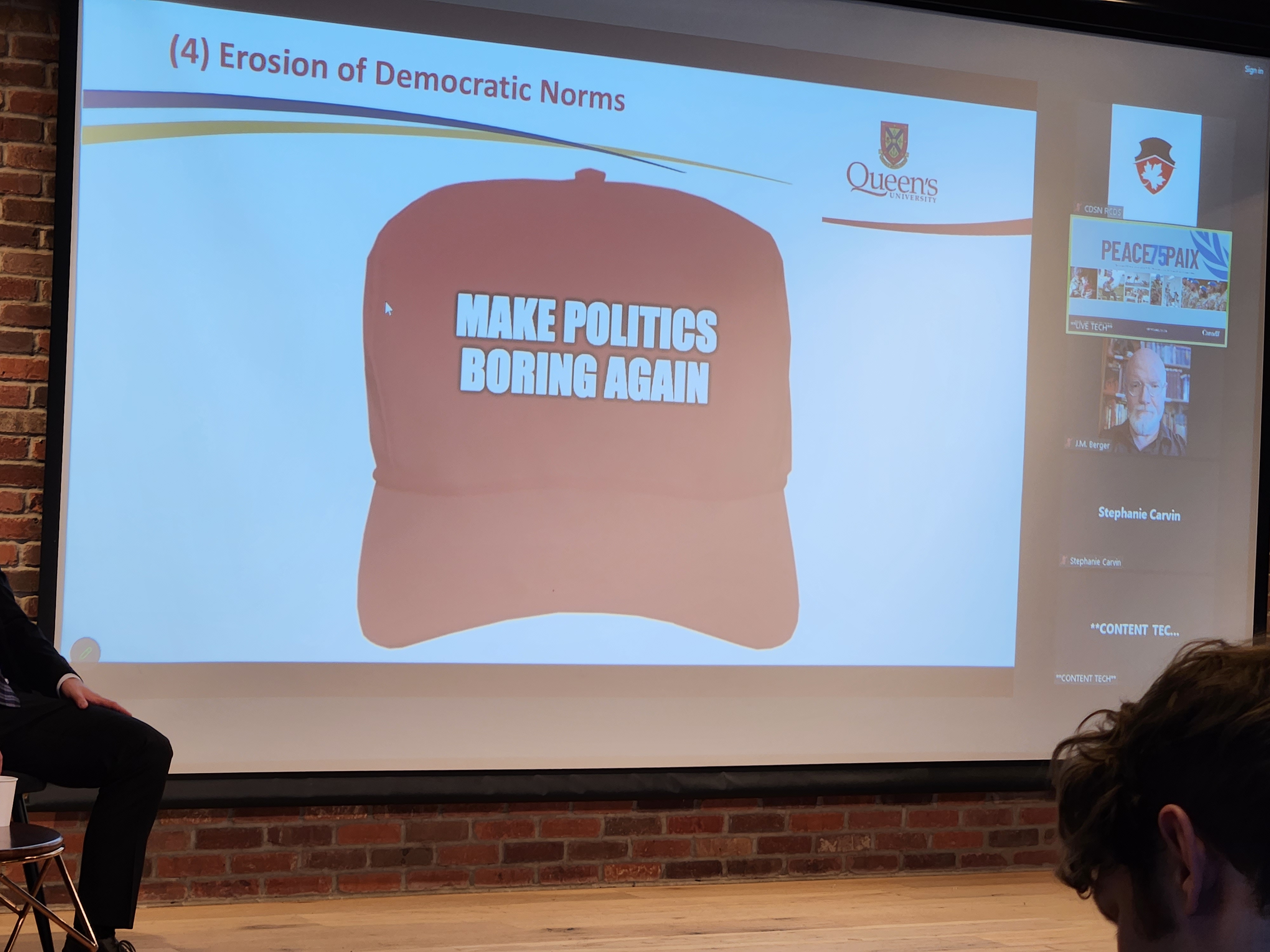
The third session considered whether and how the 2024 election would generate extremism and violence not just in the US but in Canada. They made it pretty clear that, yes, there will be more extremist violence generated by the next current election campaign, that Americans and increasingly Canadians are living in two different realities, and that things are going to get worse before they might get better.  Ryan Scrivens showed the trends over time, Amy Scooter talked about the rise of militancy in the US (buy her new book!), J.M. Berger talked about the social constructions that are driving these dynamics.  Amar Amarasingam presented more on the Canadian side of things.

As a political scientist, I ordinarily would not support this appeal that Amar made:


Our last panel was certainly not least as Srdjan
Vučetić, Jasmin Mujanović, and Sidita Kushi passionately and insightfully presented the latest dynamics in the Balkans.  I used to study the international relations of some of this so I was surprised to learn how badly the US is screwing this up by supporting directly or indirectly Serb nationalists who are preventing Kosovo from moving forward.  That five European
countries don't recognize Kosovo doesn't surprise me as these folks haven't read my earlier work--that secession is not as contagious as thought, that recognition in place does not really matter elsewhere, etc.  It was a great panel to end the day, since the speakers were very dynamic in their criticism of US and European policy in the region.  To put a Hungarian in charge of the NATO forces in the region is just dumb from so many dimensions--Hungary is a spoiler, its military was one of the worst performers in Afghanistan (the nearby New Zealanders would patrol in the Hungarian sector since the Hungarians didn't patrol)., and so on.

Oh and it turns out the metaphor I used to describe this panel was a bit ... dated and unoriginal and problematic:


 We concluded and moved on to a delightful dinner.  So glad I had a chance to meet these folks.  And I am very proud of the CDSN HQ folks--Melissa, Sherry, Racheal, and Mourad--for doing all of the heavy lifting (sometimes quite literally as our swag was in big boxes).  Much thanks to the MINDS and SSHRC folks who fund us and to the NATO Field School and the new Carleton Society on Conflict and Security (I am surely getting their name wrong)--a new student group on campus for those interested in defence and security stuff--for providing much of our audience.


Oh, and one last thing:

While others did go down the slide, I didn't manage to squeeze it in.