
Monday, November 12, 2012


Sunday, November 11, 2012
Voterfraudfraud in Retrospect
We were so focused on voter id laws and the rest that might keep people away from the polls we (at least I) did not consider the simple strategy of delay:
 Source: http://upwithchris.tumblr.com/post/35424640719/which-voters-waited-on-long-lines-to-cast-their
Oh my, what a coincidence! Or not. I was worried that voter suppression could tilt a state or two (Florida was so close again), but I do think that the lines showed determination. I think people believed that the efforts to suppress their vote should not stand, and so they stood and stood and stood in line and in defiance.
I can only thank those folks for being so determined. Maybe the GOP will learn it is better to earn their vote than their distrust via voterfraudfraud efforts. Or not.
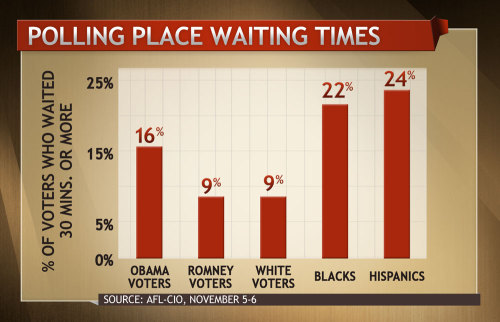
Oh my, what a coincidence! Or not. I was worried that voter suppression could tilt a state or two (Florida was so close again), but I do think that the lines showed determination. I think people believed that the efforts to suppress their vote should not stand, and so they stood and stood and stood in line and in defiance.
I can only thank those folks for being so determined. Maybe the GOP will learn it is better to earn their vote than their distrust via voterfraudfraud efforts. Or not.
Petraeus and the Modern Military
The criticism of David Petraeus will continue for quite some time. And deservedly so. He made a piss poor choice, undermining his ability to lead and serve as a role model. People, especially his adversaries in the military, will use this to attack not just the man but the policies he promoted. And it gets complicated because Petraeus did provoke the occasional crisis in civil-military relations. He engaged the Sunni Awakening before the US had a policy on it, so he made policy without guidance or permission from above.
Anyhow, the point here is that counter-insurgency is coming under attack because it has not "worked" in Afghanistan, and it was not as responsible for joy and happiness in Iraq. Heaps of folks in the US Army and outside of it are not big fans of COIN. Why? Partly because it threatens budgets if you don't need big tanks and bombers. Partly because it threatens identities--capital intensive warfare is the American way of war. Partly because COIN is complicated and appropriate for some circumstances and not others. Partly because there is no single way to execute a counter-insurgency campaign.
What made Petraeus such an improvement was his ability to think and adjust. The new counter-insurgency doctrine may not have been perfect, but it was the process that mattered. He brought together smart people across a variety of disciplines including civilians to re-think how the Army does counter-insurgency. He had studied the lessons of Vietnam, but did not just blindly apply those. Again, his version of COIN may have been lucky rather than good as it interacted with the Sunni Awakening in ways that gave the US a temporary advantage. But previous US military leaders showed no such ability to think outside the box.
The real challenge is that US conventional military supremacy means that most of the US's adversaries are not going to fight conventionally. Those that do, such as Hussein (twice!), are defeated but then leave behind tough political and military questions about what to do next. So, we need to have folks in charge who think and plan and adjust and adapt. Petraeus did that very well in Iraq in 2003 as the ground campaign ended and the aftermath became the problem. He did it very well in 2007 with the surge. Not sure how well Petraeus did in Afghanistan since there are a lot of things going on and I am still confused about how much success actually happened.
It is always so easy to confuse the person with the public relations. It is particularly the case when success is so hard to measure. As much as Petraeus has let us all down with his affair (and his being a lousy dissertation adviser), I still think how he conducted the missions he was given--conducting peace ops in Bosnia in 2002, Iraq in 2003/07, the doctrine writing in between the Iraq stints--made a difference and a positive one. Not flawless by any stretch, but better than most of the American generals.
Anyhow, the point here is that counter-insurgency is coming under attack because it has not "worked" in Afghanistan, and it was not as responsible for joy and happiness in Iraq. Heaps of folks in the US Army and outside of it are not big fans of COIN. Why? Partly because it threatens budgets if you don't need big tanks and bombers. Partly because it threatens identities--capital intensive warfare is the American way of war. Partly because COIN is complicated and appropriate for some circumstances and not others. Partly because there is no single way to execute a counter-insurgency campaign.
What made Petraeus such an improvement was his ability to think and adjust. The new counter-insurgency doctrine may not have been perfect, but it was the process that mattered. He brought together smart people across a variety of disciplines including civilians to re-think how the Army does counter-insurgency. He had studied the lessons of Vietnam, but did not just blindly apply those. Again, his version of COIN may have been lucky rather than good as it interacted with the Sunni Awakening in ways that gave the US a temporary advantage. But previous US military leaders showed no such ability to think outside the box.
The real challenge is that US conventional military supremacy means that most of the US's adversaries are not going to fight conventionally. Those that do, such as Hussein (twice!), are defeated but then leave behind tough political and military questions about what to do next. So, we need to have folks in charge who think and plan and adjust and adapt. Petraeus did that very well in Iraq in 2003 as the ground campaign ended and the aftermath became the problem. He did it very well in 2007 with the surge. Not sure how well Petraeus did in Afghanistan since there are a lot of things going on and I am still confused about how much success actually happened.
It is always so easy to confuse the person with the public relations. It is particularly the case when success is so hard to measure. As much as Petraeus has let us all down with his affair (and his being a lousy dissertation adviser), I still think how he conducted the missions he was given--conducting peace ops in Bosnia in 2002, Iraq in 2003/07, the doctrine writing in between the Iraq stints--made a difference and a positive one. Not flawless by any stretch, but better than most of the American generals.
Saturday, November 10, 2012
Expecting a Learning Curve?
Should we expect the Republicans to learn from their losses this week? No. Well, maybe. Ok, some will learn but will it change the behavior of the party? Well, the first bit of evidence would be no. John Boehner is claiming that the GOP win in the House, keeping control, is a mandate. Given that more folks voted for the Democrats but successful gerrymandering meant that the GOP got more seats, this is a thin mandate indeed.
But my doubt about GOP learning/reform is more driven by my Marxist understanding of politics. That is, who controls the commanding heights of the Republican political economy? That is, who has the money, who controls the institutions, and what are the incentives for change? Reality-based conservatives, an increasingly rare species, are noting that FOX and other GOP outlets are somewhat to blame. Is it like that FOX and talk radio and other conservative outlets will moderate their tone as they realize that the center of the political system is to the left of where they stand? Unlikely. So, the agenda-setting and issue-framing on the right will still be on the waaaay right.
Will the Koch brothers and other deep pockets who support the farthest right folks learn? Hmmmm. I am not an expert on these folks, so I cannot say for sure.
Gerrymandering has also created some incentives for always heading to the right.
My vote, as always, is also for cognitive closure. People can and will draw out whatever lessons they want, such as:
But my doubt about GOP learning/reform is more driven by my Marxist understanding of politics. That is, who controls the commanding heights of the Republican political economy? That is, who has the money, who controls the institutions, and what are the incentives for change? Reality-based conservatives, an increasingly rare species, are noting that FOX and other GOP outlets are somewhat to blame. Is it like that FOX and talk radio and other conservative outlets will moderate their tone as they realize that the center of the political system is to the left of where they stand? Unlikely. So, the agenda-setting and issue-framing on the right will still be on the waaaay right.
Will the Koch brothers and other deep pockets who support the farthest right folks learn? Hmmmm. I am not an expert on these folks, so I cannot say for sure.
Gerrymandering has also created some incentives for always heading to the right.
My vote, as always, is also for cognitive closure. People can and will draw out whatever lessons they want, such as:
- Romney was not conservative enough.
- Romney was a lousy candidate.
- Blame the hurricane.
- Blame Christie.
- Blame Bush? Nope, that is for the Democrats....
- Romney did great among whites, so it is the fault of the less legitimate voters....
- the vote distributions of ethnic groups, where even Cuban-Americans voted more for Obama than for Romney, an historic reversal;
- the losses by the rape boys and the victories of the female Democrats for a number of Senate seats;
- the passage of a pro-tax proposition in California; the passage of pro-same sex propositions elsewhere.
Sex and the Academy
Among his many parting gifts, David Petreaus reminds us that dissertation advisers can abuse their authority with a bit more immunity than CIA directors. Yes, Petraeus not only slept with his biographer, Paula Broadwell, but his student as he apparently had served as one of her dissertation advisers. This led me to tweet that the difference between a CIA director and a professor is that the former loses his/her job if he/she gets caught sleeping with a subordinate.
My blog has long protested the depiction in popular culture of professors as leches, that nearly every professor in TV and movies seems to be pursuing sexual relationships with their students. The problem is that while nearly all professors do not engage in this behavior, there are, of course, some who do. Worse, they often get away with it.
In my academic travels, I have been at a couple of places where predators existed, taking advantage of their relative power and the apparent sex appeal that comes with the job of professor (at least, this is what our pop culture suggests). These predator profs largely got away with their behavior, which, indeed, created hostile working environments not just for those that they pursued but also for many other folks in the programs. One of these did get his wrist slapped, but whatever symbolic punishments levied were only temporary.
Tenure should not protect such individuals. Indeed, it really does not, as one of the individuals was not yet tenured but protected by senior professors. The other was protected by the university, essentially, as it was afraid of lawsuits. Perhaps other schools take this stuff more seriously.
To get back to Petraeus, he seemed like a perfect candidate for teaching at Princeton, where he got his PhD. I am curious about whether the particular sin that cost him his career in government service will get in the way of getting a university job. His predecessor in Afghanistan, Stanley McChrystal, who went on to Yale, insulted his superiors and showed that he was bad at Public Relations. These are not sins in the academy but perhaps requirements. Petraeus, on the other hand, proved that he not only unfit to be CIA director but also unfit to profess. Will Petraeus get an academic post anyway? I would not bet against it.
My blog has long protested the depiction in popular culture of professors as leches, that nearly every professor in TV and movies seems to be pursuing sexual relationships with their students. The problem is that while nearly all professors do not engage in this behavior, there are, of course, some who do. Worse, they often get away with it.
In my academic travels, I have been at a couple of places where predators existed, taking advantage of their relative power and the apparent sex appeal that comes with the job of professor (at least, this is what our pop culture suggests). These predator profs largely got away with their behavior, which, indeed, created hostile working environments not just for those that they pursued but also for many other folks in the programs. One of these did get his wrist slapped, but whatever symbolic punishments levied were only temporary.
Tenure should not protect such individuals. Indeed, it really does not, as one of the individuals was not yet tenured but protected by senior professors. The other was protected by the university, essentially, as it was afraid of lawsuits. Perhaps other schools take this stuff more seriously.
To get back to Petraeus, he seemed like a perfect candidate for teaching at Princeton, where he got his PhD. I am curious about whether the particular sin that cost him his career in government service will get in the way of getting a university job. His predecessor in Afghanistan, Stanley McChrystal, who went on to Yale, insulted his superiors and showed that he was bad at Public Relations. These are not sins in the academy but perhaps requirements. Petraeus, on the other hand, proved that he not only unfit to be CIA director but also unfit to profess. Will Petraeus get an academic post anyway? I would not bet against it.
Thursday, November 8, 2012
Who is Reality Averse Now?
I didn't watch the election coverage on FOX the other night, as there is only so much schadenfreude that I can consume. But this take by Jon Stewart is delightful:
Wednesday, November 7, 2012
Not A Bad Speech
The problem with President Obama is he keeps setting expectations so high so that when he falls short, he disappoints so much. If he was only seen as inarticulate at GW Bush, then we would not expect so much.
Oh well, I do like this speech:
I will be busy with a conference in town the next couple of days, but I do have some thoughts that I will try to articulate. The good news is that no one expects me to be as articulate as the President.
Oh well, I do like this speech:
I will be busy with a conference in town the next couple of days, but I do have some thoughts that I will try to articulate. The good news is that no one expects me to be as articulate as the President.
2012 Post-Mortem
Wow. The funny thing is that while I am pleased about Obama winning, I am even more pleased that the folks who embraced reality kicked the asses of the reality-averse. Not just Nate Silver, but that the rape wonder twins lost elections that they should have won.
Yesterday, I pondered whether I was sucked in by wishful thinking (hey, I thought Mondale might win in 1984), but that bit of doubt perhaps reflected a bit more concern about reality and possible bias than what we have seen from the GOP. Why did I place my "faith" in the Democrats yesterday? Because I had seen enough policy and polls that suggested that the Republicans effectively alienated damn near all non-white folks with their stances, and that women would turn out and vote for the anti-rape party. My biggest concern: would resentment against voterfraudfraud efforts compensate for successful voter suppression. It seems that it did.
I think it was most appropriate in this year of Republicans taking the most awful stands on women that the Senate will have more women than ever.
I cannot write much now as I have to run to school to participate in a panel on the election--what does this election mean for US-Canadian relations? Not much really, as neither candidate was really promising anything sweeping in this direction, but odds are now lower that Canada will be fighting alongside the US in yet another Mideast war.
If the folks in the GOP who argue that they were not Conservative enough win, then perhaps the Libertarians will get their wish--to be the second party of the US as a more Conservative GOP can only become more marginalized. While it might be hard for the Dems to win three times in a row, if the GOP continues to alienate growing demographics, if it fails to suppress enough votes, if it continues to follow Palin's dream of being the party of white rural America, it might indeed become a third party. I doubt it because money matters and there is a enough of a base to keep the 3rd parties at bay (white evangelicals), but if the economy is better in four years and the wars are behind us, I would not bet against it. Especially if the GOP has such a disastrous primary race like it did this time. Sure, there will be better candidates out there but will they be able to overcome the party's primary process?
Yesterday, I pondered whether I was sucked in by wishful thinking (hey, I thought Mondale might win in 1984), but that bit of doubt perhaps reflected a bit more concern about reality and possible bias than what we have seen from the GOP. Why did I place my "faith" in the Democrats yesterday? Because I had seen enough policy and polls that suggested that the Republicans effectively alienated damn near all non-white folks with their stances, and that women would turn out and vote for the anti-rape party. My biggest concern: would resentment against voterfraudfraud efforts compensate for successful voter suppression. It seems that it did.
I think it was most appropriate in this year of Republicans taking the most awful stands on women that the Senate will have more women than ever.
I cannot write much now as I have to run to school to participate in a panel on the election--what does this election mean for US-Canadian relations? Not much really, as neither candidate was really promising anything sweeping in this direction, but odds are now lower that Canada will be fighting alongside the US in yet another Mideast war.
If the folks in the GOP who argue that they were not Conservative enough win, then perhaps the Libertarians will get their wish--to be the second party of the US as a more Conservative GOP can only become more marginalized. While it might be hard for the Dems to win three times in a row, if the GOP continues to alienate growing demographics, if it fails to suppress enough votes, if it continues to follow Palin's dream of being the party of white rural America, it might indeed become a third party. I doubt it because money matters and there is a enough of a base to keep the 3rd parties at bay (white evangelicals), but if the economy is better in four years and the wars are behind us, I would not bet against it. Especially if the GOP has such a disastrous primary race like it did this time. Sure, there will be better candidates out there but will they be able to overcome the party's primary process?
Tuesday, November 6, 2012
The Big Test
Today/tonight/tomorrow serves as a big test. Well, big test to this narcissist. Will the election verify the logics, arguments and facts as I have seen them over the past year or three? Or will everything I believed be revealed to be the product of wishful thinking?
I have long believed that the Republicans were hurting themselves with their xenophobia, that their non-Romney competition was going to hurt them, that Obama was fundamentally a more appealing candidate (Mrs. Spew would say his abs are quite appealing), that Obama has shown many times a keen ability to give his opponents enough rope to hang themselves (how about that Navy of 1916 comparison now?)
Of course, I could have been just motivated by my bias to believe that Obama would win. If he wins, that might mean that I was biased but accidentally right. Or if he loses, it could mean that I actually was right about much of the stuff, but underestimated the super-pacs, Obama's mis-steps or the success of the GOP's strategy to deny Obama many policy victories.
The funny thing is that I will, of course, read into tonight's outcome whatever what I want to read into them, so suggesting that this is any kind of test is deceptive. The only real tests tonight are: is Nate Silver on target? Will the Secretaries of State fail in their jobs? and will the GOP exceed expectations and not be sore losers?
I have long believed that the Republicans were hurting themselves with their xenophobia, that their non-Romney competition was going to hurt them, that Obama was fundamentally a more appealing candidate (Mrs. Spew would say his abs are quite appealing), that Obama has shown many times a keen ability to give his opponents enough rope to hang themselves (how about that Navy of 1916 comparison now?)
Of course, I could have been just motivated by my bias to believe that Obama would win. If he wins, that might mean that I was biased but accidentally right. Or if he loses, it could mean that I actually was right about much of the stuff, but underestimated the super-pacs, Obama's mis-steps or the success of the GOP's strategy to deny Obama many policy victories.
The funny thing is that I will, of course, read into tonight's outcome whatever what I want to read into them, so suggesting that this is any kind of test is deceptive. The only real tests tonight are: is Nate Silver on target? Will the Secretaries of State fail in their jobs? and will the GOP exceed expectations and not be sore losers?
Clean Government?
Last night, the Mayor of Montreal, Gerald Tremblay, resigned from his office in disgrace as the corruption scandal led directly to him. No, thus far there is no proof that he took cash, just that he would leave the room when it was clear the topic would come up, rather than tackling it. And this reminds me of the non-story in this election down in the US: there has been no significant corruption accusations/investigations the past four years. Given how enthusiastically the GOP pursued the Clintons, you know if there was any hint of smoke, they would be throwing gasoline on it.
I am not saying that Romney would be corrupt or tolerate corruption. We have no idea, but we do know that we have seem some good governance over the past four years. Sure, more executive power over-reach (not going to change with Romney), much frustration with handling of Congress (Romney might be less frustrated but I am pretty sure I would prefer him frustrated), and so on. But the relative success of FEMA and the response to Hurricane Sandy combined with the non-corruption non-scandals suggests that even as we are confused by the events in Libya, we have a government in the US right now that does not suck that much. Isn't that something to vote for?
Good luck to those who have to stand in lines today to exercise their basic freedom.
I am not saying that Romney would be corrupt or tolerate corruption. We have no idea, but we do know that we have seem some good governance over the past four years. Sure, more executive power over-reach (not going to change with Romney), much frustration with handling of Congress (Romney might be less frustrated but I am pretty sure I would prefer him frustrated), and so on. But the relative success of FEMA and the response to Hurricane Sandy combined with the non-corruption non-scandals suggests that even as we are confused by the events in Libya, we have a government in the US right now that does not suck that much. Isn't that something to vote for?
Good luck to those who have to stand in lines today to exercise their basic freedom.
Monday, November 5, 2012
Hate the Player and the Game
The Mayor of Montreal, Gerald Tremblay, is currently giving a speech where he hopefully will resign. He started by saying that his dad told/ him:
"My father told me to never get into politics because it was dirty, and I would be destroyed."
And my reaction is: I pity the fool who blames the game. At no point did this Mayor ever seem at all sincere about fighting corruption. The scandal led to his door. He made his bucks so no sympathy for him now. He played the game, he won, and now he has lost. Suck it up, take some personal responsibility and then get off the stage. Oh, and maybe donate some cash to something worthy.
Tremblay leaves as he governed--oblivious to the end.
"My father told me to never get into politics because it was dirty, and I would be destroyed."
And my reaction is: I pity the fool who blames the game. At no point did this Mayor ever seem at all sincere about fighting corruption. The scandal led to his door. He made his bucks so no sympathy for him now. He played the game, he won, and now he has lost. Suck it up, take some personal responsibility and then get off the stage. Oh, and maybe donate some cash to something worthy.
Tremblay leaves as he governed--oblivious to the end.
Pondering the Electoral College
I was asked today about the electoral college [EC], and I am clearly a bit biased this week since if there is a popular vote/electoral college conflict, the EC will be favoring my preferred candidate. But I do think that the EC, which had somewhat different aims and effects centuries ago, is not a bad thing.
Why? Well, as a scholar of ethnic conflict, I am familiar with debates about electoral institutions and especially those that advocate vote-pooling--those that compel candidates to reach out beyond a narrow constituency. Given the interaction of demographics and the electoral college, a candidate has to do amazingly well to win when appealing only to whites folks. Over time, the popular vote may end up being the same way, but the electoral college combined with everything else means that states with significant diversity (Virginia, Florida, Colorado, etc) are key. If it was just about the popular vote, then one could try to really run up the score in a few big states and ignore large swaths of the country. Yes, there is a focus only on swing states this month, but we got these states defined as such by the interaction of demographics and the electoral college. And these are mostly medium sized, fairly representative states, forcing the politicians to make broader, rather than narrower, appeals. NC, Ohio, CO, Nevada, Florida are a good mix of places.
Yes, it does have one bad effect--it makes the Secretaries of State of a few places very powerful and increases the temptation to engage in voter suppression, but I prefer the court cases to focus on a few states rather than on the entire country, which would be the case in a close popular vote, right?
Again, I am biased in this and not just because I strongly prefer Obama to Romney but also because I think appealing to a wider demographic base is better than appealing to just one group. Better to assure the many than scare the fewer; better to be broadly representative than to be the white man's man.
Tomorrow will be interesting, and not just about the Presidency. The GOP may have gone so far to the right that it may have lost a shot at winning the Senate. How cool would that be? Very cool. Of course, the next question will be what lessons to learn from this, and I am confident that in the short term the GOP will blame Romney, non-existent voterfraud, the media, Hurricane Sandy, but will not revisit its strategies and its appeal to a narrowing base. Learning is not inevitable. In a Darwinian survival of the fittest, adaptation does not have to happen. The less fit (those with narrow appeal) can be marginalized, just as the Great Powers of the past may still exist but are no longer all that relevant (Sweden, Portugal, Spain, etc.).
Why? Well, as a scholar of ethnic conflict, I am familiar with debates about electoral institutions and especially those that advocate vote-pooling--those that compel candidates to reach out beyond a narrow constituency. Given the interaction of demographics and the electoral college, a candidate has to do amazingly well to win when appealing only to whites folks. Over time, the popular vote may end up being the same way, but the electoral college combined with everything else means that states with significant diversity (Virginia, Florida, Colorado, etc) are key. If it was just about the popular vote, then one could try to really run up the score in a few big states and ignore large swaths of the country. Yes, there is a focus only on swing states this month, but we got these states defined as such by the interaction of demographics and the electoral college. And these are mostly medium sized, fairly representative states, forcing the politicians to make broader, rather than narrower, appeals. NC, Ohio, CO, Nevada, Florida are a good mix of places.
Yes, it does have one bad effect--it makes the Secretaries of State of a few places very powerful and increases the temptation to engage in voter suppression, but I prefer the court cases to focus on a few states rather than on the entire country, which would be the case in a close popular vote, right?
Again, I am biased in this and not just because I strongly prefer Obama to Romney but also because I think appealing to a wider demographic base is better than appealing to just one group. Better to assure the many than scare the fewer; better to be broadly representative than to be the white man's man.
Tomorrow will be interesting, and not just about the Presidency. The GOP may have gone so far to the right that it may have lost a shot at winning the Senate. How cool would that be? Very cool. Of course, the next question will be what lessons to learn from this, and I am confident that in the short term the GOP will blame Romney, non-existent voterfraud, the media, Hurricane Sandy, but will not revisit its strategies and its appeal to a narrowing base. Learning is not inevitable. In a Darwinian survival of the fittest, adaptation does not have to happen. The less fit (those with narrow appeal) can be marginalized, just as the Great Powers of the past may still exist but are no longer all that relevant (Sweden, Portugal, Spain, etc.).
Secretary of Whuck?
I will always be indebted to 30 Rock for dissseminating the word Whuck, which is how one pronounces WTF. Anyhow, this is relevant right now as people noticed this weekend (and before) that many states seem to be confused about how to administer an election. It is kind of like when the Montreal train system had problems dealing with snow and cold--as if winter was something new to Montreal. By this point in time, US elections should be pretty damned efficient--every 2 years for more than two centuries. But as the long lines indicated, we still don't do it well.
Why not? There may be many reasons, including the reality that something done every two years is not frequent enough for people to remember the lessons learned from the last time. But I think reason number one is that most people have no clue who is responsible in their state and thus just vote party line for the Secretary of State. Hilary Clinton is not in charge of elections, and the name of her office may confuse people when they see it on the ballot--that their state's Secretary of State is its head diplomat??? So, party line voting on "minor" offices may be the case (I speak from complete ignorance as I do not study this stuff) when it comes to this office that determines electoral outcomes.
What does this remind me of? When Lenin and the other big thinkers in the Bolsheviks thought they should give the personnel job to Stalin since that was beneath them. Good times. Or not.
So, if you have not voted yet, vote for the incumbent Secretary of State if the voting process is going well and if you do not see much effort to suppress the vote. If the voting process is going poorly, if your effort to vote was made more difficult by how it was administered, for goodness sake, VOTE AGAINST THE INCUMBENT SECRETARY OF STATE. Oh, and also vote against the governors/mayors/representatives/senators in your state that seek to suppress the vote. Denying the right to vote means many things, but for certain it means that the folks engaged in such efforts think that they cannot win on the basis of the soundness of their programs. They must resort to selecting out of the voting pool those who would vote against them. That makes such folks unworthy... unworthy of your vote and unworthy to govern.
Why not? There may be many reasons, including the reality that something done every two years is not frequent enough for people to remember the lessons learned from the last time. But I think reason number one is that most people have no clue who is responsible in their state and thus just vote party line for the Secretary of State. Hilary Clinton is not in charge of elections, and the name of her office may confuse people when they see it on the ballot--that their state's Secretary of State is its head diplomat??? So, party line voting on "minor" offices may be the case (I speak from complete ignorance as I do not study this stuff) when it comes to this office that determines electoral outcomes.
What does this remind me of? When Lenin and the other big thinkers in the Bolsheviks thought they should give the personnel job to Stalin since that was beneath them. Good times. Or not.
So, if you have not voted yet, vote for the incumbent Secretary of State if the voting process is going well and if you do not see much effort to suppress the vote. If the voting process is going poorly, if your effort to vote was made more difficult by how it was administered, for goodness sake, VOTE AGAINST THE INCUMBENT SECRETARY OF STATE. Oh, and also vote against the governors/mayors/representatives/senators in your state that seek to suppress the vote. Denying the right to vote means many things, but for certain it means that the folks engaged in such efforts think that they cannot win on the basis of the soundness of their programs. They must resort to selecting out of the voting pool those who would vote against them. That makes such folks unworthy... unworthy of your vote and unworthy to govern.
Sunday, November 4, 2012
Last Chance fo Election Comedy?
I have become a big fan of Brian MacFadden--the Sunday NYT cartoonist--party fraud!!!! No, partyfraudfraud!


Comedic Supremacy
That the funnier, more talented people are on Obama's side may not be a good reason to vote for Obama, but I will take it:
Saturday, November 3, 2012
Friday, November 2, 2012
Random Number or Real List?
I just tweeted the following:
Given that Michael Brown was the FEMA head who did New Orleans and the rest of the areas hit by Katrina few favors eight years ago, here are the seven (or as many as I can invent in fifteen minutes).
If you have to depend on Michael Brown to be the critic of Obama's reaction to Sandy, you have at least seven problems.What did I mean by that? Is there at least seven problems? Hmmm, now that I have tweeted it, it is time to enumerate, right? Or is it just that I have fifteen minutes to waste before the reception at this hotel in Kingston for folks studying Armed Forces and Society (Civil-Military Relations).
Given that Michael Brown was the FEMA head who did New Orleans and the rest of the areas hit by Katrina few favors eight years ago, here are the seven (or as many as I can invent in fifteen minutes).
- By putting "Heck of a job" Brownie on your program as a critic of the current effort, you are actually demonstrating that there may be few, if any, credible critics of the effort. This is like having Michael Dukakis criticize your campaign appearances.
- By putting Brownie on your show, you are reminding people of how badly the last Republican administration handled natural disasters. If your goal (and it is Fox's) is to help the Republicans, putting Brownie on your network is not helping your goal.
- By putting Brownie on your network, you are reducing the credibility of your entire network by at least 9%. He has less significantly less credibility than the average guest on a Fox program, and that is saying something.
- If your network license to operate depends on appearing not to be partisan and tied to a single party (yeah, right), this one appearance is enough to convince anyone that your network is in the bag for one party.
- Brownie is such a proven idiot, it might shake the credulousness of some of the Fox viewers who otherwise believe the conspiracy crap.
- Putting Brownie on your network means that you are freakin' desperate. This might be repeated 1 & 2 & 3, but it cannot be emphasized enough. It is like having Donald Trump on your network talking about fiscal responsibility (or anything else).
- Can a Fox jump a shark?
Obama and the Whack-Jobs

This is getting some attention today. Nice illustration of the strange set of beliefs about this guy. I remember a Colonel who was teaching at the US Army War College was most concerned that Obama was like Hitler--that he spoke too well and was persuasive to too many people. Given that we know have four years of evidence about how he governs (pretty moderately, not as liberal as liberals would like, borrowing a health care plan from Romney/Heritage Institute), this figure really just shows how reality averse people can be. The latest dust up with Nate Silver is yet more evidence that a certain hunk of people prefer their own realities even if they are the sole occupants of said universes.
Good times? Um, no. Our country functions better when the two major parties are run by adults who have different values but live in the same world. All I can think of these days is the Barney Frank response:
Pondering the Un-Read VII: Ricks and Generals
Tom Ricks seems to drive some of my twitter friends a bit crazy. Still, I am curious about what people think about Ricks's argument in his new book, which I have not yet read. I have read an excerpt and I have seen enough of Ricks's posts to get the gist:
American generals have been under-performing for decades as they might be good at tactical (and perhaps even operational) thinking but are lousy at creative, strategic thinking. Ricks blames a change in the culture of the US Army, as generals now have incentives to be mediocre. There is no punishment for strategic failure--with some folks who fail getting promoted, such as my former boss at J-5, George Casey, who did not do great in Iraq but moved onto the Army's highest post--Chief of Staff.
Having not read the book and not being an expert on the generals of today (but having a heap of contempt for Tommy Franks), I open the question to y'all: do we coddle the generals of today, can we remove them and then re-use them, would it make a difference?
American generals have been under-performing for decades as they might be good at tactical (and perhaps even operational) thinking but are lousy at creative, strategic thinking. Ricks blames a change in the culture of the US Army, as generals now have incentives to be mediocre. There is no punishment for strategic failure--with some folks who fail getting promoted, such as my former boss at J-5, George Casey, who did not do great in Iraq but moved onto the Army's highest post--Chief of Staff.
Having not read the book and not being an expert on the generals of today (but having a heap of contempt for Tommy Franks), I open the question to y'all: do we coddle the generals of today, can we remove them and then re-use them, would it make a difference?
Thursday, November 1, 2012
Whose Media Is It, Anyway?
I had a post-Halloween conversation with a neighbor this morning (yes, we had something like 200 kids go through our neighborhood!), and he brought up Fox news and his shock at how partisan it is. Then I saw this on twitter:
It reminds me that Rupert Murdoch is a foreigner. How so? The conventional North American understanding of the media--TV, newspapers--is that the news outlets are supposed to be relatively non-partisan, with some columnists providing spin and biased perspectives but the news was the news. However, in Europe and apparently Australia (I am guessing here), media outlets are tied to parties, so that they present their slant on the news, so the Guardian is known as being a left-wing paper, for instance. Murdoch, as an Aussie with imperial aspirations, gives us a Fox News that is very much in the European and Australian tradition, tied to one party so that talking points seem to be identical, and, yes, having their talking heads campaign for Romney. Fox pretends to be as biased or unbiased as other North American outlets. CNN is still trying, more or less, to play it the old way as are the network TV news outlets. The latter because they are more tied to old notions of broadcasting rather than niche-casting, I guess. MSNBC thinks it is like Fox, I guess.
Anyhow, the challenge of all this is that we have expectations for Fox that Fox does not really care about, but Fox does pay lip service to being neutral to fit into the American tradition. I guess Fox is here to stay, so I can only be mildly amused at the irony that the foreign way of doing media sells itself as being more American than the native forms that are truer to traditional, American media norms. Yep, Fox News is really quite foreign. Oh well.
300 instances; 40 states RT @adamserwer 32 Fox News hosts have campaigned for Mitt and the GOP this election cycle mediamatters.org/blog/2012/11/0… …
— Rodger Payne (@RodgerPayne) November 1, 2012
It reminds me that Rupert Murdoch is a foreigner. How so? The conventional North American understanding of the media--TV, newspapers--is that the news outlets are supposed to be relatively non-partisan, with some columnists providing spin and biased perspectives but the news was the news. However, in Europe and apparently Australia (I am guessing here), media outlets are tied to parties, so that they present their slant on the news, so the Guardian is known as being a left-wing paper, for instance. Murdoch, as an Aussie with imperial aspirations, gives us a Fox News that is very much in the European and Australian tradition, tied to one party so that talking points seem to be identical, and, yes, having their talking heads campaign for Romney. Fox pretends to be as biased or unbiased as other North American outlets. CNN is still trying, more or less, to play it the old way as are the network TV news outlets. The latter because they are more tied to old notions of broadcasting rather than niche-casting, I guess. MSNBC thinks it is like Fox, I guess.
Anyhow, the challenge of all this is that we have expectations for Fox that Fox does not really care about, but Fox does pay lip service to being neutral to fit into the American tradition. I guess Fox is here to stay, so I can only be mildly amused at the irony that the foreign way of doing media sells itself as being more American than the native forms that are truer to traditional, American media norms. Yep, Fox News is really quite foreign. Oh well.
Subscribe to:
Posts (Atom)