Monday, May 13, 2013

The Best Part of Publishing Is ....

The Best Part of Publishing is ... the Publication!  I just got six (!) copies of Nationalism and War, which is a volume edited by John Hall and Siniša Malešević.  I have a chapter: "When Nationalists Disagree: Who Should One Hate and Kill?"  It develops the xenophobia stuff that appeared in my 2008 book with Bill Ayres.  One of my regrets at McGill was that I didn't hang out enough with John Hall, an incredibly bright and erudite sociologist working on nationalism.  The nice thing about this project that produced this volume is that it gave me a chance to do hang out with him and his smart sociologist friends.

I often tell my students to avoid participating in edited volumes, as they are frequently a great deal of work that takes forever to get published (since they go at the speed of the slowest contributor) and rarely have any visibility.  I do tell them that if it gives you a chance to hang out with really interesting people, do it for that.   And voila!

Check it out--it is a very interesting read (and not as American-centric as the cover photo suggests).

Sunday, May 12, 2013

Proud to be a Canadian

I am proud to be a Canadian. Wait, I am not Canadian, despite many people thinking that I am (nope, those are not Canadians--they know better).  Why I am proud to live in Canada these days?

Because of this guy:


Chris Hadfield has had an amazing run, tweeting up a storm from the International Space Station.  He has had cool videos of what happens when you wring a wet towel in space, he has had heaps of great Q&As, and his twitter feed has engaged both legendary astronauts (Buzz Aldrin) and fake space travelers (William Shatner, etc.).  It has been incredibly entertaining and incredibly educational.  What a phenomenal ambassador for the space program (such as it is these days) and for Canada. 

Clear skies on your way back, Sir.  I am sure you will stick the landing, just like you have aced everything up to this point. 

Oh My, Millennials

Tis time for graduation speeches and this cartoon makes it look mighty depressing:


I actually do not think things are quite this bad, as unemployment for college graduates is pretty low.  But there are big problems now and ahead.  This is why there is much deserved outrage whenever anybody generalizes that this generation is lazy or whatever (thanks, Time). 

I have been teaching for twenty years (as of next fall), so I have taught a full generation's worth of students, and I cannot honestly say that the folks being kicked out into the world today are any different from those I first taught in 1993.  The world may be a bit different, but these students still show heaps of variation in their ability, their interests, their passions, the work habits and all that.  The only thing I can really be sure of is that in 30-40 years, the Millennials will be saying that the latest generation (mid-21st-ers or whatever) are lazy and distracted and entitled. 

One other Millennial note.  I had a heap of fun comparing with folks on twitter the Millennial scores we all got from this Pew quiz.  I got a 33--perfect for Gen X, which is what I am.  Why so low compared many of my friends on twitter: no tats, no piercings, I read the daily newspaper, I don't text much, and I contact government officials--it is part of my job. 

Enjoy this very Millennial mother's day.

The Waiting List is the Hardest Part

While Mrs. Spew was eating her Mother's Day Breakfast (pancakes but not in bed as she hates getting breakfast in bed [not a superfan of Mother's Day either]), I read and reacted to this NYT story on college waiting lists and the students/parents who obsess about them.  The story discusses students who are desperate to get in to their favorite school from the purgatory that is the waiting list.  They send cookies, more evidence of how wonderful they are (projects, etc), and heaps of email/phone calls.

My first reaction: "These are precisely the students I would not want to have in my class.  Once they get in, they will whine and whine about grades and everything else."

Mrs. Spew's reaction: "This is why professors are not admissions committees!"  Yes, this is why I married her.  Heaps of laughs on an early Sunday morning before she celebrates Mother's Day by going to a third day of Ottawa's Comic-con with Teen Spew.  The highlight of today will be T.S. getting a photo with Nathan Fillion.

Anyhow, this story reminded me of an old post that I cannot find right now: that there is such a thing as too much sucking up.  It is one thing to occasionally pander to the prof or to a school, it is another to be relentlessly in one's face.  It does far more harm than good.  And the article indicates that too much campaigning is going to backfire. 
To cut down on behavior like that, says David Borus, dean of admissions at Vassar College, “We are very explicit in the communications we send out about what’s going to help you and what’s not going to help you, and we make it pretty clear that if you do do some of this stuff, you’re just going to tick us off.” 

They probably will not tell someone that their chances have declined because they were obnoxious/obsequious/obstinate  (the three O's of over-doing), but that is almost certainly the reality.

The other reality is this: while some schools seem to fit better than others, you can be happy and successful regardless of the school.  Sure, getting into Harvard probably opens a lot more doors, but most of the time, going to choice #2 or #3 or #5 is probably not going to ruin one's life.

So, if you are on the waiting list, follow the instructions and do no more than that.  Or move on to the next school on your list.  Good luck and enjoy the best four to six years of your life!

Saturday, May 11, 2013

The Dark Side of Peacekeeping

When I was on the Joint Staff on the Bosnia desk, we knew that American contractors were participating in the trafficking of women.  That would be Dyncorp, which the US still relies upon for private military contracting.  The wiki page is pretty darned instructive and refers to a woman who blew the whistle on Dyncorp, on the International Police Task Force that was supposed to be training the Bosnian police, and on the UN and NATO for ignoring the human trafficking. 

The woman, Kathryn Bolkovac, was portrayed in the movie, Whistleblower, by Rachel Weisz that I watched last night. They used a fake name for Dyncorp, but I recognized it easily enough.  The movie makes it clear that one of the consequences of deploying peacekeepers, police trainers and others to a post-conflict zone is to create a market for prostitution.  There was plenty of organized crime that developed during the war that then took advantage of the demand and provided the supply via girls and women.  Indeed, the UN Peacekeepers that preceded the NATO mission did much to enrich the criminals

While the UN and NATO did not deliberately support human trafficking, they tended to cover it up, apparently, so that their missions would not be tainted.   It was certainly the case that individuals serving in these missions employed the prostitutes and even abetted the organized criminals.  Truly awful for organizations aimed at helping people to tolerate and even abet the impunity of the criminals.

I guess the upside to a highly kinetic war where there is pretty strict gender segregation might mean that there is less of this in Afghanistan, but I would not bet much on it. 

Every Professor's Frustration

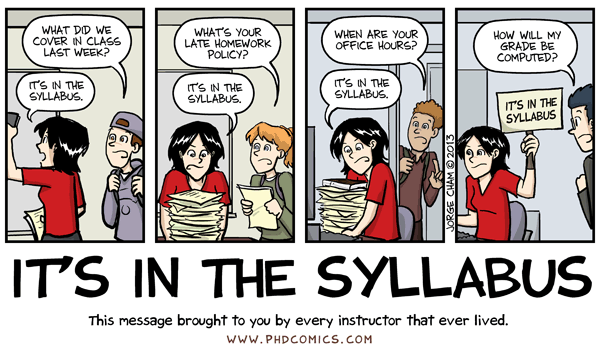
PhD comics gets it right so often, but this one strikes to the core of nearly every professor:


Indeed.  Just last week, one of my FB friends was doing his ritual "hey, here are the end of term questions might students have that ignore my syllabus" post.  Always entertaining.  I forget who came up with a good remedy but I will share it here anyway:
In the first week or two, have a quiz dedicated to the syllabus.  Easy points so students can be reminded of it if they ask for extra credit at the end of the term (especially if the syllabus says no extra credit). 

I have never done it, but tempted.  Not so necessary in the grad classes I now exclusively teach.

Oh, and one bit of Canadian culture shock--they are called outlines up here.


Friday, May 10, 2013

The Academy Vs. Vegas

The controversy du jour is that Jason Richwine was fired from the Heritage Foundation once his dissertation, where he made assertions about the intelligence of Latinos, came to light.  I  discussed yesterday the responsibilities of dissertation commmitees.  Today, the issue is clarifying academic freedom.

It has been suggested that this is somehow a violation of academic freedom because something a guy wrote for his PhD got him fired. 


There are many issues here, but I just want to focus on one--what is meant by academic freedom?  Well, first, the guy was able to get his controversial dissertation approved, so that is one bit of evidence that one can examine controversial ideas in academia.  More importantly, academic freedom exists in the academy. If you leave the academy, do not expect that freedom to come with you.  That is one reason why we professors tolerate low wages--the job security that comes with the low wages and heaps of uncertainty upfront is compensated by the academic freedom that comes with tenure.  And there are plenty of folks using that freedom to say all kinds of controversial things, like the Boston bombings were a false flag operation.

But if you leave the academy, you leave that freedom behind but you take with you your record of research.  So, it is not like Vegas, where what happens in Vegas stays in Vegas.  Nope, what you say and do in the academy can follow you around.  So, if you join a research center/think tank that cares about its image, it may dump you if your ideas from the past (and, let's be honest, this guy has not dumped his old ideas) come back to haunt them.  I am not a fan of Heritage, but they are a think tank, they have an corporate identity.  So, it is well within their right to hire and fire people based on whether their ideas fit with their corporate culture/strategy/whatever.

That it happened so quickly might suggest that there was a rush to judgment.  The bigger point here is that if employers are going to look at people's facebook pages and twitter accounts to see if they are suitable hires, you would think that a think tank would take a look at least at the abstract of a dissertation before hiring someone to do .... research!

Anyhow, there is no violation of academic freedom here.  You leave the academy, you lose the magic protections that come with the old buildings and the ivy on the walls and so forth. 

Deja Vu in American Politics

The Benghazi stuff may not be entirely about the GOP hate for Hillary Clinton, but it reminds me of something I was thinking in 2008.  I thought that Obama, because he did not have the Clinton history, might have an easier time with the GOP, given how much the GOP hated the Clintons.  I remembered the late 1990s with impeachment, the conspiracy theories and all the rest, so I figured it had to be better for Obama. 

As it turns out, I was probably wrong.  I mean, could the Republicans have been less cooperative with a President Hillary Clinton than with Obama?  Could they have engaged in darker, more wild conspiracy thinking about President Clinton in 2010 than President Obama?

And then I see the stuff about Benghazi and I think: maybe. 

Texas Lacks a Learning Curve

It is amazing how Texas politicians are responding to the West disaster.  Not surprising at all but still just pretty remarkable. 
Even in West, last month’s devastating blast did little to shake local skepticism of government regulations. Tommy Muska, the mayor, echoed Governor Perry in the view that tougher zoning or fire safety rules would not have saved his town. “Monday morning quarterbacking,” he said.
I would call it trying to learn and do better, but Monday morning quarterbacking it is, apparently.  

I lived in Texas for six years, but never realized that it was forbidden for smaller countries to have fire codes.  Which means that this should not be a surprise even though it is: "Fires and explosions at Texas’ more than 1,300 chemical and industrial plants have cost as much in property damage as those in all the other states combined for the five years ending in May 2012."

Let's say that again: Texas has more property damage due to fires and explosions than all other states combined.  That is news.  And that is just incredibly awful.  That it happens in a state hostile to regulation might just suggest that regulation does make a difference.  What a great natural experiment except for all those harmed in these fires and explosions.

Why does this continue?  "“In rural Texas,” said Stephen T. Hendrick, the engineer for McLennan County, where the explosion occurred, “no one votes for regulations.”" Good thing then that the rural counties have been losing population to the cities.... except the city folks are probably equally in denial.

Who pays instead?
In chemical fires, firefighters often bear a heavy toll. Ten of the at least 14 people who died in West were firefighters, and two more were residents helping fight the flames. This week, officials from the state firefighters’ association said the 50-foot-tall memorial to volunteers killed in the line of duty, on the Capitol grounds in Austin, had no room left for new names, not even those from West.
Reading this piece reminds me why I felt less like an alien in French-speaking Quebec than I did in Lubbock, Texas.  Businesses facing no regulations will do things that get people killed.  In Texas, that is the price of doing business rather than a reason to regulate.  

Thursday, May 9, 2013

Most Depressing Education Related Infographic

As a scholar, I find this graphic utterly depressing.  As a citizen who formerly resided in many of these states, I find this graphic a dramatic display of twisted priorities:


This is just awful on a stick.  Especially since bigtime college sports do not make money for the rest of the university.  It may sometimes pay for the big time college sports and sometimes it may pay for the smaller sports, but it does not lead to universities having more money for research and teaching and whatever else.  And, of course, the money does not really go to the student athletes as we well know.

So, if I had the power to enact one incredibly anti-market law in the US, aside from perhaps limiting the pay that execs get, it might be this: allow universities to collude to manage the salaries of coaches.  Perhaps set their wages to be no more than match the highest prof's salary.  Allow them to still make money on merch and the lame tv/radio shows, but limit how much money comes out of the universities' revenues (athletic and otherwise) to pay these folks.  There are limited spots in the NBA and NFL for coaches so you will get mighty fine coaches on less salary.

One last note--hey, gotta love Nevada.


H/T to Kyle Saunders.

Dissertation Daze

Dissertations are in the news.  Uh oh.  Yep, not in a good way.  I tend not to read Jennifer Rubin as my twitter feed usually distills her arguments, but the column raises the question of what responsibility do dissertation committees have for the content of the dissertations they supervise. 

It is a fair question in general.  The answer is: somewhat.  Or sort of.  That is, whether I agree or disagree with a student's dissertation should have little impact over whether I think it merits a PhD.  A dissertation is a serious and original investigation of a significant question.  Is the dissertation a contribution to science?  I always found that question a bit intimidating and a bit pretentious, but very much appreciated the pro-dean experiences I had at McGill where the hard scientists did very clearly elaborate their contribution to science.  Whether I agree with the conclusions and implications is almost entirely irrelevant.  The evaluation depends on whether the question is important, whether the methods chosen were appropriate, whether the research design was well-executed, whether the findings derive from the research, and whether the implications derive from the findings.*
* By the way, no one ever trained me on how to supervise a dissertation or what the criteria should be.  Ooops. 

To give you the clearest example, one of the first dissertations I supervised at McGill targeted my work directly.  The student was out to prove me wrong.  I surely did not agree with the conclusions, but did not mind the effort to prove me wrong (hate me if you want, but just cite me).  Science, even or especially social science, involves conflicting ideas and complex realities, so a well-executed piece of research may not convince me to change my views but it probably influences how I think about things. 

Most of the rest of my dissertations students worked on stuff that was largely unrelated to my work, so some produced understandings of the world that convinced me and others not so much.  But I approved of them via my signature on the various forms because I found them to be well executed investigations of interesting questions.  Would I sign off on a very racist dissertation?  Probably not because I doubt that it would have the necessary ingredients--well articulated question, logical theoretical development, good research design, and so on.  On the other hand, I did supervise a dissertation that might be read as advice for potential miltias about the strategies one chooses to get support affects one's likelihood of surviving attacks.

Of course, the really important thing to know about Political Science dissertations is that they are long, longer than nearly any other field.  But that is a topic for another day and another post.

A Short Rant On Boomers vs. Everyone Else

Everyone is aflutter because Time has a cover calling Millennials narcissists.  Well, as a self-admitted narcissist, I am just a wee bit skeptical.  How do I measure inter-generational comparisons and self-centeredness?  Well, I simply marvel at stances on where society is placing its priorities.  In the US and Canada (can't speak to the rest of the world), the older folks are most resistant to changing the current spending patterns, where most of the money in social security, health care and the like goes to ... the older folks.  We have seen heaps more cuts in education the past decade than in spending on senior citizens and those approaching senior-ness.

Now, I get the politics of it--older folks vote and they vote on such issues with great determination, so they get the politicians' attention.  But we tend to overlook that this political calculation of those seeking elections depends on the preferences of the older folks--that they care more about themselves than about their kids/grandkids.  I am tempted to insert some snark at the homophobic take on Keynes, but I will resist.  The key here is that today's spending patterns is not the fault of politicians--they are merely representing those who vote and are attentive to a few issues.  Nay, the fault lies with the older folks who are self-centered.


Time for a New Religion


A friend of mine (h/t to JJ) posted on her facebook page the divergent reactions to the National Household Survey of Canada, which is like a census but is no longer mandatory (Harper hates social science along with all other sciences, apparently).

JJ noted that the anglophone press noted that immigrants are speaking more French than before.  The French press notes that 20% of the immigrants do not speak French.  Oh joy, the cup is either 80% full or 20% empty?

For me, what this means is this: I want Confirmation Bias to be a religion because I so strongly believe in it.  Of course, those who want to see the "census" reporting French is under attack note that not all immigrants are picking up French, and, of course, those who think that the language thing is over-wrought in Quebec (which it is, I can confirm with bias).  People see what they want to see much of the time.  How can 80% of immigrants learning French be insufficient?  Oy.

Anyhow, now that we are trying to start up Confirmation Bias as a religion, what does that require?  Hmmmm.  From here, I cropped this:


The idea is that information is filtered as it comes in, so that only that which confirms one's beliefs makes it through.

Ok, next step is dogma, which we borrow from the Ironborn of Game of Thrones: That Which We Believe is Never Dead Disconfirmed.

The only rite of passage required to join is to believe what one has always believed no matter how much disconfirming information is provided. 

Holidays? We can steal the holidays of pre-existing religions by focusing on those aspects of each holiday that celebrate the selective filtering of information.

I am not an expert on religion, so let me know what we need to add, and if it fits with latent existing beliefs, I will support your suggestions.  If not, then not.

Wednesday, May 8, 2013

Breaking vs. Unbreaking

How best to illustrate the problem of post-conflict reconstruction?

Thanks to twitter conversation, I came up with this at CIC.

And the soundtrack inevitably would be this.

Tuesday, May 7, 2013

Meeting a Canadian Hero

This afternoon, a couple of NPSIA students, NPSIA Director Dane Rowlands and I attended a Carleton U Alumni Association luncheon.  The keynote speaker was Ken Taylor, who served as Canada's Ambassador to Iran during the Iranian Revolution.  Taylor's role and that of Canada in the rescue of six American diplomats were slighted in Argo.  Taylor made no bones about it in his talk today, displaying something that Americans tend to miss: a keen Canadian nationalism.  This was a big moment in Canadian history, making a difference in the lives of six Americans and in America's situation in the Mideast at the time.  Taylor did more than just open doors (as he is mostly depicted in the movie), and Canada did most of the paperwork.


Indeed, Taylor responded to a question about the passports used by the Americans with this story:
The Canadians had prepped the passports but then the CIA used the wrong stamp (using the Shah's dating system and not the new revolutionary regime's).  Ottawa had to do the passports twice, and it was not Ben Affleck's character (Tony Mendez) doing the passport alterations in a hotel room.
Taylor gave an excellent talk about his experiences in the Canadian foreign service, and some interesting perspectives on the current situations in Iran and Ottawa.  So, a well spent lunch hour or two.  

Game of Thrones, IR Theory Update 3.5

Since we are halfway through the third season (but not the third book), and we got a nice dialogue about the interplay between nation, nationalism and anarchy between Varys and Littlefinger, it is time for us to ponder how these basic concepts play in Westeros.*
* A reminder that Westeros is only one part of this world--there are the places beyond the seas that have their own political systems and identities.  Plus the world beyond the Wall is not really part of Westeros either.
When I first wrote about the IR of Game of Thrones, I tended to treat each House as a country of its own, at least the major ones.  But another way to look at this is that Westeros is one multi-ethnic nation espcially given the  aforementioned conversation about the meaning of "realm."  If one considers Robb Stark's campaign as a secessionist one, then Westeros as a nation-state makes more sense. 

Anyhow, Varys argues that he serves the realm, even if it is a bit of a myth or lie.  Sounds like imagined community to me.  That the shared sense of belonging is based on belief and shared perceptions rather than any reality yet still has real impacts on the actors and their identities.  Without a shared sense of community and identity, without all of those myths and symbols (the pointy throne for Westeros, the White House in every attack on DC movie this spring), we may only have anarchy or as it is called in the show: chaos.*  Of course, for IR theorists, anarchy simply means without government which may or not be chaotic.
* As pointed out elsewhere, in the old D&D games, characters had two sets of alignments--good/evil and lawful/chaotic.  The contrast between Melisandre and Thoros perhaps.

While the alliance by marriage stuff that dominates the politics seems so very feudal, it can also be seen as a power-sharing system that gives as many of the major Houses/ethnic groups a stake in the political system.*  If all of the marriages go right (not spoiling things for the non-book readers), Joffrey, the son of two Houses (Barratheon and Lannister, sort of if we ignore Joffrey's true father), will be married to a third house, Tyrell.  Meanwhile, Tyrion will be married to a Stark, and so on.  The Lannister strategy, for all of its, well, evil, is quite inclusive.  The only folks left outside are the Martells and the Aryns.  Mycella, the third child of Robert and Cersei (ok, Jaime and Cersei) was sent off by Tyrion to the Martells to build some ties. Tywin is also reaching out to the Aryns via Littlefinger's pursuit of Lysa Tully. 
*  Of course, power-sharing has often been criticized for not being democratic but a series of elite bargains.  And Tywin really is not sharing power, but he is, via the various claims that get inherited by the progeny of these marriages, giving the various houses stakes in the current Lannister-dominated political order.

Of course, the irony here is that we know that Littlefinger is out for himself.  While Tywin Lannister is trying to create a Lannister-based order, Littlefinger is trying to upset all efforts as he sees more opportunity in chaos.  As an IR person, I could use this to focus on anarchy at the international level, but I prefer to stick with the domestic analogy.  In civil wars, those who control the smuggling become enriched and powerful--this is the ladder of which Littlefinger speaks.  As a brothel owner and then as minister of the coin, Littlefinger was best positioned to benefit from the war and the chaos that ensued.  He started from a position of low birth but has used his "indispensible-ness" to gain a title, lands, and trust.  Well, sort of.  Tywin probably wanted a Lannister to control the money, but still gave Littlefinger heaps of opportunity.  As we shall see, Littlefinger's plans are pretty damn complex and orderly as he uses disorder to his advantage. 

The contrast between the intel expert seeking to promote order, even it is soaked in blood, and the legitimized organized criminal promoting and taking advantage of political conflict (his betrayal of Ned was key, remember) will be an interesting contest even if most of it happens behind the scenes with only a few (and the audience) privy to it.

The Game of Thrones is not for those afraid to spill blood or break a promise.  Just like civil war and ethnic conflict (and IR, of course).


Monday, May 6, 2013

Dallying at DFAIT Due to the DRC

I went to the Department of Foreign Affairs and International Trade today as they had a roundtable on the Democratic Republic of the Congo.  I don't know bumpkus about the Congo since I only studied its politics for the years 1960-1963--when Katanga tried to secede.  But I went today because the topic was intervention there, and I figured I could catch up a bit on one of the most intensive/extensive/enduring UN efforts. 

What did I learn?
  • M-23, the new rebel group getting heaps of attention, despite having various ICC indictees involved, is actually better than average on human rights abuses.  Of course, that says a lot about the average rebel group .... or government in Congo.  The army of the DRC--the FARDC--is pretty awful.
  • The various rounds of DDR (disarmament, demobilization, reintegration) have meant the inclusion of "former" rebels in the FADRC, which means that the government's military is infiltrated, that not all of the DDR-ed have given up their allegiances.  I know that the prospect of this is one thing that makes DDR hard, but I am curious whether there has been much social science to assess when this problem is particularly bad.  Any readers have any suggestions?
  • That DFAIT, the Canadian government, and perhaps Canada in general has awesome MAT leave.  The person running the roundtable is going to be gone for a year as she is about to have a baby.  I know I have heard about this policy before, but when I am reminded of this, I just think this is awesome.  I had, um, a few days.  And it was a very tough year.  So, much kudos to Canada for this policy.
  • Speaking of such stuff, this roundtable at DFAIT is a lot like a political science class at McGill--the gender balance was about 65%-35% females to males.  All of the CIDA reps who came over were female.  Not sure what, if anything, this means.  Is the DRC as a topic more likely to have female desk officers at Foreign Affairs and at Canada's Development branch?  Do the two agencies  just generally have more women?  The Department of National Defence, military folks excluded, seemed more balanced. 
Anyhow, it was an interesting morning in the big brown building on the edge of Ottawa.

Are 3D Printers the Replicators of ST-TNG?

Are the new 3-d printers the replicators we are familiar with from Star Trek: The Next Generation?  Lots of concern that these devices, which can apparently make guns, will end any effort gun control and otherwise let anyone create anything.

But are we there yet?  Can they reproduce something so that the internal chemistry, the internal wiring, whatever is all the same?  More importantly, are these things so cheap that anyone can have them?  I simply do not know.  But I sincerely doubt that anyone can simply get one of these things and pump out tons of guns, bullets or whatever.  Especially when guns and bullets and whatever are easy to  get at a fraction of the price.

Lots of fear-mongering, but until the supply and demand of these things leads to quality/quantity/input/output dynamics that compete with guns, I am more worried about the conventional gun manufacturers and their political power than the new cool devices.