Saturday, June 13, 2020

Quarantine, Week 13: The Civ-Mil-iest?

This whole thing started for us and mostly for the US and Canada the second week of March--closing things down, realizing the virus was here in a big way.  That is three months ago.  At the time, I guess I thought the shut down would last a couple of months so that we could flatten the curve.  Did I expect to still be mostly staying at home in June?  I don't think so.  Then again, I didn't expect Black Lives Matter to take off the way it has this past few weeks.  I had grown cynical about protests.  Did I expect the worst civ-mil crisis of my lifetime?  Nope.  I guess the one thing I had expected was that governments would use this time to develop good, reliable, fast testing and tracing.  So, there lies my greatest frustration--not with the impatience of the people to go out and gather, but with the failure of the US and Canada to do what was necessary to manage the re-openings.  Although to be clear, I am also annoyed that people are so impatient about getting back together and refusing to wear masks.

That's a lot of stuff to think about this week.  Yet we still keep keeping on.  I ran the first of the CDSN Summer Doctoral Seminars.  The idea is to give those students who have been deprived of chances to present work and to network--due to the cancelled conferences and workshops--an opportunity to do so.  It went really well.  We had a good discussion of how to do research in a time of pandemic, we got to know each other a bit.  The students come from across Canada and a few beyond.  It is strange that I volunteered essentially to teach an extra class, but it felt mighty good to do so.

The second CDSN activity of the week was coming up with a statement and a plan addressing Black Lives Matter.  We will roll those out on Monday.  We didn't just want to say something and do nothing more than that.  Looking at our team and our efforts over the past year, we did pretty well on some dimensions of diversity and inclusion and less well on others, and the Black Lives Matter protests remind us that we can and should do more.

The third CDSN effort was, of course, Battle Rhythm.  I taped an interview with Lindsay Cohn, an expert on the use of regular troops on US soil, on Sunday, and then taped the usual Stef and Steve part of the podcast on Tuesday.  One of the benefits of podcasting every two weeks is I get to hang out with a pal on a regular basis.  It was fun to see that Stef's idea of good military satire, War Machine, was much different than mine, M*A*S*H, as we discussed Space Force.

The fourth CDSN effort (jeez, a busy week!) was to meet with the team of research assistants to work on the COVID Response project.  Funded by Carleton, these students will try to develop the answers we gave after our conference in late April.

The highlight of the week was probably the Civ-Mil hangout.  I invited the folks on twitter who do civil-military relations to join a zoom to connect with each other.  It became more popular than I had expected with some non-twitter people, including one of the most senior civ-mil folks, folks from three of the US war colleges, and a bunch of graduate students  I had to organize subgroups for breakout rooms.  Luckily, I could rely on some folks to moderate those rooms.  Overall, it went really well, and there is definitely interest for future iterations.

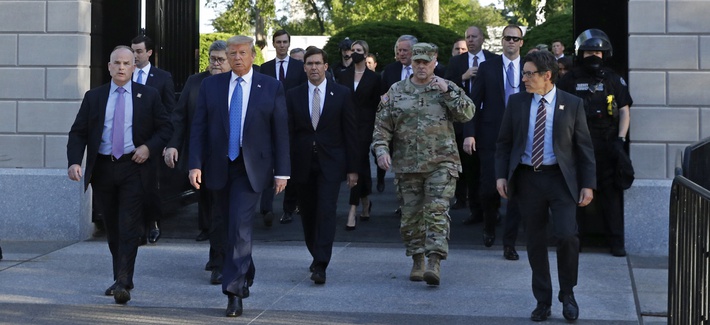
And it was well timed, given the upheaval in US civil-military relations.  Not only were people reflecting on the Chairman of the Joint Chiefs of Staff General Mark Milley being in Trump's photo op (after peaceful protesters were forcefully ejected) and Milley's apology for it (or the perceptions he created), but also the statements by the service chiefs regarding Black Lives Matter and the effort by Elizabeth Warren to require the various military bases to drop their names honoring Confederate generals and other traitors.  Lots of really good stuff online including a re-launch of the Thank You For Your Service podcast now with Alice Hunt Friend and Jim Golby.

Matt York/AP
Getting back to Black Lives Matter, I have seen a lot of debate about what Abolish and Defund mean.  Thanks to the efforts by police departments around North America (including the RCMP) abusing their power, I have been sufficiently radicalized that I support both Abolish and Defund after discussing more modest reforms last week.  The good news is that we are now having debates about how to roll back the over-policing, rather than how to expand the police.  This past week has not only seen NASCAR ban the confederate flag but also the banning of chokeholds in some places, decisions to re-allocate spending from police to mental health folks and others, the giving up of  ... yes, grenade launchers by the LA School District police, and more. So, yes, protests work.  Public attitudes have shifted.  While I am hoping this lasts, I am also hoping that everyone who can seizes this moment and gets as much change now since the momentum will not last.

So, yes, it has been three months of mostly staying at home, and we see the curves bending in the wrong direction in many places.  But this week has provided much hope--that saner heads can prevail (Milley won the argument vs Trump over the use of regulars), that change can happen.  On the other hand, we need to be clear eyed, as lynchings still take place and as police continue to abuse their authority and the public's trust.  I prefer to focus on the progress that has been made and that is in front of us, because doing otherwise will just force me to bake more sweets which only leads to stress eating and then stress exercising.

Be well and remember: with great masks comes great responsible behavior
And, no, I am not cutting my hair.  This is
my last great chance to see how long I can
get it.


Tuesday, June 9, 2020

The Return of Shame

Listening to a bunch of podcasts crystallized something for me (Jemelle Hill on the Pressbox Podcast,  Bakari Sellers on the Bill Simmons podcast).  When Trump became President, he gave permission essentially to racists to be publicly racist, that they didn't have to feel shame for stating racist stuff outloud.  As Sellers (it might have been Hill) noted, the striking thing about the Charlottesville racists was not what they were saying but that they were doing it without masks.

What is going on now?  This tweet and video struck me:


Um, yeah, the cops around North America have much to be shameful for.  Saying that they are being shamed is striking after three plus years of shamelessness.  This is progress--that impunity and entitlement are no longer in fashion.  That the public now, via various surveys, is ashamed of what the police are doing, and it is having a political impact.  A number of cities and states are starting to act to restrict the police in various ways, to regulate them. 

In Philadelphia, they took down the statue of Frank Rizzo, a polarizing police commissioner and mayor.  Politicians were always worried about doing anything like this because Rizzo was the first Italian-American mayor of Philly, and because doing so would offend, well, the white supremacists.  Then in a quick series of events, it happens.  And what is striking about that--not much opposition was raised.  Why?  Because anyone doing so would face withering shame. The silence is striking.

Shame is back!  Ok, not entirely, as Trump has not gone into hiding (unless you call his self-caging counts) and white supremacists like Tucker Carlson, Laura Ingraham, and Ann Coulter are still getting time on TV.  But now, a new boycott movement is underway to make Fox pay a price for having Carlson on. 


Obviously, there is more going on, and maybe I am exaggerating.  But I do think that just as Trump's election gave permission to racists, anti-semites, xenophobes, homophobes, and misogynists to be more brazen, I think the past few weeks may be started to reverse that.


Saturday, June 6, 2020

Quarantine, Week 12: Righteous Outrage Edition

It wasn't enough to have a poorly managed government response to a pandemic.  Nope, we had to have incredibly bad responses to protests about the death of George Floyd.  I will sift through and look for glimmers of hope, but the police have done one thing quite well: demonstrate that the country has a severe police brutality problem.

It has a police entitlement problem.  When cops in Buffalo resign from an emergency team after two of their own get suspended (not fired, just suspended) for assaulting an older protester, when cops in Philly have a blue flu protest, staying home, because, yes, Joey Bologna, a cop, was held responsible for acting brutally, when cops keep on assaulting reporters, legal advisers, and medics, it is not just a matter of a few bad cops.  Organizational cultures are diseased, oversight structures are broken.  The problem is systemic.  As someone who studies civilian control of the military, I am utterly appalled at what the cops can do, defying their civilian masters.  Intimidating them, as we see de Blasio in NYC caving in before, during, and after the police union doxxed his daughter.

And, of course, Trump, whose campaign started with racist appeals, inciting violence, has kept on keeping on.  His photo op only succeeded in worsening civil-military relations by putting the Chairman of the Joint Chiefs of Staff in an awful position.  General Milley could have handled it better, but he should not have had to.

The good news is the protests are working--Trump is even less popular, the police have inadvertently fostered more support for police reform, people are openly talking about breaking police unions (easier to say now, still hard to do), and the opponents to all of this are on their backheels.  The NFL got pushed by its players to reverse its stance on Kaepernick and other protesters.

 We shall see if anything real comes from that, but it is notable. 

And, yes, COVID-19 is still lurking.  Many cities are starting to reach capacity in their ICU's, and the police are the disease's ally by ripping off people's masks, by sticking them in enclosed spaces, and by causing these people to have to continue to protest.  The economies of Canada and the US are opening up.  This will increase risk.  I have no desire to spend time in any restaurants these days (although this week's events inspired me to try out a Black-owned Carribean place for takeout--and it was great).  

The week was difficult for another reason.  Mrs. Spew has had worse set of allergies this year than in previous years, and she had to go one of the few places in Ottawa that is treating respiratory stuff--a COVID testing centre--despite the fact that she did not have COVID.  She did get tested for it, and, she does not have it.  Well, not yet, but that experience may have increased the odds that she might catch it due to a three hour wait.  So, no, Ontario and Ottawa are not handling this great.  The Canadian COVID experiences are bimodal--Quebec and Ontario are having problems flattening the curve while BC has fought it quite well and the Maritimes have mostly dodged it.  However, since most of the people reside in QC and ON, the national figures are not great.

I have had difficulty in hiring research assistants, but this is actually good news--that the co-op programs that employ so many NPSIA grad students are starting to kick into gear.  The students may work at home (or not, it varies, I guess), but it means that they don't need my research grant money.  This may inhibit my project, but it is good for them.

Other good news?  Carleton continues to do the right things, making fast decisions to go online, and giving us the support we need to make our fall online experience much better than this winter's sudden entry into the digital classroom.  I have started working on my 90 student upper division IR theory class with my co-teacher, David Hornsby (aka Associate VP of Teaching), with some fun ideas to make it work.  There is also a growing collaboration among IR profs in Canada to share their stuff so that we do not all have to create stuff from scratch.

Events like these remind us that community is important, and there are all kinds of communities out there.  My effort to have a civ-mil hang has taken off, so now I have to figure out how to manage it since it is a bit more complicated than saying "hey, let's all meet at the conference bar at such and such time."  I think we are all thirsty for community, having been separated by quarantine.  I know I am, which is why I have become a zoom organizer of poker games, tenure parties (congrats to Steph and Alex), aforementioned civ-mil hangoutts, and, alas, a wake.   

In these difficult times, reach out.  Tell those you love that you love them, that you miss them, that you appreciate them.  For instance, I really appreciate my niece asking us to donate the present we were going to give her to a worthy BLM-related charity, so we did.  She and her siblings and cousins have turned out to be amazing adults with big hearts and righteous impatience.  Recent events remind me that sometimes you regret not doing so when you had the chance.  And, yes, as Mr. Rogers reminds us, watch the helpers, like the folks in DC that let dozens of protesters into their homes to evade the pepper-spraying cops. 

Be well, wash your hands, hug in person or virtually your loved ones, and Black Lives Matter.

Thursday, June 4, 2020

The Problem Is Systemic, We Need Systemic Reform

This problem is not about one or two bad cops.  We see police brutality from coast to coast (and in Canada, too).  Some departments have handled things better than others as I noted last week.  While biking, I listened to the Bill Simmons podcast episode with DeRay Mckesson, who has been an activist on these issues since at least Ferguson.  I was struck by much of what they discussed but also have some additional suggestions as I have been thinking of this stuff the past week.  To be sure, I am not an expert, but my outrage has caused me to think beyond what I have studied (as if I don't exceed my expertise all the time). Update: for a good piece on the problems of modern policing, ee this article.

First, Mckesson discussed a dataset that he had helped built that identified the policies of the police departments of the 100 biggest cities in the US.  They found that eight policies together reduce the likelihood of cops killing citizens by 72%.  These eight are:
  • Require officers to de-escalate situations.
  • Ban choke/strangleholds.
  • Require officers to intervene and stop excessive force used by other officers (the George Floyd case illustrates that one quite well).
  • Restrict officers from shooting at moving vehicles.  Looks good in the movies but is dangerously stupid and stupidly dangerous.
  • Develop a Force Continuum that limits types of force and/or weapons that can be used in specific types of situations.
  • Require officers to exhaust all other reasonable means before resorting to deadly force (this isn't required already?)
  • Require officers to give a verbal warning, when possible, before shooting at a civilian.
  • Require officers to report each time they use force or threaten to use force against civilians.
This is all common sense, right?  The police unions (more below) will say that this endangers the cops and makes cities more dangerous.  The data very much says otherwise.  That cities where this stuff is enacted don't have more cops getting killed and don't have more crime. I would go one step further: that the onus of risk in any interaction between police officer and civilian should be on the police officer.  Their job is to protect and serve.  If they are unwilling to risk their lives for civilians, well then, don't join.  If they think their lives are more important than civilians, again, don't join.

The good news is that most of these policies can be enacted by mayors and police chiefs and city commissioners.  Most don't require negotiating a new contract.  However, as Bill de Blasio has shown, mayors live in fear of the cops and their unions.

Mckessesen goes to talk about reducing the role of cops--that they are lousy at handling mental health problems, so don't send them out for such calls.  Send mental health specialists.  And the like.

I have two other proposals that are more politically, um, difficult.
  1. Radical transparency.  Police departments fought hard not to let this project get the information on policies.  Many union contracts require departments to rip up complaints after a few years.  The week's events, with the repeated assaults on the press, indicate that bad departments and bad cops fear the light of day.  So, let's turn the lights on real bright.  There should be state and potentially federal laws that require all police policies to be public, the next contracts should require that any complaints are made public, that any complaints that are proven to be valid are made permanently public, and so on.  We need to have better data, we need to hold accountable those who bad things, and those who might be tempted to do bad things should know that their bad behavior will follow them the rest of their lives.  The consequences for the public of abuses of authority are very high, so the consequences for those who abuse their powers should similarly be high.  Again, if you can't take it, don't join the police.
  2. Break the police unions.  Yeah, I said it.  They seem largely to serve the bad cops and encourage bad behavior.  If they are unwilling to change the culture and behavior of police, then we must find ways to reduce their power.  This weekend, the NYC police union released information about ... the mayor's daughter!  They feel so empowered, so entitled that they are willing to endanger the mayor's daughter.  And his reaction?  Cowering in fear apparently.  There is work and activism on this via https://www.checkthepolice.org/.   When unions serve as protection rackets, they need to be radically reformed.  
And, yes, who radicalized me?  Not Deray McKessen.  Nope, it was all of the videos this week of cops spraying pepper spray arbitrarily, of cops breaking and stealing the supplies of protestors, of cops attacking journalists, of cops picking the vocal but peaceful protestors out of the line and beating them.  The First Amendment was violated in so many ways over the past week.  The cops have proved that there is a police brutality problem by beating those who were protesting police brutality.  As a result, there needs to be a massive shift in how we think and do policing.  I get that the job can be dangerous, but only 5% of arrests are of violent criminals.  They may think they are under threat all the time, but part of that is that their behavior creates the conditions that make that more likely.  Crime has been doing down for decades, but police brutality has not.

The nationwide mobilization against police brutality demonstrates that local and state politicians have more political capital to do something now.  The question now is: will decision makers fear the police unions or their citizens more?

Tuesday, June 2, 2020

One of the Worst Days In American Civil-Military Relations

There is a lot going wrong in the US--pandemic, deep recession, a most corrupt government, racial injustice--but my corner lately has been civil-military relations.  That subfield focuses on how do civilians control their militaries and how do their armed forces react to the exertions of control.  One classic issue is how do the armed forces react when asked to engage in domestic security operations.  Do they obey, do they resist, do they initiate?  In the US, civ-mil scholars usually focus on whether the military fully complies with the orders of civilians, do the civilians take into account the advice of the military, and whether civilians and military understand each other.  Often, folks say there is a crisis in US civ-mil relations for one reason or another.

Yesterday was perhaps not the worst day in American civil-military relations, as the US army didn't kill, capture, or torture citizens (see Lindsay' Cohn's article for some history and the legalities of all of this).  But because of the many different actions yesterday broke so many different norms of American civil-military relations, it was perhaps the worst day for this important relationship since the Great Depression (since the vets marched on Washington). 

Let me briefly listicle the key actors in American civ-mil and where things have gone so very wrong:
  • The person who has the main responsibility for navigating the relationship is the Secretary of Defense as the most senior civilian focused on defense.  SecDef Mark Esper referred to Minneapolis as a "battlespace" which only  makes sense if ... American citizens are the adversary.  It was an awful, awful thing to say because it basically means that the US military, regulars or National Guard, are at war with civilians.  
  • Senators and Representatives on the respective Armed Services committees play a key role in overseeing the armed forces.  One of the key players on the Senate Armed Services Committee, Tom "Harvard maybe overrated" Cotton called on the US regular troops to entry the fray holding back nothing and giving no quarter--which means killing those who surrender.  Everyone pointed out this would be a war crime.  Given that the GOP has a majority in the Senate, don't expect much serious oversight coming from there, as Cotton and his peers are unlikely to let the agenda of that committee drift towards doing its responsibilities.
    AP-Patrick Semansky from Defense One
  • The Chairman of the Joint Chiefs of Staff is senior adviser to the President and the SecDef but has no command authority except over the Joint Staff--a group of unarmed staffers (I didn't see a weapon in my year in the Pentagon on the Joint Staff except by troops from elsewhere guarding the building).  Yet, Trump said that he was in command.  Making it appear that way, General Mark Milley walked around the protest/police riot* area, wearing his BDU's--the uniform officers wear when engaged in operations, not the usual spiffy uniform worn when advising the President.  So, even if Milley was not in command, he appeared to be so.  
  • The President of the United States, commander-in-chief, abused his authority to deploy US forces--National Guard and maybe Regular--for a photo op.  I have not read anything yet that clarifies who flying Blackhawk helicopters to disperse crowds--has that ever happened before on US soil--but it came clearly at the request of Trump so that he could waddle over to a
    Sam Ward from DCist.com
    vandalized church (despite the preferences of those who run that church) and hold a bible awkwardly.  Does the President have the authority to do this?  According to Lindsay Cohn, mostly, yes.  But abuse of power is when one uses their power in ways that are inappropriate.  There may be more inappropriate ways to use the military, but using them for a photo op while squelching the first amendment rights of peaceful protesters is clearly very wrong.
  • The last components of civilian control of the armed forces are the media and the public.  No, they are not "in control" of the military, but they play a vital role in the civilian-military relationship.  The media helps to shine a spotlight on when either the civilians, the military, or both are engaging ways harmful to good civ-mil relations.  The media has been doing its job this weekend, despite being under attack by police forces across the country.  Why attack the media?  Because it is much harder to hold the police accountable if we cannot see and hear what they are doing.  The public also plays a vital role--sending signals to their representatives what is acceptable or not and engaging in protest if their politicians do not act.  The vast majority of citizens involved have been engaged in protest including civil disobedience.  We shall see if the surveys match what we have seen thus far.  The problem is that Trump polarizes everything.  This weekend, there was a survey that showed the vast majority of Americans on the same side.  We shall see if this continues.
So, on the whole, civil-military relations are broken.  Not irreparably so, but that may still happen.  The big questions ahead are:
  • If Trump insists on sending troops to states where governors don't want them, will they go?  When leaders seek to use the military to repress, the military has a choice not to leave their bases.  Last night, elements left their bases for operations in DC, which has a special status, seen essentially as federal property.  While many lines have been crossed, sending regular US forces into hostile states would be a big red line.
  • What will Congress do?  
  • How will the public react?  The US military, like the armed forces of many democracies, is one of the most popular institutions.  Why?  In part because it is seen as non-partisan, whereas most other institutions are seen as partisan which combined with polarization leads to one part or another or both of America disliking it.  If the US military jumps in, doing Trump's bidding beyond, public support of the armed forces will surely drop.  It may already be happening thanks to this weekend's events.
 We have lived in dark times for quite a while, but as Trump keeps reminding us, it can always get worse.  Yesterday was the worst day in American civil-military relations in recent memory.... but it can get worse.  


* I am taking to calling these police riots since most of the violence is being instigated by the police in most places this weekend.


Sunday, May 31, 2020

Who Is Doing the Rioting?

Santa Cruz (I think) police chief leading
I am no expert in riots nor policing, but my training and my experience tells me to look for the patterns, to look for the variation.  Not every city seems to be waging war on its citizens this weekend.  This video does show that there is a widespread pattern of abusive conduct.  But we also have seen video of cities where the mayors and police chiefs try to and successfully de-escalate.  Camden is a striking example because it is a city with much problematic history, with much inequality.


When I studied ethnic conflict more than a decade ago, I was struck by works (if I remember correctly, Steven Wilkinson and, of course, Donald Horowitz) that emphasized the agency of the state.  That riots tend to happen where the local/regional governments either permit riots or encourage them.  This weekend we saw so many police officers in so many cities over-reacting, engaging in behavior that was far too aggressive.  In NY, we see cops driving through protestors.  In other cities, we see cops destroying the milk reserves of the citizens (milk is good for treating tear gas victims) and stealing their water.  We see cops shooting at people who are clearly the media. 

The question is not whether the protestors are out of control but whether the cops are doing this because they are out of control or because they are actually being controlled.  Note the statement today by the NYPD commissioner:
Even if many cops had performed well (not so sure that is true), how can a leader say that after the video of cops driving through protestors hits the airwaves?  What signal are you sending?  Mayor de Blasio did similarly.  No wonder things in NYC are so messed up--with leadership like this, the cops have impunity to act out, and, as the Trump Administration has taught us, if one has impunity, the worst, not the best, behaviors ensue.

Of course, there is another set of actors out there that are encouraging this behavior: police unions.  Unions serve their members, but they dis-serve their members when they protect the abusers causing the entire membership to be stained and to encourage bad behavior. 

One could blame the random white supremacists and anarchists who show up at these things, and we should. But they are not the systematic dynamic that is driving so much of the awful stuff we have seen across the United States.  What explains the variation is the quality of leadership in and above the police forces, the training they have done, and the doctrine they have established.  Is the priority protecting the cops or the citizens?  Is the focus on property or on people? Is the effort aimed at de-escalating or escalating?  Because there is variation among American cities, the focus should be on the factors that exist in those cities that remained peaceful versus those that are present where the police saw the public as their enemy.

The various National Guard units may help or hurt depending on their training and their leadership.  I worry a great deal about the 82nd Airborne or some other regular army force showing up mostly because I don't they have been doing much crowd control training lately.  So, they will be poorly prepared.  Oh, and their leadership--the President of the United States and the Secretary of Defense--are not up to the task.  I could and probably will blog at length at the civ-mil problems of calling out the military in a time like this, but suffice to say that a President who has encouraged the police to be more violent is not the guy who should be commanding troops while cities are burning.

Times like these show us that leadership matters.  And, alas, from Minneapolis to NYC to the White House, good leadership is in short supply. 


Saturday, May 30, 2020

Quarantine, Week 11: The Worst Week

Sure, there were worse weeks in China, in Italy, in Spain, and elsewhere, but, for me, for Canada, and for the United States, this was probably the worst week.  I found out that a friend from grad school died.  The Canadian Armed Forces troops sent to elder care facilities in Ontario and Quebec paid a significant price--the number of them testing positive for COVID jumped, and we learned that the witnessed such abuse and neglect that PTSD is going to be a significant problem.  The US started the week by going over 100,000 deaths (most assuredly an undercount) and ended with week by giving yet more of its global leadership to China by pulling out of the WHO, which may be quickly forgotten since so many cities burned last night. 

The murder of Black Americans by the state is nothing new, of course.  The 1619 project made abundantly clear that arbitrary killing of African-Americans in the United States is older than the country.  I don't remember 1968 nor any of the civil rights movement as I war a toddler, but I do remember the Philadelphia police dropping a bomb on the city, burning an entire Black neighborhood.  The LA riots happened when I was in Southern California and was thinking a lot about ethnic politics--I was working on my dissertation. 

At that time, I thought about how a concept from international relations helped to explain what I was seeing--the Security Dilemma.  In International Relations, there is no government, so every actor has to be alert to the actions of the others, for any advantage they get can be used against that actor.  In domestic society, it is supposed to be different--that government protects people so they do not have to be constantly alert.  When that breaks down, well, things look like international relations--arms races, strange alliances, self-destructive violence. 

I thought about it in this way because the riots in LA broke out not after Rodney King was beaten by the LA cops but after the trial where the jury found the cops not guilty.  That is when it was clear the police were combatants and not impartial enforcers of the law.

Looking back, I realize that I was quite blind.  Because the cops have always been combatants.  The variation over time between peace and riots has not been due to when the cops and the prosecutors and the judges were seen as impartial or not, but rather how much anger, fear, and resentment had been built up and whether there was progress or regression going on.  1992 LA had a broader context that became clearer later--that corruption and abuse--the Rampart Division in particular--was rampant.  That the African-American community had felt under siege in large part because it was.

Over the past several years (decade?), we have had story after story of cops killing Black americans, that the cops are quick to fire on Black men they think are suspicious while treating White men differently.  So many spree killers, who are almost always white, seem to get captured alive, while some kid with a toy gun or a man with a cell phone get shot while surrounded by four or fourteen cops.  In the past few weeks, we have seen several examples with George Floyd's murder lighting the latest fuse. 

Trump, of course, pours gasoline on the fire, invoking segregationist rhetoric.  I guess the surprise is that the protests and riots are happening now, amid a pandemic, rather than a few years ago with the election of a nakedly white supremacist administration.  Remember that one of its first acts was to appoint as Attorney General a man who was seen in the mid-1980s to be too racist to be a federal judge by the Senate. 

Maybe the old ethnic security dilemma still applies, but just as war is not a constant in International Relations but its potential is always looming, in the United States (and in Canada and elsewhere), the state is always a threat, but whether it produces violence and whether it produces reactions by those that are threatened varies over time.  These dynamics can be more or less acute.  The very visibly and unambiguously egregious actions by the Minneapolis cop and the failure of the city to respond quickly set things off this time.  The structures of racism, of oppression, and fear were always there, with the death toll of African-Americans climbing both due to police misconduct and the very unevenly felt pandemic. But, yes, it took an event to spark the outrage. 

UPDATE: As I see more and more evidence that much of the looting and burning has been done by white people, who may be a mix of provocateurs and crappy allies, it reminds me that the ethnic security dilemmas of Yugoslavia were largely lit by criminals mobilized for the task by Serb nationalists.

None of this should be surprising because none of this is new.  I used to argue with my daughter about the state of progress--that it was happening but not fast enough for her taste.  And her arguments were more convincing than mine.  Really hard to be patient and work for change when people are dying every week.  Well, we no longer have those arguments for three reasons: a) she went to college and then to the other side of the continent; b) she won those arguments; and c) the election of Trump was pure regression, driven in large part by the resentment of whites who feared losing their position of supremacy. 

To be clear, there is still hope.  Things can improve, but it takes more than just the election of Democrats as Minneapolis is a Democratic city in a Democratic state.  It requires mayors and prosecutors and governors and attorney generals and, of course, publics to hold police accountable when they do wrong, to focus effort on kicking white supremacists out of police forces and the armed forces, and to do much more.  Being Democrat is not sufficient, they have to actually do their damned jobs for their constituents--that the job of the police is to protect and serve the public--all of the public--and not just to protect and serve themselves.  The training should not focus on having a hair trigger when faced with a threat, but to develop "courageous restraint" and be willing to fire second, not first.  The onus of risk in any encounter between citizen and cop should be on the cops--that their lives should be at risk, not the citizens.  The focus should be on bringing back alive the alleged perpetrators.  If the cops can bring in many spree killers alive, why can't they bring in alive Black men who "fit the description?"

And, yes, defeating Trump is a necessary but insufficient step for making progress.

Tuesday, May 26, 2020

Mourning Neil Englehart

From his obituary, Eagle News
Yesterday, I was surprised to learn that Neil Englehart had died weeks earlier.  Neil and I were in the same cohort at UCSD although I might have bumped into him at Oberlin--my memory is bad.  What I do remember is that he was not only brilliant but kind.  He was quieter than most of us, but when he had something to say, it was either insightful or funny or both.


It was utterly perfect that Neil, who was so humane, spent his career studying human rights.  I love the title to his most recent book: Sovereignty, State Failure and Human Rights: Petty Despots and Exemplary Villains.  I didn't read enough of his work, an error that I will spend part of this summer correcting.

Of those of my cohort who remained in the profession, I saw him perhaps the least.  And that was my loss, as I always enjoyed my time with him.  I met his wife and family at the International Studies Association meeting in Hawaii 15 years ago, and he was so happy.  His obituary does a very good job of reflecting the guy I knew way back when and who I would see from time to time at various conferences over the years.  He clearly lived life well, but it was too damned short. 

Of course, I regret not seeking Neil out more often, and I regret not telling him what a difference he made when I was starting out. Whether he ever realized it or not, Neil played a crucial role in my graduate career.  He helped me navigate the political theory class that had little to do with politics and the comparative politics class that boggled my mind every week.

In this time where death is all around us, Neil's life and his focus on humanity reminds us of the important stuff that we ought not take for granted.

My condolences to his family, to his students and colleagues at Bowling Green State, and to all of the people he touched.


Sunday, May 24, 2020

CDSN, Year 1! Woot!

Exactly a year ago, we had our launch party for the Canadian Defence and Security Network [CDSN].  We had a good time after having a very productive meeting.  We have done much since then even as the pandemic has shifted some of our activities, postponed others, and set us in new directions. 

What have been the highlights of the past year?
    Melissa and Jeff after
    very busy first month
  • Building a team.  Melissa Jennings, our Director of Communications, not only built a pretty cool looking and functional webpage almost overnight, but also developed the skills to be our podcast producer.  Plus she brings excellent ideas and energy to everything we do.  Some of our latest COVID initiatives are largely her idea.  Jeffrey Rice, our Project Coordinator, not only organizes our events but manages our reimbursements.  He has used his connections in Canada and what he learned along the way to getting his PhD to take the Year Ahead and make it a signature CDSN event.  Alas, he is being hired away from us to be an Assistant Professor at Macewan University. 
    Pre-launch dinner with Erin and Stéphane on either side
    of me, Irina, Jeff, JC, Stef, Anessa, and Alvine across
    from me from back to front.
    Stéphane Plante will be joining us officially in July to take over from Jeffrey, but she has already become engaged in our meetings and our efforts.  Alvine Nintai, our PhD student/research assistant, helped us get the grant in the first place with her mastery of SSHRC processes and of excel spreadsheet checklists.  Since then, she has been both a vital voice for doing things for graduate students and a very helpful researcher for the podcast and for our other efforts.  We have also gotten much help at Carleton from Kevin Nzomo and Nora Kearns as well as NPSIA's staff, especially Coleen Kornelson. 
  • The podcast: Battle Rhythm It was one of the first and one of the hardest things we started.  Because Stéfanie and I were both on the road so much in June and July, it was more challenging.  But we got a cool logo, we figured out how to do it, Melissa has given us great ideas, and we have been able to interview many interesting people along the way.  CGAI has been most helpful in getting us launched, so that our joke about having only seven listeners is far, far off.  My sister regularly chats with me about the podcast, and she would have been voted Saideman Least Interested in Political Stuff. So, woot for us on that.  And the best part is I get to chat with Stef every other week.  
  • Anessa Kimball leading
    Security Theme workshop
  • Four workshops.  We were supposed to have five, but the last one, dedicated to personnel issues, got postponed due to COVID.  We have five theme teams working on specific research agendas, and we made much progress before the pandemic hit.  I attended the Security, Civ-Mil, and Procurement workshops (missed the Operations one).  I learned much at these events and was glad to see the seeds we had planted via the years of grant applications starting to grow.  I have no doubt that these teams will produce important and interesting research.
Susan Woodward
  • We had the first Paterson Chair talk with Susan Woodward presenting.  I have been a fan of her stuff since I studied the demise of Yugoslavia as it was happening nearly thirty years ago.  The talk was fascinating, and the boat of sushi we had afterwards was awesome.


    Katherine McInnis was a kickass keynote
  • We had our best Year Ahead conference.  Originally, a NPSIA research centre (CSIDS) event, it is now a CDSN event.  We had a great crowd this year, several really interesting panels, and a very informative and often moving fireside chat on diversity and inclusion in defence and security.


The Year Ahead's Fireside Chat on Diversity and Inclusion with
Kristine St. Pierre, Leila Adler, Bonnie Jenkins and Shawn Skelly


  • We held our Capstone event just as the pandemic was about to close everything down.  We brought the best of 2019's defence and security presentations from across Canada to the Canadian Forces College for a series of presentations.  It was great to see these mostly emerging scholars present their stuff.  CFC was a great host, and we hope to do this again.  However, we probably will not do so in 2021 for the simple reason that we will not have many 2020 conferences from which to get Capstone nominees.  Alas. 
  • We were asked by Canadian Special Forces Command to hold a roundtable to help them get alternative perspectives about the threats down the road.
  • We brought on three new partners: the US Air Force College, the Daillaire Centre of Excellence for Peace and Security, and the European Research Group on Military and Society [ERGOMAS].  Not only do they bring much energy and new ideas to our network, but it gives us some new focal points for future efforts.  And, yes, I had to go to Lisbon last summer to help solidify ERGOMAS as a partner and then to Paris to recruit another potential partner.  And,
    ERGOMAS
    well, yes, Barcelona happens to be between the two.  It was a great summer of travel, sigh.  
  • We had a COVID Response Conference online last month that produced a briefing note and helped us figure out what we can and cannot do online.  We hope that our findings will help the government, and they certainly will drive our research agenda.
  • We have involved graduate students in our activities at HQ, and I know our theme teams have involved students in efforts around the country.  A key CDSN objective is to foster a new generation, a more diverse and inclusive group, for the future of the Canadian defence and security community, and I feel we are making good progress.  As part of that effort, we are launching a Summer Seminar for Phd students who may be lacking in opportunities to present and network with the pandemic cancelling many conferences and workshops.

What have been the lowlights?  Yes, there have been lowlights.
  • The pandemic has caused postponements of our Personnel workshop and our Summer Institute.  We will not have a Capstone event in early 2020 either.  We are figuring out now how to use the resources we have not spent this year down the road.
  • Opencanada, one of the original CDSN partners, has been sent into a coma thanks to budget cuts.  We will find other outlets for our research, but we regret losing this vital outlet.
  • The pandemic also got in the way of some networking.  I was planning to go to South Africa this summer to connect with the International Sociology Association's Research Committee on Armed Forces and Conflict Resolution.  While they are already a partner, I wanted to meet with their members as improving our inter-disciplinarity is one of our goals.
I am probably forgetting some highlights and lowlights, as it has been a very busy year.  While the pandemic has hampered some of our efforts, I think the adaptations we have made prove that the CDSN has not just met but exceeded our expectations for what we can be doing. 

I have been so lucky to have such a great team--the co-Directors and the HQ staff--that have done all of the heavy lifting.  I am so very grateful for their support and the enthusiasm we have received from the various actors in the Defence and Security community.  It has been a hard few months for Canada and especially a hard few weeks for the Canadian Armed Forces with losses off of Greece and in the skies out west.  I hope that we can provide some solace to those in and around the defence and security sector via a more connected community. 


COVID: What We Think We Know, What It Means For What We Can/Should Do

Watching the mass of people cram into bars, onto beaches, and into parks sans masks is driving me crazy.  Watching North American governments fail to make use of the ten or so weeks semi-quarantine is agonizing.  Seems like so much wasted effort and sacrifice.  The New York Times has little obituaries to some of the nearly 100,000 Americans who have died due to COVID.  So, maybe it makes sense to take a step back and figure out what we know and what that knowledge implies.*  Oh, and I lay some blame at the end.


What We Mostly Know:
  • The virus is more dangerous than the flu, and that is not even accounting for how badly it can hurt people who survive.  The death rates may not appear to be that much, but we are learning more and more about effects.  This thing is nasty as it is not just an upper respitory disease.  It causes blood clots and more.  When this thing started, I thought: I am in my mid-50s, I am reasonably healthy, I never smoked, I could get through this ok.  But as a nurse/neighbor reminded me, this thing has a way of revealing conditions one does not know about.  So, the idea of getting it is scarier now.
  • Crucially, COVID-19 can be transmitted asymptomatically.  So, I have no idea why folks are using temperature testing as if it means anything. 
  • It is mostly spread by inhaling aerosol droplets.  While we worry about touching something that someone else has touched, it is largely spread by people breathing out the disease and others breathing it in.  This is far more likely to happen in enclosed spaces and over time.  So, we can worry less about a grocery store visit and far more about classes, concerts, churches, and planes.  
What We Should Be Doing:
  • The obvious stuff: social distancing and masks.  The best ways to stop the spread is to not gather in large groups indoors and to limit how much we breathe on each other.  Being outdoors is fine, as long as one is not on top of each other.  This weekend's pictures are so disturbing because people seem to think it is ok to be crowded again.  Yes, it is ok to be outdoors, but not when it is crowded.  This should not be that hard to figure out and respect.
  • We should be willing to allow ourselves to be traced in the short to medium term.  That is, yes, government will need to know where we are.  It seems un-American and un-Canadian, and the polls certainly show lots of hostility.  But if we want to move forward, we have to be able to squash outbreaks, and we can't do that if the disease is passed asymptomatically unless we trace.  We have the tools.  Other countries have managed to do this.  Perhaps folks can't trust the Trump Administration do get this kind of info, but, damn it, Canada, we should be able to do this.  Part if this here is caught up in the tangles of federalism, but the feds should provide a single, useable app that provides info to a non-security organization/non-corporate entity.  
  • Testing should be widely available so that we can do things like:
    • Send kids to overnight summer camp--test the kids and the counselors, enforce mask wearing the first two weeks of the session and then after the results are clear and the infected are removed, have at it for the rest of the summer.  It means that the counselors can't spend their time off away from camp.  This would be a younger version of the bubbles the NBA is thinking of developing.  The camps are already away from people--with testing and tracing, this could work and give parents and kids both some relief.
    • Start opening up smaller offices/factories/stores where you don't have large numbers gather. 
Which Brings Me to Who to Blame:
  • Our governments have varied in their reactions, but the failure to get testing to be widely available is a huge failure.  Not just in the US but in Canada as well.  This stuff may be quite hard, but it is really difficult to see how much progress has been made in testing.  Some places have testing on demand, such as Los Angeles.  But this should be more widespread.  Mask wearing should be mandatory in public. 
  • Some leaders.  Those that don't model good behavior--mask wearing--are setting lousy examples.  We are starting to see governors in the US push more on this.  But it is so little, so late.
  • Our community leaders.  Well, some of them. Those that insist that large indoor services go on share much responsibility.  They have to work harder to find ways to share community and do their functions without meeting indoors in large groups.  Churches have been major vectors in the spread of the disease.
  • China.  The early denial and the later conspiracy theorizing have made this thing worse than it could have been.
  • The US.  Its failure to lead shows how essential American leadership has been over the past few decades.  I could go on and on about Trump, but suffice to say that the US under Trump has done incredible damage to international cooperation in many fields, and this pandemic is making that felt so much.  
  • Russia.  We don't need the disinformation, Vlad.  Fuck off.
  • Ourselves.  While the protesters against the shutdowns are minorities in every state/province, those large numbers of people gathering in parks and not wearing masks are not small.  These folks need to take more care, and I have no idea how to persuade these folks when the pictures out of Italy and out of NYC failed to do.  
There are ways out of this--we can learn from the past (the Spanish Flu really is quite useful here), we can learn from other countries both what to do and what not to do (don't be Sweden).  So many people have been so patient and diligent for two or three months.  If we can just develop some new habits--not just hand-washing but mask-wearing--we can limit the spread.  Otherwise, the hospitals will be driven to the point of collapse, the rate of deaths will not fall, and the economy will not rebound.  Even if governments allow stores to open up, most will have a hard time staying open since most people will be sensible and stay home if their neighbors aren't distancing and aren't wearing masks.

Right now, we have a very reasonable fear that the others out there are endangering us.  To get to the time where there are vaccines and reliable treatments, we must do better.  This weekend suggests we will not.  Damn it.


*  No, I am not an expert, and, yes, there is some uncertainty.  New science will beat old science. 


Saturday, May 23, 2020

Quarantine, Week 10: Summer Social Distancing

It was a pretty full week, all things considered.  It included working meetings, online poker fun with friends, a milestone (not a benchmark), and more networking.

The highlight was at the start--I got to zoom with friends from more than 30 years ago.  Folks on facebook organized a reunion of sorts for those who went to Camp Airy in the early to mid 1980s. I didn't know all of those present but I knew most of them, and it was a blast.  It went on for about two and a half hours.  I learned about some stuff that happened near me but not in my presence (a combination of FOMO and phew for some of those), and I, of course, learned what folks have been up to.  The men had more hair than I was expecting.  I laughed so hard over the course of the zoom.  It was a hell of a tonic to start the week.

The business of universities continued.  I met with a graduate student working on his Master's Research Project (one way to get through our program is to write an article length paper), and I attended a dissertation proposal defense (she was successful, so one less student for my proposal workshop class next fall).  NPSIA had a meeting with the teaching and learning folks that impressed me--that folks on both sides are ready, willing, and engaged to teach online as best as we can in the fall.

The CDSN marked its first year by, well, yes, networking some more.  My staff and I met with Justin Massie and Stéfanie von Hlatky, who just received a MINDS Network Grant to fund a Francophone network aimed at improving the bilingualism of Canadian defence conversations:

Réseau d’Analyse Stratégique--Network of Strategic Analysis.  Very thrilled that they were successful and looking forward to helping each other!  

Wore Hawaiian shirt for the
not-in Hawaii ISA poker game


The best distraction, other than zooming with friends from long ago, has been online poker with friends zooming in to give each other crap about their poker play.  I brought together the folks who would have played at the ISA in Hawaii in March, and we had a good time.  Much discussion of what their universities were doing and the difficult challenges and tradeoffs facing everyone everywhere.  It was great to see them.  I am now the big winner in the two zoomed pokergames I have played the past two weeks.  I better lose soon or some people might get suspicious.  

The onset of summer is making a big difference, as it is raising our spirits.  My wife is now covered in dirt, as she can start gardening with frost advisories no longer a thing (as of a week ago).  My bike riding has gotten more frequently, and it is more fun to see folks boating as I ride.  Today, I am going to toss a frisbee with one of my teammates.  Social distancing and hand-washing will take place, as will beer-swilling.

Alas, the news beyond is mostly awful.  Canada's numbers are not going down with some blaming mother's day.  Observance of mask-wearing is more spotty than one would expect up here.  In the US, well, Trump is thinking about testing nuclear weapons because he needs to find more agreements to trash.  Biden, well, oy.  I am more confident that Biden will win--the polls are headed that way--and the Trump Administration seems determined to antagonize those who have been hit hard by this--trying to kill ACA and stop the extra unemployment cash.  The good news is that most Americans are trying to do what is right, and those protesting the mask wearing are few and are being shamed.  

Because it was a busy week, it passed quickly.  Usually, I want summer to pass by slowly so that the ultimate lasts longer, the travel and research lasts longer, and the grading is further away.  With this pandemic and the looming election, I am seeking to have time pass by faster so that we can get past this phase.  I hope you and yours are managing to fill the days and nights with a variety of activities and streaming shows.

As always, the only way out is through.  Be well.