Saturday, March 20, 2021

Quarantine Report, Week 53: The Learning Curves are Shallow

 Yes, I am going to keep this q-report going even though it has been more than a year.  Until stuff returns to something approaching normalcy, I will keep reporting my weekly descent into madness.  When I used that phrase last year as this weekly post started, I referred to insanity.  Instead, it has been about anger.  

Ontario returned to the "red" zone yesterday.  This was a couple of weeks after the wastewater tests were showing an acceleration of infections.  Nope, we had to wait until the cases started to hit the hospitals.  And what was Red mean anyway?  Only 50% capacity at restaurants.  Yeah, people are still eating in restaurants?!   They moved from 10 people can meet indoors to 5?  Why meet with anyone not in your pod?  Ontarians have been referring to our government as incompetent murderclowns, and I think that gets it right.  Doug Ford and his band of yes-folks keep opening too soon, closing too late, and keeping open places that are dangerous and occasionally closing places that are safe (public parks and the like).  It is almost as if they are not paying any attention to the science or to any of things we have observed over the past year.  We have gone from regretting that we haven't learned from the Spanish flu to we haven't learned from last month.  

Luckily, most of the folks I know are doing ok.  Mrs. Spew and I continue to listen not to our politicians but to the scientists.  We don't travel, we don't eat out except via takeout, and we don't hangout with others.  It is not the most interesting life, but the variants are scary and we can be patient.  The shot schedule up here suggests that we might get our first shot by the end of June.  This is slow compared to my American friends and relatives as my facebook pages are filled with happy folks getting vaccinated.  But it is faster than I would have expected.  My mother noted that it took decades to get a polio vaccine, and we have a boodle of vaccines within a year.  

Speaking of slow learning curves, the Canadian government continues to slow walk through the sexual misconduct and abuse of power scandal.  I did some media stuff this week after my op-ed appeared Monday night online and Tuesday in the real paper (that does not happen as often or as easily).   I had been reluctant to talk about gender and the armed forces because I know of so many people who are so sharp on that.  But when the story becomes civil-military relations, like what is the job of the Minister of Defence, well, I felt more comfy talking about it.  That the Minister of Defence still has his job speaks to two things: the amazing ability for Trudeau to dither; and how the Liberals focus on domestic politics uber alles can actually mess them up politically.  Sometimes, doing the right thing is good politics.  Just a thought. 

And I can get through this as long as folks give me chances to talk and talk and talk.  Which was the theme of the week.  I met with our first year PhD students as part of a course they have to prepare for the comprehensive exams.  So, I talked about the civ-mil field and the questions they might be asked.  At the end of the week, I was part of a virtual roundtable at Simon Fraser University--on the very western tip of Canada--to discuss Backsliding Democracies with a focus on the US.  My role was "not a coup" and then I got to also rant a bit about the GOP and false equivalence machines.   I will post later today what the other folks said and what I said.  Good q&a, and it was fun to hangout virtually with folks including a former colleague from my McG days.  

Mrs. Spew and I went on an errand together.  We had to sign some bank documents, and it was the first time we were in a car together in many months.  These days, I go out for the groceries, and she goes out less often for some errands, but we haven't been driving to random small towns and we have definitely not been going to movies.  It was fun, well for me, to see my wife unused to my driving, which is a bit more aggressive than hers.  She got back into old patterns on the way back, but it is interesting to see which muscles we have been using and which ones we have not.  

Spring is here, and it actually feels like it.  Usually, we are still deeply buried in snow and cold weather and our spring does not really start until late April/early May.  Climate change may have pushed things up this year.  Which means I may start biking soon.  I am putting away the x-country skis, the snowshoes, and my downhill skis, as the time for that stuff has passed.  I usually want winters to end here, but I was hoping for more of those adventures.  The long mud season that awaits is not so much fun.  The best news is that the ultimate folks are starting to talk about summer league, and I am aching to throw some reckless passes deep and to hang out, perhaps at a distance, with the silly folks in the great Ottawa ultimate leagues.  

To get through the next stages of anger at the governments local and federal, I will focus on the prospect of ultimate in the near future.  Whatever you are looking forward to, embrace it, as we are closer to the end of this thing now.


Monday, March 15, 2021

More Civvies, Less Mil, Please

Watching Mercedes Stephenson interview yet another survivor of sexual misconduct in the Canadian Armed Forces [CAF] and ... the Department of National Defence [DND] has caused me to expand my SecDef rant to apply more broadly: it is not good to have the part of the government that is responsible for overseeing the armed forces to have many former military folks staffing it.  

In my various posts about SecDefs Mattis and Austin, I made the claim that it is really hard to erase decades of socialization.  I haven't worked in many different kinds of organizations, but I can tell you from my one year at the Pentagon, the armed forces can be quite effective at socialization--shaping the sensibilities of those working within.  Indeed, unlike most other organizations, the armed forces does this deliberately and thoroughly--from haircuts to language to posture to daily battle rhythms.  To argue that one can simply toss that aside after twenty years or so is just silly.  It is even harder to de-socialize or re-socialize if one's next job involves both overseeing the armed forces and working closely with them.

There is also the networking side of things.  While it might be advantageous for policy-officers in the Department of National Defence to know people in the military, it also raises risks.  That the DND official might worry about the impact of a policy change upon his or her former pals.  

There is also the path dependence of gender thing--that the military is still overwhelmingly male and white and all the rest--so picking people from it to staff DND means that it will make it harder for DND to be more diverse and inclusive and representative of Canada (my friends in DC tell me the preference for veterans has the same impact on civil service jobs).  Plus given that the CAF has a legacy of treating women poorly, importing men from that environment who either participated in such treatment or were complicit, as the woman interviewed by Mercedes testififed, is a bad idea.

Sure, #notallwhitemilitarydudes are guilty, but they all come from an institution that has had pervasive problems of sexual misconduct and abuse of power. 

To be clear, we don't need the civilians and military folks to be at war over policy.  However, some tensions between the civilian side of the house and the military side of the house can be productive.  If the civilians at DND and the military folks in CAF are always seeing things exactly the same way, that is probably a problem.  Because it might just mean the civilians see themselves as allies/protectors/cheerleaders rather than overseers.*  If you want to argue that the military can oversee itself, the past couple of months should make it clear that is a bad argument.  When I talked to parliamentarians long ago, they argued their job was not to oversee the CAF but to hold the Minister to account for his work in overseeing the CAF.  Well, if he isn't doing the job (see my forthcoming editorial on that) and if the parliamentarians aren't overseeing the armed forces, who is?

So, as we move forward beyond the current mess, let's:

a) name a new Minister of Defence who did not serve in the armed forces for decades
b) re-think DND personnel policy as well
c) oh yeah, change the culture of the CAF.


* Canada is not alone in this.  Some countries' ministries of defence are entirely populated by active and retired military personnel.  Others may not be staffed that way but still see their jobs as protectors of the armed forces from civilian (legislative) interference.


Saturday, March 13, 2021

Quarantine Report 52: Whatever It Takes

 Many have commented how strange time is during this quarantine.   A week feels like a month, but it does sometimes seem like it was just yesterday that we were cancelling our trips and preparing for a few months of abnormality.  What made it such a draining week?  Lots of meetings and a guest lecture, I attended the big Ottawa defence and security conference virtually, and I faced stinging rejection.  A couple of fun zooms with friends.  And, yes, marking the year that was in quarantine with posts about the lessons learned, a discussion of the highs and lows in activities and such, and all the feels.

Rejection, as I keep saying, is inherent in the enterprise.  Yes, I have heaps of grant money to fund the activities of the Canadian Defence and Security Network for another five years (we are finishing year two of a seven year grant).  But I was hoping for more so that we could study the implications of the pandemic, and more resources would mean helping to correct some of the mistakes I made in the initial effort.  Instead, we will have to scramble a bit to do some of the stuff we have planned.  A bit more uncertainty and more grant-writing ahead.  I will eventually be de-briefed to find out what we could do better.  Revise and resubmit is the academic's way of life. 

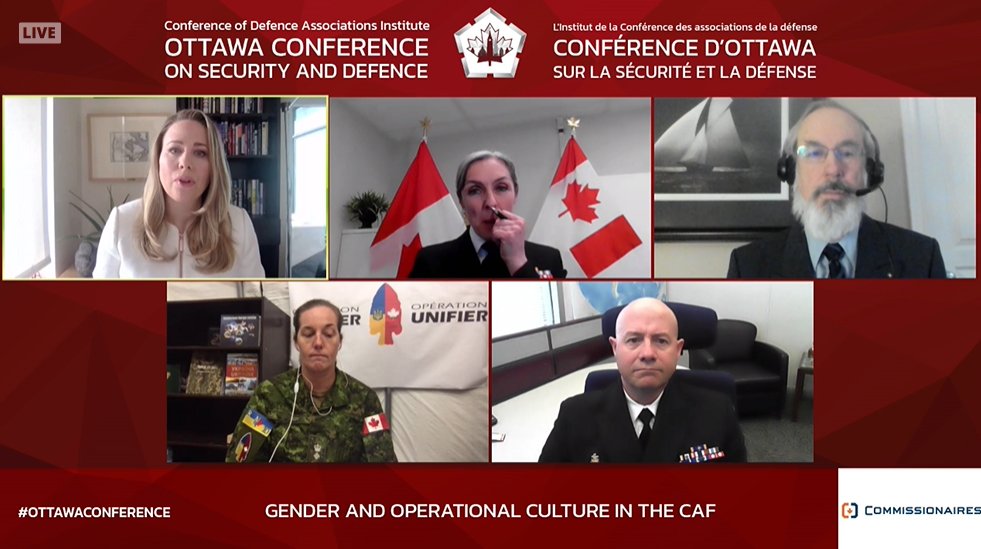
I spent Wednesday through Friday live tweeting the CDAI's Ottawa Conference on Defence and Security when I was not tied up with something else.  Usually, it is held in downtown Ottawa, and I just spend two days absorbing the info, meeting military folks and those interested in the CAF, and asking pesky questions.  I wonder if I would have had the guts to ask some of the questions I asked on twitter like: "Hey, former Prime Minister Harper, how do you feel about the global conservative movement you are trying to lead that seems either tempted or interested in appealing to extremists?" or "Hey, Minister of Defence Sajjan, if you don't use your authority to handle a situation, is that abuse of power or just misuse of power?"  See, I can be bipartisan!  A few quick bits of stuff I picked up along the way:

  • Acting CDS Lt.Gen Eyre gave a pretty strong talk about how broken the organizational culture is in the Canadian Armed Forces, uttering abuse of power, which implies his former boss Jon Vance.  Eyre noted as acting CDS, he does not know how much time he has in the job, but will not worry about job security.  It was pretty much as good of a talk one can give in this circumstance.  The question will, of course, be: how does he walk that talk.
  • A panel with Mercedes Stephenson, one of the journalists who broke the Vance story, and two women officers showed how precarious it is to be a woman in the CAF.  They were far more restrained in what they said than what Eyre's said.  Both Rear Admiral Patterson and Lt.Col Heer were very impressive, and I wish they could just do their jobs without having to speak for all
    women in the CAF, an impossible task.  Alan Okros, a CDSN Co-Director, was also on the panel and was his usual sharp, insightful self.
  • The panel on right-wing extremism showed how much of this is not just an American problem or a Trump problem but a global problem. 
  • It was fun to see Stephen Harper talk.  He is so much sharper than recent Conservative politicians, but dangerously so.  His criticisms of current and past policy on China glossed over his own efforts to embrace China in that quest to get in to that market.

 In Canadian academia, this is crunchtime as those writing Masters' Research Papers are now facing deadlines, so I have had some meetings to chat with students and much to read.  The classes have gone well this term, with the students very engaged.  It does not hurt to be teaching civil-military relations at a time where Canadian civ-mil is in its worst crisis in decades.  

I had two fun zooms this week.  One with a pal from Texas Tech who has had to grapple with chairing her program in mid-pandemic.  The other was with the IR poker group where we have a zoom open and we play poker in another window.  Second game in a row where I have lost.  But I won in the larger scheme of things as there was much solace from hanging with friends, comparing beard lengths, and discussing retirement ages.  

And, yes, I made Nigella Lawson's chocolate chip cookie dough pots to celebrate the year of quarantine:

I have gotten through this year by hanging out with friends on zoom, by stress-baking/eating/exercising, and by complaining constantly.  As Captain America said:


Thursday, March 11, 2021

All The Feels: A Year in Quarantine

Over the past few days, I have blogged about some of the highs and lows and some of the lessons to be learned from a year of this pandemic.  Today, to commemorate the year, I just want to spew about all the stuff that I have felt, which is probably what everyone else is feeling.  Again, I am lucky as my comparative plight is not that bad, but it has still been a very hard year.

Anger: The first emotion that comes to mind is anger.  Yes, we were due for a pandemic that would not be contained, given the near misses and the trends.  But it didn't have to be this bad.  Remember last winter when Trump said, among many things, that 200,000 dead was a good outcome.  The US blew by it.  Trump's failures are many, but among them are: politicizing mask wearing; acting too slowly (not unique to him or the US); undermining international cooperation rather than leading the world as Obama had done; directing assistance in the wrong directions; failing to develop testing/tracing at the federal level....  But it was not just Trump.  Leaders around the world and across the various federal units continue the pattern of closing too late and opening too soon.  A few weeks ago, the Ontario health officials were talking about re-opening amid the new variants, and a reporter basically asked: this is a disaster, right?  And the health officials said... well, yeah.  Speaking of health officials, Fauci and others pushed back against masks early on, and, as my sister said, that planted a seed.  Or watered one that was already there.  Which gets to my anger is also aimed at all the anti-maskers who push back against what was by last summer so obvious--this things spreads by air.  The politics of masks now is a replay of the politics of masks in 1918.  Which gets me to...

Frustration:  Much of what we know about COVID-19 now is really what we knew about the flu of 1918.  So many of the dynamics are the same.  So, the good news is that we social scientists can say that human behavior can be generalized because there are common dynamics. Woot?  But the bad news is that there were many mistakes that we should have known to avoid.  That public policy matters, that gutting public health would be so very costly, that perhaps one shouldn't politicize masks.  Again, it didn't have to be this way.  I am also frustrated that I have not been able to use the extra time I have had (no commutes, no travel) tog et more done. 

Loneliness:  One thing this has taught us is how much we need each other.  Yes, I am very annoyed at those who go to bars, but I get it--that the need to gather is hard-wired.  I have not been able to hang out in real life with anyone for a year except my wife and except for one day of cookie deliveries.  Zoom and phone calls and all the rest are helpful, but they are not the same.  I miss my daughter, my family, my friends, and nearly everyone else. 

Fear: The fear has come in waves.  A year ago, that morning in Billy Bishop airport, hearing every cough and sniffle definitely generated fear.  And then in the first few weeks, we set up a laundry basket and stashed our robes right inside our front door.  After every trip out for groceries or whatever, we would strip, grab the robe, and then run up to the shower to wash off ... something.  Turns out that this thing is not quite that sticky.  Less about fomites and touching stuff and far more about breathing.  The fear faded as we learned to stay at home, as the banks, takeout places, Costco, and grocery stories developed the infrastructure and habits to make those trips less problematic.  The fear is back, as the variants seem to be nastier--the UK one is not just more infectious but deadlier.  

Grief: I grieve for the lives that were lost.  I grieve for those who have been harmed perhaps forever as this thing scars lungs and does other damage--the long haulers as they are now known.  I grieve for the old folks who are spending their twilight years in isolation, deprived of contact and of the things that give them joy and relief.  I grieve for the kids who have been deprived of so much and yet have had so much thrust upon this.  I grieve for my students and everyone else's as they are under tremendous stress to keep going despite losing the best parts of university life and of k-12 life as well.  I grieve for those who have paid highest price despite facing tremendous inequalities.  People of color not only have faced a year of escalated police abuse but have been exposed to greater exposure to the virus and slower access to the vaccines.  I have cried more this year than any time since ... a long time ago.

Empathy: I feel for everyone (ok, not the anti-maskers, Trumpers, or police beating people) who are going through this madness.  We are facing a common threat and feeling many of the same things.  We have far more in common this past year than that which divides us.  When I am out and about doing some shopping, seeing the other folks struggling to keep their masks up and their distance, and seeing the clerks engaged in pandemic security theater (not sure wiping everything down compulsively really matters that much), I can feel the common humanity, the common struggle we are facing.  We are all in it together even if some folks don't act that way. 

Gratitude:  There has been so much goodness in the face of the awful, that I am so thankful for those who are doing the heavy lifting.  Not just the doctors and nurses, and not just the clerks, but also those who made the content on our streaming services that keep us distracted, amused, and moved.  A while back someone asked what this would be like in 1989, and I said that we would all be standing in lines at Blockbuster.  I am grateful that amid the screwups, the government of Canada has been willing to spend heaps of money to keep people fed, housed, and warm.  I am super-grateful for the new COVID relief act that Biden pushed through, as it will help not just my daughter (hey, unemployment tax relief!) but lots of people now and maybe well into the future if it sticks.  I am grateful for the short bust of ultimate I had last fall with an older (but not old enough!) small bubble of players--we only played for five or so weeks, but it was much solace.  I am grateful for all of the dog pics and cat pics and all the animals that have been rescued as people sought comfort in the form of furry life over the past year.  I am even grateful for our old cat--who I used to fear--who has become cuddly in his old age.  It has been an awful, awful year, but I am grateful for the silver linings that appear from time to time.

Relief: I am relieved that science was able to kick out multiple vaccines so quickly with incredibly high rates of protection.  I am relieved that my mother got her shots, that some of my siblings are semi-protected, that my friends on facebook are posting pictures of their new shot record.  I am relieved we are past the second and maybe third waves, that the end of this thing (whatever the new normal is) is closer than the start of this thing.  There is still plenty of pain and suffering in front of us, but there is some relief in knowing that we are just some jabs away from some sense of normalcy. 

Hope: I have much hope for the future--that we will be able to fly and connect and eat out and go to movies and do much of the stuff that we did before.  I don't really know much about the 1920s, but the images in my head are mostly of dancing, drinking, theater-going, and partying.  Once we can get together again, we should celebrate and we should have riotous wakes to mourn our losses.  I am hopeful that people will hug a bit more even if they shake hands less--that we will appreciate much of what we took for granted, at least for a while.  I am hoping to take the trips that we missed eventually--Hawaii, South Africa, and others.  I am determined to get my family together as soon as I can cross borders--bringing my wife to her relatives, getting out to Hollywood to see my daughter, and so on.  And yes, some of those plans involve skiing. 

Acceptance: I mentioned above my frustration at not getting enough done with all this extra time, but I also feel acceptance. That it is ok to be stressed, to be distracted, to be less productive.  It is ok to binge-watch, it is ok to eat heaps of sweets, or to drink a bit more.  There is no perfect way to handle this very difficult time, so whatever works (which also got us through the first few years of my daughter's life) is the mantra of the moment.  We could have done better, but we could have done worse.  We should not blame ourselves for falling short in our daily lives.

When people have been asking whether it is too early in the day to drink, I have said that the drinking lamp is lit for the duration. I should correct that--the drinking lamp is lit for the duration plus ... however long we want to celebrate getting through this.  It has been the longest year of our lives for most of us. We have lost much, but we can get to the end of this.  And for that, I am extremely grateful.


Wednesday, March 10, 2021

Lessons of the Lockdown, A Year Into the Madness

After a year of being home with, um, not so much freedom insight, what have I learned about myself, my life, and the world?  

Most obviously, I don't need travel, but I sure as hell want to travel.  The lack of travel has forced me to get out of various ruts at home--going beyond the tried and true dinners, pushing me to bake more than chocolate chip cookies and apple pies.  To pick up new winter sports even if they are not the ones I really enjoy.  

I learned that I have both more and less discipline than I thought.  I have managed to exercise nearly every day, thus allowing me to do that aforementioned baking.  But my work focus ... not good.  I can't complain too much because I have friends who have it far worse, but this year felt like the first few months of the Trump Administration where I spent so much time just distracted by the shitshows and desperately tried to make sense of things.

As I used to work from home a couple of days a week since we moved to Canada, I was used to dinners where we had already exchanged the day's news, leading sometimes to a loss for conversation.  Now? Jeez, a year of it being just the two of us day after day, and with me finding talk about Trump being too much, yeah, my conversation skills have ebbed.

I have learned how thirsty I am for connection.  I have organized zooms with friends on a mostly regular basis plus my twice weekly family zooms to keep my isolated mother company.  Thanks to silly games that my sister brought to these games, I have learned much about my siblings and mother that I had not known before. 

I have learned that students both hate and need asynchronous courses (taped) as live courses can be both pretty good and awfully draining.  The online era is good for some students, bad for others, and a mix for profs.  There is definitely no pleasing everyone.  I would rather be in the classroom, but I also like not having to commute to work.  I miss the camaraderie in the hallways, I miss students dropping by for random chats, and I miss the change of pace that going to work involves.  The steady drumbeat of being at home does wear on me.  But again, I can't complain too much as the students are going through so much--I can feel the stress through the zoom connection.  

Pressure really does reveal character.  Someone said in a tweet months ago that times like these make givers give more and takers take more.  The way I have put it is that COVID does to people, societies, and governments what it does to the human body: it reveals pre-existing conditions.  We have politicians who are far weaker than I suspected, unable to stand up and insist on mask mandates, so focused on keeping bars and restaurants open that they haven't prioritized schools.  They close too slow and open too soon.  But there is variation--some are willing to spend to get through this.  Canada was better off for much of the first year as Trudeau was willing to spend to keep people at home while Trump was not.  

 This crisis has reminded us that federalism is both boon and bane.  It is great to have the units make policy when the center sucks, but when the units make bad policy, it is not so good.  In Canada, the feds are reluctant to step on the toes of provinces when it comes to health care.  Which is why testing/tracing and vax rollout are not doing too well in Ontario and Alberta and Quebec.  But the feds can spend money on people and firms, so they have done better on providing a safety net.  Not so many long lines at food banks up here.  In the US, Cuomo and Newsom looked good when compared to Trump, but with Trump gone, it is clear that these governors suck mightily.  With better, smarter folks running things from DC, now federalism gets in the way, as we see in Texas and Florida where their governors seem determined to get as many of their constituents killed or sick. 

We have way too many people who have no empathy at all--which meant that explaining that masks helped other people was a bad strategy for a significant hunk of the population.  On the other hand, as Mr. Rogers would say, watch the helpers.  We have seen so many people put themselves at risk, so many people who have reached out to others.  It is easy to focus on the anti-maskers and other destructive people, but they are a minority.  Most people have managed decently through very tough times.  

Still, I have learned that my old standby, confirmation bias, works great (yes, the irony is intentional).  Folks learn the lessons they want to learn.  There were abundant lessons to be learned from past pandemics, but those who didn't want to learn chose not to.  And as we go along, we keep seeing the same things--"oh hospitalizations are not going up yet (hey, it's a lagging indicator) so things are fine." again and again.  The science does create some uncertainty like can we get it from touching things, but over time we have gotten some clarity about this pandemic.  It hasn't always shaped our behavior. Restaurants practice pandemic theatre by wiping everything down repeatedly when the danger is in the air.  Motivated bias continues to kill.  

When this all started a year ago, I thought we would be quarantined for a few months.  I was wrong in two ways--obviously this has lasted far longer but also that in Canada and the US, we really didn't quarantine.  Not like the Europeans and others.  The next bit of uncertainties involve how many people will resist the vaccinations and how can we act once most of us are vaccinated. Will we shake hands?  Will we hug?  Can we fly without too much nervousness?  Can I cross the border to visit my family?  Can I get back?

It has been a brutal year, especially for older folks who essentially losing two of the last years of their lives living just to dodge the virus and not much more and especially for the young who are losing some of the funnest years of their lives, separated from friends and family.  I think I have it the easiest as I don't have to take care of any kids at home and definitely no home-schooling, my job has continued with no real threat to lose it, and I have someone to share the madness.  And yet it is definitely one of the hardest years of my life.  We have all lost people and have had friends and relatives who have suffered.  So, there is a greater need for empathy and sympathy than any other time in my life.  

The only way out, as they say, is through.  So, here's hoping that next year's anniversary is one with far more celebration and less anxiety and stress, and may we all be able to move about the cabin.

Be well.

Monday, March 8, 2021

The Year in Quarantine: Highs and Lows

 Everyone has their own "damn, it's a pandemic" day, where they start the clock on their lockdown.  For me, it is March 11th, not because that was the day that the WHO declared there to be pandemic, but because of three things: Tom Hanks announcing his catching COVID, the NBA shutting down, and my last trip where I heard every sniffle and every cough at Billy Bishop Airport in Toronto on the way back from the first CDSN Capstone event.  Obviously, other folks' pandemic life started earlier--because they lived in countries that got hit earlier or knew people in those places or were less engaged in wishful thinking.  I think we all felt this thing coming at us, but hoped that it would somehow miss.  I know my trip to Hawaii was a big part of my wishful thinking until pop. 

As I look towards the end of the first year (hopefully of just two) of being quarantined, I thought I would look back and list the highs and lows, the things I did, the things that happened to friends and family, and so on.  This blog is mostly aimed at helping me remember now and then helping me remember down the road. So, here's some of the numbers and rankings and such from this past year:

  • Losses: two friends that were my age of out of the blue heart attacks.
  • Relatives with COVID: two nieces
  • Vaxxed: three or four nieces, one brother, one sister, one mother thus far.
  • What I Miss Most: Seeing my daughter.  We were going to see her more times in 2020 than in the past couple of years.  Nope.  
  • Non-daughter edition of what I missed most: We had a South African safari scheduled in July.
  • Most regretted pandemic decision: PS4.  I do play from time to time, but I really suck at video games.  I am, of course, thinking of getting an Oculus since VR gaming can't possibly be as difficult.
  • Home of former neighbors
    and Flying Canoe Hard Cider

    Furthest I have traveled: Mont St. Marie for one day of skiing.  Second: late spring/early summer drives to Perth and Spencerville to get out of the suburb and see small town Canadia.
  • Average pants-wearing: 1.2days/week--when I go shopping for groceries. 
  • Number of trips to campus in the past year: 3.  To my office: 2.
  • Ultimate: five or six games in the fall before things tightened up again. It was a fun team and a fun, small, bubbled leage.
  • Teleconferencing technology:
    • Frequency:  Zoom > Skype  > BigBlue Button (built into course management system) > Facetime  > Google Meetup/whatever  > Webex  > Other
    • Preference: Zoom > Skype > Facetime >>>>>>>> everything else
  • New cookbooks: 3 Nigella Lawson, 2 from my sister for cooking recipes from African-American history
  • Fave recipes
    • Baking:  Nigella's Chocolate chip cookie dough pots, King Arthur's Apple Turnovers, 
    • Cooking: Nigella's Kofta combined with KA's golden pita
  • Least used/useful purchase: PS4.  I really suck at video games
  • Most useful purchase: Kitchen Aid Stand Mixer, new mic and camera.  Oh, and the heaps and heaps of masks I bought in the spring and summer. 
  • Favorite non-downhill skiing winter exercise: snowshoeing. I get to walk in water and it is good exercise
  • Least favorite skiing/winter exercise: cross country. I am not good at it, and I fall over.  Less so but still not a lot of fun. Plus my boots don't fit great.
  • Favorite masks: Spidey!  The Carleton one that was part of a kit of pandemic stuff fits well, is comfy, and is probably the best one for doing the job.  I really like 
  • Prettiest but least usable mask:


  • Favorite re-watches: Mandalorian, seasons 1 and 2; Star Wars Rebels
  • Favorite movies: Palm Springs, Old Guard, Moxie
  • Favorite tv shows:  Wandavision, Money Heist, Lego Star Wars Holiday Special, Lupin.
  • Biggest Surprise: I not only started to exercise every day (biking and treadmilling in spring/summer/fall; the aforementioned winter stuff plus treadmilling in winter) but kept it up.  It was mostly aimed to give me permission to stress bake and stress eat, and it has worked out pretty well.  It helps me get through a lot of tv/movies, and I have been able to maintain my weight at a lower level than I started last March (a nice way to say I have plateaued).  

 I will save the big lessons I have learned for another post this week as I commemorate a year in lockdown.


Saturday, March 6, 2021

Week 51 Quarantine Report: Nearing the Anniversary

Depending on which events caused one to realize that this thing was serious, sometime in the next week for most North Americans is the anniversary of: holy shit!  This story nicely shows the Canadian tik tok, including stuff that resonated from elsewhere, as people began to realize the severity of the crisis and started to lock themselves down.  A year ago, today, I was in Kingston for a Women of International Security-Queens event where sharp young women organized a great conference.  Among those featured were Mercedes Stephenson, a TV reporter who has been killing it lately, with a series of scoops that have revealed significant abuses of power within the Canadian Armed Forces and a Minister of Defence who didn't really do much to stop it. I will get to that below. 

At that conference, I guess I remember the developing dread about what was getting closer and closer.  I still had plans to go to Toronto for the first CDSN Capstone, and, yes, I will still hoping I would be going to Hawaii for the ISA.  The CDSN Capstone went really well although two participants decided to skype into it--one from the US concerned that he could not get back to the US and one who has an immunosuppressed partner.  Their presentations went really well, which was good news given the skyped and zoomed future that awaited us.  My clearest memory of what I call Tom Hanks/NBA day (March 11th) was not that the WHO declared it to be a pandemic, but sitting in the small, lakeside airport in Toronto--Billy Bishop-- and hearing every sniffle and cough in the place.  I called Mrs. Spew and told her to buy lots of food (I wasn't thinking about toilet paper and didn't need to, given our Costco purchasing had created a sufficient supply).  She said, why, we are going to Hawaii next week.  I said: nope.  More on the anniversary when we get there on Thursday.

I am glad I got my downhill skiing in as we have had a warming and then a freezing that has turned our snow into ice.  I may have also be done with cross-country skiing and snowshoeing.  Last week's snowshoeing was very difficult because of the melting snow.  I think this week would be un-fun for the opposite reason--too hard.  But we have had a winter full of blue skies and bright white snow, so I can't really complain.  

One of the challenges of doing social science is that if you study stuff that is quite current, you will often be jammed up when things change.  I will always remember the friend in college whose research paper on the successful US arms embargo against Iran got up-ended by the news of Iran-Contra where the US was secretly selling arms to Iran (and yet folks still think Elliott Abrams should be in polite society).  So, his seminar paper blew up overnight.  I had some hard conversations this week with students working on projects that were very focused on very recent stuff, and they found themselves in trouble.  So, I will have to remember to be more assertive about this basic rule--don't try to do research on stuff that is still in motion.  

This week's civ-mil class was on multilateral civ-mil, which is what I wrote my book with Dave on--NATO and Afghanistan (and Libya).  It was fun to talk about that stuff, and the students were really engaged on the related readings.  I didn't make them read my book as I just summarized it in the week's video.  My plan this term was to do a short video each week where I cover stuff in readings that I have cut from the syllabus (hard to focus on lots of readings mid-pandemic).  It has worked ok but not brilliantly.  I may not have to learn too much about how this worked out since we are hoping to teach in person in the fall.  Canada's schedule is behind the American one--the rollout to the general population is likely to take place mid-late summer although that may get moved up with the latest vaccine approvals. 

The big policy problems--can universities require staff and students to get the vaccines--have not been resolved.  I don't think universities should have in-person classes until students can and do get the shots.  It is not enough for profs and staff to be protected--we need the students to be protected as well or else we are creating super-spreading environments.  And, again, this thing may not kill college students at a very high rate, but it can certainly cause a lot of life-altering damage.  

More and more news about the abuse of power scandal in the Canadian Armed Forces, so it remains a focal point for me and my pals who are in the defence area.  This week's news was how the ombudsman told the Minister of Defence about allegations made against the highest ranking officer in the Canadian Armed Forces, that the MinDef didn't want to see the evidence, that the ombudsman then was investigated perhaps due to retaliation, that the ombudsman didn't meet again despite many appointments with the MinDef, and the Minister of Defence appearing to lie about what he knew and when he knew it.  I don't think the Minister of Defence has much credibility anymore, and he should also bear responsibility for choosing a new chief who has allegations against him.  But (a) Trudeau moves slowly and (b) the Minister represents a key constituency.  So, maybe they will try to ride this out.  The media is not going to let them, as they have been tenacious about this story and rightly so.  

Time to figure out how to eat an iron-rich lunch now that my latest bloodwork shows that I am anemic.  Be well! 


Thursday, March 4, 2021

Binge-ing and Ranking the Marvel Cinematic Universe

Inspired by the Binge-Mode podcast and the need to watch stuff while I treadmill away the food that I stress-baked and stress-ate during this pandemic, I recently watched nearly all of the MCU movies.  I skipped a few that I had seen recently, and I didn't have access to the Hulk movies.  The hosts of Binge-Mode ranked their faves, and theirs were a bit different than mine.  And, yes, the rankings changed after re-watching and also listening to the podcasts.  So, below, I rank the movies and indicate the best/worst parts of each.  

Wednesday, March 3, 2021

The Ethnic Politics of Canada's Asia-Pacific Relations

 For a long time, I have criticized leaders for their efforts to develop better economic relations with China.  I always found China to be, at best, the Tony Soprano of international economic relations.  That is, if things are going well, China would be getting a large cut just for the privilege of operating.  That it made more sense to try to work with another billion person market that might be more compatible.  However, recent events have made it clear that this is not likely to work out so well, and it comes down to ethnic politics in India and how that interacts with Canada.  

This tweet captures some of the complexity but not all of it:

For Canada, it is not just that Modi's Hindu nationalist party is making India less democratic, which is very important and problematic, but that Modi and his party are not just exalting how wonderful it is to be Hindu.  This nationalism is aimed at a series of others--mostly Muslims in India (which is why Modi and Trump could get along so well--not just populism but shared Islamophobia) but also Sikhs.  So, when Trudeau goes to India with prominent Sikhs traveling with him or when he meets with Sikhs in India, it annoys the Hindu nationalists and gives Modi and his pals opportunities to demonstrate their sincerity about being Hindu nationalists.  Attacking Canada will be seen as a good thing since Canada is viewed as being Sikh-friendly.  After all, one of the most prominent members of Trudeau's cabinet is a Sikh--Minister of Defence Sajjan.  A core logic of ethnic politics is that the friend of my enemy is my enemy.

 To be clear, I am not asking for Trudeau or for any Canadian government to exclude Sikhs so as not to offend the Hindu nationalists of India.  Far from it, even as I am critical about Sajjan's handling the abuse of power within the Canadian Armed Forces.  Instead, I am just saying that we should not be naive or overly optimistic about Canadian relations with India at a time where India is run by a party that aims to exclude religious minorities at the expense of its democracy.  

There has been a lot of discussion of the Indo-Pacific, which has partly (mostly?) been an effort to get India to join the US and its allies to balance against China.  The good news is that India is going to do that anyway--because China poses a significant threat to India and their relationship has gotten more tense over the past year or two.  The bad news is that India is going to be a shaky partner in anything else because it is increasingly autocratic, increasingly focused on symbolic politics, and much less focused on the common good either in India or beyond.  

So, don't bet the farm on good relations with India.  There will be room for cooperation, but it will be highly circumscribed.  And, yes, embracing India will have the same kind of moral compromises as working with China, just at a slightly less intense level.


Saturday, February 27, 2021

Quarantine Report, Week 50: Embracing Winter

 I finally got to go skiing this week!  Woot!  Downhill is just more fun than cross-country and I fall far less.  I went to Mont Ste. Marie on Monday.  They had heaps of COVID protocols, so I had to buy my ticket in advance, I had to change my boots in my car and leave my stuff there as the lodges are closed except for take-out and bathrooms, and I had to space myself away from those on the lift lines.  Which was not a problem since there were no lines.  The conditions were great except, surprisingly, for the expert hill's chairlift, which got progressively shakier as the day went along.   The hill is not big, but it had enough steeps to make things fun and fast.  It was good for my ego as they had a lot of grade inflation--blue runs that were coded as black or double black diamonds.  For me, to be a black diamond it either has to be super steep, narrow, or bumpy.  None of these runs were narrow or bumpy and not extremely steep.  My kind of stuff.  

Otherwise, the highlight of the week was watching sharp colleagues speak truth to power at the Defence Committee hearings on the Canadian Armed Forces and their abuse of power problem.  I blogged about it here.   Stef vH and I had talked about these issues in our podcast both this week and in the previous episode, and I have been following her work in the CDSN Personnel Theme.  So, as awful as it is that the CAF hasn't made that much progress, it was good to see the efforts of academics, including CDSN leaders (Stef and Alan Okros), shed so much light and insight on this stuff.  The timing could not have been much better for my Civ-Mil class as it just so happened that this week's focus Gender and civil-military relations.  So, quite the learning moment for us.  

Woot! The average Saideman is now vaccinated, I think. My mother got her first shot last week, my brother got his first shot this week, one of my sister's got both shots as she volunteered to help max vax her city.  So, that just leaves me and my older sister.  It is an easy bet that I will be the last both because I am the youngest and the most Ontarian. That's ok.  My job allows me to continue to quarantine with the only risky behavior involving shopping.  It is good to hear about my friends' parents and other folks getting the shots, and the vax news, other than the inequities, is very good.  That is a big exception, and Biden seems focused on improving that.

One of the hidden benefits of skiing is that the slow chair lifts (especially the progressively shakier one) gave me time to think.  I was able to develop some CDSN strategies and figure out how to fix the article that we just had rejected.  You know what they say:


Facebook is reminded me that I came back from Japan around this time last year--my last international trip.  I drank sake last night that an old farmer gave me when I visited the kids he was hosting during their home stay.  Kampai!

Next up: reminders of last year's CDSN civ-mil workshop in Calgary and the ski trip that was just so convenient.  

Be well and be patient. 


The CDS Scandal--Who Can Lead the Canadian Armed Forces?

I spent yesterday watching three really smart people (all three are members of the CDSN and two are co-directors) testify before the Standing Committee on National Defence about both the news of the past few weeks and of deeper problems.  The man named Chief of the Defence Staff, the highest post in the Canadian Armed Forces [CAF] and more powerful vis-a-vis his military than the US Chairman is relative to the US armed forces, Admiral Art McDonald, just a few weeks ago, has to step aside due to an investigation into inappropriate sexual conduct.  He was replacing General Jon Vance, who has been accused of engaging in inappropriate sexual conduct for ... decades.   The news about Vance came out after he retired, but had been circulating in the CAF for years.*

On Sunday, Major Brennan was interviewed by Mercedes Stephenson, telling us about her relationship with Vance and his actions over the years.**  I believe her, and so did a couple of retired GOFOs who tweeted out their support.  

The fallout from this goes in two directions: what did the government do and what should be done now?  The three individuals before the committee, Allan English, Alan Okros, and Stefanie von Hlatky (my pal and co-host of the Battle Rhythm podcast) rightly dodged the first question and addressed the second.  So, I will discuss here what I learned from what they said and then, yes, I will address what several members of parliaments wanted them to address.  I will summarize some of what they said.  You can see my live tweeting of the hearing via this thread.  [To be clear, I am not an expert on gender and the armed forces (although my class on Thursday just happened to be about that topic), organizational change, or the like.]

All three identified failures in Operation Honour, which was the campaign plan set up by Vance after the Deschamps Report.  Marie Deschamps is a former Supreme Court justice who was asked to lead an investigation after reports of sexual misconduct were aired in 2014.  The first failure of Op Honour was that it did not implement many of Deschamps's recommendations.  The focus was on the Duty to Report--that anyone experiencing or witnessing sexual misconduct had a duty to report it.  This went directly against Deschamps's recommendation that the survivor of sexual misconduct should have more than one choice.  The second failure of Op Honour was that it was supposed to be implemented by the Vice Chief of the Defence Staff, but that position has become the Spinal Tap Drummer of Canadian defence--we've had seven in the past five or six years.  So, hard to get a strategy developed and implemented.  The third is probably thinking of the effort as a "campaign plan."  That framing means the effort will be temporary as campaigns are not supposed to be enduring.  "Fixing" the force takes more than a few years.  Fourth, Op Honour was not really aimed at changing the culture of the organization or the incentive structures that discouraged reporting and provided some level of impunity to those at the top of the chain of command.  And, yes, fifth, Op Honour was launched by a general who was perceived to be in breach of the values he was trying to promote.

All three witnesses focused on abuse of power at the heart of this.  Okros said that when you get hit by a shovel, you don't call it gardening misconduct.  Stef vH argued that the extreme hierarchy creates asymmetries that make it hard for those lower down to be able to give consent or not.  All three agreed that the Path to Dignity and Respect is a significant improvement but just a first step.  It focuses more on organizational culture than the previous efforts, but falls short, in my humble opinion, of calling out toxic masculinity and abuse of power as key elements of the problem. Stef vH argued that incentive structures have to be changed.  English went so far as to say that operational success has been the sole metric for promotions (I think he said that, I could be a little off) and that should change.

As a scholar currently writing about legislative oversight over the armed forces, a study comparing over a dozen democracies, I could not help but notice great variance among the members of parliament.  Some were solely focused on point-scoring, and it was fun to see the witnesses to refuse to engage.  One Liberal MP tried desperately to get SvH to talk about her history of founding Women in International Security-Canada (a great organization and a CDSN partner) so that the clock would run out before people asked pesky questions about what the Liberals in power should have done.  She didn't play. Others did ask good questions, such as whether the Duty to Report might be problematic.  Okros responded that we need to have Duty to Respond--that reports of sexual misconduct do not have a one-size-fits-all dynamic and that the target of such conduct should have some say over how it is handled. One pissed me off by asking a Huntingtonian type question: since the military is a unique organization, how could civilians be able to offer up any recommendations?  Okros noted that the folks in the military are humans, and there is much civilian expertise on psychology, for instance.

I get that the purpose of the critics is to hold the government to account--to place blame on Minister of Defence Sajjan and Prime Minister Trudeau.  And there is much blame to be had, but these witnesses were not the best tools for that exercise.  These folks have given the committee important ideas to consider.  If only the committee and the parliament actually legislated much, then I could see new laws being passed that would force the CAF to do stuff.  But that is not really how things work here, as far as I can tell.  Instead, the government will have perhaps better ideas of how to proceed on these issues and react better.  The good news is that the CDSN and other networks and research centres are working on these issues and have much to recommend.  Our personnel theme has focused in part on the condition of women in the CAF.

So, what about the short term problem of political accountability?  In previous hearings and in one question yesterday, a contrast was drawn between how fast Vice Admiral Mark Norman was suspended after questions of him leaking information about shipbuilding arose versus Vance sticking around at least two years or so after Sajjan learned of allegations.  McDonald was suspended within either a day or a month, depending on the reports, so perhaps Sajjan is learning.  Still, getting back to the Vance case, Sajjan said that he reported the allegations to the "proper authorities" when he learned of them.  He meant the ombudsman, I guess.  

However, in my mind, there are two other proper authorities--Sajjan himself and the Prime Minister.  The CDS position is not just some civil service job where due process is the key--it is a political position as the individual is chosen by the Prime Minister and serves at his or her pleasure.  At any time, the MinDef and PM can ask the CDS to retire (since, with one exception, there are no other next jobs for a four star officer in the CAF).***  Vance had already served three years, so he could have been asked to retire in 2018 without any publicity about the allegations.  Instead, he was kept on, serving longer than any other CDS in history.  Maybe that was due to the spin cycle of senior leadership that the Norman case helped to create, but there is always another person who can do the job.  No one is indispensable.  So, either Sajjan failed to report the news to the PM in 2018 and thus should lose his job for surprising his boss OR he told Trudeau, who was fine with having Vance continue despite these allegations, in which case Sajjan needs to be shuffled out of cabinet to soak up the blame that should be headed for Trudeau.  

In short, the Liberal government failed to take seriously these allegations that were widely known in the CAF.  That the officer responsible for Op Honour was tainted undermined the effort--it lacked legitimacy.  I heard that from women in and near the CAF over the past few years.  So, we don't necessarily need to name a woman to be CDS, but we do need to have a CDS that is above reproach.  Which means that McDonald may not be the right person for the job.  And neither is Sajjan, not any more. 

* This morning, there is news that the highest Canadian officer in NORAD, LTG Chris Coates, had an affair while in that position.  While the person with whom Coates was apparently having an affair was not in his chain of command, militaries tend to care about honor and integrity and keeping one's oathes, and Coates was married at the time.  So, not great.  When the Minister of Defence learned of this, Coates apparently lost his chance to serve at the NATO Defence College in Rome and instead got one of the top positions in the CAF--commander of Canadian Joint Operations Command. Again, what signal does that send to the CAF? 

**  Mercedes Stephenson and Amanda Connolly have done a fantastic job chasing this story, breaking news, and forcing the government to react.  I always insist that civilian control of the military involves more than just a few people at the top of the executive branch and absolutely does include the media. Without such reporting, these problems get buried.

*** There was much criticism last summer that Trudeau did not put Vance up for the job of Chairman of NATO's Military Committee, a four star job.  Good thing that didn't happen since the embarrassment over the Vance-Brennan story would be much more international.  We have no idea if Trudeau was foresighted on this or whether he was just scared of more international rejection after not getting the UN Security Council seat.


Saturday, February 20, 2021

Quaratine Report, Week 49: The Second Worst Week

I would call this my worst work of the pandemic except I lost a friend, a cohort-mate, last spring to a heart attack.  Since I wrote my previous q post:

  • I had a really awful fight with a friend,
  • my covid long hauling niece got a concussion,
  • I got food poisoned, which caused me to ->
  • get a covid test (negative) which probably exposed me to more risk than anything else (other than the weekly grocery store trip),
  • which upset my wife's schedule since she had to self-isolate until the test came back. 
  • I had a pretty tough meeting that was productive but not easy. 
  • I had to prep for a colonoscopy (for those who don't know, it involves drinking four liters of a potion that gets increasingly hard to drink--Dumbledore understands only too well), then repeat my Sunday night/Monday morning experience as the potion did its job, and the fasting started to get bothersome.  
  • The colonoscopy went fine, and then I gorged on too much food, which tends to cause me to have a backache, which, well, it did, so I didn't get much sleep Thursday night/Friday morning. Friday night was my best sleep of the week, thankfully.

On the bright side, I am not nor will I ever be Ted Cruz.  And I am not in Texas where the politicians left the state unprepared for the increasingly extreme weather that reminds me we started calling it climate change rather than global warming for a reason (I'd be in the part that still has power as Lubbock is not in the Texan grid).  So, in comparative perspective, it was not that horrific.  It was awful, but nobody in my family or circle of friends died.  And I guess, given the plague and the stuff going on in Texas, we count that as a good week.  

Very much not the winter break I had hoped for.  Last year's winter break involved chaperoning a group of graduate students who did not need a chaperone around a less crowded Tokyo (thanks to the pandemic) and visiting them in their home stays with their sweet elderly Japanese hosts.

10:30 AM, welcomed with sake, and then told
the local tradition is to drink two cups... and then
the host gave me that golden bottle in front of me
to take home.  Time to drink it since I never could
drop it off with my daughter.

That week was terrific, certainly the best week of the past 53.  This time last year, I went from Germany to home to Japan to a great small conference run by sharp young women at Queen's (Women in International Security-Queens) to our capstone event at the Canadian Forces College to ... hearing every sniffle and cough at the smaller airport in downtown Toronto on the day Tom Hanks announced to the world that he had COVID and the NBA shutdown.  For me, that was the start of quarantining.  We are not quite at that anniversary yet, but we can see it from here.

I really can't complain too much despite having a hard week, as my friends with kids at home are facing tougher days every week. The things I dealt with this week happen far less often.  Every five years for some things (poison potion, colonoscopy), first time in my life in another case.  

The survival strategies remain the same--baking, cooking, exercising (less this week thanks to the accidental and then deliberate poisoning), heaps of streaming with Wandavision remaining the highlight of the week.  I have much less patience these days for shows that are too dour (goodbye Black Lightning) or too dumb (stopped watching Greenland, a disaster flick, about 15 minutes in when the hero leaves to go in search of insulin).

I did finish my treadmill re-watch of the Marvel Cinematic Universe, so I will just conclude by stealing Cap's speech:


Wednesday, February 17, 2021

The Hardest Part of Starting a Research Project

 I originally asked what the hardest part of doing social science is and folks ended up talking about policy relevance and getting published and getting grants.  So, to be clear, my focus was and is for this post--how to get started and what is the hardest mental/brainpower part. As a prof running a PhD dissertation proposal workshop, as a supervisor of nearly 20 PhD students over my career, and as a researcher, I thought the answer was obvious.  But nope, it ain't:

 What is the hardest part of doing social science?

Turns out all three parts--the question, the answer, how to figure out if the answer is right--are all seen as being the hardest part by roughly an equal percentage of people who answered the survey.  Again, others suggested other parts of the process, but every research project involves at least these three pieces.  And again, I was really trying to ask about what is the hardest mental exercise--figuring out what to study, how to think about it, or how to design the research?

I asked this survey out of frustration--that many of my current students are so focused on the methods that they skip over the thing that logically comes before methods: what is your proposed answer to the question?  What is your theory of x?  What do you think is the key causal mechanisms at work, what are the key conditions associated with the outcome, and why?  What is the logic of all of this?  What is the logical glue that holds together the various things that you think matters most?* 

I do think that coming up with research questions is hard, especially early in one's career. Dr. Wahedi's points here are really important.

That it is hard to figure out what to ask that hasn't been asked before.  Or, more likely, what has been asked but not answered satisfactorily that one can answer?  Of course, that already begins to bleed into the theory--do I have an answer that hasn't been posed or posed well before? As Dr. W suggests, this probably gets easier over time.  I have found it far easier now than when I started to figure out what questions are interesting and have not been answered satisfactorily.  I now have too many questions, not enough time to figure out the answers and then do the research.

The methods should be driven by the theory.  It can be hard to figure out how to test a theory, but, it is, of course, impossible without having some observable implications derived from a theory to try to, um, observe.  Once one has hypotheses, figuring out to test them can be much work.  Is there a dataset?  Can one construct a dataset?  What kinds of case studies make sense?  Most likely?  Least likely?  A sample representing the different possibilities (one case for each cell of a 2 by 2)?  Outliers?  There are plenty of books and articles that explain not just the methods but how to select which ones.  Why choose negative binomial distribution rather than poisson?  

There are far fewer guides for how to think theoretically.  While there are plenty of courses aimed at improving one's ability to think theoretically, none are so explicit about step 2 as methods courses are regarding step 3 (unless one gets a purely theoretical version of a methods course, like, alas, I got long ago).

Perhaps one reason why my Phd students in the past found this harder than other students is that I am not a disciple nor insist that my students be disciples.  I am theoretically eclectic as my supervisor was before me, and so I can't tell my students to think in a particular way.  If I did, then the challenge they would have faced is: what is a good question to apply our favorite theory to and what are the methods to test it.  For the proposal class, this is doubly true since the students range across International Affairs, from largely economic studies on trade or investment to mixed questions to mostly poli sci type questions.  So, there definitely is no magical theory that all students should be adopting.  Indeed, many of them apply pieces of theories that I am most unfamiliar with.   Which then makes it harder for me to help them through this troublesome stage.  

However, the survey suggests that I was wrong about which part of the research thinking process is the hardest.  Ironically, I have found an interesting question--why do people see the different stages differently?  I could develop a theory, but that would require work.  So, we don't really know what is the hardest part.  Tom Petty said it was the waiting, but Blondie says otherwise.


* My view of all of this is, of course, biased as I am a positivist.  One of my struggles with post-positivism is understanding how their pieces fit together.


Saturday, February 13, 2021

Quarantine Report, Week 48: Limited Learning

 We are nearing the anniversary of the start of the quarantine, and it seems like we haven't learned a damn thing.  Ontario is opening up on Tuesday, despite its chief medical types saying this is a bad idea, while Newfoundland is shutting down amid a provincial election.  The latter had largely and notably escaped the worst of the pandemic, but the new variant has caused cases to skyrocket.  You'd think that Ontario would be a bit more careful, but Doug Ford (the closest thing to Trump in Canada?) is always slow to close and quick to open.  Given that vaccinations are rolling out at an accelerating pace (with some bumps), it is amazing that Ontario and similar political units are rushing to open up rather than waiting an additional week or two to give medical staff a small breather.  Nope, we are looking at a third wave in April.  The health officials themselves are expecting ... disaster.

There are more articles lately about people hitting the pandemic wall--that they (we/I) are facing more stress, more distraction, less productivity, as the end is not as near as we had hoped, that the months of this madness just add up.  The stress my friends are feeling, especially those with kids, is palpable.  There is good news, but it is hard to see amid all of the dumb decisions and irresponsible behavior.  Where is John Krasinski when you need him?

Among the good news: my mother got her first shot this week.  Philly's screwing this up by giving it to young douchebros was reversed.  Woot!  Next week is winter break/reading week at Carleton! Woot!  Ok, does not feel like that much of a break--different kinds of meetings rather than classes and, of course, no travel--but still a small change of pace.  Wandavision remains incredibly delightful!  I haven't fallen cross-country skiing in my last couple of outings.  The weather here has been winter-good.  That is, plenty of blue skies, and it has stayed below freezing.  This is good as the snow remains snow.  I hate it when it snows, melts, rains, freezes, turns to ice.  So, steady freezing temps means it is more pleasant being outside except for ... right now as it has been sub 0F.  And that turns bearably cold to unbearably.  

On the professorial front, it was a week of bad political news making classes more interesting.  The Canadian military picture of the week fostered good conversation for this week's civ-mil class, where the focus just happened to be on Canadian civ-mil.  Between that and the Vance controversy, we had much to talk about.  I am finding that this seminar works pretty well on zoom, so much so that, well I am breaking my promise to them.  I told them I would keep classes short since zooms are exhausting, supplementing the seminars with video lectures that cover the readings I cut.  Yet, we consistently go beyond the 1.5 hour mark that was my goal.  I will have to re-calibrate in the second half.  I was worried that transporting the meme of the week assignment to this class would not work, but it did:


So, woot for that!  On the homefront, it is anniversary season, so we are finding new restaurants to order food from and I am making cupcakes in an hour or two.  And we have started thinking about next year's big 30!  We hope to travel for that--whether to do the Maui trip that we lost due to COVID or go to Spain or Morocco.... hmmm.  I really can't wait to get on a plane again.  Really.  But not until I am jabbed.  We did get a notice this week that the firm with whom we placed a deposit for last summer's safari is going out of business, so we will have to see what the company does as it fades away.  We still hope to go to South Africa, maybe in the summer of 2022?

Anyhow, thinking about the future provides a nice distraction from the madness of the moment.  Whatever it takes to get through this long winter, do it.  For me, that means baking, eating, and flailing at winter sports as the one I am competent at--downhill--is out of reach for now.

Be well, and stay locked down as much as you can as the politicians find old and new ways to screw this up.


Thursday, February 11, 2021

The CAF Learns that Poor Optics is Bad Policy and Vice Versa

 Today was a learning experience for the new Chief of Defence Staff.  He sent out this tweet with a picture that was, well, problematic.

 Conversations on diversity, inclusion, and culture change are not incompatible with our thirst for operational excellence. I count on my senior leaders to champion culture change. Diversity makes us stronger, inclusion improves our institution. We are #StrongerTogether - ArtMcD pic.twitter.com/y4piRhtW3N

 The group of officers are the Canadian Armed Forces [CAF] command team--the CDS, the Vice Chief, the heads of the Navy, Air Force, Army, etc.  All white dudes.  So, not really a diverse group.  So, what is the message that they are trying to convey and what is the message they are actually conveying?

The attempt: that the senior leadership is serious about fostering diversity and inclusion.  That they are champions.  One thing that they have been doing is assigning senior leaders (white dudes) to be champions of different less-well represented groups with the idea in mind that white men have to be part of the solution, that the work of improving diversity and inclusion and dismantling racism is not a job for only Black Canadians, for Indigenous Canadians, for Women, for LGBTQ2S+.  

The message they are actually conveying: the CAF is an institution that seem to only promote white dudes to the highest levels.  Yes, there have been and are a few women who have gotten to the rank of Lieutenant General and Vice Admiral, but not in that picture.  I don't know if there have been any people from racialized communities that have served near the top of the CAF--this picture suggests not so much.  The picture illustrates much that the CDS may not have intended but is there for all to see.  It is a picture that does not look like Canada but does look like Canadian power structures but perhaps more so.

The CDS could have taken this picture and admitted the reality: "The current command group is committed to making sure that this is one of the last pictures that looks like this."  A little self-awareness would have been handy.

The picture/tweet combo was awful, but it gets to a thorny problem that I have been facing with the CDSN.  Some say the best way to improve diversity and inclusion is to do the hard work silently and let the results speak for themselves.  Others say that in order to attract people from less well represented communities to one's efforts, one should show how such people are included.  That doing good is not sufficient, that one should show that one is doing good.  I am struggling to figure out which way to proceed.  I will, of course, focus on the substance--how to do better.  But the comms side of things is important, and it is not straightforward.  So, I am consulting folks to get a broader set of perspectives to figure out the way ahead.  

While there are far more eyes on the CAF, the CAF also has far more resources to get this right.  Do better on the substance and maybe the optics will follow. 


Saturday, February 6, 2021

Quarantine Report, Week 47: Planning Amid Uncertainty

 Trying to move ahead right now is a challenge as we do not know when the vaccinations will have proceeded far enough for some sense of normalcy to return.  Will an event scheduled in August (the CDSN Summer Institute) be in person?  No.  Will the fall classes be in person?  Probably not, at least at the start.  Will APSA, which takes place at the end of September, be in person?  Damned, I hope so--it would be great to see folks again and to hang with my sister.  But, if I go to the US for APSA for any other reason, will I have to pay $2k to stay in a Canadian quarantine hotel when I return?  I have no idea when that policy will actually start and stop.  

There is good news.  The curves are mostly bending back down.  The vaccination is increasing in most places.  We probably got a bit impatient given the scale of the problem, but it is easy to see where states and provinces are screwing things up.  Other good news--Biden and the Dems are not playing along with Mitch's efforts to block everything.  So, there will be a huge COVID relief effort, and the Republicans will have to tell their constituents why they wanted to spend about a third as much.  The teams of super competent and reasonable people are now filling the executive offices, so good policies are being rolled in and craptastic ones are being tossed out.  Trump will not be getting intel briefings anymore, not that he ever paid much attention.  

In Canada, the blame game is dizzying.  Two things can be true at the same time--that it is in some ways too soon to be too critical of the vax rollout as it is really early and that all of the major political actors have also underperformed.  The worst of them are undoing the quarantine restrictions just as the curves start to bend down, which means they will bend back up.  

The best news is that my friends are reporting that their parents and grandparents are getting the shots and that my mother is now finally going to get one in the next week.  We just have to persist in our good habits a while longer.  It is made harder by the selfish people.  I saw a tweet citing a nurse that said that times like these mean that givers give more and takers take more, and it is spot on.  So, we should probably be good Mr. Rogers followers and focus on the helpers.

On the work front, it was a busy week, as the CDSN is announcing a series of events and initiatives for teh spring and summer.  We have a post-doc competition this month so that a sharp young scholar can join one of our research themes for next year, probably virtually for the first half of the fellowship.  The deadline is the end of February.  We got a great person the first year--Linna Tam-Seto.  We will aim to do as well again.  We also announced our Summer Institute for 2021 that will be online.  The aim is two-fold--to offer a professional development opportunity to advance the participant's understanding of the Canadian defence and security challenges and institutions while building bridges among different parts of the community.  We hope to get relatively junior military officers, government officials, journalists, and academics together.  Doing it online will require a lot of adaptation, but we have some practice now at doing such stuff.  Our fiscal year ends at the end of March so we are also working on how to get our subunits to inform us of what they have done while planning Year 3.  Amazing that we are already that deep into this effort.  

I also managed to do that classic "flip it to the co-author" twice on Monday.  I had enough free time and focus to finish my portion of two projects on Monday to be able to ship the projects off to others.  Tis a great feeling until... the projects come back.  I did find it a struggle to be as productive the next few days, but it was good to move some of the things along.  My MA civ-mil class continues to go well--we have good engagement, with nearly everyone participating and fewer glitches.  Our timing was either great or bad as we did the coup stuff a week before Myanmar's latest coup and we are doing both Canadian civ-mil and gender stuff in the weeks after the revelations about the retiring Chief of the Defence Staff's inappropriate behavior.  

On that, on the Jon Vance story, I have not said much.  I have been trying to figure out what to say, and I will say much of it in the next Battle Rhythm podcast that drops on Wednesday, Feb 10th.  The shorthand of the story is: the highest official in the Canadian military came into that position with sexual harassment and sexual assault as one of the most visible problems, launched a campaign called Operation Honor to address it, the campaign faced mixed results although it built up much capacity for survivors to get help and it also built up much data and efforts to study the problem, and then a week or two after he retires, news breaks of stuff that people had clearly known about but were reluctant to raise while he was CDS.  Ok, not so short of a shorthand.  

Oh, and a complication for me is that I know Vance.  I met him before he was CDS as I interviewed him for my NATO and Afghanistan projects.  I kept bumping into him and chatting with him at events in Ottawa ever since.  I am profoundly disappointed although not entirely shocked as I had heard whispers, as folks wondered how Operation Honor can work if led by a guy with some history.  I had been wondering whether the events of the past five years indicate that organizational culture is very hard to change despite the efforts made by those at the top, but maybe that is the wrong question given what we know now.  It was most striking that the response of the new CDS, Admiral Art McDonald, was to cite in his statement the need to deal with the fears and realities of retaliation when dealing with sexual harassment and assault issues.  Maybe he was struck by the timing of the news--so shortly after Vance stepped down. 

So, that is the Canadian military story of the week, and it will be with us, deservedly so, for quite some time.  On the bright side, these dynamics are being studied by members of the CDSN as part of our Personnel theme, and there are super-sharp people in and outside of government who have been working in this area over the past half-dozen years.  

On the personal side of things, it is time for me to figure out if it is a cross country day or a snowshoe day as it is beautiful today in Ottawa with blue skies and a fresh layer of white snow to cover the gray snow.

Be well, be patient, and be distanced.