Showing posts with label russia. Show all posts

Saturday, March 2, 2024

Zeitenwende All Over the World!

 Two years ago, Olaf Scholtz, the German Chancellor, announced that we were at a moment of Zeitenwende in the aftermath of Russia's renewed invasion of Ukraine (2014 was the start, 2022 was much deeper with greater intensity and more far-reaching aims).  The term refers to a watershed moment, a rupture, a turning point that ushers out the old way of thinking and ushers in a new one.  That alters the ideational foundations of foreign/defense policy and grand strategy.  I am lucky enough to be in Berlin and at the Hertie School as they held an event aimed at seeking to understand whether this was just a German thing or whether other parts of Europe were also changing their worldviews/mindsets.  The public event was advertised thusly.

For the Germans, a key was that rather than thinking that there is no security in Europe if it is not cooperative security with Russia, now the thinking is that there is no security in Europe if it is not cooperative security against Russia.  The big question, of course, is whether there have been changes not just in thoughts but in deeds.  And, yes, Germany is doing stuff it had not done before: spending at least for now more than 2% of its GDP on defense, sending arms to a war zone, reduction of energy dependence on Russia, etc.  But does it have a clear idea of what the new world view is?  Not so sure.  

The panelists from all over Europe were asked a bunch of questions by the organizers including: has your country or region had a zeitenwende, if so, what is it, when was it?  How is the match between the governing elites and the public on attitudes about all of this?  We folks in the audience asked whatever questions that came to us (yes, I tended to ask civ-mil questions).  And hanging over all of this was Trump potentially winning in November and the meaning of that--can there be a European NATO (with a Canadian appendage?)*

Since we had three workshop panels and one public panel essentially covering most of Europe, I am not going to repeat everything I learned.  I did learn a lot and will remember some of it.  But here are some of the highlights:

  • The Baltics and Poland did not have a change in worldviews in 2022, but could simply say "we told you so," as their views towards Russia and European security were either formed around 2007-8 with Russia's cyberattack on Estonia and war with Georgia or... always saw NATO and European security as against Russia not with Russia.  UK was also in this camp, more or less, and is better able to respond as it has reduced the dependence on Russian capital in the financial sector.
  • France has made some significant policy shifts, but providing extended deterrence if Trump pulls back the US commitment is not going to happen.  
  • Lots of lag--several countries want to make adaptations but implementation is slow.  I got some knowing laughs at lunch today when I said that everyone's procurement was broken in different ways--kind of the way every snowflake is different.
  • Everybody has recruitment/retention issues in their militaries--Canada is far from alone in that.
  • Germany is trying to find the old playbooks from the Cold War--how did West Germany contract with the US and others about the long term bases--providing schools and infrastructure and the like--as they need to know for their plan to have such bases in Lithuania.  Yes, they are moving not just a brigade of troops but their families as the US, UK, Canada, and others did during the Cold War. This contrasts sharply with the Canadian strategy of shipping troops in and out every six months.  It shows how long term and how serious the Germans are.  Significant up front costs but probably less expensive in the long run.
  • Carlo Masala's public talk started the three known unknowns that frame thinking--will Russians win in Ukraine, what will happen in the US election, what will be the future of EU/will the far right gain more ground?  
  • Speaking of Trump, there is still some wishful thinking in Europe--that Trump will not follow through if elected. I kept telling folks that he wouldn't have sent forces to help an invaded ally before and he certainly won't do so in the future.
  • Sweden and Finland had public opinion flip after 2022 invasion, so, yes, some zeitenwende here.  But an interesting contrast as for Finland, neutrality was a strategy, but for Sweden, it was an identity.  
  • Poland having nuclear thoughts?  Irony is that this almost makes Mearsheimer right as he predicted that Germany would develop nukes after NATO falls apart after the end of the Cold War.  Instead, after the end of the after the cold war, due to the possibility of American withdrawal, Poland, not Germany, is now pondering proliferation.  Much talk in that part of the world about whether the Russian timeline for invading Poland/Baltics is 2-3 years or more like 5-7.  And yeah, I don't think that is likely, but it is easy for me to say from distant Canada.  One thing is clear in Poland--no one is wondering where the money will come from as they move beyond 2% to 3.5% or more.
  • The Baltics convo started with a reminder that Trump was so ignorant he thought World War I started there and not in the Balkans.  
  • The NATO-Founding Act is not dead enough.  It no longer restricts conventional deployments (see German permanent basing in Lithuania above), but it does restrict the nuke stuff.  Which enrages the Baltics who think that agreement is dead, dead, dead.
  • Ethnic politics is alive in the Balkans as the various stances of countries towards Russia-Ukraine is complicated by the ethnic politics within.  Three cheers for my first ten years of research!  Serbia is pro-Russia, the Serb entity in Bosnia is pro-Russia.  This leads to actors in the region that are not pro-NATO. Of course, those that benefited from NATO intervention are pro-NATO--Albania, Kosovo, Northern Macedonia.  This discussion raised another complication from a Trump victory--NATO is still in Kosovo.  But probably would not be if Trump is President again.  
  • Romania's relations with Ukraine did go through a big swing from tensions over old territorial claims to friendship as they both are threatened by Russia.
  • A side discussion mines floating in the Black Sea reminded me that the consequences of this war will outlast the war, just as the Germans at the conference reminded me that construction workers discover a old bomb from WWII in Berlin every couple of weeks.
  • Why is Hungary such an outlier in all things these days?  Mostly because it wants to be exactly that.  Since there is no real competition domestically, Orban can fixate on foreign policy and wants to pull Europe in his direction.  I had forgotten about the Hungarian minority in Ukraine, but, of course, an optimally obnoxious nationalist country such as Hungary (see the Steve and Bill book) would want to keep that tension alive.  
  • The challenge of potential Ukrainian membership in the EU is mostly about the fact that Ukraine is big--it would have a major impact on the distribution of agricultural benefits/competition and also specific sectors like transit.  So, Portugal and Spain (and others) are more concerned about the economic impact of Ukraine joining the EU than any implications regarding Russia or anything else.
  • Greece is in surprisingly good shape.  Its spending on defense is now more focused on modernizing the force, it is attempting rapprochement with Turkey, and is even participating in the US-led op in the Red Sea (if I heard correctly).  Greek support for Ukraine is ahead of where the public is. 

Some big themes drawn by the organizers at the end:

  • Distance matters--those closer to Russia either already had shifted their stances and were in "I told you so" mode or flipped quite dramatically, changing decades of orientation (Finland/Sweden).  Those furthest away and least energy dependent on Russia didn't really have to shift.
  • Everyone is holding their breath for the next zeitenwende--if Trump gets elected---what happens with NATO (Steve says it essentially dies or becomes far weaker with Europe plus Canadsa)?  
  • Some ZW was a matter of time--some revolutions in thinking started with Crimea in 2014, some started in 2022, some started in 2007-08.  And some have not had a major re-thinking.

The only Canadian content was injected by... me.   During the lunch on the second day, I got some questions about whether there has been a Canadian zeitenwende, and I basically said no.  That would require some real hard thinking on Canada's role in the world and how it has changed and what should be the Canadian response.  And, no, this Canadian government is not doing that thinking (nor would a Conservative one lead by PP).  Instead, as someone asked me: is Canadian foreign policy diaspora politics, I pretty much said yes.

It was a great event for me.  First, I came to Europe in part to get European perspectives on the state of play, and this I got in a big way. Second, I met a number of people who I hope to interview for my current project, so I am a bit less anxious about getting to talk to the right people and enough of them.  I have plenty of time between this three month trip and next year's, but always good to have a more in-person, human connection with the sharp folks on the stuff I am studying.  Third, it was just fascinating.  I got into IR because this stuff engages me, and this conference did so.  Finally, the folks involved--the organizers and the speakers--are simply nice, sharp folks, and so it was fun.


Monday, December 12, 2022

The Year Ahead 2023

 The Year Ahead conference, which started before the CDSN came into existence, has become a flagship event for both the Carleton research center, Centre for Security, Intelligence, and Defence Studies, and the CDSN.  It provides NPSIA-based scholars with a chance to interact with experts we bring to town and folks from in and around government who attend the event.  We consult our partners in government to see what is on their radar screen for the next year, and try to have panels that are relevant to them.  This year, we had panels on:

  • learning from Ukraine's successes and Russia's aggressive failures
  • the state of Canadian civil-military relations
  • xenophobia and national security, organized by our collaborator Women of Colour Advancing Peace and Security.

We also had a fourth session that was a little different.  We started with a Q&A between myself and Colonel Cathy Blue, our visiting Defence Fellow.  An Air Force officer, she is spending the year with us, auditing a few classes, working on a research project, advising us, providing us with a military point of view, engaging the students, and continuing her professional military education program that comes out of the Canadian Forces College.  She has been an incredible asset this year, a great sounding board.  

After that, we launched the CDSN Podcast Network!  We decided to build our own network so that we could provide opportunities to new podcasts across the country to be heard.  In addition to BattleRhythm, the CDSN's podcast for the past 3.5 years and Conseils de Sécurité, our partnered podcast with RAS/NAS en français, we will have SecurityScape and NATO Field Report.  SecurityScape is a podcast by graduate students at Calgary's Centre for Military, Security, and Strategic Studies, a partner of the CDSN.  They have had one season thus far, and they will drop six episodes of season two in 2023.  NATO Field Report will be a completely new podcast, run by the students and professions involved in the NATO Field School, which brings students to Vancouver for classwork and then onto Europe to various NATO facilities and headquarters.  They will be be dropping episodes episodically--as the field school approaches and then have interviews and reports during the field school's trips to Brussels, Latvia, and wherever else they go.  That we include a podcast that is a different model from the original ones helps to open our imagination for future additions to our network.

Along the way, we fixed a problem with had with our Apple feed. While we have consistently been producing episodes of BattleRhythm, those that relied on our Apple field were not getting automatic downloads of episodes.  Our stuff has always been available at the other outlets (Soundcloud, Spotify, Stitcher, etc.), but now we fixed this problem.  Folks just have to go to the Apple podcast app and search for CDSN and subscribe to get all of our podcasts.  

At the conference, we did a Q&A with the producers and hosts of the various podcasts.  We are very excited about all of this.  If you have an idea for a podcast on defense/security broadly defined, let us know, as we are looking to connect and amplify--the basic CDSN mission.

Nina Tannenwald
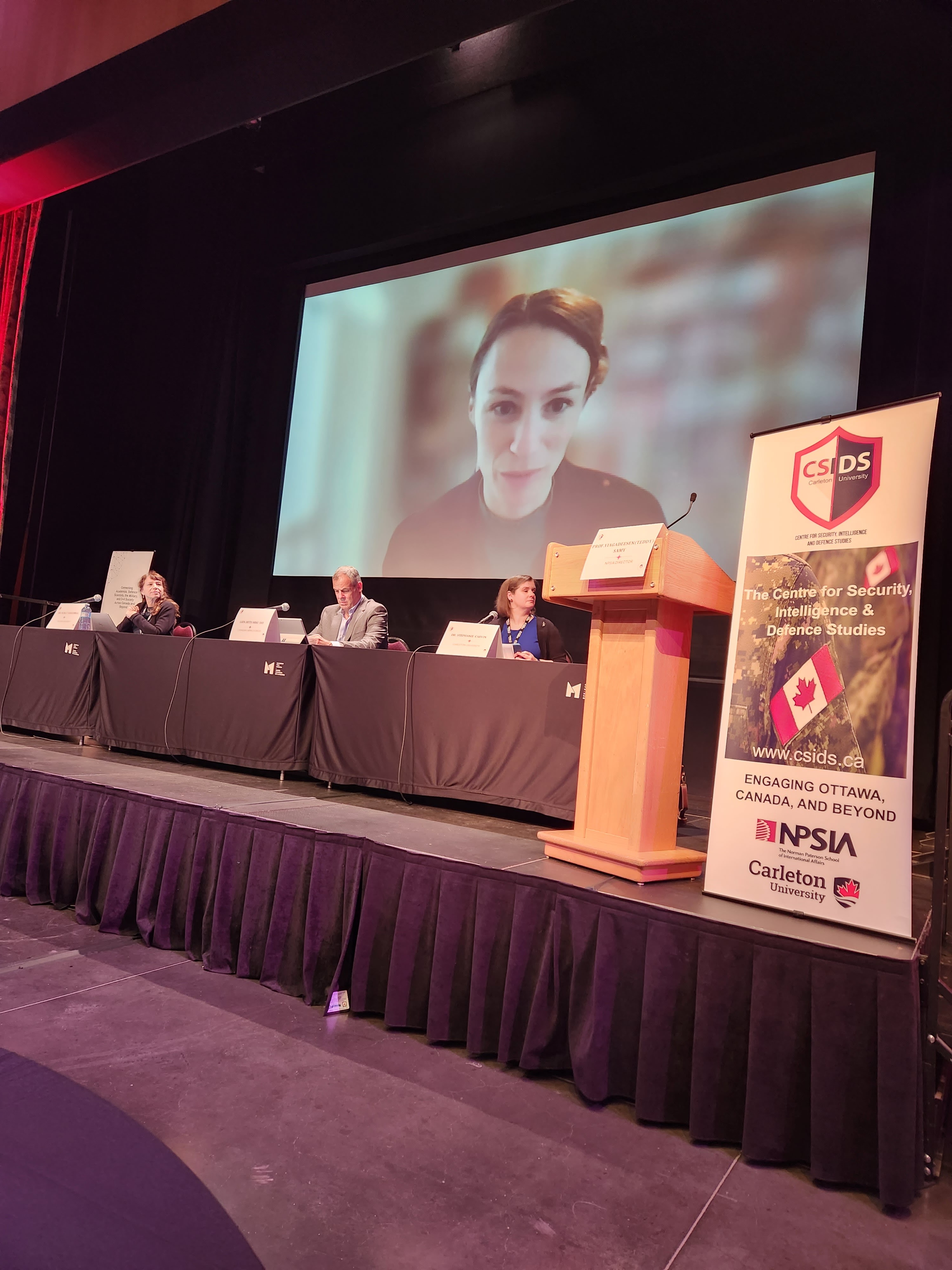
Back to the panels, we had Brown University Professor Nina Tannenwald, who discussed the nuclear weapon issues related to the war, retired LGen Mike Day who delineated the lessons from the war itself, and, via zoom, U of Texas Professor Sheena Greitens, who analyzed China's responses to the conflict.  It was a fascinating discussion.  

I moderated the Civil-Military Relations panel where Calgary Prof. Jean-Christophe Boucher and Charlotte Duval-Lantoine of Women in Defence and Security presented a survey they (and me and Lynne Gouliquer) are working on whether the various scandals are affecting Canadians' trust in the military, Andrea Lane of Defence Research and Development Canada presented the challenges posed to the Canadian Armed Forces by political polarization, and Alexandra Richards of Simon Fraser U. analyzed differences among the various generations and their attitudes.  

The final panel on Redefining National Security, organized by WCAPS-C, included Dr. Nadia Abu-Zahra of both Carleton and U of Ottawa, Azeezah Kanji of the Noor Cultural Centre, Jillian Sunderland and Aaron Francis of U of Toronto.  They presented critiques of the defence and security apparatus and community, especially the treatment of historically excluded communities.

We streamed the event, and it will appear on our youtube channels (CDSN and CSIDS) once we get things cleaned up. We will also be circulating a report and related policy notes in January.

I am very grateful for Team CDSN, especially Melissa Jennings, Sherry Laplante, Cathy Blue, Carelove Doreus, Racheal Wallace, Robyn Lalecheur, David Le, Duncan Herd, and Daniel Kholodar, and to the presenters and moderators.  It was great meeting both presenters and audience members, as the event is also a great networking opportunity.  We will do a "hot wash" to figure out what worked best and what could use improvement.  We are open to feedback so if you have suggestions, let us know.

And, yes, we do this stuff so we can eat food and hang out.  

Indeed it was.


I love Charlotte's expression as she realizes
that I am taking a mid-meal pic


Tuesday, November 15, 2022

This is Not How NATO Works

 I spent part of this afternoon being interviewed by television outlets about the missiles that hit


Poland today and NATO might do.  This is one time where TV is going to get it much more right than the newspaper.  Why?  Because the major paper of record in Canada got it spectacularly wrong:


FFS!  NATO is a collective organization--one country cannot wave a magic wand and shout "Accio alliance!  Tada, Article V is invoked!!!"  Nope.  What any country in NATO can do is call a meeting so that the alliance could consider invoking these famed article.  A5 is the "an attack upon one is equal to an attack upon all."  The Dave and Steve book on NATO explored how obligatory that is (it's not) and what explains how countries behave when asked by the alliance to do something.  

But getting back to that attacked thing: it only counts as an attack that deserves a collective response if a consensus among the members.  Everything at NATO operates by consensus--no one is ordered to do anything by any specific country or any sub-group of countries.  This means there is a lot of lowest common denominator kind of decisions with opt out clauses (did you read the Dave and Steve book yet?).  

So, one of the first things Poland (or anyone else seeking to invoke A5) has to consider is: can they get consensus?  If not, don't ask because it is more than a bit embarrassing to ask and then be denied.  Ask Turkey about that.  It is kind of like going up for Full Professor when you don't know what the result will be--it only ends in pain and sadness (and moving which then leads to joy).  Can Poland get damn near all of the alliance (Greece or Hungary or Turkey can agree not to be too disagreeable but not support the decision and then not deploy troops)?  Um, no.  France, Germany, and Italy, to name a few obvious, more powerful members, have been just a wee bit ambivalent all the way along, and they certainly don't want to be involved in a shooting war with Russia.

One of the other things Poland has to consider is: would A5 be good for Poland?  Um, no.  Because if NATO would go to war with Russia, which is what invoking A5 means, that would mean that Russia is no longer restrained from attacking the supply lines leading from the West to Ukraine through ... Poland.  

The existence of A5 in the treaty is working--for both the alliance and for Russia.  Until today, after nine months or so of war, Russia had refrained from hitting any NATO country and specifically Poland.  And today was probably an accident.  An accident that may have been made more likely by a loosening of Russia's rules as they hadn't attacked border cities all that often.  But Kherson and other developments may have changed the risk calculus for Russia.  Anyhow, A5 has been good for NATO's eastern members as it has restrained Russia.  It has also been good for Russia since it has restrained NATO from engaging in direct violence.  

So, no, Article 5 is not going to be invoked.  Article 4, which is a way to indicate the need for serious discussions against a threat, will be.  Poland will get reinforcements as will other NATO allies, Ukraine will get more anti-aircraft equipment, but Ukraine will not get what it wants for an early Christmas present--a NATO intervention.  This would be great in the very short term, but might also lead to nuclear war, which would be bad for a very long time.  As I said at the start of this, rule #1 of avoiding nuclear war is for nuclear powers not to fight each other directly.  India and Pakistan have made us all very nervous.  US and Russia have stuck by rule number one, and that is not going to change now.

So, as I told CBC Kids last month, no, Virginia, there will not be a nuclear war.  

But then again, some elements of the media want to scare folks for sales and market share and ratings, I suppose.  For shame, Globe and Mail, for shame.  


Wednesday, March 9, 2022

Russian Irredentism: Killing the Kin to Save Them

Watching recent events (and inspired by this tweet about Latvia's PM's take on this), I am reminded of the misquoted from the American war in Vietnam: we had to destroy the village in order to save it.  Seems like Putin's Russia is killing the kin in order to save them.  That the attacks on the Russian-speaking parts of Ukraine are hurting those that Russia is supposedly trying to help.  This speaks to a variety of aspects here that I want to address.

First, when a country tries to reclaim supposedly lost territory, the ethnic kin in the lost territory don't have to demand this effort but it does help legitimate (or at least soften the illegitimacy) of the cause. It also might impact the domestic politics of the redeeming country.  In our book, Bill and I found that irredentist foreign policies did not seem to be related to how endangered the kin are (see middle column of the table to the right), but, of course, we didn't consider whether the danger came from the irredentist state.

Second, the plight of the kin (real or imagined) can operate in at least two ways: putting pressure via domestic politics on the leadership of the kin state to do something about it or providing an opportunity for the leadership to focus the domestic audience on this threat to the nation (which includes those outside the country).  That is, it can be a bottom-up or top-down dynamic.  In this case, it is pretty clear it is top-down--that Putin was under little or no pressure to do something about the plight of Russians in the Ukraine.  Instead, among his motives may have been a desire to strengthen Russian nationalism at home by emphasizing the us-ness of Russian speakers within and outside of Russia at the expense potentially of other conceptions of the Russian nation.  But I can't imagine that killing Russian speakers in Ukraine helps the building of domestic support within Russia or to define the Russian nation in ways that abet Putin's desires to stay in power.

This reinforces my conclusion (and my bias) that irredentism does not have to be sincere, and that Russia's irredentism towards Ukraine, besides maybe Crimea*, is entirely insincere.  I never thought that the separatist groups in the Donbass were genuine efforts at greater self-determination but rather created by Russia.  Putin's speech to kick off the war was very much an irredentist appeal--that Ukraine never really existed and has always been Russian, etc.  Despite this speech, I am not so sure he is all that sincere--that he would have been happy in 2013 with a pro-Russia Ukraine, he would have been happy in 2021 with a pro-Russia Crimea-less Ukraine.  I don't think Putin is really motivated to create a Greater Russia despite his apparently longing for the good old Soviet days.  I do think he wants domination--that dominating Ukraine and Belarus and other parts of the former Soviet space would have been sufficient.  

The threat to that domination was never NATO but the European Union.  That is, an alternative, west-leaning model has been a threat to Putin's domination of Russia and much of the former Soviet space.  Again, the timing here is suggestive--2014 when Ukraine starts looking to the EU; 2022 when Ukraine keeps looking westward.

And here is an irony and a stupidity: that Putin, by absorbing Crimea and by taking the eastern regions of Ukraine out of Ukraine's political system, altered the balance of political power in Ukraine.  He removed the most Russia-leaning components, which meant that even if the rest of Ukraine wasn't pissed off, the balance of voters shifted by subtraction, making it more likely to have pro-western leaders.  Putin improved Zelenskyy's chances of getting elected.  When folks talk about California seceding, I push back, saying that would alter the balance of power in the US, making it impossible for the Dems to win at the national level.  Well, Putin did this--he made it far harder for a pro-Russian Ukrainian politician to win just on the numbers, not to mention antagonizing many Ukrainians via his bullying.

This conflict is an intersection of many things: irredentism and other elements of ethnic politics (see the Ukrainian diaspora mobilize), civil-military relations, alliance politics, sanctions, coercive diplomacy, nuclear strategy (stability-instability paradox), and more.  From most perspectives, Putin has screwed up bigtime, including the third classic error of thinking regime change will be easy (don't wager with a Silician when death is on the line is the second).  Which, of course, is not reassuring because there is plenty of room for Putin to get into deeper and deeper trouble, hurting more and more people and risking a wider and wider war. 


* The referendum was a sham, but there did seem to be a fair amount of Crimean Russians who wanted to be in a Greater Russia.

Tuesday, February 22, 2022

Putin and Ukraine: Irredentism 101

 Irredentism is refers to efforts by groups or countries to reunify lost territories with a homeland.  I wrote a book with Bill Ayres about the irredentism that did and did not occur in the 1990s: Greater Armenia, Greater Croatia, Greater Serbia vs Hungary, Romania, and Russia not pursuing such efforts.  We got to release a paperback edition with a new preface in 2015 thanks to .... Putin's irredentist move where Russia seized Crimea.  Here's what I know about irredentism from my previous work and from other people's work in this area and how these basic rules apply here.

  1. Irredentism is always costly for the country engaging in the effort--it generally requires war since countries do not part with their territory without a fight (well, almost always).
  2. What is bad for the country may or may not be good for the leader.  Irredentism is a nationalist effort that can tie folks together towards a common identity.  Politicians may use irredentist appeals (whether they follow through on it or not) to refocus the country's nationalism on this cause rather than other aspects (see Hungary and Viktor Orban where Hungary was optimally obnoxious to the neighbors--enough to get support domestically, not enough to risk war).
  3. #2 suggests a third rule--Realists have a hard time explaining irredentist efforts because they do not help the country become more secure or even gain more power.  They just gain perhaps some territory and some new citizens.  In the 21st century, this does not help Russia become more powerful or more secure.  Maybe it will make Putin more secure, but that ain't the same thing, is it?
  4. Irredentism is driven by domestic political dynamics more than international.  Some would argue that countries engage in irredentism when there is a good opportunity, but I can summon examples where countries not only jump through open windows but also attempt to jump through brick walls.  Somalia engaged in irredentism both when it was relatively stronger than its neighbors and when it was weaker.  Croatia engaged in irredentism even as it was being taken apart by an irredentist war thanks to Serbia.
  5. What about these domestic political dynamics?  It is not just pure nationalism since nationalisms are around all the time--it takes a political entrepreneur to push for "reunion" and one has to figure out their game.  And that is where I am mostly stumped since I don't know contemporary Russian politics these days.  All I can say for certain is that the domestic game matters quite a bit.  
  6. One thing that enables Putin is that Russia is already a multiethnic country dominated by one group.  This war doesn't change that, and irredentism is easier/more desirable for countries in this position.  In our book, we found that fear or hate of others, xenophobia, can actually inhibit irredentism since a successful irredentist foreign policy is the equivalent of a giant wave of immigration--adding many new others to one's country.  But Russia is not so xenophobic so it can do this without the nationalist backlash (unlike, say, Hungary).   

Update:  7.  Irredentism need not be consistent.  The actor may not claim all disputed/historical territory.  The key is what is digestible--who lives where, how easy are they to rule, what do they do to the domestic political balance of the irredentist state.  In this case, that means maybe Eastern Ukraine gets absorbed formally or informally but perhaps not all of Ukraine.  

Russian irredentism here is more than just imagined since the territory in question used to be part of Russia and there are Russian speakers who may identify with Russia and want to be part of Russia (#notallUkranians or even residents of Eastern Ukraine).  Saddam Hussein's moves against Kuwait were not really irredentism since there was not really a people or land to be be redeemed.

This does not make Russia's moves legitimate at all.  But it does give this a bit more heft within Russia than Poland or Bulgaria.  The Baltics?  Oh my.  The history gives Putin something to play with and he seems to have his own grievances at stake in all of this--resenting the breakup of the Soviet Union.  International law, such as it is, is not on his side.   Conquest is not hip as the Kenyan rep at the UN made clear.  And while the US has committed many awful acts including a pretty illegitimate war in 2003, it has not engaged in conquest lately.  Who has?  Um, China with Tibet and perhaps Taiwan in the near future.  So, rule 6: don't expect the UN to stop this.  

This is a bad move for Russia and the Russian people and much worse for Ukraine.  Whether it pays off politically for Putin is not clear.  Many irredentist efforts are gambles that do not pay off very well.   And, yeah, there was not much anyone could do to deter Putin and Russia in this.  As long as the US/NATO weren't willing to risk WWIII over a non-ally, we had few cards to play.  

In sum, irredentism means war, and it is not easy to deter or prevent.  Ukraine is screwed, and there is not much we can do about it but make it costly.

Monday, March 12, 2018

Russian Poison, Britain and NATO

Now that Theresa May has said that it is "highly likely" that the Russians used a nerve agent fairly recklessly as they sought to kill a double agent, lots of questions arise.  One could easily code this as an attack, not the first one since other Russians have been killed in the UK, but a more severe one given the number of bystanders and first responders who may have been exposed.  And once you use the word "attack," one of the first things that comes to mind is: an attack upon one equals an attack upon all--NATO's Article V.  It has only been invoked once, after 9/11, despite other attacks against NATO allies--Russian cyber attack against Estonia, Syrian shells and bombs hitting Turkey, etc.

Consulting NATO via Article IV is a natural way to proceed.  It would allow the UK to establish the seriousness of what has happened, that this is a very warlike thing to have happened.  However, bringing in NATO involves larger risks.  Specifically, the US, which has not acknowledged that Russia is "highly likely" to be guilty here, and with Trump never saying an unkind word about Putin, the danger is that the UK tries to get NATO to take a stand and fails.  That would cast doubt about the alliance itself.  It is like the US non-response to North Korean missile tests: sure, you can try to shoot them down, but, if you fail, you might reveal that the system does not work so well.  Well, with Trump being so hostile to NATO and pretty unfriendly to May, one can easily imagine the US blocking consensus at NATO probably with help from Hungary and Greece.  And then what?

With the economic fiasco that is Brexit going on, the UK has not many choices, especially with an unreliable US (today's alliance dilemma horn is abandonment), May is stuck.  What can she do?  I will agree with those who suggest new economic sanctions, the end of Russian oligarchs moving to London, and kissing RT goodbye.  Oh, and, this might sound awful, but the old spy game had some rules, and if one breaks the rules, one should pay.  So, yeah, the British should find the most guilty Russian spy, and remove him from the game.  Teach the Russians to be more careful.

So far, the Russians have not paid much of a price for their reckless moves across the globe--meddling in elections, using poisons in ways that harm bystanders, and on and on.  The US under Trump is not going to act as strongly as it should--the allies will need to do so.

Oh, and when folks say that Trump hasn't made that much of a difference in foreign policy yet, the refusal to respond to the election mess and now this are big pieces of evidence that, yes, Trump is making a difference and not in a good way.


Friday, July 28, 2017

There's No Party Like a Cold War Party

Russia is retaliating for American sanctions by limiting the staff and travel and such of American diplomats in Moscow.  So I tweeted the title to this post, so it raises the question: is this really a cold war?

Similarities to the good old days (ok, bad old days for most, good for a cranky troll):
  • NATO is hip again!  The gnashing of teeth about whether it should exist is mostly over, except in Trump's mind (and Putin's).
  • We have tripwires and nuclear threats.
  • We have the aforementioned tit-for-tat.
  • Proxy wars--Syria is very familiar, if more complex than the old proxy wars.
  • Planes buzzing planes and ships.
What is different?
  • The Russia-US relationship is not the axis upon which the world turns.  Heaps of stuff going outside of US-Russia.
  • China is more powerful, more relevant than Russia in most areas other than election meddling.
  • Russia's conventional threat is only to the Baltics (and maybe Sweden) and not for Germany/France, which leads to not quite as much effort by the West Europeans.
  • Whatever North Korea does, it is not guided by/influenced/etc by Russia.
  • Most of the clusterfuck in the Mideast is not driven by Russia.  Nope, it is mostly Shia v. Sunni, Saudi Arabia vs Iran.  
  • The biggest threat to the world is not nuclear war between the US and Russia but climate change.
 I could go on with each list.  That it is cold war-ish with Russia does mean that some plays in the old cold war playbook are relevant again--tripwires and extended deterrence and sanctions. But it is not cold war enough that the US can focus on Russia or see the world through the lens of conflict with Russia.  Oh, and during the Cold War, the White House was not occupied with the Soviet Union's best pal.  Ah, the mole hunters of the past would be aghast at the Oval Office being occupied by a fellow traveler/useful idiot/whatever Trump is.

When applying analogies, one must remember what pieces of the old dynamics apply and which ones don't.  Cold war-ish is not cold war.  But it is also not all unicorns, rainbows and happiness.

Thursday, January 12, 2017

My Moscow Experience

Way back when there was still a Leningrad, I spent two weeks in the Soviet Union.  It was a winter term college trip, led by a Russian language prof and a Soviet politics prof.  We were a group of 20 or so folks, with mixed language skills.  Of course, we stayed only at hotels that were run by intourist, the Soviet government agency that kept track of us.  All of our touring was led by people from this agency.  We were able to go out on our own and did meet some Russians in Moscow and Leningrad and some Estonians in Tallinn.

But the point of this tale is not the friendly folks of the USSR.  No, it was that we constantly joked about being recorded.  We (ok, I) talked into lamps.  It was all fun, and then something strange happened
In between the two beds was a shelf/table built into the wall.  It had a hole/socket in it that would fit the plug for old headphones (not the smaller receptacle we are accustomed to now).  Anyhow, my roomie and I were surprised when a maid knocked, entered the room, and then stuck something into the hole in the shelf.  She then removed it, and left the room.  Was she starting or stopping the recording?  Or was it something else?
 All I know is that what goes in Moscow probably does not stay in Moscow (otherwise, the place is just like Vegas).

Of course, much has changed in thirty years (happy anniversary, college trip to the USSR!).   But honey traps, videotaping high profile folks, and all that?  Not sure that has changed.

I honestly don't know if the Russians have anything on Trump.  Trump's stances are so awful, it almost does not matter if he is a stooge or not.  But yes, it should matter.  Indeed, one of the reasons I got the election wrong is that I thought there were more nevertrumpers among the GOP, who were appalled by Trump's ties to/love of Putin, which were known then.  Ooops, party > country.

Good times, eh?  Nyet.

Sunday, November 20, 2016

NATO Workshop Report: Can We Panic Now?

I was in Montreal on Friday for a workshop that been organized to ponder the NATO-Canada relationship after the Warsaw Summit.  Something happened in between the summit and the workshop that makes the summit just a wee bit less central to our thinking about NATO--the rise of Trump.  I learned a great deal from the participants, which included academics from Europe as well as the French General who is the Supreme Allied Commander-Transformation.  This used to be SACLANT, commander of NATO forces in the Atlantic.  Not entire sure what SACT does, but it is one of hte highest jobs in NATO, on par (technically but not politically) with SACEUR (the commander of all NATO forces in Europe.

It was not clear whether this was under Chatham House rules, so I can only give my impressions and reactions.
  • Before this weekend, I was not sure what the acronym for SAC Transformation was--SACT is probably a bit less controversial than SACTRANS.  
  • The officers around SACT were  most sharp, as I had a very informative conversation with one of his staff over lunch.
  • One speaker made me realize that there is a big window of vulnerability for NATO and opportunity for Putin between Trump's inauguration and when the deployments to the Baltics begins.
  • The Europeans generally seemed to share the same hope: that what politicians say in campaigns is different from how they govern.  I pushed back, as we know that politicians do tend to keep their promises AND Trump's first choices for key positions indicates that he is going to be as bad as we feared.
  • As a result, my talk was far more alarmist than anyone else's.  I went so far as to suggest that Lt. Gen Michael Flynn as National Security Adviser might ease the principal-agent relationship between Putin and Trump, serving as the equivalent of a police patrol/commissar (the guys who would shoot Soviet troops if they retreated from the Nazis and ensured party control).  No, I don't really believe Trump is acting on the orders of Putin, so the P-A stuff does not quite apply.  But I do harbor suspicions about Flynn, given that he has been on the payroll of a Russian propaganda outlet (one that invited me for an interview and which I declined).
  • In the course of conversations, I realized why Erdogan of Turkey is more comfortable with Putin these days--the aftermath of the coup attempt has allowed him to shed his democratic clothing and embrace his authoritarian ambitions.  So, he has to ask Putin for the secret handshake for Autocrat Club.  Of course, first rule of Autocrat Club is to kill the media who report about it.  Uh oh.
  • The young folks organizing the conference--UdeM's Phd Students--were super-sharp and well organized, filling in gaps in the program that opened up a few times.  
  • The lunch was a Quebec version of a bento box.  Not bad.
  • Oh yeah, traffic in Montreal sucks more than ever.

Friday, September 9, 2016

When Politics Imitates Art Badly: Monty Python Edition

One of the classic Monty Python bits is this:


What has Putin done to be so appealing?  Economic disaster?  Check. Journalists being killed?  Sure.  The courts being used against Putin's enemies?  Sure, but apart from that?  Oh, yeah, produced greater self-encirclement via annexation of Crimea and intervening in Ukraine.

I can go on, of course.  Putin might, indeed, be "strong" (if we define strong as making the country less democratic) but successful?  Sure, Trump's sole metric are polls/ratings.  Is Russia better off now than four years ago?  Nope, not domestically as it is less free and the economy is in recession.  Internationally, Russia is much more alone, and has had to make deals with China from a position of weakness.

So, keep on admiring his squelching of democracy and his trolling foreign policy.  It might make him popular, but that does not make him admirable. 

Oh, and that weak Obama fella?  How about this:

Wednesday, August 17, 2016

Trump and Putin: Birds of a Feather

I spent this morning chatting about Trump and the strange role of Russia in the US election on radio stations across Canada. As usual, there was a basic set of questions asked over and over (eight hits this time).  What was asked?  What did I say?  While some of the hosts went off script slightly, this was the gist:


1. What do you think of the ways in which Russia is being raised in the American election campaign...How surprising is it to you that Russia has taken this sort of prominence? 

It is pretty amazing. During the Cold War, the Soviet Union played a major role in elections but only as a question: is a candidate up for dealing with the threat?  After 1991, Russia was less relevant and then people, including myself, scoffed when Mitt Romney listed Russia as biggest threat in 2012.  But since Crimea and the war in Ukraine, Russia is relevant again but now it is actually seeking to influence the election
 
2. How much of a preference does the Russian Government or Vladimir Putin have between the two U-S Presidential candidates?
The less covered story is that Putin apparently dislikesHillary Clinton from her time as Secretary of State
Trump, on other hand, has very visibly promised a set of policies that Putin prefers: recognizing Crimea, softening sanctions, not being so enthusiastic about supporting Ukraine, potentially breaking NATO, and that last one is one of Putin's highest priorities.  So, yes, Putin has a very clear preference.

 3. There have been accusations directed at Trump's campaign manager, Paul Manafort, accusing him of pro-Russian ties. How  plausible is it that Russia is exerting influence through members of the Trump campaign?
[This one was slightly overcome by events since Manafort got demoted last night with word breaking this morning]
The ties between Manafort and Putin/Russia are pretty clear, as he worked for pro-Russian figures in Ukraine and elsewhere
It is hard to explain the stances of Trump on Russia without thinking that someone is pushing this as there is no real domestic constituency pushing for this AND the effort to change the GOP platform at the convention was a major exertion of political capital.  Why?  Because elements within the campaign care a great deal. 

4. There are also allegations that Russia is behind hacks of the D-N-C and the Clinton campaign's computer servers. Do you think this is the sort of thing the Russian state would undertake?

Russia has advanced cyberwarfare capability, so it definitely is something the Russians can do.  Russia engaged in cyber attacks against Estonia in 2007, and used cyber attacks as part of its campaign against Ukraine.  When the hack was originally discovered, Russians were immediately suspected, and then the emails were given to wikileaks and released a month later. 

5. What does all of this suggest about the U.S. relationship with Russia over the longer term, after the election?
HRC is going to win, and she will remember this unprecedented effort by Russia to influence a US election.  So, expect an increased chill in US-Russian relations but not that much change in substance since US is already confronting Russia over Ukraine and is already reinforcing NATO in the Baltics/Poland.

Tuesday, August 16, 2016

Talking Coast to Coast to Coast on CBC Radio: Trump and Russia Edition

Tomorrow, August 17th, I will be doing some CBC syndicated radio to talk about the strange role played by Russia in this election.  Here's my schedule (the more west coast ones are likely to be taped if prior experience is any indicator):


6:40
Kitchener-Waterloo
Host: Craig Norris
Twitter: @cbckw891

6:50
Thunder Bay - Superior Morning
@CBCSuperiorMorn
Lisa Laco - Host @morningshowlisa

7:20
Winnipeg - Information Radio **IP**
Marcy Markusa - Host
Twitter: @CBCInfoRad

7:40
Ontario AM
Wei Chen - Host
Twitter: @CBCOntMorning

7:50
Victoria - On The Island
Gregor Craigie - Host
Twitter: @cbcontheisland @GregorCraigie

8:09
Calgary--The Eyeopener
David Gray - Host
Twitter (host David Gray): @graydio1
Show: @cbceyeopener

8:18
Regina - The Morning Edition
Host: Sheila Cole, Coreen Larson - Producer,
Twitter handle: @sheilacolescbc

8:40
Saskatoon -- Saskatoon Morning
Leisha Grebinski - Host
Twitter: @cbcsaskatoon