When we discuss the size of militaries and the costs of modern warfare, a key concept is tooth to tail--how much of one's allocation of personnel/money is to the actual fighting versus the support necessary to keep the personnel and weapons systems in the fight.
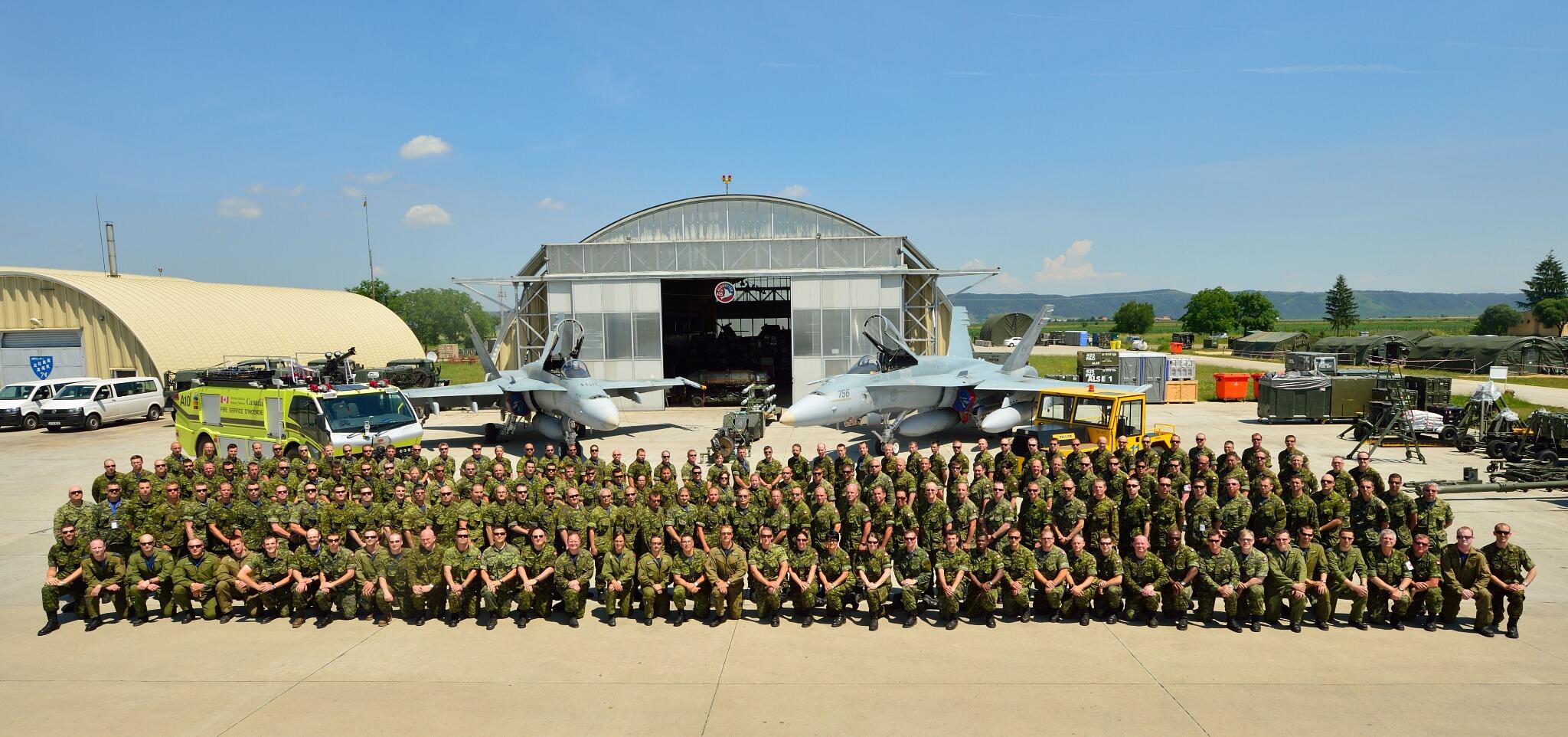
Today, the Canadian Forces tweeted a picture that unintentionally demonstrated this to a T:
Canada has sent six CF-18s (Canadian versions of F-18s). There are way more than six pilots in this picture, eh? So, this picture is a mighty good demonstration of modern-day tooth to tail--where most of the resources support the folks in combat rather than actually go into combat.
I do not post this as a critque of the RCAF but to merely illustrate a basic reality for most (all?) modern militaries.
International Relations, Ethnic Conflict, Civil-Military Relations, Academia, Politics in General, Selected Silliness
Showing posts with label military. Show all posts
Monday, June 9, 2014
Tuesday, June 19, 2012
Gunning for the Game
NBC has a new reality show: Stars for Stripes. The idea is that some C level celebrities (Dean Cain, Picaboo Street, Todd Palin, etc) will complete in military style competitions, complete with trainers who co-compete with them. I love the wonderful symmetry between NBC as a crappy network and the Democrats as a crappy party both relying on a retired general, Wesley Clark, who is universally reviled among folks in the US military.
But the point of this post is to suggest potential games for the competition. The articles I have seen mention target shooting and, I think, rappelling out of helicopters. From my time in the Pentagon and then as an observer via twitter and various interactions/interviews over the past decade, I have a few suggestions:
- Powerpoint Ranger: The contestants must take a concept or plan and devise the most complex set of slides. Extra points for flying graphics that swoop across the screen.
- Acronym Alphabet: Competitors must be able to list acronyms from A to Z--the one that can keep going the longest wins.
- Moving Machines: The first contestant to move their belongings from one base to another to a third without losing more than 10% of their belongings wins.
- PC DFAC: During the competition, the contestants must eat only at military dining facilities and must avoid all pork products. Anyone who eats a pork product is out. Also known as the Green Zone Challenge.
- Service Rivalry: Each contest will be associated with a service and within that service a distinct branch (Surface vs Sub, Armor vs Infantry vs. Arty; Pilot vs Missileer, etc). Contestants will compete to buy the biggest, most expensive and least useful pieces of equipment. Winner is the one that gets the largest percentage of the budget.
- Word-Smithing: Each contestant will be given a document and will have to change all of the nouns and verbs to their synonyms, such as small dog to puppy.
- Hooah? Another mindgame: contestants will compete to see who can figure out the meaning of a "hooah" given the context of a particular situation.
- Navy Fashion: Contestants who dresses the fastest in the correct uniform once they are told which season it is wins.
Monday, May 28, 2012
Hardly Academic? Hardly!
A very good piece in the NYT today about the debate within West Point about the future of counter-insurgency and the US military. The article covers the views of both COIN-istas and COIN haters. This is progress. Why? Because ten years ago, there was little debate about COIN at all. Now, you have two sides engaged in an argument, which is one of the best things that can happen to the folks going through West Point--to be exposed to this argument. They don't have be a COIN fan or foe, but to see that sharp minds can disagree is a valuable thing. When these cadets some day get placed into harm's way or are in the chain of command, they will perhaps be more open to different points of view.
One of the critical problems in the US military has been the desire to forget unfortunate pasts and avoid skill sets that might end up being used. After Vietnam, COIN was put away and not really considered except by some mavericks like Petraeus. My hope is that this history is not repeated. The reality is that politicians will put troops into situations that require many of the skills and tactics that the Army learned at great cost the past ten years, whether the military wants to do such stuff or not. Better to remember these lessons with a slightly higher risk of having to use them than to forget and then have to re-learn while under fire.
War, as Clausewitz said, is politics by other means. COIN doctrine takes that to heart. US grand strategy may be better served by avoiding fighting any insurgents, but as long as the US remains the predominant conventional power, the opponents of the US will mostly try to fight via insurgency. Well, the smart ones, anyway. Shouldn't we be prepared for that reality?
One of the critical problems in the US military has been the desire to forget unfortunate pasts and avoid skill sets that might end up being used. After Vietnam, COIN was put away and not really considered except by some mavericks like Petraeus. My hope is that this history is not repeated. The reality is that politicians will put troops into situations that require many of the skills and tactics that the Army learned at great cost the past ten years, whether the military wants to do such stuff or not. Better to remember these lessons with a slightly higher risk of having to use them than to forget and then have to re-learn while under fire.
War, as Clausewitz said, is politics by other means. COIN doctrine takes that to heart. US grand strategy may be better served by avoiding fighting any insurgents, but as long as the US remains the predominant conventional power, the opponents of the US will mostly try to fight via insurgency. Well, the smart ones, anyway. Shouldn't we be prepared for that reality?
Sunday, May 27, 2012
Memorial Day With Some Perspective Sauce
Joe Biden is often viewed as a joke, especially when he goes off script. Not here:
Monday, December 12, 2011
Rename the Mercs Contest
Blackwater, the infamous private security company, changed its name to Xe, but that didn't work. So now: ACADEMI. Really. I am not kidding. This seems to be a focus group mistake. After all, if you want to have the image of being decisive, forceful, reliable, and assertive, do you really want to identify yourself with academics who dither, passive, and cannot meet a deadline to save their lives.
So, let's ask the interwebs: what should be the new name of Blackwater Xe ACADEMI?
Here are a couple of suggestions to get us going:
What say you?
So, let's ask the interwebs: what should be the new name of
Here are a couple of suggestions to get us going:
- Mercs' R Us
- Xarbucks
- TMI [The Military Inc.]
- Xpendables
- The Starks
- The Knights Who Say Ni!
What say you?
Saturday, July 2, 2011
Joint Staff Rocks Again
Check out this interesting post by a "Feminist in the Pentagon." Like me, she was surprised at how welcoming the folks on the Joint Staff were. And then she enumerates why they are so swell:
But I wholeheartedly agree with this line: "The serious content of our work, juxtaposed with the camaraderie and humor of our office, strikes a great balance."
Of course, this woman is generalizing about the military. It may be the case that the Joint Staff is the best part of the military--that is what they always told me. We have examples of other places in the military where team means the boss tells you to just do what he thinks is right, that they are not that bright, and where they do not hold diverse views--CENTCOM under Tommy Franks, for instance.
Still nice to see that my experience was not unique and that today's Joint Staff is not that different from the one I enjoyed ten years ago.
- They work as a team.
- They encourage professional development.
- They are smart.
- They reward good work.
- They don't bullshit.
- They hold diverse views.
But I wholeheartedly agree with this line: "The serious content of our work, juxtaposed with the camaraderie and humor of our office, strikes a great balance."
Of course, this woman is generalizing about the military. It may be the case that the Joint Staff is the best part of the military--that is what they always told me. We have examples of other places in the military where team means the boss tells you to just do what he thinks is right, that they are not that bright, and where they do not hold diverse views--CENTCOM under Tommy Franks, for instance.
Still nice to see that my experience was not unique and that today's Joint Staff is not that different from the one I enjoyed ten years ago.
Friday, June 17, 2011
Thanks for the Tanks
I am working on a paper about Canadian military adaptation while in Afghanistan. A key example is below:
Saturday, June 11, 2011
A Successful Junket
I am recovering from a day at an airshow. It was a lot of fun and actually quite productive as I had conversations with two officers with interesting experiences--Afghanistan and Libya. So, I think I blew Canadian tax dollars in a productive fashion. And got a bag full of swag at the same time.
I am beat but I learned a great deal and had a good time. I do love my job.
So, what did I observe during the course of the airshow?
- I think American planes are louder. Or they are flown more loudly. The F-16 flown by an American pilot (Canada only has F-18s) had a tendency to hit his afterburners while they were slightly pointed towards the audience. Super-loud. And, yes, super-cool. there is something visceral about a plane blasting overhead. I felt a huge urge to sing this South Park song (NSFW). It may not make sense, but a loud fighter flying low overhead just is absolutely thrilling.
- I loved the reactions of the Canadians when I told them that the sound of a fighter jet blasting by is the sound of freedom. And boy did I feel freer after the show.
- We were only able to breech the defenses of the VIP tent (even though we had VIP badges) when we went to meet the Commanding Officer (and ask him a bunch of Afghanistan questions). But once there, we found free beer, and good free beer. I don't know why they were selling Coors Light elsewhere since Canadians produce far better beer than that swill.
- Very interesting musical selection to accompany the various planes, including the theme from Band of Brothers for the Sabre, a Korean War era plane (the yellow/gold one in the pic above).
I am beat but I learned a great deal and had a good time. I do love my job.
Monday, April 18, 2011
Beware of Officers Carrying Reading Lists
Military folks are surprisingly well read. We academics tend to think of folks in the military as knuckle-dragging neanderthals, but they almost surely, on average, have read more stuff than civilians, especially non-academic ones. They tend to have very sharp eyes for stuff on military history, strategy and such. Indeed, commanders at all levels have developed reading lists for those under them so that the subordinates can understand where their bosses are coming from.
But I would like to suggest one caveat: these folks tend to better when focused on the military and less so when it comes to getting background on where the military will be operating. Lots of stories now, starting with a 60 minutes piece on Greg Mortenson and his Three Cups of Tea book and its limited accuracy. The Chairman of the Joint Chiefs of Staff Mike Mullen was a big fan of this book (although his official reading list did not include this book).
I am familiar with this tendency within the military, as the Balkans Branch of the Joint Staff had Balkan Ghosts by Robert Kaplan on its reading list in 2001. Perhaps my greatest contribution during my year on the Joint Staff was getting to revise the list and drop that book. It is exactly the kind of thing that seems attractive to uniformed types--a travelogue with lots of local color, developing a very general (but severely flawed) understanding of the place.
So, the lesson du jour for civilian types is discriminate when getting reading suggestions from military folks--do read their recommended stuff on military history and strategy. But don't read their suggestions for the history and cultures of countries, unless you don't mind blowing time on reading stuff that is utter crap. Of course, I cannot say if Cups of Tea is utter crap, but Balkan Ghosts was/is. The lesson du jour for the military types is that they should not buy into the most popular stuff on countries in which they are operating. Just because something is widely cited does not mean it is good or right.
But I would like to suggest one caveat: these folks tend to better when focused on the military and less so when it comes to getting background on where the military will be operating. Lots of stories now, starting with a 60 minutes piece on Greg Mortenson and his Three Cups of Tea book and its limited accuracy. The Chairman of the Joint Chiefs of Staff Mike Mullen was a big fan of this book (although his official reading list did not include this book).
I am familiar with this tendency within the military, as the Balkans Branch of the Joint Staff had Balkan Ghosts by Robert Kaplan on its reading list in 2001. Perhaps my greatest contribution during my year on the Joint Staff was getting to revise the list and drop that book. It is exactly the kind of thing that seems attractive to uniformed types--a travelogue with lots of local color, developing a very general (but severely flawed) understanding of the place.
So, the lesson du jour for civilian types is discriminate when getting reading suggestions from military folks--do read their recommended stuff on military history and strategy. But don't read their suggestions for the history and cultures of countries, unless you don't mind blowing time on reading stuff that is utter crap. Of course, I cannot say if Cups of Tea is utter crap, but Balkan Ghosts was/is. The lesson du jour for the military types is that they should not buy into the most popular stuff on countries in which they are operating. Just because something is widely cited does not mean it is good or right.
Friday, February 11, 2011
More Pentagon Jargon
This page has a heap of Pentagon-speak, and it is mostly useful.* In my time, I never heard "put steel on target" and I had a heap of artillery officers in my branch, including commanding officer. So, I am not sure how prevalent that phrase is. Task/tasker/tasking is absolutely on target. Our taskers were called JSAPs (Joint Staff Action P-something), See the edited Far Side -->
Warfighter? I guess. I was struck by folks using the word "warrior" until I realized that I was working with folks who were trained to kill people.
De-conflict: "To synthesize and eliminate inconsistencies." I do not think I ever heard this in the Pentagon, but heard it a heap during my research for the current project, as in the NATO-led International Security Assistance Force folks had to de-conflict with the Operational Enduring Freedom folks, especially since the latter often were Special Operations types wondering through somebody else's battlespace.
Stoplight charts were not a word that was used, but definitely a very common way to illustrate progress/desired endstates (never heard the word endstate until my time in the Pentagon), and my favorite argument within NATO--milestones vs. benchmarks.
Battle rhythm. Agreed, a big hooah here, as we did frequently hear this phrase to describe our schedule, including regular PT (physical training), which, in our office, meant three or four of us on a racquetball court (and yes, I got spanked on a regular basis).
This list at wired comes from the Ink Spots blog that I have linked to before, with previous Pentagon-ese.
* And yes, this is a quick and dirty blog post to make up for the fact that I spent the day skiing with my daughter, since she had no school today. Clear skies, good snow, great skiing.
Warfighter? I guess. I was struck by folks using the word "warrior" until I realized that I was working with folks who were trained to kill people.
De-conflict: "To synthesize and eliminate inconsistencies." I do not think I ever heard this in the Pentagon, but heard it a heap during my research for the current project, as in the NATO-led International Security Assistance Force folks had to de-conflict with the Operational Enduring Freedom folks, especially since the latter often were Special Operations types wondering through somebody else's battlespace.
Stoplight charts were not a word that was used, but definitely a very common way to illustrate progress/desired endstates (never heard the word endstate until my time in the Pentagon), and my favorite argument within NATO--milestones vs. benchmarks.
Battle rhythm. Agreed, a big hooah here, as we did frequently hear this phrase to describe our schedule, including regular PT (physical training), which, in our office, meant three or four of us on a racquetball court (and yes, I got spanked on a regular basis).
This list at wired comes from the Ink Spots blog that I have linked to before, with previous Pentagon-ese.
* And yes, this is a quick and dirty blog post to make up for the fact that I spent the day skiing with my daughter, since she had no school today. Clear skies, good snow, great skiing.
Wednesday, January 19, 2011
For Your Situational Awareness: Speaking Pentagon-ese
I just want to highlight a blog that just started a running series on learning to speak Pentagon-ese.
The first lesson is on "working that."
The second is: "FYI/FYSA" referring to the distinction between "for your information" vs. "for your situational awareness."
I am looking forward to other terms that will remind me of my "drinking from the firehose" as I was indoctrinated during my year in the Pentagon.
Any suggestions that we should pass on?
The first lesson is on "working that."
The second is: "FYI/FYSA" referring to the distinction between "for your information" vs. "for your situational awareness."
I am looking forward to other terms that will remind me of my "drinking from the firehose" as I was indoctrinated during my year in the Pentagon.
Any suggestions that we should pass on?
Thursday, December 23, 2010
When Experience Might Be Better than Some Book Learnin'
I love that Star's & Stripes is pondering the shortage of folks going through the Ranger School pipeline because so many guys have been getting experience in Afghanistan and Iraq. I learned in my year in the Pentagon that lots of army guys would go through Ranger school to get the tab (badge that goes on their shoulder) and then never serve in a Ranger unit. It was a status thing. Now, lots of folks apparently are not going to the school since they are seen real combat, heaps of it. They don't need simulations of combat, they don't need to learn combat skills at school. They are getting it under fire.
While there are lots of stories raising questions about how the experiences of Iraq and Afghanistan may be breaking the military due to folks being over-extended and stressed out, this kind of story is actually a bit of the positive side--that the US military has heaps of combat (and non-combat) experience, that the next generation of leaders (those who stay in) will have a better background for what they have seen and done. Worrying about too few folks in Ranger School is a good problem to have as it is not really a problem, unless one's ego is invested in tabs on shoulders.
By the way, I never got my Acronym tab or my Powerpoint tab. I earned them, but never got the stuff to sew on to my suit shoulders.
While there are lots of stories raising questions about how the experiences of Iraq and Afghanistan may be breaking the military due to folks being over-extended and stressed out, this kind of story is actually a bit of the positive side--that the US military has heaps of combat (and non-combat) experience, that the next generation of leaders (those who stay in) will have a better background for what they have seen and done. Worrying about too few folks in Ranger School is a good problem to have as it is not really a problem, unless one's ego is invested in tabs on shoulders.
By the way, I never got my Acronym tab or my Powerpoint tab. I earned them, but never got the stuff to sew on to my suit shoulders.
Thursday, November 11, 2010
DVRs and Canadian Military History
The Canadian version of the History Channel has been running a heap of movies and documentaries about Canadian military history the past week in the run up to Remembrance Day (Veteran's Day in the US). So, with my relatively new DVR, my Remembrance Week effort is now more than just wearing a poppy. I recorded shows on Vimy (key Canadian battle in World War I), Dieppe, Juno Beach (the Canadians got their landing zone on D-Day), the Battle of Verrières Ridge (post D-day battle in Normandy), the Medak Pocket (combat during the peacekeeping effort in the Balkans), and Kandahar.
Thus far, I have only watched the show on Dieppe, but it might be pretty emblematic of the Canadian military experience. Feeling shunted aside, the Canadian elites sought a greater role, and, unfortunately, got it. What started out as a small raid became a much bigger affair, partly to assuage Stalin that the Western allies were serious about relieving some of the pressure the Soviets were facing. So, the Canadians and some others were sent to seize an armed port (another of Churchill's less brilliant ideas) and didn't even have surprise on their side for a variety of reasons (including this was the second attempt after a failed effort the month before or so). It was an utter failure, with poor planning, unrealistic training, little real knowledge about the targets, and confronting tough German positions. Some Canadians were able to escape but many were killed or taken prisoner for the duration of the war.
To be clear, yes, much blame can be heaped upon the British leaders, especially Churchill and Mountbatten, but Canadian leaders in Ottawa and London had plenty of opportunities to influence things.
The solace that can be taken has been that the failed raid produced lessons that made the eventual invasion of Normandy a success. This has been debated. It is clear that D-Day was far better planned with clearer chains of command (Ike told the navies and air forces what to do and they did it, however reluctantly), much more preparation work (destroying the German air force), and the rest.
Anyway, on this Remembrance Day, we should remember not just the sacrifices made by the soldiers, sailors and air folks of the past, but also the mistakes made and the lessons learned so that present and future military endeavors can be without unnecessary risks. War is risky enough without doing the stupid stuff that makes the guys on the ground, at sea and in the air face more dangers than need be the case.
Thus far, I have only watched the show on Dieppe, but it might be pretty emblematic of the Canadian military experience. Feeling shunted aside, the Canadian elites sought a greater role, and, unfortunately, got it. What started out as a small raid became a much bigger affair, partly to assuage Stalin that the Western allies were serious about relieving some of the pressure the Soviets were facing. So, the Canadians and some others were sent to seize an armed port (another of Churchill's less brilliant ideas) and didn't even have surprise on their side for a variety of reasons (including this was the second attempt after a failed effort the month before or so). It was an utter failure, with poor planning, unrealistic training, little real knowledge about the targets, and confronting tough German positions. Some Canadians were able to escape but many were killed or taken prisoner for the duration of the war.
To be clear, yes, much blame can be heaped upon the British leaders, especially Churchill and Mountbatten, but Canadian leaders in Ottawa and London had plenty of opportunities to influence things.
The solace that can be taken has been that the failed raid produced lessons that made the eventual invasion of Normandy a success. This has been debated. It is clear that D-Day was far better planned with clearer chains of command (Ike told the navies and air forces what to do and they did it, however reluctantly), much more preparation work (destroying the German air force), and the rest.
Anyway, on this Remembrance Day, we should remember not just the sacrifices made by the soldiers, sailors and air folks of the past, but also the mistakes made and the lessons learned so that present and future military endeavors can be without unnecessary risks. War is risky enough without doing the stupid stuff that makes the guys on the ground, at sea and in the air face more dangers than need be the case.
Thursday, October 28, 2010
Military Takes Concussions Seriously
As I am traveling, I got to see a USA Today story about the new US military policy on concussions. We are now taking soldiers, marines, sailors, and air folks (not so much) out of duty if they have a concussion. With the bombs bursting in air and all, this is not an insignificant number of folks. Should help generate better understanding of concussions. But entire units might have to be pulled off the line after a major battle with close artillery/air support, right? The article cites a retired general about the tradeoffs between readiness and caring for the troops. I guess the numbers are small enough (although plenty of troops affected) that this is not that severe a problem---we are not losing entire units to the concussion doctors.
Still, with better equipment and medical care, brain injuries are becoming a much bigger part of the post-combat health challenge. This is good news in some ways--folks are surviving that would not have done so 10, 20, 50 years ago. But the explosiveness of the new generations of IEDs (improvised bombs) also plays a role here.
This story combined with the effort to cut suicides in the army reveals that these wars are more than just about KIA--the toll is high and getting higher still.
Still, with better equipment and medical care, brain injuries are becoming a much bigger part of the post-combat health challenge. This is good news in some ways--folks are surviving that would not have done so 10, 20, 50 years ago. But the explosiveness of the new generations of IEDs (improvised bombs) also plays a role here.
This story combined with the effort to cut suicides in the army reveals that these wars are more than just about KIA--the toll is high and getting higher still.
Tuesday, October 19, 2010
Non-Strategic Thinking UK style
Ok, so the Canadians may not have thought that seriously about what the F-35 would be used for. Well, as I discussed earlier, the Brits seem to be cutting their military without thinking that hard about for which purposes they might use their armed forces. And now it gets worse. They are making such deep cuts in their army that they will no longer be so special--that they will not be able to put more than a brigade into a long-lasting commitment. This makes them pretty ordinary to the US, which will ultimately have significant repercussions for British influence. Hard choices must be made, certainly. Not clear that having carriers but no ability to sustain land operations makes a lot of sense. Perhaps the UK is moving back to being only a naval power, like it used to be a long time ago. Of course, having a 25 ship navy with carriers sans planes may not be much of a naval power either.
Tuesday, September 14, 2010
Holy Military-University Complex, Batman!
Very interesting how life (or killing) imitations art: the guys designing wearable military technology not only are inspired by Batman, but use the name and related images (Dark Knight).* The piece has interviews with the folks inventing the next generation of equipment for Special Forces types. See if you can spot the hidden link to my grad school of UCSD.
* Hat tip to Jason Ferrell
Saturday, June 26, 2010
NATO Forgotten Again?
In all of the McChrystal/Petraeus news, one thing is being forgotten: the commander of ISAF is a NATO position. When Obama and Gates fired General McKiernan and replaced him with McChrystal, a modest amount of due diligence was exerted to make the allies feel almost as if they are part of the process. This time, not so much. Of course, time was tight, and we will find out in the days ahead whether any allies were seriously consulted, but I doubt it. This is one of the many challenges that arise when folks where two or more hats--being responsible to two or more chains of command.
Speaking of command questions, another question: who runs CENTCOM now that Petraeus is moving down the chain of command to COMISAF? Few folks are asking about this. So far, two Marines have been mentioned--Petraeus's deputy at CENTCOM: LtG Allen; and General Matthis. Whoever runs CENTCOM is going to have an even more complicated hand to play with the biggest name in the military and previous occupant actually serving under him.
Wednesday, June 2, 2010
Worst American General?
Tom Ricks has started a bit of a firestorm with his list of worst American generals.
1. Douglas MacArthur
2. Benedict Arnold
3. Ned Almond
4. Tommy R. Franks
5. William Westmoreland
6. George McClellan
7. Ambrose Burnside
8. Horatio Gates
55 very intelligent comments thus far about the merits of these folks and others. The discussion is incredibly informative.
Some folks suggest Franks should not be included because the invasion went so well, but he was the one who yes-sirred to Rummy's commandments on keeping the size of the force as small as possible. This allowed a great many bad things to happen, and by not thinking and preparing for the post-war phase, he set the conditions for failure.
I second the high (or low) ranking of General Doug. His ego, the need to protect it, and the coterie he facilitated led to poor decisions. The Aussies were not big fans, as their War Memorial testifies to some poor decisions and lousy treatment of an ally. The lack of preparation for the Japanese invasion, especially with the key air assets vulnerable to bombing, is especially damning.
Anyhow, Rick's post is recommended reading for the comments--not something that is a regular occurrence on the web.
1. Douglas MacArthur
2. Benedict Arnold
3. Ned Almond
4. Tommy R. Franks
5. William Westmoreland
6. George McClellan
7. Ambrose Burnside
8. Horatio Gates
55 very intelligent comments thus far about the merits of these folks and others. The discussion is incredibly informative.
Some folks suggest Franks should not be included because the invasion went so well, but he was the one who yes-sirred to Rummy's commandments on keeping the size of the force as small as possible. This allowed a great many bad things to happen, and by not thinking and preparing for the post-war phase, he set the conditions for failure.
I second the high (or low) ranking of General Doug. His ego, the need to protect it, and the coterie he facilitated led to poor decisions. The Aussies were not big fans, as their War Memorial testifies to some poor decisions and lousy treatment of an ally. The lack of preparation for the Japanese invasion, especially with the key air assets vulnerable to bombing, is especially damning.
Anyhow, Rick's post is recommended reading for the comments--not something that is a regular occurrence on the web.
Tuesday, April 27, 2010
Blaming the Technology, Not the Users [Updated]
I have received multiple facebook links to a NYT story on Powerpoint. As a long time user (addict?), as a short time resident of the Pentagon, as an occasional victim of Powerpoint Poisoning, I have a similar reaction to this as I do to advice columnists (Dear Abby, Anne Landers and their ilk) that blame the breakups of relationships on the internet: how do you feel about the phone? Just like the internet, the advent of the telephone sped up communications and allowed spouses to meet and plan affairs. Tiger's texting is just a slight advance over the telephone hookups that have been doing on since Alexander Graham Bell breathlessly said. "I need you."
What are the criticisms?
Sunday, March 28, 2010
Not All Those Who Survive Are Fit
Nearly all of the time that I interact with senior officers (American, Canadian, British, German, French, Aussie, Kiwi, etc), I am impressed. They tend to be very smart, very articulate and usually quite curious and willing to learn. And this makes sense as getting promoted in a military hierarchy is no easy thing. The higher you go, the harder it is to make to the next left. Up or out, eventually.
Of course, what it takes to rise in a peacetime military and what it takes to succeed in wartime are two different things. Likewise, what it takes to win a battle may quite different than what it takes to deal with matters after conventional combat ends (Franks could win a battle, but Petraeus could win a battle and then build on it).
Why do I bring this up now? I am reading Kokoda by Peter Fitzsimmons. I picked it up while I was in Canberra because Kokoda seemed to be a big WWII battle for the Aussies. Indeed, it was their Guadalcanal--their first successful land battle against the Japanese after incredibly hard fighting. Indeed, it was probably harder than Guadalcanal since Kokoda was fought on a vertical battlefield.
Anyhow, Kokoda helps to remind me that General Douglas MacArthur was perhaps more trouble than he was worth. I am no Japan expert, but I guess Doug did ok administrating Japan after the war. And Inchon was a gamble that worked out great. But his Generalship, otherwise, leaves much to be desired. MacArthur's legendary arrogance and the sycophancy he encouraged around himself blinded him to the facts on the ground, leading to far less support than the Aussies needed or deserved. I am actually somewhat surprised that no one fragged him. Victory during World War II came despite, not because of, General Doug. And his firing was perhaps one of Truman's very best decisions.
Of course, what it takes to rise in a peacetime military and what it takes to succeed in wartime are two different things. Likewise, what it takes to win a battle may quite different than what it takes to deal with matters after conventional combat ends (Franks could win a battle, but Petraeus could win a battle and then build on it).
Why do I bring this up now? I am reading Kokoda by Peter Fitzsimmons. I picked it up while I was in Canberra because Kokoda seemed to be a big WWII battle for the Aussies. Indeed, it was their Guadalcanal--their first successful land battle against the Japanese after incredibly hard fighting. Indeed, it was probably harder than Guadalcanal since Kokoda was fought on a vertical battlefield.
Anyhow, Kokoda helps to remind me that General Douglas MacArthur was perhaps more trouble than he was worth. I am no Japan expert, but I guess Doug did ok administrating Japan after the war. And Inchon was a gamble that worked out great. But his Generalship, otherwise, leaves much to be desired. MacArthur's legendary arrogance and the sycophancy he encouraged around himself blinded him to the facts on the ground, leading to far less support than the Aussies needed or deserved. I am actually somewhat surprised that no one fragged him. Victory during World War II came despite, not because of, General Doug. And his firing was perhaps one of Truman's very best decisions.
Subscribe to:
Posts (Atom)


