Tuesday, May 19, 2009

Sri Lanka and the Tamils: The Standard Scenario

Sri Lanka's war with the Tamils seems to be entering its final stages, with much uncertainty about the future of the very long-lasting conflict. This particular secessionist war has always shaped my understanding of ethnic conflict as it seemed to be the exemplar for many of the dynamics/processes we associate with ethnic conflict.
  • Ethnic outbidding: This is when two or more factions of one ethnic group play a game of one-ups-man-ship, each promising to be a better nationalist and defend their people against another ethnic group. Sri Lanka, or Ceylon as it was known at decolonization, was not seen as a likely spot for a brutal, enduring conflict. But in the 1956 election, one of the major Sinhalese parties realized that it was really just competing for Sinhalese votes since they make up 90% of the population, more or less. That party played up the big divide of language and promoted Sinhalese as the national language. It won the election, and with the British-style first-past-the-post electoral system, a sweeping majority. That started a series of elections where the two major Sinhalese parties competed by promising to marginalize the Tamils. Donald Horowitz used this case to illustrate and understand ethnic outbidding both in articles and in his classic Ethnic Groups in Conflict.
  • Group Concentration Matters More than Ethnic Heterogeneity. In academic discussions, there are largely separate debates/literatures on ethnic conflict and civil war. In the ethnic conflict literature, there is much focus on group concentration and its impact on ethnic violence and almost none on ethnic heterogeneity. In the civil war literature, almost all of the efforts to test quantitatively relationships between various factors and violence use as an indicator for ethnicity diversity and largely ignore group concentration and usually it is found to be insignificant. In this case of Sri Lanka, we find more support for the ethnic conflict consensus and less for the civil war view, as the Tamils were both concentrated in certain parts of the country but also somewhat spread out. In terms of heterogeneity, Sri Lanka would be at the low end of the spectrum since there are essentially only two major groups and one is roughly 90% of the population.
  • Separatist wars are longer-lasting. Separatist conflicts last longer than other kinds of ethnic conflicts. In the article cited, Fearon argues that these kinds of conflicts face greater challenges for governments and rebels to make credible commitments (Fearon would quibble with my focus on separatism where he focuses on sons of the soil, but that is an argument for another day).
  • Diasporas are problematic for both the conflict and for outside actors. While diasporas are the subject of my next project, I can safely assert now that they greatly complicate things. The Tamil Tigers have been extraordinarily successful in gaining funding from Tamils around the world. There are real questions to be asked about how much of this is voluntary and due to kinship (how we usually see diaspora financing) and how much is the result of protection rackets run by the Tigers in Canada, the US and elsewhere. Canada, because the Tamil population resides in some important ridings (constituencies), was slow to categorize the Tamil Tigers as a terrorist organization.
  • Neighbors Can Be Trouble. Adjacent countries tend to be key, as many can be bases for the rebels. For a new book that documents this quite well, see Idean Saleyhan's Rebels W/o Borders. India, particularly its state of Tamil Nadu, provided much support for the Tigers, particularly before India's ill-fated intervention.
  • Military Victories Produce Longer Lasting Periods of Peace But More Immediate Bloodshed. Studies of civil wars have shown that the ending matters--that where one side wins outright, violence is less likely to recur. In other kinds of conflicts, cease-fires and settlements tend to get violated. But the problem with letting them fight it out is that the winner is then unconstrained and can then engage in retaliation, leading to mass killings.
So, what should we expect now? Well, it really depends on the Sri Lankan government. If it tries to rebuild the destroyed areas and give some real political power and protections to the Tamil minority, then it might be the case that those aggrieved by the war's brutal ending might not find an audience. However, if the government and army do not assure the Tamils that they can live and thrive in the newly united Sri Lanka, the victory might be a pyrrhic one, as the Tigers might be pushed off of the island but become a force somewhere else in the world. Terrorism is likely to continue at some level, but the level depends largely on the Sinhalese.

To be clear, I am not a fan of either the Sri Lankan government or the Tamil Tigers. Institutions from 1956-1983 created incentives for the Sinhalese leaders to engage in ethnic outbidding, which alienated the Tamils. However, the Tigers were the one group to emerge, largely by killing Tamils with whom they disagreed. Recent and on-going events have created opportunities for a new approach. Whether the bloodshed is the last of its kind or just part of the larger conflict yet to be resolved depends on how the various actors react to the new circumstances.

Monday, May 18, 2009

Rice and Rummy Follow Up

Just a quick link to add another reason to regret the Rice/Rummy era. According to Salon, they are both members of the Torture 13, responsible for creating the torture regime. In other words, war criminals.

While I disagree that the latest news exonerates the folks who got the early blame (BG Karpinski and the other folks in Baghdad), it is relatively clear where most of the accountability resides. This piece names the names and places the blame where it should be. Those under them can take satisfaction that they were doing things that were approved at the highest level of government, but following an illegal order is following an illegal order. Nuremberg did away with that defense, as far as I can tell.

On a personal note, I was glad to see that the JS lawyer trying to do the right thing:

In October 2002, when the legal counsel for the military's Joint Chiefs of Staff attempted to conduct a thorough legal review of the techniques, Haynes ordered her to stop, because "people were going to see" the objections that some in the military had raised.
We had to get legal approval from the JS lawyers on pretty much everything we did (guidance cables, policy documents, etc.) and it was not a pro forma process.

Anyhow, the Salon piece is disturbing as it is quite clarifying.


Sunday, May 17, 2009

Running Down Rummy


My conversations with more than a dozen Bush loyalists, including several former cabinet-level officials and senior military commanders, have revealed another element of this legacy-building moment: intense feelings of ill will toward Donald Rumsfeld. Though few of these individuals would speak for the record (knowing that their former boss, George W. Bush, would not approve of it), they believe that Rumsfeld’s actions epitomized the very traits—arrogance, stubbornness, obliviousness, ineptitude—that critics say drove the Bush presidency off the rails.
I was going to continue the weekend's theme of light-hearted posting, but Frank Rich's column, which linked to a GQ piece (cited above and quoted below as well--a very sharp article on the damage Rumsfeld wrought) on former Secretary of Defense Donald "No Mistake is Too Large" Rumsfeld, has got me going this morning. In past postings, I have briefly addressed The Worst Secretary of Defense in US history in past posts (here, here, and here).

I spent a year in Rumsfeld's Pentagon, but never interacted directly with him. Instead, I felt tremors in the dark side of the force via the behavior of those under him and through snowflakes. First, a bit of scene-setting. I always react a bit whenever I hear "Pentagon" being used to describe some sort of position coming out of the Department of Defense. Why? Because the Pentagon really does have five sides to it: the Office of the Secretary of Defense (mostly civilians who directly advise the SecDef), the Joint Staff (mostly military who advise the Chairman of the Joint Chiefs of Staff, who then advises the SecDef and the President), and the Army, Navy and Air Force Staffs. In my time, there was often very little consensus, at least over the Balkans (I had no opportunity to see how things were playing out in other regions or issues), between OSD and the JS. But I did see that the folks in OSD lived in fear of Rumsfeld, so much so that they often would let the JS take the lead on writing a policy paper rather than risk being criticized for having their own ideas.
Second, the snowflakes referred to the memos that Rummy would send down that needed an immediate response (before they melt). This was his way to get the bureaucracy moving, I suppose. But he was not really looking for the best advice unless "best" meant what fitted with his preconceptions. I personally was responsible for replying to the same snowflake three times, as we did not give him the answer he desired. We were pretty stubborn, I suppose. Clearly, others in defense bureaucracy were less so (suitable spot here for another jab at Tommy Franks).

But why does Rummy vex me so?
  1. Because he ruled his fiefdom with fear and intimidation and only sought information that concurred with his views, I left the Pentagon in 2002 expecting his people to mess up the war in Iraq. I just didn't realize that he/they would take the list of things not to do and turn it into a checklist.
  2. This was bad enough, but he was determined to control, or at least prevent the influence of others, areas he perceived as belong to him: “I’m not saying State could have done any better,” this official says of the bungled reconstruction efforts. “But he owned it [GQ piece again].”
  3. His selective attention span yo-yoing created uncertainty and policy shifts. He micro-managed the war in Afghanistan (well-document in a good book on the Anaconda battle), but then completely ignored it after the Taliban fell and as Iraq heated up. He then shifted attention back when he realized that his commander there (Gen. Barno) was doing more than counter-terrorism but counter-insurgency as well (Auerswald and Saideman paper to be submitted somewhere soon). Rumsfeld seems to have done the same thing in Iraq, micro-managing the lead up to the invasion and the several months that followed "the end of military operations," and then he checked out again. While micomanagement can be and often is counter-productive, extreme shifts from one end of the spectrum and back can be even more detrimental.
  4. He had the temperament of a spoiled eight year-old. He was quite talented at blocking the efforts of others, even if he had no constructive alternative: “No one,” says another former official, “threw sand in the gears like Rumsfeld.”
  5. He sought to confuse, rather than clarify, to avoid accountability. Unknown unknowns, indeed.
  6. I didn't know that he was also partly responsible for messing up the government's reponse to Hurricane Katrina.
  7. There are rumors that he is writing a memoir that paints himself as an opponent of the war.
The only good news in this story is that Bush's refusal to fire Rummy before the midterm elections in 2006 might have been partly responsible for the Republicans losing the Senate.

The money quote that captures it all is:
“I want to know if the president knows what a @$## a-hole Don Rumsfeld is.”
And being an a-hole would not be such a horrible thing--plenty of excellent leaders have been obnoxious, arrogant, etc. But that his a-hole-ness had a direct impact on the quality of the decisions he made and on the implementation of US foreign and defense policy. And not in a good way.

Given that there have only been Secretaries of Defense since 1947, being the worst SecDef in US history is not as impressive as, say, worst President since 1900 or ever (hmmm).

Saturday, May 16, 2009

Pirates, Zombies, Vampires, Oh My!

Perhaps life is imitating art, and not in a good way.

First, pirates become all the vogue (if that makes any sense), with a series of blockbuster movies: Cutthroat Island? No, Pirates of the Caribbean. Despite significant decreases in quality and coherence, the series continued to clean up at the box office in North America and around the world. Talk Like a Pirate Day (September 19th) has gained in popularity, becoming an international phenomenon. A pirate game was one of the first to sweep facebook. Indeed, a major religion has seized up on piracy's decline in the 20th century with the rise of global warming:


Sure, some might suggest spurious correlation--that there is no real causal process at work, but more research is required to determine the connections. Even now, scholars are scrambling for grant money to find the causal mechanisms involved.

All of this attention to fictional pirates and questionable correlations has been followed by ... a sudden spike in piracy (although it may have actually peaked a few years ago), particularly in the waters off of Somalia, but not exclusively so. While the actual impact of piracy in the aggregate is actually quite small, it is still disturbing (at least for the sake of this post) that the media fad in piracy has been followed by an actual wave of piracy. Why is this disturbing?

Because the trend du jour is: Zombies!!! There have been an outbreak of zombie games (Last Stand 2, Resident Evil, Pandemic 2, Zombie Rampage); movies (28 Days/Weeks Later, remakes of Day/Dawn of the Dead, Shaun of the Dead [my personal favorite]; and books, including World War Z and the Zombie Survival Guide, both by Max Brooks, with the former soon to be a movie. Indeed, WWZ has even spawned a fan fiction site.


So, is H1N1 really a coverup for a Zombie outbreak? Is life once again imitating art? Given how poorly governments are likely to react (again, see WWZ), I certainly hope not.

There is good news, however. The newest fad, that of moping emo Vampires (Twilight), is far less threatening.

Friday, May 15, 2009

Why Canada Rocks

Let's just go ahead and say it: Canada rocks!! This seems so un-Canadian to say--so boastful, so assertive, so silly. Oops. Canada is the home to silly, as Kids in the Hall and William Shatner exemplify. But, given my previous whining about Canada, I have to say that I am incredibly fortunate to find myself in this mysterious land, despite the incredibly long winters and high taxes. Not only do I have tenure, something that is increasingly scarce [More on the changes in the profession in a future post], but I have students who care about the world because they are genuinely curious and not just because they want a high grade. So, let me count the ways in which Canada rocks:
  1. Canadians care about the world around them and have a pretty good idea not only of where places are, but why they matter in the broader scheme of things. Reporters don't have to ask me "why does x matter for Montreal or Canada." In Lubbock, I had to show a connection between international events and Lubbock, which was sometimes hard to do. Indeed, it resulted in a 1996 story that suggested that Lubbock was a prime target for terrorism (long story how that happened).
  2. Canadians care more about the collateral damage they cause than the average American. Indeed, I think the Canadian Military bought into the Petraeus playbook on counter-insurgency before most American units. Less force is often better. Indeed, because of the events during the 1993 effort in Somalia, the issue of detainees is quite important to military officials and civilians alike. So, oversight over detention is significant and an Abu Ghraib is far less likely and certainly far less tolerated.
  3. Canadians have a great sense of humor (humour?) about themselves and everyone else, peaking at the Just for Laughs festival in Montreal every summer. Indeed, they have such an excess of funny folks, it has become a major export industry: Will Arnett, Dan Ackroyd, Jim Carrey, Dave Foley and the rest of the aforementioned Kids in the Hall, the late Phil Hartman, the SCTV folks, Norm MacDonald, Mike Myers, Leslie Nielsen, Catherine O'Hara, Martin Short, and more. Indeed, the only thing they export more than comedians would be failing sports teams (Expos, the Vancouver basketball team, half of the NHL, etc).
  4. While the English/French issues are not close to being solved, they are well-managed compared to most places.
  5. The people are incredibly friendly and supportive. Even the thieves are mostly non-violent, and were considerate enough to steal two desktops from my office and one car from a commuter lot without my being around. Good show!
  6. Their mainstream beers are quite good, compared to the swill produced by the major US breweries, although US has more and better microbrews.
  7. Home of Wolverine and Alpha Flight (which had the first major out-of-the-closet superhero in the Marvel Universe).
  8. It is a very small pond, so I have been able to use McGill's status as one of the top 2-3 schools in the country to get access to nearly every single politician and military officer whom I wanted to interview, including one former Prime Minister, two former Ministers of National Defense, two Chiefs of Defense Staff (Hillier when he was in the position, Natynczyk when he was the Vice CDS), a couple of Deputy CDS's, the Commander of Canadian Expeditionary Force Command (CEFCOM), two deputy commanders of CEFCOM, and most of the folks who have commanded in Afghanistan. I was even invited to go Afghanistan in December 2007.
  9. The name of its Defense bureaucracy is the Department of National Defence or DND, which always makes me think of Dungeons and Dragons and that a dice roll of 17-19 led to the deployment in Kandahar as opposed one of 20, which would have been Tikrit.
  10. Canadians have been incredibly tolerant of this curious, somewhat(?) outspoken, occasionally(?) critical foreigner, and their accommodation of me has been far more than reasonable but downright generous. Hopefully, that will continue as I complain about Canada some more in future posts (insert winky face here).

Thursday, May 14, 2009

Are Military Officers Romantic?

In my experiences during my time on the Joint Staff and since, I have been frequently struck with how sensitive, sentimental, and, dare I say it, sweet, members of modern militaries are. Yes, these officers [almost all of my interactions have been with officers and not enlisted men and women] who are trained to lead their soldiers into battle--to kill and perhaps to be killed seem to be softies!

First, during my time in the Pentagon, I saw a great number of ceremonies and ate a great deal of cake (one of the key reasons my year had the same impact as freshman year in college--about 15 pounds--notice the guinea pig cheeks in the picture) celebrating a variety of events, but the essence of each was the showering of affection on those who had achieved and those who were moving on to other assignments. One can be cynical and suggest the darker sources of these traditions, but the reality was lots of heartfelt appreciation. When someone asked on the political science job rumors blog about whether the granting of tenure is accompanied by ceremonies, I snorted.

Second, recently, I have contacted my old partner on the Bosnia Desk of the Joint Staff to ask for his help for my upcoming trip to Europe since he is a defense attache in one of the countries I am visiting. His response, getting his aides to help an "old and dear friend," will make the trip quite successful and far easier than I have a right to expect.

Third, today, I interviewed a Canadian general about his experiences in Afghanistan and elsewhere, and he emphasized, like others but perhaps more clearly, that the military is in the people business. He was referring not to the killing of people, but of relationships--that officers need to build relationships with officers from other countries, with those back home, with civilians in the field, etc. The project I am researching focuses on how countries control their forces engaged in multilateral military operations, and the stress has very much been on the points of tension among allies about who is willing to do what on the ground. This conversation, like others, emphasized how building relationships among commanders in theatre can mitigate some of the challenges presented by domestic politics on the home front.

What all three of these experiences share is that these folks who put others and themselves in harm's way have taken that obligations seriously and understand that equipment and ideas (ideologies, tactics, strategies) do not function too well if people do not trust either other. Band of Brothers, indeed! Of course, we should not idealize these guys too much. There are plenty of socially-unskilled, reckless, nasty, short-sighted, alienating officers out there as well (Tommy Franks, I am talking about you). I met a few while working on the Joint Staff*--although these guys happened (coincidentally or not) to be based elsewhere.

Of course, the resulting emotions from this realization are shame and embarassment. We academics with our small stakes and safe positions are quite able to brutalize each other due to rivalry, jealousy, incompetence, a total lack of self- and other-awarness, and/or arrogance (just to start the list). Of course, I could just be remembering the stuff that sticks out in my year there and in my life here and might be imposing more consistency and coherence to both experiences.


* During my year on the Joint Staff, it was constantly repeated that the folks who worked there were the best the US military had to offer. And while we occasionally argued about all things political, I think I would have to agree. Of course, they were not only affectionate, but also highly skilled in giving people friendly abuse. I fit in, as I could take their @#$# and dish it back out. Glad my smart-ass skills were up to the task.

Creative Comparisons: Moving Beyond the US

After a few of my less positive posts about Quebec received some well-deserved criticism, it reminded me of one of my biggest pet peeves about Canadians--that they are satisfied with comparing their situations with the American equivalent. Canadians, while deeply dissatisfied about their health care, do not agitate for significant reform because the US system is worse. Well, that really is a non sequitor as reform does not imply or require adopting the American system. Instead, Canadians should consult the European systems that work the best.

My post about the Quebec day care system is in the same vein. Child care is a challenge everywhere, but it is impossible for many folks to find available care in Quebec because the simplistic $7/day program distorted the market too much. Why not means-test so that poor and middle class get day care and the well off have to pay extra to get it? There seems to be a hostility here to any kind of means testing for social services, so everybody gets the same mediocre services.

Tuition is similar. In Quebec, there is the belief that all should pay only a relatively nominal fee for university, which means that the higher educational system is in a permanent funding crisis. While the American system is also out of control, the idea that providing financial aid to the less well off and having the more well off pay seems to be anathema.

Of course, why should I complain? I would be means tested out of getting these benefits. But the problem is that I end up paying for everyone's mediocre services. And a little imagination would be nice--considering alternatives other than the worst examples of American policies would be nice.

And of course, I should not complain so much since I am a guest in this country. Canada is an amazing place, and Montreal is a wonderful city. We feel far more welcome here than we did in West Texas. I just want this place to be better still.

[And, of course, I didn't even mention the seal hunt ;)]

One Size Fits All

Montreal and Quebec are kings of the one-size-fits-all solution. My three favorite examples of highly dysfunctional "solutions" to public problems.

  1. Moving Day: All leases in Montreal end on the same day: July 1st, which is a national holiday (Canada Day) in the rest of the country. Why? Apparently, at some point in time, leases ended during the school year, and moving messed with the kids' education. Ok. So, the powers that be decided to have a single day for leases to end/start. Why they could not have made it a week or a month or a season (summer) is beyond me. As a result, everyone around here who moves does so on a single day, distoring the moving industry not just of Montreal but of northeastern North America and beyond. Moving trucks arrive from Vancouver, from New Jersey and elsewhere. And national goverment offices that might be useful or necessary during this process are closed.
  2. Construction Holiday: Sometime in the past, construction workers got hosed because they were not allowed to take vacations in the summer time, but were often forced to take their vacation days when the construction season was over and while they were already onto their second jobs. So, the wise folks in Quebec decided that all construction workers would have the same two weeks off at the end of July. As a result, in the short span of time where construction can happen (winters are long up here), for two weeks in July, no construction happens. AND all of the these folks and people in associated industries hit the border at the same time. Woe be unto those who try to leave Canada at the beginning of the construction holiday or those who seek to return that same day. Occasionally, our trips have overlapped and we have had to be strategic.
  3. Day Care: Politicians in the past promised $5/day care for kids since there was a day care crisis--people had a hard time paying for it. Serious problem, so the politicians said that people would only have to pay $5 day and the Quebec government would pick up the rest. This distorted the market to such an extreme that it is very, very difficult to get a spot in a day care (one of my colleagues is realizing this now), as many folks who would not have used it are doing so because it is so convenient. AND it has busted the budget, as a huge entitlement program. It is not means tested at all.
I don't know why Montreal and Quebec cannot develop a nuanced policy. But it is what it is.

Wednesday, May 13, 2009

McChrystal Clear?

Trying to figure out what any decision-maker will do before they start their new job is always a challenge, but ruthless speculation is hardly rare in the blogosphere. So, what are implications of choice of the new commander of the forces in Afghanistan, Lt. Gen. Stanley A. McChrystal?

First, he has been a Special Operator for much of his career, and ran Joint Special Ops Command. The stories thus far about his role are a mix--that he pushed his forces to seek out and kill the insurgent leadership, which I actually have little problem with in the abstract, but he also spent much time in theatre with an overly detailed knowledge of the actions. So, does he micromanage or is he just really smart and keen to have a good understanding of the battlespace?
The biggest concern from this experience is that much of the collateral damage in Afghanistan is caused by air strikes, particularly those called in to support Special Ops. In my conversations with Canadians and others who have worked in Afghanistan, it seems quite clear that the Special Ops side of the war has frequently undermined the rest of the counter-insurgency. On the other hand, Captain Counterinsurgency--Gen. Petraeus--seems to like the guy.

Second, his current posting is as Director of the Joint Staff [DJS]. This position puts the General at a key node between the Joint Staff and the Chairman of the Joint Staff, receiving the politico-military advice from all the various segments of the Joint Staff, including the one I inhabited seven years ago. And this position also requires a fair amount of interaction with the rest of the National Security bureaucracy. So, McChrystal probably has a better grasp of the interactions between military and civilian aspects of counter-insurgency and the larger diplomatic puzzle than most.
On the other hand, two past DJSs, John Abizaid and George Casey, did not do too well in Iraq. Clearly, they inherited a bad situation and had to deal with a Secretary of Defense (Rumsfeld) who inhibited any significant reforms. Still, Abizaid was Tommy Franks's deputy in 2003 and should have insisted on a realistic plan for the post-invasion situation. Again, because Franks slavishly followed Rumsfeld and ignored his subordinates, there was probably little that Abizaid could do, other than resign in protest.

The third bit of knowledge emerging is that McChrystal had a fellowship on the Council of Foreign Relations--the same kind that put me in the Pentagon. The idea is to give policy-makers a year to interact with thinkers and put scholars and others into a policy-making position to learn how it is done. So, McChrystal might have a broader imagination about the possibilities and may be more open to the thoughts of others. I think I am better scholar for that experience, but, then again, Condi Rice had the same fellowship and served in the Joint Staff in her day.
Indeed, one of the key lessons I learned during my year that personalities matter more than political scientists usually assert.

So, we really have no clue as to how this new guy is going to work out. It does show that SecDef Gates is setting the stage, and is not thinking in the short term. It does indicate that there is a better effort to build a team than in the past, where Rummy seemed to pick people who were good at taking orders (the passages in the Woodward books about choosing the Chairman of the Joint Staff were disturbing in the extreme).

So much for speculation.

Tuesday, May 12, 2009

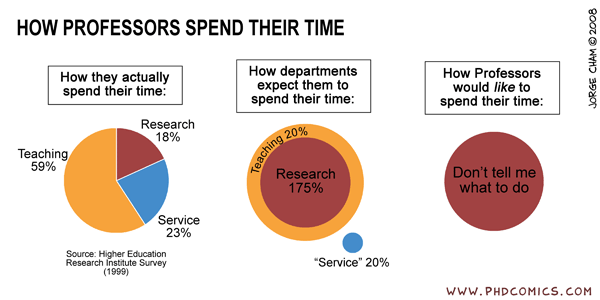
Professors are Like Icebergs? A bit of edumication for the non-Academic

Things tend to go in waves, or, at least we perceive such patterns even if they do not exist. So, the media seems to really like it when professors go bad. For instance, the Georgia prof who killed his family and then himself. Perhaps I am reading too much into it, but there seems to be some delight taken when it is a professor, as opposed to a bricklayer (yes, a vague reference to a classic Trek-ism).

Whoa is us, the poorly understood profession. The classic pet peeve is, of course, "so, you have the summer off, right?" Nothing gets me going faster than that one. Explaining the academic job market to outsiders is always a challenge--how come you ended up in Montreal? Some un-named members of my family still don't get it, thinking that my occasional appearances on Montreal or Canadian TV or in the newspapers somehow makes me a more marketable political science professor. Umm, no.

And, of course, the other classic, usually said with shock and disdain, "How many hours do you spend in the classroom?" Well, our time in the classroom is the tip of the iceberg--it is part of what we do, but only a small part of the job. The rest is less obvious to the passing ships students, parents and media types.

  • Not only does teaching involve preparation, grading, and office hours to meet with students (of which students may or may not take advantage), but it also involves supervision of graduate students. This can take quite a lot of time if the students actually write. The advantage of my previous job is that I had few graduate students, so I didn't spend much time reading stuff. At McGill, I often put it that the grad students do my work (as research and teaching assistants) so that I can do their work--reading their proposals, theses, dissertations, article drafts, etc.
  • Then there is the research. Obviously, this varies--some schools value it more or less than others, but one of the effects of the bad academic job market of the early 90's was to increase the ability of schools to demand more productivity. So, now liberal arts colleges and lesser universities have greater expectations. What is this research? Well, the least humble way to think about it is that we profs create knowledge! So, that is a bit high falutin'. But we write articles and books, which, as my wife noted when I was in grad school, is mostly for others of our kind to read. So, I write mostly so that other political scientists (well, mostly those who are in my subfield) can be convinced of my arguments. In other posts past and future, I address the question of whether this actually matters or not for the greater good. But, research takes a great deal of time--reading the existing arguments, coding datasets, consulting archives, traveling to conduct interviews, writing, etc. This is what gets us merit increases, job offers, glory, donuts, and such. Again, I will defend the research enterprise on another day where I run out of ideas.
  • And, the most hidden and unpleasant part of the iceberg--service. Profs serve on a variety of department committees, including searching for hires, admissions for grad studetns and the like. The most intensive service within departments tends to be those that involve directing the graduate program or chairing the department. Neither are for the faint of heart. Profs help universities run by serving on all kinds of committees, which raises the question of why we need so many high level administrators, but that is a rant for another day. And then there is service to the profession--reviewing manuscripts, tenure files and grants; serving on committees of professional organizations, etc. This stuff is the least recognized by outsiders and least rewarded by departments, at least in my experience. Indeed, there are significant incentives to develop a reputation for being unreliable in the service category--you end up free riding on the efforts of others.
So, that is my rant du jour. Overall, it is a great job, and probably the only one for which I am suited. If I had to do it all over again, I would still choose this profession and this discipline despite the complete loss of control over where I can live. I just might have learned to say "no" more when asked to do stuff, but, then again, I am a collective action sucker.

Monday, May 11, 2009

Changing the Guard: New Direction in Afghanistan

SecDef Gates fired Gen. McKiernan as commander of the US troops and NATO forces in Afghanistan and replaced him with Gen. Stanley McChrystal--a striking move since firing four star generals does not happen too often. Fred Kaplan has an interesting early take on this, but I disagree with the final line: that this war will determine the status of the administration. It is an important war, but Kaplan forgets that the economy is and will be the highest priority of Obama and everyone at home.

One question to follow--did Gates and Obama consult at all with the NATO partners since the new commander will also be commanding NATO troops in ISAF.

Survival of the Fittest or of the Fortunate

As I read this letter, written by a teacher who was sued for being critical of creationism, I can only think how lucky I was that my exercise in critical thinking did not torpedo my career.

At Texas Tech, I taught the Freshman seminar for a couple of years to make some extra cash. It was a course aimed at preparing the new students for life in Lubbock and at TTU. For a week before the term started, and then for several one hour sessions for the first few weeks of the fall semester, we taught time management, money management, note-taking, and other college survival skills, with an emphasis on critical thinking. One of the topics of the course was diversity--that wherever the students were coming from, TTU was going to include people that were unfamiliar--different races, different linguistic backgrounds, different income levels, and even different religions.

So, one of the exercises we were given was to ask the students what an average Texas Tech student was, so that we could realize how much of the campus would be different from the assumed average. The students quickly got the idea that some of their classmates were from places that were smaller than Lubbock and from places that were larger (rural folks, urban folks); that not all TTU students were of Anglo background, etc. It took awhile from them to acknowledge that there was racial diversity, but the big challenge was the religious one. None of the students imagined this as an identity that might vary. So, when I asked if how many people in the group were Christian, all raised their hands--and their notion of Christianity was a pretty narrow definition (Catholics would not have fit, nor would non-evangelicals).

So, one of the students asked: "If we are all Christian (missing the point of the exercise that a significant minority of students at TTU, if not in this group, were not Christian), why do THEY teach evolution?" This was not a question that I was expecting and was outside the focus of the course, BUT we were told to encourage critical thinking skills. So, I turned the question around and asked them, why do you think THEY teach evolution at Texas Tech?

Well, the answers varied, but mostly centered around the theme of: this is what others believe so we should understand it. Finally, after much of this, I suggested to them that evolution (its logic, its applications, etc) are foundational to physics, geology, biology, chemistry, medicine, economics, political science, sociology and beyond. The students uncritically accepted my take. But floored me with the follow up--"So, why don't they teach creation science here?" Since this was a few years before the rise of pastafarianism, I didn't have a ready answer that would not require an explanation of the definition of oxymoron. Instead, I said that we had spent enough time on a tangent and tried to get us back to the central ideas of that day's material.

And now a teacher in California lost a lawsuit for disparaging creationism. Lovely. TTU did back up a biology professor who got into some trouble over this issue--refusing to write letters of recommendation to medical school aspirants if they did not buy into evolution. So my career was probably not at risk....

I will always remember that experience, less because of the fear of a lawsuit, but what it told me about the students and their pre-TTU environment. They had clearly been warned about the teaching of evolution at TTU and the apparent refusal to teach creation science (aka intelligent design). This is not why I left TTU, but it is one of the reasons why I feel more comfortable and less alienated in another country in an area where I am not particularly skilled in the language of the local majority than I did in West Texas.

Something Old, Something New: Shifting Defense $$

Secretary of Defense Robert Gates is attempting cut and shift some of the hundreds of billions of $$ the US spends on defense, and is, unsurprisingly, running into some opposition. Neither the effort nor the obstacles should be much of a surprise. The wars of this decade have revealed, once again, that the US prepares for the wars it wants to fight, not so much the wars it is going to fight, to paraphrase the worst Secretary of Defense in US history (that would be Rumsfeld). Gates wants more spending on unmanned aerial vehicles (UAVs) that can loiter over the battlefield, and less on super-advanced fighter planes that cost hundreds of millions of dollars per plane. He would like to spend less on the planned next generation of army vehicles and more on those that can resist roadside bombs (improvised explosive devices---IEDs).

To be fair, these are not so simple tradeoffs. The US is fighting insurgents because its opponents cannot fight and win a conventional war. The US supremacy on the conventional battlefield does deter opponents and is worth continued investment. So, opponents have to avoid American strengths and fight guerrilla wars.

This guns vs guns debate is complicated by a couple of other dynamics. One of the big lessons learned during my year in the Pentagon was that there is a fetish for having the very, very best equipment. At the time, Rumsfeld sought to cancel the Crusader artillery system--perhaps one of the few good decisions he made. Well, most of the Army guys in my office on the Joint Staff had backgrounds in Artillery since their planning expertise/experience worked well for serving in the Directorate of Strategic Planning and Policy (J-5). So, I engaged these officers in discussions about the Crusader debate. The more senior officers argued, almost convincingly, that in battle you want to have the most capable weapon system possible. That any additional feature that had some added value in war was extremely desirable. But the problem is that it cost $25 millions a gun, five times as much as the reasonably similar German arty system and 3 times as much as the British system. So, there is often a real quality vs quantity debate. The desire to have absolutely the best means having a smaller number. This has significantly limited how many fighter planes the US has.

The second dynamic is the resistance of the defense contractors, who often fight through a variety of strategies to maintain their systems and their profits, including the famous example of the B-1 bomber. It had components built in nearly every state and in over 400 congressional districts--that is an outcome produced not by a desire for optimal production but for the political survival of a contentious project (Ironically, the B-1 is now better suited, thanks to smart weapons systems, to do the work that is planned for the next generation of fighters). And the same continues today with the new weapons systems. Interestingly, in the NYT piece linked above, it appears that these folks are sitting out this debate. Perhaps it is because Gates is not really cutting that much from the big projects but shifting priorities to other things that defense contractors can build.

The third dynamic is Congress. This is where much of the resistance is based, and where it is most significant. Congress has kept alive programs and bases that Presidents and SecDefs have tried to kill. Partly, there may be an honest difference of opinion about how to weigh the present war concerns with the threats (China, China, China, Russia) down the road. Partly, this is an avenue through which Republicans can fight the Obama Administration--an area of party strength at a time where it is declining everywhere else. But there are Democrats who are also pushing back.

Congress's ability to resist depends on its ability to find allies within the military, and those will always exist. The US Air Force has already faced much criticism for downplaying UAVs, which have been a much greater force multiplier than the F-22. The traditional and likely corrrect story is that the USAF is run by pilots who see their livelihoods, egos, missions, power and future budgets at risk, threatened by UAVs--where the U stands for Unmanned.

My best guess is that Gates will win some of these battles but not all of them. When Americans are dying due to vehicles that are poorly designed for a counter-insurgency campaign, it will be tough for the Army to argue that it needs weapon systems that can only operate in a conventional battlefield. The SecDef does have the power to micromanage, as we saw to great misfortune in 2003-04, so that he can send specific units to Afghanistan even if the USAF resists, such as more helos as ambulances. But on the big projects, the chances of eliminating projects are low as long as the systems are built in a majority of Congressional districts.

At least Gates is confronting the reality that the US does not have unlimited $ to throw at the military and has to face tough choices. Up here in Canada, the tradeoffs are more stark, as the much more limited defense budget means that Canada can really only afford one or two branches if it wants to have quality Forces, but not all three. It needs to choose having an Army or a Navy or an Air Force or two of the three, but it cannot do all three very well. As a result of trying to ignore the difficult tradeoffs, Canada buys used submarines from the UK which break down on their way to their new country. The new focus on Arctic Sovereignty and spending money on ships and planes that can operate way up north (although the new icebreaker may only be ready after global warming eliminates its raison d'etre) should mean that the Canadian Army comes home in 2011 and never goes out in the field again. To be clear, I am an Arctic Sovereignty skeptic since Canada will never be able to buy enough stuff to deter the two likely violators--Russia or the US. But it should be obvious that Canada cannot have it all and must make the hard choices, just as Gates is trying to do. Instead, the Canadian Forces often show up around the world willing to do the hard work but having to rely on others to provide much of the stuff they need.

So, ultimately, Rumsfeld was right--you go to war with the army you have, not the one you would like. But, then, perhaps you should spend more effort thinking about whether one should go to war if it means being unprepared.

Saturday, May 9, 2009

Geek Squared! Star Trek and Public Goods

I have a modest spoiler so don't read below if you care about the content of the curriculum at Vulcan Junior High.


Ok, not to give anything away in the movie, but in an early sequence where the various Vulcan kids are being tested on all kinds of knowledge--math, biology, physics, etc--there was one clear social science reference--non-rivalry & non-excludability. These are the defining characteristics of Public Goods, and are central concepts in Mancur Olson's classic Logic of Collective Action. Olson famously (famous enough to make it into the 23rd century and all the way to Vulcan) argues that it will be difficult to cooperate to provide Public Goods--when one's usage of a good does not reduce its availability for others and where non-contributors cannot be excluded. In such cases, free-riding is not only likely but the logical course of action.

Olson's insights here, while often contested, have shaped how we think about political mobilization, the need for government/coercion, and especially the environment. Why recycle? If I do it and no one else does, my effort is wasted. If everyone does it but I do not, then the planet is clean and my marginal waste is irrelevant.

It is especially ironic that Public Goods appears in the new (and rockin') Star Trek because the logic of collective action largely produces a pessimistic, cynical outlook towards human nature and the possibility of cooperation but ST is all about an optimistic vision of the future. Perhaps the new writers of ST mythology, JJ Abrams and the gang, are trying to square the geek circle--that we can overcome the collective action problem and that we will so that we get this amazing future of the Federation of Planets, in which Starfleet is explicitly referred as a force for humanitarian efforts and peacekeeping. Indeed, for a minute, it sounded like the conventional perception of the mission of the Canadian Forces before Operation Medusa in Afghanistan in 2006 (first major combat for Canada since the Korean War).

Of course, Olson and his successors provide a variety of ways out of the collective action problem: small groups can mobilize as their members perceive their contributions as mattering; individual entrepreneurs can see it in their interests to facilitate and even underwrite cooperation; and the like.

To sum up, it was just a fun movie that made a very interesting and deliberate reference that is far more intriguing to me than the volume of a cylinder--another example in that sequence in the movie. This is not the first time that Star Trek has overlapped with social science, and it will almost certainly not be the last, given the box office success it is having. Live long and prosper, indeed.

Ask The Reader: To Wiki Or Not To Wiki

While my readership is not large enough for polls to work out, I will be asking for your thoughts when I am seriously confused. Which should be almost every day.

The question du jour is: Some people have posted my name on Wikipedia with a short, positive but inaccurate (although not entirely wrong) summary of my career. Should I revise it, so that it is accurate? How much shameless self-promotion is too much?

I will ponder this today while watching the ads before the trailers before Star Trek.

Friday, May 8, 2009

Group Think Follow-Up

Earlier, I wrote that this administration was less likely to be a victim of groupthink than the previous one. Well, we have some evidence to suggest that Obama is deliberately trying to avoid this tendency:

It’s not that Barack Obama isn’t aware of what’s at stake. That’s very likely why on April 27, the president gathered in some of his chief outside economic critics ..... Why did Obama hold the meeting? “I think he wanted to hear the [opposing] arguments right in front of him,” says Blinder. “All I can say is if the president of the United States devotes that much personal time, and it was about two-hour dinner, he must want to hear what people outside the administration are saying and hear what his own people say in rebuttal to that.”

How cool is that? Very cool.

Another One Bites The Dust

For fans of baseball, it has been an incredibly sad decade. Yesterday's news that Manny Ramirez seems to have made a bigger impact than when we learned/admitted that other players had cheated the game, whether it was Mark McGwire, Sammy Sosa, Roger Clemens, Alex Rodriguez or Barry Bonds. Perhaps it is because Manny got caught for doing it now and the suddenness of the news, as opposed to growing suspicions about the others. Perhaps it is because Manny was more likable, particularly compared to A-Rod, Clemens or Bonds. My favorite sports blogger had a great column on this yesterday, depicting a future conversation with his son, trying to explain how the 2004 Red Sox miracle might not be totally soiled or spoiled. And failing miserably. As a Mets fan, I guess I should be thrilled that my team probably did not cheat in 1986 much, before the real peak of the steroids era, but instead only fell far short of what it should have been due to epic abuse of performance-ruining drugs. Should I be happier about Doc and Straw ending their careers with coke, rather than prolonging them via HGH, steroids and the like?

Baseball purists will argue that PEDs matter more here than in other sports because of the stats that we hold dear, that we can compare baseball players across the years. The drugs of today, they argue, undermine these comparisons. But, as a social scientist, other comparisons come to mind: Babe Ruth didn't compete against all of the best players, since Blacks were not allowed to play; greenies played a big role in the 1950's and beyond; etc. The Sports Guy has ruined Field of Dreams for me forever, as he noted that only white ghosts seemed to play in Kevin Costner's cornfield.

So, where does all of this leave us? This morning, I had two conversations, one with my daughter and one with my wife, about progress and inertia. We didn't put it like that, but, while going to school this morning, my daughter wondered why ethnic hatred still exists (after my mentioning the classic Trek episode), and I mentioned not just Obama as President, but also the other ethnic divides that no longer have much resonance today. When was the last riot between Italian- and Irish-Americans? And then, I come home, and my wife reacts to a story about the Obama Administration with frustration that progress on gay rights still seems to be blocked by Christian right. I considered the state by state victories of late, the need for Obama to focus on the veritable cornucopia of policy disasters he inherited, and the lessons from Clinton's early days, and suggested that there is progress.

I guess I should take my family's frustrations to heart--that there is progress, but there will always be challenges that have not yet been met and new ones that arise. In baseball, we do have significant questions about the recent past, but the game, with the influx of players from around the world, is more competitive than ever before, and the displays of talent are amazing. I don't follow basketball that much, but whenever I switch the channel to a game, particularly one with Lebron James, I quickly become amazed at the athleticism.

In terms of ethnic conflict, my daughter is correct that we should be beyond race by now, as depicted by Star Trek, when Kirk and Spock wonder about how people can be judged by the color of their kin. But we can appreciate how far we have come. A lot of people didn't think Obama had a chance, that there were too many racists out there, and so on. And while it took an unpopular war and a disasterous economic situation to clear the way, Obama was able to gain votes from all ethnic groups in significant numbers. He may not be the messiah, but his election symbolizes the progress made in my lifetime, from the assassination of Martin Luther King to a black President.

Funny, I didn't intend to write about race when thinking about baseball, but the two have been interwined as integral parts of American life.

Wednesday, May 6, 2009

The Nationalist Tax: Where Does It Go?

I changed the subtitle to this blog, suggesting that I would occasionally discuss ethnic politics, which has been the focus of most of my research. Given that my work has mostly focused on separatism, it was ironic that I ended up in Quebec (although Texas, with the recent mutterings by Governor Perry, would have been appropriate as of late). My usual line is that Quebec is a great place as a scholar of secession, but a lousy place to be a taxpayer. I would suggest that the two are related.

I have begun to semi-seriously consider the following puzzle: taxes/fees are higher in Quebec than in the rest of Canada [ROC is a standard acronym up here] or than any state in the US, yet, objectively, the various functions of the Quebec government seem to be, well, dysfunctional, and perhaps far worse than most of the other provinces. For example, one can immediately tell when one's car is leaving the province by the sudden smoothness of the roads. The excuse is that winter is bad for the roads, but I think that Vermont, New York, and Ontario have severe winters as well. The health care system is problematic, with hospitals that seem to be falling apart and significant waits. One friend had to have his finger re-broken as he was waiting in the ER so long it had set.

The obvious difference between Quebec and ROC is the nationalist cause. Why is nationalism in Quebec associated with higher taxes and lesser service/public performance?

1) Spending on nationalist projects: Perhaps the government spends lots of tax dollars on the language police (arms of government dedicated to enforcing the primacy of French); the delegations abroad (Quebec has pseudo-embassies to present the Quebec nation); and the like. The problem with this argument is that this really isn't that much money, compared to the revenues and expenditures. Plus plenty of federal units have some kind of foreign policy, involving representatives abroad even if Quebec flushes more money on this.

2) Nationalism + Unions = No Good: The unions in Quebec are much stronger than unions in the ROC (I think) and in the US (absolutement!). AND the unions have been tied to the Parti Quebecois, which has been the party of Quebec separatism. So, when the PQ is in power in Quebec, perhaps unions get sweetheart deals. It is clear that when the Liberals (a federalist party) are in power, the unions tend to do their best to undermine them. I do think, but have no facts at hand, that Quebec employs far more people than it should, perhaps due to the power of the unions, but these government employees, except at the top, are not overpaid. Indeed, wages are lower in Quebec than elsewhere in Canada. So, this may be a factor, but not a big one, I think.

3) Elections Are NOT About Public Service: I think the key is that the nationalistic politics have caused elections to lose their essential accountability function. That is, instead of competing with each other based on who is providing the public goods, each election with a notable exception has turned on whether the public is more or less alienated by Canada or Quebec at that moment. It was quite amazing in a recent provincial election (2007) when there was a three party race between the Liberals, the PQ and the ADQ (a slightly right-center party with an anti-immigration platform) and suddenly, with the thrashing the PQ received, attention was briefly on public service. Indeed, one of PQ leaders said, "I guess we are going to have to focus on public service now."!!!!! In the aftermath of this election, the Liberals seemed responsive, but now that the ADQ has collapsed, the status quo ante has returned, I think.

A fourth explanation is that there is a fetish here for big projects and one-size-fits-all solutions that lead to tremendous waste with the 1976 Olympics as the exemplar. I need to work on this one some more.

Finally, yes, I have used words separatism and secession rather than sovereignty. I will work on the semantics of Quebec separatism in a future post.

Tuesday, May 5, 2009

Stats Versus Stories and the Zero Tolerance Society

One of the problems we face is that our experiences tend to color (wow, almost typed in colour--another sign of being in Canada for seven years) our perceptions so much that salient stories tend to overwhelm reality--reality as defined by statistics. The classic example is that there is less crime than there used to be but people actually believe crime is still peaking. This is largely because the media focuses on the stories of crimes rather than the non-stories of non-crimes. This leads to all kind of behavior that diminishes how we experience life.

This was made clearer to me when Steve Greene, not only a blogger but also FB friend, linked to article covering Lenore Skenazy and her new book, Free Range Kids, that asserts that our kids are just as safe as we were when we were growing up. While I find her willingness to let her nine year old ride the NY subway on her own a bit troublesome (tempting fate?), clearly we have gone overboard trying to safeguard our kids. Kids are safer waiting with each other (parents tend to wait these days with them) at bus stops than, well, riding in the busses or, worse, in our cars. One of the on-going arguments in my own house has been whether there are more predators than before, or that they are simply revealed and covered more than in the past. The odds, Skenazy, suggests are against any individual kid being harmed, so we need to evaluate critically the relative risks and benefits of safeguarding versus "free ranging" our kids.

I did plenty of stupid things completely unsupervised when I was a kid and managed to survive with all of my fingers and toes and only a few scars. I also saw far more inappropriate movies than my parents would probably admit these days. So, I think I should generalize from my own experience that we worry too much. And the stats are on my side!

And this leads to a frequent rant of mine--that we now live in a zero tolerance society where institutions set up rules that are enforced rigidly rather than adjusting to circumstance. A kid says, "I want you to die" and then is suspended even though he had no intention of killing anyone. I certainly would have liked certain people to die when I was in middle school, but had no intention of killing them. The new book on Columbine should help clarify how we prevent and react to such events, but I am afraid that the early lessons drawn will be the ones that last. Oprah canceled her show on the book because it focused too much on the killers, missing an opportunity to try to replace the old myths with some useful, fear-reducing truths. The good news is that the police have learned new tactics to deal with such events and are prepared for them. The bad news is that schools and other institutions will focus on reducing all risks as much as possible, particularly the risk of lawsuits, and reduce the discretion that the teachers and principals should have.

And this matters for international relations as well. My current work, with David Auerswald, is on the varying levels of discretion the commanders have in Afghanistan, and, by extension, elsewhere. NATO has been caught in a series of debates and conflicts over the burden-sharing problem in Afghanistan--some countries are facing much higher risks than others, with Canada quite visibly bearing a disproportionate burden. These national restrictions, a.k.a. caveats, are not new, but are quite important because the less flexibility the commanders on the ground have, the less able they are to respond and adapt to the insurgents.

Our analytical question is on the how and the way of degrees of discretion, with a sometimes obvious judgment that more discretion is often better. Certainly, six years of Rumsfeldian micro-management has made more discretion appear to be the better choice. To be clear, the decision to delegate should not be automatic either, as often major and not-so-major decisions about war are too important to be left to the generals. This is something I am trying to figure out--no easy solutions come to mind.

And, of course, I am a hyprocite as a recent article in the local Montreal newspaper indicated that the risks of speeding far outweigh the rewards, particularly for short trips. Despite the fact that the stats used in the article ignore the incredibly lengthy and poorly designed traffic lights in Montreal (which make beating the light more important), the point is well-taken. But will I change my behavior? Not likely.

Monday, May 4, 2009

Cognitive Consistency is the Hobgoblin ....


Robert Jervis's Perception and Misperception in International Politics was one of the key readings that got me hooked on IR as an undergrad. Or at least, that is what I think I remember. As a consequence, my default expectation of others is that they will look at reality through a particular lens and ignore information that does not fit, or squeeze that info into their mental boxes (lens, box, yes, mixing my metaphors). Of course, the problem is that a lens or box (a theory, that is) is only suitable part of the time, so if you only have a limited repertoire, you are going to wrong much of the time. My focus in my Intro to IR class is to present a bunch of theories so that students will be armed with multiple lens and hopefully shift to more appropriate ones as circumstances change.

For instance, there has been a debate the past few years about why the US invaded Iraq and did it so badly. This was particularly galling to those whose theories focus on countries responding rationally to threats as maximize power (Mearsheimer) or security (Walt). Because US behavior appalled them so, they ended up jumping far from their comfort zone of systemic forces to domestic politics and came up with a controversial argument about the Israel lobby (accused of being anti-semitic, but my concern is the quality of their social science). The problem is that neither was trained nor inclined to think systematically about domestic interest groups or diasporas and did not rely upon existing work in these areas to build a good argument about why one set of interests was able, they asserted, to trump the national interest.

Had they been my undergraduate students, they might have considered other theories of decision-making, especially groupthink. The most clarifying statement Bush ever made about his role as the "Decider" was when he said that he didn't read the newspapers, but relied on his advisors to keep him informed. This, plus my experience in Rumsfeld's Pentagon, where he ruled through fear, suggest that the key dynamic was not AIPAC or other interest groups drove Bush Foreign Policy, including the bungled Iraq expedition, but that administration lived in an echo chamber where new information was only useful insofar as it supported pre-existing preferences and plans.

Why does this matter now? Because we should not hold onto groupthink as the rosseta stone for understanding the Obama Administration. We don't know enough yet about how decisions get made, but it seems pretty clear that this group is far less insulated and far less ideologically committed than its predecessors. So, what can we predict? This administration is far less likely to be consistent than the previous one as it is probably more sensitive to new information, to domestic interest groups, and international pressures. After all, this is a reality based group, unlike its predecessors.

Sunday, May 3, 2009

Movies, TV and IR Theory, oh my!

Every once in a while, folks tend to focus on the same thing. In this case, there are a few blogs all focused on which movies are the best ones for International Relations scholars/classes. Stephen Walt, Dan Drezner, and the Duck of Minerva considered a variety of movies and their relevance for IR. Below, I note a couple of noticeable omissions and then move on to TV, which these folks almost entirely ignore.

Missing Movies:
  • Perhaps because the Monty Python crew focus more on classical questions of comparative politics, the Holy Grail and Life of Brian are not mentioned. The former does a great job of addressing state building and the sources of political legitimacy. The latter helped clarify for me the politics of the middle east, but also the fissile nature of political mobilization.
  • Kelly's Heroes: The lists by the others above mention a few classic civil-military relations movies, but here is another--that looting is a temptation that may undermine control of the guys on the ground.
Television and IR:
There is much from TV that we can use to illustrate our points and helps to reveal some of the dynamics in play in international relations.
  • One must begin with Star Trek in its various incarnations, especially the classic version, Next Generation, and Deep Space Nine. The classic Trek was hardly subtle about anything, including episodes named "Balance of Terror," "The Doomsday Machine," or "Day of the Dove." Alliance politics, deterrence, arms races, not to mention the question of whether to intervene or not (the Prime Directive was violated on a regular basis), and ethnic conflict all showed up repeatedly. Next Gen addressed the same issues, but with more subtlety. DS9 seemed to be more of a Middle East conflict--refugees, terrorism, occupation, and the like.
  • Babylon 5 was explicitly a space station dedicated to being the UN/Switzerland of the various civilizations. Very interesting alliance politics, explicit efforts at diplomacy, ethnic conflict, etc. Indeed, just as Classic Trek had an episode about ethnic conflict (black/white people vs. white/black people, leading to mutual annihalation), B5 had an episode where this one group of aliens divided every few years randomly by selection of green and purple scarves, providing a very clear example of imagined or invented identities. I would show both in my IR of Ethnic Conflict class because each clearly showed the implications of identity for intervention--do nothing if there is ancient hatred, intervene if identity is invented.
  • The new Battlestar Galatica had many IR-ish elements as well--the aftermath of conquest and genocide; civil-military relations including a good model of a coup attempt in one of the last episodes; and the interaction between civil wars and international conflict (intra-Cylon dynamics affecting Human-Cylon conflict).
  • Lots of stuff the past few years on interactions in the absence of government: Survivor, Deadwood, and the first season or two of Lost. In each, we have a model of anarchy, like international relations, where there is no legimate authority, where competition is relatively unregulated, and where the fittest survive and thrive. But what each demonstrates, particularly the latter two, is there are multiple strategies to survive and thrive under anarchy. Nature shows are also good for demonstrating this specific point.
  • The first couple of seasons of Happy Days--each episode consists of Richie and his father, Howard Cunningham, teaching Fonzie, the most powerful actor in the system (because of his reputed fighting prowess and his keen ability to attract females) the appropriate way to behave. What better demonstration of constructivism's logic of appropriateness?
  • Any other suggestions?

Saturday, May 2, 2009

Wolverine, Reality TV and Social Science

  • Wolverine
People who know me know that I am big fan of movies, TV, and books, including comic books. I used to collect, especially X-Men and Spiderman related titles, until the choice became diapers or comic books. It was easy to make the break at the time as the plots of the books at the time went deeply south and Marvel was proliferating titles so it really became hard to follow a single group or character without buying4 or 5 books a month. Anyhow, the past several years have been a bonanza for those with my interests--heaps of good to excellent comic book-based movies: X-Men, the new Batman, Iron Man, etc. So, we saw Wolverine today, and I will not talk about it much for about a week so that my three or four readers are not spoiled. I will say two things:
  1. definitely a fun movie to see in the theatre with all of the noise and effects; and
  2. After seven years in Canada, it has struck me how un-Canadian Wolverine is. Yes, his roots in the books and the movies are in Canada, but the opening montage shows him fighting in American (and Union) uniforms. Wolverine is one of the most aggressive superheroes in the Marvel universe--he has killed; he was prone to beserker rages early on (I don't know how he is portrayed in the books these days); he is a loner, etc. Canadians are surprised that their military is trained to fight and kill; always seek consensus (hence the eh? that is either implicit or explicit); and are pretty calm if they are not Montreal drivers. Perhaps that is why Wolverine spends most of his time in the US.
Reality TV and Social Science:
While biking today, I was listening to my favorite podcast: the Sports Guy, a columnist for ESPN and former poli sci major, about 4-6 years my junior with a similar passion for pop cultural references. His conversation about a favorite Reality TV show reminded me of something I have been thinking about for a few years. I wish I had a research agenda that required experimenting on people. That's right--on people. Malcolm Gladwell's Tipping Point reminds us of the dark ages of social science, with various conversation experiments on people--the Milgram authority/shock experiment; the Stanford Prison experiments; etc. Now, each university has a research ethics board to approve any funded research that involves experiments or people. I have had to fill out the forms so that I could interview military officers about their experiences. My students have had to do the same. So, it would be very difficult or impossible to get approval to do morally questionable research on people today.

And that is why we might want to turn to reality tv game shows. Rather than getting funding from an established foundation with procedures for treatment of human subjects, if one has a question that requires putting people through troublesome situations, there is now an alternative. It does not take much viewing of the various reality TV shows to see that young and not-so-young people are willing to do pretty much anything for a modicum of cash and/or their 15 minutes of fame. We can already learn much from the first season of Survivor about how people react to competition with few rules and modest manipulation. We can learn from the subsequent seasons how people learn and imitate as the strategies of the first season, such as alliances and duplicity, are applied anew or not so anew.

If only I had testable hypotheses about individuals or small group behavior?!

Friday, May 1, 2009

Piling on Condi?

Condi Rice has been getting a fair amount of attention lately, including an embarrassing incident on her old home court--Stanford. She is currently trying to defend some indefensible behavior--particularly torture.

Before going on, I must admit a couple of things:
  • on 9/11, I was in the Pentagon before and after the attack, but not during (for my 9/11 story, click here), so I do have a somewhat visceral action to that event, and wanted to see the people who were responsible put on a plane that would crash into a convenient ocean.
  • during my fellowship on the Joint Staff, I did take part in a process through which terrorists were sent from Bosnia to Gitmo--the first non-Afghan combatants to be sent there.
So, I do understand only too well some of the pressures and difficult decisions that faced the Administration after 9/11. The problem is that President Bush, as advised by Rice, made pretty much every bad decision possible. Indeed, after my year in the Pentagon, I knew that Rumsfeld and his shop would screw up the Occupation (largely because of his fearsome, groupthink management style), but I didn't realize then that they would consider the list of things not to do as a checklist of things to do: fire the Army, get rid of the entire senior and middle level strata of the civil service, use only the fewest possible troops, keep all experts away from the process, etc.

[See Ricks, Fiasco; Gordon and Trainor, Cobra II; Packer, Assassin's Gate; Chandrasekaran, Imperial Life in an Emerald City; among others. I read but do not recommend (except for those doing research or seeking to lose brain cells) Bremer, who seems to be lying to himself, and Franks, who was well-suited for interacting with Doug Feith, as both were the dumbest @#$#@$ers and makes me both curious and sad that the Army could allow him to rise so far. I do plan to read LtGen Sanchez's book this summer as he ran the military side of things while Bremer was running the Coalition Provisional Authority (CPA was said to stand for Can't Produce Anything); and Rick's new book, The Gamble, on Gen. Petraeus and the surge.]

The best evidence, in my mind, for Rice's epic failure to serve as an adequate National Security Advisor is that Jerry Bremer fired the Iraqi Army despite the decisions taken by the President and others to choose a more reasonable course of action. The damning evidence is really the fact that we do not really know today whether Bremer or Rumsfeld really made this decision. Since Rice's job as NSA was to coordinate foreign policy, she should have put in place a process so that Bremer's big decisions would have to be vetted by the relevant agencies--State, NSC, the Office of the SecDef, and the Joint Staff. In my time in DC, nearly all decisions of any consequence in the Balkans went through each agency at the appropriate level (at a lower level after 9/11 when the Balkans moved to the back burner of US foreign policy) with lawyers for each agency "chopping", that is assessing their legality. That Bremer, Rumsfeld and others can point fingers at each other (see No End in Sight, a great and depressing documentary) for perhaps the single dumbest decision in US foreign policy since ..... supporting the French in 1945 when they wanted to get back into Vietnam.

One can debate whether invading Iraq was a good or bad idea, but firing several hundred thousand young men with guns and training and knowledge of the locations of arms/explosive caches, at a time where folks in the interagency (Joint Staff, State, etc) were trying to find ways to reduce the Bosnian militaries by a few thousand without creating a pool of resentful young men, was incredibly dumb. This single decision lead to many unnecessary deaths--Iraqi, American, British and others. And the blood is on the hands of Bremer, of Rumsfeld, of Bush, and of Rice. While the focus today is on torture, and deservedly so (see my friend Steve's blog for an on-going discussion of the torture discussion), if we calculate the numbers of people directly harmed (as opposed to the damage to American influence or values), the number of torture victims must pale in comparison to the casualties after June 2003 on all sides.

Of course, the best is yet to come as Rummy is apparently writing a book where he says he was against the war in Iraq.

First Crash

Second day, first crash. Not just to my blog, but to a bunch. I think it is fixed, but who knows. Thanks for your patience!

Surprised, Troubled, Enchanted and Humbled


I found the
question at the press conference by the New York Times reporter to be quite, well, surprising, troubling, enchanting and humbling. That is, it is surprising and troubling that the NYT is asking college entrance exam questions at a televised press conference. Where is Peter Baker, ace reporter for the NYT and formerly of the Washington Post, and even more formerly of the Oberlin Review (and my roommate my first year at Oberlin), when we need him? The question deepened my enchantment with Obama becaues he was able to respond quite well to this bizarre question. I can only imagine that the previous president might have cackled a bit, answered one or two parts inadequately and then moved on. And I am humbled by how smart our new President is. He will not always be right, and I will find much with which to disagree, but as a professor, I probably over-value intelligence, so President Obama impresses my socks off.

Thanks to this question, I have been given a gift--a gag I can run with for days and months when I run short of other ideas. So, here is my
STEH take of my first 100 days and 6.5 years or so in Canada:
  • Upon moving to Canada, I was most surprised that while one can get a liter of milk in a plastic or cardboard carton or jug, you cannot get the gallon equivalent in anything but a plastic bag.
  • I am most troubled that Canadians are often satisfied with comparing themselves and their systems to the U.S. rather than considering other, better alternatives. The most glaring example is that Canadians tend to be critical of their health care system, but do not imagine significant changes because they assert that their system is better than the U.S. Instead, I would suggest that they ought to compare their public health care system to the most functional public health care systems in Europe and elsewhere.
  • I am enchanted by the passionate curiosity Canadians have about the world around them, despite the aforementioned acceptance of the US as the comparison category. In my classes, on the streets, and everywhere else, people here want to know more about the entire world. In West Texas, the media always had to ask--what does this mean for the folks here? In Montreal and in Canada, they don't have to do that.
  • I am humbled by the ability of most of the Montrealers with whom I interact to converse in two or more languages with such a facility that conversations move back and forth among the various languages from sentence to sentence.
Of course, the reporter could have used different passive verbs: enraged, puzzled, confused, seduced, alarmed, depressed, energized, constrained, coerced, etc.