Folks have been picking on the last episode for a variety of unrealistic or unearned developments. Here's my take on the secessionist element below the break.
Showing posts with label secession. Show all posts
Showing posts with label secession. Show all posts
Monday, May 20, 2019


Tuesday, March 26, 2019
Good News About Brexit!
 Brexit is a mitigated disaster. What mitigates it? It makes me feel good about my stances on secession in advanced democracies. Huh? Basically, all the reasons I have opposed secessionism in otherwise functional countries have played out here. And, yes, Brexit is secession.
- 50%+1 is a crappy rule to make decisions about massive social/political change. It is too thin--there is not enough consensus, which means not just parties fighting but parties divided on this. You can't tell your Leavers/Remainers without a program. I was reminded by the ever-wise Peter Trumbore that Theresa May was a Remainder until she became Prime Minister.
- Proponents of secession will play down all of the likely costs, making it seem as if nothing will change except for the few things that annoy people the most (paying into the system, mobility of undesired folks). Yet as things progress, we find out all kinds of costs and complications including Northern Ireland!
- Defenders of the status quo will be slow to mobilize as they will take for granted that secession would be a dumb thing to do.
- Outbidding and fears of it cause leaders to do dumb things: David Cameron feared his right flank and promised to hold a referendum that would surely not go anywhere.
- Most importantly, unless one is facing serious repression, secession is just not worth it. I might end up supporting renewed Scottish separatism simply because I could sympathize with them that they don't want to go down with the ship of fools that is being led by May and Corbyn.
Saturday, October 28, 2017
Secessionism is Hip Again: Catalonia Edition
When I started writing my dissertation long ago in a galaxy far away (early 1990s San Diego), I had a problem: each day there seemed to be a new secessionist crisis, which meant re-writing the intro chapter every day. I eventually learned a key pro-tip: write a very drafty intro and then leave it behind and then re-write it LAST since the diss/article/book will inevitably change somewhat. Anyhow, I am having deja vu, what with the Kurds and then the Catalans making news.
I have not studied the Catalans, and I have not been able to pay much attention because I have lots of other stuff getting my attention (yeah, full profs need to remember how to say no, pro-tip deux). But I did write a bunch of stuff back when I was a junior prof that applies now. While much of it was on the International Relations of Secession (see ye olde ties that divide or "Discrimination in IR"), I did do some data stuff on separatism. One of the clearest findings then and now is this: groups that lose autonomy tend to be separatist. Oh, and groups that lose their institutional means of expressing dissent may resort to violence.
So, while the Catalans may not have played this brilliantly, the government of Spain has been dumber. There really was no reason for Spain to jump so hard and so fast on the Catalans. Before the past several months, Catalans were ambivalent about secession. How to reduce that ambivalence? Revoke their autonomy and do other things to make the Catalans feel as if they cannot exert their voice in a democratic Spain. What should Spain should have done? Arrogant for me to say from my position of ignorance, but here I go: not much. Spanish leaders should just not have recognized the referendum as happening. "Oh, you guys are lining up to vote on something purely symbolic? How cute."
What has worked in Canada could have worked in Spain: give the separatists enough of what they want that it becomes hard for them to win a referendum. Sure, sometimes you get a nail-biter, but it is easy to imagine what would have happened in 1995 if Canada had been heavy-handed. Yes, more decentralization can lead to more demands and perhaps more separatism, but doing the opposite does so more quickly and, more importantly, can lead to violence. As Spain shuts off the ability of the Catalans to win democratically, it would not be surprising if some Catalans became radicalized and started using violence.
Then again, unforced errors are all the rage these days: Brexit and Trump and now Spain v Catalonia. So, we can pile on the Spaniards for messing this up, but damn our houses of glass are broken.
I have not studied the Catalans, and I have not been able to pay much attention because I have lots of other stuff getting my attention (yeah, full profs need to remember how to say no, pro-tip deux). But I did write a bunch of stuff back when I was a junior prof that applies now. While much of it was on the International Relations of Secession (see ye olde ties that divide or "Discrimination in IR"), I did do some data stuff on separatism. One of the clearest findings then and now is this: groups that lose autonomy tend to be separatist. Oh, and groups that lose their institutional means of expressing dissent may resort to violence.
So, while the Catalans may not have played this brilliantly, the government of Spain has been dumber. There really was no reason for Spain to jump so hard and so fast on the Catalans. Before the past several months, Catalans were ambivalent about secession. How to reduce that ambivalence? Revoke their autonomy and do other things to make the Catalans feel as if they cannot exert their voice in a democratic Spain. What should Spain should have done? Arrogant for me to say from my position of ignorance, but here I go: not much. Spanish leaders should just not have recognized the referendum as happening. "Oh, you guys are lining up to vote on something purely symbolic? How cute."
What has worked in Canada could have worked in Spain: give the separatists enough of what they want that it becomes hard for them to win a referendum. Sure, sometimes you get a nail-biter, but it is easy to imagine what would have happened in 1995 if Canada had been heavy-handed. Yes, more decentralization can lead to more demands and perhaps more separatism, but doing the opposite does so more quickly and, more importantly, can lead to violence. As Spain shuts off the ability of the Catalans to win democratically, it would not be surprising if some Catalans became radicalized and started using violence.
Then again, unforced errors are all the rage these days: Brexit and Trump and now Spain v Catalonia. So, we can pile on the Spaniards for messing this up, but damn our houses of glass are broken.
Monday, March 13, 2017
My Current Secessionist Stances
I generally oppose secession in democracies since it usually is very costly for all, and these groups usually have ways to have their interests addressed while staying put (yes, Quebec, I am speaking of you).
So, what do I think about the two hypothesized secessionist efforts: Scotland and California/Blue America?
I opposed Scottish separatism the last time because I didn't think the benefits were good enough, and the Scots seemed to have enough sway to get what they needed while staying in. Um, now? Oh my. I think that Brexit essentially represents the English reneging on the deal, that it is being yanked out of the EU. Sure, it may take time and heaps of paperwork to rejoin, but I could see why leaving the UK as it tries to destroy itself might be a good move. So, I am no longer opposed.
California/Blue America? In short: FFS. The plight of Blue America is, if the institutions are not destroyed utterly, temporary. Opting out because of a lost election is very much antithetical to democracy. If Trump utterly subverts the system and the US is no longer a democracy, then one can speak of separatism. But Blue America needs to stay put to rescue the rest of America from Trumpism. Leaving would consign all of the nonTrump people of remnant America to perpetual awfulness. Stay and fight, damn it!
Of course, the only folks who are serious about California secession are Russians, so maybe any fellow travelers/useful idiots might want to think about why that might be the case. Let's focus on resisting Trump, not surrendering to him, shall we?
--Sincerely, Cranky Steve
So, what do I think about the two hypothesized secessionist efforts: Scotland and California/Blue America?
I opposed Scottish separatism the last time because I didn't think the benefits were good enough, and the Scots seemed to have enough sway to get what they needed while staying in. Um, now? Oh my. I think that Brexit essentially represents the English reneging on the deal, that it is being yanked out of the EU. Sure, it may take time and heaps of paperwork to rejoin, but I could see why leaving the UK as it tries to destroy itself might be a good move. So, I am no longer opposed.
California/Blue America? In short: FFS. The plight of Blue America is, if the institutions are not destroyed utterly, temporary. Opting out because of a lost election is very much antithetical to democracy. If Trump utterly subverts the system and the US is no longer a democracy, then one can speak of separatism. But Blue America needs to stay put to rescue the rest of America from Trumpism. Leaving would consign all of the nonTrump people of remnant America to perpetual awfulness. Stay and fight, damn it!
Of course, the only folks who are serious about California secession are Russians, so maybe any fellow travelers/useful idiots might want to think about why that might be the case. Let's focus on resisting Trump, not surrendering to him, shall we?
--Sincerely, Cranky Steve
Friday, June 24, 2016
Instant Hottakes on Brexit
 We will have much, much time to ponder and study what happened yesterday... whether it was the weather that made the difference in London, why Cameron was such an idiot, and on and on. I have a few quick reactions guided by and due to my faith in confirmation bias!
- While I am kind of surprised by the results, I should not be as I co-authored a book that argued that individuals and leaders will often embrace xenophobia for its short term allure despite the great costs to the country. That is why we named the book: For Kin or Country: Xenophobia, Nationalism, and War (now available in an updated 2015 paperback version!). That Brexit did well in England but not in Scotland or Northern Ireland (Wales confuses me as it always does--not enough vowels) is not surprising, AND neither does the fact that most of the polls indicated that the relationship between fear of immigrants and support of Brexit. The strange thing, of course, is that the UK was not part of the Schengen system so it still had much more control of its borders and of immigration than the rest of the EU. So, leaving the EU does not really "fix" the "problem" of too much immigration.
- Events like these have huge ramifications for those inside that country, including potentially more separatism, but not so much elsewhere. In short, direct effects matter a lot [update: see statement by Scottish National Party leader], but indirect lesson learning does not. Why? For the former, the exit will directly affect the interests (incomes!) and power of those inside the UK, leading to stronger interests on the part of the Scots to leave (although it may not be as instant as some might have thought). For the latter, the problem is that there are multiple lessons to learn. For those who want to leave the EU or separate from their current country, they can look at Brexit and say: they did it, we can do it too, taking away the positive lessons. For those who don't want to leave the EU or secede from wherever, they can observe the economic shocks and other painful consequences and learn that this would be awful for them. Let confirmation bias be your guide, I always say. Again, multiple lessons to learn, so which lessons will people take away? The only common lesson will be that David Cameron will go down in history as one of the worst Prime Ministers of all time.
- Already folks are worrying what this says about Trump--that if the wave of populist nationalism can break the UK, then shouldn't we worry about Trump getting more votes than we expect? Um, no. Why not? First, the electoral college means that the US election is not a pure referendum where mobilizing the cranky can lead to a win. Trump would have to do very well across a number of states, including some very diverse ones. Second, while whites are a majority in the US, white men are not. I don't know what the gender breakdown of Brexit was, but in the US, Trump has been quite successful at alienating not just non-whites but women. Third, there is a huge imbalance in the American election in terms of organization, skill, discipline, resources and resources and resources--Hillary Clinton and the Democrats have a huge lead here that Trump will not be able to surmount, especially as potential donors ponder whether Trump is using the campaign contributions to win the election or to save his failing businesses. I have no idea what the balance was in the UK. Fourth, the GOP is divided, with vulnerable Senators running away from Trump as fast as they can. Yes, the Dems are currently divided with Sanders still not dropping out (oy!), but eventually he will. That HRC is ahead despite Sanders sticking around is a testament either to her strength, revulsion for Trump or both.
- Most importantly, Lindsay Lohan is relevant again!
Alas, she seems to have deleted all of her anti-Brexit tweets.As if we weren't already headed towards a freaky Friday https://t.co/Epkvv3Khny— Jake Tapper (@jaketapper) June 24, 2016
Anyhow, for those outside of the UK, we don't need to panic much. For those inside, I am so sorry for your loss.
Tuesday, June 21, 2016
Brexit Contagion? NO!
I got into a twitter conversation with a Canadian columnist about the implications of Brexit for Quebec/Canada. My short answer: t'ain't none. Or, damned little. Why? Mostly because much of my early work (and more recent stuff) points against political movements changing significantly due to observing events elsewhere.
Brexit is akin to secession, but secessionism is not contagious. Politicians and publics respond most strongly to the domestic political conditions that they live with and provide incentives. If a piece of a federation leaves, then sure, that affects the various actors within that federation. So, secessionism was contagious within Yugoslavia and the Soviet Union. BUT outsiders who are not impacted directly can learn both positive and negative lessons, and they will tend to learn those that reinforce their existing preferences--confirmation base and cognitive closure have a huge impact here.
For example, the Quebec separatists were following the Scottish referendum very closely until the Scots said nay. Then the Quebec separatists basically forgot that the whole thing happened. The lessons Quebec and Canada learned from Montenegro's secession proves the power of confirmation bias.
To be sure, if the UK leaves the EU, then, yes, Scotland will leave the UK. Things were close enough last time, and the Scots are mostly fans of the EU. What will this mean for Quebec? Not much. Quebec separatism is moribund for a reason. Ok, many reasons: the Quebeckers have gotten most of what they wanted, the Rest of Canada has learned not to poke at the beast by avoiding constitutional discussions, and the Prime Minister happens to be a Quebecker. While that last bit is no guarantee, Quebeckers are less upset with the federation now than they were under Harper, and they were not that mobilized then either. Oh, and it is both a cause and consequence of the weak state of Quebec separatism that the Parti Quebecois is so incredibly lame right now.
There are plenty of good reasons to oppose Brexit,* but spawning separatism in Canada is not one of them.
Brexit is akin to secession, but secessionism is not contagious. Politicians and publics respond most strongly to the domestic political conditions that they live with and provide incentives. If a piece of a federation leaves, then sure, that affects the various actors within that federation. So, secessionism was contagious within Yugoslavia and the Soviet Union. BUT outsiders who are not impacted directly can learn both positive and negative lessons, and they will tend to learn those that reinforce their existing preferences--confirmation base and cognitive closure have a huge impact here.
For example, the Quebec separatists were following the Scottish referendum very closely until the Scots said nay. Then the Quebec separatists basically forgot that the whole thing happened. The lessons Quebec and Canada learned from Montenegro's secession proves the power of confirmation bias.
Quebec separatists: wow, Montenegro had a vote and voila, independent!
Canada: Hey, 55% as a threshold for legitimate referendum.
Quebec: huh? I can't hear you.
To be sure, if the UK leaves the EU, then, yes, Scotland will leave the UK. Things were close enough last time, and the Scots are mostly fans of the EU. What will this mean for Quebec? Not much. Quebec separatism is moribund for a reason. Ok, many reasons: the Quebeckers have gotten most of what they wanted, the Rest of Canada has learned not to poke at the beast by avoiding constitutional discussions, and the Prime Minister happens to be a Quebecker. While that last bit is no guarantee, Quebeckers are less upset with the federation now than they were under Harper, and they were not that mobilized then either. Oh, and it is both a cause and consequence of the weak state of Quebec separatism that the Parti Quebecois is so incredibly lame right now.
There are plenty of good reasons to oppose Brexit,* but spawning separatism in Canada is not one of them.
* My favorites are: massive economic changes that are poorly understood, the magical thinking of the Brexit folks, and, oh yes, that much of the Brexit movement is driven by the same blend of ignorance and xenophobia as the Trump campaign.
Wednesday, June 8, 2016
Brexit Epiphany: Secession of a Kind
As I was chatting with my dissertation adviser yesterday while in DC (yes, my dissertation was completed in 1993 but the relationship goes on), I had an epiphany that had been on the edges of my thinking but finally popped: the Brexit folks are secessionists.
Sure, the European Union is not a country (nor does it have an army), but the effort to pull the UK out of the EU is very much like the effort to secede from an advanced democracy. How so? While the EU's democratic credentials have long been criticized (so many articles about its democratic deficit), the key here is that it is not oppressive or repressive. Which makes it hard for those to make the case that their hunk of territory should exit. This is very similar to the problem facing the Scots and the Quebecois--that secession would not solve the problem of political repression, which distinguishes the cases and outcomes of these places with the South Sudans and Kosovos of the world.
When the Scottish separatists sought to win their referendum, they seemed to borrow from the Quebec playbook: minimize the costs of departure (hey, we can get right back into the EU and even NATO, no economic harm will happen, yada, yada) and maximize the expected gains. Indeed, this is rule #1 of secessionists.
While I have not followed Brexit as closely as I probably should, I do see lots of the same kinds of claims being made--that there will be no harm to the economy from departure, that any economic instability/uncertainty would be short-lived, that it will be easy to develop new trade agreements (despite the fact that bilateral deals favor the stronger player, which would not be the UK vis-a-vis the US, China, the rest of the EU, etc), and on and on.
The arguments that this secession would free the UK from its obligations to the EU army is just the silliest bunch of crap. As long as Greece remains in the EU and Turkey remains in NATO, there will be little progress on a common security policy of any kind (I am very much a Common Security and Defence Policy skeptic). Oh, and by the way, any/all coalition/alliance commitments made are, um, purely voluntary. You don't have to read the Dave and Steve book to understand that [though it helps :) ] The EU could not drag the UK into any commitment that would get in the way of the UK's NATO commitments. The UK remains very sovereign in that regard.
Indeed, the one very predictable consequence of a Brexit would be bad for NATO--that if the UK leaves the EU, the next Scottish referendum would produce a very different result. And that independent Scotland would be problematic for NATO given British basing of its nuclear subs way up north.
The big question I have for the Brexiters is this: what will British politics look like without Scotland? Is that something you desire? Because the Brexiters on the right find that future appealing, but the Brexiters on the left? Hmmmm.
Sure, the European Union is not a country (nor does it have an army), but the effort to pull the UK out of the EU is very much like the effort to secede from an advanced democracy. How so? While the EU's democratic credentials have long been criticized (so many articles about its democratic deficit), the key here is that it is not oppressive or repressive. Which makes it hard for those to make the case that their hunk of territory should exit. This is very similar to the problem facing the Scots and the Quebecois--that secession would not solve the problem of political repression, which distinguishes the cases and outcomes of these places with the South Sudans and Kosovos of the world.
When the Scottish separatists sought to win their referendum, they seemed to borrow from the Quebec playbook: minimize the costs of departure (hey, we can get right back into the EU and even NATO, no economic harm will happen, yada, yada) and maximize the expected gains. Indeed, this is rule #1 of secessionists.
While I have not followed Brexit as closely as I probably should, I do see lots of the same kinds of claims being made--that there will be no harm to the economy from departure, that any economic instability/uncertainty would be short-lived, that it will be easy to develop new trade agreements (despite the fact that bilateral deals favor the stronger player, which would not be the UK vis-a-vis the US, China, the rest of the EU, etc), and on and on.
The arguments that this secession would free the UK from its obligations to the EU army is just the silliest bunch of crap. As long as Greece remains in the EU and Turkey remains in NATO, there will be little progress on a common security policy of any kind (I am very much a Common Security and Defence Policy skeptic). Oh, and by the way, any/all coalition/alliance commitments made are, um, purely voluntary. You don't have to read the Dave and Steve book to understand that [though it helps :) ] The EU could not drag the UK into any commitment that would get in the way of the UK's NATO commitments. The UK remains very sovereign in that regard.
Indeed, the one very predictable consequence of a Brexit would be bad for NATO--that if the UK leaves the EU, the next Scottish referendum would produce a very different result. And that independent Scotland would be problematic for NATO given British basing of its nuclear subs way up north.
The big question I have for the Brexiters is this: what will British politics look like without Scotland? Is that something you desire? Because the Brexiters on the right find that future appealing, but the Brexiters on the left? Hmmmm.
Saturday, September 13, 2014
Why I Would Vote Nay
If I had a vote, I would vote against independence for Scotland. Why? Because I tend to be a skeptic about independence movements in advanced democracies.
To be fair, at least these folks are doing it right when compared to the most recent "referendum"
Also, to be fair, this is all about Scotland and the UK. Whatever precedents get set are largely irrelevant. Why? As I have studied and written about for my entire career, separatists elsewhere have their own motivations and potential referendum voters will care far more about their local conditions than about the inspirational Scots. Secession is not contagious (nor does fear of secession inhibit countries from supporting it elsewhere).
So, why I am opposed to most independent movements on democracies? Because there is another way. Sure, there are some democracies where an ethnic group is small enough to be politically irrelevant and thus dominated with no chance to affect its fortunes. But mostly, democracy means both having one's rights protected and having access to the political system. The Scots are not powerless. Much of the independence movement is mostly frustrated because of who governs the UK right now--the Conservatives. But that is temporary (unless Scotland secedes).
An essential part of democracy is that when a side loses, they accept defeat and work to come back into power some time later. Democracy will not work if losing an election or two leads to secession. Again, losing is an essential part of democracy.
Besides my general problem with secession, there are two other parts of this process that bother me.
First, what the Quebec and Scottish referendums share in common is a low threshold--50% plus one. I find this incredibly problematic. Why? Because massive political and social change should require not just a few folks more being in favor than opposed--it should have much enthusiasm that most people desire it. If 50% plus one wins the day, then a narrow majority can impose its preference on the minority in a way the minority cannot ameliorate without leaving.
Second, while the question is clear, the outcome is not because of my long stated rule #1 of secessionist movements: they downplay the costs. Because the benefits are pretty vague and not so compelling in advanced democracies (it is not about repression or freedom), pro-secession people have to downplay the costs. If there was a really compelling need to be independent, then the activists would not have to say that there would be no economic uncertainty, that their membership in international organizations was not at risk and on and on.
Secessionist efforts in advanced democracies tend have both of these problems. In places which are far less democratic, the outcome of the referendums are entirely predictable--a sweeping majority in favor due to the desire to have real self-rule instead of domination AND there is no need to underplay the costs because whatever the costs are, they are less than being dominated by another nation. Kosovo, South Sudan, East Timor are prime examples where the benefits of independence are so clear and striking that no one has to worry about 50% plus one, and the advocates did not have to worry about the "fearmongering" of the no's about membership in international organizations.
If the Scots were a smaller group, whose rights were violated, who never could exercise much political power, then it would be different. But the Scots have won most of the battles, including gaining more autonomy, which means that there is less to be gained by independence. This, in turn, means that the yeses need a low threshold and for people to ignore the costs.
To be fair, at least these folks are doing it right when compared to the most recent "referendum"
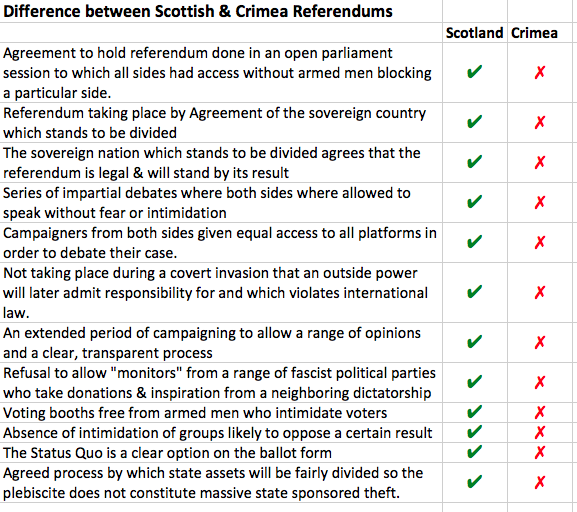 | |
| from https://twitter.com/edwardlucas/status/510717257388130304 |
So, why I am opposed to most independent movements on democracies? Because there is another way. Sure, there are some democracies where an ethnic group is small enough to be politically irrelevant and thus dominated with no chance to affect its fortunes. But mostly, democracy means both having one's rights protected and having access to the political system. The Scots are not powerless. Much of the independence movement is mostly frustrated because of who governs the UK right now--the Conservatives. But that is temporary (unless Scotland secedes).
An essential part of democracy is that when a side loses, they accept defeat and work to come back into power some time later. Democracy will not work if losing an election or two leads to secession. Again, losing is an essential part of democracy.
Besides my general problem with secession, there are two other parts of this process that bother me.
First, what the Quebec and Scottish referendums share in common is a low threshold--50% plus one. I find this incredibly problematic. Why? Because massive political and social change should require not just a few folks more being in favor than opposed--it should have much enthusiasm that most people desire it. If 50% plus one wins the day, then a narrow majority can impose its preference on the minority in a way the minority cannot ameliorate without leaving.
Second, while the question is clear, the outcome is not because of my long stated rule #1 of secessionist movements: they downplay the costs. Because the benefits are pretty vague and not so compelling in advanced democracies (it is not about repression or freedom), pro-secession people have to downplay the costs. If there was a really compelling need to be independent, then the activists would not have to say that there would be no economic uncertainty, that their membership in international organizations was not at risk and on and on.
Secessionist efforts in advanced democracies tend have both of these problems. In places which are far less democratic, the outcome of the referendums are entirely predictable--a sweeping majority in favor due to the desire to have real self-rule instead of domination AND there is no need to underplay the costs because whatever the costs are, they are less than being dominated by another nation. Kosovo, South Sudan, East Timor are prime examples where the benefits of independence are so clear and striking that no one has to worry about 50% plus one, and the advocates did not have to worry about the "fearmongering" of the no's about membership in international organizations.
If the Scots were a smaller group, whose rights were violated, who never could exercise much political power, then it would be different. But the Scots have won most of the battles, including gaining more autonomy, which means that there is less to be gained by independence. This, in turn, means that the yeses need a low threshold and for people to ignore the costs.
Thursday, June 19, 2014
Peaceful Boundary Changing: Europe is Spiffy?
Dan Drezner's post du jour focuses on the absence of international processes for changing boundaries peaceful and asserts that Europe seems to do this pretty well. As he poaches on my old territory--the IR of Secession, I cannot but wonder where my citations are poke at some of this. Overall, the main point is a solid one--that we don't have a mechanism that really facilitates boundary changes peacefully in large part because there is a shared interest in not making secession too easy.
Dan argues that Europe does this pretty well, pointing at the Czech/Slovak divorce, Montenegro's peaceful referendum/secession, and now Scotland's referendum process. To be clear, Europe had nothing to do with the first one, as the Czechs and Slovaks agreed to disagree and go their separate ways precisely at the same time that Europe was not being all that helpful/sucessful managing the secessionist/irredentist/boundary changing crises of Yugoslavia.
People forget but the EU in its first few days of EU-ness (having recently transitioned from EEC) tried to manage the Yugoslav crisis. They sent "ice cream men"--observers in white uniforms--to serve as monitors, and they were utterly irrelevant. They thought that recognizing the more fit units as states might reduce the violence. Not only did this hope lack much logic, but the EU violated their own rules. The Badinter Commission was given the job of recommending which parts of Yugoslavia should be recognized, based on a variety of criteria, and the commission chose Slovenia and Macedonia. The EU chose then to recognize Slovenia and Croatia--because Croatia had Germany as a friend and Macedonia had Greece as an un-friend.
To be fair, the secession of Montenegro reflected much lessons learned, with the EU serving as a key player pushing for a reasonable process including a 55% majority required qualify for independence. Note that the Scottish referendum is not being managed by the EU, and as far as I can tell, is still going by 50% plus one (which I cannot stand--a very narrow and potentially temporary basis of support).
Dan ignores the other violent cases that have petered out--Northern Ireland and the Basques. Which is fine, since they are less violent now. But again, Europe has little to do with it. What does? That magic sauce of democracy and economic development. Canada's own secessionist movement--Quebec--has been similarly non-violent except for a quite token murder in 1970.
How does this work? Jason Sorens has written much on this, but the basic idea is that if you give people a chance to leave peacefully, via democratic means, they do not need to choose violence, and they then often do not choose to leave. The benefits of leaving an advanced democracy with a good economy are not so great. The costs are always downplayed but are quite real.
Both violence and secession are far more popular where people do not have the means to address their grievances through the political system--so they opt out. What makes Europe different is not the EU but the prevalence of strong democracies and decent economies (even now, when compared to elsewhere).
So, I would focus less on Europe and more on the stuff that has spread--democracy--and on the economics that create incentives/disincentives.
Still, Dan is right that we can think about Europe as a model for peaceful boundary change--but it is less about EUROPE and more about the characteristics of European countries. And, yes, blaming Europe for messing up the boundaries of the rest of the world is fair game.*
Dan argues that Europe does this pretty well, pointing at the Czech/Slovak divorce, Montenegro's peaceful referendum/secession, and now Scotland's referendum process. To be clear, Europe had nothing to do with the first one, as the Czechs and Slovaks agreed to disagree and go their separate ways precisely at the same time that Europe was not being all that helpful/sucessful managing the secessionist/irredentist/boundary changing crises of Yugoslavia.
People forget but the EU in its first few days of EU-ness (having recently transitioned from EEC) tried to manage the Yugoslav crisis. They sent "ice cream men"--observers in white uniforms--to serve as monitors, and they were utterly irrelevant. They thought that recognizing the more fit units as states might reduce the violence. Not only did this hope lack much logic, but the EU violated their own rules. The Badinter Commission was given the job of recommending which parts of Yugoslavia should be recognized, based on a variety of criteria, and the commission chose Slovenia and Macedonia. The EU chose then to recognize Slovenia and Croatia--because Croatia had Germany as a friend and Macedonia had Greece as an un-friend.
To be fair, the secession of Montenegro reflected much lessons learned, with the EU serving as a key player pushing for a reasonable process including a 55% majority required qualify for independence. Note that the Scottish referendum is not being managed by the EU, and as far as I can tell, is still going by 50% plus one (which I cannot stand--a very narrow and potentially temporary basis of support).
Dan ignores the other violent cases that have petered out--Northern Ireland and the Basques. Which is fine, since they are less violent now. But again, Europe has little to do with it. What does? That magic sauce of democracy and economic development. Canada's own secessionist movement--Quebec--has been similarly non-violent except for a quite token murder in 1970.
How does this work? Jason Sorens has written much on this, but the basic idea is that if you give people a chance to leave peacefully, via democratic means, they do not need to choose violence, and they then often do not choose to leave. The benefits of leaving an advanced democracy with a good economy are not so great. The costs are always downplayed but are quite real.
Both violence and secession are far more popular where people do not have the means to address their grievances through the political system--so they opt out. What makes Europe different is not the EU but the prevalence of strong democracies and decent economies (even now, when compared to elsewhere).
So, I would focus less on Europe and more on the stuff that has spread--democracy--and on the economics that create incentives/disincentives.
Still, Dan is right that we can think about Europe as a model for peaceful boundary change--but it is less about EUROPE and more about the characteristics of European countries. And, yes, blaming Europe for messing up the boundaries of the rest of the world is fair game.*
* Although to be fair, the Europeans drew many, many boundaries and irredentism is rather rare.
Thursday, March 20, 2014
Are We Russophoboes?
Lots of words have been spilled on this Crimea thing, and so it is reasonable to ask whether our opposition to Crimean self-determination might be more about our feelings about Russia than about secession/irredentism.
Chris Blattman asked:
It is really hard to ignore the process. That is, the way this thing was conducted taints it entirely--sham referendum, held as a pop quiz, at gun point, with much fraud. Putting that aside, the general argument that I follow is that secession is something that is a last resort (there is a vast literature on the morality of secession--see Allen Buchanan and Margaret Moore). Massive political change has lots of consequences so we should save it for when other solutions have been ruled out. Part of this is because if Crimea gets to change its boundaries, what about groups within Crimea? Quebec is facing that discussion right now--if it secedes, what about the Anglophones of various parts of Quebec? What about the First Nations? Part of this is that democracy only works if those who lose accept losing.
The problem with Ukraine/Crimea/Russia is that the political changes in Kyiv were just a few weeks ago. If the concern is that the new Ukraine government might repress Russians in Crimea, then the first step is to try to encourage the government to restrain itself, to develop new institutions that give Crimea more autonomy and all the other tools in the ethnic conflict management tool box. When the Baltics became independent, they promised new policies that would be harmful to the Russians living there--mostly language laws that would restrict rights. A bunch of international organizations, including the EU, NATO, and OSCE jumped on them to encourage more moderate policies. Things are not perfect in these places, but they are better than what people initially feared.
So, the really big problem with the Crimean situation and Russia's handling of Ukraine in general is that not enough time has passed to figure out what is likely to happen, for outsiders to pressure, and so on. What separates Kosovo and South Sudan from Crimea is that the former experienced decades of repression, where the host governments of Serbia and Sudan broke many promises despite facing significant international pressure. It is not just that these government repressed, but that they repressed for a long time despite much pressure. Kosovars and South Sudanese had few tools left to improve their condition besides secession. Crimean Russians? None of the usual tools had a chance to work yet.
You don't have to hate or fear Russia to find the Crimean situation play out in bad ways. Should there be a high bar for secession? Yes. Even higher for irredentism since irredentism usually implies war (the country losing the territory usually gives it up only after a fight).
Chris Blattman asked:
Bleg: Someone please explain to me why I should accept that the annexation of Crimea is a terrible thing http://t.co/Op7T0aNN7TIt raises a legitimate question: shouldn't people be allowed to choose their destinies? Shouldn't folks be allowed to engage in self-determination? I responded with heaps of tweets, but let me summarize my twittering here.
— Chris Blattman (@cblatts) March 20, 2014
It is really hard to ignore the process. That is, the way this thing was conducted taints it entirely--sham referendum, held as a pop quiz, at gun point, with much fraud. Putting that aside, the general argument that I follow is that secession is something that is a last resort (there is a vast literature on the morality of secession--see Allen Buchanan and Margaret Moore). Massive political change has lots of consequences so we should save it for when other solutions have been ruled out. Part of this is because if Crimea gets to change its boundaries, what about groups within Crimea? Quebec is facing that discussion right now--if it secedes, what about the Anglophones of various parts of Quebec? What about the First Nations? Part of this is that democracy only works if those who lose accept losing.
The problem with Ukraine/Crimea/Russia is that the political changes in Kyiv were just a few weeks ago. If the concern is that the new Ukraine government might repress Russians in Crimea, then the first step is to try to encourage the government to restrain itself, to develop new institutions that give Crimea more autonomy and all the other tools in the ethnic conflict management tool box. When the Baltics became independent, they promised new policies that would be harmful to the Russians living there--mostly language laws that would restrict rights. A bunch of international organizations, including the EU, NATO, and OSCE jumped on them to encourage more moderate policies. Things are not perfect in these places, but they are better than what people initially feared.
So, the really big problem with the Crimean situation and Russia's handling of Ukraine in general is that not enough time has passed to figure out what is likely to happen, for outsiders to pressure, and so on. What separates Kosovo and South Sudan from Crimea is that the former experienced decades of repression, where the host governments of Serbia and Sudan broke many promises despite facing significant international pressure. It is not just that these government repressed, but that they repressed for a long time despite much pressure. Kosovars and South Sudanese had few tools left to improve their condition besides secession. Crimean Russians? None of the usual tools had a chance to work yet.
You don't have to hate or fear Russia to find the Crimean situation play out in bad ways. Should there be a high bar for secession? Yes. Even higher for irredentism since irredentism usually implies war (the country losing the territory usually gives it up only after a fight).
Saturday, March 8, 2014
Irredentism Is Not the Only Inconsistent Thing in IR
I am shocked, shocked that countries may develop inconsistent policies as they react to separatism in other countries. Ok, I am not. After all, my quantitative piece on this stuff is entitled: Discrimination in International Relations. That and the related book, The Ties That Divide, argue that countries will support those secessionists that they "like" and oppose those that they "dislike." What do I mean by like? Domestic politics FTW! That is, often but not always, domestic audiences in country x will have a preference about what happens in country y based on whether the folks in x have ties to anyone in y, particularly ethnic ties. When ethnic ties do not exist, other stuff may matter more, such as precedents (I am a precedent-skeptic), norms (I am a norm-skeptic), or strategic interests (yeah, those make sense).
So, to take a local and obvious example, Canada is taking a strong position on this. Some would say this is because Canada is vulnerable to secession. To that, I say booshwah. Canada recognized Kosovo. Indeed, one of the key targets of Ties That Divide was the conventional wisdom that vulnerability to secession deters support for secession elsewhere. Anyhow, Canada might be doing this because it is a good friend of countries that are sort of friend with NATO. But part of it is that Ukrainian-Canadians are a key constituency in Canada.
Sure, it is not just about ethnic ties, but countries react to secessionist movements based on the context of each one, rather than to any over-arching principle. Russia supports secessionists it likes (Abkhaz, South Osettian, Transnistrian, Crimean Russian) and not those it dislikes (Kosovo). The US tends not to like secession because it disrupts the status quo, and as the dominant power in the system, the US likes things as it is. But when repression of an ethnic group is a greater threat to regional stability (Kosovo) or when movie stars keep pushing (South Sudan?), the US will support secession.
There is heaps of good normative work by Allen Buchanan, Margaret Moore, Jason Sorens and others on the oughts of secession and recognition. I have my own views, partly guided by these folks and partly shaped by my prejudices (as a Yankee) and as a scholar of separatism. I tend not to support secession in democracies since there are other ways to get one's interests represented. Quebec and Scotland, for instance, can get much from their current governments and are not repressed. But when facing a government that repeatedly targeted ethnic minorities and revoked whatever autonomy, then, yeah, secession makes sense (Kosovo, South Sudan, East Timor).
Anyhow, the point here is that in International Relations, one should expect inconsistency in irredentism and in secession. Otherwise, one is a foolish hobgoblin or something like that.
So, to take a local and obvious example, Canada is taking a strong position on this. Some would say this is because Canada is vulnerable to secession. To that, I say booshwah. Canada recognized Kosovo. Indeed, one of the key targets of Ties That Divide was the conventional wisdom that vulnerability to secession deters support for secession elsewhere. Anyhow, Canada might be doing this because it is a good friend of countries that are sort of friend with NATO. But part of it is that Ukrainian-Canadians are a key constituency in Canada.
Sure, it is not just about ethnic ties, but countries react to secessionist movements based on the context of each one, rather than to any over-arching principle. Russia supports secessionists it likes (Abkhaz, South Osettian, Transnistrian, Crimean Russian) and not those it dislikes (Kosovo). The US tends not to like secession because it disrupts the status quo, and as the dominant power in the system, the US likes things as it is. But when repression of an ethnic group is a greater threat to regional stability (Kosovo) or when movie stars keep pushing (South Sudan?), the US will support secession.
There is heaps of good normative work by Allen Buchanan, Margaret Moore, Jason Sorens and others on the oughts of secession and recognition. I have my own views, partly guided by these folks and partly shaped by my prejudices (as a Yankee) and as a scholar of separatism. I tend not to support secession in democracies since there are other ways to get one's interests represented. Quebec and Scotland, for instance, can get much from their current governments and are not repressed. But when facing a government that repeatedly targeted ethnic minorities and revoked whatever autonomy, then, yeah, secession makes sense (Kosovo, South Sudan, East Timor).
Anyhow, the point here is that in International Relations, one should expect inconsistency in irredentism and in secession. Otherwise, one is a foolish hobgoblin or something like that.
Tuesday, March 4, 2014
The Electoral Politics of Boundary Changing
Keith Darden points out that if Crimea secedes from Ukraine, electoral outcomes in Ukraine would shift with fewer pro-Russia voters in the political system, and that would be bad for Russia. This is not unique to this case.
In any successful secession or irredentist effort (the latter refers to annexing a "lost" territory inhabited by ethnic kin), the boundary moves, changing who votes in the rump state (Ukraine in this case) and who votes in the new state (Crimea if independent, Russia if this is irredentist and Crimea gets annexed). In this case, new voters in Russia would be largely irrelevant, given the populations of Crimea compared to Russia. But in Ukraine, the change is significant, given that the elections in Ukraine seem to have a blue/red, polarized, narrow outcomes kind of thing that might seem familiar to the US. Indeed, if Texas left the union (please?), and the electoral votes of Texas went away, the Republicans would have a much, much harder time winning national elections.
This change in the balance of political power is what can make one secession so very relevant for the rest of the country (see Slovenia and Yugoslavia). It also can be a deterrent to irredentism since the new voters may not vote the way the folks in power would want them--hence no Greater Albania project (a Greater Kosovo project is something else).
My point here is that Darden's point is not just relevant for Russian interests today but is relevant for understanding secession and irredentism in general--you are not just changing a line, and not just changing who governs person x or group y, but also who wins and loses elections (or other ways to allot power) in the new and old states. And folks anticipate that, shaping their preferences towards secession and irredentism.
Of course, that is not the only set of interests in play or else Harper's Conservative government would want Quebec to secede since that would mean a heap of Liberal and NDP voters no longer counting.... Hmmm.
In any successful secession or irredentist effort (the latter refers to annexing a "lost" territory inhabited by ethnic kin), the boundary moves, changing who votes in the rump state (Ukraine in this case) and who votes in the new state (Crimea if independent, Russia if this is irredentist and Crimea gets annexed). In this case, new voters in Russia would be largely irrelevant, given the populations of Crimea compared to Russia. But in Ukraine, the change is significant, given that the elections in Ukraine seem to have a blue/red, polarized, narrow outcomes kind of thing that might seem familiar to the US. Indeed, if Texas left the union (please?), and the electoral votes of Texas went away, the Republicans would have a much, much harder time winning national elections.
This change in the balance of political power is what can make one secession so very relevant for the rest of the country (see Slovenia and Yugoslavia). It also can be a deterrent to irredentism since the new voters may not vote the way the folks in power would want them--hence no Greater Albania project (a Greater Kosovo project is something else).
My point here is that Darden's point is not just relevant for Russian interests today but is relevant for understanding secession and irredentism in general--you are not just changing a line, and not just changing who governs person x or group y, but also who wins and loses elections (or other ways to allot power) in the new and old states. And folks anticipate that, shaping their preferences towards secession and irredentism.
Of course, that is not the only set of interests in play or else Harper's Conservative government would want Quebec to secede since that would mean a heap of Liberal and NDP voters no longer counting.... Hmmm.
Friday, November 8, 2013
Internationally Irrelevant: The Limited Reach of Scotland’s Precedent Setting
There have long been fears that a successful secessionist
effort will encourage other potential secessionists, potentially causing a
domino effect. These fears are
over-wrought. The reality is that each
secessionist movement is driven by domestic dynamics, and the examples set
elsewhere are almost entirely irrelevant.
Whatever happens in Scotland next year will only matter in Scotland and
in the rest of the United Kingdom. Whether
the vote is for or against independence, it will not matter much to the rest of
the world.
Why? For two reasons:
there are always multiple lessons to be learned, so people tend to learn the
lessons they want; and nearly all politics is local. We also have some scholarship that suggests
that separatism is “contagious” under very limited circumstances. Let me
explain.
In the aftermath of the nearly simultaneous disintegrations
of Yugoslavia, the Soviet Union and Czechoslovakia, there was some thought that
separatism was akin to a contagious disease spreading across Europe. The problem is that each “domino” presented
both positive and negative lessons to those thinking about separatism
elsewhere. When Yugoslavia broke apart,
it could have encouraged potential secessionist movements or discouraged them,
depending on whether such groups viewed themselves as being akin to Slovenia or
to Bosnia. When the Soviet Union
disintegrated, it could have prompted more separatism if those elsewhere viewed
themselves as being in a similar situation as Estonia, but perhaps not so much
if they felt more similar to Azerbaijan.
The political psychological dynamic at play here is
confirmation bias. Reality will produce
all kinds of things to observe, and people will tend to observe those dynamics
and those lessons that reinforce their existing attitudes. Americans, for instance, are still arguing
over the lessons to learn from Vietnam, with some arguing that the US used too
little force and others arguing it used too much.
A more direct comparison and more recent example is the
discourse that developed in Canada in the aftermath of Montenegro’s referendum
in 2006. Quebec separatists were
impressed at the ability of Montenegro to hold a referendum and then become
independent once the threshold was exceeded, without prolonged bargaining with
the rump state—a unilateral declaration of independence. Canadian federalists, on the other hand,
noticed that the threshold was set at 55% rather than the 50% + one that had
been the standard in past Quebec referendums.
The first key point here is this: whatever the outcome in
Scotland is, it will be read by those elsewhere in ways that confirm their
attitudes. If Scotland does not become
independence, motivated secessionists will indicate how Scotland is not a
relevant or comparable case. If Scotland
does become independent, then those opposing secession elsewhere will argue
Scotland is a special case that does not a set a precedent.
The second point is that secessionism is largely driven by
domestic politics. Whatever happens in
Scotland, potential separatists in other countries will be motivated by more
immediate concerns: can their group gain access to power via elections? Is power decentralized? Is their group oppressed? Can separatism be used to outflank other
parties? The apparent spread of
secessionism in Eastern Europe and the Soviet Union in the late 1980s was not
because one outbreak causing others, but that the advent of political
competition provided politicians running for office in sub-state units—the
various Soviet Socialist Republics, Slovenia, Croatia and the others—with
incentives to play towards narrower audiences.
The first elections were at the sub-national level, which meant that
more homogeneous audiences were the electorates that mattered, leading to a
focus on ethnic nationalist concerns.
The separatists beyond Scotland will have more or less
support and will be more or less motivated not by the outcome in Scotland but
by the people they seek to mobilize and represent. The local conditions matter the most. The only place where Scotland’s independence
could affect the interests of potential separatists is the United Kingdom. What would the departure of Scotland mean for
the balance of power within the UK? This
is far less clear than the departure of Slovenia and Croatia from
Yugoslavia. Will Wales feel at greater
risk of tyranny of the majority from the English in a Scotland-less United
Kingdom?
To be clear, there is one mechanism that causes secession in
one spot to reverberate elsewhere, but it is absent in this case. Studies have shown that when a group is
separatist in more than one country, the activity and the outcomes in one
country may matter in other places that group resides. For instance, when Kosovo became independent
(de facto in 1999), that had ramifications
for other places where Albanians resides—especially Macedonia. If the Kurds in Iraq become independent, that
will have implications for the Kurds in Turkey, Syria and elsewhere. However, there are no similar groups of Scots
in other countries that might become more separatist in the aftermath of a
successful referendum.
In sum, while the referendum will be quite important for
Scotland and for the United Kingdom, it will have a minimal impact beyond. Worries about precedents are exaggerated as
local politics triumphs over the ebbs and flows of secessionism elsewhere. So,
the Scots should vote based on what it means for Scotland, and outsiders should
be concerned only insofar as independence would affect their interests in
Scotland.
Tuesday, October 29, 2013
Secession Is Either Meaningful Or It Ain't
I have mentioned before the tendency (a.k.a. rule #1) for those advocating secession from advanced democracies to promise that the enterprise will be relatively cost-free. Why? Because they need votes to win a referendum, and if they can just promise unicorns and candy, or just promise better identity protection (French, Scottish, whatever), without the new country having to start from scratch, they might get more votes.
But the reality is this: if you become an independent country, you are no longer part of the old one. Yeah, that is pretty much true by definition, but the idea that you can keep the good stuff and dump the bad stuff is just not reality-based. The rump country will treat the citizens of the new country like ... foreigners. As much as we get heaps of integration (NAFTA, EU), those invisible lines between countries mean something.
So, the latest "surprise" is that if Scotland leaves the UK, it will no longer be covered/part of MI-5, MI-6, the Five Eyes (the intel sharing community much in the news lately---US, UK, Canada, Australia, New Zealand), etc. I have already discussed the need for the Scottish separatists to start changing their tunes on NATO and nukes.
Of course, the UK folks have an incentive to make independence appear to be more costly and to diminish the apparent benefits of leaving while making sticking around more attractive. The reality is that most of the clubs that the Scots (or the Quebeckers) would suddendly find themselves out of would eventually let them back in. Ok, most of them but not all, as the parliaments and Prime Ministers would no longer have any incentive to play to the audiences that are now outside their country. Scotland would get back into NATO, but I am not sure how many UK tax dollars would be spent on helping Scotland be secure via various UK intel services. Maybe some but certainly less than the status quo ante.
Perhaps I am status quo-biased, but in these kinds of arguments about leaving while keeping the goodies, I tend to find the host state more credible than the pie crust promising secessionists. Becoming independent has costs. The problem that separatists in advanced democracies generally have is this: the democracy is not that oppressive (or is at all oppressive), so the benefits of becoming independent are not nearly as bountiful. The costs, then, become important. In other places, where one is seceding from a brutal, repressive, unrepresentative government, then no one argues about which organizations or services will remain intact. The idea is to get out regardless of the residual benefits because the costs of remaining are quite significant.
The funny thing is that the separatists get caught in a dilemma--they have to argue that secession will be meaningful to attract the more passionate nationalists but then they also have to ague that it will not matter that much to get the softer nationalists who care about identity but not so much that they want to sacrifice much.
But the reality is this: if you become an independent country, you are no longer part of the old one. Yeah, that is pretty much true by definition, but the idea that you can keep the good stuff and dump the bad stuff is just not reality-based. The rump country will treat the citizens of the new country like ... foreigners. As much as we get heaps of integration (NAFTA, EU), those invisible lines between countries mean something.
So, the latest "surprise" is that if Scotland leaves the UK, it will no longer be covered/part of MI-5, MI-6, the Five Eyes (the intel sharing community much in the news lately---US, UK, Canada, Australia, New Zealand), etc. I have already discussed the need for the Scottish separatists to start changing their tunes on NATO and nukes.
Of course, the UK folks have an incentive to make independence appear to be more costly and to diminish the apparent benefits of leaving while making sticking around more attractive. The reality is that most of the clubs that the Scots (or the Quebeckers) would suddendly find themselves out of would eventually let them back in. Ok, most of them but not all, as the parliaments and Prime Ministers would no longer have any incentive to play to the audiences that are now outside their country. Scotland would get back into NATO, but I am not sure how many UK tax dollars would be spent on helping Scotland be secure via various UK intel services. Maybe some but certainly less than the status quo ante.
Perhaps I am status quo-biased, but in these kinds of arguments about leaving while keeping the goodies, I tend to find the host state more credible than the pie crust promising secessionists. Becoming independent has costs. The problem that separatists in advanced democracies generally have is this: the democracy is not that oppressive (or is at all oppressive), so the benefits of becoming independent are not nearly as bountiful. The costs, then, become important. In other places, where one is seceding from a brutal, repressive, unrepresentative government, then no one argues about which organizations or services will remain intact. The idea is to get out regardless of the residual benefits because the costs of remaining are quite significant.
The funny thing is that the separatists get caught in a dilemma--they have to argue that secession will be meaningful to attract the more passionate nationalists but then they also have to ague that it will not matter that much to get the softer nationalists who care about identity but not so much that they want to sacrifice much.
Wednesday, December 5, 2012
Texas Secede? We Wish?
I love a good short video laying out the truths, convenient or otherwise:
The Texans would always tell me they could because they were extra-special. But no. Plus the Texas secessionist movement that existed when I lived there had its embassy in a trailer in Texas. The big mistake is not the trailer but the location--you put the embassy in another country. Jeez.
Anyhow, this whole Texas secession thing now is just a small minority of sore losers. Anyone can vote on silly petitions on the White House website. For a while, there was one insisting that we build a death star... Really. Now that is a healthy dose of perspective sauce.
The Texans would always tell me they could because they were extra-special. But no. Plus the Texas secessionist movement that existed when I lived there had its embassy in a trailer in Texas. The big mistake is not the trailer but the location--you put the embassy in another country. Jeez.
Anyhow, this whole Texas secession thing now is just a small minority of sore losers. Anyone can vote on silly petitions on the White House website. For a while, there was one insisting that we build a death star... Really. Now that is a healthy dose of perspective sauce.
Sunday, December 2, 2012
The Secession Solution: Congo Edition
In yesterday's NYT, J. Peter Pham argued that we should let the Democratic Republic of Congo (DRC) fall apart--that separatism would somehow make things better. While the government has had problems governing the entire country, most of the problems that Pham cites in the piece are not about different ethnic groups with different preferences, but about poor leaders and the challenges of having too much in the way of minerals (the resource curse and all that).
The militias he refers to as protectors? Well, these folks are the threat, and it is not clear how allowing several of them to have their own countries will make them any less rapacious. Yes, DRC is an artificial state, but so are most countries in the world (Japan, the Koreas not so much).
To be clear, as a scholar of separatism and its international relations, I am not opposed to DRC falling apart due to precedent setting (I tend to believe that precedents do not matter that much). It is just not clear in this article how secession would solve any of Congo's problems. Would the smaller hunks be that much easier to govern since they would still be big, landlocked, mineral-rich, and so on? The Africanists on my twitter feed think this particular "solution" is no solution at all.
If the piece was about recognizing Somaliland, I would take a different stance as separatism can be a reasonable approach under some circumstances ... like if Texas was willing to pay of its share of the national debt as it left the US ;)
The militias he refers to as protectors? Well, these folks are the threat, and it is not clear how allowing several of them to have their own countries will make them any less rapacious. Yes, DRC is an artificial state, but so are most countries in the world (Japan, the Koreas not so much).
To be clear, as a scholar of separatism and its international relations, I am not opposed to DRC falling apart due to precedent setting (I tend to believe that precedents do not matter that much). It is just not clear in this article how secession would solve any of Congo's problems. Would the smaller hunks be that much easier to govern since they would still be big, landlocked, mineral-rich, and so on? The Africanists on my twitter feed think this particular "solution" is no solution at all.
If the piece was about recognizing Somaliland, I would take a different stance as separatism can be a reasonable approach under some circumstances ... like if Texas was willing to pay of its share of the national debt as it left the US ;)
Wednesday, November 14, 2012
Lose an Election and Cry Secessionism
Or just cry, you silly sore losers. The spate of secessionist petitions shows mostly that Republicans are sore losers (and some other folks, too). When we speak of contagion/diffusion--how do things spread, and the claim is made that secessionism might be contagious, we need to be about what it is we are seeing right now: an online petition. Which is a long ways away from being a secessionist movement, which is a long ways away from being a real political entity with any relevance.
There has been a long-lasting separatist campaign in Texas by a small group of folks. How do we know not to take them seriously? Their embassy is a trailer .... in Texas. If you are going to secede, then the embassy needs to go outside one's territory, right?
Anyhow, not only have I studied secession--the causes and the international relations of--but I have lived in Texas and in Quebec, so I have both scholarly and real life experience with secession. What we see here is nothing more than a small percentage of folks (as in under 1% if the link above is correct) doing the very absolute minimum. That is, they don't have to leave their couches and they are exposed to no risk.
So, let's pour some perspective sauce on all of this. Quebec has been pursuing secession for the past thirty-five years or so, and are not getting much closer. The Quebeckers at least have the advantage of a real identity divide--language. And with heaps of institutional support. The US is still run for and by white folks, white Christian folks, and Obama's election just means that minorities had their say. The reality is that the internet, when combined with a media that needed to fill some time on its 24 hour networks (until the Petraeus mess hit the waves), amplifies all of this--but, to quote that Shakespeare guy, it is sound and fury signifying nothing. I will let you folks consider who the idiot is in all of this.
There has been a long-lasting separatist campaign in Texas by a small group of folks. How do we know not to take them seriously? Their embassy is a trailer .... in Texas. If you are going to secede, then the embassy needs to go outside one's territory, right?
Anyhow, not only have I studied secession--the causes and the international relations of--but I have lived in Texas and in Quebec, so I have both scholarly and real life experience with secession. What we see here is nothing more than a small percentage of folks (as in under 1% if the link above is correct) doing the very absolute minimum. That is, they don't have to leave their couches and they are exposed to no risk.
So, let's pour some perspective sauce on all of this. Quebec has been pursuing secession for the past thirty-five years or so, and are not getting much closer. The Quebeckers at least have the advantage of a real identity divide--language. And with heaps of institutional support. The US is still run for and by white folks, white Christian folks, and Obama's election just means that minorities had their say. The reality is that the internet, when combined with a media that needed to fill some time on its 24 hour networks (until the Petraeus mess hit the waves), amplifies all of this--but, to quote that Shakespeare guy, it is sound and fury signifying nothing. I will let you folks consider who the idiot is in all of this.
Monday, September 24, 2012
The New World, Largely Same as the Old One
My friends on twitter got a bit outraged yesterday over this NYT spec piece on the possible new maps in the future after some countries blow up or join together or both. When I first glanced it, I was pretty dismissive since it runs through eleven hunks of territory quickly, making quick guesses about which ones will break apart and which ones will join together. I am a jack of all trades, master of none kind of guy so I cannot (and, my readers will thank me, will not) go into great depth on any one of these cases. I will leave that to the Comparativists who have heaps of knowledge about specific cases.
However, since the trades of which I am jack (no, that makes little sense to me as well) are secession and irredentism--the fission and fusion of countries*--I can make some general comments and then skip through the cases briefly. First, secession is damned hard--countries resist losing pieces of themselves (see Monica Toft's work). There are many lessons to draw from South Sudan, but one of them is--it takes decades. Six of them or so. And South Sudan is hardly swell today.
Second, irredentism, the amalgamation of one piece of one county with a piece or an entirety of another, will find resistance even perhaps from the folks related to the desired region. As my book with Bill Ayres avers, xenophobia can serve as a key restraint on irredentism. Imagine, if you will, a successful effort at reuniting a lost hunk of territory and people with a homeland. The practical and political effect is much like a huge wave of immigration, and who wants that these days?
Third, precedent setting in this area is wildly over-rated. The various federations of the former Soviet space broke apart not because of inspiration from each other but due to the common stresses of democratization and the timing of provincial elections in relation to the national ones. Incentives and institutions matter--domestic ones, that is. The key here is also confirmation bias--that potential separatists (secessionists and irredentists) will learn the lessons they want to learn and ignore the rest. Is my situation like Slovenia or Bosnia? Many lessons to learn, which ones will be the ones that people glom on to?
Ok, now let's run through the list quickly because I have to teach today and because other folks know more about the cases:
However, since the trades of which I am jack (no, that makes little sense to me as well) are secession and irredentism--the fission and fusion of countries*--I can make some general comments and then skip through the cases briefly. First, secession is damned hard--countries resist losing pieces of themselves (see Monica Toft's work). There are many lessons to draw from South Sudan, but one of them is--it takes decades. Six of them or so. And South Sudan is hardly swell today.
* Fission and fusion? Why did I only now realize that should be on my business card: my business is fission and fusion! Not quite as good as "I deal in lead" but pretty good.
Second, irredentism, the amalgamation of one piece of one county with a piece or an entirety of another, will find resistance even perhaps from the folks related to the desired region. As my book with Bill Ayres avers, xenophobia can serve as a key restraint on irredentism. Imagine, if you will, a successful effort at reuniting a lost hunk of territory and people with a homeland. The practical and political effect is much like a huge wave of immigration, and who wants that these days?
Third, precedent setting in this area is wildly over-rated. The various federations of the former Soviet space broke apart not because of inspiration from each other but due to the common stresses of democratization and the timing of provincial elections in relation to the national ones. Incentives and institutions matter--domestic ones, that is. The key here is also confirmation bias--that potential separatists (secessionists and irredentists) will learn the lessons they want to learn and ignore the rest. Is my situation like Slovenia or Bosnia? Many lessons to learn, which ones will be the ones that people glom on to?
Ok, now let's run through the list quickly because I have to teach today and because other folks know more about the cases:
- Mali? The folks behind Mali's breakup have more enemies than friends. Is their independence sustainable? Not clear, but I think Vegas has set the odds on continued independence at 4 to 1.
- Belgium Splits Up. Maybe. The EU as a destination for the pieces is less attractive than it was a few years ago, but the differences between Flemish and Walloons fester. Perhaps most likely to break up but most peacefully as well. On the other hand, Newton was right about inertia.
- Congo splinters? We have been thinking about the Congo breaking up since 1960. The first case study in the aforementioned book on the IR of secession is on Katanga and its effort secede way back when. My Africanist twitter pal is most skeptical, and she does research, so I will leave it at that.
- Somalia's Breakup Confirmed. Somaliland has been de facto independent for about twenty years, so this is not a new revision of the map, just recognition of reality. But recognition may or may not come anytime soon, as Somaliland has few fans despite being far more functional than Somalia. And the African Union may just keep on mismanaging this situation, raising some costs to the first recognizers. To be clear, there is another lesson, one of the key ones, from my work that indicates recognition sooner than later--countries are not that deterred from supporting secession elsewhere despite their own separatist challenges at home. Somaliland's problem is not the vulnerability of others but the lack of allies. Anyone who has ties to Somaliland also has ties to Somalia, except at the clan level, which makes it hard to find best friends out there.
- Alawites Go Solo. I expect the endgame of Syria not be a breakup but potentially mass killings of those seen as complicit with the regime--the entire Alawite community, whether that is fair or not (not). The folks who win in Syria are not going to let their former oppressors escape, especially with the coastline. Choosing to be landlocked? No.
- Arab Gulf Union? To quote 30 Rock and Tim Goodman, whuck? (WTF).
- Kurdistan? Independent? Maybe, maybe not. But it would just be a piece of Iraq, not with the rest of the Kurds in a greater Kurdistan. Turkey has way too much equity in that fight.
- Greater Azerbaijan? Since when has anyone thought that Iran will implode? Azerbaijan may have a friend in Turkey, but it has an enemy in Armenia that continues to hold onto Azerbaijan's territory. The only successful post-Cold War irredentism has been (well, besides Germany) Armenia. So, before Azerbaijan aims at Greater Azerbaijan, it will obsess about what it has lost.
- Pakistan falls apart? Sure. The country is incredibly messed up, but Pashtunistan is not in the cards. The Pashtuns may be able to agree on somethings, but on a single country crossing Afghanistan and Pakistan? Nay. There are other identities and cleavages that present challenges to a single country for all Pashtuns. Plus many on the Afghan side of the border are not fond of Pakistan. Baluchistan? Pakistan has showed plenty of will to crush these folks, so even a Pakistan in decline would would make Baluchistan very hard to accomplish.
- China gobbles up Siberia? Jeez, now the speculation is completely absent of any real trend. Yes, Russia is big and China is powerful, but China will have many fish to fry. Over-expanding in this direction might suit Jack Snyder, but is not likely at all.
- Yes, Korea may unify some day, but I am not sure the South Koreans are looking forward to this. And isn't this something we have been expecting more or less for twenty or thirty years? North Korean rulers have managed to succeed one another and have managed to repress their country quite effectively. It might change, but it might not.
Tuesday, February 21, 2012
Montreal versus Quebec
Henry Aubin wrote a column today that tries to make the point that the Parti Quebecois does not understand or does not care that a secessionist effort would be bad for Montreal. I think he is close but not quite there. It is not so much that the PQ is "willfully ignoring Montreal" as much as it is that the PQ is running against Montreal. In my ten years here, it has been quite clear that a rural vs urban, Montreal vs the Rest of Quebec (ROQ to parallel the ROC of the rest of Canada) divide is perhaps just as important or even more so than the Angophone/Francophone debate.
Depending on the year, Montreal is:
I have no doubt that Aubin is right--that secession would be awful for Montreal and thus bad for the Quebec economy. I also have no doubt that the PQ largely does not care since its political strategy focuses mostly on getting votes elsewhere by running against Montreal. It makes sense politically, but as we all know, what is good for a party or a politician can be bad for a state/province/country. For Kin or Country indeed!
Depending on the year, Montreal is:
- the haven of immigrants that seemingly cannot assimilate into Quebec culture;
- overrun by non-Francophones;
- dominated by Anglophones;
- and so on.
I have no doubt that Aubin is right--that secession would be awful for Montreal and thus bad for the Quebec economy. I also have no doubt that the PQ largely does not care since its political strategy focuses mostly on getting votes elsewhere by running against Montreal. It makes sense politically, but as we all know, what is good for a party or a politician can be bad for a state/province/country. For Kin or Country indeed!
Friday, January 27, 2012
Nationalists Are Like Snowflakes?
My post earlier today got a rapid response from some Scots/allies who seem to think I don't know much about Scottish nationalism. And they are right. I have not studied the Scottish independence movement as it has not been violent (at least for the past few hundred years). All I know about Scotland comes from my wife's stories about her year in Aberdeen when she was in college and from the Highlander movies and TV shows.
But I am just a bit familiar with secessionist movements. I do dare to compare because even though nationalists think that their movement is unique* (hence the snowflake title), the dynamics of nationalism and the problems that separatists encounter are often comparable (not identical but compare-able) to such folks elsewhere.
Let me focus on just a few points need further elaboration:
But I am just a bit familiar with secessionist movements. I do dare to compare because even though nationalists think that their movement is unique* (hence the snowflake title), the dynamics of nationalism and the problems that separatists encounter are often comparable (not identical but compare-able) to such folks elsewhere.
* Unless it is politically expedient to think otherwise.
Let me focus on just a few points need further elaboration:
- The folks commenting on my blog seem to find 55% as a threshold for a successful referendum vote (that is, 55% of those voting have to say yes, rather than 50%) to be a bridge too far. Due to past decisions or whatever, it seems as if barely scraping by to get a very slim majority is sufficient for massive political changes. But there are heaps of problems with 50% plus one:
- It increases the temptations to cheat. A two vote swing is sufficient for either rejection or acceptance of independence. So, hide some ballot boxes from less separatist areas. Or stuff some ballot boxes. Yes, folks could cheat to get from 54.9% to 55%, but there is much more certainty that the decision has a majority of public support at 55% however it is rounded then at 50.00001%.
- What I call the drunk frat-boy factor: that with a razor's edge margin, you can get some people voting one way just for entertainment value. This is probably what gave Jesse "The Body" Ventura the Governorship of Minnesota in a three-way race. Again, if there is sufficient interest to get close to 55%, then a few folks who think it would be fun to vote against their sober preferences are not as consequential.
- In the history of separatist referendums, nearly all clear 50% easily, 55% easily, 65% easily, 75% easily and so on. The only referenda that didn't manage widespread support were the ones lost by the Quebec separatists and Montenegro which just cleared 55%.
- Whether the 55% precedent that the EU set with Montenegro applies to Scotland is a good question. Perhaps the EU will not get involved as there is little risk of violence, but I have also made it a habit in my career poking fun at the inconsistency of the EU in how it sets conditions. If 55% is good enough for Montenegro, then the EU should expect the Scots to do the same.
- Basically, the point is that if you want to make a significant political change, I think you need to do more than crawl barely over the most minimal threshold possible. I think you need to make an argument that gets significant support that will not change a day later due to buyer's remorse. I am a stronger believer in protection from tyranny of the majority. If the majority is only of one, it needs to be more restrained than if it has an overwhelming mandate for change.
- While Scottish nationalists would like to vote and then become independent, they will have to think about what the Brits want. Why? Because the reality of the situation is that there would have to be much bargaining over how to divide assets and debts, manage the border and customs, and deal with other complications that come with turning the line between Scotland and England into a real international border.
- Canada has had to contemplate this, and both the courts and the parliament have essentially said that a key requirement for such negotiations would be a clear mandate for independence--the Clarity Act. Parliament, which would have to pass various legislation to manage the division of stuff, has a reasonable expectation to engage in such bargaining if there is a clear mandate for independence. The 1995 referendum in Quebec fell far short of providing such a mandate, not just in terms of votes but also because of the question.
- If Scotland's referendum asks: do you want Scotland to be independent from Great Britain/United Kingdom or whatever the relevant other is, that would be a fine question. If there is a question that asks if Scots would prefer some change to its current status that might mean independence but also could mean autonomy, well, that would not be clear.
- The danger, of course, is that a clear question reduces support for independence as the Quebeckers have found out. Still, I do expect the SNP to put forth a clear question.
Subscribe to:
Posts (Atom)